×
Request Free Sample ×

Kindly complete the form below to receive a free sample of this Report

* Please use a valid business email

Leading companies partner with us for data-driven Insights

clients tt-cursor
Hero Background

Iot In Engineering Service Market

ID: MRFR/ICT/30094-HCR
100 Pages
Aarti Dhapte
October 2025

IoT in Engineering Service Market Research Report: By IoT Service Type (Predictive Maintenance, Asset Tracking, Remote Monitoring, Data Analytics), By Industry Application (Manufacturing, Construction, Energy and Utilities, Transportation and Logistics), By Connectivity Technology (Cellular, LPWAN (Low Power Wide Area Network), Wi-Fi, Bluetooth), By Deployment Model (On-premise, Cloud-based, Hybrid), By Customer Type (Large Enterprises, Small and Medium Enterprises (SMEs), Public Sector) and By Regional (North America, Europe, South America... read more

Share:
Download PDF ×

We do not share your information with anyone. However, we may send you emails based on your report interest from time to time. You may contact us at any time to opt-out.

Iot In Engineering Service Market Infographic
Purchase Options

Iot In Engineering Service Market Summary

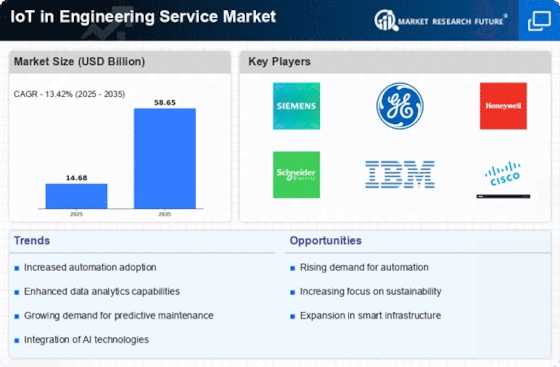
As per MRFR analysis, the IoT in Engineering Service Market was estimated at 14.68 USD Billion in 2024. The IoT in Engineering Service industry is projected to grow from 16.65 USD Billion in 2025 to 58.65 USD Billion by 2035, exhibiting a compound annual growth rate (CAGR) of 13.42 during the forecast period 2025 - 2035.

Key Market Trends & Highlights

The IoT in Engineering Service Market is experiencing robust growth driven by automation and data analytics advancements.

  • North America remains the largest market for IoT in engineering services, driven by technological innovation and investment.
  • Asia-Pacific is emerging as the fastest-growing region, with increasing adoption of IoT solutions across various industries.
  • Predictive maintenance is the largest segment, while data analytics is rapidly gaining traction as the fastest-growing segment.
  • Key market drivers include rising demand for predictive maintenance and advancements in connectivity technologies.

Market Size & Forecast

2024 Market Size 14.68 (USD Billion)
2035 Market Size 58.65 (USD Billion)
CAGR (2025 - 2035) 13.42%

Major Players

Siemens (DE), General Electric (US), Honeywell (US), Schneider Electric (FR), IBM (US), Cisco Systems (US), Rockwell Automation (US), ABB (CH), Bosch (DE)

Iot In Engineering Service Market Trends

The IoT in Engineering Service Market is currently experiencing a transformative phase, driven by advancements in technology and the increasing demand for automation across various sectors. Companies are increasingly adopting IoT solutions to enhance operational efficiency, reduce costs, and improve decision-making processes. This trend is particularly evident in industries such as manufacturing, construction, and energy, where real-time data collection and analysis are becoming essential for maintaining competitiveness. As organizations seek to leverage the benefits of connected devices, the integration of IoT into engineering services is likely to reshape traditional practices, fostering innovation and collaboration. Moreover, the growing emphasis on sustainability and environmental responsibility is influencing the IoT in Engineering Service Market. Organizations are exploring ways to minimize their carbon footprint and optimize resource utilization through smart technologies. This shift towards greener practices not only aligns with regulatory requirements but also appeals to a more environmentally conscious consumer base. As a result, the market is poised for continued growth, with new opportunities emerging for service providers who can offer tailored IoT solutions that address specific industry challenges. The future landscape of the IoT in Engineering Service Market appears promising, with potential for significant advancements in efficiency and sustainability.

Increased Automation and Efficiency

The trend towards automation in engineering services is gaining momentum, as organizations seek to streamline operations and enhance productivity. IoT technologies facilitate real-time monitoring and control, allowing for quicker responses to issues and improved workflow management.

Focus on Sustainability

There is a growing emphasis on sustainable practices within the IoT in Engineering Service Market. Companies are increasingly adopting IoT solutions to optimize resource usage and reduce environmental impact, aligning with global sustainability goals.

Enhanced Data Analytics Capabilities

The integration of advanced data analytics within IoT frameworks is transforming decision-making processes. Organizations are leveraging big data to gain insights into operations, leading to more informed strategies and improved outcomes.

Iot In Engineering Service Market Drivers

Integration of Smart Technologies

The integration of smart technologies into engineering services is a pivotal driver in the IoT in Engineering Service Market. The advent of smart sensors, connected devices, and advanced analytics is transforming traditional engineering practices. These technologies facilitate real-time data collection and analysis, enabling engineers to make informed decisions swiftly. For instance, smart sensors can monitor structural integrity in construction projects, ensuring safety and compliance. The market for smart technologies in engineering services is projected to expand significantly, with estimates suggesting a compound annual growth rate of over 20% in the coming years. This integration not only enhances operational efficiency but also fosters innovation, making it a crucial factor in the evolution of the IoT in Engineering Service Market.

Rising Demand for Predictive Maintenance

The IoT in Engineering Service Market is witnessing a notable rise in demand for predictive maintenance solutions. Organizations are increasingly adopting IoT technologies to monitor equipment health in real-time, thereby reducing downtime and maintenance costs. According to recent data, predictive maintenance can lead to a 10-15% reduction in maintenance costs and a 20-25% increase in equipment uptime. This trend is driven by the need for operational efficiency and cost-effectiveness, as companies seek to leverage data analytics to anticipate failures before they occur. The integration of IoT devices enables continuous monitoring and analysis, allowing for timely interventions. As industries become more competitive, the emphasis on predictive maintenance is likely to grow, positioning it as a key driver in the IoT in Engineering Service Market.

Advancements in Connectivity Technologies

Advancements in connectivity technologies are playing a crucial role in the growth of the IoT in Engineering Service Market. The proliferation of 5G networks and improved wireless communication protocols are enabling seamless connectivity between devices and systems. This enhanced connectivity allows for faster data transmission and more reliable communication, which is essential for real-time monitoring and control in engineering services. As industries adopt IoT solutions, the demand for robust connectivity is expected to surge, with projections indicating a significant increase in the number of connected devices in the coming years. This trend not only enhances operational efficiency but also opens new avenues for innovation, making advancements in connectivity a vital driver in the IoT in Engineering Service Market.

Regulatory Compliance and Safety Standards

Regulatory compliance and adherence to safety standards are increasingly influencing the IoT in Engineering Service Market. As industries face stringent regulations regarding safety and environmental impact, the implementation of IoT solutions becomes essential. IoT technologies enable organizations to monitor compliance in real-time, ensuring that safety protocols are followed. For example, in the construction sector, IoT devices can track worker safety and equipment usage, reducing the risk of accidents. The market for compliance-related IoT solutions is expected to grow, driven by the need for transparency and accountability. Companies that leverage IoT for compliance not only mitigate risks but also enhance their reputation, making this a significant driver in the IoT in Engineering Service Market.

Growing Focus on Data-Driven Decision Making

The growing focus on data-driven decision making is reshaping the landscape of the IoT in Engineering Service Market. Organizations are increasingly recognizing the value of data analytics in optimizing operations and enhancing productivity. By harnessing IoT-generated data, companies can gain insights into performance metrics, resource utilization, and operational bottlenecks. This shift towards data-centric strategies is expected to propel the market, with forecasts indicating a potential increase in market size by over 30% in the next five years. The ability to make informed decisions based on real-time data not only improves efficiency but also fosters innovation, positioning data-driven decision making as a key driver in the IoT in Engineering Service Market.


Market Segment Insights

By Type: Predictive Maintenance (Largest) vs. Data Analytics (Fastest-Growing)

In the IoT in Engineering Service Market, the distribution among the various types reveals that Predictive Maintenance holds a significant share, making it a dominant force in the industry. It is widely adopted across sectors like manufacturing and energy due to its ability to reduce downtime and increase operational efficiency. On the other hand, Data Analytics is rapidly gaining traction, showcasing its potential to transform raw data into actionable insights, which is increasingly valued in today's data-driven landscape. The growth trends in this market segment are heavily influenced by advancements in sensor technologies and machine learning algorithms. Industries are realizing the benefits of implementing IoT solutions, with Predictive Maintenance proving essential for operational efficiency. Concurrently, as organizations prioritize decision-making based on data, Data Analytics is quickly establishing itself as a crucial component, driving investment and innovation in the IoT engineering services sector.

Predictive Maintenance (Dominant) vs. Data Analytics (Emerging)

Predictive Maintenance is characterized by its proactive approach to equipment management, employing real-time data collection and analytics to predict failures before they occur. This segment has established a strong foothold in industries such as manufacturing, oil and gas, and utilities as businesses seek to minimize unexpected downtimes and optimize equipment repairs. Conversely, Data Analytics, while still nascent compared to Predictive Maintenance, is experiencing rapid growth driven by the need for improved decision-making processes. By analyzing vast amounts of data generated by IoT devices, this emerging segment offers organizations the ability to enhance efficiencies across operational procedures. Together, these two segments are transforming the engineering landscape, offering innovative solutions to modern engineering challenges.

By Industry Application: Manufacturing (Largest) vs. Construction (Fastest-Growing)

The IoT in Engineering Service Market showcases a diverse range of applications, with Manufacturing leading the way as the largest segment. This segment benefits from the digital transformation initiatives that are being adopted globally, leveraging IoT technologies to improve efficiency, reduce operational costs, and enhance product quality. Meanwhile, Construction represents the fastest-growing segment, driven by the increasing integration of smart technologies to manage projects, improve safety, and enhance collaboration among stakeholders. As industries evolve, the IoT market is witnessing rapid adoption in both Manufacturing and Construction. The evolution towards Industry 4.0 in Manufacturing is a substantial driver, highlighting automation and data exchange in manufacturing technologies. For Construction, growth is propelled by rising investments in smart construction techniques and the need for real-time monitoring solutions, creating an environment ripe for IoT innovations.

Manufacturing (Dominant) vs. Construction (Emerging)

The Manufacturing sector, equipped with advanced IoT technologies, stands as a dominant player in the IoT in Engineering Service Market, primarily due to its ability to streamline operations and enhance productivity through the application of real-time data analytics and automation. Key features include predictive maintenance, intelligent supply chain management, and process optimization which significantly lower downtime. On the other hand, Construction is emerging with innovative IoT solutions aimed at project monitoring and safety enhancement which streamline workflows and improve project timelines. The integration of IoT tools in Construction not only aids in workflow enhancement but also fosters environmental sustainability through smart energy management, making it a pivotal segment for future growth in IoT applications.

By Connectivity Technology: Cellular (Largest) vs. LPWAN (Fastest-Growing)

In the IoT in Engineering Service Market, the connectivity technology segment demonstrates a diverse distribution among its key values: Cellular, LPWAN, Wi-Fi, and Bluetooth. Cellular technology currently holds the largest share due to its extensive coverage and reliability, making it a preferred choice for many engineering applications. Conversely, LPWAN is emerging as a significant contender, leveraging its unique capabilities for low-power and long-range connectivity, thus attracting increasing attention within the sector.

Connectivity Technology: Cellular (Dominant) vs. LPWAN (Emerging)

Cellular technology, recognized for its robust performance and widespread infrastructure, continues to dominate the connectivity landscape of the IoT in Engineering Service Market. It is favored for applications requiring high data rates and reliable connections. In contrast, LPWAN is rapidly establishing itself as an emerging technology tailored for low-power, long-range communications. It is especially advantageous for applications such as remote monitoring and data collection in hard-to-reach areas, providing a cost-effective solution that supports a growing number of IoT devices. As both technologies evolve, their roles in the market will shape future connectivity solutions.
By Deployment Model: Cloud-based (Largest) vs. Hybrid (Fastest-Growing)

The IoT in Engineering Service Market is characterized by a diverse range of deployment models, with Cloud-based solutions currently holding the largest share. This segment benefits from scalability and flexibility, allowing organizations to rapidly deploy IoT applications without significant upfront infrastructure costs. On-premise solutions, while still crucial for certain applications requiring stringent data control, are gradually losing ground to the efficiency offered by cloud solutions. Hybrid models are also gaining traction, serving as a bridge between traditional and modern systems, thus fostering a more adaptable environment for IoT integration.

Cloud-based (Dominant) vs. Hybrid (Emerging)

In the IoT in Engineering Service Market, Cloud-based deployment is recognized as the dominant model due to its ability to provide real-time data access, extensive analytics, and remote management capabilities. This deployment method facilitates seamless integration of IoT devices and enhances collaboration among teams. Meanwhile, the Hybrid model emerges as an important player by allowing companies to maintain sensitive data on-premise while leveraging cloud services for enhanced scalability and computational power. This flexibility makes Hybrid appealing for industries with fluctuating needs or those aiming to maintain compliance with data regulations.

By Customer Type: Large Enterprises (Largest) vs. Public Sector (Fastest-Growing)

The IoT in Engineering Service Market is characterized by a significant market share concentration among large enterprises, which dominate due to their robust resource allocation and technological adoption. These large entities often capitalize on IoT solutions to enhance operational efficiency, reduce costs, and improve service delivery. On the other hand, the public sector is gaining momentum by adopting IoT technologies, fueled by government initiatives aimed at digital transformation and smart city solutions, thus capturing an increasingly larger share of the market.

Large Enterprises (Dominant) vs. Small and Medium Enterprises (SMEs) (Emerging)

Large enterprises hold a dominant position in the IoT in Engineering Service Market, leveraging their vast resources and data analytics capabilities for advanced IoT implementations. They have the infrastructure and capital to invest in a wide array of IoT applications, driving innovation and performance improvements. Conversely, small and medium enterprises (SMEs) are emerging as key players as they increasingly recognize the potential of IoT solutions to enhance their competitiveness. SMEs are leveraging more affordable and scalable IoT solutions, enabling them to streamline operations and tap into new markets. Both segments exhibit unique strengths, with large enterprises focusing on comprehensive solutions, while SMEs are adopting innovative approaches to bridge technology gaps.

Get more detailed insights about Iot In Engineering Service Market

Regional Insights

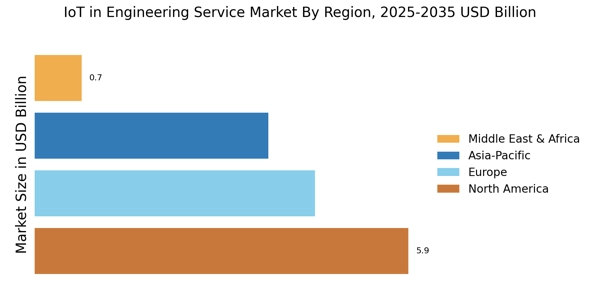
The IoT in Engineering Service Market exhibits significant growth potential across various regions, as highlighted by its expected valuation of 11.41 USD Billion in 2023. North America leads with a valuation of 4.42 USD Billion, dominating the market due to its advancement in technology and infrastructure. Europe follows closely with 3.11 USD Billion, driven by the strong industrial base and regulatory support for digital transformation initiatives.

The Asia Pacific region, valued at 2.81 USD Billion, is rapidly evolving and serves as a major opportunity hub due to the increasing adoption of IoT in manufacturing processes.South America, at 0.83 USD Billion, showcases emerging potential driven by investments in smart technologies, while the Middle East and Africa, valued at 0.24 USD Billion, reflect early-stage growth influenced by infrastructure development efforts. This segmentation of the IoT in Engineering Service Market revenue illustrates the varied pace of IoT integration across regions, with market growth heavily influenced by technological advancements, regional regulations, and investment capabilities.

Figure 3  IoT in Engineering Service Market Service Type Insights 2023-2032

Iot In Engineering Service Market Regional Image

Key Players and Competitive Insights

The IoT in Engineering Service Market is experiencing rapid transformation, driven by technological advancements and the increasing integration of IoT solutions across various industries. This market encompasses a broad range of engineering services where interconnected devices and data analytics play a pivotal role in enhancing operational efficiency, reducing costs, and improving overall productivity. As competition heats up, key players are consistently innovating to offer cutting-edge solutions, leading to a dynamic landscape characterized by strategic partnerships, mergers and acquisitions, and continuous research and development endeavors.

The competitive insights reveal that companies operating within this space must not only provide robust IoT engineering services but also adapt to evolving customer needs and industry trends.Infosys stands out in the IoT in Engineering Service Market due to its extensive expertise and commitment to leveraging IoT technologies to drive client success. The company boasts a diverse portfolio of services that incorporate advanced analytics, cloud solutions, and enterprise application integration, all specifically tailored to enhance industrial operations. Infosys's strong market presence is backed by its ability to deliver end-to-end IoT solutions that facilitate real-time data utilization and smart decision-making processes.

With a focus on innovation, the company has developed strategic partnerships with leading technology providers, strengthening its position and enabling it to offer comprehensive and scalable engineering services. This adaptability and foresight allow Infosys to maintain a competitive edge, emphasizing quality and reliability.Oracle's contribution to the IoT in Engineering Service Market is both formidable and noteworthy. Known for its robust cloud infrastructure and comprehensive suite of IoT applications, Oracle provides cutting-edge solutions designed to streamline operations and enhance connectivity for businesses.

The company’s strengths lie in its ability to integrate IoT data with its industry-leading database and analytics tools, enabling organizations to gain valuable insights and optimize their engineering processes. Oracle's commitment to innovation is reflected in its continual investment in research and development, solidifying its reputation as a market leader. Furthermore, Oracle benefits from its significant brand recognition and loyal customer base, allowing it to effectively capture market opportunities and meet the diverse needs of industries embracing IoT solutions.

Key Companies in the Iot In Engineering Service Market market include

Industry Developments

The IoT in Engineering Service Market has been characterized by significant developments in recent months, with companies like Siemens and Honeywell expanding their service offerings to include more advanced IoT solutions tailored for manufacturing and infrastructure automation. Industry leaders are increasingly investing in R&D, as seen with General Electric's recent announcements highlighting advancements in industrial IoT applications that enhance operational efficiency. Furthermore, there has been a notable trend in mergers and acquisitions, such as the acquisition of PTC by Rockwell Automation, which is expected to amplify its IoT capabilities significantly.

This consolidation is driving a surge in market valuations, with firms like IBM and Cisco witnessing substantial growth, thereby catalyzing innovation and competition. As these developments unfold, the market is projected to continue its robust growth trajectory, capitalizing on the demand for smart engineering solutions that leverage real-time data analytics and automation.

Future Outlook

Iot In Engineering Service Market Future Outlook

The IoT in Engineering Service Market is projected to grow at a 13.42% CAGR from 2024 to 2035, driven by advancements in automation, data analytics, and connectivity.

New opportunities lie in:

  • Development of predictive maintenance solutions for industrial equipment.
  • Integration of IoT-enabled smart sensors in construction projects.
  • Creation of cloud-based platforms for real-time project management.

By 2035, the market is expected to be robust, driven by innovative IoT applications and increased adoption across industries.

Market Segmentation

Iot In Engineering Service Market Type Outlook

  • Predictive Maintenance
  • Asset Tracking
  • Remote Monitoring
  • Data Analytics

Iot In Engineering Service Market Customer Type Outlook

  • Large Enterprises
  • Small and Medium Enterprises (SMEs)
  • Public Sector

Iot In Engineering Service Market Deployment Model Outlook

  • On-premise
  • Cloud-based
  • Hybrid

Iot In Engineering Service Market Industry Application Outlook

  • Manufacturing
  • Construction
  • Energy and Utilities
  • Transportation and Logistics

Iot In Engineering Service Market Connectivity Technology Outlook

  • Cellular
  • LPWAN (Low Power Wide Area Network)
  • Wi-Fi
  • Bluetooth

Report Scope

MARKET SIZE 202414.68(USD Billion)
MARKET SIZE 202516.65(USD Billion)
MARKET SIZE 203558.65(USD Billion)
COMPOUND ANNUAL GROWTH RATE (CAGR)13.42% (2024 - 2035)
REPORT COVERAGERevenue Forecast, Competitive Landscape, Growth Factors, and Trends
BASE YEAR2024
Market Forecast Period2025 - 2035
Historical Data2019 - 2024
Market Forecast UnitsUSD Billion
Key Companies ProfiledMarket analysis in progress
Segments CoveredMarket segmentation analysis in progress
Key Market OpportunitiesIntegration of advanced analytics and machine learning enhances predictive maintenance in the IoT in Engineering Service Market.
Key Market DynamicsRising demand for real-time data analytics drives innovation in IoT engineering services across various industries.
Countries CoveredNorth America, Europe, APAC, South America, MEA

Leave a Comment

FAQs

What is the projected market valuation for the IoT in Engineering Service Market by 2035?

The projected market valuation for the IoT in Engineering Service Market by 2035 is 58.65 USD Billion.

What was the market valuation of the IoT in Engineering Service Market in 2024?

The market valuation of the IoT in Engineering Service Market in 2024 was 14.68 USD Billion.

What is the expected CAGR for the IoT in Engineering Service Market during the forecast period 2025 - 2035?

The expected CAGR for the IoT in Engineering Service Market during the forecast period 2025 - 2035 is 13.42%.

Which companies are considered key players in the IoT in Engineering Service Market?

Key players in the IoT in Engineering Service Market include Siemens, General Electric, Honeywell, Schneider Electric, IBM, Cisco Systems, Rockwell Automation, ABB, and Bosch.

What are the main segments of the IoT in Engineering Service Market?

The main segments of the IoT in Engineering Service Market include Type, Industry Application, Connectivity Technology, Deployment Model, and Customer Type.

How much is the Predictive Maintenance segment projected to be worth by 2035?

The Predictive Maintenance segment is projected to be worth 14.65 USD Billion by 2035.

What is the projected value of the Cloud-based deployment model by 2035?

The projected value of the Cloud-based deployment model by 2035 is 28.0 USD Billion.

Which industry application is expected to have the highest valuation in 2035?

The Manufacturing industry application is expected to have the highest valuation at 20.0 USD Billion in 2035.

What is the projected value of the Asset Tracking segment by 2035?

The projected value of the Asset Tracking segment by 2035 is 16.0 USD Billion.

How does the market valuation for Small and Medium Enterprises (SMEs) compare to that of Large Enterprises by 2035?

By 2035, the market valuation for Small and Medium Enterprises (SMEs) is projected to be 17.6 USD Billion, compared to 23.45 USD Billion for Large Enterprises.

Download Free Sample

Kindly complete the form below to receive a free sample of this Report

Compare Licence

×
Features License Type
Single User Multiuser License Enterprise User
Price $4,950 $5,950 $7,250
Maximum User Access Limit 1 User Upto 10 Users Unrestricted Access Throughout the Organization
Free Customization
Direct Access to Analyst
Deliverable Format
Platform Access
Discount on Next Purchase 10% 15% 15%
Printable Versions