×
Hero Background
English
Chinese
French
Japanese
Korean
German
Spanish

Iron Ore Mining Market Share

ID: MRFR/CnM/14612-HCR
111 Pages
Chitranshi Jaiswal
October 2025

Iron Ore Mining Market Research Report Information By Type (Iron Ore Mining Fines, Iron Ore Mining Pellets, Iron Ore Pellet Feed, and Others), By End-user (Construction, Transportation, and Others), And By Region (North America, Europe, Asia-Pacific, And Rest of The World) –Market Forecast Till 2035.

Share:
Download PDF ×

We do not share your information with anyone. However, we may send you emails based on your report interest from time to time. You may contact us at any time to opt-out.

Iron Ore Mining Market Infographic
Purchase Options

Market Share

Iron Ore Mining Market Share Analysis

In the fiercely competitive Iron Ore Mining market, companies employ a variety of strategies to establish and strengthen their market share positioning. A fundamental strategy is differentiation, where companies aim to set their iron ore mining operations apart from competitors by offering unique extraction methods, product specifications, or sustainable and ethical mining practices. This might involve innovations in ore processing for increased purity, reduced environmental impact, or community engagement initiatives. Through differentiation, companies attract investors and buyers seeking socially and environmentally responsible iron ore mining operations, enabling them to secure a distinctive market share within the Iron Ore Mining industry.

Cost leadership is another prevalent strategy in this market, where companies strive to become the low-cost producers of iron ore. This involves optimizing mining processes, negotiating favorable terms with suppliers, and implementing cost-effective environmental and safety measures. Cost leadership is effective in appealing to investors and buyers seeking economically viable iron ore production. However, maintaining high safety standards, minimizing environmental impact, and complying with regulatory requirements are crucial to ensure sustainable iron ore mining and customer satisfaction in this cost-driven strategy.

Market segmentation is widely adopted in the Iron Ore Mining industry. Companies analyze the diverse needs of their customer base, including steel manufacturers, construction firms, and industrial users, and adjust their iron ore production to meet specific market demands. For instance, they might focus on high-grade iron ore for steel production or iron ore concentrates for industrial applications. By addressing the unique requirements of each segment, companies can establish a robust presence within different markets, contributing to an overall enhanced market share.

Strategic partnerships and collaborations play a pivotal role in the Iron Ore Mining market. Companies often form alliances with infrastructure developers, steel manufacturers, or research institutions to strengthen their operational capabilities, enhance brand visibility, and address social and environmental concerns. Collaborative efforts can lead to shared resources, access to new technologies, and the development of sustainable mining practices. Through strategic partnerships, companies can navigate industry challenges more effectively, ultimately contributing to a more secure market share position.

Innovation stands as a cornerstone strategy in the Iron Ore Mining market, driven by the continual pursuit of improved extraction methods, environmental sustainability, and product applications. Companies invest in research and development to introduce mining technologies that reduce energy consumption, minimize waste, and enhance overall efficiency. Innovations in responsible mining practices, digitalization of mining operations, and water recycling contribute to staying competitive and attracting investors and buyers seeking socially and environmentally conscious iron ore mining operations. By being at the forefront of innovation, companies position themselves as leaders in the Iron Ore Mining market, securing a significant market share.

Customer-centric strategies are gaining prominence as companies recognize the importance of providing exceptional stakeholder experiences. This involves transparent communication about mining practices, engagement with local communities, and adherence to ethical and sustainable mining standards. Exceptional corporate responsibility contributes to stakeholder satisfaction and loyalty, encouraging investors, buyers, and local communities to choose a particular mining company for their iron ore needs. By focusing on building strong relationships with stakeholders, companies can solidify their market share and maintain a competitive edge in the Iron Ore Mining industry.
Author
Chitranshi Jaiswal
Research Analyst Level I

In her 3 years of experience in the market research field, she has handled critical cross-domain projects. She has an in-depth knowledge of market estimation & analysis, problem-solving, primary as well as secondary research, and team management.She holds an engineering degree and is an MBA professional from a well-known university, capable of evaluating the market and competitive conditions. An exceptional strategist with excellent communication skills and a passion for delivering cutting-edge & practical insights for the market. Proficient in multi-tasking, and can successfully deal with competing demands, while maintaining complete confidentiality. Generated business through active client and project development, networking, and high-quality responses. Her knowledge and skills have helped in making solid business decisions, securing funding from investors, and avoiding business failures.

Leave a Comment

FAQs

What is the projected market valuation of the Iron Ore Mining Market by 2035?

The Iron Ore Mining Market is projected to reach a valuation of 8.129 USD Billion by 2035.

What was the market valuation of the Iron Ore Mining Market in 2024?

In 2024, the Iron Ore Mining Market was valued at 3.557 USD Billion.

What is the expected CAGR for the Iron Ore Mining Market during the forecast period 2025 - 2035?

The expected CAGR for the Iron Ore Mining Market during the forecast period 2025 - 2035 is 7.8%.

Which companies are considered key players in the Iron Ore Mining Market?

Key players in the Iron Ore Mining Market include Vale S.A., Rio Tinto Group, BHP Group, and Fortescue Metals Group Ltd.

What are the main segments of the Iron Ore Mining Market?

The main segments of the Iron Ore Mining Market include Iron Ore Mining Fines, Iron Ore Mining Pellets, and Iron Ore Pellet Feed.

What was the valuation of Iron Ore Mining Fines in 2024?

In 2024, the valuation of Iron Ore Mining Fines was 1.5 USD Billion.

Market Summary

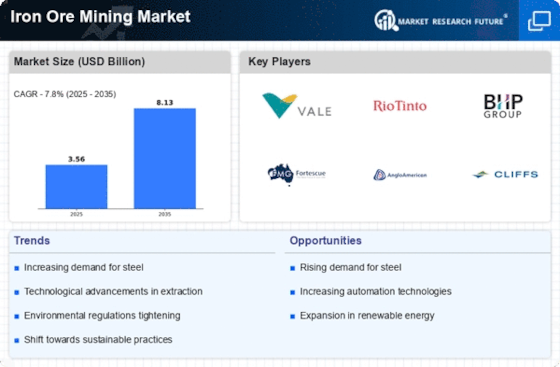
As per MRFR analysis, the Iron Ore Mining Market Size was estimated at 3.557 USD Billion in 2024. The Iron Ore Mining industry is projected to grow from 3.835 USD Billion in 2025 to 8.129 USD Billion by 2035, exhibiting a compound annual growth rate (CAGR) of 7.8 during the forecast period 2025 - 2035.

Key Market Trends & Highlights

The Iron Ore Mining Market is currently experiencing a dynamic shift driven by technological advancements and sustainability initiatives.

  • Technological advancements in mining are enhancing operational efficiency and reducing costs in North America, the largest market. Sustainability initiatives are gaining traction, particularly in the Asia-Pacific region, which is the fastest-growing market. Iron ore mining fines remain the largest segment, while iron ore pellets are emerging as the fastest-growing segment due to increased demand for high-quality products. Rising steel demand and infrastructure development projects are key drivers propelling growth in both the construction and transportation segments.

Market Size & Forecast

2024 Market Size 3.557 (USD Billion)
2035 Market Size 8.129 (USD Billion)
CAGR (2025 - 2035) 7.8%
Largest Regional Market Share in 2024 Asia Pacific

Major Players

<p>Vale S.A. (BR), Rio Tinto Group (GB), BHP Group (GB), Fortescue Metals Group Ltd (AU), Anglo American plc (GB), Cleveland-Cliffs Inc. (US), ArcelorMittal (LU), Champion Iron Limited (CA)</p>

Market Trends

The Iron Ore Mining Market is currently experiencing a dynamic phase characterized by evolving demand patterns and technological advancements. As global economies continue to recover and industrial activities ramp up, the need for iron ore remains robust. This market is influenced by various factors, including infrastructure development, urbanization, and the growing emphasis on sustainable practices. Companies are increasingly adopting innovative mining techniques and automation to enhance efficiency and reduce environmental impact. Furthermore, geopolitical factors and trade policies are shaping the landscape, leading to fluctuations in supply and pricing. In addition, the Iron Ore Mining Market is witnessing a shift towards more sustainable mining practices. Stakeholders are increasingly prioritizing environmental stewardship, which is prompting investments in cleaner technologies and responsible sourcing. This trend is likely to reshape operational strategies and may lead to a more resilient market structure. As the industry adapts to these changes, it appears poised for growth, albeit with challenges that require careful navigation. Overall, the Iron Ore Mining Market is at a pivotal juncture, balancing traditional practices with modern demands and sustainability imperatives.

Technological Advancements in Mining

The Iron Ore Mining Market is seeing a surge in the adoption of advanced technologies. Innovations such as automation, artificial intelligence, and data analytics are enhancing operational efficiency. These technologies not only streamline processes but also contribute to safety improvements and cost reductions.

Sustainability Initiatives

There is a growing emphasis on sustainable mining practices within the Iron Ore Mining Market. Companies are increasingly focusing on reducing their carbon footprint and implementing eco-friendly methods. This shift is driven by regulatory pressures and consumer demand for responsibly sourced materials.

Geopolitical Influences

Geopolitical factors are playing a crucial role in shaping the Iron Ore Mining Market. Trade policies, tariffs, and international relations can significantly impact supply chains and pricing. As nations navigate these complexities, market participants must remain agile to adapt to changing conditions.

Iron Ore Mining Market Market Drivers

Rising Steel Demand

The Iron Ore Mining Market is experiencing a surge in demand driven primarily by the increasing need for steel in various sectors, including construction, automotive, and infrastructure. As economies continue to develop, the demand for steel is projected to rise, with estimates suggesting that global steel production could reach over 2 billion metric tons by 2025. This growth in steel production directly correlates with the need for iron ore, as it is a primary raw material in steel manufacturing. Consequently, iron ore mining companies are likely to ramp up production to meet this escalating demand, thereby enhancing their market presence and profitability. The interplay between steel demand and iron ore supply dynamics is crucial for stakeholders in the Iron Ore Mining Market.

Geopolitical Factors

Geopolitical factors are playing an increasingly critical role in the Iron Ore Mining Market, influencing supply chains and trade dynamics. Political stability in key iron ore-producing regions can significantly impact production levels and export capabilities. For instance, tensions in regions rich in iron ore resources may lead to supply disruptions, affecting global prices and availability. Additionally, trade policies and tariffs imposed by various countries can alter the competitive landscape, prompting mining companies to reassess their market strategies. As nations navigate complex geopolitical landscapes, the ability to adapt to these changes will be essential for stakeholders in the Iron Ore Mining Market. Understanding these geopolitical influences is crucial for making informed decisions in this volatile market.

Environmental Regulations

The Iron Ore Mining Market is increasingly influenced by stringent environmental regulations aimed at promoting sustainable mining practices. Governments and regulatory bodies are implementing policies that require mining companies to adopt environmentally friendly practices, such as reducing emissions and minimizing land disturbance. Compliance with these regulations often necessitates investment in cleaner technologies and processes, which can initially increase operational costs. However, companies that successfully adapt to these regulations may gain a competitive advantage by appealing to environmentally conscious consumers and investors. Moreover, the shift towards sustainability is likely to reshape the operational landscape of the Iron Ore Mining Market, as firms that prioritize environmental stewardship may experience enhanced reputational benefits and long-term viability.

Technological Innovations

Technological advancements are reshaping the Iron Ore Mining Market, leading to enhanced efficiency and productivity. Innovations such as automation, artificial intelligence, and advanced data analytics are being integrated into mining operations. These technologies facilitate real-time monitoring of mining processes, optimizing resource extraction and reducing operational costs. For instance, the implementation of autonomous trucks and drilling systems has been shown to increase output while minimizing human error. Furthermore, the adoption of sustainable mining technologies is becoming increasingly prevalent, as companies seek to reduce their environmental footprint. As these technologies continue to evolve, they are expected to play a pivotal role in shaping the future landscape of the Iron Ore Mining Market.

Infrastructure Development Projects

Infrastructure development projects are a significant driver of the Iron Ore Mining Market, particularly in emerging economies. Governments are investing heavily in infrastructure to stimulate economic growth, which in turn increases the demand for iron ore. For example, large-scale projects such as highways, railways, and urban development initiatives require substantial amounts of steel, thereby boosting the need for iron ore. Recent reports indicate that infrastructure spending could exceed trillions of dollars over the next decade, creating a robust market for iron ore. This trend suggests that mining companies may need to enhance their production capabilities to align with the growing infrastructure demands, thereby solidifying their position in the Iron Ore Mining Market.

Market Segment Insights

By Type: Iron Ore Mining Market Fines (Largest) vs. Iron Ore Pellets (Fastest-Growing)

<p>In the Iron Ore Mining Market, the segment distribution highlights Iron Ore Mining Market Fines as the largest contributor, commanding a significant proportion of the market share. This segment benefits from the versatility and widespread application of fines in various industries, making it a staple in iron ore usage. Meanwhile, Iron Ore Pellets have emerged as the fastest-growing segment, driven by an increase in demand for high-quality iron products and more efficient production methods. The shift towards cleaner and more sustainable production processes has added to the attractiveness of pellets in the current market landscape.</p>

<p>Iron Ore Mining Market Fines (Dominant) vs. Iron Ore Pellets (Emerging)</p>

<p>Iron Ore Mining Market Fines play a dominant role in the market, primarily due to their ready availability and applicability in various steel manufacturing processes. With a focus on product quality because of their smaller particle size, fines are essential for blast furnace operations and sintering processes. On the other hand, Iron Ore Pellets represent an emerging segment, rapidly gaining traction owing to their enhanced performance in <a href="https://www.marketresearchfuture.com/reports/steel-market-5465">steel</a> production, providing higher iron content and lower impurities. Their use is growing in response to stricter environmental regulations that favor cleaner production technologies. The versatility and performance benefits of both segment types illustrate their critical roles in ensuring the ongoing evolution and sustainability of the iron ore mining market.</p>

By End-User: Construction (Largest) vs. Transportation (Fastest-Growing)

<p>The 'End-User' segment of the Iron Ore Mining Market is primarily divided into three categories: <a href="https://www.marketresearchfuture.com/reports/construction-market-16065">Construction</a>, Transportation, and Others. Among these, the Construction sector holds the largest share due to the extensive application of iron ore in producing steel, which is fundamental to various construction projects. The Transportation sector, while smaller in comparison, is emerging rapidly as companies look to improve infrastructure and vehicle efficiency, contributing to its growth within the market.</p>

<p>Construction (Dominant) vs. Transportation (Emerging)</p>

<p>The Construction sector in the Iron Ore Mining Market is characterized by its dominance, relying heavily on the material for steel production essential in building structures, bridges, and roads. This segment benefits from global urbanization and infrastructural developments, making it a critical driver for iron ore demand. In contrast, the Transportation sector is seen as an emerging force, emphasizing advancements in rail and shipping equipment that utilize iron ore. With growing environmental regulations and a push toward more sustainable practices, this sector is adapting quickly and represents a significant opportunity for future growth, shifting towards greener technologies and enhanced operational efficiency.</p>

Get more detailed insights about Iron Ore Mining Market Research Report - Global Forecast by 2035

Regional Insights

North America : Resource-Rich Market

North America is witnessing significant growth in the iron ore mining sector, driven by increasing demand from the construction and manufacturing industries. The United States and Canada are the largest markets, holding approximately 60% of the regional share. Regulatory support for sustainable mining practices and infrastructure development further catalyzes this growth. The U.S. is home to key players like Cleveland-Cliffs Inc. and has a competitive landscape characterized by technological advancements and environmental regulations. Canada, with companies like Champion Iron Limited, complements this market with its rich iron ore deposits. The focus on innovation and sustainability is shaping the future of iron ore mining in this region.

Europe : Sustainable Mining Initiatives

Europe is emerging as a leader in sustainable iron ore mining, with a focus on reducing carbon emissions and promoting circular economy practices. The region's largest markets, Germany and Sweden, account for about 55% of the total market share. Regulatory frameworks, such as the European Green Deal, are driving investments in eco-friendly mining technologies and practices. Countries like Sweden are home to major players like LKAB, which is pioneering sustainable mining methods. The competitive landscape is evolving, with a strong emphasis on innovation and collaboration among industry stakeholders. The presence of regulatory bodies ensures that mining operations align with environmental standards, fostering a responsible mining culture in Europe.

Asia-Pacific : Emerging Powerhouse in Mining

The Asia-Pacific region is a powerhouse in iron ore mining, primarily driven by the rapid industrialization and urbanization in countries like China and India. China is the largest market, holding approximately 70% of the regional share, followed by India with around 15%. The demand for iron ore is fueled by the construction and automotive sectors, alongside government initiatives to boost domestic production. Australia stands out as a leading exporter, with major players like BHP Group and Fortescue Metals Group Ltd. dominating the landscape. The competitive environment is marked by significant investments in mining technology and infrastructure, ensuring that the region remains a critical player in The Iron Ore Mining Market. The focus on sustainable practices is also gaining traction among industry leaders.

Middle East and Africa : Resource-Rich Frontier

The Middle East and Africa are emerging as significant players in the iron ore mining market, driven by abundant natural resources and increasing demand for steel production. South Africa and Morocco are the largest markets, collectively holding about 50% of the regional share. The region benefits from favorable mining regulations and government initiatives aimed at attracting foreign investment in the mining sector. South Africa is home to key players like Kumba Iron Ore, which is enhancing its production capabilities. The competitive landscape is characterized by a mix of established companies and new entrants, focusing on innovation and sustainable practices. The region's potential for growth is substantial, with ongoing investments in infrastructure and technology to support the mining industry.

Key Players and Competitive Insights

The Iron Ore Mining Market is currently characterized by a competitive landscape that is both dynamic and multifaceted. Key growth drivers include increasing global demand for steel, particularly in emerging economies, and the ongoing push for sustainable mining practices. Major players such as Vale S.A. (BR), Rio Tinto Group (GB), and BHP Group (GB) are strategically positioned to leverage their extensive resources and technological advancements. Vale S.A. (BR) focuses on innovation in mining processes, while Rio Tinto Group (GB) emphasizes digital transformation to enhance operational efficiency. BHP Group (GB) is actively pursuing regional expansion, particularly in Africa and South America, which collectively shapes a competitive environment that is increasingly reliant on technological integration and sustainable practices.

The business tactics employed by these companies reflect a concerted effort to optimize supply chains and localize operations. The market structure appears moderately fragmented, with a few dominant players exerting considerable influence over pricing and production levels. This fragmentation allows for niche players to emerge, yet the collective strength of the key players ensures that competition remains robust and focused on efficiency and sustainability.

In August 2025, Vale S.A. (BR) announced a partnership with a leading technology firm to develop AI-driven solutions aimed at enhancing ore extraction efficiency. This strategic move is likely to bolster Vale's operational capabilities, enabling it to reduce costs and improve yield, thereby reinforcing its competitive edge in a market that increasingly values technological innovation.

In September 2025, Rio Tinto Group (GB) unveiled its ambitious plan to achieve net-zero emissions by 2030, which includes significant investments in renewable energy sources for its mining operations. This commitment not only positions Rio Tinto as a leader in sustainability but also aligns with global trends towards environmentally responsible mining practices, potentially attracting investors and customers who prioritize sustainability.

In October 2025, BHP Group (GB) completed the acquisition of a smaller iron ore mining company in Brazil, enhancing its resource base and operational footprint in a key market. This acquisition is indicative of BHP's strategy to consolidate its position in the iron ore sector, allowing for greater economies of scale and improved market share in a competitive landscape.

As of October 2025, current competitive trends in the Iron Ore Mining Market are heavily influenced by digitalization, sustainability initiatives, and the integration of artificial intelligence. Strategic alliances are increasingly shaping the landscape, as companies recognize the need for collaboration to address complex challenges. Looking ahead, competitive differentiation is expected to evolve from traditional price-based competition towards a focus on innovation, technological advancements, and supply chain reliability, reflecting a broader shift in the industry towards sustainable and efficient mining practices.

Key Companies in the Iron Ore Mining Market market include

Industry Developments

  • Q2 2025: BHP beats global iron ore production guidance in FY25 Australian iron ore producer BHP mined 263 million tonnes of iron ore in the July 2024-June 2025 financial year, surpassing expectations despite severe weather challenges. The company set its 2025-26 production guidance at 258-269 million tonnes, reflecting ongoing ramp-up at its Samarco mine in Brazil.
  • Q3 2025: BHP increased iron ore production to 263 million tons in the 2024-2025 financial year BHP Group increased iron ore production by 1% year-on-year to 263 million tons in the 2024/2025 financial year, with the final volumes at the upper end of its forecast range due to improved logistics productivity. The company expects further increases at its Samarco mine in Brazil for the next financial year.

Future Outlook

Iron Ore Mining Market Future Outlook

<p>The Iron Ore Mining Market is projected to grow at a 7.8% CAGR from 2024 to 2035, driven by increasing global steel demand, technological advancements, and sustainable mining practices.</p>

New opportunities lie in:

  • <p>Investment in automated ore sorting technologies to enhance efficiency.</p>
  • <p>Development of green iron production methods to meet sustainability goals.</p>
  • <p>Expansion into emerging markets with untapped iron ore reserves.</p>

<p>By 2035, the market is expected to solidify its position as a key player in the global mining sector.</p>

Market Segmentation

Iron Ore Mining Market Type Outlook

  • Iron Ore Mining Fines
  • Iron Ore Mining Pellets
  • Iron Ore Pellet Feed
  • Others

Iron Ore Mining Market End-User Outlook

  • Construction
  • Transportation
  • Others

Report Scope

MARKET SIZE 2024 3.557(USD Billion)
MARKET SIZE 2025 3.835(USD Billion)
MARKET SIZE 2035 8.129(USD Billion)
COMPOUND ANNUAL GROWTH RATE (CAGR) 7.8% (2024 - 2035)
REPORT COVERAGE Revenue Forecast, Competitive Landscape, Growth Factors, and Trends
BASE YEAR 2024
Market Forecast Period 2025 - 2035
Historical Data 2019 - 2024
Market Forecast Units USD Billion
Key Companies Profiled Market analysis in progress
Segments Covered Market segmentation analysis in progress
Key Market Opportunities Adoption of advanced automation technologies enhances efficiency in the Iron Ore Mining Market.
Key Market Dynamics Rising demand for high-grade iron ore drives competition and influences pricing strategies among mining companies.
Countries Covered North America, Europe, APAC, South America, MEA

FAQs

What is the projected market valuation of the Iron Ore Mining Market by 2035?

The Iron Ore Mining Market is projected to reach a valuation of 8.129 USD Billion by 2035.

What was the market valuation of the Iron Ore Mining Market in 2024?

In 2024, the Iron Ore Mining Market was valued at 3.557 USD Billion.

What is the expected CAGR for the Iron Ore Mining Market during the forecast period 2025 - 2035?

The expected CAGR for the Iron Ore Mining Market during the forecast period 2025 - 2035 is 7.8%.

Which companies are considered key players in the Iron Ore Mining Market?

Key players in the Iron Ore Mining Market include Vale S.A., Rio Tinto Group, BHP Group, and Fortescue Metals Group Ltd.

What are the main segments of the Iron Ore Mining Market?

The main segments of the Iron Ore Mining Market include Iron Ore Mining Fines, Iron Ore Mining Pellets, and Iron Ore Pellet Feed.

What was the valuation of Iron Ore Mining Fines in 2024?

In 2024, the valuation of Iron Ore Mining Fines was 1.5 USD Billion.

  1. SECTION I: EXECUTIVE SUMMARY AND KEY HIGHLIGHTS
    1. EXECUTIVE SUMMARY
      1. Market Overview
      2. Key Findings
      3. Market Segmentation
      4. Competitive Landscape
      5. Challenges and Opportunities
      6. Future Outlook 2
  2. SECTION II: SCOPING, METHODOLOGY AND MARKET STRUCTURE
    1. MARKET INTRODUCTION
      1. Definition
      2. Scope of the study
    2. RESEARCH METHODOLOGY
      1. Overview
      2. Data Mining
      3. Secondary Research
      4. Primary Research
      5. Forecasting Model
      6. Market Size Estimation
      7. Data Triangulation
      8. Validation 3
  3. SECTION III: QUALITATIVE ANALYSIS
    1. MARKET DYNAMICS
      1. Overview
      2. Drivers
      3. Restraints
      4. Opportunities
    2. MARKET FACTOR ANALYSIS
      1. Value chain Analysis
      2. Porter's Five Forces Analysis
      3. COVID-19 Impact Analysis
  4. SECTION IV: QUANTITATIVE ANALYSIS
    1. Chemicals and Materials, BY Type (USD Billion)
      1. Iron Ore Mining Fines
      2. Iron Ore Mining Pellets
      3. Iron Ore Pellet Feed
      4. Others
    2. Chemicals and Materials, BY End-User (USD Billion)
      1. Construction
      2. Transportation
      3. Others
    3. Chemicals and Materials, BY Region (USD Billion)
      1. North America
      2. Europe
      3. APAC
      4. South America
      5. MEA
  5. SECTION V: COMPETITIVE ANALYSIS
    1. Competitive Landscape
      1. Overview
      2. Competitive Analysis
      3. Market share Analysis
      4. Major Growth Strategy in the Chemicals and Materials
      5. Competitive Benchmarking
      6. Leading Players in Terms of Number of Developments in the Chemicals and Materials
      7. Key developments and growth strategies
      8. Major Players Financial Matrix
    2. Company Profiles
      1. Vale S.A. (BR)
      2. Rio Tinto Group (GB)
      3. BHP Group (GB)
      4. Fortescue Metals Group Ltd (AU)
      5. Anglo American plc (GB)
      6. Cleveland-Cliffs Inc. (US)
      7. ArcelorMittal (LU)
      8. Champion Iron Limited (CA)
    3. Appendix
      1. References
      2. Related Reports 6 LIST OF FIGURES
    4. MARKET SYNOPSIS
    5. NORTH AMERICA MARKET ANALYSIS
    6. US MARKET ANALYSIS BY TYPE
    7. US MARKET ANALYSIS BY END-USER
    8. CANADA MARKET ANALYSIS BY TYPE
    9. CANADA MARKET ANALYSIS BY END-USER
    10. EUROPE MARKET ANALYSIS
    11. GERMANY MARKET ANALYSIS BY TYPE
    12. GERMANY MARKET ANALYSIS BY END-USER
    13. UK MARKET ANALYSIS BY TYPE
    14. UK MARKET ANALYSIS BY END-USER
    15. FRANCE MARKET ANALYSIS BY TYPE
    16. FRANCE MARKET ANALYSIS BY END-USER
    17. RUSSIA MARKET ANALYSIS BY TYPE
    18. RUSSIA MARKET ANALYSIS BY END-USER
    19. ITALY MARKET ANALYSIS BY TYPE
    20. ITALY MARKET ANALYSIS BY END-USER
    21. SPAIN MARKET ANALYSIS BY TYPE
    22. SPAIN MARKET ANALYSIS BY END-USER
    23. REST OF EUROPE MARKET ANALYSIS BY TYPE
    24. REST OF EUROPE MARKET ANALYSIS BY END-USER
    25. APAC MARKET ANALYSIS
    26. CHINA MARKET ANALYSIS BY TYPE
    27. CHINA MARKET ANALYSIS BY END-USER
    28. INDIA MARKET ANALYSIS BY TYPE
    29. INDIA MARKET ANALYSIS BY END-USER
    30. JAPAN MARKET ANALYSIS BY TYPE
    31. JAPAN MARKET ANALYSIS BY END-USER
    32. SOUTH KOREA MARKET ANALYSIS BY TYPE
    33. SOUTH KOREA MARKET ANALYSIS BY END-USER
    34. MALAYSIA MARKET ANALYSIS BY TYPE
    35. MALAYSIA MARKET ANALYSIS BY END-USER
    36. THAILAND MARKET ANALYSIS BY TYPE
    37. THAILAND MARKET ANALYSIS BY END-USER
    38. INDONESIA MARKET ANALYSIS BY TYPE
    39. INDONESIA MARKET ANALYSIS BY END-USER
    40. REST OF APAC MARKET ANALYSIS BY TYPE
    41. REST OF APAC MARKET ANALYSIS BY END-USER
    42. SOUTH AMERICA MARKET ANALYSIS
    43. BRAZIL MARKET ANALYSIS BY TYPE
    44. BRAZIL MARKET ANALYSIS BY END-USER
    45. MEXICO MARKET ANALYSIS BY TYPE
    46. MEXICO MARKET ANALYSIS BY END-USER
    47. ARGENTINA MARKET ANALYSIS BY TYPE
    48. ARGENTINA MARKET ANALYSIS BY END-USER
    49. REST OF SOUTH AMERICA MARKET ANALYSIS BY TYPE
    50. REST OF SOUTH AMERICA MARKET ANALYSIS BY END-USER
    51. MEA MARKET ANALYSIS
    52. GCC COUNTRIES MARKET ANALYSIS BY TYPE
    53. GCC COUNTRIES MARKET ANALYSIS BY END-USER
    54. SOUTH AFRICA MARKET ANALYSIS BY TYPE
    55. SOUTH AFRICA MARKET ANALYSIS BY END-USER
    56. REST OF MEA MARKET ANALYSIS BY TYPE
    57. REST OF MEA MARKET ANALYSIS BY END-USER
    58. KEY BUYING CRITERIA OF CHEMICALS AND MATERIALS
    59. RESEARCH PROCESS OF MRFR
    60. DRO ANALYSIS OF CHEMICALS AND MATERIALS
    61. DRIVERS IMPACT ANALYSIS: CHEMICALS AND MATERIALS
    62. RESTRAINTS IMPACT ANALYSIS: CHEMICALS AND MATERIALS
    63. SUPPLY / VALUE CHAIN: CHEMICALS AND MATERIALS
    64. CHEMICALS AND MATERIALS, BY TYPE, 2024 (% SHARE)
    65. CHEMICALS AND MATERIALS, BY TYPE, 2024 TO 2035 (USD Billion)
    66. CHEMICALS AND MATERIALS, BY END-USER, 2024 (% SHARE)
    67. CHEMICALS AND MATERIALS, BY END-USER, 2024 TO 2035 (USD Billion)
    68. BENCHMARKING OF MAJOR COMPETITORS 7 LIST OF TABLES
    69. LIST OF ASSUMPTIONS
    70. North America MARKET SIZE ESTIMATES; FORECAST
      1. BY TYPE, 2025-2035 (USD Billion)
      2. BY END-USER, 2025-2035 (USD Billion)
    71. US MARKET SIZE ESTIMATES; FORECAST
      1. BY TYPE, 2025-2035 (USD Billion)
      2. BY END-USER, 2025-2035 (USD Billion)
    72. Canada MARKET SIZE ESTIMATES; FORECAST
      1. BY TYPE, 2025-2035 (USD Billion)
      2. BY END-USER, 2025-2035 (USD Billion)
    73. Europe MARKET SIZE ESTIMATES; FORECAST
      1. BY TYPE, 2025-2035 (USD Billion)
      2. BY END-USER, 2025-2035 (USD Billion)
    74. Germany MARKET SIZE ESTIMATES; FORECAST
      1. BY TYPE, 2025-2035 (USD Billion)
      2. BY END-USER, 2025-2035 (USD Billion)
    75. UK MARKET SIZE ESTIMATES; FORECAST
      1. BY TYPE, 2025-2035 (USD Billion)
      2. BY END-USER, 2025-2035 (USD Billion)
    76. France MARKET SIZE ESTIMATES; FORECAST
      1. BY TYPE, 2025-2035 (USD Billion)
      2. BY END-USER, 2025-2035 (USD Billion)
    77. Russia MARKET SIZE ESTIMATES; FORECAST
      1. BY TYPE, 2025-2035 (USD Billion)
      2. BY END-USER, 2025-2035 (USD Billion)
    78. Italy MARKET SIZE ESTIMATES; FORECAST
      1. BY TYPE, 2025-2035 (USD Billion)
      2. BY END-USER, 2025-2035 (USD Billion)
    79. Spain MARKET SIZE ESTIMATES; FORECAST
      1. BY TYPE, 2025-2035 (USD Billion)
      2. BY END-USER, 2025-2035 (USD Billion)
    80. Rest of Europe MARKET SIZE ESTIMATES; FORECAST
      1. BY TYPE, 2025-2035 (USD Billion)
      2. BY END-USER, 2025-2035 (USD Billion)
    81. APAC MARKET SIZE ESTIMATES; FORECAST
      1. BY TYPE, 2025-2035 (USD Billion)
      2. BY END-USER, 2025-2035 (USD Billion)
    82. China MARKET SIZE ESTIMATES; FORECAST
      1. BY TYPE, 2025-2035 (USD Billion)
      2. BY END-USER, 2025-2035 (USD Billion)
    83. India MARKET SIZE ESTIMATES; FORECAST
      1. BY TYPE, 2025-2035 (USD Billion)
      2. BY END-USER, 2025-2035 (USD Billion)
    84. Japan MARKET SIZE ESTIMATES; FORECAST
      1. BY TYPE, 2025-2035 (USD Billion)
      2. BY END-USER, 2025-2035 (USD Billion)
    85. South Korea MARKET SIZE ESTIMATES; FORECAST
      1. BY TYPE, 2025-2035 (USD Billion)
      2. BY END-USER, 2025-2035 (USD Billion)
    86. Malaysia MARKET SIZE ESTIMATES; FORECAST
      1. BY TYPE, 2025-2035 (USD Billion)
      2. BY END-USER, 2025-2035 (USD Billion)
    87. Thailand MARKET SIZE ESTIMATES; FORECAST
      1. BY TYPE, 2025-2035 (USD Billion)
      2. BY END-USER, 2025-2035 (USD Billion)
    88. Indonesia MARKET SIZE ESTIMATES; FORECAST
      1. BY TYPE, 2025-2035 (USD Billion)
      2. BY END-USER, 2025-2035 (USD Billion)
    89. Rest of APAC MARKET SIZE ESTIMATES; FORECAST
      1. BY TYPE, 2025-2035 (USD Billion)
      2. BY END-USER, 2025-2035 (USD Billion)
    90. South America MARKET SIZE ESTIMATES; FORECAST
      1. BY TYPE, 2025-2035 (USD Billion)
      2. BY END-USER, 2025-2035 (USD Billion)
    91. Brazil MARKET SIZE ESTIMATES; FORECAST
      1. BY TYPE, 2025-2035 (USD Billion)
      2. BY END-USER, 2025-2035 (USD Billion)
    92. Mexico MARKET SIZE ESTIMATES; FORECAST
      1. BY TYPE, 2025-2035 (USD Billion)
      2. BY END-USER, 2025-2035 (USD Billion)
    93. Argentina MARKET SIZE ESTIMATES; FORECAST
      1. BY TYPE, 2025-2035 (USD Billion)
      2. BY END-USER, 2025-2035 (USD Billion)
    94. Rest of South America MARKET SIZE ESTIMATES; FORECAST
      1. BY TYPE, 2025-2035 (USD Billion)
      2. BY END-USER, 2025-2035 (USD Billion)
    95. MEA MARKET SIZE ESTIMATES; FORECAST
      1. BY TYPE, 2025-2035 (USD Billion)
      2. BY END-USER, 2025-2035 (USD Billion)
    96. GCC Countries MARKET SIZE ESTIMATES; FORECAST
      1. BY TYPE, 2025-2035 (USD Billion)
      2. BY END-USER, 2025-2035 (USD Billion)
    97. South Africa MARKET SIZE ESTIMATES; FORECAST
      1. BY TYPE, 2025-2035 (USD Billion)
      2. BY END-USER, 2025-2035 (USD Billion)
    98. Rest of MEA MARKET SIZE ESTIMATES; FORECAST
      1. BY TYPE, 2025-2035 (USD Billion)
      2. BY END-USER, 2025-2035 (USD Billion)
    99. PRODUCT LAUNCH/PRODUCT DEVELOPMENT/APPROVAL
    100. ACQUISITION/PARTNERSHIP


Market Segmentation

Iron Ore Mining Market Type Outlook (USD Billion, 2018-2032)

  • Iron Ore Mining Fines
  • Iron Ore Mining Pellets
  • Iron Ore Pellet Feed
  • Others

Iron Ore Mining Market End User Outlook (USD Billion, 2018-2032)

  • Construction
  • Transportation
  • Others

Iron Ore Mining Market Regional Outlook (USD Billion, 2018-2032)

  • North America Outlook (USD Billion, 2018-2032)

    • North America Iron Ore Mining Market by Type

      • Iron Ore Mining Fines
      • Iron Ore Mining Pellets
      • Iron Ore Pellet Feed
      • Others
    • North America Iron Ore Mining Market by End User

      • Construction
      • Transportation
      • Others
    • US Outlook (USD Billion, 2018-2032)

    • US Iron Ore Mining Market by Type
      • Iron Ore Mining Fines
      • Iron Ore Mining Pellets
      • Iron Ore Pellet Feed
      • Others
    • US Iron Ore Mining Market by End User
      • Construction
      • Transportation
      • Others
    • CANADA Outlook (USD Billion, 2018-2032)

    • CANADA Iron Ore Mining Market by Type
      • Iron Ore Mining Fines
      • Iron Ore Mining Pellets
      • Iron Ore Pellet Feed
      • Others
    • CANADA Iron Ore Mining Market by End User

      • Construction
      • Transportation
      • Others
  • Europe Outlook (USD Billion, 2018-2032)

    • Europe Iron Ore Mining Market by Type
      • Iron Ore Mining Fines
      • Iron Ore Mining Pellets
      • Iron Ore Pellet Feed
      • Others
    • Europe Iron Ore Mining Market by End User
      • Construction
      • Transportation
      • Others
    • Germany Outlook (USD Billion, 2018-2032)

    • Germany Iron Ore Mining Market by Type
      • Iron Ore Mining Fines
      • Iron Ore Mining Pellets
      • Iron Ore Pellet Feed
      • Others
    • Germany Iron Ore Mining Market by End User
      • Construction
      • Transportation
      • Others
    • France Outlook (USD Billion, 2018-2032)

    • France Iron Ore Mining Market by Type
      • Iron Ore Mining Fines
      • Iron Ore Mining Pellets
      • Iron Ore Pellet Feed
      • Others
    • France Iron Ore Mining Market by End User
      • Construction
      • Transportation
      • Others
    • UK Outlook (USD Billion, 2018-2032)

    • UK Iron Ore Mining Market by Type
      • Iron Ore Mining Fines
      • Iron Ore Mining Pellets
      • Iron Ore Pellet Feed
      • Others
    • UK Iron Ore Mining Market by End User
      • Construction
      • Transportation
      • Others
    • ITALY Outlook (USD Billion, 2018-2032)

    • ITALY Iron Ore Mining Market by Type
      • Iron Ore Mining Fines
      • Iron Ore Mining Pellets
      • Iron Ore Pellet Feed
      • Others
    • ITALY Iron Ore Mining Market by End User
      • Construction
      • Transportation
      • Others
    • SPAIN Outlook (USD Billion, 2018-2032)

    • Spain Iron Ore Mining Market by Type
      • Iron Ore Mining Fines
      • Iron Ore Mining Pellets
      • Iron Ore Pellet Feed
      • Others
    • Spain Iron Ore Mining Market by End User
      • Construction
      • Transportation
      • Others
    • Rest Of Europe Outlook (USD Billion, 2018-2032)

    • Rest Of Europe Iron Ore Mining Market by Type
      • Iron Ore Mining Fines
      • Iron Ore Mining Pellets
      • Iron Ore Pellet Feed
      • Others
    • Rest Of Europe Iron Ore Mining Market by End User
      • Construction
      • Transportation
      • Others
  • Asia-Pacific Outlook (USD Billion, 2018-2032)

    • Asia-Pacific Iron Ore Mining Market by Type
      • Iron Ore Mining Fines
      • Iron Ore Mining Pellets
      • Iron Ore Pellet Feed
      • Others
    • Asia-Pacific Iron Ore Mining Market by End User
      • Construction
      • Transportation
      • Others
    • China Outlook (USD Billion, 2018-2032)

    • China Iron Ore Mining Market by Type
      • Iron Ore Mining Fines
      • Iron Ore Mining Pellets
      • Iron Ore Pellet Feed
      • Others
    • China Iron Ore Mining Market by End User
      • Construction
      • Transportation
      • Others
    • Japan Outlook (USD Billion, 2018-2032)

    • Japan Iron Ore Mining Market by Type
      • Iron Ore Mining Fines
      • Iron Ore Mining Pellets
      • Iron Ore Pellet Feed
      • Others
    • Japan Iron Ore Mining Market by End User
      • Construction
      • Transportation
      • Others
    • India Outlook (USD Billion, 2018-2032)

    • India Iron Ore Mining Market by Type
      • Iron Ore Mining Fines
      • Iron Ore Mining Pellets
      • Iron Ore Pellet Feed
      • Others
    • India Iron Ore Mining Market by End User
      • Construction
      • Transportation
      • Others
    • Australia Outlook (USD Billion, 2018-2032)

    • Australia Iron Ore Mining Market by Type
      • Iron Ore Mining Fines
      • Iron Ore Mining Pellets
      • Iron Ore Pellet Feed
      • Others
    • Australia Iron Ore Mining Market by End User
      • Construction
      • Transportation
      • Others
    • Rest of Asia-Pacific Outlook (USD Billion, 2018-2032)

    • Rest of Asia-Pacific Iron Ore Mining Market by Type
      • Iron Ore Mining Fines
      • Iron Ore Mining Pellets
      • Iron Ore Pellet Feed
      • Others
    • Rest of Asia-Pacific Iron Ore Mining Market by End User
      • Construction
      • Transportation
      • Others
  • Rest of the World Outlook (USD Billion, 2018-2032)

    • Rest of the World Iron Ore Mining Market by Type
      • Iron Ore Mining Fines
      • Iron Ore Mining Pellets
      • Iron Ore Pellet Feed
      • Others
    • Rest of the World Iron Ore Mining Market by End User
      • Construction
      • Transportation
      • Others
    • Middle East Outlook (USD Billion, 2018-2032)

    • Middle East Iron Ore Mining Market by Type
      • Iron Ore Mining Fines
      • Iron Ore Mining Pellets
      • Iron Ore Pellet Feed
      • Others
    • Middle East Iron Ore Mining Market by End User
      • Construction
      • Transportation
      • Others
    • Africa Outlook (USD Billion, 2018-2032)

    • Africa Iron Ore Mining Market by Type
      • Iron Ore Mining Fines
      • Iron Ore Mining Pellets
      • Iron Ore Pellet Feed
      • Others
    • Africa Iron Ore Mining Market by End User
      • Construction
      • Transportation
      • Others
    • Latin America Outlook (USD Billion, 2018-2032)

    • Latin America Iron Ore Mining Market by Type
      • Iron Ore Mining Fines
      • Iron Ore Mining Pellets
      • Iron Ore Pellet Feed
      • Others
    • Latin America Iron Ore Mining Market by End User
      • Construction
      • Transportation
      • Others
Infographic

Free Sample Request

Kindly complete the form below to receive a free sample of this Report

Get Free Sample

Customer Strories

Compare Licence

×
Features License Type
Single User Multiuser License Enterprise User
Price $4,950 $5,950 $7,250
Maximum User Access Limit 1 User Upto 10 Users Unrestricted Access Throughout the Organization
Free Customization
Direct Access to Analyst
Deliverable Format
Platform Access
Discount on Next Purchase 10% 15% 15%
Printable Versions