Iron Steelmaking Market (2026 - 2035)

Iron & teelmaking Market Research Report Information By Product Type (Flat Steel, Long Steel, Tubular Steel, and Specialty Steel), By Process (Basic Oxygen Furnace (BOF), Electric Arc Furnace (EAF), and Open Hearth), By Application (Construction, Automotive, Energy & Power, Machinery & Equipment, Consumer Goods, and Shipbuilding), By End User (Building & Construction, Transportation, Energy, Industrial Manufacturing, and Defense), By Raw Material (Iron Ore-Based, Scrap-Based, and DRI-Based), and By Region (North America, Europe, Asia-Pacific, and Rest Of The World) - Forecast Till 2035
ID: MRFR/CnM/66585-CR
111 Pages
Chitranshi Jaiswal
Last Updated: July 10, 2026
Iron Steelmaking Market
Market Size
Forecast Period2026-2035
CAGR (2026-2035)4.2%
2025 Market SizeUSD 879,723.48 Million (USD 879.72 Billion)
2035 Market SizeUSD 1,405,172.55 Million (USD 1,405.17 Billion)
Key Players
China Baowu Steel Group
ArcelorMittal
Ansteel Group
Nippon Steel Corporation
HBIS Group
Jiangsu Shagang Group
Opportunities
  • Transition To Green Steel & Hydrogen-Based Technologies
  • Expansion Of Infrastructure Projects In Emerging Economies
  • Rising Steel Recycling & Circular Economy Initiatives

Iron Steelmaking Market Summary

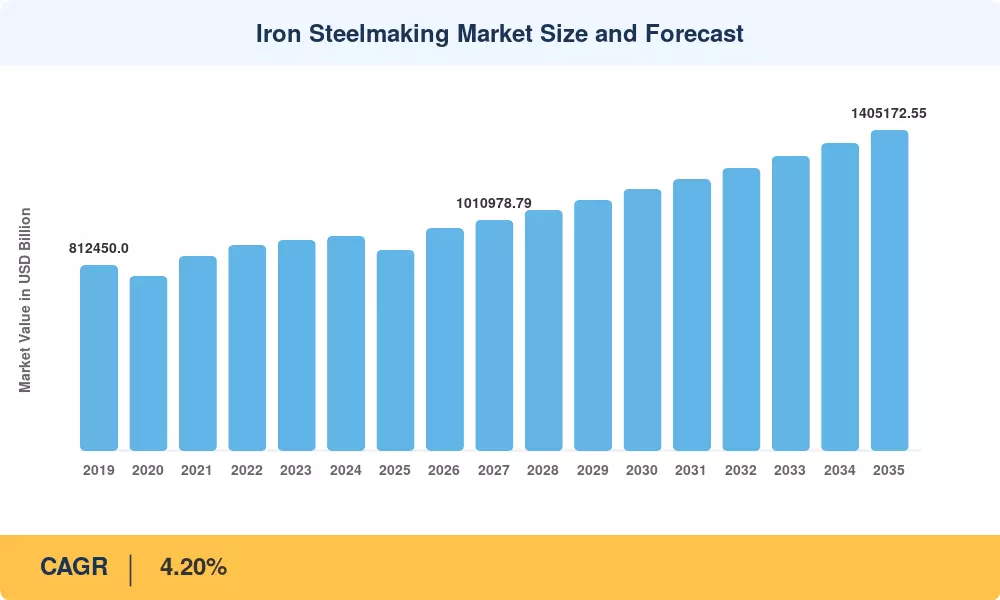
The global iron and steelmaking market was valued at approximately USD 879.72 billion in 2025 and is projected to reach USD 1,405.17 billion by 2035, expanding at a compound annual growth rate (CAGR) of 4.20% during the 2026–2035 forecast period. The market recorded an estimated value of USD 974.25 billion in 2026, marking the beginning of a sustained growth trajectory driven by large-scale infrastructure investment, rising construction activity in both advanced and emerging economies, and expanding automotive and industrial manufacturing output [1]. Governments worldwide have committed trillions of dollars to transportation, energy, and urban development programs—including multi-year stimulus packages in the United States, the European Union, India, and Southeast Asia—generating persistent baseload demand for structural steel, reinforcing bar, and flat-rolled products [2].

A significant technological shift is taking place in the steelmaking sector. Electric Arc Furnace (EAF) steelmaking is the fastest-growing process segment, driven by scrap availability, lower capital intensity, and decarbonization imperatives. However, Basic Oxygen Furnace (BOF) pathways continue to dominate global crude steel output [3]. Important events in 2024–2025 highlight this change: In April 2025, POSCO Holdings and Hyundai Motor Group signed a Memorandum of Understanding to work together on low-carbon steel and battery supply chains. This agreement includes joint pursuit of hydrogen and electrification across steel and EV value chains, as well as co-investment in Hyundai's new US steel mill in Louisiana [4]. In September 2024, Tata Steel put into service India's largest blast furnace in Kalinganagar, Odisha, increasing site capacity from 3 MTPA to 8 MTPA at a capital outlay of Rs 27,000 crore. This investment was made to meet the growing demand for automotive, infrastructure, and defense products, including thicker plate products for oil and gas, lifting, and construction applications [5].

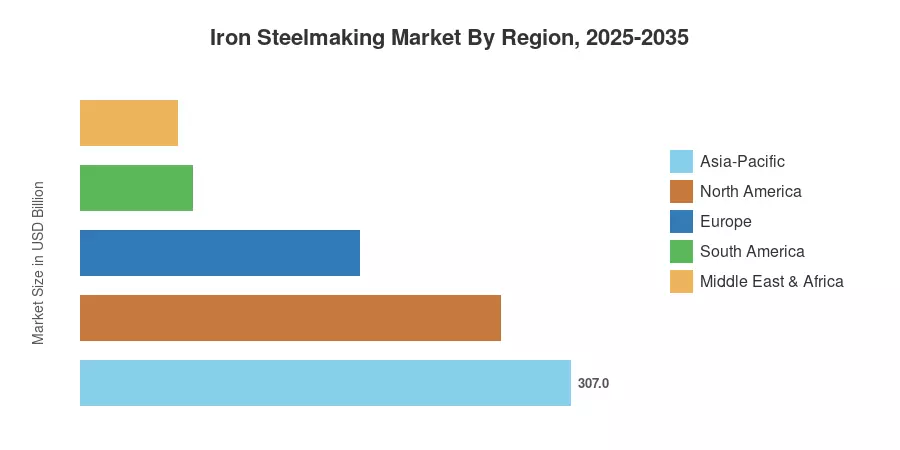
Due to onshoring tendencies, the US Infrastructure Investment and Jobs Act, and growing demand in the energy industry, North America is the largest regional market by value [6]. The fastest-growing regional market is Asia-Pacific, driven by industrialization, urbanization, and extensive infrastructure projects in China, India, and Southeast Asian countries. Europe continues to be the second-largest consumer market, with a focus on regulations pertaining to the circular economy and green steel [7]. In the future, supply-side economics are anticipated to change while maintaining above-trend demand growth through 2035 due to the convergence of energy transition investments, green hydrogen-based steelmaking pilots, and growing steel recycling rates.


Key Report Takeaways

Segment Dimension Key Metric Notes
Global Market Size (2025) USD 879,723.48 Mn Base year valuation
Global Market Size (2035) USD 1,405,172.55 Mn End-of-forecast projection
Forecast CAGR (2026–2035) 4.20% Steady long-term expansion
Dominant Process Basic Oxygen Furnace (BOF) Largest production volume share in 2025
Fastest Growing Process Electric Arc Furnace (EAF) Driven by scrap recycling and decarbonization mandates
Dominant Product Type Flat Steel Products Highest 2025 revenue contribution
Fastest Growing Product Type Specialty & High-Strength Steel Demand from automotive lightweighting and energy
Dominant Application Construction & Infrastructure Accounts for the largest end-use demand share
Fastest Growing Application Energy & Power Infrastructure Accelerated by renewable energy buildout
Dominant Region North America Highest 2025 regional market value
Fastest Growing Region Asia-Pacific Highest forecast CAGR to 2035
Leading Company by Market Share China Baowu Steel Group (6.9%) World's largest steel producer by volume


Market Size and Forecast (2019–2035)

MRFR's market sizing methodology integrates a top-down and bottom-up approach, triangulating supply-side production statistics from the World Steel Association and national statistical agencies with demand-side consumption data from construction, automotive, energy, and industrial end-users. The base year (2025) valuation was cross-validated against company annual reports, trade data, and third-party economic databases. Forecast projections employ econometric models linking steel demand to GDP growth, fixed capital formation, industrial production indices, and infrastructure spending commitments, with scenario adjustments for policy changes, technology adoption, and commodity price fluctuations.
Iron Steelmaking Market Size and Forecast
Our Impact
Enabled $4.3B Revenue Impact for Fortune 500 and Leading Multinationals
Partnering with 2000+ Global Organizations Each Year
30K+ Citations by Top-Tier Firms in the Industry

Driver Impact Analysis

Driver ~% Impact on CAGR Geographic Relevance Impact Timeline
Infrastructure Investment & Construction Activity ~35% Global (US, India, ASEAN) Short to Long-term
Automotive & Industrial Manufacturing Output ~25% North America, Europe, APAC Medium-term
Energy Transition & Power Infrastructure Expansion ~25% Global (EU, US, China) Medium to Long-term
Raw Material Availability & Scrap Recycling ~15% Global Short to Medium-term


Infrastructure Investment & Construction Activity

The world market for iron and steel is still driven mostly by government-led infrastructure initiatives. Over USD 550 billion in new federal investment on roads, bridges, rail, water systems, and broadband has been allotted in the United States under the Infrastructure Investment and Jobs Act (IIJA), with peak disbursement taking place between 2025 and 2030 [1]. The National Infrastructure Pipeline of India aims to invest USD 1.4 trillion in infrastructure by 2025, with project schedules for ports, highways, railroads, and smart cities extending into the early 2030s. In a similar vein, long steel products, reinforcing bars, structural sections, and plate continue to be in high demand due to China's Belt and Road Initiative and domestic urbanization initiatives.

The construction industry is the leading end-use vertical, accounting for 50–55% of the world's steel consumption. Due to ongoing housing shortages and population urbanization, Southeast Asia, the Middle East, and Sub-Saharan Africa are seeing an acceleration of commercial and residential real estate development. The long-term demand prognosis is supported by these fundamental elements, which also offer a stable floor for market expansion throughout the course of the projected period [2].


Automotive & Industrial Manufacturing Output

The global automotive industry consumes approximately 12–15% of total steel output, making it the second-largest demand sector after construction. The transition toward electric vehicles (EVs) is reshaping steel demand composition: while EV platforms use less traditional mild steel, they require significantly more advanced high-strength steel (AHSS), electrical steel for motor cores, and specialized battery enclosure materials. Global light vehicle production is projected to exceed 95 million units annually by 2030, supporting sustained flat steel and specialty steel consumption [3].

Industrial machinery and equipment manufacturing, including heavy engineering, shipbuilding, and renewable energy hardware, further reinforces demand. Wind turbine towers alone require 150–300 tonnes of steel per unit, and global installed wind capacity targets suggest cumulative steel demand of 30–50 million tonnes from wind energy alone over the forecast period [4].

Energy Transition & Power Infrastructure Expansion

The global energy transition is generating a structural step-change in steel demand. Renewable energy installations—wind, solar, nuclear, and grid infrastructure—require intensive steel inputs for towers, mounting structures, transmission lines, and substations. The International Energy Agency estimates that achieving net-zero by 2050 will require a doubling of grid infrastructure investment, with steel accounting for 60–70% of transmission tower and substation weight [3]. Hydrogen production facilities, carbon capture infrastructure, and LNG terminals represent additional demand vectors that are emerging across all major regions.

Raw Material Availability & Scrap Recycling

Iron ore availability and scrap steel recycling rates directly influence production economics and capacity utilization. Global scrap availability is expanding as the installed base of steel in use increases—estimated at 35–40 billion tonnes worldwide. Rising scrap collection rates, particularly in North America and Europe, where end-of-life recovery systems are mature, are enabling greater EAF output at lower cost and lower carbon intensity. This driver also intersects with the green steel opportunity, as scrap-based EAF production generates 75% fewer CO2 emissions than integrated BOF routes [4].

Restraints Impact Analysis

Restraint ~% Drag on CAGR Geographic Relevance Impact Timeline
Stringent Environmental Regulations & Decarbonization Costs ~60% Europe, North America, APAC (China, Japan, Korea) Medium to Long-term
Volatility In Raw Material & Energy Prices ~40% Global Short to Medium-term


Stringent Environmental Regulations & Decarbonization Costs

One of the hardest-to-abate economic sectors and a major target for climate legislation, the steelmaking industry contributes roughly 7–9% of the world's CO2 emissions [5]. Carbon charges on imported steel products are imposed by the European Union's Carbon Border Adjustment Mechanism (CBAM), which began its transitional phase in 2023 and will be fully operational by 2026. This essentially raises production costs for exporters without comparable domestic carbon pricing. While the US is investigating comparable approaches, national emissions trading systems in China, South Korea, and Japan are tightening allocation limitations. By 2030, steel production prices in regulated markets are expected to increase by USD 50–150 per tonne due to compliance expenses, which include carbon credits, capital expenditures for green technologies, and operational redesign. This will compress margins for manufacturers who are unable to make the shift swiftly.


Volatility In Raw Material & Energy Prices

Iron ore, coking coal, and natural gas prices exhibit significant volatility driven by supply disruptions, geopolitical events, and speculative trading. Iron ore prices have fluctuated between USD 80 and USD 160 per tonne over the past five years, while coking coal prices spiked above USD 500 per tonne during the 2022 energy crisis [6]. Such price swings directly impact steelmaker margins, which typically range between 5–15% EBITDA. Energy costs represent 20–40% of steel production expenses, depending on process route (BOF vs. EAF) and regional energy mix. The ongoing energy transition introduces additional uncertainty as natural gas and electricity prices diverge across regions, creating competitive asymmetries between producers in energy-abundant versus energy-constrained markets.

Iron Steelmaking Market Opportunities

Transition To Green Steel & Hydrogen-Based Technologies

The most revolutionary prospect in the steelmaking sector is green steel, which is made utilizing hydrogen-based direct reduction of iron (H-DRI) or renewable-powered EAF methods. By 2035, corporate procurement pledges from consumer goods businesses, construction organizations, and automakers looking to reduce Scope 3 emissions could propel the global green steel industry to around USD 80–100 billion [7]. Commercial-scale proof points are being established by ArcelorMittal's DRI-EAF investments in Spain and Canada, Thyssenkrupp's hydrogen-based blast furnace experiments, and SSAB's HYBRIT project in Sweden. In advantageous regions, green hydrogen production costs are expected to drop from USD 5–7/kg to USD 1.5–2.5/kg by 2030, radically changing the economics of hydrogen-based steelmaking. The automotive-steel value chain is aggressively aligning around low-carbon solutions, as seen by POSCO Holdings' April 2025 Memorandum of Understanding with Hyundai Motor Group to jointly pursue hydrogen and electrification in steel and EV supply chains.


Expansion Of Infrastructure Projects In Emerging Economies

Emerging economies in South and Southeast Asia, Sub-Saharan Africa, and Latin America face massive infrastructure deficits that will drive decades of above-average steel demand growth. India alone requires an estimated 300 million tonnes of annual steel capacity by 2030 (up from approximately 155 million tonnes in 2024) to support housing, transportation, and industrial development [8]. Indonesia, Vietnam, the Philippines, and Bangladesh are similarly scaling infrastructure spending as their economies industrialize. Multilateral development bank lending and bilateral infrastructure agreements (including China's BRI and Japan's Quality Infrastructure Initiative) are channeling capital into these regions, creating sustained project pipelines that underwrite long-term steel demand growth at rates significantly above the global average.

Rising Steel Recycling & Circular Economy Initiatives

The circular economy is reshaping steelmaking economics and sustainability profiles. Steel is the world's most recycled material, with a global recycling rate exceeding 85%. However, collection and processing efficiency varies widely by region, creating opportunity for improvement—particularly in emerging markets where informal scrap sectors dominate [9]. EU regulations mandating minimum recycled content in construction products, automotive end-of-life directives requiring higher material recovery, and corporate ESG commitments to circular supply chains are driving investment in advanced scrap sorting, shredding, and refining technologies. The economics are compelling: EAF steelmaking from scrap requires approximately 75% less energy than integrated BOF routes and generates a fraction of the carbon emissions, offering both cost and compliance advantages.

Iron Steelmaking Market Future Outlook

Technology & Process Evolution

The steel industry is about to embark on a multi-decade technological shift away from carbon-intensive integrated BOF pathways and toward advanced scrap-based EAF production and hydrogen-based DRI-EAF. Hydrogen-based steelmaking is predicted to increase from less than 1% of the world's crude steel production to 8–12% by 2035 [11]. This shift necessitates significant investments in renewable energy production, DRI shaft furnaces, and green hydrogen electrolysis capability. Digital technologies, such as digital twins, AI-driven process optimization, and autonomous operations, are simultaneously increasing product quality, yield, and energy efficiency in all current facilities.


Competitive Dynamics & Market Structure

The competitive landscape is expected to consolidate modestly, with the top 10 producers increasing their combined market share from approximately 27–28% to 30–35% by 2035. Cross-border M&A, joint ventures, and strategic partnerships—such as the POSCO-Hyundai collaboration—are accelerating as companies seek scale, technology access, and geographic diversification. Chinese producers, led by China Baowu (6.9% share), will continue to dominate by volume, while Japanese and Korean producers focus on high-value specialty steels and technology licensing. Indian producers are the most aggressively expanding, targeting 300 MTPA national capacity by 2030.

Sustainability & Regulatory Shifts

Decarbonization regulation will increasingly differentiate competitive positioning. Carbon border taxes (EU CBAM, potential US and UK mechanisms), mandatory Scope 3 reporting, and green procurement standards for public infrastructure will create a two-tier market: low-carbon producers commanding premium pricing and market access, and conventional producers facing margin compression and trade barriers. Steel recycling mandates and circular economy regulations will drive EAF adoption and investment in advanced scrap processing.

Long-Range Demand Scenario

Under MRFR's base-case scenario, global steel demand grows at approximately 4.2% CAGR through 2035, reaching USD 1,405.17 billion. Upside risk stems from accelerated infrastructure spending in India and ASEAN, faster-than-expected hydrogen cost declines, and supply-side consolidation improving pricing discipline. Downside risk includes prolonged Chinese demand deceleration, global recession, or technological disruption from alternative materials (carbon fiber, advanced composites) in key end-use sectors.

Iron Steelmaking Market Segmentation

Dimension Sub-Segments Dominant Segment (2025) Fastest Growing Segment
By Product Type Flat Steel, Long Steel, Tubular Steel, Specialty Steel Flat Steel Specialty & High-Strength Steel
By Process Basic Oxygen Furnace (BOF), Electric Arc Furnace (EAF), Open Hearth BOF EAF
By Application Construction, Automotive, Energy & Power, Machinery & Equipment, Consumer Goods, Shipbuilding Construction Energy & Power
By End User Building & Construction, Transportation, Energy, Industrial Manufacturing, Defense Building & Construction Energy
By Raw Material Iron Ore-Based, Scrap-Based, DRI-Based Iron Ore-Based Scrap-Based


By Product Type

Segment Key Metric Primary Demand Driver
Flat Steel Largest segment (~48% of 2025 value) Automotive body panels, appliances and construction cladding
Long Steel Second-largest (~30%) Reinforcing bar, structural sections, rail
Tubular Steel ~12% Oil & gas pipelines, water infrastructure
Specialty Steel ~10%; highest CAGR Automotive AHSS, electrical steel, defense applications


Flat steel products—including hot-rolled coil, cold-rolled sheet, and coated products—dominate the market by value, driven by high-volume consumption in automotive, appliance, and construction applications. Specialty and high-strength steel is the fastest-growing product segment, reflecting automotive lightweighting trends, increasing demand for grain-oriented electrical steel in EV motors and transformers, and defense sector procurement of armor-grade and high-hardness plate.

By Process

Segment Key Metric Primary Demand Driver
Basic Oxygen Furnace (BOF) ~70% of 2025 production volume Integrated works; iron ore-based primary steelmaking
Electric Arc Furnace (EAF) ~28%; highest CAGR Scrap recycling, mini-mills, decarbonization mandates
Open Hearth ~2%; declining Legacy facilities in select markets


BOF production continues to dominate global crude steel output, particularly in China, Japan, and integrated works worldwide. However, EAF steelmaking is growing rapidly across all regions, supported by expanding scrap availability, lower capital requirements, operational flexibility, and significantly lower carbon intensity. Open hearth steelmaking continues to decline globally, with remaining capacity concentrated in legacy facilities.

By Application

Segment Key Metric Primary Demand Driver
Construction Dominant segment (~52% of demand) Infrastructure programs, urbanization and housing
Automotive ~14% Vehicle production, EV transition, lightweighting
Energy & Power ~12%; highest CAGR Renewable energy, grid expansion, LNG
Machinery & Equipment ~11% Capital goods, heavy engineering and agriculture
Consumer Goods & Shipbuilding ~11% Appliances, packaging, naval and merchant vessels


Construction remains the overwhelmingly dominant application, consuming over half of global steel output. Energy and power are the fastest-growing application segments, driven by massive investment in wind turbines, solar mounting structures, grid transmission infrastructure, and hydrogen production facilities worldwide.

By End User

Segment Key Metric Primary Demand Driver
Building & Construction Largest end-user sector Government infrastructure spending, commercial real estate
Transportation Second-largest Automotive, rail, aerospace
Energy Fastest-growing end-user Renewable buildout, power grid expansion
Industrial Manufacturing Steady growth Machinery, tools, industrial equipment
Defense Niche but growing Armored vehicles, naval vessels, munitions


Building and construction end-users account for the largest share of steel consumption globally. The energy end-user segment is expected to register the highest CAGR through 2035, as the global energy transition drives demand for steel-intensive infrastructure, including wind farms, transmission networks, battery storage facilities, and hydrogen production plants.

By Raw Material

Segment Key Metric Primary Demand Driver
Iron Ore-Based Dominant (~65%) Integrated BOF production; pig iron route
Scrap-Based ~30%; fastest CAGR EAF steelmaking expansion, recycling mandates
DRI-Based ~5%; rapid emerging growth Green steel transition, natural gas-rich regions


Iron ore-based steelmaking remains dominant, supported by the vast installed base of integrated blast furnace-BOF facilities worldwide. Scrap-based production is the fastest-growing raw material segment as EAF adoption accelerates, while DRI-based production is expanding in natural gas-rich regions (Middle East, North Africa) and increasingly positioning itself as the bridge to hydrogen-based green steelmaking.

Regional Market Share Analysis

Region 2025 Market (USD Mn) CAGR (2026–2035) Primary Investment Themes
North America 263,917.04 3.90% Onshoring, IIJA infrastructure, energy transition
Europe 175,944.70 3.60% Green steel mandates, CBAM, EAF expansion
Asia-Pacific 307,903.22 5.10% Urbanization, industrialization and BRI projects
South America 70,377.88 3.80% Mining infrastructure, housing and energy
Middle East & Africa 61,580.64 4.50% Megaprojects, diversification, construction boom
**Total** **879,723.48** **4.20%**


North America

Country Key Metric Key Driver
United States Largest market; ~75% of regional value IIJA disbursement, energy infrastructure, EV manufacturing
Canada Second-largest; growing EAF presence Mining and resource investment, green hydrogen pilots
Mexico Fastest-growing in the region Nearshoring-driven manufacturing expansion


North America is the dominant regional market, supported by the convergence of infrastructure stimulus, manufacturing onshoring, and energy sector investment. The US Infrastructure Investment and Jobs Act is driving multi-year demand for structural steel, plate, and rebar across transportation, water, and energy projects. Simultaneously, US and Canadian EAF capacity is expanding as steelmakers capitalize on abundant scrap supply and lower-carbon production requirements. Mexico's steel consumption is growing rapidly as nearshoring trends redirect manufacturing supply chains from Asia to North America, with major automotive and appliance OEMs expanding production capacity.

Europe

Country Key Metric Key Driver
Germany Largest European steel producer Automotive, mechanical engineering, green steel transition
France Significant flat steel consumer Nuclear energy expansion, infrastructure renewal
United Kingdom Post-Brexit investment shifts Offshore wind, infrastructure modernization
Italy Major producer (Taranto integrated works) Construction, machinery, EU recovery funds


Europe represents the second-largest regional market, distinguished by its aggressive regulatory posture on decarbonization. The EU's CBAM, Green Deal Industrial Plan, and national hydrogen strategies are collectively reshaping the competitive landscape, favoring producers that invest early in hydrogen-based DRI and EAF capacity. European steelmakers, including ArcelorMittal, thyssenkrupp, and Salzgitter, have committed billions of euros to decarbonization capital programs, with EU and national subsidies partially offsetting transition costs.

Asia-Pacific

Country Key Metric Key Driver
China World's largest producer (~55% of global output) Urbanization (slowing), infrastructure, Belt and Road
India Fastest-growing major market National Infrastructure Pipeline, housing and manufacturing
Japan Third-largest producer; technology leader High-value steel, automotive, export-oriented
South Korea Fifth-largest producer Shipbuilding, automotive, electronics
ASEAN Collectively high-growth Industrialization, infrastructure deficit addressal


Asia-Pacific is the fastest-growing regional market, led by India's rapid capacity expansion and sustained (if decelerating) Chinese demand. Tata Steel's commissioning of India's largest blast furnace at Kalinganagar in September 2024, expanding capacity to 8 MTPA, exemplifies the scale of investment underway. China remains the world's dominant producer and consumer at over 1 billion tonnes of annual crude steel output, though growth is moderating as the economy shifts toward services. ASEAN nations—particularly Vietnam, Indonesia, and the Philippines—represent the frontier growth opportunity, with steel consumption per capita well below global averages and infrastructure investment accelerating.

South America

Country Key Metric Key Driver
Brazil Dominant regional producer Mining, construction, automotive
Argentina Second-largest market Industrial recovery, housing demand
Chile Copper-mining-driven steel demand Mining equipment, infrastructure


South America's steel market is anchored by Brazil, which accounts for approximately 65–70% of regional production and consumption. Brazilian steelmakers Gerdau, Usiminas, and CSN are investing in EAF expansion and downstream value addition. Regional demand is supported by mining sector activity, residential construction, and automotive manufacturing, with commodity price cycles influencing investment timing.

Middle East & Africa

Country Key Metric Key Driver
Saudi Arabia Largest MEA market Vision 2030 megaprojects, NEOM, tourism infrastructure
UAE Regional hub; high per-capita consumption Real estate, logistics infrastructure
South Africa Largest African producer Mining, infrastructure, industrial development
Egypt Rapidly growing market New capital city, housing deficit addressal


The Middle East and Africa region exhibits the second-highest forecast CAGR, driven by Saudi Arabia's Vision 2030 megaprojects (NEOM, The Line, Jeddah Tower, Red Sea tourism), UAE construction activity, and African infrastructure development. DRI-based steelmaking is prevalent in the Middle East, leveraging abundant and low-cost natural gas. The region's transition to green hydrogen production positions it as a potential major green steel hub by the mid-2030s.

Iron Steelmaking Market By Region, 2025-2035

Competitive Benchmarking

The global iron and steelmaking market is moderately fragmented, with the top 10 producers collectively accounting for approximately 27.5% of global market share by revenue. The Herfindahl-Hirschman Index (HHI) is estimated in the range of 150–200, indicating a highly competitive market structure with no single player commanding decisive pricing power. China Baowu Steel Group leads the market at 6.9% share following its consolidation of multiple Chinese state-owned steelmakers, while the remaining top-ten players hold shares ranging from 1.7% to 3.3%. The "long tail" of smaller producers—comprising regional mills, mini-mills, and specialty steelmakers—accounts for approximately 72.5% of total market revenue, reflecting the local and regional nature of steel distribution and end-use markets.

Company Est. Revenue Share (%) Key Offerings Strategic Positioning
China Baowu Steel Group 6.9% Full-range flat and long products; automotive steel; specialty alloys World's largest steelmaker; state-backed consolidation; diversified product portfolio
ArcelorMittal 3.3% Flat products, long products, tubular, mining Global footprint across the Americas, Europe and Asia; decarbonization leader (XCarb)
Ansteel Group 3.1% Flat products, special steel, vanadium-titanium Major Chinese integrated steelmaker; specialty mineral extraction
Nippon Steel Corporation 2.3% Automotive AHSS, electrical steel, seamless pipe Technology leader; premium product focus; US acquisition (US Steel)
HBIS Group 2.2% Flat products, hot-rolled coil, specialty steel Large Chinese integrated producer; overseas expansion
Jiangsu Shagang Group 2.1% Long products, wire rod, bar, special steel Largest private steelmaker in China; cost-efficient operations
JFE Steel Corporation 2.1% Automotive steel, shipbuilding plate, electrical steel Japanese technology leader; high-value specialty products
POSCO Holdings 2.0% Flat products, automotive steel, lithium, battery materials Integrated steel-to-battery value chain; green steel pioneer
Tata Steel Group 1.8% Flat products, long products; automotive; construction India's largest private steelmaker, with aggressive capacity expansion
Shougang Group 1.7% Flat products, automotive steel, electrical steel Chinese state-owned, Beijing-headquartered, automotive focus
Other Market Players 72.5% Regional producers, mini-mills, specialty steelmakers, traders Fragmented; localized distribution; niche product specialization


Recent News & Developments

POSCO Holdings (April 2025):

POSCO Holdings signed a Memorandum of Understanding with Hyundai Motor Group in April 2025 for collaboration on low-carbon steel and battery value chains. Under the agreement, POSCO will co-invest in Hyundai's new US steel mill in Louisiana, and the two groups will jointly pursue hydrogen and electrification technologies across both the steel production and electric vehicle supply chains. This partnership represents a significant strategic alignment between a leading steelmaker and a major automotive OEM, reflecting the convergence of decarbonization imperatives across the steel-automotive value chain. The collaboration positions both companies to benefit from the US Inflation Reduction Act incentives for domestic production and clean energy technology deployment [4].

Tata Steel (September 2024):

Tata Steel commissioned India's largest blast furnace at its Kalinganagar facility in Odisha in September 2024, as part of the site's Phase II expansion. The new facility increases Kalinganagar's capacity from 3 MTPA to 8 MTPA at a total investment of Rs 27,000 crore (approximately USD 3.2 billion). The expanded plant is designed to serve rising demand from the automotive, infrastructure, and defense sectors, with capabilities to produce thicker plate products for oil and gas, lifting equipment, and construction applications. This investment underscores India's ambition to become a 300 MTPA steel-producing nation by 2030 and Tata Steel's strategic positioning as the country's leading private-sector steelmaker [5].

Iron Steelmaking Market Report Scope

Parameter Detail
Market Scope Global Iron and Steelmaking Market
Study Period 2019–2035
CAGR Window 2026–2035
Base Year 2025
Market Size (2025) USD 879,723.48 Million (USD 879.72 Billion)
Market Size (2035) USD 1,405,172.55 Million (USD 1,405.17 Billion)
CAGR 4.20%
Fastest Growing Region Asia-Pacific
Dominant Region North America
Fastest Growing Segment (By Process) Electric Arc Furnace (EAF)
Fastest Growing Segment (By Product) Specialty & High-Strength Steel
Fastest Growing Segment (By Application) Energy & Power
Companies Profiled ArcelorMittal, POSCO Holdings, Nippon Steel Corporation, Tata Steel Group, JFE Steel Corporation, China Baowu Steel Group, Ansteel Group, Jiangsu Shagang Group, HBIS Group, Shougang Group
Valuation Currency USD (Million and Billion)
Segments Covered By Product Type, By Process, By Application, By End User, By Raw Material


FAQs

What is the projected size of the global iron and steelmaking market by 2035?
The global iron and steelmaking market is projected to reach approximately USD 1,405.17 billion by 2035, growing from USD 879.72 billion in 2025 at a CAGR of 4.20% during the 2026–2035 forecast period [1]. This growth is primarily driven by sustained infrastructure investment, automotive manufacturing output, and energy transition-related demand.
Which region is expected to grow fastest in the iron and steelmaking market?
Asia-Pacific is the fastest-growing regional market, driven by India's rapid capacity expansion, continued urbanization in China, and accelerating industrialization across ASEAN nations, including Vietnam, Indonesia, and the Philippines [8]. India's National Steel Policy targets 300 MTPA capacity by 2030, underscoring the scale of anticipated growth.
What is green steel, and why is it important for the market's future?
Green steel refers to steel produced using hydrogen-based direct reduction of iron (H-DRI) or renewable-powered electric arc furnaces, resulting in near-zero carbon emissions. It is important because the steel industry generates 7–9% of global CO2 emissions and faces increasing regulatory pressure from mechanisms like the EU's CBAM [3]. The transition to green steel represents both a compliance imperative and a commercial opportunity worth an estimated USD 80–100 billion by 2035.
Which company holds the largest market share in the global steelmaking industry?
China Baowu Steel Group holds the largest estimated revenue share at 6.9%, making it the world's largest steelmaker by both volume and revenue. The company achieved its scale through state-directed consolidation of multiple Chinese steel enterprises and operates a diversified portfolio spanning flat products, long products, automotive steel, and specialty alloys [5].
How is the energy transition affecting steel demand?
The energy transition is generating substantial incremental steel demand through renewable energy installations (wind turbines, solar mounting structures), grid transmission expansion, hydrogen production infrastructure, and carbon capture facilities. The IEA estimates that achieving net-zero emissions by 2050 will require a doubling of grid infrastructure investment, with steel comprising 60–70% of transmission and substation material content [3].
What are the key risks facing the iron and steelmaking market through 2035?
The principal risks include rising compliance costs from decarbonization regulation (particularly EU CBAM and carbon trading schemes), volatility in iron ore, coking coal, and energy prices, potential deceleration in Chinese steel demand as the economy rebalances, and competition from alternative materials in selected applications [5][6]. Geopolitical trade disruptions and protectionist policies also pose risks to cross-border steel flows.
What role does steel recycling play in the market outlook?
Steel recycling is a critical growth enabler, as scrap-based EAF production requires approximately 75% less energy and generates far fewer emissions than integrated BOF routes. With global steel-in-use estimated at 35–40 billion tonnes and recycling rates exceeding 85%, expanding scrap availability supports EAF capacity additions worldwide. EU and North American mandates for minimum recycled content in construction products are further accelerating this trend [9][13].                                        
Author
Author
Author Profile
Chitranshi Jaiswal LinkedIn
Team Lead - Research
Chitranshi is a Team Leader in the Chemicals & Materials (CnM) and Energy & Power (EnP) domains, with 6+ years of experience in market research. She leads and mentors teams to deliver cross-domain projects that equip clients with actionable insights and growth strategies. She is skilled in market estimation, forecasting, competitive benchmarking, and both primary & secondary research, enabling her to turn complex data into decision-ready insights. An engineer and MBA professional, she combines technical expertise with strategic acumen to solve dynamic market challenges. Chitranshi has successfully managed projects that support market entry, investment planning, and competitive positioning, while building strong client relationships. Certified in Advanced Excel & Power BI she leverages data-driven approaches to ensure accuracy, clarity, and impactful outcomes.
Download Free Sample

Kindly complete the form below to receive a free sample of this Report

Download PDF ×

We do not share your information with anyone. However, we may send you emails based on your report interest from time to time. You may contact us at any time to opt-out.