IT Training and Certification Market

IT Training and Certification Market Size, Share and Trends Analysis Research Report Information By Target Audience (Corporate Professionals, Students, Job Seekers, IT Enthusiasts), By Technology Focus (Cloud Computing, Cybersecurity, Data Science, Software Development), By Certification Type (Professional, Vendor, Academic, Skill-Based), By Duration of Training (Short-Term Courses, Long-Term Programs, Workshops, Bootcamps), By Training Delivery Method (Online, In-Person, Blended, Self-Paced), And By Region – Market Forecast Till 2035.

Forecast Period
2025 - 2035
CAGR
4.58%
2024 Market Size
$ 55 Billion
2035 Market Size
$ 90 Billion
Professional Services ● Updated March 28, 2026 Report ID: MRFR/PS/65342-HCR | Pages: 200 | Author: Rahul Gotadki, Garvit Vyas

IT Training and Certification Market Summary

As per MRFR analysis, the IT Training and Certification Market Size was estimated at 55.0 USD Billion in 2024. The IT Training and Certification industry is projected to grow from 57.52 USD Billion in 2025 to 90.0 USD Billion by 2035, exhibiting a compound annual growth rate (CAGR) of 4.58% during the forecast period 2025 - 2035.

Key Market Trends & Highlights

The IT Training and Certification market is experiencing a dynamic shift towards remote learning and specialized skills development.

  • The North American market remains the largest, driven by a robust demand for IT professionals and advanced training solutions.
  • Asia-Pacific is emerging as the fastest-growing region, with a notable increase in online training offerings.
  • Professional certification continues to dominate the market, while vendor certification is rapidly gaining traction among learners.
  • Key market drivers include the increased demand for IT professionals and the ongoing shift towards digital transformation.

Market Size & Forecast

2024 Market Size 55.0 (USD Billion)
2035 Market Size 90.0 (USD Billion)
CAGR (2025 - 2035) 4.58%

Major Players

Coursera (US), Udacity (US), Pluralsight (US), LinkedIn Learning (US), edX (US), Skillsoft (US), CompTIA (US), Cisco (US), Microsoft (US), AWS Training and Certification (US)

Our Impact

Enabled $4.3B Revenue Impact for Fortune 500 and Leading Multinationals

Partnering with 2000+ Global Organizations Each Year

30K+ Citations by Top-Tier Firms in the Industry

IT Training and Certification Market Drivers

Technological Advancements

Rapid technological advancements significantly influence the IT Training and Certification Industry. Emerging technologies such as artificial intelligence, cloud computing, and cybersecurity necessitate continuous learning and skill enhancement. Organizations are increasingly investing in training programs to ensure their workforce remains adept at utilizing these technologies. For instance, the rise of cloud services has led to a 30% increase in demand for cloud-related certifications. This trend underscores the importance of ongoing education in the IT sector, compelling training providers to adapt their offerings to meet the evolving needs of the industry.

Growing Importance of Soft Skills

In addition to technical expertise, the growing importance of soft skills is reshaping the IT Training and Certification Industry. Employers increasingly value skills such as communication, teamwork, and problem-solving alongside technical capabilities. This trend prompts training providers to incorporate soft skills development into their certification programs. Research indicates that 93% of employers consider soft skills essential for workplace success. As a result, the IT Training and Certification Industry is evolving to address this need, offering programs that blend technical training with soft skills enhancement, thereby producing well-rounded professionals.

Regulatory Compliance Requirements

Regulatory compliance requirements are becoming increasingly stringent, thereby impacting the IT Training and Certification Industry. Organizations must adhere to various standards and regulations, particularly in sectors such as finance and healthcare. This necessity drives the demand for certified professionals who understand compliance protocols and can implement them effectively. For example, the General Data Protection Regulation (GDPR) has heightened the need for data protection training. Consequently, training providers are expanding their offerings to include compliance-focused certifications, ensuring that professionals are well-equipped to meet these regulatory demands.

Shift Towards Digital Transformation

The ongoing shift towards digital transformation across various sectors propels the IT Training and Certification Industry forward. Businesses are increasingly adopting digital tools and platforms to enhance efficiency and customer engagement. This transition creates a pressing need for employees who are proficient in digital technologies. As a result, training programs focusing on digital skills are witnessing heightened enrollment. Data suggests that organizations investing in employee training see a 24% increase in productivity. Thus, the IT Training and Certification Industry plays a crucial role in equipping the workforce with the necessary skills to navigate this digital landscape.

Increased Demand for IT Professionals

The IT Training and Certification sector experiences a notable surge in demand for skilled IT professionals. As organizations increasingly rely on technology, the need for certified individuals who can manage, secure, and optimize IT systems becomes paramount. According to recent data, the IT sector is projected to grow by approximately 11% over the next decade, indicating a robust job market for certified professionals. This growth drives individuals to seek training and certification programs, enhancing their employability and career prospects. Consequently, the IT Training and Certification Industry is positioned to thrive as it caters to this escalating demand for qualified personnel.

Market Segment Insights

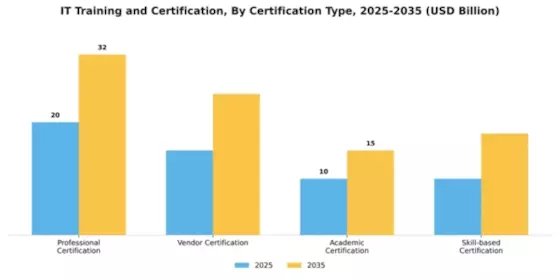
By Certification Type: Professional Certification (Largest) vs. Vendor Certification (Fastest-Growing)

In the IT Training and Certification market, Professional Certification holds the largest market share, reflecting its importance among IT professionals seeking to enhance their credentials and career prospects. This segment comprises widely recognized certifications from reputable organizations, contributing significantly to the overall growth of the sector. Meanwhile, Vendor Certification is emerging as a formidable competitor, driven by partnerships with major technology companies, catering to the need for specialized knowledge on their products and services.
IT Training and Certification Market Segment Image 0

Professional Certification (Dominant) vs. Vendor Certification (Emerging)

Professional Certification is characterized by its broad acknowledgment and acceptance across many sectors, providing IT professionals with robust credentials that signify expertise and competence. This segment generally includes certifications from established bodies, such as CompTIA and Cisco, motivating individuals to pursue lifelong learning and continuous skill enhancement. On the other hand, Vendor Certification is gaining traction as tech companies introduce programs that focus on their specific products. These certifications are tailored towards technicians and professionals who require specialized skills to support and implement these technologies, positioning Vendor Certification as an essential emerging segment in today's fast-evolving IT landscape.
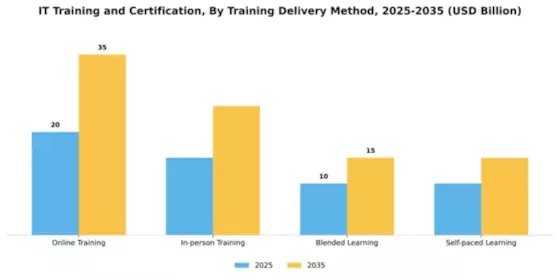
By Training Delivery Method: Online Training (Largest) vs. In-person Training (Fastest-Growing)

IT Training and Certification Market Segment Image 1

The IT training and certification market exhibits a diverse distribution of training delivery methods, with online training commanding the largest share. Organizations have increasingly adopted online training due to its flexibility, accessibility, and cost-effectiveness, making it the preferred choice for many learners. In contrast, in-person training is witnessing rapid growth, appealing to those who value face-to-face interactions and hands-on experience, reflecting a resurgence of interest in traditional training methods as companies seek deeper engagement with their employees.

Online Training: Dominant vs. Blended Learning: Emerging

Online training has solidified its dominance in the IT training and certification sector, characterized by its vast reach and adaptability to various learning styles. The convenience of participating from anywhere combined with a wide array of courses enhances its appeal. On the other hand, blended learning is emerging as a strong contender, integrating online resources with in-person sessions to optimize learning experiences. This hybrid model caters to diverse learner preferences and promotes better retention of knowledge through real-world interactions, positioning blended learning as a competitive and innovative approach in the training landscape.

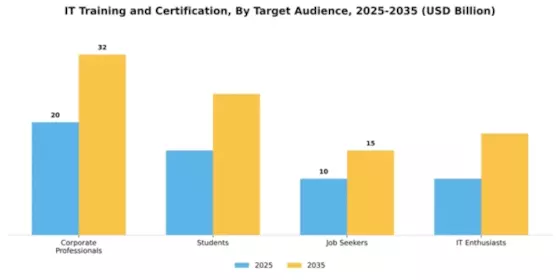
By Target Audience: Corporate Professionals (Largest) vs. Job Seekers (Fastest-Growing)

The IT training and certification market is segmented into various target audiences, with corporate professionals holding the largest share. This segment encompasses individuals who pursue certification to enhance their skills and career prospects within their current organizations. On the other hand, job seekers represent a rapidly growing demographic as they seek certifications to improve their employability and demonstrate their technical qualifications to potential employers. This dynamic reflects broader trends in the IT labor market, where upskilling is vital for career advancement.
IT Training and Certification Market Segment Image 2

Corporate Professionals: (Dominant) vs. Job Seekers (Emerging)

Corporate professionals are a dominant force in the IT training and certification market, leveraging programs to gain specific skills relevant to their roles, thus enhancing productivity and innovation within organizations. This segment focuses on specialized certifications that align with industry trends and organizational needs. Conversely, job seekers are emerging as a noteworthy segment, particularly as digital transformation accelerates across industries. These individuals are actively pursuing certifications to stand out in a competitive job market, equipping themselves with the necessary expertise to catch the attention of employers who prioritize certified professionals. As such, this segment is marked by an increasing number of entrants seeking to build a solid foundation for a successful IT career.
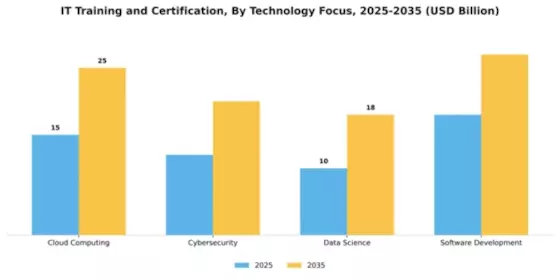
By Technology Focus: Cloud Computing (Largest) vs. Cybersecurity (Fastest-Growing)

IT Training and Certification Market Segment Image 3

The IT Training and Certification market reveals a diverse distribution of focus areas, with Cloud Computing taking the lead as the largest segment. Many organizations are investing heavily in training personnel to utilize cloud technologies efficiently. Cybersecurity follows closely as a significant area of interest, especially as cyber threats increase globally. As businesses recognize the importance of safeguarding their digital assets, the demand for training in cybersecurity is pushing its rapid growth.

Cloud Computing: Dominant vs. Cybersecurity: Emerging

Cloud Computing stands out as the dominant technology focus within IT Training and Certification, primarily due to its extensive implementation across various industries. Organizations are increasingly shifting their operations to the cloud, necessitating a skilled workforce proficient in cloud technologies. On the other hand, Cybersecurity emerges as an essential focus amid rising cyber threats. With increasing data breaches, there is a heightened need for professionals trained in cybersecurity measures. Companies are prioritizing certification programs to ensure their teams are equipped to counteract potential cyber risks effectively.

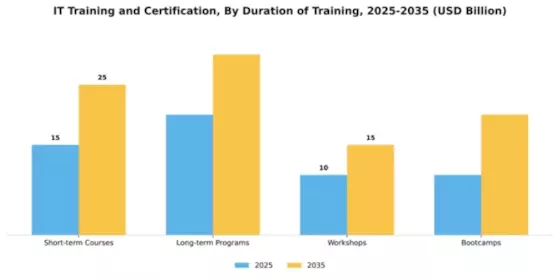
By Duration of Training: Bootcamps (Largest) vs. Short-term Courses (Fastest-Growing)

In the IT Training and Certification market, the distribution of training durations reveals a competitive landscape where bootcamps hold the largest market share. These intensive, focused programs attract a significant number of participants looking for quick skills acquisition in specific IT domains. On the other hand, short-term courses are rapidly gaining popularity, serving a diverse audience from beginners to professionals seeking upskilling opportunities, thus increasing their stake in the market.
IT Training and Certification Market Segment Image 4

Bootcamps (Dominant) vs. Workshops (Emerging)

Bootcamps have emerged as a dominant force in the IT training landscape, offering accelerated learning paths that equip participants with in-demand skills within a concentrated timeframe. Their focus on practical, hands-on training makes them exceptionally appealing to those looking to enter the job market quickly or enhance their existing IT capabilities. Conversely, workshops represent an emerging trend that emphasizes collaborative learning and specialized topics. These shorter sessions are perfect for professionals looking to expand specific skills without the commitment of a longer program, thus catering to a growing demand for flexible and targeted learning solutions.

Get more detailed insights about IT Training and Certification Market Request Free Sample

Key Players and Competitive Insights

The IT Training and Certification market is currently characterized by a dynamic competitive landscape, driven by rapid technological advancements and an increasing demand for skilled professionals. Key players such as Coursera (US), Udacity (US), and AWS Training and Certification (US) are strategically positioning themselves through innovative course offerings and partnerships. For instance, Coursera (US) has focused on expanding its catalog of professional certificates in collaboration with leading universities and corporations, thereby enhancing its appeal to both learners and employers. This collective emphasis on innovation and strategic partnerships among major players is shaping a competitive environment that prioritizes quality and relevance in training programs.The market structure appears moderately fragmented, with numerous players vying for market share. Companies are employing various business tactics, such as localizing content to cater to regional markets and optimizing their digital platforms for enhanced user experience. This competitive structure allows for a diverse range of offerings, although the influence of key players remains substantial, as they set benchmarks for quality and accessibility in IT training.In November AWS Training and Certification (US) announced a significant expansion of its training programs, introducing new courses focused on machine learning and cloud security. This strategic move is likely to enhance AWS's competitive edge by addressing the growing demand for specialized skills in these areas, thereby attracting a broader audience of learners seeking to advance their careers in technology. The emphasis on cutting-edge topics aligns with industry trends and positions AWS as a leader in the evolving landscape of IT training.In October Udacity (US) launched a new initiative aimed at providing scholarships for underrepresented groups in tech. This initiative not only reflects Udacity's commitment to diversity and inclusion but also serves to expand its user base by making high-quality training more accessible. By fostering a more inclusive environment, Udacity may enhance its brand reputation and attract partnerships with organizations focused on social impact, thereby strengthening its market position.In September Microsoft (US) unveiled a new certification program tailored for cybersecurity professionals, which is particularly timely given the increasing prevalence of cyber threats. This program is expected to solidify Microsoft's role as a key player in the IT training sector, as it addresses urgent industry needs while also promoting its own technologies. The strategic focus on cybersecurity training may also lead to increased collaboration with educational institutions and businesses, further embedding Microsoft within the training ecosystem.As of December the competitive trends in the IT Training and Certification market are increasingly defined by digitalization, AI integration, and a focus on sustainability. Strategic alliances among companies are becoming more prevalent, as organizations recognize the value of collaboration in enhancing their offerings. The shift from price-based competition to a focus on innovation and technology is evident, with companies striving to differentiate themselves through unique course content and reliable supply chains. Looking ahead, it seems likely that competitive differentiation will continue to evolve, emphasizing the importance of adaptability and forward-thinking strategies in a rapidly changing market.


Key Companies in the IT Training and Certification Market include

Future Outlook

IT Training and Certification Market Future Outlook

The IT Training and Certification market is projected to grow at a 4.58% CAGR from 2025 to 2035, driven by technological advancements, increasing demand for skilled professionals, and evolving industry standards.

New opportunities lie in:

  • Development of AI-driven personalized learning platforms Expansion of virtual reality training environments Creation of industry-specific certification programs for emerging technologies

By 2035, the IT Training and Certification market is expected to be robust, reflecting sustained growth and innovation.

Market Segmentation

it-training-and-certification Target Audience Outlook

  • Corporate Professionals
  • Students
  • Job Seekers
  • IT Enthusiasts

it-training-and-certification Technology Focus Outlook

  • Cloud Computing
  • Cybersecurity
  • Data Science
  • Software Development

it-training-and-certification Certification Type Outlook

  • Professional Certification
  • Vendor Certification
  • Academic Certification
  • Skill-based Certification

it-training-and-certification Duration of Training Outlook

  • Short-term Courses
  • Long-term Programs
  • Workshops
  • Bootcamps

it-training-and-certification Training Delivery Method Outlook

  • Online Training
  • In-person Training
  • Blended Learning
  • Self-paced Learning

Report Scope

MARKET SIZE 2024 55.0(USD Billion)
MARKET SIZE 2025 57.52(USD Billion)
MARKET SIZE 2035 90.0(USD Billion)
COMPOUND ANNUAL GROWTH RATE (CAGR) 4.58% (2025 - 2035)
REPORT COVERAGE Revenue Forecast, Competitive Landscape, Growth Factors, and Trends
BASE YEAR 2024
Market Forecast Period 2025 - 2035
Historical Data 2019 - 2024
Market Forecast Units USD Billion
Key Companies Profiled Coursera (US), Udacity (US), Pluralsight (US), LinkedIn Learning (US), edX (US), Skillsoft (US), CompTIA (US), Cisco (US), Microsoft (US), AWS Training and Certification (US)
Segments Covered Certification Type, Training Delivery Method, Target Audience, Technology Focus, Duration of Training
Key Market Opportunities Growing demand for cybersecurity skills drives expansion in IT Training and Certification offerings.
Key Market Dynamics Rising demand for skilled IT professionals drives competition among training providers and influences certification standards.
Countries Covered North America, Europe, APAC, South America, MEA

Table of Contents

  1. 1 SECTION I: EXECUTIVE SUMMARY AND KEY HIGHLIGHTS
    1. 1.1 EXECUTIVE SUMMARY
      1. 1.1.1 Market Overview
      2. 1.1.2 Key Findings
      3. 1.1.3 Market Segmentation
      4. 1.1.4 Competitive Landscape
      5. 1.1.5 Challenges and Opportunities
      6. 1.1.6 Future Outlook
  2. 2 SECTION II: SCOPING, METHODOLOGY AND MARKET STRUCTURE
    1. 2.1 MARKET INTRODUCTION
      1. 2.1.1 Definition
      2. 2.1.2 Scope of the study
        1. 2.1.2.1 Research Objective
        2. 2.1.2.2 Assumption
        3. 2.1.2.3 Limitations
    2. 2.2 RESEARCH METHODOLOGY
      1. 2.2.1 Overview
      2. 2.2.2 Data Mining
      3. 2.2.3 Secondary Research
      4. 2.2.4 Primary Research
        1. 2.2.4.1 Primary Interviews and Information Gathering Process
        2. 2.2.4.2 Breakdown of Primary Respondents
      5. 2.2.5 Forecasting Model
      6. 2.2.6 Market Size Estimation
        1. 2.2.6.1 Bottom-Up Approach
        2. 2.2.6.2 Top-Down Approach
      7. 2.2.7 Data Triangulation
      8. 2.2.8 Validation
  3. 3 SECTION III: QUALITATIVE ANALYSIS
    1. 3.1 MARKET DYNAMICS
      1. 3.1.1 Overview
      2. 3.1.2 Drivers
      3. 3.1.3 Restraints
      4. 3.1.4 Opportunities
    2. 3.2 MARKET FACTOR ANALYSIS
      1. 3.2.1 Value chain Analysis
      2. 3.2.2 Porter's Five Forces Analysis
        1. 3.2.2.1 Bargaining Power of Suppliers
        2. 3.2.2.2 Bargaining Power of Buyers
        3. 3.2.2.3 Threat of New Entrants
        4. 3.2.2.4 Threat of Substitutes
        5. 3.2.2.5 Intensity of Rivalry
      3. 3.2.3 COVID-19 Impact Analysis
        1. 3.2.3.1 Market Impact Analysis
        2. 3.2.3.2 Regional Impact
        3. 3.2.3.3 Opportunity and Threat Analysis
  4. 4 SECTION IV: QUANTITATIVE ANALYSIS
    1. 4.1 Medical Device, BY Certification Type (USD Billion)
      1. 4.1.1 Professional Certification
      2. 4.1.2 Vendor Certification
      3. 4.1.3 Academic Certification
      4. 4.1.4 Skill-based Certification
    2. 4.2 Medical Device, BY Training Delivery Method (USD Billion)
      1. 4.2.1 Online Training
      2. 4.2.2 In-person Training
      3. 4.2.3 Blended Learning
      4. 4.2.4 Self-paced Learning
    3. 4.3 Medical Device, BY Target Audience (USD Billion)
      1. 4.3.1 Corporate Professionals
      2. 4.3.2 Students
      3. 4.3.3 Job Seekers
      4. 4.3.4 IT Enthusiasts
    4. 4.4 Medical Device, BY Technology Focus (USD Billion)
      1. 4.4.1 Cloud Computing
      2. 4.4.2 Cybersecurity
      3. 4.4.3 Data Science
      4. 4.4.4 Software Development
    5. 4.5 Medical Device, BY Duration of Training (USD Billion)
      1. 4.5.1 Short-term Courses
      2. 4.5.2 Long-term Programs
      3. 4.5.3 Workshops
      4. 4.5.4 Bootcamps
    6. 4.6 Medical Device, BY Region (USD Billion)
      1. 4.6.1 North America
        1. 4.6.1.1 US
        2. 4.6.1.2 Canada
      2. 4.6.2 Europe
        1. 4.6.2.1 Germany
        2. 4.6.2.2 UK
        3. 4.6.2.3 France
        4. 4.6.2.4 Russia
        5. 4.6.2.5 Italy
        6. 4.6.2.6 Spain
        7. 4.6.2.7 Rest of Europe
      3. 4.6.3 APAC
        1. 4.6.3.1 China
        2. 4.6.3.2 India
        3. 4.6.3.3 Japan
        4. 4.6.3.4 South Korea
        5. 4.6.3.5 Malaysia
        6. 4.6.3.6 Thailand
        7. 4.6.3.7 Indonesia
        8. 4.6.3.8 Rest of APAC
      4. 4.6.4 South America
        1. 4.6.4.1 Brazil
        2. 4.6.4.2 Mexico
        3. 4.6.4.3 Argentina
        4. 4.6.4.4 Rest of South America
      5. 4.6.5 MEA
        1. 4.6.5.1 GCC Countries
        2. 4.6.5.2 South Africa
        3. 4.6.5.3 Rest of MEA
  5. 5 SECTION V: COMPETITIVE ANALYSIS
    1. 5.1 Competitive Landscape
      1. 5.1.1 Overview
      2. 5.1.2 Competitive Analysis
      3. 5.1.3 Market share Analysis
      4. 5.1.4 Major Growth Strategy in the Medical Device
      5. 5.1.5 Competitive Benchmarking
      6. 5.1.6 Leading Players in Terms of Number of Developments in the Medical Device
      7. 5.1.7 Key developments and growth strategies
        1. 5.1.7.1 New Product Launch/Service Deployment
        2. 5.1.7.2 Merger & Acquisitions
        3. 5.1.7.3 Joint Ventures
      8. 5.1.8 Major Players Financial Matrix
        1. 5.1.8.1 Sales and Operating Income
        2. 5.1.8.2 Major Players R&D Expenditure. 2023
    2. 5.2 Company Profiles
      1. 5.2.1 Coursera (US)
        1. 5.2.1.1 Financial Overview
        2. 5.2.1.2 Products Offered
        3. 5.2.1.3 Key Developments
        4. 5.2.1.4 SWOT Analysis
        5. 5.2.1.5 Key Strategies
      2. 5.2.2 Udacity (US)
        1. 5.2.2.1 Financial Overview
        2. 5.2.2.2 Products Offered
        3. 5.2.2.3 Key Developments
        4. 5.2.2.4 SWOT Analysis
        5. 5.2.2.5 Key Strategies
      3. 5.2.3 Pluralsight (US)
        1. 5.2.3.1 Financial Overview
        2. 5.2.3.2 Products Offered
        3. 5.2.3.3 Key Developments
        4. 5.2.3.4 SWOT Analysis
        5. 5.2.3.5 Key Strategies
      4. 5.2.4 LinkedIn Learning (US)
        1. 5.2.4.1 Financial Overview
        2. 5.2.4.2 Products Offered
        3. 5.2.4.3 Key Developments
        4. 5.2.4.4 SWOT Analysis
        5. 5.2.4.5 Key Strategies
      5. 5.2.5 edX (US)
        1. 5.2.5.1 Financial Overview
        2. 5.2.5.2 Products Offered
        3. 5.2.5.3 Key Developments
        4. 5.2.5.4 SWOT Analysis
        5. 5.2.5.5 Key Strategies
      6. 5.2.6 Skillsoft (US)
        1. 5.2.6.1 Financial Overview
        2. 5.2.6.2 Products Offered
        3. 5.2.6.3 Key Developments
        4. 5.2.6.4 SWOT Analysis
        5. 5.2.6.5 Key Strategies
      7. 5.2.7 CompTIA (US)
        1. 5.2.7.1 Financial Overview
        2. 5.2.7.2 Products Offered
        3. 5.2.7.3 Key Developments
        4. 5.2.7.4 SWOT Analysis
        5. 5.2.7.5 Key Strategies
      8. 5.2.8 Cisco (US)
        1. 5.2.8.1 Financial Overview
        2. 5.2.8.2 Products Offered
        3. 5.2.8.3 Key Developments
        4. 5.2.8.4 SWOT Analysis
        5. 5.2.8.5 Key Strategies
      9. 5.2.9 Microsoft (US)
        1. 5.2.9.1 Financial Overview
        2. 5.2.9.2 Products Offered
        3. 5.2.9.3 Key Developments
        4. 5.2.9.4 SWOT Analysis
        5. 5.2.9.5 Key Strategies
      10. 5.2.10 AWS Training and Certification (US)
        1. 5.2.10.1 Financial Overview
        2. 5.2.10.2 Products Offered
        3. 5.2.10.3 Key Developments
        4. 5.2.10.4 SWOT Analysis
        5. 5.2.10.5 Key Strategies
    3. 5.3 Appendix
      1. 5.3.1 References
      2. 5.3.2 Related Reports
  6. 6 LIST OF FIGURES
    1. 6.1 MARKET SYNOPSIS
    2. 6.2 NORTH AMERICA MARKET ANALYSIS
    3. 6.3 US MARKET ANALYSIS BY CERTIFICATION TYPE
    4. 6.4 US MARKET ANALYSIS BY TRAINING DELIVERY METHOD
    5. 6.5 US MARKET ANALYSIS BY TARGET AUDIENCE
    6. 6.6 US MARKET ANALYSIS BY TECHNOLOGY FOCUS
    7. 6.7 US MARKET ANALYSIS BY DURATION OF TRAINING
    8. 6.8 CANADA MARKET ANALYSIS BY CERTIFICATION TYPE
    9. 6.9 CANADA MARKET ANALYSIS BY TRAINING DELIVERY METHOD
    10. 6.10 CANADA MARKET ANALYSIS BY TARGET AUDIENCE
    11. 6.11 CANADA MARKET ANALYSIS BY TECHNOLOGY FOCUS
    12. 6.12 CANADA MARKET ANALYSIS BY DURATION OF TRAINING
    13. 6.13 EUROPE MARKET ANALYSIS
    14. 6.14 GERMANY MARKET ANALYSIS BY CERTIFICATION TYPE
    15. 6.15 GERMANY MARKET ANALYSIS BY TRAINING DELIVERY METHOD
    16. 6.16 GERMANY MARKET ANALYSIS BY TARGET AUDIENCE
    17. 6.17 GERMANY MARKET ANALYSIS BY TECHNOLOGY FOCUS
    18. 6.18 GERMANY MARKET ANALYSIS BY DURATION OF TRAINING
    19. 6.19 UK MARKET ANALYSIS BY CERTIFICATION TYPE
    20. 6.20 UK MARKET ANALYSIS BY TRAINING DELIVERY METHOD
    21. 6.21 UK MARKET ANALYSIS BY TARGET AUDIENCE
    22. 6.22 UK MARKET ANALYSIS BY TECHNOLOGY FOCUS
    23. 6.23 UK MARKET ANALYSIS BY DURATION OF TRAINING
    24. 6.24 FRANCE MARKET ANALYSIS BY CERTIFICATION TYPE
    25. 6.25 FRANCE MARKET ANALYSIS BY TRAINING DELIVERY METHOD
    26. 6.26 FRANCE MARKET ANALYSIS BY TARGET AUDIENCE
    27. 6.27 FRANCE MARKET ANALYSIS BY TECHNOLOGY FOCUS
    28. 6.28 FRANCE MARKET ANALYSIS BY DURATION OF TRAINING
    29. 6.29 RUSSIA MARKET ANALYSIS BY CERTIFICATION TYPE
    30. 6.30 RUSSIA MARKET ANALYSIS BY TRAINING DELIVERY METHOD
    31. 6.31 RUSSIA MARKET ANALYSIS BY TARGET AUDIENCE
    32. 6.32 RUSSIA MARKET ANALYSIS BY TECHNOLOGY FOCUS
    33. 6.33 RUSSIA MARKET ANALYSIS BY DURATION OF TRAINING
    34. 6.34 ITALY MARKET ANALYSIS BY CERTIFICATION TYPE
    35. 6.35 ITALY MARKET ANALYSIS BY TRAINING DELIVERY METHOD
    36. 6.36 ITALY MARKET ANALYSIS BY TARGET AUDIENCE
    37. 6.37 ITALY MARKET ANALYSIS BY TECHNOLOGY FOCUS
    38. 6.38 ITALY MARKET ANALYSIS BY DURATION OF TRAINING
    39. 6.39 SPAIN MARKET ANALYSIS BY CERTIFICATION TYPE
    40. 6.40 SPAIN MARKET ANALYSIS BY TRAINING DELIVERY METHOD
    41. 6.41 SPAIN MARKET ANALYSIS BY TARGET AUDIENCE
    42. 6.42 SPAIN MARKET ANALYSIS BY TECHNOLOGY FOCUS
    43. 6.43 SPAIN MARKET ANALYSIS BY DURATION OF TRAINING
    44. 6.44 REST OF EUROPE MARKET ANALYSIS BY CERTIFICATION TYPE
    45. 6.45 REST OF EUROPE MARKET ANALYSIS BY TRAINING DELIVERY METHOD
    46. 6.46 REST OF EUROPE MARKET ANALYSIS BY TARGET AUDIENCE
    47. 6.47 REST OF EUROPE MARKET ANALYSIS BY TECHNOLOGY FOCUS
    48. 6.48 REST OF EUROPE MARKET ANALYSIS BY DURATION OF TRAINING
    49. 6.49 APAC MARKET ANALYSIS
    50. 6.50 CHINA MARKET ANALYSIS BY CERTIFICATION TYPE
    51. 6.51 CHINA MARKET ANALYSIS BY TRAINING DELIVERY METHOD
    52. 6.52 CHINA MARKET ANALYSIS BY TARGET AUDIENCE
    53. 6.53 CHINA MARKET ANALYSIS BY TECHNOLOGY FOCUS
    54. 6.54 CHINA MARKET ANALYSIS BY DURATION OF TRAINING
    55. 6.55 INDIA MARKET ANALYSIS BY CERTIFICATION TYPE
    56. 6.56 INDIA MARKET ANALYSIS BY TRAINING DELIVERY METHOD
    57. 6.57 INDIA MARKET ANALYSIS BY TARGET AUDIENCE
    58. 6.58 INDIA MARKET ANALYSIS BY TECHNOLOGY FOCUS
    59. 6.59 INDIA MARKET ANALYSIS BY DURATION OF TRAINING
    60. 6.60 JAPAN MARKET ANALYSIS BY CERTIFICATION TYPE
    61. 6.61 JAPAN MARKET ANALYSIS BY TRAINING DELIVERY METHOD
    62. 6.62 JAPAN MARKET ANALYSIS BY TARGET AUDIENCE
    63. 6.63 JAPAN MARKET ANALYSIS BY TECHNOLOGY FOCUS
    64. 6.64 JAPAN MARKET ANALYSIS BY DURATION OF TRAINING
    65. 6.65 SOUTH KOREA MARKET ANALYSIS BY CERTIFICATION TYPE
    66. 6.66 SOUTH KOREA MARKET ANALYSIS BY TRAINING DELIVERY METHOD
    67. 6.67 SOUTH KOREA MARKET ANALYSIS BY TARGET AUDIENCE
    68. 6.68 SOUTH KOREA MARKET ANALYSIS BY TECHNOLOGY FOCUS
    69. 6.69 SOUTH KOREA MARKET ANALYSIS BY DURATION OF TRAINING
    70. 6.70 MALAYSIA MARKET ANALYSIS BY CERTIFICATION TYPE
    71. 6.71 MALAYSIA MARKET ANALYSIS BY TRAINING DELIVERY METHOD
    72. 6.72 MALAYSIA MARKET ANALYSIS BY TARGET AUDIENCE
    73. 6.73 MALAYSIA MARKET ANALYSIS BY TECHNOLOGY FOCUS
    74. 6.74 MALAYSIA MARKET ANALYSIS BY DURATION OF TRAINING
    75. 6.75 THAILAND MARKET ANALYSIS BY CERTIFICATION TYPE
    76. 6.76 THAILAND MARKET ANALYSIS BY TRAINING DELIVERY METHOD
    77. 6.77 THAILAND MARKET ANALYSIS BY TARGET AUDIENCE
    78. 6.78 THAILAND MARKET ANALYSIS BY TECHNOLOGY FOCUS
    79. 6.79 THAILAND MARKET ANALYSIS BY DURATION OF TRAINING
    80. 6.80 INDONESIA MARKET ANALYSIS BY CERTIFICATION TYPE
    81. 6.81 INDONESIA MARKET ANALYSIS BY TRAINING DELIVERY METHOD
    82. 6.82 INDONESIA MARKET ANALYSIS BY TARGET AUDIENCE
    83. 6.83 INDONESIA MARKET ANALYSIS BY TECHNOLOGY FOCUS
    84. 6.84 INDONESIA MARKET ANALYSIS BY DURATION OF TRAINING
    85. 6.85 REST OF APAC MARKET ANALYSIS BY CERTIFICATION TYPE
    86. 6.86 REST OF APAC MARKET ANALYSIS BY TRAINING DELIVERY METHOD
    87. 6.87 REST OF APAC MARKET ANALYSIS BY TARGET AUDIENCE
    88. 6.88 REST OF APAC MARKET ANALYSIS BY TECHNOLOGY FOCUS
    89. 6.89 REST OF APAC MARKET ANALYSIS BY DURATION OF TRAINING
    90. 6.90 SOUTH AMERICA MARKET ANALYSIS
    91. 6.91 BRAZIL MARKET ANALYSIS BY CERTIFICATION TYPE
    92. 6.92 BRAZIL MARKET ANALYSIS BY TRAINING DELIVERY METHOD
    93. 6.93 BRAZIL MARKET ANALYSIS BY TARGET AUDIENCE
    94. 6.94 BRAZIL MARKET ANALYSIS BY TECHNOLOGY FOCUS
    95. 6.95 BRAZIL MARKET ANALYSIS BY DURATION OF TRAINING
    96. 6.96 MEXICO MARKET ANALYSIS BY CERTIFICATION TYPE
    97. 6.97 MEXICO MARKET ANALYSIS BY TRAINING DELIVERY METHOD
    98. 6.98 MEXICO MARKET ANALYSIS BY TARGET AUDIENCE
    99. 6.99 MEXICO MARKET ANALYSIS BY TECHNOLOGY FOCUS
    100. 6.100 MEXICO MARKET ANALYSIS BY DURATION OF TRAINING
    101. 6.101 ARGENTINA MARKET ANALYSIS BY CERTIFICATION TYPE
    102. 6.102 ARGENTINA MARKET ANALYSIS BY TRAINING DELIVERY METHOD
    103. 6.103 ARGENTINA MARKET ANALYSIS BY TARGET AUDIENCE
    104. 6.104 ARGENTINA MARKET ANALYSIS BY TECHNOLOGY FOCUS
    105. 6.105 ARGENTINA MARKET ANALYSIS BY DURATION OF TRAINING
    106. 6.106 REST OF SOUTH AMERICA MARKET ANALYSIS BY CERTIFICATION TYPE
    107. 6.107 REST OF SOUTH AMERICA MARKET ANALYSIS BY TRAINING DELIVERY METHOD
    108. 6.108 REST OF SOUTH AMERICA MARKET ANALYSIS BY TARGET AUDIENCE
    109. 6.109 REST OF SOUTH AMERICA MARKET ANALYSIS BY TECHNOLOGY FOCUS
    110. 6.110 REST OF SOUTH AMERICA MARKET ANALYSIS BY DURATION OF TRAINING
    111. 6.111 MEA MARKET ANALYSIS
    112. 6.112 GCC COUNTRIES MARKET ANALYSIS BY CERTIFICATION TYPE
    113. 6.113 GCC COUNTRIES MARKET ANALYSIS BY TRAINING DELIVERY METHOD
    114. 6.114 GCC COUNTRIES MARKET ANALYSIS BY TARGET AUDIENCE
    115. 6.115 GCC COUNTRIES MARKET ANALYSIS BY TECHNOLOGY FOCUS
    116. 6.116 GCC COUNTRIES MARKET ANALYSIS BY DURATION OF TRAINING
    117. 6.117 SOUTH AFRICA MARKET ANALYSIS BY CERTIFICATION TYPE
    118. 6.118 SOUTH AFRICA MARKET ANALYSIS BY TRAINING DELIVERY METHOD
    119. 6.119 SOUTH AFRICA MARKET ANALYSIS BY TARGET AUDIENCE
    120. 6.120 SOUTH AFRICA MARKET ANALYSIS BY TECHNOLOGY FOCUS
    121. 6.121 SOUTH AFRICA MARKET ANALYSIS BY DURATION OF TRAINING
    122. 6.122 REST OF MEA MARKET ANALYSIS BY CERTIFICATION TYPE
    123. 6.123 REST OF MEA MARKET ANALYSIS BY TRAINING DELIVERY METHOD
    124. 6.124 REST OF MEA MARKET ANALYSIS BY TARGET AUDIENCE
    125. 6.125 REST OF MEA MARKET ANALYSIS BY TECHNOLOGY FOCUS
    126. 6.126 REST OF MEA MARKET ANALYSIS BY DURATION OF TRAINING
    127. 6.127 KEY BUYING CRITERIA OF MEDICAL DEVICE
    128. 6.128 RESEARCH PROCESS OF MRFR
    129. 6.129 DRO ANALYSIS OF MEDICAL DEVICE
    130. 6.130 DRIVERS IMPACT ANALYSIS: MEDICAL DEVICE
    131. 6.131 RESTRAINTS IMPACT ANALYSIS: MEDICAL DEVICE
    132. 6.132 SUPPLY / VALUE CHAIN: MEDICAL DEVICE
    133. 6.133 MEDICAL DEVICE, BY CERTIFICATION TYPE, 2024 (% SHARE)
    134. 6.134 MEDICAL DEVICE, BY CERTIFICATION TYPE, 2024 TO 2035 (USD Billion)
    135. 6.135 MEDICAL DEVICE, BY TRAINING DELIVERY METHOD, 2024 (% SHARE)
    136. 6.136 MEDICAL DEVICE, BY TRAINING DELIVERY METHOD, 2024 TO 2035 (USD Billion)
    137. 6.137 MEDICAL DEVICE, BY TARGET AUDIENCE, 2024 (% SHARE)
    138. 6.138 MEDICAL DEVICE, BY TARGET AUDIENCE, 2024 TO 2035 (USD Billion)
    139. 6.139 MEDICAL DEVICE, BY TECHNOLOGY FOCUS, 2024 (% SHARE)
    140. 6.140 MEDICAL DEVICE, BY TECHNOLOGY FOCUS, 2024 TO 2035 (USD Billion)
    141. 6.141 MEDICAL DEVICE, BY DURATION OF TRAINING, 2024 (% SHARE)
    142. 6.142 MEDICAL DEVICE, BY DURATION OF TRAINING, 2024 TO 2035 (USD Billion)
    143. 6.143 BENCHMARKING OF MAJOR COMPETITORS
  7. 7 LIST OF TABLES
    1. 7.1 LIST OF ASSUMPTIONS
  8. 7.1.1
    1. 7.2 North America MARKET SIZE ESTIMATES; FORECAST
      1. 7.2.1 BY CERTIFICATION TYPE, 2025-2035 (USD Billion)
      2. 7.2.2 BY TRAINING DELIVERY METHOD, 2025-2035 (USD Billion)
      3. 7.2.3 BY TARGET AUDIENCE, 2025-2035 (USD Billion)
      4. 7.2.4 BY TECHNOLOGY FOCUS, 2025-2035 (USD Billion)
      5. 7.2.5 BY DURATION OF TRAINING, 2025-2035 (USD Billion)
    2. 7.3 US MARKET SIZE ESTIMATES; FORECAST
      1. 7.3.1 BY CERTIFICATION TYPE, 2025-2035 (USD Billion)
      2. 7.3.2 BY TRAINING DELIVERY METHOD, 2025-2035 (USD Billion)
      3. 7.3.3 BY TARGET AUDIENCE, 2025-2035 (USD Billion)
      4. 7.3.4 BY TECHNOLOGY FOCUS, 2025-2035 (USD Billion)
      5. 7.3.5 BY DURATION OF TRAINING, 2025-2035 (USD Billion)
    3. 7.4 Canada MARKET SIZE ESTIMATES; FORECAST
      1. 7.4.1 BY CERTIFICATION TYPE, 2025-2035 (USD Billion)
      2. 7.4.2 BY TRAINING DELIVERY METHOD, 2025-2035 (USD Billion)
      3. 7.4.3 BY TARGET AUDIENCE, 2025-2035 (USD Billion)
      4. 7.4.4 BY TECHNOLOGY FOCUS, 2025-2035 (USD Billion)
      5. 7.4.5 BY DURATION OF TRAINING, 2025-2035 (USD Billion)
    4. 7.5 Europe MARKET SIZE ESTIMATES; FORECAST
      1. 7.5.1 BY CERTIFICATION TYPE, 2025-2035 (USD Billion)
      2. 7.5.2 BY TRAINING DELIVERY METHOD, 2025-2035 (USD Billion)
      3. 7.5.3 BY TARGET AUDIENCE, 2025-2035 (USD Billion)
      4. 7.5.4 BY TECHNOLOGY FOCUS, 2025-2035 (USD Billion)
      5. 7.5.5 BY DURATION OF TRAINING, 2025-2035 (USD Billion)
    5. 7.6 Germany MARKET SIZE ESTIMATES; FORECAST
      1. 7.6.1 BY CERTIFICATION TYPE, 2025-2035 (USD Billion)
      2. 7.6.2 BY TRAINING DELIVERY METHOD, 2025-2035 (USD Billion)
      3. 7.6.3 BY TARGET AUDIENCE, 2025-2035 (USD Billion)
      4. 7.6.4 BY TECHNOLOGY FOCUS, 2025-2035 (USD Billion)
      5. 7.6.5 BY DURATION OF TRAINING, 2025-2035 (USD Billion)
    6. 7.7 UK MARKET SIZE ESTIMATES; FORECAST
      1. 7.7.1 BY CERTIFICATION TYPE, 2025-2035 (USD Billion)
      2. 7.7.2 BY TRAINING DELIVERY METHOD, 2025-2035 (USD Billion)
      3. 7.7.3 BY TARGET AUDIENCE, 2025-2035 (USD Billion)
      4. 7.7.4 BY TECHNOLOGY FOCUS, 2025-2035 (USD Billion)
      5. 7.7.5 BY DURATION OF TRAINING, 2025-2035 (USD Billion)
    7. 7.8 France MARKET SIZE ESTIMATES; FORECAST
      1. 7.8.1 BY CERTIFICATION TYPE, 2025-2035 (USD Billion)
      2. 7.8.2 BY TRAINING DELIVERY METHOD, 2025-2035 (USD Billion)
      3. 7.8.3 BY TARGET AUDIENCE, 2025-2035 (USD Billion)
      4. 7.8.4 BY TECHNOLOGY FOCUS, 2025-2035 (USD Billion)
      5. 7.8.5 BY DURATION OF TRAINING, 2025-2035 (USD Billion)
    8. 7.9 Russia MARKET SIZE ESTIMATES; FORECAST
      1. 7.9.1 BY CERTIFICATION TYPE, 2025-2035 (USD Billion)
      2. 7.9.2 BY TRAINING DELIVERY METHOD, 2025-2035 (USD Billion)
      3. 7.9.3 BY TARGET AUDIENCE, 2025-2035 (USD Billion)
      4. 7.9.4 BY TECHNOLOGY FOCUS, 2025-2035 (USD Billion)
      5. 7.9.5 BY DURATION OF TRAINING, 2025-2035 (USD Billion)
    9. 7.10 Italy MARKET SIZE ESTIMATES; FORECAST
      1. 7.10.1 BY CERTIFICATION TYPE, 2025-2035 (USD Billion)
      2. 7.10.2 BY TRAINING DELIVERY METHOD, 2025-2035 (USD Billion)
      3. 7.10.3 BY TARGET AUDIENCE, 2025-2035 (USD Billion)
      4. 7.10.4 BY TECHNOLOGY FOCUS, 2025-2035 (USD Billion)
      5. 7.10.5 BY DURATION OF TRAINING, 2025-2035 (USD Billion)
    10. 7.11 Spain MARKET SIZE ESTIMATES; FORECAST
      1. 7.11.1 BY CERTIFICATION TYPE, 2025-2035 (USD Billion)
      2. 7.11.2 BY TRAINING DELIVERY METHOD, 2025-2035 (USD Billion)
      3. 7.11.3 BY TARGET AUDIENCE, 2025-2035 (USD Billion)
      4. 7.11.4 BY TECHNOLOGY FOCUS, 2025-2035 (USD Billion)
      5. 7.11.5 BY DURATION OF TRAINING, 2025-2035 (USD Billion)
    11. 7.12 Rest of Europe MARKET SIZE ESTIMATES; FORECAST
      1. 7.12.1 BY CERTIFICATION TYPE, 2025-2035 (USD Billion)
      2. 7.12.2 BY TRAINING DELIVERY METHOD, 2025-2035 (USD Billion)
      3. 7.12.3 BY TARGET AUDIENCE, 2025-2035 (USD Billion)
      4. 7.12.4 BY TECHNOLOGY FOCUS, 2025-2035 (USD Billion)
      5. 7.12.5 BY DURATION OF TRAINING, 2025-2035 (USD Billion)
    12. 7.13 APAC MARKET SIZE ESTIMATES; FORECAST
      1. 7.13.1 BY CERTIFICATION TYPE, 2025-2035 (USD Billion)
      2. 7.13.2 BY TRAINING DELIVERY METHOD, 2025-2035 (USD Billion)
      3. 7.13.3 BY TARGET AUDIENCE, 2025-2035 (USD Billion)
      4. 7.13.4 BY TECHNOLOGY FOCUS, 2025-2035 (USD Billion)
      5. 7.13.5 BY DURATION OF TRAINING, 2025-2035 (USD Billion)
    13. 7.14 China MARKET SIZE ESTIMATES; FORECAST
      1. 7.14.1 BY CERTIFICATION TYPE, 2025-2035 (USD Billion)
      2. 7.14.2 BY TRAINING DELIVERY METHOD, 2025-2035 (USD Billion)
      3. 7.14.3 BY TARGET AUDIENCE, 2025-2035 (USD Billion)
      4. 7.14.4 BY TECHNOLOGY FOCUS, 2025-2035 (USD Billion)
      5. 7.14.5 BY DURATION OF TRAINING, 2025-2035 (USD Billion)
    14. 7.15 India MARKET SIZE ESTIMATES; FORECAST
      1. 7.15.1 BY CERTIFICATION TYPE, 2025-2035 (USD Billion)
      2. 7.15.2 BY TRAINING DELIVERY METHOD, 2025-2035 (USD Billion)
      3. 7.15.3 BY TARGET AUDIENCE, 2025-2035 (USD Billion)
      4. 7.15.4 BY TECHNOLOGY FOCUS, 2025-2035 (USD Billion)
      5. 7.15.5 BY DURATION OF TRAINING, 2025-2035 (USD Billion)
    15. 7.16 Japan MARKET SIZE ESTIMATES; FORECAST
      1. 7.16.1 BY CERTIFICATION TYPE, 2025-2035 (USD Billion)
      2. 7.16.2 BY TRAINING DELIVERY METHOD, 2025-2035 (USD Billion)
      3. 7.16.3 BY TARGET AUDIENCE, 2025-2035 (USD Billion)
      4. 7.16.4 BY TECHNOLOGY FOCUS, 2025-2035 (USD Billion)
      5. 7.16.5 BY DURATION OF TRAINING, 2025-2035 (USD Billion)
    16. 7.17 South Korea MARKET SIZE ESTIMATES; FORECAST
      1. 7.17.1 BY CERTIFICATION TYPE, 2025-2035 (USD Billion)
      2. 7.17.2 BY TRAINING DELIVERY METHOD, 2025-2035 (USD Billion)
      3. 7.17.3 BY TARGET AUDIENCE, 2025-2035 (USD Billion)
      4. 7.17.4 BY TECHNOLOGY FOCUS, 2025-2035 (USD Billion)
      5. 7.17.5 BY DURATION OF TRAINING, 2025-2035 (USD Billion)
    17. 7.18 Malaysia MARKET SIZE ESTIMATES; FORECAST
      1. 7.18.1 BY CERTIFICATION TYPE, 2025-2035 (USD Billion)
      2. 7.18.2 BY TRAINING DELIVERY METHOD, 2025-2035 (USD Billion)
      3. 7.18.3 BY TARGET AUDIENCE, 2025-2035 (USD Billion)
      4. 7.18.4 BY TECHNOLOGY FOCUS, 2025-2035 (USD Billion)
      5. 7.18.5 BY DURATION OF TRAINING, 2025-2035 (USD Billion)
    18. 7.19 Thailand MARKET SIZE ESTIMATES; FORECAST
      1. 7.19.1 BY CERTIFICATION TYPE, 2025-2035 (USD Billion)
      2. 7.19.2 BY TRAINING DELIVERY METHOD, 2025-2035 (USD Billion)
      3. 7.19.3 BY TARGET AUDIENCE, 2025-2035 (USD Billion)
      4. 7.19.4 BY TECHNOLOGY FOCUS, 2025-2035 (USD Billion)
      5. 7.19.5 BY DURATION OF TRAINING, 2025-2035 (USD Billion)
    19. 7.20 Indonesia MARKET SIZE ESTIMATES; FORECAST
      1. 7.20.1 BY CERTIFICATION TYPE, 2025-2035 (USD Billion)
      2. 7.20.2 BY TRAINING DELIVERY METHOD, 2025-2035 (USD Billion)
      3. 7.20.3 BY TARGET AUDIENCE, 2025-2035 (USD Billion)
      4. 7.20.4 BY TECHNOLOGY FOCUS, 2025-2035 (USD Billion)
      5. 7.20.5 BY DURATION OF TRAINING, 2025-2035 (USD Billion)
    20. 7.21 Rest of APAC MARKET SIZE ESTIMATES; FORECAST
      1. 7.21.1 BY CERTIFICATION TYPE, 2025-2035 (USD Billion)
      2. 7.21.2 BY TRAINING DELIVERY METHOD, 2025-2035 (USD Billion)
      3. 7.21.3 BY TARGET AUDIENCE, 2025-2035 (USD Billion)
      4. 7.21.4 BY TECHNOLOGY FOCUS, 2025-2035 (USD Billion)
      5. 7.21.5 BY DURATION OF TRAINING, 2025-2035 (USD Billion)
    21. 7.22 South America MARKET SIZE ESTIMATES; FORECAST
      1. 7.22.1 BY CERTIFICATION TYPE, 2025-2035 (USD Billion)
      2. 7.22.2 BY TRAINING DELIVERY METHOD, 2025-2035 (USD Billion)
      3. 7.22.3 BY TARGET AUDIENCE, 2025-2035 (USD Billion)
      4. 7.22.4 BY TECHNOLOGY FOCUS, 2025-2035 (USD Billion)
      5. 7.22.5 BY DURATION OF TRAINING, 2025-2035 (USD Billion)
    22. 7.23 Brazil MARKET SIZE ESTIMATES; FORECAST
      1. 7.23.1 BY CERTIFICATION TYPE, 2025-2035 (USD Billion)
      2. 7.23.2 BY TRAINING DELIVERY METHOD, 2025-2035 (USD Billion)
      3. 7.23.3 BY TARGET AUDIENCE, 2025-2035 (USD Billion)
      4. 7.23.4 BY TECHNOLOGY FOCUS, 2025-2035 (USD Billion)
      5. 7.23.5 BY DURATION OF TRAINING, 2025-2035 (USD Billion)
    23. 7.24 Mexico MARKET SIZE ESTIMATES; FORECAST
      1. 7.24.1 BY CERTIFICATION TYPE, 2025-2035 (USD Billion)
      2. 7.24.2 BY TRAINING DELIVERY METHOD, 2025-2035 (USD Billion)
      3. 7.24.3 BY TARGET AUDIENCE, 2025-2035 (USD Billion)
      4. 7.24.4 BY TECHNOLOGY FOCUS, 2025-2035 (USD Billion)
      5. 7.24.5 BY DURATION OF TRAINING, 2025-2035 (USD Billion)
    24. 7.25 Argentina MARKET SIZE ESTIMATES; FORECAST
      1. 7.25.1 BY CERTIFICATION TYPE, 2025-2035 (USD Billion)
      2. 7.25.2 BY TRAINING DELIVERY METHOD, 2025-2035 (USD Billion)
      3. 7.25.3 BY TARGET AUDIENCE, 2025-2035 (USD Billion)
      4. 7.25.4 BY TECHNOLOGY FOCUS, 2025-2035 (USD Billion)
      5. 7.25.5 BY DURATION OF TRAINING, 2025-2035 (USD Billion)
    25. 7.26 Rest of South America MARKET SIZE ESTIMATES; FORECAST
      1. 7.26.1 BY CERTIFICATION TYPE, 2025-2035 (USD Billion)
      2. 7.26.2 BY TRAINING DELIVERY METHOD, 2025-2035 (USD Billion)
      3. 7.26.3 BY TARGET AUDIENCE, 2025-2035 (USD Billion)
      4. 7.26.4 BY TECHNOLOGY FOCUS, 2025-2035 (USD Billion)
      5. 7.26.5 BY DURATION OF TRAINING, 2025-2035 (USD Billion)
    26. 7.27 MEA MARKET SIZE ESTIMATES; FORECAST
      1. 7.27.1 BY CERTIFICATION TYPE, 2025-2035 (USD Billion)
      2. 7.27.2 BY TRAINING DELIVERY METHOD, 2025-2035 (USD Billion)
      3. 7.27.3 BY TARGET AUDIENCE, 2025-2035 (USD Billion)
      4. 7.27.4 BY TECHNOLOGY FOCUS, 2025-2035 (USD Billion)
      5. 7.27.5 BY DURATION OF TRAINING, 2025-2035 (USD Billion)
    27. 7.28 GCC Countries MARKET SIZE ESTIMATES; FORECAST
      1. 7.28.1 BY CERTIFICATION TYPE, 2025-2035 (USD Billion)
      2. 7.28.2 BY TRAINING DELIVERY METHOD, 2025-2035 (USD Billion)
      3. 7.28.3 BY TARGET AUDIENCE, 2025-2035 (USD Billion)
      4. 7.28.4 BY TECHNOLOGY FOCUS, 2025-2035 (USD Billion)
      5. 7.28.5 BY DURATION OF TRAINING, 2025-2035 (USD Billion)
    28. 7.29 South Africa MARKET SIZE ESTIMATES; FORECAST
      1. 7.29.1 BY CERTIFICATION TYPE, 2025-2035 (USD Billion)
      2. 7.29.2 BY TRAINING DELIVERY METHOD, 2025-2035 (USD Billion)
      3. 7.29.3 BY TARGET AUDIENCE, 2025-2035 (USD Billion)
      4. 7.29.4 BY TECHNOLOGY FOCUS, 2025-2035 (USD Billion)
      5. 7.29.5 BY DURATION OF TRAINING, 2025-2035 (USD Billion)
    29. 7.30 Rest of MEA MARKET SIZE ESTIMATES; FORECAST
      1. 7.30.1 BY CERTIFICATION TYPE, 2025-2035 (USD Billion)
      2. 7.30.2 BY TRAINING DELIVERY METHOD, 2025-2035 (USD Billion)
      3. 7.30.3 BY TARGET AUDIENCE, 2025-2035 (USD Billion)
      4. 7.30.4 BY TECHNOLOGY FOCUS, 2025-2035 (USD Billion)
      5. 7.30.5 BY DURATION OF TRAINING, 2025-2035 (USD Billion)
    30. 7.31 PRODUCT LAUNCH/PRODUCT DEVELOPMENT/APPROVAL
  9. 7.31.1
    1. 7.32 ACQUISITION/PARTNERSHIP
  10. 7.32.1

FAQs

What is the current market valuation of IT Training and Certification as of 2024?

The market valuation of IT Training and Certification was 55.0 USD Billion in 2024.

What is the projected market size for IT Training and Certification by 2035?

The projected market size for IT Training and Certification is expected to reach 90.0 USD Billion by 2035.

What is the expected CAGR for the IT Training and Certification market from 2025 to 2035?

The expected CAGR for the IT Training and Certification market during the forecast period 2025 - 2035 is 4.58%.

Which companies are considered key players in the IT Training and Certification market?

Key players in the IT Training and Certification market include Coursera, Udacity, Pluralsight, LinkedIn Learning, edX, Skillsoft, CompTIA, Cisco, Microsoft, and AWS Training and Certification.

What are the different types of certifications available in the IT Training and Certification market?

The types of certifications include Professional Certification, Vendor Certification, Academic Certification, and Skill-based Certification, with valuations ranging from 10.0 to 32.0 USD Billion.

How does the delivery method impact the IT Training and Certification market?

The market segments by training delivery method include Online Training, In-person Training, Blended Learning, and Self-paced Learning, with valuations from 10.0 to 35.0 USD Billion.

Who are the primary target audiences for IT Training and Certification?

The primary target audiences include Corporate Professionals, Students, Job Seekers, and IT Enthusiasts, with market valuations between 10.0 and 32.0 USD Billion.

What are the leading technology focuses within the IT Training and Certification market?

Leading technology focuses include Cloud Computing, Cybersecurity, Data Science, and Software Development, with valuations ranging from 10.0 to 27.0 USD Billion.

What types of training durations are available in the IT Training and Certification market?

Training durations include Short-term Courses, Long-term Programs, Workshops, and Bootcamps, with valuations from 10.0 to 30.0 USD Billion.

How has the market for IT Training and Certification evolved from 2024 to 2025?

The market for IT Training and Certification has shown growth, with a valuation increase anticipated as it approaches the projected figures for 2035.

Author
Author
Author Profile
Rahul Gotadki LinkedIn
Research Manager
He holds an experience of about 9+ years in Market Research and Business Consulting, working under the spectrum of Life Sciences and Healthcare domains. Rahul conceptualizes and implements a scalable business strategy and provides strategic leadership to the clients. His expertise lies in market estimation, competitive intelligence, pipeline analysis, customer assessment, etc.
Co-Author
Co-Author Profile
Garvit Vyas LinkedIn
Vice President - Operations
Garvit Vyas is a Research Analyst with experience in working across multiple industry domains in the market research sector. Over the past four years, he has been actively involved in analyzing diverse markets, gathering industry insights, and contributing to the development of comprehensive research reports. His work includes studying market trends, evaluating competitive landscapes, and supporting data-driven business insights. In the early phase of his career, Garvit worked on cross-domain research projects, which helped him build a strong foundation in market analysis, data interpretation, and industry intelligence across various sectors. Later, he transitioned into the Quality Control (QC) function, where he focuses on reviewing and refining research reports and marketing collaterals to ensure accuracy, consistency, and high editorial standards. His responsibilities include validating research data, improving report structure, and maintaining the overall quality of published content. Garvit is committed to maintaining strong research integrity and delivering reliable insights that support informed business decision-making.
Share::
Request Free Sample
Download Free Sample

Kindly complete the form below to receive a free sample of this Report

Share::
Request Free Sample
Download PDF ×

We do not share your information with anyone. However, we may send you emails based on your report interest from time to time. You may contact us at any time to opt-out.