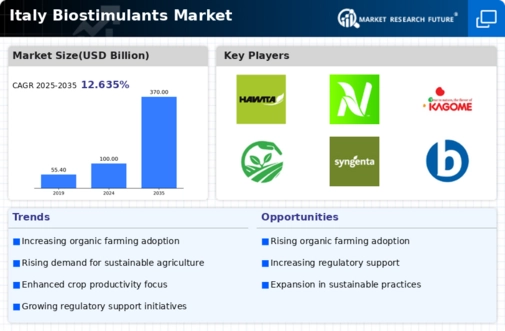
The biostimulants market in Italy is characterized by a dynamic competitive landscape, driven by increasing demand for sustainable agricultural practices and the need for enhanced crop productivity. Key players such as Valagro (IT), BASF (DE), and Syngenta (CH) are actively shaping the market through strategic initiatives focused on innovation and regional expansion. Valagro (IT) emphasizes its commitment to research and development, aiming to introduce novel biostimulant products that cater to the specific needs of Italian farmers. Meanwhile, BASF (DE) leverages its extensive global network to enhance its product offerings, focusing on integrating biostimulants into its existing portfolio to provide comprehensive solutions for crop management. Syngenta (CH) adopts a multifaceted approach, investing in digital transformation to optimize its product delivery and customer engagement, thereby enhancing its competitive positioning.
The business tactics employed by these companies reflect a concerted effort to localize manufacturing and optimize supply chains, which are crucial in a moderately fragmented market. The collective influence of these key players fosters a competitive environment where innovation and sustainability are paramount. As companies strive to differentiate themselves, the focus on localized production not only reduces costs but also aligns with the growing consumer preference for environmentally friendly products.
In November 2025, Valagro (IT) announced the launch of a new line of biostimulants specifically designed for the Mediterranean climate, which is expected to enhance crop resilience against climate variability. This strategic move underscores Valagro's commitment to addressing local agricultural challenges and positions the company as a leader in tailored solutions for Italian farmers. The introduction of these products is likely to strengthen Valagro's market share and reinforce its reputation for innovation.
In October 2025, BASF (DE) entered into a partnership with a leading Italian agricultural university to develop cutting-edge biostimulant technologies. This collaboration aims to leverage academic research to accelerate product development and enhance the efficacy of biostimulants. Such strategic alliances not only bolster BASF's R&D capabilities but also facilitate knowledge transfer, which is essential for maintaining a competitive edge in the rapidly evolving market.
In September 2025, Syngenta (CH) launched a digital platform that integrates its biostimulant products with precision agriculture tools, allowing farmers to optimize their application strategies. This initiative reflects Syngenta's focus on digitalization and its potential to revolutionize how biostimulants are utilized in the field. By providing farmers with data-driven insights, Syngenta enhances the value proposition of its products, thereby fostering customer loyalty and driving sales growth.
As of December 2025, the competitive trends in the biostimulants market are increasingly defined by digitalization, sustainability, and the integration of AI technologies. Strategic alliances are becoming more prevalent, enabling companies to pool resources and expertise to innovate more effectively. The shift from price-based competition to a focus on technological advancement and supply chain reliability is evident, suggesting that future competitive differentiation will hinge on the ability to deliver innovative, sustainable solutions that meet the evolving needs of the agricultural sector.






















Leave a Comment