×
Request Free Sample ×

Kindly complete the form below to receive a free sample of this Report

* Please use a valid business email

Leading companies partner with us for data-driven Insights

clients tt-cursor
Hero Background

Italy Data Historian Market

ID: MRFR/ICT/63014-HCR
200 Pages
Aarti Dhapte
October 2025

Italy Data Historian Market Research Report By Component (Software, Services), By Deployment (Cloud-based, On-Premise), By Application (Production Tracking, Environmental Auditing, Asset Performance Management, Predictive Maintenance, Others) and By End User (Oil and Gas, Marine, Chemicals, Pharmaceuticals, Paper, Pulp, Metals, Mining, Utilities, Data Centers, Others)- Forecast to 2035

Share:
Download PDF ×

We do not share your information with anyone. However, we may send you emails based on your report interest from time to time. You may contact us at any time to opt-out.

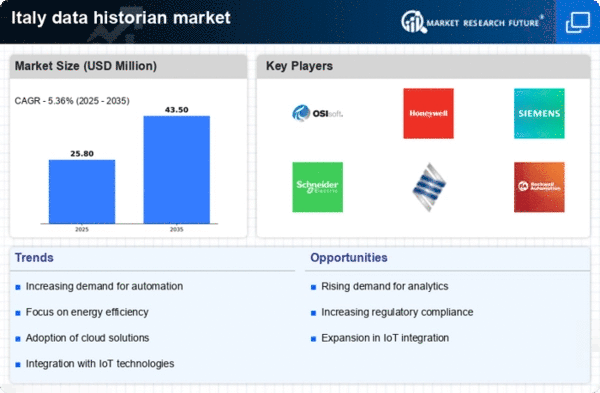
Italy Data Historian Market Infographic
Purchase Options

Italy Data Historian Market Summary

As per MRFR analysis, the data historian market Size was estimated at 24.49 USD Million in 2024. The data historian market industry is projected to grow from 25.8 USD Million in 2025 to 43.5 USD Million by 2035, exhibiting a compound annual growth rate (CAGR) of 5.36% during the forecast period 2025 - 2035.

Key Market Trends & Highlights

The Italy data historian market is experiencing a transformative shift driven by technological advancements and evolving regulatory landscapes.

  • The integration with IoT technologies is reshaping data historian functionalities, enhancing real-time data collection and analysis.
  • There is a notable emphasis on data security and compliance, reflecting the increasing regulatory pressures faced by organizations.
  • The market is witnessing a shift towards cloud-based solutions, which offer scalability and flexibility for data management.
  • Key market drivers include the rising demand for real-time data analysis and the growing focus on energy efficiency and sustainability.

Market Size & Forecast

2024 Market Size 24.49 (USD Million)
2035 Market Size 43.5 (USD Million)
CAGR (2025 - 2035) 5.36%

Major Players

OSIsoft (US), Honeywell (US), Siemens (DE), Schneider Electric (FR), Emerson (US), Rockwell Automation (US), ABB (CH), General Electric (US), Mitsubishi Electric (JP)

Italy Data Historian Market Trends

The data historian market is currently experiencing notable growth, driven by the increasing demand for data management solutions across various sectors. Organizations are recognizing the value of historical data in enhancing operational efficiency and decision-making processes. This trend is particularly evident in industries such as manufacturing, energy, and utilities, where the ability to analyze past performance can lead to significant improvements in productivity and cost savings. Furthermore, advancements in technology, including cloud computing and IoT, are facilitating the integration of data historian systems, making them more accessible and user-friendly. As a result, businesses are more inclined to invest in these solutions to harness the power of their data. In addition, regulatory compliance and the need for data security are becoming increasingly critical in shaping the data historian market. Companies are required to adhere to stringent regulations regarding data storage and management, which drives the adoption of robust data historian solutions. The emphasis on data integrity and security is prompting organizations to seek systems that not only store data but also ensure its accuracy and reliability. This focus on compliance and security is likely to influence purchasing decisions, as businesses prioritize solutions that align with their operational and regulatory requirements.

Integration with IoT Technologies

The integration of data historian systems with IoT technologies is becoming a prominent trend. This synergy allows for real-time data collection and analysis, enhancing operational insights. As industries increasingly adopt IoT devices, the demand for data historian solutions that can effectively manage and analyze this influx of data is likely to rise.

Emphasis on Data Security and Compliance

There is a growing emphasis on data security and compliance within the data historian market. Organizations are prioritizing solutions that ensure data integrity and adhere to regulatory standards. This trend reflects a broader commitment to safeguarding sensitive information and maintaining trust with stakeholders.

Shift Towards Cloud-Based Solutions

A notable shift towards cloud-based data historian solutions is occurring. This transition offers scalability, flexibility, and cost-effectiveness, appealing to businesses seeking to optimize their data management strategies. Cloud solutions are likely to become increasingly popular as organizations look to streamline operations and reduce infrastructure costs.

Italy Data Historian Market Drivers

Rising Demand for Real-Time Data Analysis

The increasing need for real-time data analysis is a pivotal driver in the data historian market. Industries in Italy, particularly manufacturing and energy, are recognizing the value of immediate insights for operational efficiency. According to recent statistics, approximately 60% of Italian companies are investing in technologies that facilitate real-time data processing. This trend is likely to enhance decision-making processes, reduce downtime, and optimize resource allocation. As organizations strive to remain competitive, the demand for data historian solutions that can provide timely and accurate data is expected to grow. This shift towards real-time analytics is reshaping the data historian market, compelling vendors to innovate and offer solutions that meet these evolving needs.

Expansion of Smart Manufacturing Initiatives

The expansion of smart manufacturing initiatives in Italy is significantly impacting the data historian market. As industries embrace Industry 4.0 principles, the need for robust data management systems becomes paramount. Smart factories rely on data historians to collect, store, and analyze vast amounts of operational data. It is projected that investments in smart manufacturing technologies will increase by 40% over the next five years. This trend is likely to drive the demand for data historian solutions that can seamlessly integrate with IoT devices and provide actionable insights. Consequently, the data historian market is expected to experience substantial growth as manufacturers seek to enhance productivity and operational efficiency through data-driven strategies.

Increased Regulatory Compliance Requirements

The data historian market is significantly influenced by the heightened regulatory compliance requirements in Italy. Industries such as pharmaceuticals and food processing are subject to stringent regulations that mandate accurate data recording and reporting. As a result, companies are increasingly adopting data historian solutions to ensure compliance with local and EU regulations. It is estimated that compliance-related investments in data management systems have surged by 25% in the past year. This trend not only drives the demand for data historian technologies but also encourages vendors to enhance their offerings to meet these regulatory standards. Consequently, the data historian market is likely to see sustained growth as organizations prioritize compliance and data integrity.

Adoption of Advanced Analytics and Machine Learning

The integration of advanced analytics and machine learning into data historian solutions is emerging as a crucial driver in the data historian market. Italian companies are increasingly leveraging these technologies to extract deeper insights from historical data. This trend is particularly evident in sectors such as automotive and energy, where predictive maintenance and operational optimization are paramount. Reports indicate that the adoption of machine learning algorithms in data analysis has increased by 30% among Italian firms. As organizations seek to harness the power of their data, the demand for sophisticated data historian solutions that incorporate these advanced capabilities is expected to rise, thereby propelling market growth.

Growing Focus on Energy Efficiency and Sustainability

The emphasis on energy efficiency and sustainability is becoming a significant driver in the data historian market. Italian industries are under pressure to reduce their carbon footprint and optimize energy consumption. Data historian solutions play a vital role in monitoring and analyzing energy usage patterns, enabling organizations to implement more sustainable practices. Recent studies suggest that companies utilizing data historian technologies have achieved energy savings of up to 20%. This growing focus on sustainability not only aligns with regulatory expectations but also resonates with consumers' increasing demand for environmentally responsible practices. As a result, the data historian market is likely to expand as organizations prioritize energy efficiency initiatives.


Market Segment Insights

By Component: Software (Largest) vs. Services (Fastest-Growing)

In the Italy data historian market, Software captures the largest market share, reflecting its vital role in data management and analysis. This segment benefits from a widespread adoption across industries seeking to enhance data-driven decision-making processes. Meanwhile, Services are carving out a significant niche, demonstrating robust demand as businesses look for customized solutions that integrate seamlessly with their existing systems. Growth trends in this segment indicate a strong drive towards digital transformation, with organizations prioritizing data analytics and visualization tools. The increasing complexity of data environments necessitates enhanced Services that offer support and integration capabilities. This trend is further fueled by the need for compliance with regulatory standards, pushing businesses to invest in Services that ensure both efficiency and security.

Software (Dominant) vs. Services (Emerging)

Software is positioned as a dominant segment within the Italy data historian market, serving as the backbone for data storage and analysis initiatives. It offers extensive functionalities, allowing organizations to collect, process, and visualize data seamlessly. On the other hand, Services are emerging as a critical component, focusing on implementation, consultation, and ongoing support, thus facilitating the adaptation of new technologies. The interplay between these two segments is vital; while Software provides the tools necessary for data management, Services enhance user experience and ensure that organizations can maximize their investment in technology. This synergy is essential for businesses aiming to leverage data effectively.

By Deployment: Cloud-based (Largest) vs. On-Premise (Fastest-Growing)

In the deployment segment of the Italy data historian market, cloud-based solutions hold the largest market share. This segment has gained substantial traction due to the increasing need for flexible and scalable data management solutions, allowing organizations to harness large volumes of data effortlessly. In contrast, on-premise deployments are experiencing growth primarily among enterprises that prioritize security and control over their data, reflecting a significant shift in preferences among various industries. The emerging trend is clearly in favor of cloud-based solutions, driven by advancements in cloud technology and rising demand for real-time analytics. On-premise solutions, while slower in growth compared to cloud offerings, are becoming favorable for organizations with strict compliance requirements. As digital transformation accelerates, both deployment types are expected to play crucial roles, catering to diverse organizational needs in the Italy data historian market.

Deployment: Cloud-based (Dominant) vs. On-Premise (Emerging)

Cloud-based deployments are dominating the Italy data historian market due to their scalability, cost-effectiveness, and ease of access. These solutions facilitate real-time data processing and analytics, empowering businesses to make informed decisions swiftly. Conversely, on-premise deployments are emerging as a preferred choice for entities that demand higher levels of data security and customization. While they may have higher upfront costs, on-premise systems provide organizations with more control over their infrastructure. The availability of hybrid solutions that combine both approaches is also gaining attention, allowing organizations to enjoy the benefits of both cloud and on-premise deployments, thereby maximizing efficiency and security.

By Application: Production Tracking (Largest) vs. Predictive Maintenance (Fastest-Growing)

In the Italy data historian market, the distribution of the application segment reveals that production tracking holds the largest market share. This significant portion underscores the critical need for manufacturers to monitor production processes in real time, ensuring efficiency and quality control. Environmental auditing and asset performance management also comprise notable shares, while predictive maintenance is emerging rapidly, reflecting a shift towards proactive maintenance strategies. Growth trends in the application segment are largely driven by advancements in IoT technologies and the increasing demand for operational efficiency. Predictive maintenance, in particular, is gaining traction as it allows companies to anticipate failures and reduce downtime, bringing in considerable cost savings. The rise in data analytics capabilities further fuels this growth by enabling organizations to optimize their asset management and environmental compliance strategies.

Production Tracking (Dominant) vs. Predictive Maintenance (Emerging)

Production tracking serves as the dominant application within the Italy data historian market, emphasizing its importance for manufacturers seeking operational excellence. This segment is characterized by real-time data collection and analytics, which play a crucial role in enhancing manufacturing efficiency and quality assurance. Conversely, predictive maintenance is an emerging force that focuses on leveraging data to preemptively identify maintenance needs, thus minimizing unexpected downtimes. It is characterized by advanced analytics and machine learning models that utilize historical data to predict future failures. Together, these application segments reflect the evolving landscape of data utilization in industrial settings, where efficiency and reliability are paramount.

By End User: Oil and Gas (Largest) vs. Data Centers (Fastest-Growing)

In the Italy data historian market, the largest segment is Oil and Gas, which commands a substantial portion of the market share due to the industry's rigorous need for real-time data management and optimization of production processes. Following closely are Chemicals and Pharmaceuticals, and Utilities, which also hold significant market shares as they continuously seek to enhance operational efficiencies through data analytics. The growth trends for the Italy data historian market are heavily influenced by the increasing adoption of IoT and automation technologies across various sectors. Data Centers have emerged as the fastest-growing segment, driven by the surge in data generation and the need for efficient data storage and management solutions. Furthermore, sectors like Marine and Metals and Mining are gradually adopting data historian solutions to improve productivity and compliance, indicating a robust shift towards digitization in these industries.

Oil and Gas: Dominant vs. Data Centers: Emerging

The Oil and Gas segment stands as the dominant force in the Italy data historian market, thriving on the essential need to monitor and analyze operations meticulously to ensure safety and efficiency. It encompasses a variety of processes where historical data plays a vital role in decision-making. In contrast, Data Centers represent an emerging segment characterized by rapid growth, largely fueled by the cloud computing boom and the escalating demand for data processing capabilities. This segment is focused on leveraging historical data to optimize data flow and enhance system performance. As a result, both segments highlight distinct characteristics, with Oil and Gas rooted in legacy systems, while Data Centers exemplify the modern shift towards agile data management.

Get more detailed insights about Italy Data Historian Market

Key Players and Competitive Insights

The data historian market in Italy is characterized by a competitive landscape that is increasingly shaped by technological advancements and the growing demand for data-driven decision-making. Key players such as OSIsoft (US), Honeywell (US), and Siemens (DE) are at the forefront, leveraging their extensive expertise to enhance operational efficiencies and drive innovation. OSIsoft (US) focuses on integrating its PI System with emerging technologies, thereby facilitating real-time data analytics and operational intelligence. Meanwhile, Honeywell (US) emphasizes its commitment to digital transformation, aiming to provide comprehensive solutions that enhance productivity and sustainability across various sectors. Siemens (DE) adopts a strategy centered on smart infrastructure, integrating data historian capabilities into its broader digital ecosystem, which positions it favorably in the market.

The business tactics employed by these companies reflect a nuanced understanding of local market dynamics. For instance, localizing manufacturing and optimizing supply chains are critical strategies that enhance responsiveness to customer needs. The competitive structure of the market appears moderately fragmented, with several players vying for market share, yet the influence of major companies remains substantial. This dynamic fosters an environment where innovation and strategic partnerships are essential for maintaining competitive advantage.

In October 2025, OSIsoft (US) announced a strategic partnership with a leading Italian energy provider to enhance data integration capabilities across renewable energy sources. This collaboration is poised to significantly improve operational efficiencies and data accessibility, aligning with the growing emphasis on sustainability in the energy sector. The strategic importance of this partnership lies in its potential to set a benchmark for future collaborations within the industry, particularly as the demand for renewable energy solutions continues to rise.

In September 2025, Honeywell (US) unveiled its latest data historian software, designed to optimize industrial operations through advanced analytics and machine learning. This launch underscores Honeywell's commitment to innovation and positions the company as a leader in providing cutting-edge solutions that address the complexities of modern industrial environments. The introduction of this software is likely to enhance Honeywell's competitive edge, particularly in sectors where operational efficiency is paramount.

In August 2025, Siemens (DE) expanded its digital services portfolio by integrating AI capabilities into its data historian solutions. This strategic move aims to enhance predictive maintenance and operational insights for clients across various industries. The integration of AI not only strengthens Siemens' market position but also reflects a broader trend towards the adoption of intelligent technologies in data management, which is becoming increasingly critical in today's data-centric landscape.

As of November 2025, the competitive trends in the data historian market are heavily influenced by digitalization, sustainability initiatives, and the integration of AI technologies. Strategic alliances are becoming more prevalent, as companies recognize the value of collaboration in driving innovation and enhancing service offerings. Looking ahead, it is anticipated that competitive differentiation will increasingly pivot from price-based strategies to a focus on technological innovation, reliability in supply chains, and the ability to deliver sustainable solutions. This shift underscores the importance of adaptability and forward-thinking in navigating the evolving landscape of the data historian market.

Key Companies in the Italy Data Historian Market market include

Industry Developments

The Italy Data Historian Market has seen significant advancements recently, with companies such as Emerson, Siemens, and AVEVA taking the lead roles in innovative technologies aimed at improving data management and analytics in industrial settings. With the goal of increasing Italian exports to EUR 700 billion by 2027, the Italian Ministry of Foreign Affairs introduced a strategic action plan in May 2025 to grow exports to high-potential non-EU markets. 

As Italian businesses grow internationally, this strategy is anticipated to increase demand for data historian solutions. To control its public finances, the Italian government stated in April 2025 that it would sell assets worth about 1% of GDP through 2027. As part of modernization initiatives, this action can result in higher investments in data management and industrial automation systems, including data historian technology. 

According to January 2025, the Italian M&A market grew significantly in 2024, with transaction volumes rising by 13% over the prior year. As businesses look to expand their technology capabilities through strategic acquisitions, this trend is anticipated to continue in 2025 and may result in further market consolidation in the data historian space.

Although no significant mergers or acquisitions involving the mentioned companies were reported in recent months, the landscape continues to be dynamic, reflecting the rapid evolution of technology and customer needs across Italy’s industrial sectors.

Future Outlook

Italy Data Historian Market Future Outlook

The Data Historian Market in Italy is projected to grow at a 5.36% CAGR from 2024 to 2035, driven by increasing data analytics needs and industrial automation.

New opportunities lie in:

  • Integration of AI-driven analytics for predictive maintenance solutions.
  • Development of cloud-based data historian platforms for enhanced accessibility.
  • Expansion into IoT data management services for smart manufacturing applications.

By 2035, the data historian market is expected to be robust, reflecting substantial growth and innovation.

Market Segmentation

Italy Data Historian Market End User Outlook

  • Oil and Gas
  • Marine
  • Chemicals and Pharmaceuticals
  • Paper and Pulp
  • Metals and Mining
  • Utilities
  • Data Centers
  • Others

Italy Data Historian Market Component Outlook

  • Software
  • Services

Italy Data Historian Market Deployment Outlook

  • Cloud-based
  • On-Premise

Italy Data Historian Market Application Outlook

  • Production Tracking
  • Environmental Auditing
  • Asset Performance Management
  • Predictive Maintenance
  • Others

Report Scope

MARKET SIZE 2024 24.49(USD Million)
MARKET SIZE 2025 25.8(USD Million)
MARKET SIZE 2035 43.5(USD Million)
COMPOUND ANNUAL GROWTH RATE (CAGR) 5.36% (2024 - 2035)
REPORT COVERAGE Revenue Forecast, Competitive Landscape, Growth Factors, and Trends
BASE YEAR 2024
Market Forecast Period 2025 - 2035
Historical Data 2019 - 2024
Market Forecast Units USD Million
Key Companies Profiled OSIsoft (US), Honeywell (US), Siemens (DE), Schneider Electric (FR), Emerson (US), Rockwell Automation (US), ABB (CH), General Electric (US), Mitsubishi Electric (JP)
Segments Covered Component, Deployment, Application, End User
Key Market Opportunities Integration of advanced analytics and IoT in the data historian market enhances operational efficiency and decision-making.
Key Market Dynamics Rising demand for real-time data analytics drives innovation in the data historian market.
Countries Covered Italy

Leave a Comment

FAQs

What is the expected market size of the Italy Data Historian Market in 2024?

The Italy Data Historian Market is expected to be valued at 45.0 USD Million in 2024.

What will be the expected market size of the Italy Data Historian Market by 2035?

By 2035, the Italy Data Historian Market is anticipated to reach a value of 89.0 USD Million.

What is the compound annual growth rate (CAGR) for the Italy Data Historian Market from 2025 to 2035?

The expected CAGR for the Italy Data Historian Market from 2025 to 2035 is 6.396%.

Which component has a larger market share in the Italy Data Historian Market?

The software component is projected to have a larger share, valued at 27.0 USD Million in 2024.

What is the market size for the software component of the Italy Data Historian Market in 2035?

The software component of the Italy Data Historian Market is expected to be valued at 54.0 USD Million by 2035.

What is the market value for services in the Italy Data Historian Market in 2024?

The services component of the Italy Data Historian Market is valued at 18.0 USD Million in 2024.

What is the expected value of services in the Italy Data Historian Market by 2035?

By 2035, the services component of the Italy Data Historian Market is anticipated to reach 35.0 USD Million.

Who are the key players in the Italy Data Historian Market?

Major players in the Italy Data Historian Market include Emerson, Siemens, AVEVA, and Honeywell.

What are some emerging trends in the Italy Data Historian Market?

Emerging trends include increased demand for data management solutions and a shift towards cloud-based services.

How does the current global scenario impact the Italy Data Historian Market?

The ongoing global trends and technological advancements are influencing the growth dynamics and innovation in the market.

Download Free Sample

Kindly complete the form below to receive a free sample of this Report

Compare Licence

×
Features License Type
Single User Multiuser License Enterprise User
Price $4,950 $5,950 $7,250
Maximum User Access Limit 1 User Upto 10 Users Unrestricted Access Throughout the Organization
Free Customization
Direct Access to Analyst
Deliverable Format
Platform Access
Discount on Next Purchase 10% 15% 15%
Printable Versions