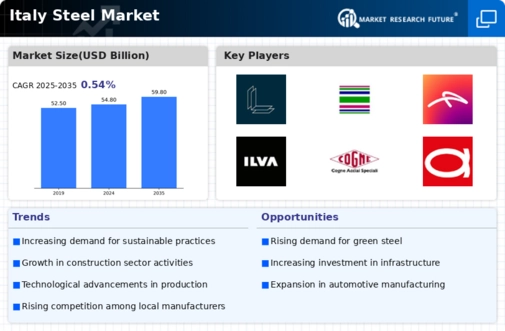
The steel market in Italy is characterized by a competitive landscape that is both dynamic and multifaceted. Key growth drivers include increasing demand for high-quality steel products, particularly in construction and automotive sectors, alongside a push towards sustainability and digital transformation. Major players such as ArcelorMittal (IT), Tenaris S.A. (IT), and Acciaierie d'Italia (IT) are strategically positioned to leverage these trends. ArcelorMittal (IT) focuses on innovation and sustainability, investing heavily in green steel technologies, while Tenaris S.A. (IT) emphasizes regional expansion and supply chain optimization. Acciaierie d'Italia (IT) is also enhancing its operational efficiency through digital initiatives, collectively shaping a competitive environment that prioritizes technological advancement and environmental responsibility.
In terms of business tactics, localizing manufacturing and optimizing supply chains are pivotal strategies employed by these companies. The market structure appears moderately fragmented, with several key players exerting influence over various segments. This fragmentation allows for competitive differentiation, as companies strive to enhance their offerings through localized production and tailored solutions, thereby responding effectively to regional demands.
In November 2025, ArcelorMittal (IT) announced a partnership with a leading technology firm to develop advanced AI-driven solutions for steel production. This strategic move is likely to enhance operational efficiency and reduce waste, aligning with the industry's shift towards sustainability. The integration of AI technologies could potentially revolutionize production processes, enabling more precise control over manufacturing parameters and reducing environmental impact.
In October 2025, Tenaris S.A. (IT) expanded its operations by acquiring a local steel processing facility in Northern Italy. This acquisition is significant as it not only increases Tenaris's production capacity but also strengthens its supply chain resilience. By localizing production, the company aims to better serve its customers in the region, thereby enhancing its competitive edge in the market.
In September 2025, Acciaierie d'Italia (IT) launched a new initiative aimed at reducing carbon emissions by 30% by 2030. This ambitious goal underscores the company's commitment to sustainability and positions it favorably in a market increasingly driven by environmental considerations. The initiative is expected to attract environmentally conscious clients and investors, further solidifying its market position.
As of December 2025, current competitive trends in the steel market are heavily influenced by digitalization, sustainability, and the integration of AI technologies. Strategic alliances are becoming increasingly important, as companies collaborate to enhance their technological capabilities and sustainability efforts. The competitive landscape is likely to evolve from traditional price-based competition towards a focus on innovation, technology, and supply chain reliability. This shift suggests that companies that prioritize these aspects will be better positioned to thrive in the future.




















Leave a Comment