×
Request Free Sample ×

Kindly complete the form below to receive a free sample of this Report

* Please use a valid business email

Leading companies partner with us for data-driven Insights

clients tt-cursor
Hero Background

Japan Applied Ai In Education Market

ID: MRFR/ICT/63179-HCR
200 Pages
Aarti Dhapte
February 2026

Japan Applied AI in Education Market Research Report By Component (Solutions, Services), By Deployment (Cloud-based, On-premises), By Technology (Machine Learning, Computer Vision, Virtual Assistants/Chatbots) and By Application (Virtual Facilitators for IT Automation, Intelligent Tutoring Systems, Content Delivery Systems, Fraud and Risk Management, Student-centric Recommendation Systems) - Forecast to 2035

Share:
Download PDF ×

We do not share your information with anyone. However, we may send you emails based on your report interest from time to time. You may contact us at any time to opt-out.

Japan Applied Ai In Education Market Infographic
Purchase Options

Japan Applied Ai In Education Market Summary

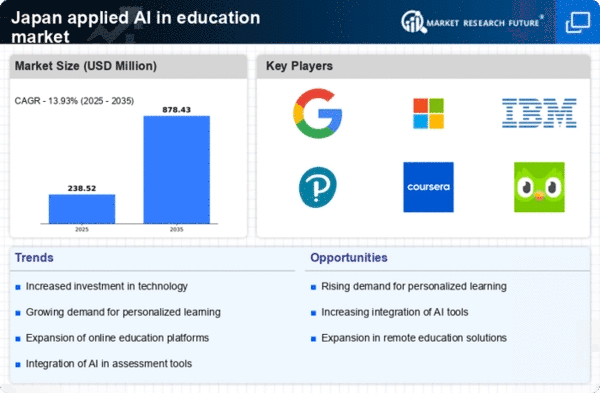
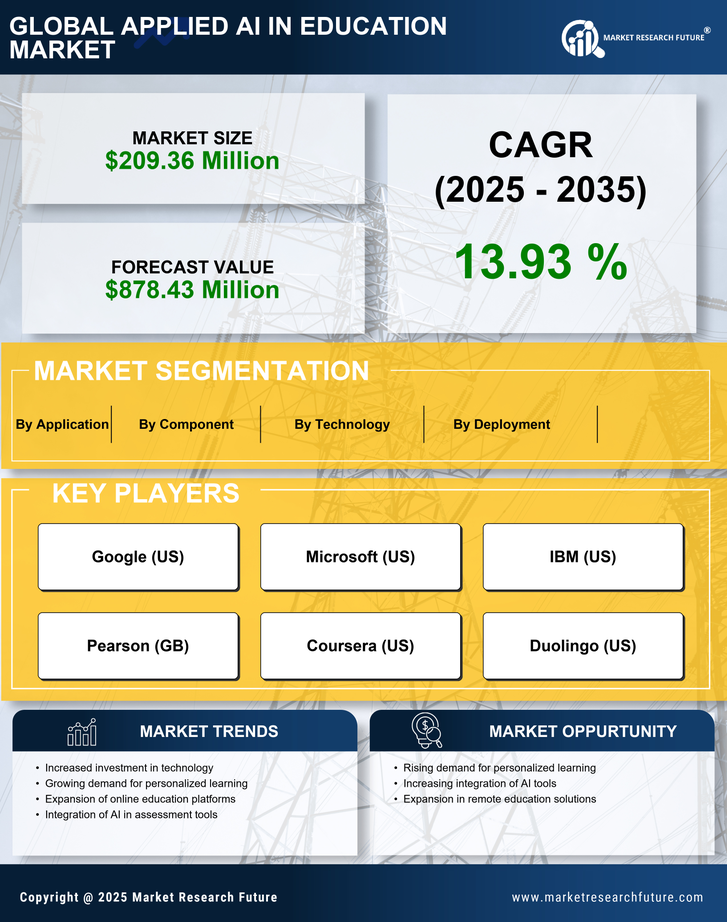
As per Market Research Future analysis, the Japan Applied Ai In Education Market size was estimated at 209.36 USD Million in 2024. The Applied Ai-in-education market is projected to grow from 238.52 USD Million in 2025 to 878.43 USD Million by 2035, exhibiting a compound annual growth rate (CAGR) of 13.9% during the forecast period 2025 - 2035

Key Market Trends & Highlights

The Japan applied AI-in-education market is experiencing robust growth driven by innovative technologies and evolving educational needs.

  • Personalized learning solutions are gaining traction, enabling tailored educational experiences for students.
  • Intelligent tutoring systems are emerging as a key component, providing adaptive learning pathways and support.
  • Data-driven decision making is becoming increasingly prevalent, allowing educators to enhance teaching strategies and outcomes.
  • The integration of AI technologies in curriculum and government initiatives are major drivers propelling market expansion.

Market Size & Forecast

2024 Market Size 209.36 (USD Million)
2035 Market Size 878.43 (USD Million)
CAGR (2025 - 2035) 13.93%

Major Players

Google (US), Microsoft (US), IBM (US), Pearson (GB), Coursera (US), Duolingo (US), Knewton (US), Squirrel AI (CN), Edmodo (US)

Our Impact
Enabled $4.3B Revenue Impact for Fortune 500 and Leading Multinationals
Partnering with 2000+ Global Organizations Each Year
30K+ Citations by Top-Tier Firms in the Industry

Japan Applied Ai In Education Market Trends

The Japan Applied Ai In Education Market is currently experiencing a transformative phase, driven by advancements in technology and a growing emphasis on personalized learning. In Japan, educational institutions are increasingly integrating artificial intelligence tools to enhance teaching methodologies and improve student engagement. This shift appears to be influenced by the need for innovative solutions that cater to diverse learning styles and the demand for efficient educational practices. As a result, educators are exploring various applications of AI, from intelligent tutoring systems to automated administrative tasks, which may lead to more effective learning environments. Moreover, the landscape of the applied ai-in-education market is evolving with the rise of data analytics and machine learning. These technologies enable educators to analyze student performance and tailor educational content accordingly. The potential for AI to provide real-time feedback and support is becoming more apparent, suggesting that its role in education will continue to expand. As Japan prioritizes technological integration in its educational framework, the applied ai-in-education market is likely to witness significant growth, fostering a culture of innovation and continuous improvement in learning outcomes.

Personalized Learning Solutions

The applied ai-in-education market is increasingly focusing on personalized learning solutions. These tools leverage AI algorithms to adapt educational content to individual student needs, enhancing engagement and comprehension. This trend reflects a broader shift towards customized education, where learning experiences are tailored to the unique strengths and weaknesses of each learner.

Intelligent Tutoring Systems

Intelligent tutoring systems are gaining traction within the applied ai-in-education market. These systems utilize AI to provide personalized instruction and feedback, simulating one-on-one tutoring experiences. By analyzing student interactions, these systems can identify areas for improvement and adjust their teaching strategies accordingly, potentially leading to better educational outcomes.

Data-Driven Decision Making

The application of data analytics in the applied ai-in-education market is becoming more prevalent. Educational institutions are harnessing AI to analyze vast amounts of data related to student performance and engagement. This data-driven approach enables educators to make informed decisions, optimize curricula, and enhance overall educational effectiveness.

Japan Applied Ai In Education Market Drivers

Government Initiatives and Funding

Government initiatives and funding play a crucial role in shaping the applied ai-in-education market. In Japan, the government has launched various programs aimed at promoting the use of AI in education. For instance, the Ministry of Education has allocated significant budgets to support the development of AI-based educational tools and resources. This funding is expected to increase by 15% over the next few years, reflecting the government's commitment to enhancing educational outcomes through technology. Such initiatives not only provide financial support but also create a conducive environment for collaboration between educational institutions and tech companies. As a result, the applied ai-in-education market is likely to witness accelerated growth, driven by these supportive policies and investments.

Rising Demand for Remote Learning Solutions

The rising demand for remote learning solutions is a significant driver for the applied ai-in-education market. In Japan, there is an increasing need for flexible learning options that cater to students' varying circumstances. This demand has led to the development of AI-powered platforms that facilitate remote learning, enabling students to access quality education from anywhere. Recent statistics indicate that around 40% of students in Japan prefer online learning options, which has prompted educational institutions to invest in AI technologies. The applied ai-in-education market is poised for growth as more schools and universities adopt these solutions to meet the evolving needs of learners. This trend suggests that the future of education in Japan will increasingly rely on innovative AI-driven approaches to deliver effective learning experiences.

Integration of AI Technologies in Curriculum

The integration of AI technologies into educational curricula is a pivotal driver for the applied ai-in-education market. In Japan, educational institutions are increasingly adopting AI tools to enhance learning experiences. This integration allows for personalized learning pathways, catering to diverse student needs. According to recent data, approximately 30% of schools in Japan have implemented AI-driven educational tools, indicating a growing trend. The applied ai-in-education market is likely to expand as more institutions recognize the benefits of AI in improving student engagement and outcomes. Furthermore, the Japanese government has been promoting digital transformation in education, which further supports the adoption of AI technologies. This trend suggests a robust future for the applied ai-in-education market as educational stakeholders seek innovative solutions to enhance teaching and learning.

Increased Adoption of Data Analytics in Education

Increased adoption of data analytics in education is a key driver for the applied ai-in-education market. Educational institutions in Japan are leveraging data analytics to gain insights into student performance and learning behaviors. This data-driven approach enables educators to make informed decisions and tailor their teaching strategies to meet individual student needs. Recent studies indicate that around 50% of schools in Japan are utilizing data analytics tools to enhance educational outcomes. The applied ai-in-education market is expected to grow as more institutions recognize the value of data in improving teaching effectiveness and student success. This trend highlights the potential for AI technologies to transform educational practices through the power of data.

Focus on Skill Development and Workforce Readiness

The focus on skill development and workforce readiness is becoming increasingly prominent in Japan's educational landscape, driving the applied ai-in-education market. As industries evolve, there is a growing emphasis on equipping students with the skills necessary for future employment. AI technologies are being utilized to create tailored learning experiences that align with industry demands. For example, AI-driven platforms can analyze job market trends and adjust curricula accordingly, ensuring that students acquire relevant skills. This alignment is crucial, as approximately 70% of employers in Japan express concerns about the skill gaps in the workforce. Consequently, the applied ai-in-education market is likely to expand as educational institutions collaborate with industries to develop programs that enhance students' employability.

Market Segment Insights

By Component: Solutions (Largest) vs. Services (Fastest-Growing)

In the Japan applied ai-in-education market, Solutions hold the largest market share, dominating the component segment due to their integral role in providing AI-driven educational tools. These solutions encompass various applications, including personalized learning platforms and administrative automation, which have garnered significant adoption among educational institutions seeking efficiency and enhanced learning outcomes. Conversely, Services are rapidly gaining traction, reflecting a shift towards integrated support systems that complement technology deployment within educational settings. The growth of Solutions is largely driven by the increasing emphasis on digital transformation in education, alongside the demand for tailored learning experiences that cater to diverse student needs. Services, on the other hand, are noted for their fast growth, primarily fueled by rising partnerships between tech providers and educational organizations, as well as a burgeoning need for consulting and implementation support, ensuring that educational entities can fully leverage AI capabilities for effective learning processes.

Solutions: Dominant vs. Services: Emerging

In the Japan applied ai-in-education market, Solutions are considered the dominant component due to their comprehensive offerings that encompass software and platforms tailored for educational use. These solutions aim to enhance learning outcomes, streamline administrative processes, and ensure personalized educational experiences. The strong demand for such tools is reflected in their widespread integration across various educational tiers. Services, while emerging, are gaining momentum as they provide crucial support to educational institutions, enabling effective implementation and utilization of AI technologies. This includes consulting, training, and ongoing technical support, which are increasingly sought after by schools and universities while navigating the integration of AI solutions into their curricula.

By Deployment: Cloud-based (Largest) vs. On-premises (Fastest-Growing)

In the Japan applied ai-in-education market, the deployment landscape is primarily dominated by cloud-based solutions, which capture a significant market share due to their flexibility and scalability. Educational institutions increasingly prefer cloud solutions for their ability to facilitate remote learning and collaboration, particularly in an era where digital transformation is imperative to educational outcomes. On-premises solutions, while historically favored for their control and security, are witnessing a decline as cloud offerings enhance educational accessibility and user experience. Growth trends in this segment indicate that cloud-based deployments will continue to expand as more institutions seek to adopt innovative technologies that support interactive and personalized learning. Meanwhile, on-premises solutions are becoming the fastest-growing choice for specific markets, particularly those requiring stringent data regulations and privacy controls. The shift is driven by the increasing need for tailored software solutions that address unique institutional challenges, making both segments vital to the evolving educational landscape.

Deployment: Cloud-based (Dominant) vs. On-premises (Emerging)

Cloud-based deployments serve as the cornerstone of the educational technology landscape, offering institutions benefits such as real-time access to learning resources, lower infrastructure costs, and enhanced collaborative tools. This dominant model allows for easy updates and integration of advanced AI functionalities, which enhance the overall learning experience. In contrast, on-premises solutions are emerging rapidly, appealing to organizations that prioritize data security and control over their educational processes. As educational institutions in Japan adapt to changing technological needs and regulatory frameworks, on-premises deployments are increasingly being tailored to meet the specific requirements of these environments, thus carving out a significant niche within the market.

By Technology: Machine Learning (Largest) vs. Computer Vision (Fastest-Growing)

The technology segment in the Japan applied ai-in-education market is seeing notable distribution among its key components. Machine Learning holds the largest market share due to its foundational role in personalizing education and its wide array of applications in assessments, curriculum planning, and student performance tracking. Conversely, Computer Vision, while smaller, is rapidly gaining traction for its innovative applications in monitoring classroom dynamics and enhancing learning through visual input analysis. The growth trends in this segment are primarily driven by the increasing adoption of AI technologies and advancements in computational capabilities. As educational institutions continue to seek efficiency and personalization, Machine Learning remains pivotal. However, the rise of Computer Vision, especially amidst the demand for interactive and engaging learning environments, indicates a shifting focus towards utilizing visual data for educational improvement, signifying its emergence as a critical growth area.

Technology: Machine Learning (Dominant) vs. Computer Vision (Emerging)

Machine Learning is recognized as the dominant technology in the Japan applied ai-in-education market, providing robust solutions for automating administrative tasks and tailoring educational experiences. Its ability to deliver personalized learning paths is enhancing student engagement and optimizing educational outcomes. On the other hand, Computer Vision is emerging as a key area of growth, leveraging imagery and visual data to create immersive learning environments. Its applications range from analyzing student engagement through facial recognition to supporting interactive learning systems. Together, these technologies illustrate a dynamic evolution within the educational landscape, with Machine Learning paving the way for foundational improvements while Computer Vision introduces innovative methods of learning and assessment.

By Application: Intelligent Tutoring Systems (Largest) vs. Virtual Facilitators for IT Automation (Fastest-Growing)

The Japan applied ai-in-education market showcases a diverse application landscape, with Intelligent Tutoring Systems capturing the largest share due to their effectiveness in personalized learning experiences. Following closely are Virtual Facilitators for IT Automation, which are gaining traction for their ability to streamline educational processes and support IT infrastructure. Content Delivery Systems, Fraud and Risk Management, and Student-centric Recommendation Systems also play significant roles, albeit with smaller market shares, highlighting the competitive nature of these applications. Growth trends indicate a robust demand for Intelligent Tutoring Systems driven by an increasing focus on tailored education and improved student outcomes. Meanwhile, Virtual Facilitators for IT Automation are emerging as a fast-growing segment, fueled by the need for efficiency in educational institutions. The rising adoption of AI technologies and a growing emphasis on personalized learning experiences propel this segment forward, indicating a shift towards technology-driven educational solutions in the market.

Intelligent Tutoring Systems (Dominant) vs. Virtual Facilitators for IT Automation (Emerging)

Intelligent Tutoring Systems (ITS) dominate the application landscape by providing customized educational experiences that cater to individual learning styles and paces, making them indispensable in classrooms. Their effectiveness in enhancing student performance and engagement has led to widespread adoption across various educational institutions. In contrast, Virtual Facilitators for IT Automation represent an emerging trend, leveraging AI to optimize administrative and educational processes. These systems are designed to assist educators and streamline tasks, thereby enhancing operational efficiency. As institutions increasingly embrace digital transformation, both ITS and Virtual Facilitators are becoming integral to the educational ecosystem, each contributing to a more advanced and effective learning environment.

Get more detailed insights about Japan Applied Ai In Education Market

Key Players and Competitive Insights

The applied ai-in-education market in Japan is characterized by a dynamic competitive landscape, driven by rapid technological advancements and increasing demand for personalized learning experiences. Major players such as Google (US), Microsoft (US), and Squirrel AI (CN) are at the forefront, leveraging their technological prowess to enhance educational outcomes. Google (US) focuses on integrating AI into its educational tools, emphasizing collaboration and accessibility, while Microsoft (US) is enhancing its Azure platform to support educational institutions in adopting AI-driven solutions. Squirrel AI (CN), known for its adaptive learning technologies, is expanding its reach in Japan, indicating a growing interest in localized AI applications that cater to specific educational needs.The market structure appears moderately fragmented, with a mix of established tech giants and emerging startups. Key players are employing various business tactics, such as localizing their offerings to better align with Japanese educational standards and optimizing their supply chains to ensure timely delivery of AI solutions. This collective approach not only enhances their competitive positioning but also fosters a collaborative environment where innovation thrives.

In September Google (US) announced a partnership with a leading Japanese educational institution to develop AI-driven language learning tools tailored for local students. This strategic move underscores Google's commitment to enhancing language acquisition through personalized learning experiences, potentially setting a new standard in the market. The collaboration is likely to enhance Google's brand presence in Japan, while also addressing the unique linguistic challenges faced by learners.

In October Microsoft (US) launched a new AI-based analytics tool designed specifically for educators in Japan, aimed at providing insights into student performance and engagement. This initiative reflects Microsoft's strategy to empower educators with data-driven insights, thereby facilitating more effective teaching methodologies. The introduction of this tool may significantly influence how educational institutions leverage data to improve learning outcomes, positioning Microsoft as a leader in educational technology.

In August Squirrel AI (CN) expanded its operations in Japan by introducing a localized version of its adaptive learning platform, which utilizes AI to tailor educational content to individual student needs. This expansion not only signifies Squirrel AI's commitment to the Japanese market but also highlights the increasing demand for personalized learning solutions. By adapting its technology to local preferences, Squirrel AI is likely to enhance its competitive edge in a market that values customization.

As of November the competitive trends in the applied ai-in-education market are increasingly defined by digitalization, sustainability, and the integration of AI technologies. Strategic alliances among key players are shaping the landscape, fostering innovation and collaboration. The shift from price-based competition to a focus on technological advancement and supply chain reliability is evident, suggesting that future differentiation will hinge on the ability to innovate and deliver tailored solutions that meet the evolving needs of educators and learners alike.

Key Companies in the Japan Applied Ai In Education Market include

Industry Developments

The Japan Applied AI in Education Market has seen significant developments in recent months, including strategic partnerships and technological advancements by key players such as NEC, Google, and Fujitsu.A collaborative research project between the University of Osaka and Fujitsu Japan Limited was announced in June 2025 with the goal of using generative AI to offer specialized education for kids from linguistically and culturally diverse backgrounds. The four-month research, which will run from June to September 2025, investigates how AI can help with the creation of customized lesson plans. Macquarie University and Fujitsu Limited established a strategic alliance in March 2025 to provide students with access to faster and more accurate AI models.

By giving students in Australia and Japan access to cutting-edge AI tools and resources, our partnership seeks to improve AI education. SoftBank Group and OpenAI formed SB OpenAI Japan in February 2025 as a 50:50 joint company with an emphasis on "Advanced Enterprise AI" called "Cristal intelligence." By automating processes like code interpretation and strategic marketing planning, the effort seeks to implement AI agents in subsidiaries like as Arm and PayPay.The overall investments in AI technology for educational purposes are projected to increase as Japan prioritizes digital transformation in its education system, propelled by governmental support for technological integration across schools. This drive reflects the broader objectives outlined in Japan's Society 5.0 initiative, emphasizing innovation in various sectors, including education.

Future Outlook

Japan Applied Ai In Education Market Future Outlook

The Applied AI in Education Market in Japan is projected to grow at a 13.93% CAGR from 2025 to 2035, driven by technological advancements and increasing demand for personalized learning solutions.

New opportunities lie in:

  • Development of AI-driven personalized learning platforms for diverse learning styles.
  • Integration of AI analytics in educational institutions for performance tracking.
  • Creation of AI-based tutoring systems to enhance student engagement and outcomes.

By 2035, the market is expected to be robust, reflecting substantial growth and innovation.

Market Segmentation

Japan Applied Ai In Education Market Component Outlook

  • Solutions
  • Services

Japan Applied Ai In Education Market Deployment Outlook

  • Cloud-based
  • On-premises

Japan Applied Ai In Education Market Technology Outlook

  • Machine Learning
  • Computer Vision
  • Virtual Assistants/Chatbots

Japan Applied Ai In Education Market Application Outlook

  • Virtual Facilitators for IT Automation
  • Intelligent Tutoring Systems
  • Content Delivery Systems
  • Fraud and Risk Management
  • Student-centric Recommendation Systems

Report Scope

MARKET SIZE 2024 209.36(USD Million)
MARKET SIZE 2025 238.52(USD Million)
MARKET SIZE 2035 878.43(USD Million)
COMPOUND ANNUAL GROWTH RATE (CAGR) 13.93% (2025 - 2035)
REPORT COVERAGE Revenue Forecast, Competitive Landscape, Growth Factors, and Trends
BASE YEAR 2024
Market Forecast Period 2025 - 2035
Historical Data 2019 - 2024
Market Forecast Units USD Million
Key Companies Profiled Google (US), Microsoft (US), IBM (US), Pearson (GB), Coursera (US), Duolingo (US), Knewton (US), Squirrel AI (CN), Edmodo (US)
Segments Covered Component, Deployment, Technology, Application
Key Market Opportunities Integration of personalized learning solutions leveraging artificial intelligence to enhance student engagement and outcomes.
Key Market Dynamics Rising demand for personalized learning solutions drives innovation in the applied AI-in-education market.
Countries Covered Japan
Leave a Comment

FAQs

What is the projected market size of the Japan Applied AI in Education Market in 2024?

The projected market size of the Japan Applied AI in Education Market in 2024 is estimated to be valued at 300.0 million USD.

What will be the expected market value of the Japan Applied AI in Education Market by 2035?

By 2035, the Japan Applied AI in Education Market is expected to reach a value of 3000.0 million USD.

What is the expected CAGR for the Japan Applied AI in Education Market from 2025 to 2035?

The expected CAGR for the Japan Applied AI in Education Market from 2025 to 2035 is 23.285%.

Which segments will dominate the Japan Applied AI in Education Market by component?

By component, the solutions segment is expected to dominate with a projected value of 180.0 million USD in 2024.

How much is the services segment expected to be valued in 2024 within the Japan Applied AI in Education Market?

The services segment of the Japan Applied AI in Education Market is expected to be valued at 120.0 million USD in 2024.

Who are the major players in the Japan Applied AI in Education Market?

Major players in the Japan Applied AI in Education Market include NEC, Google, Microsoft, and IBM.

What opportunities exist for growth in the Japan Applied AI in Education Market?

The increasing adoption of AI technologies in educational institutions presents significant growth opportunities.

What challenges does the Japan Applied AI in Education Market face?

Challenges include resistance to technology adoption and the need for substantial investment in infrastructure.

How does the Japan Applied AI in Education Market compare regionally?

Japan leads the Applied AI in Education Market within Asia due to its advanced technological infrastructure.

What is the forecasted value of the solutions segment in 2035?

The solutions segment of the Japan Applied AI in Education Market is forecasted to reach a value of 1800.0 million USD by 2035.

Download Free Sample

Kindly complete the form below to receive a free sample of this Report

Compare Licence

×
Features License Type
Single User Multiuser License Enterprise User
Price $4,950 $5,950 $7,250
Maximum User Access Limit 1 User Upto 10 Users Unrestricted Access Throughout the Organization
Free Customization
Direct Access to Analyst
Deliverable Format
Platform Access
Discount on Next Purchase 10% 15% 15%
Printable Versions