Download Free Sample
Kindly complete the form below to receive a free sample of this Report
Japan Colour Cosmetics Market Size, Share, Industry Trend & Analysis Research Report: By Target (Prestige Products, Mass Products), By Distribution Channel (Offline, Online), andBy Application (Nail Products, Hair Products, Lip Products, Face Products, Others)- Forecast to 2035.
As per Market Research Future analysis, the Japan colour cosmetics market Size was estimated at 3329.55 USD Million in 2024. The Japan colour cosmetics market is projected to grow from 3535.31 USD Million in 2025 to 6438.0 USD Million by 2035, exhibiting a compound annual growth rate (CAGR) of 6.1% during the forecast period 2025 - 2035
The Japan colour cosmetics market is experiencing a shift towards natural products and digital engagement.
| 2024 Market Size | 3329.55 (USD Million) |
| 2035 Market Size | 6438.0 (USD Million) |
| CAGR (2025 - 2035) | 6.18% |
L'Oreal (FR), Estée Lauder (US), Procter & Gamble (US), Revlon (US), Shiseido (JP), Coty (US), Unilever (GB), Mary Kay (US), Avon (GB)
Our Impact
Enabled $4.3B Revenue Impact for Fortune 500 and Leading Multinationals
Partnering with 2000+ Global Organizations Each Year
30K+ Citations by Top-Tier Firms in the Industry
The colour cosmetics market in Japan exhibits a dynamic landscape characterized by evolving consumer preferences and innovative product offerings. As of November 2025, there is a noticeable shift towards natural and organic formulations, driven by increasing awareness of health and environmental issues. Consumers are gravitating towards products that not only enhance beauty but also align with their values regarding sustainability and ethical sourcing. This trend is further supported by a growing demand for transparency in ingredient sourcing, prompting brands to disclose their formulations and production processes. Moreover, the rise of digital platforms has transformed the way consumers engage with colour cosmetics. Online shopping has become a primary channel for purchasing, with social media influencers playing a pivotal role in shaping consumer choices. The integration of augmented reality in virtual try-on experiences is enhancing customer engagement, allowing individuals to experiment with different looks before making a purchase. This technological advancement appears to be reshaping the retail landscape, making it more interactive and personalized. Overall, the colour cosmetics market is poised for continued growth, driven by innovation and a deeper understanding of consumer needs.
There is a growing preference for natural and organic formulations within the colour cosmetics market. Consumers are increasingly seeking products that are free from harmful chemicals and are made from sustainable ingredients. This trend reflects a broader societal shift towards health-conscious and environmentally friendly choices.
The rise of digital platforms has significantly influenced consumer behavior in the colour cosmetics market. Online shopping is becoming the norm, with social media and influencers driving product discovery. Brands are leveraging technology, such as augmented reality, to enhance the shopping experience and engage customers more effectively.
Consumers are showing a strong interest in customized and personalized colour cosmetics. Brands are responding by offering tailored products that cater to individual preferences and skin tones. This trend indicates a shift towards more inclusive beauty standards and a desire for unique, individualized beauty solutions.
The colour cosmetics market in Japan is witnessing a significant expansion in the male grooming segment. Traditionally dominated by female consumers, the market is now seeing an increasing number of male consumers seeking cosmetic products. This shift is attributed to changing societal norms and a growing acceptance of makeup among men. Recent data indicates that the male grooming market is expected to grow by approximately 20% over the next five years. This trend presents a unique opportunity for brands to develop targeted marketing strategies and product lines specifically designed for male consumers. Consequently, the colour cosmetics market is likely to evolve, catering to a more diverse consumer base.
The colour cosmetics market in Japan is being transformed by the emergence of advanced retail technologies. Innovations such as augmented reality (AR) and artificial intelligence (AI) are enhancing the shopping experience for consumers. For example, AR applications allow customers to virtually try on products before making a purchase, which can significantly reduce return rates. Data suggests that retailers implementing these technologies may see an increase in sales by up to 30%. This technological advancement not only improves customer satisfaction but also streamlines the purchasing process. As a result, the colour cosmetics market is likely to benefit from these innovations, leading to increased consumer engagement and loyalty.
The colour cosmetics market in Japan is experiencing a notable shift towards innovative formulations that cater to diverse consumer preferences. This trend is driven by an increasing awareness of skincare benefits associated with makeup products. For instance, products that offer hydration, sun protection, and anti-aging properties are gaining traction. According to recent data, the market for multifunctional cosmetics is projected to grow by approximately 15% annually. This indicates a strong consumer inclination towards products that not only enhance appearance but also contribute positively to skin health. As a result, brands are investing in research and development to create unique formulations that align with these consumer demands, thereby propelling growth in the colour cosmetics market.
Sustainability has emerged as a critical driver in the colour cosmetics market in Japan, with consumers becoming more environmentally conscious. Brands are responding by adopting eco-friendly practices, such as using sustainable packaging and sourcing natural ingredients. A survey indicated that around 60% of Japanese consumers prefer brands that demonstrate a commitment to sustainability. This shift is prompting companies to reformulate products and reduce their carbon footprint, which may lead to a competitive advantage in the market. As a result, the colour cosmetics market is likely to see an increase in demand for products that align with these values, potentially reshaping consumer preferences and purchasing decisions.
The impact of social media and beauty influencers on consumer purchasing behavior is profound within the colour cosmetics market in Japan. Platforms such as Instagram and TikTok serve as vital channels for brands to engage with potential customers. Influencers often showcase products through tutorials and reviews, which can significantly sway consumer opinions. Recent statistics suggest that approximately 70% of young consumers in Japan are influenced by social media when making beauty purchases. This trend underscores the importance of digital marketing strategies for brands aiming to capture the attention of a tech-savvy audience. Consequently, the colour cosmetics market is increasingly focusing on collaborations with influencers to enhance brand visibility and drive sales.
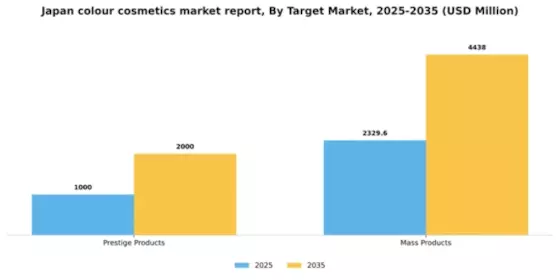
In the Japan colour cosmetics market, the segmentation reveals a clear distinction in market share between mass and prestige products. Mass products dominate the landscape, capturing a significant portion of consumer preference due to their affordability and accessibility across various retail channels. In contrast, prestige products, while holding a smaller share of the market, are gaining traction among consumers seeking premium quality and unique formulations. Growth trends in the Japan colour cosmetics market are heavily influenced by changing consumer preferences and increasing availability of prestige products. The rise in disposable income among Japanese consumers is driving demand for high-end beauty products, while mass products continue to benefit from strong brand loyalty and widespread distribution. Innovative marketing strategies and the incorporation of new technologies in product development further enhance the growth prospects of prestige cosmetics, positioning them as the fastest-growing segment in the market.
Mass Products (Dominant) vs. Prestige Products (Emerging)
Mass products in the Japan colour cosmetics market represent the dominant force, appealing to a broad demographic through their economical pricing and widespread availability. These products are typically favored by everyday consumers who prioritize functionality and value over luxury. Brands in this segment often leverage large-scale retail partnerships, ensuring that their offerings are readily available to a diverse audience. Conversely, prestige products are emerging as a noteworthy segment, driven by consumers' increasing interest in high-quality and innovative beauty solutions. This segment often targets niche markets, focusing on personalized experiences and premium ingredients. As a result, while mass products maintain dominance, prestige products are identifying growth opportunities through targeted marketing and enhanced customer engagement.
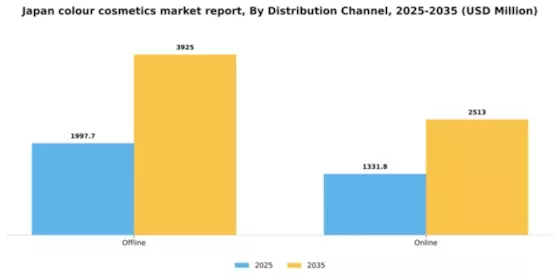
The distribution of market share within the segment values of the Japan colour cosmetics market shows a clear preference for offline channels, which dominate with the largest portion of sales. Retail stores, department stores, and beauty counters play a significant role in attracting consumers who prefer a tactile shopping experience, enabling them to test products before purchase. In contrast, the online segment, although smaller in overall share, is rapidly gaining traction among consumers seeking convenience and diverse product offerings. Growth trends indicate that the online distribution channel is emerging as the fastest-growing segment due to changing consumer behaviors influenced by digital engagement and advertising. The shift towards e-commerce is propelled by factors such as easy access to a broader range of products, competitive pricing, and the convenience of home delivery. As brands enhance their online presence, it is expected that this segment will continue to thrive, capturing a larger slice of the market.
Offline (Dominant) vs. Online (Emerging)
The offline channel remains the dominant force in the Japan colour cosmetics market, characterized by extensive physical retail networks and loyal customer bases. Consumers value the ability to experience products firsthand, which is a significant selling point for many brands. In addition, offline retailers often host promotions and events, providing further incentives for customer engagement. Conversely, the online channel is emerging as a vibrant and efficient segment. It leverages technological advancements to attract tech-savvy consumers who prioritize convenience and accessibility. As brands adopt innovative digital marketing strategies and enhance their user interfaces, the online segment is forecasted to grow rapidly, capturing the interest of younger demographics while also addressing the needs of busy professionals.
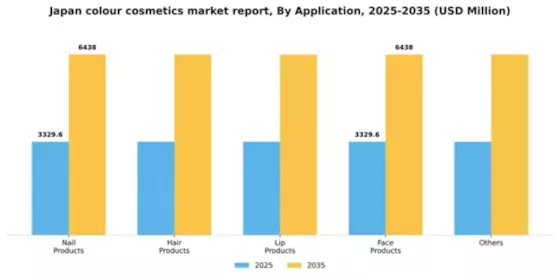
In the Japan colour cosmetics market, the distribution of market share among the application segments reveals that lip products continue to hold the largest proportion, appealing to a diverse consumer base that prioritizes innovation and quality. Hair products and face products follow, with significant shares, while nail products and others represent emerging segments gaining traction in recent years. Growth trends within this segment are driven by the rising demand for premium and organic products, particularly in the lip and nail categories. Younger consumers, influenced by social media trends, are particularly leaning toward vibrant and diverse color palettes. The ongoing interest in personal grooming and self-expression through cosmetics further fuels the expansion of these segments, making them pivotal in shaping market dynamics.
Lip Products (Dominant) vs. Nail Products (Emerging)
Lip products have established themselves firmly within the market, capturing the attention of consumers with a wide array of offerings, from traditional lipsticks to innovative lip stains and balms. The emphasis on vibrant colors and long-lasting formulas caters to the demands of a fashion-conscious public. In contrast, nail products are emerging as a dynamic segment, propelled by trends such as nail art and at-home manicures. The growing interest in creative expression through nail design and the introduction of high-quality polishes and treatments position nail products as a fast-growing category, appealing to consumers seeking uniqueness and versatility in their beauty routines.
Get more detailed insights about Japan Colour Cosmetics Market Request Free Sample
The colour cosmetics market in Japan is characterized by a dynamic competitive landscape, driven by innovation, consumer preferences, and a growing emphasis on sustainability. Major players such as Shiseido (JP), L'Oreal (FR), and Estée Lauder (US) are actively shaping the market through strategic initiatives. Shiseido (JP) focuses on leveraging its heritage and local expertise to enhance product offerings, while L'Oreal (FR) emphasizes digital transformation and e-commerce expansion. Estée Lauder (US) is known for its premium positioning and strong brand portfolio, which collectively contribute to a competitive environment that is both vibrant and multifaceted.Key business tactics within the market include localizing manufacturing and optimizing supply chains to meet consumer demands effectively. The competitive structure appears moderately fragmented, with several key players holding substantial market shares. This fragmentation allows for a diverse range of products and brands, catering to various consumer segments and preferences, thereby enhancing the overall market dynamism.
In October Shiseido (JP) announced a partnership with a leading tech firm to integrate AI-driven personalization into its product lines. This strategic move is likely to enhance customer engagement and tailor offerings to individual preferences, thereby strengthening Shiseido's market position. The integration of AI not only aligns with current consumer trends but also positions the company as a forward-thinking leader in the industry.
In September L'Oreal (FR) launched a new sustainability initiative aimed at reducing its carbon footprint by 30% by 2030. This initiative underscores L'Oreal's commitment to environmental responsibility and reflects a broader trend within the market towards sustainable practices. By prioritizing sustainability, L'Oreal is likely to attract environmentally conscious consumers, thereby enhancing brand loyalty and market share.
In August Estée Lauder (US) expanded its product line to include a range of vegan and cruelty-free cosmetics. This expansion not only caters to the growing demand for ethical beauty products but also positions Estée Lauder as a leader in the ethical cosmetics segment. The strategic introduction of these products may appeal to a younger demographic increasingly concerned with ethical consumption.
As of November current trends in the colour cosmetics market indicate a strong shift towards digitalization, sustainability, and the integration of advanced technologies such as AI. Strategic alliances are becoming increasingly important, as companies seek to enhance their capabilities and market reach. The competitive differentiation is likely to evolve from traditional price-based competition to a focus on innovation, technology, and supply chain reliability, suggesting a transformative period ahead for the industry.

In recent months, the Japan Colour Cosmetics Market has seen significant developments. Companies such as Shiseido and Kanebo have ramped up their emphasis on sustainability, integrating eco-friendly ingredients into their product lines and enhancing packaging to be more environmentally responsible. In September 2023, L'Oreal announced an expansion of its product offerings, focusing on digital marketing strategies to attract younger consumers. Moreover, Fancl has been focusing on its direct-to-consumer approach, which has proven effective in boosting sales.
In terms of mergers, Pola Orbis announced a strategic partnership with Estée Lauder in August 2023 to collaborate on product innovation and share market insights. This partnership is expected to enhance their competitiveness in the Asian market. The growing emphasis on skincare-infused cosmetic products has led to substantial growth in valuations for companies like Mizuno and DHC, reflecting a rising consumer trend towards multipurpose beauty products. Furthermore, an annual report by the Japan Cosmetics Industry Association highlighted a steady growth rate of approximately 5% in market valuation, driven primarily by innovation and changing consumer preferences.
Industry giants like Chanel and Amorepacific are also adapting to these trends by launching new collections that resonate with Japanese consumers.
The colour cosmetics market in Japan is projected to grow at a 6.18% CAGR from 2025 to 2035, driven by innovation, sustainability, and changing consumer preferences.
New opportunities lie in:
By 2035, the market is expected to achieve robust growth, reflecting evolving consumer demands and innovative strategies.
| MARKET SIZE 2024 | 3329.55(USD Million) |
| MARKET SIZE 2025 | 3535.31(USD Million) |
| MARKET SIZE 2035 | 6438.0(USD Million) |
| COMPOUND ANNUAL GROWTH RATE (CAGR) | 6.18% (2025 - 2035) |
| REPORT COVERAGE | Revenue Forecast, Competitive Landscape, Growth Factors, and Trends |
| BASE YEAR | 2024 |
| Market Forecast Period | 2025 - 2035 |
| Historical Data | 2019 - 2024 |
| Market Forecast Units | USD Million |
| Key Companies Profiled | L'Oreal (FR), Estée Lauder (US), Procter & Gamble (US), Revlon (US), Shiseido (JP), Coty (US), Unilever (GB), Mary Kay (US), Avon (GB) |
| Segments Covered | Target Market, Distribution Channel, Application |
| Key Market Opportunities | Growing demand for sustainable and clean beauty products in the colour cosmetics market. |
| Key Market Dynamics | Rising demand for sustainable and innovative formulations drives competition in the colour cosmetics market. |
| Countries Covered | Japan |
The market valuation was $3329.55 Million in 2024.
The projected valuation for 2035 is $6438.0 Million.
The expected CAGR during the forecast period 2025 - 2035 is 6.18%.
Key players include L'Oreal, Estée Lauder, Procter & Gamble, Revlon, Shiseido, Coty, Unilever, Mary Kay, and Avon.
The two main segments are Prestige Products and Mass Products.
The market size for Mass Products was $2329.55 Million in 2024.
In 2024, the offline distribution channel was valued at $1997.73 Million, while the online channel was valued at $1331.82 Million.
Application segments include Nail Products, Hair Products, Lip Products, Face Products, and Others.
The market size for Face Products was $3329.55 Million in 2024.
The market is expected to grow steadily, reaching $6438.0 Million by 2035, indicating a robust growth trajectory.


Kindly complete the form below to receive a free sample of this Report

“This is really good guys. Excellent work on a tight deadline. I will continue to use you going forward and recommend you to others. Nice job”


“Thanks. It’s been a pleasure working with you, please use me as reference with any other Intel employees.”


“Thanks for sending the report it gives us a good global view of the Betaïne market.”


“Thank you, this will be very helpful for OQS.”


“We found the report very insightful! we found your research firm very helpful. I'm sending this email to secure our future business.”


“I am very pleased with how market segments have been defined in a relevant way for my purposes (such as "Portable Freezers & refrigerators" and "last-mile"). In general the report is well structured. Thanks very much for your efforts.”


“I have been reading the first document or the study, ,the Global HVAC and FP market report 2021 till 2026. Must say, good info! I have not gone in depth at all parts, but got a good indication of the data inside!”


“We got the report in time, we really thank you for your support in this process. I also thank to all of your team as they did a great job.”


“The Automotive 48V ECU Components Procurement Intelligence Study” was a complex project, but the Market Research Future (MRFR) team handled it with quality, agility, and customer-centricity. They delivered all requested data on time and within the agreed scope. The team, including Shubhendra Anand and Rahul Gotadki, was always readily available to clarify questions and swiftly implement necessary adjustments, driving the project to a successful conclusion within a very demanding timeframe.
I would also like to specifically commend Akshay Agarwal for his responsiveness and support at every stage—from our initial inquiry on May 6th through to final delivery on June 18th. His dedication made the entire process seamless.”



