Download Free Sample
Kindly complete the form below to receive a free sample of this Report
Japan Medical Automation Market Research Report By Type (Diagnostic and amp; monitoring automation, Therapeutic automation, Lab and amp; Pharmacy Automation, Medical Logistics and amp; Training) and By End Users (Hospitals and amp; Diagnostics Centers, Pharmacy, Research Lab and amp; Institutes, Others) - Growth & Industry Forecast 2025 To 2035
As per Market Research Future analysis, the Japan medical automation market size was estimated at 1008.0 USD Million in 2024. The Japan medical automation market is projected to grow from 1069.19 USD Million in 2025 to 1928.0 USD Million by 2035, exhibiting a compound annual growth rate (CAGR) of 6.0% during the forecast period 2025 - 2035
The Japan medical automation market is poised for substantial growth driven by technological advancements and increasing demand for efficiency.
| 2024 Market Size | 1008.0 (USD Million) |
| 2035 Market Size | 1928.0 (USD Million) |
| CAGR (2025 - 2035) | 6.07% |
Medtronic (US), Siemens Healthineers (DE), Philips (NL), GE Healthcare (US), Abbott Laboratories (US), Johnson & Johnson (US), Baxter International (US), Roche (CH), Boston Scientific (US)
Our Impact
Enabled $4.3B Revenue Impact for Fortune 500 and Leading Multinationals
Partnering with 2000+ Global Organizations Each Year
30K+ Citations by Top-Tier Firms in the Industry
The medical automation market in Japan is currently experiencing a transformative phase. This transformation is driven by advancements in technology and an increasing demand for efficiency in healthcare delivery. Automation solutions are being integrated into various aspects of medical practice, including diagnostics, patient management, and surgical procedures. This shift is largely influenced by the need to enhance patient outcomes while reducing operational costs. As healthcare providers seek to streamline processes, the adoption of automated systems appears to be gaining momentum, suggesting a robust growth trajectory for the sector. Furthermore, the aging population in Japan is likely to amplify the demand for innovative medical solutions, thereby propelling the market forward. In addition, regulatory frameworks are evolving to accommodate the rapid advancements in medical technology. The Japanese government is actively promoting initiatives that encourage the development and implementation of automation in healthcare settings. This supportive environment may foster collaboration between technology firms and healthcare providers, leading to the creation of tailored solutions that address specific needs within the medical automation market. As a result, stakeholders are increasingly optimistic about the future, anticipating that these trends will contribute to a more efficient and effective healthcare system in Japan.
The incorporation of artificial intelligence (AI) into the medical automation market is becoming increasingly prevalent. AI-driven tools are enhancing diagnostic accuracy and enabling predictive analytics, which can lead to improved patient care. This trend suggests a shift towards more personalized medicine, where treatment plans are tailored based on individual patient data.
Robotic systems are revolutionizing surgical procedures, offering precision and minimally invasive options. There is a rise in the adoption of robotic-assisted surgeries, which may lead to shorter recovery times and reduced hospital stays. This trend indicates a growing acceptance of technology in operating rooms.
The expansion of telemedicine services is reshaping patient interactions with healthcare providers. Remote monitoring technologies are being integrated into the medical automation market, allowing for continuous patient assessment outside traditional clinical settings. This trend highlights the potential for improved access to care and enhanced patient engagement.
Government initiatives in Japan are playing a crucial role in propelling the medical automation market forward. The Japanese government has recognized the importance of technological advancements in healthcare and has allocated substantial funding to support research and development in this sector. For instance, the Ministry of Health, Labour and Welfare has introduced various programs aimed at promoting automation in hospitals and clinics. This financial backing is expected to stimulate innovation and adoption of automated systems, potentially leading to a market growth rate of around 12% in the coming years. Such initiatives indicate a strong commitment to enhancing healthcare delivery through automation.
The growing adoption of data analytics in healthcare is reshaping the medical automation market in Japan. Healthcare providers are increasingly leveraging big data to make informed decisions, optimize operations, and improve patient outcomes. Automation tools that incorporate data analytics capabilities are becoming essential for managing patient information and streamlining workflows. This trend is likely to propel the market forward, with estimates suggesting a growth rate of approximately 10% in the next few years. The integration of data analytics into automation solutions indicates a shift towards more data-driven approaches in healthcare, enhancing the overall effectiveness of medical services.
Patient safety remains a paramount concern in the medical automation market in Japan. The integration of automated systems is seen as a viable solution to minimize risks associated with human error in clinical settings. Technologies such as automated medication dispensing and robotic surgical systems are being implemented to enhance precision and reliability in patient care. As healthcare providers strive to meet stringent safety standards, the demand for automation solutions is likely to rise. This focus on safety could contribute to a projected market growth of approximately 9% over the next few years, reflecting a broader trend towards prioritizing patient welfare in healthcare practices.
Japan is experiencing a notable surge in demand for efficiency within healthcare systems. As the population ages, healthcare providers are increasingly pressured to deliver high-quality care while managing costs. Automation technologies, such as robotic process automation and AI-driven diagnostics, are being adopted to streamline operations and reduce human error. Reports indicate that the market is projected to grow at a CAGR of approximately 10% over the next five years, driven by the need for improved patient outcomes and operational efficiency. This trend suggests that healthcare facilities are likely to invest significantly in automation solutions, thereby enhancing the overall effectiveness of medical services.
Rapid technological advancements in medical devices significantly influence the market. Innovations such as smart infusion pumps, automated laboratory analyzers, and telehealth platforms are transforming the landscape of healthcare delivery in Japan. These advancements not only improve operational efficiency but also enhance the quality of care provided to patients. The market for automated medical devices is expected to expand at a CAGR of around 11% as healthcare facilities increasingly adopt these technologies to stay competitive. This trend underscores the importance of continuous innovation in driving the growth of the medical automation market.
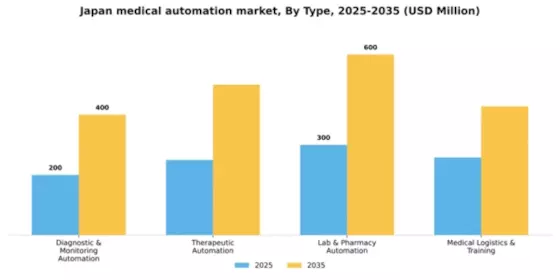
The Japan medical automation market is characterized by a diverse range of segment values, primarily led by Diagnostic & Monitoring Automation, which holds the largest market share due to its essential role in enhancing patient care through accurate diagnostics. Following closely is Therapeutic Automation, which is rapidly gaining traction as healthcare providers increasingly adopt automated solutions to improve therapeutic outcomes and operational efficiency. The other segment values, including Lab & Pharmacy Automation and Medical Logistics & Training, also contribute significantly but at a slower growth rate. Growth trends within the Japan medical automation market indicate a shift towards more integrated and intelligent automation solutions. The increasing demand for personalized healthcare and advancements in digital technologies drive the adoption of automated systems. Key drivers for therapeutic automation include the rising need for effective treatment protocols and the continuous evolution of medical practices that prioritize efficiency. As healthcare infrastructures adapt, both Diagnostic & Monitoring and Therapeutic Automation are expected to lead the charge in transforming patient care methodologies.
Therapeutic Automation (Dominant) vs. Lab & Pharmacy Automation (Emerging)
Therapeutic Automation stands as a dominant force in the Japan medical automation market, employing state-of-the-art technologies to streamline treatment processes and enhance patient outcomes significantly. This segment focuses on automating medication administration and monitoring therapy adherence, thereby reducing human error and improving operational efficiencies. On the other hand, Lab & Pharmacy Automation is viewed as an emerging segment that is rapidly gaining importance, offering innovative solutions such as automated dispensing systems and laboratory workflow optimizations. This transition aids healthcare facilities in managing increasing workloads and improving service delivery. Both segments epitomize the strategic shift towards automation in healthcare, fostering an environment where technology and patient care intersect more effectively.
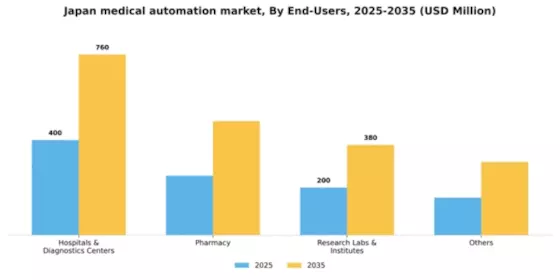
In the Japan medical automation market, Hospitals & Diagnostics Centers lead the segment, holding a significant market share due to the growing patient population and increasing automation of diagnostic processes. This dominance is driven by the need for efficiency, accuracy, and enhanced patient care, thereby attracting investments in advanced medical technologies. Conversely, the Pharmacy segment is witnessing rapid growth as automation in medication dispensing and management becomes essential for improving operational efficiency and reducing human error. The growth trends in this segment are influenced by several factors. The aging population in Japan necessitates enhanced medical services, pushing hospitals and diagnostics centers to adopt automated solutions to manage workloads. Moreover, pharmacies are adapting quickly to technological advancements, offering automated services for prescription management. This evolution is fostering a competitive environment where both segments must innovate continually to address the dynamic demands of healthcare delivery.
Hospitals & Diagnostics Centers (Dominant) vs. Pharmacy (Emerging)
Hospitals & Diagnostics Centers represent the dominant force in the Japan medical automation market due to their substantial investments in sophisticated automation technologies that streamline operations and enhance patient outcomes. Facilities are leveraging these advancements to incorporate robotics, AI, and data analytics into their workflows, signifying a commitment to quality care. On the other hand, the Pharmacy segment, although emerging, is rapidly gaining traction. Increasing demand for automated prescription filling and inventory management systems highlights the sector's evolution. As pharmacies embrace automation, they are expected to improve accuracy and efficiency, setting the stage for future innovations that will cater to the needs of healthcare providers and patients alike.
Get more detailed insights about Japan Medical Automation Market Request Free Sample
The medical automation market in Japan is characterized by a dynamic competitive landscape, driven by technological advancements and an increasing demand for efficiency in healthcare delivery. Key players such as Medtronic (US), Siemens Healthineers (DE), and Philips (NL) are at the forefront, each adopting distinct strategies to enhance their market presence. Medtronic (US) focuses on innovation through the development of advanced robotic surgical systems, while Siemens Healthineers (DE) emphasizes digital transformation, integrating AI into imaging solutions. Philips (NL) is strategically positioned towards patient-centric care, leveraging data analytics to improve health outcomes. Collectively, these strategies foster a competitive environment that prioritizes technological innovation and operational efficiency. In terms of business tactics, companies are increasingly localizing manufacturing to reduce costs and enhance supply chain resilience. The market structure appears moderately fragmented, with several players vying for market share. However, the influence of major companies is substantial, as they set benchmarks for quality and innovation. This competitive structure encourages smaller firms to innovate rapidly, thereby contributing to a vibrant ecosystem. In October 2025, Medtronic (US) announced the launch of its latest robotic-assisted surgical platform, which integrates AI capabilities to enhance precision in minimally invasive procedures. This strategic move is likely to solidify Medtronic's position as a leader in surgical automation, responding to the growing demand for advanced surgical solutions in Japan. The introduction of this platform not only showcases Medtronic's commitment to innovation but also reflects a broader trend towards automation in surgical practices. In September 2025, Siemens Healthineers (DE) unveiled a new AI-driven imaging system designed to streamline diagnostic processes in hospitals. This development is significant as it aligns with the increasing emphasis on digital health solutions, potentially improving patient outcomes and operational efficiency. By enhancing diagnostic accuracy, Siemens Healthineers is likely to strengthen its competitive edge in the medical automation market. In August 2025, Philips (NL) entered a strategic partnership with a leading Japanese healthcare provider to co-develop integrated health solutions that leverage data analytics. This collaboration is indicative of a growing trend towards partnerships that enhance technological capabilities and expand market reach. By aligning with local healthcare providers, Philips is positioned to better understand and meet the specific needs of the Japanese market, thereby enhancing its competitive stance. As of November 2025, the competitive trends in the medical automation market are increasingly defined by digitalization, sustainability, and the integration of AI technologies. Strategic alliances are becoming pivotal, as companies seek to leverage complementary strengths to drive innovation. The competitive landscape is shifting from traditional price-based competition towards a focus on technological advancement, reliability in supply chains, and the ability to deliver superior patient outcomes. This evolution suggests that future differentiation will hinge on the capacity to innovate and adapt to the rapidly changing healthcare environment.




The Japan Medical Automation Market has seen significant developments recently, driven by technological advancements and increasing demand for efficiency in healthcare. M3 has been expanding its digital healthcare services, focusing on enhancing patient management systems. Siemens is enhancing its automation solutions for diagnostic imaging, while Abbott Laboratories is integrating AI technologies to streamline laboratory processes. Mitsubishi Electric has introduced advanced automation technologies aimed at improving medical device manufacturing efficiency. Recently, in September 2023, Canon announced its acquisition of a medical imaging technology firm to bolster its imaging business. Fujitsu is actively involved in automating electronic medical records through cloud solutions.
On the growth front, GE Healthcare and Philips are witnessing a surge in demand for automated imaging and monitoring systems as Japan's aging population increases the need for efficient medical services. Over the past 2-3 years, companies like Omron and Hitachi have also made strides in robotic-assisted surgeries, enhancing operational efficiency. In April 2021, Roche expanded its presence in the Japanese market by launching a new line of automated diagnostic solutions. These advancements reflect Japan's commitment to enhancing healthcare delivery through medical automation technologies.
The Medical Automation Market in Japan is projected to grow at a 6.07% CAGR from 2025 to 2035, driven by technological advancements, increasing healthcare demands, and efficiency improvements.
New opportunities lie in:
By 2035, the market is expected to achieve substantial growth, reflecting advancements in automation technologies.
| MARKET SIZE 2024 | 1008.0(USD Million) |
| MARKET SIZE 2025 | 1069.19(USD Million) |
| MARKET SIZE 2035 | 1928.0(USD Million) |
| COMPOUND ANNUAL GROWTH RATE (CAGR) | 6.07% (2025 - 2035) |
| REPORT COVERAGE | Revenue Forecast, Competitive Landscape, Growth Factors, and Trends |
| BASE YEAR | 2024 |
| Market Forecast Period | 2025 - 2035 |
| Historical Data | 2019 - 2024 |
| Market Forecast Units | USD Million |
| Key Companies Profiled | Medtronic (US), Siemens Healthineers (DE), Philips (NL), GE Healthcare (US), Abbott Laboratories (US), Johnson & Johnson (US), Baxter International (US), Roche (CH), Boston Scientific (US) |
| Segments Covered | Type, End-Users |
| Key Market Opportunities | Integration of artificial intelligence in medical automation enhances diagnostic accuracy and operational efficiency. |
| Key Market Dynamics | Rising demand for robotic surgical systems drives innovation and competition in the medical automation market. |
| Countries Covered | Japan |
The market valuation was $1008.0 Million in 2024.
The projected valuation for 2035 is $1928.0 Million.
The expected CAGR is 6.07%.
Key segments include Diagnostic & Monitoring Automation, Therapeutic Automation, Lab & Pharmacy Automation, and Medical Logistics & Training.
The segment was valued between $200.0 Million and $400.0 Million.
The Therapeutic Automation segment had a valuation range of $250.0 Million to $500.0 Million in 2024.
Lab & Pharmacy Automation was valued between $300.0 Million and $600.0 Million.
Primary end-users include Hospitals & Diagnostics Centers, Pharmacy, Research Labs & Institutes, and Others.
This segment was valued between $400.0 Million and $760.0 Million.
Key players include Medtronic, Siemens Healthineers, Philips, GE Healthcare, Abbott Laboratories, Johnson & Johnson, Baxter International, Roche, and Boston Scientific.



Kindly complete the form below to receive a free sample of this Report

“This is really good guys. Excellent work on a tight deadline. I will continue to use you going forward and recommend you to others. Nice job”


“Thanks. It’s been a pleasure working with you, please use me as reference with any other Intel employees.”


“Thanks for sending the report it gives us a good global view of the Betaïne market.”


“Thank you, this will be very helpful for OQS.”


“We found the report very insightful! we found your research firm very helpful. I'm sending this email to secure our future business.”


“I am very pleased with how market segments have been defined in a relevant way for my purposes (such as "Portable Freezers & refrigerators" and "last-mile"). In general the report is well structured. Thanks very much for your efforts.”


“I have been reading the first document or the study, ,the Global HVAC and FP market report 2021 till 2026. Must say, good info! I have not gone in depth at all parts, but got a good indication of the data inside!”


“We got the report in time, we really thank you for your support in this process. I also thank to all of your team as they did a great job.”


“The Automotive 48V ECU Components Procurement Intelligence Study” was a complex project, but the Market Research Future (MRFR) team handled it with quality, agility, and customer-centricity. They delivered all requested data on time and within the agreed scope. The team, including Shubhendra Anand and Rahul Gotadki, was always readily available to clarify questions and swiftly implement necessary adjustments, driving the project to a successful conclusion within a very demanding timeframe.
I would also like to specifically commend Akshay Agarwal for his responsiveness and support at every stage—from our initial inquiry on May 6th through to final delivery on June 18th. His dedication made the entire process seamless.”



