Download Free Sample
Kindly complete the form below to receive a free sample of this Report
Japan Radiology Services Market Research Report: Size, Share, Trend Analysis By Imaging Technique (X-Ray, Ultrasound, Computed Tomography, Magnetic Resonance Imaging, Nuclear Medicine), By Service Type (Diagnostic Imaging, Interventional Radiology, Radiation Oncology), By End Users (Hospitals, Diagnostic Imaging Centers, Outpatient Clinics, Research Institutions) and By Applications (Oncology, Cardiology, Neurology, Orthopedics) - Growth Outlook & Industry Forecast 2025 To 2035
As per Market Research Future analysis, the Japan Radiology Services Market Size was estimated at 1500.64 USD Million in 2024. The Japan radiology services market is projected to grow from 1568.17 USD Million in 2025 to 2435.24 USD Million by 2035, exhibiting a compound annual growth rate (CAGR) of 4% during the forecast period 2025 - 2035
The Japan radiology services market is experiencing robust growth driven by technological advancements and demographic shifts.
| 2024 Market Size | 1500.64 (USD Million) |
| 2035 Market Size | 2435.24 (USD Million) |
| CAGR (2025 - 2035) | 4.5% |
Siemens Healthineers (DE), GE Healthcare (US), Philips Healthcare (NL), Canon Medical Systems (JP), Fujifilm Holdings (JP), Hitachi Medical Systems (JP), Agfa HealthCare (BE), Radiology Partners (US), Mednax (US)
Our Impact
Enabled $4.3B Revenue Impact for Fortune 500 and Leading Multinationals
Partnering with 2000+ Global Organizations Each Year
30K+ Citations by Top-Tier Firms in the Industry
the radiology services market is currently experiencing notable transformations driven by advancements in technology and an increasing demand for diagnostic imaging. The integration of artificial intelligence (AI) into imaging processes appears to enhance accuracy and efficiency, potentially leading to improved patient outcomes. Furthermore, the aging population in Japan is likely to contribute to a higher prevalence of chronic diseases, thereby increasing the need for radiological examinations. This demographic shift necessitates a robust healthcare infrastructure capable of accommodating the growing demand for imaging services. In addition, the Japanese government is actively promoting initiatives aimed at enhancing healthcare accessibility and quality. Investments in modern imaging equipment and facilities are expected to bolster the capabilities of healthcare providers. Moreover, the emphasis on preventive care may lead to a rise in routine imaging procedures, further expanding the radiology services market. As these trends unfold, stakeholders in the healthcare sector must remain vigilant and adaptable to the evolving landscape, ensuring that they meet the needs of patients and healthcare professionals alike.
The radiology services market is witnessing rapid technological advancements, particularly in imaging modalities such as MRI and CT scans. Innovations in imaging techniques are likely to improve diagnostic accuracy and reduce examination times, thereby enhancing patient experiences.
Japan's demographic trends indicate a significant increase in the elderly population, which is expected to drive demand for radiological services. This shift may lead to a greater focus on chronic disease management and preventive imaging.
The Japanese government is implementing various initiatives to improve healthcare delivery, including investments in radiology infrastructure. These efforts aim to enhance access to imaging services and ensure high-quality care for patients.
Japan's healthcare expenditure has been on the rise, which is positively impacting the radiology services market. The government has been investing heavily in healthcare infrastructure, aiming to improve access to advanced medical technologies. In 2025, healthcare spending is projected to reach approximately ¥45 trillion, with a significant portion allocated to diagnostic services. This increase in funding is likely to facilitate the acquisition of advanced imaging equipment and the expansion of radiology departments in hospitals. Consequently, the radiology services market is expected to benefit from enhanced service offerings and improved patient access to essential diagnostic imaging.
The expansion of tele-radiology services is emerging as a key driver in the radiology services market. With advancements in communication technology, remote interpretation of radiological images is becoming more feasible. This trend is particularly beneficial for rural and underserved areas in Japan, where access to radiology specialists may be limited. Tele-radiology not only enhances access to diagnostic services but also allows for quicker turnaround times in image interpretation. As healthcare facilities increasingly adopt tele-radiology solutions, the radiology services market is likely to experience growth, driven by the demand for efficient and accessible imaging services.
The increasing prevalence of chronic diseases in Japan is driving the demand for diagnostic imaging services within the radiology services market. Conditions such as cancer, cardiovascular diseases, and neurological disorders necessitate advanced imaging techniques for accurate diagnosis and treatment planning. According to recent data, the market for diagnostic imaging is projected to grow at a CAGR of approximately 5.2% from 2025 to 2030. This growth is indicative of a broader trend where healthcare providers are increasingly relying on radiology services to enhance patient outcomes. As a result, the radiology services market is likely to experience heightened activity, with investments in state-of-the-art imaging technologies becoming a priority for healthcare facilities.
The integration of artificial intelligence (AI) in radiology is transforming the landscape of the radiology services market in Japan. AI technologies are being utilized to improve the accuracy and efficiency of image analysis, thereby reducing the workload on radiologists. This technological advancement is expected to enhance diagnostic capabilities and streamline workflows. Reports suggest that AI applications in radiology could potentially reduce diagnostic errors by up to 30%. As healthcare providers increasingly adopt AI solutions, the radiology services market is likely to witness a surge in demand for AI-enhanced imaging services, leading to improved patient care and operational efficiency.
There is a notable shift towards preventive healthcare in Japan, which is influencing the radiology services market. As the population becomes more health-conscious, there is an increasing demand for routine screenings and early detection of diseases. This trend is reflected in the rising number of health check-ups that incorporate imaging services. The radiology services market is likely to see a corresponding increase in demand for preventive imaging modalities such as mammography and CT scans. This growing awareness is expected to drive market growth, as healthcare providers adapt to meet the needs of a more proactive patient population.
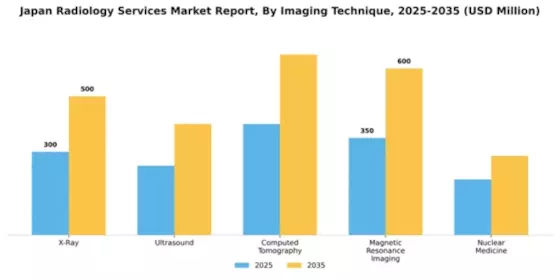
In the Japan radiology services market, various imaging techniques exhibit distinct market shares. Computed Tomography holds a significant portion of the market, primarily due to its widespread application in diagnosing a diverse range of conditions. Ultrasound and X-Ray are also crucial, catering to different medical needs, while Nuclear Medicine, though smaller, plays a specialized role in certain therapeutic areas. Each technique serves unique functions and has specific patient demographic outreach. Growth trends for these imaging techniques are shaped by technological advancements, increasing demand for precise diagnostics, and a growing elderly population in Japan. The adoption of Artificial Intelligence in imaging processes boosts efficiency and accuracy, fostering the expansion of Magnetic Resonance Imaging as it becomes the fastest-growing segment. Additionally, the rising prevalence of chronic diseases propels the demand for advanced imaging techniques across healthcare facilities.
Computed Tomography (Dominant) vs. Magnetic Resonance Imaging (Emerging)
Computed Tomography (CT) is a dominant imaging technique within the Japan radiology services market, celebrated for its speed and accuracy in diagnosing complex medical conditions. It has gained acceptance due to its comprehensive imaging capabilities and minimal patient discomfort. Meanwhile, Magnetic Resonance Imaging (MRI), though emerging, is experiencing rapid adoption, driven by its ability to provide detailed soft tissue images and its non-invasive nature. Both CT and MRI cater to crucial diagnostic needs; however, as healthcare technology evolves, MRI's role is expanding, especially in neurology and oncology, making it an increasingly essential tool while appealing to a broader range of medical specialties.
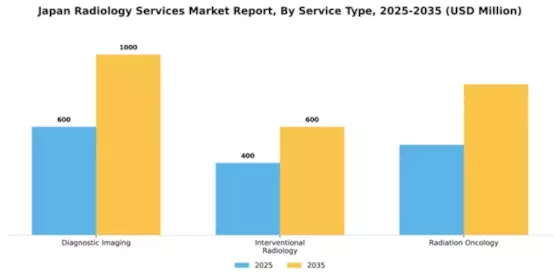
The Japan radiology services market showcases Diagnostic Imaging as the largest segment, capturing a significant market share due to its widespread application in medical diagnostics. Interventional Radiology follows closely, gaining traction for its minimally invasive procedures that appeal to both healthcare providers and patients. Radiation Oncology, while vital, represents the smallest share in this landscape, primarily utilized for treating cancer, thus having a specific target audience that restricts its broader market influence. As the market evolves, Interventional Radiology is witnessing the fastest growth, driven by technological advancements and an increasing preference for non-invasive treatment options among patients. The rise in chronic diseases and the aging population further accentuate the demand for both Diagnostic Imaging and Interventional Radiology services. Healthcare institutions are increasingly investing in advanced imaging technologies and training professionals, which supports the expansion of these service categories in the Japan radiology services market.
Diagnostic Imaging (Dominant) vs. Interventional Radiology (Emerging)
Diagnostic Imaging remains the dominant force in the Japan radiology services market, characterized by its established technology and trusted methodologies, such as X-rays, CT scans, and MRIs, widely adopted across healthcare facilities. This segment benefits from strong reimbursement policies and a robust demand for accurate diagnostics. On the other hand, Interventional Radiology is an emerging segment featuring innovative procedures that integrate imaging with surgical interventions. Its quick growth is a result of advanced imaging techniques that enable real-time guidance for various treatments, thereby enhancing patient outcomes. Both segments contribute significantly to improving healthcare efficiency and patient care, making them essential to the overall radiology services framework.
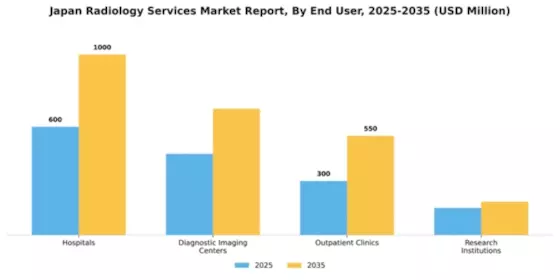
In the Japan radiology services market, hospitals account for the largest share, providing comprehensive diagnostic services and advanced imaging technologies. They play a critical role in the healthcare system, attracting a significant patient base. Diagnostic imaging centers, on the other hand, are emerging rapidly, catering to outpatient services and offering specialized imaging modalities. Their growth aligns with increasing patient demands for accessible imaging services. The overall growth trends in this segment are driven by technological advancements and increasing awareness of early disease detection. Additionally, the rise in chronic diseases and aging population in Japan propels the need for efficient diagnostic services. Moreover, outpatient clinics are expanding their offerings, while research institutions are focusing on innovative imaging techniques, supporting the market's evolution.
Hospitals: Dominant vs. Diagnostic Imaging Centers: Emerging
Hospitals are the backbone of the Japan radiology services market, equipped with state-of-the-art imaging technologies and a robust infrastructure to support extensive diagnostic processes. They are established entities within healthcare, often partnering with medical professionals to ensure quality patient care. Conversely, diagnostic imaging centers represent an emerging segment aimed at improving patient access to imaging services. These centers specialize in specific diagnostic technologies, such as MRI and CT scans, often providing quicker service with less wait time, catering to the growing demand for efficiency in healthcare delivery.
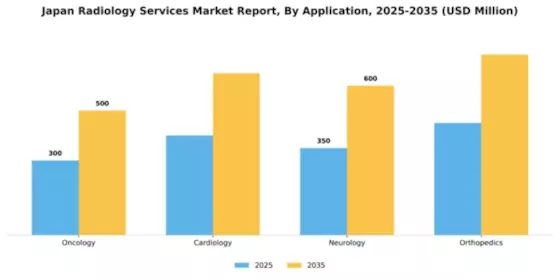
In the Japan radiology services market, Oncology holds the largest share among various application segments, showcasing its significant demand driven by the increasing prevalence of cancer. Cardiology follows closely, marked by its emerging status as a fast-growing application area, spurred by heightened awareness and advances in cardiovascular imaging technology. Growth trends in this segment are primarily influenced by technological advancements and an aging population predisposed to different health conditions. The ongoing innovations in imaging techniques, such as high-resolution imaging and real-time imaging modalities, are projected to enhance diagnostic accuracy, significantly boosting the adoption of radiology services in both Oncology and Cardiology. The increasing investments in healthcare infrastructure further support this growth trajectory.
Oncology (Dominant) vs. Cardiology (Emerging)
Oncology remains the dominant application segment in the radiology services market, characterized by robust utilization of imaging technologies to enhance cancer detection and treatment efficacy. The segment benefits from comprehensive screening programs and the integration of advanced imaging modalities such as PET and MRI, which foster precise diagnosis and treatment planning. Meanwhile, Cardiology is recognized as an emerging segment, driven by the rising incidence of cardiovascular diseases and the need for effective diagnostic solutions. Innovative imaging technologies like echocardiography and cardiac CT are advancing rapidly, enabling better patient management and outcomes. Together, these segments are pivotal in shaping the landscape of radiology services, reflecting varying but critical healthcare needs.
Get more detailed insights about Japan Radiology Services Market Request Free Sample
The radiology services market in Japan is characterized by a competitive landscape that is increasingly shaped by technological advancements and strategic collaborations. Key growth drivers include the rising demand for diagnostic imaging, an aging population, and the integration of artificial intelligence (AI) in imaging processes. Major players such as Siemens Healthineers (DE), GE Healthcare (US), and Canon Medical Systems (JP) are actively positioning themselves through innovation and partnerships. Siemens Healthineers (DE) focuses on enhancing its imaging portfolio with AI capabilities, while GE Healthcare (US) emphasizes digital transformation to streamline operations and improve patient outcomes. Canon Medical Systems (JP) is leveraging its strong local presence to expand its service offerings, thereby contributing to a dynamic competitive environment.In terms of business tactics, companies are increasingly localizing manufacturing and optimizing supply chains to enhance efficiency and reduce costs. The market appears moderately fragmented, with several key players exerting influence over various segments. This fragmentation allows for niche players to thrive, while larger companies leverage their scale to dominate in technology and service delivery. The collective influence of these key players shapes the market structure, fostering an environment where innovation and customer-centric solutions are paramount.
In October Siemens Healthineers (DE) announced a strategic partnership with a leading Japanese healthcare provider to develop AI-driven imaging solutions tailored for the local market. This collaboration is expected to enhance diagnostic accuracy and streamline workflows, reflecting Siemens' commitment to integrating cutting-edge technology into its offerings. Such partnerships may significantly bolster Siemens' competitive edge in Japan, where the demand for advanced imaging solutions is on the rise.
In September GE Healthcare (US) launched a new cloud-based platform designed to facilitate remote diagnostics and improve data sharing among healthcare providers. This initiative aligns with the growing trend towards digitalization in healthcare, enabling more efficient patient management and care coordination. The strategic importance of this move lies in GE's ability to position itself as a leader in digital health solutions, potentially attracting a broader customer base in Japan's evolving healthcare landscape.
In August Canon Medical Systems (JP) unveiled a new line of MRI systems that incorporate advanced imaging technologies aimed at reducing scan times and enhancing image quality. This product launch not only demonstrates Canon's commitment to innovation but also addresses the increasing demand for efficient imaging solutions in a competitive market. By focusing on technological advancements, Canon is likely to strengthen its market position and appeal to healthcare providers seeking state-of-the-art equipment.
As of November current competitive trends in the radiology services market are heavily influenced by digitalization, sustainability, and the integration of AI technologies. Strategic alliances are becoming increasingly vital, as companies seek to enhance their capabilities and expand their market reach. The competitive differentiation is expected to evolve from traditional price-based competition towards a focus on innovation, technological advancements, and supply chain reliability. This shift indicates a future where companies that prioritize cutting-edge solutions and collaborative strategies will likely emerge as leaders in the radiology services market.

Recent developments in the Japan Radiology Services Market have focused on technological advancements and strategic collaborations. Notably, Fujifilm Holdings has made strides in enhancing its imaging solutions, aiming to integrate artificial intelligence for improved diagnostic accuracy as of September 2023. Meanwhile, GE Healthcare's expansion of its ultrasound technology capabilities has contributed to a broader service portfolio in the nation, reflecting the growing demand for non-invasive diagnostic tools. Current affairs highlight an ongoing interest in mergers and acquisitions, although only a few are publicly reported.
In April 2023, Medtronic announced the acquisition of a Japanese health technology firm, enhancing their offerings in radiological services within the region. The market has also experienced growth, with companies like Siemens Healthineers and Canon Medical Systems expanding their distribution networks, driven by increased investments in healthcare services by the Japanese government, which aims to elevate national health standards. Over the past two years, the industry has seen a rise in adoption rates of advanced imaging technologies, further catalyzing market growth, as healthcare facilities seek to improve patient outcomes while managing resources effectively.
The Radiology Services Market in Japan is projected to grow at a 4.5% CAGR from 2025 to 2035, driven by technological advancements, increasing healthcare demand, and an aging population.
New opportunities lie in:
By 2035, the radiology services market is expected to be robust, reflecting sustained growth and innovation.
| MARKET SIZE 2024 | 1500.64(USD Million) |
| MARKET SIZE 2025 | 1568.17(USD Million) |
| MARKET SIZE 2035 | 2435.24(USD Million) |
| COMPOUND ANNUAL GROWTH RATE (CAGR) | 4.5% (2025 - 2035) |
| REPORT COVERAGE | Revenue Forecast, Competitive Landscape, Growth Factors, and Trends |
| BASE YEAR | 2024 |
| Market Forecast Period | 2025 - 2035 |
| Historical Data | 2019 - 2024 |
| Market Forecast Units | USD Million |
| Key Companies Profiled | Siemens Healthineers (DE), GE Healthcare (US), Philips Healthcare (NL), Canon Medical Systems (JP), Fujifilm Holdings (JP), Hitachi Medical Systems (JP), Agfa HealthCare (BE), Radiology Partners (US), Mednax (US) |
| Segments Covered | Imaging Technique, Service Type, End User, Application |
| Key Market Opportunities | Integration of artificial intelligence in diagnostic imaging enhances efficiency and accuracy in the radiology services market. |
| Key Market Dynamics | Technological advancements drive efficiency and accuracy in radiology services, reshaping competitive dynamics in Japan's healthcare sector. |
| Countries Covered | Japan |
The market valuation was $1500.64 Million in 2024.
The projected valuation for 2035 is $2435.24 Million.
The expected CAGR during this period is 4.5%.
Key players include Siemens Healthineers, GE Healthcare, Philips Healthcare, Canon Medical Systems, and Fujifilm Holdings.
The main segments include Imaging Technique, Service Type, End User, and Application.
The X-Ray segment generated between $300.0 Million and $500.0 Million in 2024.
The Ultrasound segment's revenue ranged from $250.0 Million to $400.0 Million in 2024.
Diagnostic Imaging services generated between $600.0 Million and $1000.0 Million in 2024.
The Hospitals segment had the highest revenue, ranging from $600.0 Million to $1000.0 Million in 2024.
The projected revenue for the Cardiology application is expected to range from $400.0 Million to $650.0 Million by 2035.


Kindly complete the form below to receive a free sample of this Report

“This is really good guys. Excellent work on a tight deadline. I will continue to use you going forward and recommend you to others. Nice job”


“Thanks. It’s been a pleasure working with you, please use me as reference with any other Intel employees.”


“Thanks for sending the report it gives us a good global view of the Betaïne market.”


“Thank you, this will be very helpful for OQS.”


“We found the report very insightful! we found your research firm very helpful. I'm sending this email to secure our future business.”


“I am very pleased with how market segments have been defined in a relevant way for my purposes (such as "Portable Freezers & refrigerators" and "last-mile"). In general the report is well structured. Thanks very much for your efforts.”


“I have been reading the first document or the study, ,the Global HVAC and FP market report 2021 till 2026. Must say, good info! I have not gone in depth at all parts, but got a good indication of the data inside!”


“We got the report in time, we really thank you for your support in this process. I also thank to all of your team as they did a great job.”


“The Automotive 48V ECU Components Procurement Intelligence Study” was a complex project, but the Market Research Future (MRFR) team handled it with quality, agility, and customer-centricity. They delivered all requested data on time and within the agreed scope. The team, including Shubhendra Anand and Rahul Gotadki, was always readily available to clarify questions and swiftly implement necessary adjustments, driving the project to a successful conclusion within a very demanding timeframe.
I would also like to specifically commend Akshay Agarwal for his responsiveness and support at every stage—from our initial inquiry on May 6th through to final delivery on June 18th. His dedication made the entire process seamless.”



