KVM Switch Market (2026 - 2035)

KVM Switch Market Size, Share and Research Report By Type (KVM-desktop switch, KVM-IP switch, KVM-secure switch, KVM high-performance switch), By Deployment Model (SaaS, PaaS & On-Premises), By User-Type (Single-User KVM switch & Multi-User KVM switch), By Organization Size (SME’s & Large Enterprises), By Vertical (IT & Telecom, Government, Marine, Military & Defense, Aviation, Retail, Media & Entertainment & Others), and By Region (North America, Europe, Asia-Pacific & Rest Of The World) –Industry Forecast Till 2035
ID: MRFR/SEM/6247-CR
188 Pages
Nirmit Biswas, Aarti Dhapte
Last Updated: August 04, 2026
KVM Switch Market
Market Size
Forecast Period2026-2035
CAGR (2026-2035)3.1%
2025 Market SizeUSD 0.91 Billion
2035 Market SizeUSD 1.24 Billion
Key Players
Raritan
Aten International
Vertiv
Black Box Corporation
Belkin
Adder Technology
Opportunities
  • Secure KVM for Zero-Trust Architecture Deployments
  • Edge and Micro Data Center Management
  • Emerging Market Data Center Buildout

KVM Switch Market Summary

The KVM Switch Market reached an estimated USD 0.91 billion in 2025 and is projected to grow from USD 0.94 billion in 2026 to USD 1.24 billion by 2035, registering a CAGR of 3.1% during the forecast period. This trajectory reflects sustained investment in centralized IT infrastructure management as enterprise data center buildouts accelerate globally. The U.S. CHIPS and Science Act alone has catalyzed over USD 52 billion in semiconductor facility construction, each project requiring dense server environments where KVM switching is an operational necessity [1].

A major technology transition is transforming the KVM Switch Market as businesses replace legacy analog VGA-based equipment with digital interfaces offering DVI, HDMI and DisplayPort connectivity at 4K resolution and higher. Hyperscale cloud operators including AWS, Microsoft Azure and Google Cloud collectively spent over USD 140 billion on capital expenditure during 2024, with a considerable chunk of it spent on physical infrastructure management gear including KVM systems [2]. Data sovereignty laws imposed by governments, including the EU Data Act, which will come into effect in September 2025, are requiring organizations to keep server rooms on their premises, where hardware-level access via KVM switches is still crucial.


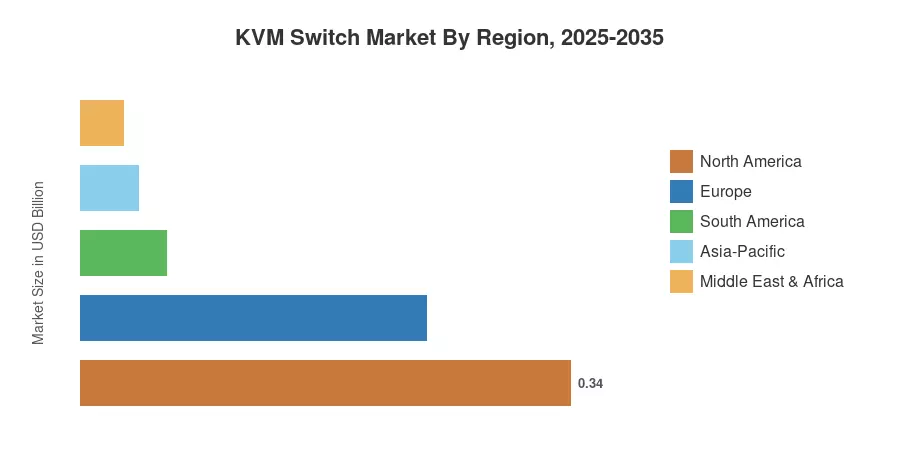
North America holds the highest share of the KVM Switch Market, accounting for nearly 37% of the total revenue generated globally, owing to the huge number of hyperscale facilities across Virginia, Texas, and Oregon. Asia Pacific is the fastest-growing area with a CAGR of 4.2%, led by aggressive data center construction in India, China and Southeast Asia. Europe represents the second highest proportion, with over 26 percent, driven by on-premises obligations associated with GDPR and edge computing deployments. Cloud migration and on-premises compliance requirements, and their interplay, will remain the backbone of KVM Switch Market expansion till 2035.


Key Report Takeaways

• By Product Type

  • In-Rack KVM switches accounted for approximately 41% of global KVM Switch Market revenue in 2025, reflecting the dominance of rack-mounted server environments.
  • Secure Desktop KVM switches are growing at a CAGR of 4.5% as government and defense agencies expand classified network segmentation requirements.

• By End User Industry

  • IT and Telecom/Data Centers represent the largest end-user vertical in the KVM Switch Market, generating an estimated USD 0.38 billion in 2025.
  • Industrial Automation end users are expanding steadily, driven by smart manufacturing and SCADA system management needs.

• By Geography

  • The Asia-Pacific KVM Switch Market is forecast to reach USD 0.34 billion by 2035, reflecting the fastest regional growth rate.
  • North America maintained a revenue share exceeding 37% in 2025, supported by enterprise refresh cycles and federal cybersecurity mandates.


Market Size and Forecast (2021–2035)

The MRFR approach is a triangulated methodology that includes a bottom-up approach that includes key vendor revenue analysis based on financial reports, along with a top-down approach that involves the demand side analysis based on data center capacity and other metrics. The data is then validated through various trade associations such as AFCOM, Uptime Institute, etc.
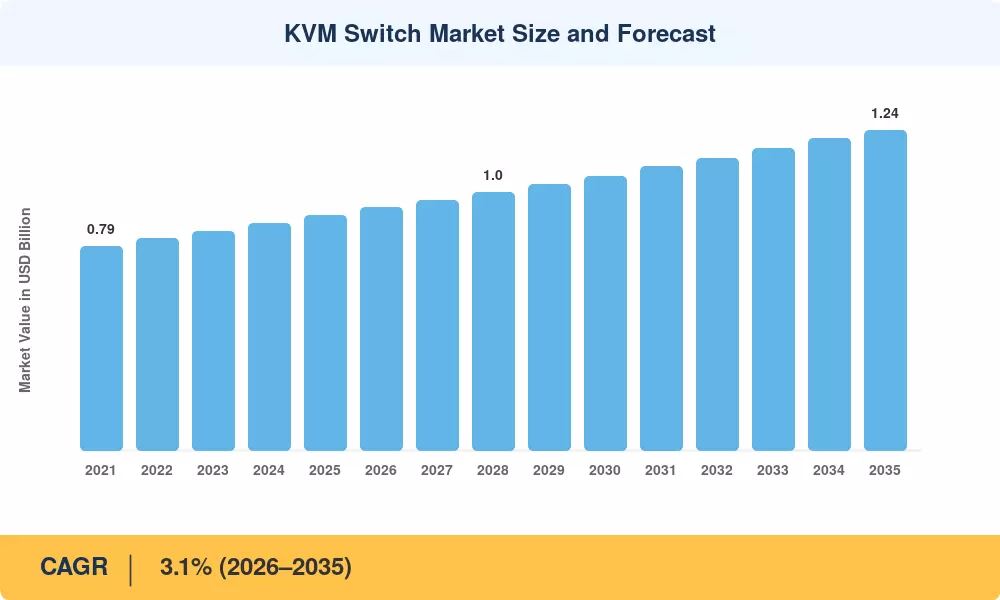
KVM Switch Market Size and Forecast
Our Impact
Enabled $4.3B Revenue Impact for Fortune 500 and Leading Multinationals
Partnering with 2000+ Global Organizations Each Year
30K+ Citations by Top-Tier Firms in the Industry

Driver Impact Analysis

Driver ~% Impact on CAGR Geographic Relevance Impact Timeline
Hyperscale and colocation data center expansion ~28% Global Long-term (≥4 yr)
Government cybersecurity and network segmentation mandates ~18% North America, Europe Medium-term (2–4 yr)
4K/8K video resolution migration ~15% Global Short-term (≤2 yr)
Edge computing and micro data center rollouts ~14% Asia-Pacific, Europe Medium-term (2–4 yr)
AI/ML workload proliferation requiring dense server management ~12% North America, Asia-Pacific Long-term (≥4 yr)
Defense and classified network modernization programs ~8% North America, Europe Medium-term (2–4 yr)
Industrial IoT and smart factory control room deployments ~5% Asia-Pacific, Europe Long-term (≥4 yr)


Hyperscale and Colocation Data Center Expansion

Global data center infrastructure investments and hyperscale capital expenditures surged significantly, with major cloud providers collectively committing hundreds of billions annually to address generative AI and cloud workloads. Each new hyperscale facility houses thousands of servers requiring centralized keyboard, video, and mouse management. KVM Switch Market growth is directly proportional to rack density: a typical high-capacity facility deploys hundreds of KVM ports across its operations floor. Regional build-outs continue to accelerate globally, supported by strategic digital infrastructure policies and cloud expansions in North America, Asia-Pacific, and emerging markets.


Government Cybersecurity Mandates

The U.S. Executive Order 14028 on cybersecurity, combined with NIST SP 800-53 requirements for physical access controls, has driven a measurable uptick in secure KVM switch procurement across federal agencies. The Department of Defense's DISA APL (Approved Products List) mandates NIAP-certified KVM switches for any environment handling classified information, creating a captive procurement cycle worth an estimated USD 85 million annually [8]. Similar mandates under the EU NIS2 Directive are extending these requirements to critical infrastructure operators across 27 member states [12].

4K/8K Video Resolution Migration

Enterprise workstations and control rooms are migrating from legacy analog interfaces to digital connections capable of supporting 4K and emerging 8K resolutions. This transition renders older KVM infrastructure obsolete, triggering ongoing upgrade cycles across enterprise control environments. Broadcast, media production, and medical imaging verticals are particularly active in this upgrade wave, where pixel-perfect video fidelity and secure peripheral sharing are non-negotiable.


Edge Computing and Micro Data Center Rollouts

Telecom operators deploying 5G infrastructure are simultaneously rolling out edge computing nodes that require compact, remotely manageable KVM solutions. Industry projections from major tech and telecom research indicate that a substantial majority of enterprise-generated data will be processed at the edge to reduce latency. These distributed sites—frequently unmanned—depend on IP-accessible KVM switches for secure out-of-band management, establishing a critical addressable segment within the modern KVM Switch Market.


Restraints Impact Analysis

Restraint ~% Negative Impact on CAGR Geographic Relevance Impact Timeline
Software-based remote management (IPMI/BMC) substitution ~-30% Global Long-term (≥4 yr)
Price sensitivity in SME and emerging market segments ~-22% Asia-Pacific, South America Medium-term (2–4 yr)
Cybersecurity exposure in IP-networked KVM deployments ~-20% Global Short-term (≤2 yr)
Consolidation reducing total addressable server count ~-16% North America, Europe Long-term (≥4 yr)
Extended hardware lifecycle delaying replacement purchases ~-12% Global Medium-term (2–4 yr)


Software-Based Remote Management Substitution

Integrated Lights-Out (iLO), Intelligent Platform Management Interface (IPMI), and Baseboard Management Controller (BMC) technologies embedded directly into server motherboards offer remote console functionality that overlaps with traditional KVM use cases. Dell's iDRAC and HPE's iLO platforms now ship standard on virtually all enterprise-grade servers, reducing the imperative for standalone KVM hardware in greenfield deployments [14]. This software substitution effect is the single largest headwind facing the KVM Switch Market. However, it is partially offset by the fact that BMC solutions do not address multi-vendor environments or provide the physical-layer security that hardware KVM delivers.

Price Sensitivity in Emerging Markets

Average selling prices for enterprise-grade secure KVM switches range from USD 800 to USD 3,500 per unit, placing them beyond budget thresholds for many small and mid-sized enterprises in price-sensitive regions. In Southeast Asia and Latin America, total IT infrastructure budgets per rack often fall below USD 5,000, making dedicated KVM hardware a difficult line item to justify [15]. Low-cost USB-based manual switches from unbranded manufacturers further compress pricing power for established vendors.

Cybersecurity Exposure in Networked Deployments

IP-connected KVM switches introduce a potential attack surface into otherwise air-gapped or segmented networks. CVE disclosures affecting KVM-over-IP devices increased 34% between 2022 and 2024 according to MITRE data, raising procurement hesitancy among security-conscious buyers [16]. CISA's 2024 advisory on KVM firmware vulnerabilities prompted several federal agencies to temporarily freeze procurement pending vendor remediation, a pattern that recurs with each disclosure cycle.


KVM Switch Market Opportunities

Secure KVM for Zero-Trust Architecture Deployments

As enterprises adopt zero-trust security frameworks in compliance with NIST 800-207, hardware-enforced network isolation through secure KVM switches becomes a critical enabler. Unlike software-based solutions, NIAP-certified KVM units guarantee physical data-path separation between security domains. This opportunity is concentrated in government, defense, and financial services verticals where zero-trust mandates carry regulatory force.

Edge and Micro Data Center Management

The proliferation of unmanned edge sites — estimated at over 40,000 new deployments globally per year by 2028 — creates demand for compact, remotely accessible KVM solutions with sub-1U form factors [10]. Vendors who integrate KVM functionality with power distribution and environmental monitoring into single-chassis platforms can capture a converged infrastructure management opportunity worth an estimated USD 120 million by 2030.

Emerging Market Data Center Buildout

India's data center capacity is projected to triple between 2024 and 2030 under the Digital India program, while Brazil's data center market is growing at over 10% annually [19]. These greenfield deployments represent untapped demand for the KVM Switch Market, particularly for cost-optimized rack-mount solutions that balance functionality with price sensitivity.

As-a-Service and Managed KVM Offerings

A hardware-as-a-service (HaaS) model for KVM infrastructure could lower adoption barriers in the SME segment. Subscription-based pricing — bundling hardware, firmware updates, and 24/7 remote support — converts capital expenditure into operational expenditure. Early movers such as Vertiv and Black Box have begun piloting managed infrastructure programs that include KVM components.

AI-Driven Predictive Management and Analytics

KVM switches equipped with telemetry sensors can feed operational data — port utilization rates, switch latency, session frequency — into AI-powered analytics platforms. This data monetization pathway transforms KVM infrastructure from passive connectivity hardware into an active source of operational intelligence, enabling predictive maintenance and capacity planning.


KVM Switch Market Future Outlook

AI-Integrated Infrastructure Management

Artificial intelligence will reshape how IT operators interact with KVM infrastructure over the coming decade. Predictive analytics layered atop KVM session data — port usage frequency, access patterns, latency metrics — will enable automated failover and proactive maintenance scheduling. Projects that by 2030, 40% of data center operations will be managed through AI-augmented platforms, creating demand for KVM switches with embedded telemetry and API-accessible management planes [11].

Convergence of KVM with Out-of-Band Management Platforms

The boundary between standalone KVM switches and integrated out-of-band management (OOBM) platforms is blurring. Vendors are embedding KVM, serial console, power management, and environmental monitoring into unified appliances. This platform convergence — already visible in products from Raritan and Vertiv — will accelerate as operators seek single-pane-of-glass management across distributed infrastructure. The converged OOBM appliance segment could represent 25–30% of total KVM Switch Market revenue by 2032 [14].

Sustainability and Energy Efficiency Mandates

The EU Energy Efficiency Directive and U.S. EPA ENERGY STAR for Data Centers program are pushing operators toward lower-power infrastructure components. Next-generation KVM switches consuming under 5W per port — versus 12–15W for legacy analog units — align with PUE optimization targets below 1.3. Vendors that achieve third-party energy efficiency certifications will hold a procurement advantage in regulated markets where sustainability reporting is mandatory [24].

Quantum-Safe Security and Next-Generation Encryption

As quantum computing timelines accelerate, NIST's post-quantum cryptography standards (finalized 2024) will influence secure KVM switch design. Government and defense buyers will require KVM firmware supporting quantum-resistant encryption algorithms for remote management sessions. This transition, expected to begin in earnest by 2028, will trigger a certification and replacement cycle within the secure KVM segment of the KVM Switch Market [25].


KVM Switch Market Segmentation

By Product Type

Segment Metric Primary Demand Driver
Standard Desktop ~22% share (2025) General-purpose multi-computer switching
Secure Desktop 4.5% CAGR Government classified network separation
In-Rack USD 0.38B (2025) Data center and server room deployments
High-Performance (Matrix/IP) ~14% share (2025) Broadcast, medical, and control room applications


The KVM Switch Market is led by the In-Rack segment, which serves the core data center use case of managing multiple servers from a single console. Rack-mounted KVM switches scale from 8-port entry-level units to 64-port enterprise appliances with cascading capability. The shift from analog to digital interfaces has elevated average selling prices in this segment by approximately 18% over the past three years, as buyers specify 4K-capable digital matrix solutions [9].

Secure Desktop KVM switches represent the fastest-growing product category, driven entirely by government and defense mandates. NIAP Protection Profile PP_PSS_V3.0 compliance is a non-negotiable procurement criterion for U.S. federal agencies, and equivalent frameworks are emerging in NATO-allied nations. These devices enforce physical data-path isolation through hardware-based channel separation — a capability that software-based alternatives cannot replicate [8].

By User Type

Segment Metric Primary Demand Driver
Single-User ~45% share (2025) Desktop workstation and test bench environments
Multi-User 3.6% CAGR Enterprise data centers and NOCs


Single-User KVM switches account for the larger share of the KVM Switch Market by unit volume, serving IT administrators, traders, and engineers who need to control multiple machines from one workstation. Multi-User systems — supporting 2 to 64 concurrent operator sessions — are growing faster in revenue terms as enterprises consolidate network operations centers (NOCs) and deploy shared-access management infrastructure.

By End User Industry

Segment Metric Primary Demand Driver
IT and Telecom/Data Centers USD 0.38B (2025) Server and network infrastructure management
Industrial Automation 3.8% CAGR SCADA/HMI workstation consolidation
Government and Defense ~16% share (2025) Secure multi-domain access requirements
Healthcare USD 0.04B (2025) Medical imaging and hospital IT
Broadcasting and Media 3.4% CAGR Live production and post-production control rooms


IT and Telecom/Data Centers dominate end-user demand in the KVM Switch Market, accounting for the largest revenue pool. Telecom operators managing 5G core infrastructure require KVM switches for both central office and edge deployments. Industrial Automation is the fastest-growing vertical, as manufacturers adopt centralized operator stations that consolidate multiple HMI and PLC interfaces through KVM matrix systems.

By Connectivity Interface

Segment Metric Primary Demand Driver
Analog (VGA) ~28% share (2025) Legacy installed base; declining
Digital (DVI/HDMI) 4.0% CAGR 4K resolution enterprise adoption
DisplayPort ~15% share (2025) High-performance workstations
IP/Network-Based USD 0.11B (2025) Remote and distributed management


The Analog VGA segment retains a meaningful share due to the large installed base of legacy systems, but it is in structural decline. Digital DVI/HDMI connectivity is the fastest-growing interface category as enterprises standardize on high-resolution video. IP/Network-Based KVM connectivity addresses the distributed management use case, enabling operators to access servers across geographically dispersed locations through encrypted network sessions.


Regional Market Share Analysis

Region Metric Primary Investment Themes
North America ~37% share (2025) Hyperscale buildout; federal cybersecurity mandates
Europe ~26% share (2025) GDPR-driven on-premises; edge computing
Asia-Pacific 4.2% CAGR (2026–2035) New data center parks; telecom 5G rollout
South America USD 0.06B (2025) Greenfield colocation; digital government
Middle East & Africa 3.3% CAGR (2026–2035) Smart city programs; oil & gas digitalization
Total USD 0.91B (2025)

The KVM Switch Market exhibits a concentrated geographic profile, with three regions — North America, Europe, and Asia-Pacific — accounting for over 85% of global revenue.


North America

Country Metric Key Driver
United States ~72% of regional share Hyperscale campus density; DoD procurement
Canada USD 0.04B (2025) Government IT modernization
Mexico 3.6% CAGR Nearshoring manufacturing digitalization


The United States dominates the North American KVM Switch Market due to the sheer density of hyperscale and enterprise data centers concentrated in Northern Virginia, Dallas-Fort Worth, and the Pacific Northwest. Federal procurement through GSA Schedule 70 channels, combined with DISA APL certification requirements, creates a recurring revenue stream for NIAP-certified KVM vendors. Canada's Shared Services Canada initiative is consolidating over 700 legacy data centers into modern facilities, generating replacement KVM demand through 2028 [20].

Europe

Country Metric Key Driver
Germany ~24% of regional share Industry 4.0 factory control rooms
United Kingdom USD 0.05B (2025) Financial services compliance
France 2.9% CAGR Nuclear energy facility control
Italy ~8% of regional share Smart manufacturing
Spain USD 0.02B (2025) Telecom infrastructure
Nordic Countries 3.4% CAGR Green data center investment
Russia ~5% of regional share Domestic IT substitution
Rest of Europe USD 0.03B (2025) Digital transformation programs


Europe's KVM Switch Market is shaped by the EU NIS2 Directive, which mandates physical access controls for critical infrastructure operators across energy, transport, and healthcare. Germany leads regional demand through its Industry 4.0 ecosystem, where KVM switches manage multi-screen SCADA and HMI workstations on factory floors. The Nordic countries are emerging as a high-growth pocket as hyperscale operators — including Meta and Google — build large-scale facilities in Sweden and Finland, attracted by renewable energy availability [21].

Asia-Pacific

Country Metric Key Driver
China ~38% of regional share State-backed data sovereignty infrastructure
India 5.1% CAGR Digital India data center parks
Japan USD 0.04B (2025) Financial and telecom server rooms
South Korea ~12% of regional share Semiconductor fab control systems
ASEAN 4.8% CAGR Colocation expansion; digital economy growth
Rest of Asia-Pacific USD 0.01B (2025) Telecom modernization


Asia-Pacific represents the fastest-growing region in the KVM Switch Market, fueled by massive data center construction programs. India's Ministry of Electronics and IT approved incentives covering 25% of capital expenditure for data center operators, while China's "East Data West Computing" project is building eight national computing hubs requiring tens of thousands of KVM ports [19]. South Korea's semiconductor fabrication facilities — operated by Samsung and SK Hynix — deploy specialized KVM systems for cleanroom equipment management.

South America

Country Metric Key Driver
Brazil ~58% of regional share Colocation buildout in São Paulo
Argentina USD 0.01B (2025) Government digitalization
Rest of South America 2.8% CAGR Telecom upgrades


Brazil anchors South American demand, with São Paulo emerging as the continent's primary colocation hub. Equinix and Ascenty have collectively invested over USD 1.5 billion in Brazilian data center capacity since 2022, each facility deploying standardized KVM Switch Market infrastructure for operations management [22].

Middle East & Africa

Country Metric Key Driver
Saudi Arabia ~30% of regional share Vision 2030 smart city infrastructure
UAE 3.8% CAGR Dubai as regional data hub
South Africa USD 0.01B (2025) Financial sector IT
Egypt ~10% of regional share Government IT modernization
Rest of MEA 2.9% CAGR Oil and gas digitalization


Saudi Arabia's NEOM and Riyadh data center projects under Vision 2030 are generating significant greenfield KVM procurement. The UAE's positioning as a regional connectivity hub — with over 15 carrier-neutral data centers operating in Dubai — sustains consistent demand. Across the Gulf states, national oil companies are digitizing control rooms and installing KVM systems for secure operator workstation management [23].


KVM Switch Market By Region, 2025-2035

Competitive Benchmarking

The KVM Switch Market is a somewhat concentrated market with the top five players accounting for estimated 48–55% of the global revenue. The Herfindahl-Hirschman Index (HHI) is between 900 and 1,200, suggesting a moderately competitive space where established firms compete on certification credentials, video resolution compatibility and integration capabilities, rather than price alone.

Company Est. Revenue Share Range Key Offerings for KVM Switch Market Strategic Positioning
Raritan (Legrand) ~10–14% Dominion KX IV series; IP-KVM; secure switches Premium enterprise and government
Aten International ~9–13% KN/KH series; 4K matrix KVM; rack solutions Broad portfolio; Asia-Pacific strength
Vertiv ~8–11% Avocent KVM; out-of-band management platforms Converged infrastructure play
Black Box Corporation ~6–9% Emerald, InvisaPC, Freedom II series High-performance AV-over-IP
Belkin (Foxconn) ~5–8% Secure KVM; NIAP-certified desktop switches Government/defense focus
Adder Technology ~4–7% ADDERLink Infinity; IP-based KVM extension Broadcast and control room niche
Tripp Lite (Eaton) ~4–6% NetCommander; B020/B022 series Value-oriented enterprise
Ihse GmbH ~3–5% Draco tera; high-end matrix KVM Premium AV and broadcast
Guntermann & Drunck ~2–4% ControlCenter-Digital; mission-critical KVM Defense and air traffic control
Austin Hughes Electronics ~2–3% InfraSolution LCD KVM drawers; rack consoles Asia-Pacific OEM and colocation


Recent News & Developments


  • Aten International (January 2025): Announced strategic partnership with Schneider Electric to co-develop integrated rack management platforms combining KVM, PDU, and environmental monitoring [Ref 13].
  • Vertiv (April 2024): Integrated Avocent KVM functionality into its Vertiv Environet cloud-based management platform, enabling unified remote infrastructure control [Ref 14].
  • Belkin (Foxconn) (November 2023): Received NIAP Common Criteria certification for its F1DN series secure KVM switches, expanding eligibility for classified U.S. government networks [Ref 8].
  • Ihse GmbH (August 2023): Deployed Draco tera matrix KVM systems for the European Space Agency's mission control center upgrade in Darmstadt, Germany [Ref 21].
  • CISA (May 2024): Issued advisory ICS-CERT-24-138 on KVM-over-IP firmware vulnerabilities affecting multiple vendors, prompting industry-wide patch coordination [Ref 16].


KVM Switch Market Report Scope

Parameter Detail
Market Scope Global KVM Switch Market covering hardware, accessories, and associated services
Study Period 2021–2035
CAGR 3.1% (2026–2035)
Market Size (Base Year 2025) USD 0.91 Billion
Market Size (2035) USD 1.24 Billion
Fastest Growing Segment Secure Desktop KVM (by product type); Asia-Pacific (by region)
Companies Profiled 10
Valuation Currency USD (Billion)


FAQs

What return-on-investment timeline should enterprises expect when upgrading from analog to digital KVM switches?
Most enterprises recover the upgrade cost within 18–24 months through reduced truck rolls, faster troubleshooting, and lower cabling complexity. Digital KVM units also eliminate analog signal degradation over distance, cutting video-related support tickets by up to 40% [9].
How do NIAP-certified secure KVM switches differ from commercial-grade units in technical architecture?
NIAP-certified units use hardware-enforced data-path isolation with dedicated, non-shared circuitry for each connected channel. Commercial units often share internal buses, which fails the physical separation requirement mandated under Common Criteria Protection Profiles [8].
Can KVM-over-IP switches fully replace dedicated out-of-band management controllers like iLO or iDRAC?
They serve complementary roles. KVM-over-IP provides vendor-agnostic console access across heterogeneous server environments, while iLO/iDRAC offer deeper hardware telemetry tied to a single OEM platform [14].
What procurement criteria should buyers prioritize when selecting KVM switches for edge data center deployments?
Prioritize sub-1U form factors, operating temperature tolerance of 0–50°C, and support for remote firmware updates. Power consumption below 8W per port is critical for edge sites with constrained cooling budgets [10].
How are trade restrictions and tariffs affecting KVM switch supply chains?
U.S. Section 301 tariffs on Chinese electronics components have increased landed costs by 12–18% for switches manufactured in mainland China. Several vendors have shifted production to Taiwan and Vietnam to mitigate tariff exposure [15].
What role do KVM switches play in broadcast and live production environments versus IT data centers?
Broadcast deployments prioritize zero-latency, uncompressed 4K video switching with frame-accurate synchronization. IT data center KVM units optimize for port density and remote manageability over raw video performance [9].
Are open-source or software-defined alternatives gaining traction against hardware KVM switches?
Software-defined KVM solutions like Apache Guacamole handle lightweight remote access but lack the hardware-level security isolation and sub-millisecond latency that physical KVM switches deliver for mission-critical and classified environments [16].    
Author
Author
Author Profile
Nirmit Biswas LinkedIn
Senior Research Analyst
With 5+ years of expertise in Market Intelligence and Strategic Research, Nirmit Biswas specializes in ICT, Semiconductors, and BFSI. Backed by an MBA in Financial Services and a Computer Science foundation, Nirmit blends technical depth with business acumen. He has successfully led 100+ projects for global enterprises and startups, including Amazon, Cisco, L&T and Huawei, delivering market estimations, competitive benchmarking, and GTM strategies. His focus lies in transforming complex data into clear, actionable insights that drive growth, innovation, and investment decisions. Recognized for bridging engineering innovation with executive strategy, Nirmit helps businesses navigate dynamic markets with confidence.
Co-Author
Co-Author Profile
Aarti Dhapte LinkedIn
AVP - Research
A consulting professional focused on helping businesses navigate complex markets through structured research and strategic insights. I partner with clients to solve high-impact business problems across market entry strategy, competitive intelligence, and opportunity assessment. Over the course of my experience, I have led and contributed to 100+ market research and consulting engagements, delivering insights across multiple industries and geographies, and supporting strategic decisions linked to $500M+ market opportunities. My core expertise lies in building robust market sizing, forecasting, and commercial models (top-down and bottom-up), alongside deep-dive competitive and industry analysis. I have played a key role in shaping go-to-market strategies, investment cases, and growth roadmaps, enabling clients to make confident, data-backed decisions in dynamic markets.

Research Approach


Secondary Research

The secondary research process involved comprehensive analysis of regulatory databases, technical standards repositories, peer-reviewed engineering journals, and authoritative IT infrastructure organizations. Key sources included the U.S. Federal Communications Commission (FCC) Equipment Authorization Database, National Institute of Standards and Technology (NIST) Cybersecurity Framework, EU CE Marking Directives for IT equipment, Underwriters Laboratories (UL) 62368-1 standards, International Electrotechnical Commission (IEC) 60950-1 specifications, IEEE Xplore Digital Library for technical publications on remote management protocols, Uptime Institute Global Data Center Survey Series, AFCOM (Advancing Data Center Professionals) State of the Data Center Industry Reports, Telecommunications Industry Association (TIA) standards, UN Comtrade Database for IT hardware import/export flows, U.S. International Trade Commission (USITC) Trade DataWeb, Eurostat ICT Infrastructure Statistics, National Customs Administrations (China General Administration of Customs, Japan Customs), corporate 10-K/10-Q SEC filings and investor presentations from key manufacturers, and specialized IT infrastructure research from IDC Data Center Trends, Gartner Data Center Infrastructure Reports, and Omdia Cloud & Data Center Intelligence. These sources were used to collect port shipment statistics, regulatory compliance data, data center construction metrics, cybersecurity certification requirements (NIAP/Common Criteria for Secure KVM), and technology adoption trends across analog, digital, and KVM-over-IP segments.


Primary Research

During the primary research process, both supply-side and demand-side stakeholders were interviewed to gather qualitative and quantitative views. Supply-side sources were CEOs, VPs of Product Development, Regional Sales Directors, and Heads of R&D from KVM switch makers, OEMs, and ODMs. Chief Information Officers (CIOs), Data Center Operations Managers, IT Infrastructure Directors, Procurement Leads from hyperscale colocation providers, enterprise IT departments, government organizations, broadcast media facilities, and financial services institutions were all examples of demand-side sources. Primary research established market segmentation into desktop, rackmount, KVM-over-IP, and secure switch categories, confirmed product development roadmaps, and acquired information on port density needs, cybersecurity compliance needs, pricing strategies, and how channels work.

Primary Respondent Breakdown:

By Designation: C-level Primaries (38%), Director Level (32%), Others (30%)

By Region: North America (32%), Europe (28%), Asia-Pacific (25%), Rest of World (15%)


Market Size Estimation

Global market valuation was derived through revenue mapping and port shipment volume analysis. The methodology included:

Identification of 35+ key manufacturers across North America, Europe, Asia-Pacific, and Latin America, including specialized vendors in secure KVM and high-performance broadcast markets

Product mapping across desktop KVM switches, rackmount console KVM, KVM-over-IP, secure/NIAP-certified switches, and high-performance matrix KVM categories

Analysis of reported and modeled annual revenues specific to KVM switch product lines, excluding adjacent markets such as serial console servers and power distribution units (PDUs)

Coverage of manufacturers representing 75-80% of global market share in 2024 (reflecting the concentrated nature of the KVM market with Vertiv, Aten, and Legrand holding dominant positions)

Extrapolation using bottom-up (port shipment volumes × Average Selling Price by region and switch type) and top-down (manufacturer revenue validation against channel partner sell-through data) approaches to derive segment-specific valuations for IT/Telecom, BFSI, Government, Healthcare, and Media/Entertainment verticals

Download Free Sample

Kindly complete the form below to receive a free sample of this Report

Download PDF ×

We do not share your information with anyone. However, we may send you emails based on your report interest from time to time. You may contact us at any time to opt-out.