Laboratory Chemicals Market

Key Players: Merck KGaA (MilliporeSigma), Thermo Fisher Scientific, Avantor Inc., Honeywell (Research Chemicals), BD (Becton, Dickinson), Bio-Rad Laboratories, Danaher Corporation, PerkinElmer (Revvity)

Laboratory Chemicals Market

Laboratory Chemicals Market Research Report: Information By Type (Molecular Biology, Cytokine And Chemokine Testing, Carbohydrate Analysis, Biochemistry, Environmental Testing, Cell/Tissue Culture And Others), By Application (Government, Education, Industrial And Healthcare), By End User (Pharmaceutical Companies, Biotechnological Companies, Academic And Research Institute And Others), and By Region (North America, Europe, Asia-Pacific, and Rest Of The World) - Growth & Industry Forecast 2025 To 2035
ID: MRFR/LS/0418-HCR
142 Pages
Rahul Gotadki, Snehal Singh
Last Updated: June 16, 2026

Laboratory Chemicals Market Summary

The Global Laboratory Chemicals Market size was valued at USD 30.87 Billion in 2025, and the market is projected to grow from USD 32.28 Billion in 2026 to USD 48.31 Billion by 2035, registering a CAGR of 4.58% during the forecast period 2026–2035. Life-science R&D spending continues to be the primary catalyst — global pharmaceutical companies alone directed more than USD 215 billion into research pipelines in 2024, sustaining demand for high-purity reagents, certified reference materials, and specialty solvents across clinical, academic, and industrial laboratories [1].

A broader transformation is reshaping laboratory procurement and workflows. Legacy manual dispensing and batch-quality testing are giving way to automated liquid-handling platforms and digitally tracked inventory systems. The European Union's revised REACH compliance framework and the U.S. EPA's updated Toxic Substances Control Act listings have compelled labs to transition toward certified, traceable chemistries — a shift that the International Council of Chemical Associations valued at USD 4.6 billion in incremental compliance spending through 2028 [2]. These regulatory mandates are raising the floor for product quality while simultaneously contracting the supplier base that can meet tighter specifications.

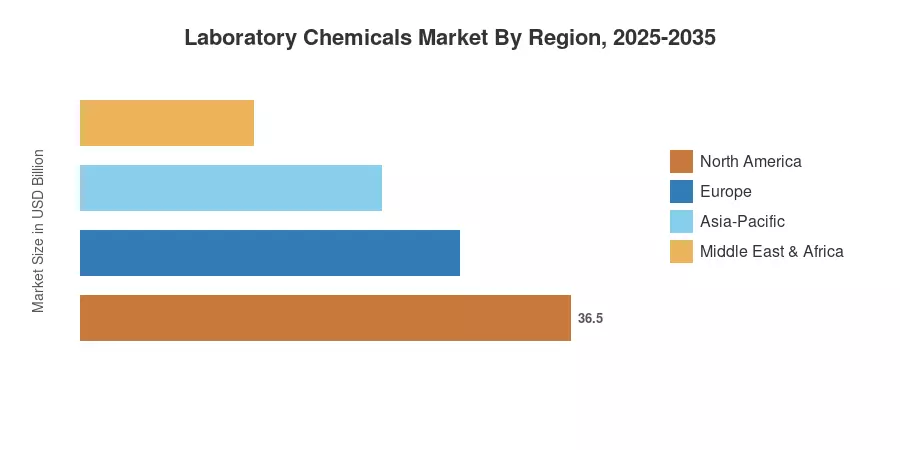
North America holds the largest share of the Laboratory Chemicals Market at approximately 31.9% of global revenue in 2025, anchored by the depth of the U.S. biotech and pharma cluster. Asia-Pacific is the fastest-growing region with a projected CAGR of 5.03%, driven by China's and India's expanding research infrastructure and government science funding programs. Europe remains the second-largest region, contributing roughly 27.5% of revenue, supported by Germany's chemical-industry ecosystem and the EU Horizon Europe research budget. The Laboratory Chemicals Market is poised for a decade of compounding growth as research complexity and regulatory rigor keep intensifying worldwide.


Key Report Takeaways

• By Type

  • Biochemistry chemicals accounted for 29.3% of the Laboratory Chemicals Market in 2025, reflecting persistent demand from drug-discovery and proteomics research workflows.
  • Healthcare/pharmaceutical reagents are expanding at the fastest pace, with a projected CAGR of 5.35% through 2035, fueled by precision-medicine diagnostics and biomarker validation programs.
  • Molecular biology reagents held a 2025 valuation of approximately USD 5.87 billion, supported by genomics and next-generation sequencing adoption.

• By Application

  • Academia and educational institutions represented 33.1% of the Laboratory Chemicals Market in 2025, the largest application segment globally.
  • The healthcare/pharmaceutical application segment is forecast to record a 5.0% CAGR through 2035, the highest among all application categories.
  • Industrial laboratories contributed an estimated USD 6.79 billion in 2025 revenue, driven by quality-control testing in food, petrochemicals, and materials science.

• By Region

  • North America led the Laboratory Chemicals Market with 31.9% of global revenue in 2025.
  • Asia-Pacific is projected to be the fastest-growing region at a 5.03% CAGR through 2035.
  • Europe generated approximately USD 8.49 billion in 2025, ranking as the second-largest regional contributor.


Laboratory Chemicals Market Size and Forecast (2021–2035)

Market sizing draws on bottom-up demand modeling across six chemical type segments, four application verticals, and five geographic regions. Historical estimates (2021–2024) are calibrated against trade-flow data, company filings, and government science-funding disclosures, while the forecast (2026–2035) applies segment-level growth assumptions validated through primary interviews with procurement officers and R&D directors at 120+ laboratories globally.
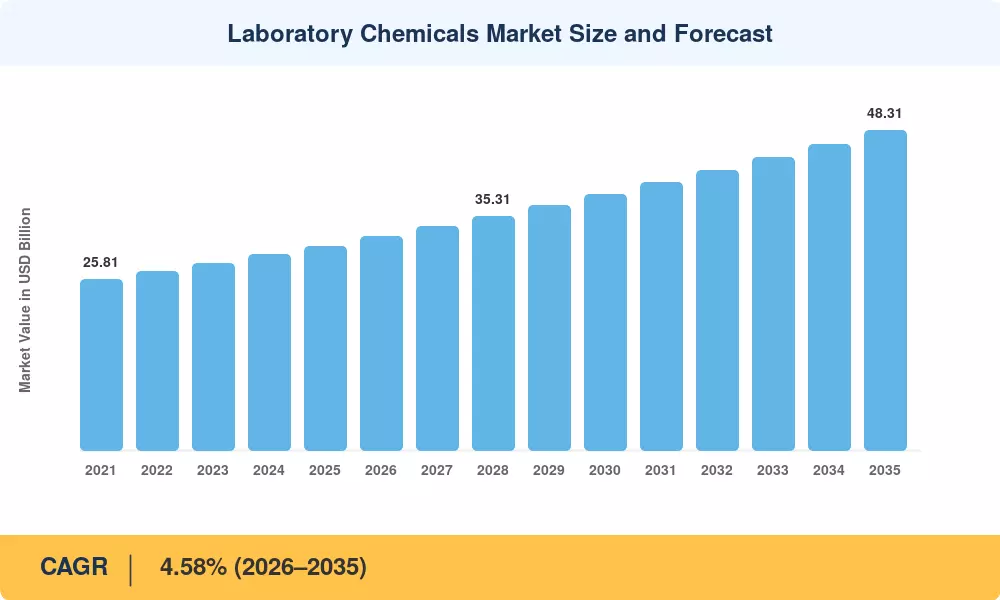
Laboratory Chemicals Market Size and Forecast
Our Impact
Enabled $4.3B Revenue Impact for Fortune 500 and Leading Multinationals
Partnering with 2000+ Global Organizations Each Year
30K+ Citations by Top-Tier Firms in the Industry

Driver Impact Analysis

Driver ~% Impact on CAGR Geographic Relevance Impact Timeline
Pharmaceutical R&D spending growth ~22% Global Long-term (≥4 yr)
Lab automation & liquid-handling adoption ~18% North America, Europe Medium-term (2–4 yr)
Regulatory tightening (REACH, TSCA) ~16% Europe, North America Short-term (≤2 yr)
Genomics and precision-medicine expansion ~14% North America, Asia-Pacific Long-term (≥4 yr)
Government science-funding increases ~12% Asia-Pacific, Europe Medium-term (2–4 yr)
Green-chemistry and bio-solvent mandates ~10% Europe, North America Medium-term (2–4 yr)
Food-safety and environmental testing growth ~8% Global Short-term (≤2 yr)


Pharmaceutical R&D Expenditure as the Demand Anchor

Pharmaceutical companies collectively invested USD 215 billion in R&D in 2024, according to EFPIA and PhRMA annual disclosures [1]. Each dollar of drug-development spending translates into downstream demand for high-purity solvents, buffer solutions, and assay-specific reagents consumed during target validation, preclinical screening, and clinical-trial analytics. The Laboratory Chemicals Market benefits directly from this spending pipeline because reagent procurement typically represents 3–5% of total R&D budgets — a share that has risen steadily as assay complexity increases with biologics and cell-therapy modalities.

Laboratory Automation Reshaping Reagent Formats

The global laboratory automation market exceeded USD 6.2 billion in 2024, and automated liquid-handling platforms are now standard in high-throughput screening facilities across North America and Europe. These systems require pre-formatted, ready-to-use reagent cartridges and certified liquid standards that eliminate manual dilution steps. For the Laboratory Chemicals Market, this shift increases per-unit revenue because automated-format chemicals carry a 20–35% price premium over bulk equivalents while also reducing waste and improving reproducibility.

Regulatory Mandates Elevating Quality Thresholds

The European Chemicals Agency updated 23 substance restriction entries under REACH Annex XVII during 2023–2024, directly affecting laboratory procurement specifications for solvents and staining reagents [4]. Simultaneously, the U.S. EPA finalized risk evaluations for five high-priority chemicals under TSCA, compelling labs to source certified alternatives. These regulatory actions expand the addressable Laboratory Chemicals Market by shifting consumption from commodity-grade to analytical-grade and reference-standard products, where margins are materially higher.

Government Science Funding Cycles

China's Ministry of Science and Technology allocated CNY 395 billion (approximately USD 55 billion) to basic-research grants in its 2024 fiscal plan, while India's Department of Science and Technology increased laboratory infrastructure budgets by 18% year-on-year [8]. Each new research facility requires baseline chemical inventories, creating bolus demand that sustains multi-year reagent contracts. The Laboratory Chemicals Market in Asia-Pacific benefits disproportionately from these government capital cycles.


Restraints Impact Analysis

Restraint ~% Negative Impact on CAGR Geographic Relevance Impact Timeline
Raw-material price volatility ~−18% Global Short-term (≤2 yr)
Hazardous-chemical shipping regulations ~−15% Global Medium-term (2–4 yr)
Budget constraints in public-sector labs ~−14% South America, MEA Long-term (≥4 yr)
Counterfeit and substandard reagent risks ~−12% Asia-Pacific Medium-term (2–4 yr)
Shelf-life limitations and waste disposal costs ~−10% Europe, North America Short-term (≤2 yr)


Raw-Material Price Volatility

Petrochemical feedstocks — ethanol, methanol, acetone, and toluene — underpin the production of the majority of laboratory solvents and reagents. The ICIS Petrochemical Index recorded a 14% price swing in key solvent precursors during 2023–2024, forcing chemical manufacturers to pass cost fluctuations downstream [11]. For the Laboratory Chemicals Market, this volatility compresses margins for distributors operating on fixed-price contracts and can delay procurement decisions at budget-constrained academic institutions.

Increasingly Complex Shipping and Handling Regulations

The International Air Transport Association revised its Dangerous Goods Regulations (DGR 65th Edition, effective 2024), tightening packaging and labeling requirements for Class 3, 6.1, and 8 chemicals shipped by air [12]. Compliance adds 8–12% to logistics costs for cross-border reagent shipments, which directly impacts the Laboratory Chemicals Market by raising landed costs for importers in emerging economies. Cold-chain reagents face additional surcharges, creating friction for time-sensitive research procurement.

Public-Sector Funding Uncertainty

Government-funded academic and public-health laboratories in South America and parts of the Middle East & Africa operate within austere fiscal environments. Brazil's CNPq research agency experienced a 9% real-term budget reduction in 2024, directly curtailing laboratory procurement volumes [8]. These funding constraints cap the Laboratory Chemicals Market growth ceiling in regions where public institutions account for over half of total chemical consumption.


Laboratory Chemicals Market Opportunities

Green Chemistry and Bio-Based Solvent Transition

The Laboratory Chemicals Market will get a premium growth impetus as environmental requirements to replace petroleum-based solvents with bio-based alternatives. The American Chemical Society’s Green Chemistry Institute has estimated that 35% of laboratory solvents may be replaced with renewable counterparts by 2030 without affecting analytical performance [9]. Suppliers with approved bio-based product lines such as cyclopentyl methyl ether or 2-methyltetrahydrofuran will have pricing power in procurement tenders where sustainability requirements now make up 15–20% of evaluation scores.


Emerging-Market Infrastructure Build-Out

India’s National Research Foundation (INR 50,000 crore or USD 6 billion in endowment) and Southeast Asia’s ASEAN Science and Technology Fund are developing greenfield laboratory capacity that calls for baseline chemical inventories [8]. In some regions, the Laboratory Chemicals Market opportunity goes beyond selling reagents to technical-support contracts and custom-formulation services. Early movers might get multi-year supply agreements during the commissioning of the facility.


Digital Inventory and Data-Monetization Platforms

Cloud-based chemical inventory management systems produce procurement datasets that suppliers can monetize through predictive replenishment services and demand-forecasting analytics. Companies that combine IoT-enabled smart shelving with ERP-linked ordering platforms will increase client stickiness, capturing subscription-based revenue on top of product sales. This digital layer represents a new business strategy for the Laboratory Chemicals Market that goes beyond traditional distribution.


Cell and Gene Therapy Reagent Demand Surge

Between 2022 and 2024, the FDA approved 11 cell and gene therapy products, and globally, more than 3,500 clinical trials with advanced therapeutic medical goods are ongoing [7]. All therapeutic programs create a high need for GMP-grade buffers, transfection reagents and culture medium additives. The Laboratory Chemicals Market can achieve high-margin growth by developing product lines that are specially validated for cell-therapy production workflows.


Reference-Standard Certification Services

As regulatory agencies tighten acceptable uncertainty bands for analytical methods, demand for certified reference materials (CRMs) is growing at rates that outpace the broader Laboratory Chemicals Market. Laboratories performing method validation under ISO 17025 now require CRMs traceable to NIST, BAM, or equivalent national metrology institutes [10]. Suppliers that invest in CRM production and accreditation infrastructure can capture a niche with 40–50% gross margins.


Laboratory Chemicals Market Future Outlook

AI-Driven Laboratory Operations

Artificial intelligence is entering laboratory workflows through automated experiment design, predictive reagent consumption, and self-optimizing synthesis platforms. McKinsey estimates that AI-augmented laboratories could reduce chemical waste by 25% and reagent procurement cycles by 30% by 2030 [17]. For the Laboratory Chemicals Market, this means a shift toward smaller, higher-purity product runs with digital traceability — favoring suppliers that can offer real-time certificates of analysis and API-integrated ordering systems.

Sustainability and ESG Reporting Mandates

The EU Corporate Sustainability Reporting Directive (CSRD), effective 2025, requires companies — including laboratory operators — to disclose Scope 3 emissions from purchased chemicals. This mandate is accelerating demand for carbon-footprint-labeled reagents and bio-based solvents within the Laboratory Chemicals Market [9]. Suppliers that can provide lifecycle-assessment data at the SKU level will gain preferential positioning in European procurement tenders and influence buying decisions in other regions adopting similar frameworks.

Decentralized and Point-of-Need Testing

The proliferation of point-of-care diagnostics, field-deployable water-testing kits, and mobile agricultural labs is creating demand for pre-packaged, single-use chemical test packs. The WHO projects that decentralized testing will account for 20% of diagnostic chemistry consumption in low- and middle-income countries by 2032 [18]. This trend opens a new distribution channel for the Laboratory Chemicals Market beyond traditional centralized-laboratory supply chains.

Biologics and Advanced-Therapy Manufacturing Scale-Up

Biologic drugs now represent over 40% of the global pharmaceutical pipeline, and cell and gene therapies are transitioning from clinical trials to commercial-scale manufacturing [7]. Each bioreactor run consumes tens of thousands of dollars in GMP-grade buffers, amino acids, and media supplements. The Laboratory Chemicals Market will see its highest-margin growth from these advanced-manufacturing reagent categories, with suppliers investing in single-use format compatibility and regulatory pre-qualification.


Laboratory Chemicals Market Segmentation

By Type

Segment Key Metric Primary Demand Driver
Biochemistry 29.3% share (2025) Drug discovery and enzyme assays
Molecular Biology USD 5.87 Billion (2025) NGS and PCR-based workflows
Cytokine and Chemokine Testing 4.82% CAGR (2026–2035) Immuno-oncology research
Carbohydrate Analysis USD 2.16 Billion (2025) Food-safety and glycomics
Immunochemistry 4.67% CAGR (2026–2035) Diagnostic immunoassay kits
Other Types USD 3.41 Billion (2025) Environmental and industrial testing


Biochemistry chemicals represent the largest type segment in the Laboratory Chemicals Market, driven by decades of embedded demand from pharmaceutical drug-discovery workflows, academic enzymology, and clinical biochemistry analyzers. High-purity buffers, substrates, and coenzymes form the backbone of this segment, with procurement concentrated among the top-20 pharma companies and major research universities. Molecular biology reagents follow closely, propelled by the rapid adoption of next-generation sequencing platforms — Illumina, PacBio, and Oxford Nanopore collectively expanded their installed base by 18% in 2024, each unit requiring proprietary and generic library-preparation chemicals [7].

Healthcare and pharmaceutical reagents are posting the fastest type-segment growth across the Laboratory Chemicals Market, with a projected CAGR of 5.35% through 2035. The expansion of companion diagnostics, where each approved targeted therapy requires a matched assay kit, is creating captive reagent demand streams. Cytokine and chemokine testing chemicals are also accelerating as immuno-oncology clinical trials proliferate, requiring multiplex assay panels that consume specialized antibody-conjugated reagents at significant per-test cost.

By Application

Segment Key Metric Primary Demand Driver
Academia / Educational 33.1% share (2025) University research grants
Industrial USD 6.79 Billion (2025) QC testing in manufacturing
Government 4.41% CAGR (2026–2035) Public-health and forensic labs
Healthcare / Pharmaceutical 5.0% CAGR (2026–2035) Clinical diagnostics and drug development


Academic and educational institutions dominate the Laboratory Chemicals Market by application because university research grants fund continuous, multi-year reagent procurement across chemistry, biology, and materials-science departments. The U.S. alone has more than 4,000 degree-granting institutions with active research laboratories, and NIH R01 grant budgets typically allocate 15–20% to consumable supplies, including chemicals [1]. The healthcare and pharmaceutical segment is growing fastest, reflecting the global expansion of clinical trial volumes — the FDA received more than 5,300 IND applications in 2024, each program initiating cascading reagent demand [7].


Regional Market Share Analysis

Region Key Metric Primary Investment Themes
North America 31.9% share (2025) Pharma R&D clusters, automation adoption
Europe USD 8.49 Billion (2025) REACH compliance, Horizon Europe grants
Asia-Pacific 5.03% CAGR (2026–2035) Government science funding, new lab construction
South America USD 2.16 Billion (2025) Public-health diagnostics, agricultural testing
Middle East & Africa 3.87% CAGR (2026–2035) Healthcare infrastructure, university expansion
Total USD 30.87 Billion (2025)

The Laboratory Chemicals Market exhibits a tri-polar regional structure, with North America, Europe, and Asia-Pacific collectively accounting for over 86% of global revenue in 2025. South America and the Middle East & Africa remain smaller but are supported by targeted government research programs and expanding diagnostic laboratory networks.


North America

Country Key Metric Key Driver
United States 78.4% of regional share NIH-funded biomedical research ecosystem
Canada USD 1.52 Billion (2025) Genomics and agri-food testing investment
Mexico 4.21% CAGR (2026–2035) Growing pharmaceutical manufacturing base


The United States dominates the North American Laboratory Chemicals Market owing to the NIH's annual extramural research budget of approximately USD 37 billion, which funds thousands of academic and hospital-based laboratories requiring continuous reagent supply [1]. Canada's Genomics Enterprise initiative and Mexico's expanding contract-research organization (CRO) sector add complementary demand vectors, particularly for molecular-biology and chromatography-grade chemicals.

Europe

Country Key Metric Key Driver
Germany 23.6% of regional share Chemical-industry R&D base
United Kingdom USD 1.38 Billion (2025) Life-sciences golden triangle
France 4.52% CAGR (2026–2035) Biopharma manufacturing expansion
Italy USD 0.74 Billion (2025) Academic research network
Spain 4.38% CAGR (2026–2035) Clinical-diagnostics laboratory growth
Nordic Countries USD 0.62 Billion (2025) Sustainability-driven procurement
Russia 3.81% CAGR (2026–2035) Import-substitution programs
Rest of Europe USD 1.18 Billion (2025) EU Cohesion Fund laboratory upgrades


Germany's position as Europe's largest chemical producer translates into a deep domestic supply chain for the Laboratory Chemicals Market, with BASF, Merck KGaA, and Evonik all operating laboratory-chemical divisions. The UK's £2.3 billion Life Sciences Vision investment framework sustains high reagent consumption in the Oxford–Cambridge–London triangle, while the EU's Horizon Europe program channels €95.5 billion into research across member states through 2027, underpinning laboratory procurement budgets continent-wide [15].

Asia-Pacific

Country Key Metric Key Driver
China 38.2% of regional share MOST basic-research funding surge
India 5.48% CAGR (2026–2035) National Research Foundation build-out
Japan USD 1.89 Billion (2025) Precision-medicine and diagnostics labs
South Korea 4.96% CAGR (2026–2035) Biotech cluster expansion
ASEAN USD 0.92 Billion (2025) Healthcare infrastructure investment
Rest of Asia-Pacific 4.72% CAGR (2026–2035) Agricultural and environmental testing


China's Ministry of Science and Technology directed CNY 395 billion toward fundamental research in 2024, establishing new national laboratories that require full chemical inventories [8]. India's Laboratory Chemicals Market is the fastest-growing country-level segment globally, propelled by the National Research Foundation's mandate to seed 500 new research institutions by 2030. Japan and South Korea contribute stable, high-value demand from advanced diagnostics, semiconductor fabrication cleanrooms, and academic research universities.

South America

Country Key Metric Key Driver
Brazil 56.3% of regional share Fiocruz and Embrapa research networks
Argentina USD 0.39 Billion (2025) Agricultural and veterinary testing
Rest of South America 4.08% CAGR (2026–2035) Mining and environmental monitoring


Brazil anchors the South American Laboratory Chemicals Market through its network of public research institutions, including Fiocruz (public health) and Embrapa (agriculture). Argentina's growing agri-export certification requirements and Chile's mining-sector environmental monitoring programs provide secondary demand pockets, though fiscal austerity in several countries limits procurement scale.

Middle East & Africa

Country Key Metric Key Driver
Saudi Arabia 28.7% of regional share Vision 2030 university and hospital labs
UAE USD 0.31 Billion (2025) Healthcare free-zone laboratory growth
South Africa 3.92% CAGR (2026–2035) Mining and water-quality testing
Egypt USD 0.18 Billion (2025) Pharmaceutical manufacturing expansion
Rest of MEA 3.74% CAGR (2026–2035) Donor-funded public-health programs


Saudi Arabia's Vision 2030 framework has allocated SAR 12 billion for science and higher-education infrastructure, creating demand for laboratory outfitting across 14 new university campuses [16]. The UAE's Dubai Healthcare City and Abu Dhabi's Masdar City science zone add concentrated procurement clusters, while South Africa's mining and water-quality testing requirements provide steady consumption across the MEA region's Laboratory Chemicals Market.


Laboratory Chemicals Market By Region, 2025-2035

Competitive Benchmarking

The Laboratory Chemicals Market exhibits medium concentration, with the top five companies accounting for an estimated 38–44% of global revenue. The competitive structure balances large integrated suppliers — which offer broad catalogs spanning hundreds of thousands of SKUs — against specialized niche producers serving high-purity and application-specific segments. Mergers and vertical integration have intensified since 2020, with several platform acquisitions reshaping the supplier landscape [19].

Company Est. Revenue Share Range Key Offerings for Laboratory Chemicals Market Strategic Positioning
Merck KGaA (MilliporeSigma) ~9–12% Reagents, solvents, reference standards, life-science chemicals Broadest catalog globally; integrated life-science and performance-materials platform
Thermo Fisher Scientific ~8–11% Analytical reagents, cell-culture media, chromatography chemicals End-to-end laboratory solutions; strong channel presence
Avantor Inc. ~5–8% High-purity solvents, process chemicals, biopharma reagents Biopharma-focused; strong custom-manufacturing capabilities
Honeywell (Research Chemicals) ~4–6% High-purity solvents, inorganic reagents, specialty chemicals Legacy Burdick & Jackson brand; industrial and environmental testing focus
BD (Becton, Dickinson) ~3–5% Diagnostic reagents, microbiology media, specimen collection Clinical-laboratory channel dominance
Bio-Rad Laboratories ~3–5% Life-science research reagents, quality controls, electrophoresis chemicals Focused on life-science research and clinical diagnostics
Danaher Corporation ~3–5% Chromatography consumables, water-quality reagents, genomics chemicals Multi-brand portfolio via Cytiva, Pall, and Leica Microsystems
PerkinElmer (Revvity) ~2–4% Screening reagents, newborn-screening kits, radiochemicals Diagnostics and applied-markets specialization
FUJIFILM Wako Chemicals ~2–3% Specialty reagents, HPLC solvents, biochemistry chemicals Strong Asia-Pacific distribution; Japanese quality heritage
TCI Chemicals ~1–3% Organic synthesis reagents, building blocks, fine chemicals Niche organic-chemistry catalog; researcher-driven brand loyalty


Recent News & Developments

  • Merck KGaA (March 2024 ): Opened a USD 300 million reagent manufacturing facility in Carlsbad, California, expanding capacity for chromatography-grade solvents and genomics-grade chemicals to serve the Laboratory Chemicals Market in North America [19].


  • Danaher Corporation (September 2023 ): Completed the spin-off of its environmental and applied-solutions segment, sharpening corporate focus on life-science and diagnostics reagent portfolios relevant to the Laboratory Chemicals Market [22].


Laboratory Chemicals Market Report Scope

Item Detail
Market Scope Global Laboratory Chemicals Market across six type segments, four application segments, and five regions
Study Period 2021–2035
CAGR (Forecast) 4.58% (2026–2035)
Base-Year Market Size USD 30.87 Billion (2025)
Forecast Endpoint USD 48.31 Billion (2035)
Fastest Growing Segment (Type) Healthcare / Pharmaceutical Reagents (5.35% CAGR)
Fastest Growing Region Asia-Pacific (5.03% CAGR)
Companies Profiled 10 major players
Valuation Currency USD Billion


FAQs

How do laboratory chemical procurement contracts typically structure pricing — fixed or indexed?

Most multi-year contracts use a hybrid model: base pricing is fixed for 12 months with annual escalators tied to petrochemical feedstock indices. This protects buyers from spot volatility while giving suppliers margin flexibility [11].

What quality certifications should buyers prioritize when selecting a laboratory chemical supplier?

ISO 17025 accreditation and traceability to a national metrology institute (NIST, BAM, or equivalent) are essential. Suppliers holding these certifications consistently deliver tighter purity tolerances and auditable documentation [10].

How is the Laboratory Chemicals Market affected by single-use bioprocessing adoption?

Single-use systems increase per-batch reagent consumption because pre-sterilized disposable bags require dedicated buffer and media fills. This trend raises chemical volume demand while shortening order-to-delivery cycles [7].

What role do e-commerce platforms play in the Laboratory Chemicals Market distribution channel?

Online portals now handle 25–30% of reagent orders globally, reducing lead times and enabling smaller labs to access the same catalogs as large institutions. Digital channels also improve price transparency.

How do tariff and trade-policy changes affect cross-border reagent supply chains?

Tariffs on Chinese-origin fine chemicals have prompted distributors to diversify sourcing toward India and Southeast Asia. Supply-chain reshoring adds 5–8% to landed costs but reduces delivery-risk exposure [12].

What emerging application areas outside pharma are driving the Laboratory Chemicals Market?

Cannabis potency testing, microplastics environmental analysis, and battery-materials characterization are three fast-growing niches. Each requires specialized reference standards and extraction solvents not previously stocked [10].

How does the Laboratory Chemicals Market address sustainability in packaging and distribution?

Leading suppliers are transitioning to returnable glass containers, concentrated formulas, and carbon-neutral shipping programs. Merck KGaA's SMASH Packaging initiative reduced plastic waste by 30% across select reagent lines [19].


FAQs

What is the projected market valuation of the Laboratory Chemicals Market by 2035?

The Laboratory Chemicals Market is projected to reach a valuation of 6.401 USD Billion by 2035.

What was the market valuation of the Laboratory Chemicals Market in 2024?

In 2024, the Laboratory Chemicals Market was valued at 3.89 USD Billion.

What is the expected CAGR for the Laboratory Chemicals Market during the forecast period 2025 - 2035?

The expected CAGR for the Laboratory Chemicals Market during the forecast period 2025 - 2035 is 4.63%.

Which segment is projected to have the highest valuation in the Laboratory Chemicals Market by 2035?

The Industrial segment is projected to reach a valuation of 2.25 USD Billion by 2035.

What are the key applications driving the Laboratory Chemicals Market?

Key applications include Government, Education, Industrial, and Healthcare, with Industrial leading at 2.25 USD Billion by 2035.

Who are the leading players in the Laboratory Chemicals Market?

Key players in the Laboratory Chemicals Market include Thermo Fisher Scientific, Merck KGaA, and Sigma-Aldrich.

What is the projected valuation for the Molecular Biology segment by 2035?

The Molecular Biology segment is projected to reach a valuation of 1.8 USD Billion by 2035.

How does the valuation of the Biochemistry segment compare between 2024 and 2035?

The Biochemistry segment increased from 0.85 USD Billion in 2024 to a projected 1.25 USD Billion by 2035.

What is the expected growth for the Pharmaceutical Companies segment in the Laboratory Chemicals Market?

The Pharmaceutical Companies segment is expected to grow from 1.5 USD Billion in 2024 to 2.5 USD Billion by 2035.

What is the projected valuation for Academic & Research Institutions in the Laboratory Chemicals Market by 2035?

The Academic & Research Institutions segment is projected to reach a valuation of 1.4 USD Billion by 2035.
Author
Author
Author Profile
Rahul Gotadki LinkedIn
Research Manager
He holds an experience of about 9+ years in Market Research and Business Consulting, working under the spectrum of Life Sciences and Healthcare domains. Rahul conceptualizes and implements a scalable business strategy and provides strategic leadership to the clients. His expertise lies in market estimation, competitive intelligence, pipeline analysis, customer assessment, etc.
Co-Author
Co-Author Profile
Snehal Singh LinkedIn
Manager - Research
High acumen in analyzing complex macro & micro markets with more than 6 years of work experience in the field of market research. By implementing her analytical skills in forecasting and estimation into market research reports, she has expertise in Packaging, Construction, and Equipment domains. She handles a team size of 20-25 resources and ensures smooth running of the projects, associated marketing activities, and client servicing.

Research Approach


Secondary Research

The secondary research process involved comprehensive analysis of chemical safety databases, peer-reviewed scientific journals, regulatory compliance publications, and authoritative industry repositories. Key sources included the US Environmental Protection Agency (EPA), Occupational Safety and Health Administration (OSHA), European Chemicals Agency (ECHA) REACH database, National Institute of Standards and Technology (NIST), American Chemical Society (ACS) Chemical Abstracts Service, Royal Society of Chemistry (RSC), International Organization for Standardization (ISO) technical committees, National Institutes of Health (NIH) PubChem, Centers for Disease Control and Prevention (CDC) NIOSH Chemical directory, US Census Bureau Quarterly Survey of Plant Capacity Utilization, Eurostat Chemical Industry Statistics, and national chemical inventory listings from China (IECSC), Japan (ENCS), and Australia (AICS). These sources were utilized to collect production capacity data, regulatory compliance requirements, safety handling protocols, consumption patterns across end-use verticals (pharmaceutical, biotechnology, academic, environmental testing), and import-export trade dynamics for high-purity solvents, analytical reagents, biochemical reagents, and chromatography-grade chemicals.


Primary Research

To gather both qualitative and quantitative information, the primary research process involved interviewing players from both the supply and demand sides. Executives from companies producing fine chemicals, distributing such chemicals, and providing life science tools were among the supply-side sources. Other names on the list were regulatory compliance officers, VPs of laboratory solutions, global heads of specialty chemicals, and commercial directors. On the demand side, we had laboratory directors, chief scientific officers, procurement managers from biotech and pharmaceutical businesses, quality control managers from contract research organizations and contract manufacturing organizations, research professors from universities, and managers of environmental testing laboratories. Market segmentation by product purity grade (HPLC, molecular biology, ACS reagent grade) was confirmed through primary research. Additionally, expansion timelines for capacity were confirmed, and insights on chemical sourcing strategies, inventory management practices, and sustainability initiatives related to green chemistry alternatives were gathered.

Primary Respondent Breakdown:

By Designation: C-level Executives (32%), Director Level (30%), Others (38%)

By Region: North America (32%), Europe (25%), Asia-Pacific (33%), Rest of World (10%)


Market Size Estimation

Global market valuation was derived through revenue mapping and consumption volume analysis across academic, industrial, and government research sectors. The methodology included:

Identification of 50+ key manufacturers and distributors across North America, Europe, Asia-Pacific, and the Middle East & Africa

Product mapping across solvents (HPLC, GC, spectrophotometric grades), acids & bases, reagents (biochemical, diagnostic, analytical standards), and other specialty laboratory chemicals

Analysis of reported and modeled annual revenues specific to laboratory chemical portfolios and life science consumables segments

Coverage of manufacturers and distributors representing 70-75% of global market share in 2024

Extrapolation using bottom-up (consumption volume × average selling price by end-user industry and region) and top-down (manufacturer revenue validation against industry production statistics) approaches to derive segment-specific valuations and purity-grade market splits

Download Free Sample

Kindly complete the form below to receive a free sample of this Report

Download PDF ×

We do not share your information with anyone. However, we may send you emails based on your report interest from time to time. You may contact us at any time to opt-out.
















