Download Free Sample
Kindly complete the form below to receive a free sample of this Report
Language Learning and Translation Services Market Research Report Information By End Use (Educational Institutions, Corporate Sector, Government Agencies, Individual Learners), By Application (Language Learning, Translation Services, Localization Services, Interpretation Services), By Service Type (Self-Paced Learning, Instructor-Led Learning, Automated Translation, Human Translation), By Delivery Mode (Online Learning, In-Person Learning, Blended Learning, Mobile Applications), By Language Type (Native Languages, Foreign Languages, Sign Languages, Regional Dialects) And By Region (North America, Europe, Asia-Pacific, And Rest Of The World) – Market Forecast Till 2035.
As per MRFR analysis, the Language Learning and Translation Services Market was estimated at 55.0 USD Billion in 2024. The industry is projected to grow from 57.22 USD Billion in 2025 to 85.0 USD Billion by 2035, exhibiting a compound annual growth rate (CAGR) of 4.04% during the forecast period 2025 - 2035.
The Language Learning and Translation Services Market is experiencing dynamic growth driven by technological advancements and increasing demand for multilingual communication.
| 2024 Market Size | 55.0 (USD Billion) |
| 2035 Market Size | 85.0 (USD Billion) |
| CAGR (2025 - 2035) | 4.04% |
Berlitz (US), Rosetta Stone (US), Duolingo (US), Babbel (DE), iTalki (CN), Preply (UA), Lingoda (DE), TransPerfect (US), SDL (GB), Lionbridge (US)
Our Impact
Enabled $4.3B Revenue Impact for Fortune 500 and Leading Multinationals
Partnering with 2000+ Global Organizations Each Year
30K+ Citations by Top-Tier Firms in the Industry
The Language Learning and Translation Services Market is currently experiencing a dynamic evolution, driven by the increasing globalization of businesses and the growing need for effective communication across diverse linguistic landscapes. As organizations expand their reach into international markets, the demand for language learning solutions and translation services appears to be on the rise. This trend is further fueled by advancements in technology, which facilitate more efficient and accessible language acquisition methods. Moreover, the proliferation of digital platforms has transformed how individuals engage with language learning, making it more interactive and personalized. In addition to technological advancements, cultural exchange and migration patterns contribute to the market's growth. As people move across borders for work, education, or personal reasons, the necessity for language proficiency becomes paramount. This has led to an increased interest in both formal and informal language learning opportunities. Furthermore, the translation services sector is adapting to meet the needs of a more interconnected world, with a focus on providing high-quality, contextually relevant translations that resonate with local audiences. Overall, the Language Learning and Translation Services Market is poised for continued expansion, reflecting the complexities of a globalized society.
The integration of technology into language learning is reshaping how individuals acquire new languages. Online platforms, mobile applications, and virtual classrooms are becoming increasingly prevalent, offering learners flexible and engaging ways to study. This trend suggests that traditional methods may be supplemented or even replaced by innovative digital solutions that cater to diverse learning styles.
As businesses expand globally, the need for multilingual communication is intensifying. Companies are recognizing the importance of reaching diverse audiences, which drives demand for translation services. This trend indicates a shift towards more inclusive marketing strategies that consider cultural nuances and language preferences.
There is a growing emphasis on personalized learning experiences within the Language Learning and Translation Services Market. Tailored programs that adapt to individual needs and preferences are gaining traction. This trend highlights the importance of learner-centric approaches that enhance engagement and retention in language acquisition.
The Language Learning and Translation Services Market is profoundly shaped by the dynamics of cultural exchange and globalization. As societies become more interconnected, the need for understanding and communicating across cultures intensifies. This phenomenon is evident in the rise of cultural events, international collaborations, and cross-border partnerships. The market for translation services is projected to grow, with estimates indicating a value of around 56 billion USD by 2027. This growth is driven by the increasing demand for accurate translations in various sectors, including entertainment, business, and education. As individuals seek to engage with diverse cultures, language learning becomes a vital tool, further propelling the market for both language education and translation services.
The Language Learning and Translation Services Market is significantly influenced by the increasing global mobility and migration trends. As individuals relocate for work, education, or personal reasons, the necessity for language proficiency becomes paramount. This trend is reflected in the growing number of expatriates and international students, which has led to a heightened demand for language learning solutions. Data suggests that the number of international students has risen to over 5 million, creating a substantial market for language services. Furthermore, businesses are expanding their operations across borders, necessitating effective communication strategies. Consequently, the demand for translation services is likely to increase, as companies seek to bridge language barriers and enhance their global presence.
The Language Learning and Translation Services Market is significantly impacted by the rise of e-learning and remote education trends. The shift towards online learning platforms has made language education more accessible to a broader audience. With the proliferation of digital tools and resources, learners can engage with language content from anywhere in the world. Recent data indicates that the e-learning market is expected to reach 375 billion USD by 2026, highlighting the potential for language learning services within this sector. As more individuals seek to learn new languages online, the demand for translation services is likely to increase, as accurate translations are essential for effective communication in diverse educational contexts.
The Language Learning and Translation Services Market is witnessing a notable increase in corporate investment in language training programs. Companies recognize the value of multilingual employees in enhancing communication and fostering international business relationships. As organizations expand their global footprint, they are more inclined to invest in language learning initiatives for their workforce. Recent statistics indicate that approximately 70% of companies are implementing language training programs to improve employee skills. This trend not only boosts employee productivity but also enhances customer relations in diverse markets. Consequently, the demand for translation services is likely to rise, as businesses require accurate translations to support their multilingual operations and marketing strategies.
The Language Learning and Translation Services Market is experiencing a surge in technological advancements that enhance the learning experience. Innovations such as artificial intelligence, machine learning, and mobile applications are transforming traditional language education. For instance, AI-driven platforms provide personalized learning paths, adapting to individual user needs and preferences. According to recent data, the market for language learning apps is projected to reach approximately 25 billion USD by 2026, indicating a robust growth trajectory. These technologies not only facilitate easier access to language resources but also improve engagement through interactive content. As a result, learners are more likely to achieve fluency, thereby driving demand for translation services that cater to diverse linguistic needs.
The Language Learning and Translation Services Market is characterized by distinct yet interrelated segments, with Language Learning capturing the largest share. This segment benefits from increasing globalization and the rising demand for new language acquisition skills across diverse demographics. Translation Services, while smaller in comparison, exhibit robust growth driven by the proliferation of digital content and the necessity for effective communication in multi-lingual environments. Localization and Interpretation Services also hold notable positions, with each segment carving its niche based on consumer needs and technological advancements. Growth trends within the Language Learning and Translation Services Market reflect broader societal shifts. The Language Learning segment thrives on technological integration, including online platforms and mobile applications, making language education more accessible. Translation Services are propelled by the demand for real-time communication and content adaptation in diverse markets. The increasing emphasis on cultural sensitivity and accuracy in translation drives these services, making them essential for businesses aiming to engage global audiences.
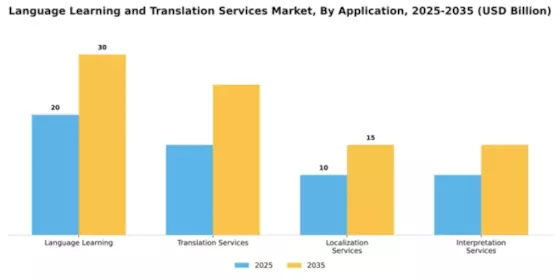
Language Learning (Dominant) vs. Interpretation Services (Emerging)
Language Learning has established itself as the dominant segment in the Language Learning and Translation Services Market due to its fundamental role in fostering cross-cultural communication and personal growth. It appeals to a diverse customer base, including students, professionals, and travelers. This segment leverages digital platforms, creating interactive learning experiences that resonate with modern learners. On the other hand, Interpretation Services are emerging, driven by the increasing need for real-time communication in a globalized world. With the rise of virtual conferences and international partnerships, interpretation services are finding new applications in business and events, bridging communication gaps across languages. The dynamic nature of these segments showcases the evolving landscape of language services.
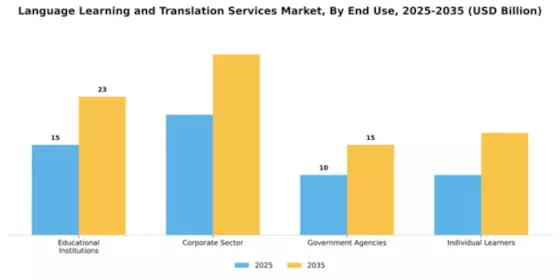
In the Language Learning and Translation Services Market, the distribution of market share among the end-use segments reveals that Educational Institutions hold the largest share, underscoring the pivotal role they play in language education. This segment encompasses schools, universities, and other educational entities committed to providing language learning and translation services, making them a cornerstone of the market. Meanwhile, the Corporate Sector is gaining traction, reflecting an increasing demand for language services in business environments to facilitate global communication and enhance competitiveness. The growth trends within these segments illustrate a dynamic landscape driven by changing educational methodologies and globalization. Educational Institutions continue to expand their language offerings, responding to diverse student needs and technological advancements. In contrast, the Corporate Sector is experiencing rapid growth, fueled by the demand for language skills in international trade and cross-cultural collaborations, encouraging organizations to invest in language training and translation services to improve operational efficiency and market reach.
Educational Institutions (Dominant) vs. Corporate Sector (Emerging)
The Educational Institutions segment remains dominant in the Language Learning and Translation Services Market due to the foundational role of language education in academic settings. Schools and universities actively seek comprehensive language programs and translation services to cater to a diverse student population, addressing the needs of both domestic and international learners. This segment's stability is complemented by long-term partnerships with language service providers, ensuring a consistent demand for tailored educational content. Meanwhile, the Corporate Sector is emerging rapidly, characterized by organizations recognizing the necessity of multilingual capabilities in an increasingly globalized economy. Companies are prioritizing employee language skills to facilitate effective communication with international clients and to penetrate new markets. This shift not only enhances competitive advantage but also reflects a broader commitment to diversity and inclusion within the workplace.
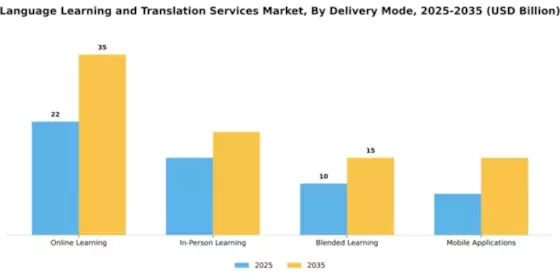
Within the Language Learning and Translation Services Market, the delivery mode segment showcases a diverse distribution of preferences among learners. Currently, Online Learning holds the largest share, driven by its accessibility and the convenience it offers to various demographics. Meanwhile, In-Person Learning is gaining traction as it allows for direct interaction, displaying a notable increase in popularity among learners who value face-to-face engagement. This segment is particularly favored in regions where personal connection remains a strong factor in the learning process.
Delivery Mode: Online Learning (Dominant) vs. Blended Learning (Emerging)
Online Learning has positioned itself as the dominant delivery mode in the Language Learning and Translation Services Market. Its extensive reach, coupled with advancements in technology, enables learners to access resources anytime, anywhere. In contrast, Blended Learning is emerging as a hybrid model that combines online and face-to-face instruction. This approach appeals to those seeking flexibility while maintaining personal engagement. The desire for interactive experiences is driving the growth of Blended Learning, offering a balanced method that meets diverse learner preferences.
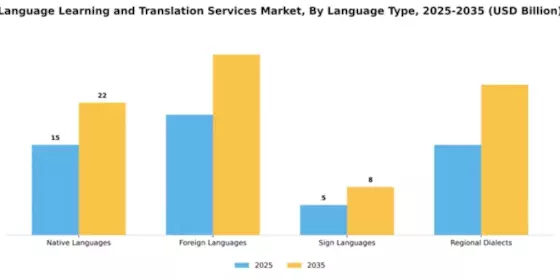
In the Language Learning and Translation Services Market, Native Languages constitute the largest segment, providing significant support to multilingual communication strategies and fostering cultural understanding. This segment remains critical as businesses and individuals continue to emphasize effective communication in their native tongues, resulting in a stable demand for services that facilitate this need. Conversely, Foreign Languages are emerging as the fastest-growing segment. With globalization and cross-border interactions on the rise, there is an increasing demand for proficiency in foreign languages, particularly in business and tourism sectors, leading to a notable surge in related services.
Native Languages (Dominant) vs. Foreign Languages (Emerging)
The segment of Native Languages is central to the Language Learning and Translation Services Market. It encompasses a wide array of services, including translation, interpretation, and language learning tailored to speakers of specific native tongues. This segment is characterized by its extensive user base, which relies on native language expertise for personal, professional, and cultural exchanges. In contrast, Foreign Languages as an emerging category reflect the growing necessity for understanding global languages due to increased international relations and travel. This segment, focusing on languages such as Mandarin, Spanish, and Arabic, showcases a dynamic shift where learning and translation services must adapt to the fast-evolving language landscape, positioning itself as a vital contributor to the future of communication.
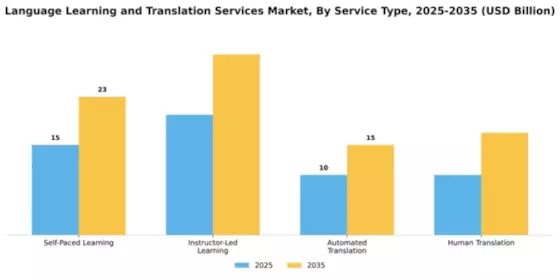
In the Language Learning and Translation Services Market, the distribution of market share among service types reveals Instructor-Led Learning as the leading segment. This segment appeals to those seeking personalized, directed education and training experiences, capturing a substantial portion of the market due to its efficacy in skill acquisition. Automated Translation, while smaller in share, is rapidly gaining traction, driven by technological advancements and an increase in demand for quick, cost-effective solutions to language translation needs.
Instructor-Led Learning (Dominant) vs. Automated Translation (Emerging)
Instructor-Led Learning is characterized by structured environments where learners benefit from direct interaction with educators, making it particularly popular among corporate training establishments and academic institutions. This service type provides a hands-on approach, fostering an engaging learning atmosphere. On the other hand, Automated Translation leverages advanced algorithms and artificial intelligence, appealing to businesses and individuals requiring speedy translations without human intervention. This segment is gaining momentum due to its scalability and affordability, representing a shift towards digital solutions that can handle large-scale translation tasks efficiently.
Get more detailed insights about Language Learning and Translation Services Market Request Free Sample
North America continues to lead the Language Learning and Translation Services Market, holding a significant market share of 27.5% as of 2024. The region's growth is driven by increasing globalization, a rising demand for multilingual communication, and advancements in technology that enhance learning experiences. Regulatory support for educational initiatives further catalyzes this growth, making language services more accessible to diverse populations. The competitive landscape in North America is robust, featuring key players such as Berlitz, Rosetta Stone, and Duolingo. The U.S. stands out as the largest market, with a strong emphasis on digital learning platforms and personalized language instruction. Companies are leveraging innovative technologies like AI and machine learning to improve service delivery, ensuring they meet the evolving needs of learners and businesses alike.
Europe's Language Learning and Translation Services Market is valued at €15.0 billion, reflecting a growing demand for multilingual capabilities across various sectors. The region benefits from a rich cultural diversity, which drives the need for language services in business, education, and tourism. Regulatory frameworks promoting language education in schools and workplaces are key growth drivers, enhancing accessibility and participation in language learning initiatives. Leading countries in this market include Germany, France, and the UK, where companies like Babbel and Lingoda are making significant impacts. The competitive landscape is characterized by a mix of established players and innovative startups, all vying to capture the growing demand for language services. The presence of EU regulations supporting language learning further strengthens the market, ensuring a steady influx of investment and innovation.
The Asia-Pacific region, with a market size of $10.0 billion, is witnessing rapid growth in the Language Learning and Translation Services Market. Factors such as increasing international business activities, a growing expatriate population, and the rise of online learning platforms are driving demand. Governments are also recognizing the importance of language skills in enhancing global competitiveness, leading to supportive policies and initiatives. Countries like China, India, and Japan are at the forefront of this growth, with platforms like iTalki and Preply gaining traction. The competitive landscape is evolving, with both local and international players expanding their offerings to cater to diverse linguistic needs. The region's unique cultural dynamics and increasing digital penetration are further fueling the demand for innovative language solutions.
The Middle East and Africa region, valued at $2.5 billion, presents untapped opportunities in the Language Learning and Translation Services Market. The growth is driven by increasing globalization, a rising number of expatriates, and the need for effective communication in diverse linguistic environments. Governments are beginning to recognize the importance of language education, leading to initiatives aimed at improving language skills among the workforce. Countries like South Africa and the UAE are emerging as key players in this market, with a growing number of language service providers entering the landscape. The competitive environment is characterized by a mix of local and international companies, all striving to meet the increasing demand for language services. As the region continues to develop, the potential for growth in language learning and translation services remains significant.
The Language Learning and Translation Services Market is characterized by a dynamic competitive landscape, driven by technological advancements and an increasing demand for multilingual communication. Key players such as Duolingo (US), TransPerfect (US), and Babbel (DE) are at the forefront, each adopting distinct strategies to enhance their market presence. Duolingo (US) focuses on gamification and user engagement, leveraging its mobile platform to attract a younger demographic. In contrast, TransPerfect (US) emphasizes comprehensive translation solutions, catering to businesses seeking to expand globally. Babbel (DE) positions itself as a premium language learning platform, offering tailored courses that appeal to professionals and serious learners. Collectively, these strategies contribute to a competitive environment that is increasingly reliant on innovation and user-centric approaches.The market structure appears moderately fragmented, with numerous players vying for market share. Key business tactics include localized content development and strategic partnerships that enhance service offerings. For instance, companies are increasingly localizing their content to meet regional demands, which not only optimizes user experience but also strengthens brand loyalty. The influence of major players is significant, as their operational strategies often set benchmarks for emerging companies, thereby shaping the overall market dynamics.In November Duolingo (US) announced the launch of a new AI-driven feature that personalizes learning paths based on user performance. This strategic move is likely to enhance user retention and engagement, as it tailors the learning experience to individual needs, thereby increasing the platform's appeal. Such innovations may position Duolingo as a leader in adaptive learning technologies, potentially attracting a broader user base.In October TransPerfect (US) expanded its global reach by acquiring a regional translation firm in Southeast Asia. This acquisition is strategically significant as it allows TransPerfect to tap into emerging markets, enhancing its service capabilities and diversifying its client portfolio. The move underscores the importance of regional expansion in a competitive landscape where localized services are increasingly valued.In September Babbel (DE) launched a partnership with a leading tech company to integrate augmented reality (AR) into its language learning modules. This initiative is indicative of a broader trend towards immersive learning experiences, which could redefine how users interact with language content. By incorporating AR, Babbel aims to create a more engaging and effective learning environment, potentially setting a new standard in the industry.As of December the competitive trends in the Language Learning and Translation Services Market are heavily influenced by digitalization, AI integration, and sustainability initiatives. Strategic alliances are becoming increasingly prevalent, as companies recognize the value of collaboration in enhancing service offerings and expanding market reach. Looking ahead, competitive differentiation is likely to evolve from traditional price-based competition to a focus on innovation, technology integration, and supply chain reliability. This shift suggests that companies that prioritize technological advancements and user-centric solutions will be better positioned to thrive in an increasingly competitive landscape.




The Language Learning and Translation Services Market is projected to grow at a 4.04% CAGR from 2025 to 2035, driven by technological advancements and increasing globalization.
New opportunities lie in:
By 2035, the market is expected to be robust, reflecting substantial growth and innovation.
| MARKET SIZE 2024 | 55.0(USD Billion) |
| MARKET SIZE 2025 | 57.22(USD Billion) |
| MARKET SIZE 2035 | 85.0(USD Billion) |
| COMPOUND ANNUAL GROWTH RATE (CAGR) | 4.04% (2025 - 2035) |
| REPORT COVERAGE | Revenue Forecast, Competitive Landscape, Growth Factors, and Trends |
| BASE YEAR | 2024 |
| Market Forecast Period | 2025 - 2035 |
| Historical Data | 2019 - 2024 |
| Market Forecast Units | USD Billion |
| Key Companies Profiled | Berlitz (US), Rosetta Stone (US), Duolingo (US), Babbel (DE), iTalki (CN), Preply (UA), Lingoda (DE), TransPerfect (US), SDL (GB), Lionbridge (US) |
| Segments Covered | Application, End Use, Delivery Mode, Language Type, Service Type |
| Key Market Opportunities | Integration of artificial intelligence in personalized language learning and translation services. |
| Key Market Dynamics | Rising demand for personalized language learning solutions drives innovation and competition in translation services. |
| Countries Covered | North America, Europe, APAC, South America, MEA |
The market valuation reached 55.0 USD Billion in 2024.
The market is expected to grow to 85.0 USD Billion by 2035.
The market is projected to experience a CAGR of 4.04% from 2025 to 2035.
Key segments include Language Learning, Translation Services, Localization Services, and Interpretation Services.
The Language Learning segment is anticipated to reach between 30.0 and 35.0 USD Billion by 2035.
The Corporate Sector is projected to contribute between 20.0 and 30.0 USD Billion by 2035.
Online Learning is likely to grow to between 22.0 and 35.0 USD Billion by 2035.
Key players include Berlitz, Rosetta Stone, Duolingo, Babbel, and TransPerfect.
Human Translation services are expected to reach between 10.0 and 17.0 USD Billion by 2035.
The Foreign Languages segment is expected to grow to between 20.0 and 30.0 USD Billion by 2035.


Kindly complete the form below to receive a free sample of this Report

“This is really good guys. Excellent work on a tight deadline. I will continue to use you going forward and recommend you to others. Nice job”


“Thanks. It’s been a pleasure working with you, please use me as reference with any other Intel employees.”


“Thanks for sending the report it gives us a good global view of the Betaïne market.”


“Thank you, this will be very helpful for OQS.”


“We found the report very insightful! we found your research firm very helpful. I'm sending this email to secure our future business.”


“I am very pleased with how market segments have been defined in a relevant way for my purposes (such as "Portable Freezers & refrigerators" and "last-mile"). In general the report is well structured. Thanks very much for your efforts.”


“I have been reading the first document or the study, ,the Global HVAC and FP market report 2021 till 2026. Must say, good info! I have not gone in depth at all parts, but got a good indication of the data inside!”


“We got the report in time, we really thank you for your support in this process. I also thank to all of your team as they did a great job.”


“The Automotive 48V ECU Components Procurement Intelligence Study” was a complex project, but the Market Research Future (MRFR) team handled it with quality, agility, and customer-centricity. They delivered all requested data on time and within the agreed scope. The team, including Shubhendra Anand and Rahul Gotadki, was always readily available to clarify questions and swiftly implement necessary adjustments, driving the project to a successful conclusion within a very demanding timeframe.
I would also like to specifically commend Akshay Agarwal for his responsiveness and support at every stage—from our initial inquiry on May 6th through to final delivery on June 18th. His dedication made the entire process seamless.”



