Download Free Sample
Kindly complete the form below to receive a free sample of this Report
Laparoscopic Appendectomy Market Research Report: Size, Share, Trend Analysis By Application Outlook (Diagnostic, Therapeutic, Preventive, Postoperative Care) By Type of Procedure Outlook (Elective Surgery, Emergency Surgery) By Healthcare Setting Outlook (Hospital, Ambulatory Surgical Center, Specialty Clinic) By Surgical Technique Outlook (Single Incision Laparoscopic Surgery, Conventional Laparoscopic Surgery, Robotic-Assisted Surgery) By Patient Demographics Outlook (Pediatric, Adult, Geriatric) – Growth Outlook & Industry Forecast To 2035
As per MRFR analysis, the Laparoscopic Appendectomy Market Size was estimated at 3.2 USD Billion in 2024. The Laparoscopic Appendectomy industry is projected to grow from 3.34 USD Billion in 2025 to 5.1 USD Billion by 2035, exhibiting a compound annual growth rate (CAGR) of 4.33% during the forecast period 2025 - 2035.
The Laparoscopic Appendectomy Market is poised for substantial growth driven by technological advancements and increasing patient-centric approaches.
| 2024 Market Size | 3.2 (USD Billion) |
| 2035 Market Size | 5.1 (USD Billion) |
| CAGR (2025 - 2035) | 4.33% |
Medtronic (US), Johnson & Johnson (US), Stryker (US), Boston Scientific (US), B. Braun Melsungen AG (DE), Olympus Corporation (JP), Conmed Corporation (US), Karl Storz (DE), Intuitive Surgical (US)
Our Impact
Enabled $4.3B Revenue Impact for Fortune 500 and Leading Multinationals
Partnering with 2000+ Global Organizations Each Year
30K+ Citations by Top-Tier Firms in the Industry
The Laparoscopic Appendectomy Market is currently experiencing a notable transformation, driven by advancements in surgical techniques and increasing patient preference for minimally invasive procedures. Surgeons are increasingly adopting laparoscopic methods due to their associated benefits, such as reduced recovery times and lower postoperative complications. This shift is further supported by the growing body of clinical evidence that underscores the efficacy and safety of laparoscopic appendectomy compared to traditional open surgery. As healthcare systems evolve, the integration of innovative technologies, including robotic-assisted surgery, is likely to enhance the precision and outcomes of these procedures. Moreover, the rising prevalence of appendicitis, coupled with an aging population, is expected to fuel demand within the Laparoscopic Appendectomy Market. Patients are becoming more informed about their treatment options, leading to a greater inclination towards procedures that promise quicker recovery and less discomfort. Additionally, the expansion of healthcare infrastructure in emerging economies may provide further impetus for market growth. As the landscape continues to evolve, stakeholders must remain vigilant to emerging trends and adapt their strategies accordingly to capitalize on the opportunities presented by this dynamic market.
The Laparoscopic Appendectomy Market is witnessing a surge in technological innovations, particularly in surgical instruments and imaging techniques. Enhanced visualization tools and robotic systems are being integrated into surgical practices, which may improve precision and reduce the risk of complications. These advancements are likely to attract more healthcare providers to adopt laparoscopic methods.
There is a growing emphasis on patient-centric care within the Laparoscopic Appendectomy Market. Patients are increasingly seeking minimally invasive options that promise shorter recovery times and less postoperative pain. This trend suggests that healthcare providers may need to prioritize patient education and shared decision-making to align with evolving patient preferences.
The Laparoscopic Appendectomy Market appears to be expanding globally, particularly in developing regions where healthcare access is improving. As surgical facilities enhance their capabilities and more surgeons are trained in laparoscopic techniques, the market may experience significant growth. This expansion could lead to increased competition and innovation in surgical practices.
The rise in healthcare expenditure across various regions is positively impacting the Laparoscopic Appendectomy Market. Increased investment in healthcare infrastructure, coupled with the expansion of insurance coverage for surgical procedures, is facilitating access to laparoscopic appendectomy. As healthcare systems allocate more resources towards advanced surgical techniques, the availability of laparoscopic appendectomy is likely to improve. Furthermore, the emphasis on cost-effective treatment options is driving hospitals to adopt laparoscopic procedures, which often result in shorter hospital stays and lower overall costs. This trend suggests that the Laparoscopic Appendectomy Market will continue to thrive as healthcare expenditure rises.
The increasing prevalence of appendicitis is a primary driver for the Laparoscopic Appendectomy Market. Studies indicate that appendicitis affects approximately 7% of the population at some point in their lives, leading to a consistent demand for surgical interventions. As the incidence of appendicitis rises, healthcare systems are compelled to adopt minimally invasive surgical techniques, such as laparoscopic appendectomy, which is associated with reduced recovery times and lower complication rates. This trend is further supported by the growing awareness among patients and healthcare providers regarding the benefits of laparoscopic procedures. Consequently, the Laparoscopic Appendectomy Market is likely to experience sustained growth as more patients seek effective and efficient treatment options for appendicitis.
The emphasis on enhanced training and education for surgeons is a crucial driver of the Laparoscopic Appendectomy Market. As surgical techniques evolve, there is a growing need for specialized training programs that equip surgeons with the skills necessary to perform laparoscopic procedures effectively. Medical institutions and surgical societies are increasingly offering workshops, simulations, and certification programs focused on laparoscopic techniques. This investment in education not only improves surgical proficiency but also boosts surgeon confidence in performing laparoscopic appendectomies. As more surgeons become adept at these techniques, the adoption of laparoscopic appendectomy is expected to rise, further propelling the growth of the Laparoscopic Appendectomy Market.
Technological advancements in surgical instruments and techniques are significantly influencing the Laparoscopic Appendectomy Market. Innovations such as high-definition cameras, advanced energy devices, and robotic-assisted surgery are enhancing the precision and safety of laparoscopic procedures. These technologies not only improve surgical outcomes but also reduce the duration of surgeries, which is appealing to both surgeons and patients. The integration of artificial intelligence and machine learning in surgical planning and execution is also emerging, potentially transforming the landscape of laparoscopic surgeries. As these technologies continue to evolve, they are expected to drive the adoption of laparoscopic appendectomy, thereby propelling the growth of the Laparoscopic Appendectomy Market.
The growing preference for minimally invasive surgical techniques is a significant factor driving the Laparoscopic Appendectomy Market. Patients increasingly favor procedures that promise shorter recovery times, less postoperative pain, and minimal scarring. Laparoscopic appendectomy, characterized by its small incisions and reduced trauma to surrounding tissues, aligns perfectly with these patient preferences. According to recent data, minimally invasive surgeries have seen a rise in adoption rates, with laparoscopic procedures accounting for a substantial portion of appendectomies performed. This shift in patient expectations is prompting healthcare providers to enhance their surgical offerings, thereby contributing to the expansion of the Laparoscopic Appendectomy Market.
In the Laparoscopic Appendectomy Market, the application segment is diverse, comprising diagnostic, therapeutic, preventive, and postoperative care elements. Among these, the therapeutic applications dominate the market, capturing the largest share due to their widespread adoption in surgical practices. Diagnostic applications provide crucial insights for treatment approaches and are significantly utilized, though they lag behind therapeutic uses in terms of market share. Postoperative care and preventive applications are also gaining traction, although they remain comparatively smaller segments in the overall market distribution. The growth trends in the laparoscopic appendectomy market reflect an increasing emphasis on therapeutic applications, driven by advances in surgical technology and minimally invasive techniques. Preventive applications are recognized as the fastest-growing segment as awareness regarding preventative healthcare measures rises. Factors such as an aging population, increased cases of appendicitis, and the growing preference for outpatient surgeries are propelling the growth trajectory of therapeutic and preventive applications, fostering innovation and leading to improved overall patient outcomes.
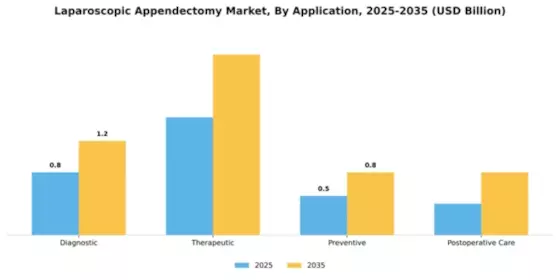
Therapeutic (Dominant) vs. Preventive (Emerging)
Therapeutic applications in the laparoscopic appendectomy market serve as the backbone of the segment, primarily focused on the effective treatment of appendicitis through advanced laparoscopic techniques. These procedures are designed to minimize recovery time and enhance surgical precision, making them the preferred choice among surgeons. In contrast, the preventive application is emerging as a significant focus in the market, driven by a growing trend towards preventive healthcare strategies. This segment encompasses innovative approaches, such as preoperative assessments and patient education, aimed at reducing the incidence of appendicitis. As healthcare providers prioritize proactive care, the preventive segment is likely to expand rapidly, highlighting a shift in the market toward enhancing patient education and long-term health outcomes.
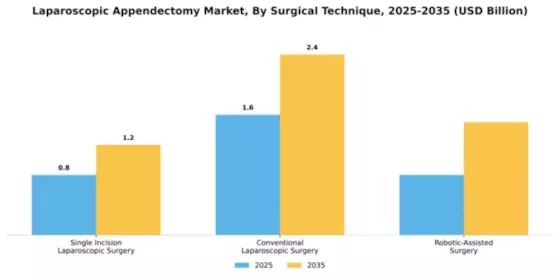
In the Laparoscopic Appendectomy Market, Single Incision Laparoscopic Surgery (SILS) holds the largest market share due to its minimally invasive nature, reduced recovery time, and lower post-operative pain. Conventional Laparoscopic Surgery continues to maintain a significant presence, being a well-established technique with high adoption rates among surgeons. Robotic-Assisted Surgery is gaining traction quickly and is recognized as the fastest-growing segment, driven by advancements in robotic technology that enhance precision and control during surgery.
Surgical Technique: Single Incision Laparoscopic Surgery (Dominant) vs. Robotic-Assisted Surgery (Emerging)
Single Incision Laparoscopic Surgery (SILS) has emerged as the dominant technique in the Laparoscopic Appendectomy Market, characterized by its unique approach of using one small incision, resulting in minimal scarring and quicker recovery times. It appeals to both patients and surgeons looking for less invasive options. In contrast, Robotic-Assisted Surgery is an emerging technique that is rapidly gaining popularity owing to its enhanced capabilities, providing surgeons with improved visualizations and superior dexterity. This segment is expected to expand further due to technological advancements and increased adoption in surgical practices, although its current market share is smaller compared to SILS.
In the Laparoscopic Appendectomy Market, the distribution of patient demographics shows that adults constitute the largest segment, significantly outpacing pediatric and geriatric patients. Adults, often experiencing appendicitis more frequently, represent a considerable portion of surgical interventions in laparoscopic appendectomies. Conversely, pediatric patients have shown the fastest growth trends due to increasing incidences of appendicitis and a rising preference for minimally invasive surgical techniques among healthcare professionals for younger populations.
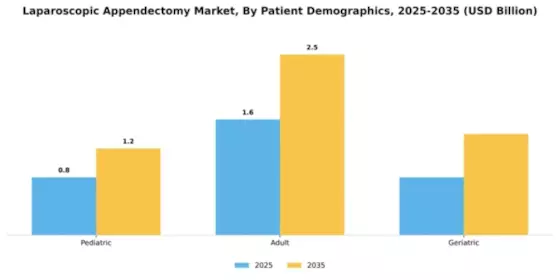
Adult (Dominant) vs. Pediatric (Emerging)
The adult demographic remains the dominant group in the Laparoscopic Appendectomy Market, primarily due to the higher prevalence of appendicitis in this age range. Adults are generally more likely to seek surgical intervention, and the advancements in laparoscopic techniques have further encouraged this segment's growth. Meanwhile, the pediatric segment is emerging rapidly as healthcare has increasingly emphasized minimally invasive surgeries for younger patients. Pediatric patients are often treated with great care, leading to an uptick in laparoscopic appendectomy procedures. The preference for reduced recovery times and lower complication rates has made this demographic critical in driving innovations and attracting investment in the market.
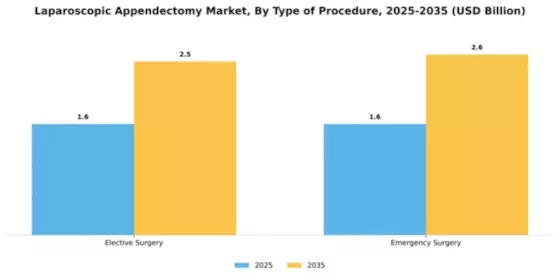
In the Laparoscopic Appendectomy Market, the distribution of market share between elective and emergency surgeries reveals a notable preference for elective procedures. Elective surgeries tend to dominate as they are scheduled in advance and allow for proper patient management, which positively affects recovery outcomes. Emergency surgeries, while less frequent, are critical for patients requiring immediate intervention, accounting for a significant portion of surgery types performed in urgent medical situations.
Surgery Type: Elective (Dominant) vs. Emergency (Emerging)
Elective surgeries represent the dominant force in the laparoscopic appendectomy market, characterized by their planned nature, allowing for comprehensive preoperative assessments and optimized surgical conditions. These procedures benefit from advancements in minimally invasive techniques, resulting in quicker recovery times and less postoperative pain. In contrast, emergency surgeries are emerging as a rapidly growing segment due to the increasing incidence of acute appendicitis cases. This shift is fueled by the rising prevalence of lifestyle-related health issues and enhanced awareness of treatment effectiveness, leading to more individuals seeking prompt surgical solutions.
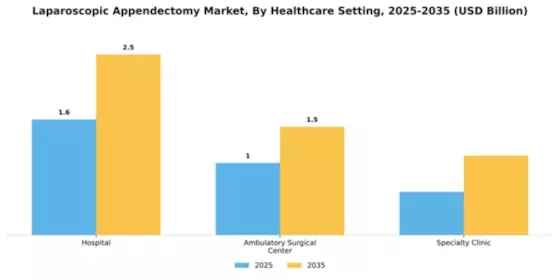
The Laparoscopic Appendectomy Market is predominantly driven by the hospital segment, which holds the largest share due to the advanced facilities and skilled surgical teams available. Hospitals are equipped with sophisticated technology and resources, enabling them to perform complex minimally invasive surgeries efficiently. Ambulatory Surgical Centers (ASCs) follow as a significant segment, gaining traction for their ability to streamline the outpatient surgical process, offering patients quicker recovery times and lower costs. Specialty clinics, while important, hold a lesser share compared to these two segments as they focus more on specific patient populations and less on general surgical procedures.
Hospital (Dominant) vs. Ambulatory Surgical Center (Emerging)
In the Laparoscopic Appendectomy Market, hospitals play a dominant role, equipped with cutting-edge technology and experienced surgical teams that ensure high-quality care. These institutions are often preferred for their comprehensive services and emergency capabilities. On the other hand, Ambulatory Surgical Centers are emerging as a competitive alternative, significantly growing in popularity due to their efficiency and cost-effectiveness. They focus on outpatient procedures, allowing patients to return home the same day, thereby offering a more convenient surgical experience. The trend towards minimally invasive surgery has fueled the growth of ASCs, as they cater to the increasing demand for quicker recovery times and lower healthcare costs.
Get more detailed insights about Laparoscopic Appendectomy Market Request Free Sample
North America is poised to maintain its leadership in the laparoscopic appendectomy market, holding a market size of $1.6 billion in 2025. Key growth drivers include advanced healthcare infrastructure, increasing prevalence of appendicitis, and a rising preference for minimally invasive surgeries. Regulatory support and reimbursement policies further enhance market dynamics, fostering innovation and adoption of new technologies. The United States stands as the largest contributor, with major players like Medtronic, Johnson & Johnson, and Intuitive Surgical leading the competitive landscape. The presence of established healthcare systems and a focus on research and development bolster the market. As the region continues to invest in surgical advancements, North America is expected to sustain its significant market share, driven by technological innovations and a robust healthcare framework.
Europe's laparoscopic appendectomy market is projected to reach $1.0 billion by 2025, driven by increasing surgical procedures and a growing aging population. The region benefits from strong regulatory frameworks that promote minimally invasive techniques, enhancing patient outcomes. Countries like Germany and the UK are at the forefront, with rising healthcare expenditures and a shift towards outpatient surgeries contributing to market growth. Germany, France, and the UK are leading players in this market, with significant investments from key companies such as B. Braun Melsungen AG and Olympus Corporation. The competitive landscape is characterized by collaborations and partnerships aimed at enhancing surgical technologies. As Europe embraces innovative solutions, the market is expected to expand, supported by favorable regulations and a focus on improving surgical efficiency.
The Asia-Pacific laparoscopic appendectomy market is estimated at $0.8 billion in 2025, reflecting a growing demand for minimally invasive surgical procedures. Factors such as increasing healthcare access, rising disposable incomes, and a surge in appendicitis cases are driving market growth. Additionally, government initiatives aimed at improving healthcare infrastructure are expected to further boost the market. Countries like Japan, China, and India are leading the charge, with a notable presence of key players such as Olympus Corporation and Stryker. The competitive landscape is evolving, with local manufacturers emerging alongside established global companies. As the region continues to invest in healthcare advancements, the laparoscopic appendectomy market is set to experience significant growth, driven by technological innovations and increasing patient awareness.
The Middle East and Africa laparoscopic appendectomy market is projected to reach $0.3 billion by 2025, driven by increasing healthcare investments and a growing focus on surgical innovations. However, challenges such as limited access to advanced medical technologies and varying healthcare standards across countries may hinder growth. Nonetheless, rising awareness of minimally invasive procedures is gradually changing the landscape. Countries like South Africa and the UAE are leading the market, with efforts to enhance healthcare infrastructure and attract foreign investments. Key players are beginning to establish a presence in the region, aiming to capitalize on the emerging demand for laparoscopic surgeries. As healthcare systems evolve, the potential for growth in this market remains significant, supported by ongoing investments and a shift towards modern surgical practices.
The Laparoscopic Appendectomy Market is characterized by a dynamic competitive landscape, driven by technological advancements, increasing demand for minimally invasive surgical procedures, and a growing emphasis on patient outcomes. Key players such as Medtronic (US), Johnson & Johnson (US), and Intuitive Surgical (US) are at the forefront, leveraging innovation and strategic partnerships to enhance their market positions. Medtronic (US) focuses on integrating advanced robotic systems into their surgical offerings, while Johnson & Johnson (US) emphasizes expanding its product portfolio through acquisitions and collaborations with healthcare providers. Intuitive Surgical (US) continues to lead in robotic-assisted surgery, enhancing its competitive edge through continuous innovation and user training programs, collectively shaping a landscape that prioritizes technological superiority and patient-centric solutions.In terms of business tactics, companies are increasingly localizing manufacturing to reduce costs and improve supply chain efficiency. The market appears moderately fragmented, with several players vying for market share, yet the influence of major companies remains substantial. This competitive structure allows for a diverse range of products and services, catering to varying surgical needs and preferences across different regions.In November Medtronic (US) announced the launch of its latest robotic-assisted surgical system, which integrates AI capabilities to enhance surgical precision and reduce recovery times. This strategic move is likely to bolster Medtronic's position in the market, as it aligns with the growing trend towards automation and AI in surgical procedures, potentially attracting a broader customer base seeking advanced surgical solutions.In October Johnson & Johnson (US) completed the acquisition of a leading surgical instrument manufacturer, which is expected to expand its product offerings and strengthen its market presence. This acquisition not only enhances Johnson & Johnson's portfolio but also signifies a strategic shift towards consolidating resources to better compete in the evolving landscape of minimally invasive surgeries.In September Intuitive Surgical (US) launched a comprehensive training program for surgeons utilizing its robotic systems, aimed at improving surgical outcomes and increasing adoption rates. This initiative underscores the importance of education and training in the competitive landscape, as it not only enhances user proficiency but also fosters trust in robotic-assisted procedures among healthcare professionals.As of December the competitive trends in the Laparoscopic Appendectomy Market are increasingly defined by digitalization, sustainability, and the integration of AI technologies. Strategic alliances among key players are shaping the landscape, facilitating knowledge sharing and resource optimization. The shift from price-based competition to a focus on innovation, technology, and supply chain reliability is evident, suggesting that future competitive differentiation will hinge on the ability to deliver superior surgical solutions and enhanced patient experiences.





The Laparoscopic Appendectomy Market is projected to grow at a 4.33% CAGR from 2025 to 2035, driven by technological advancements, increasing surgical adoption, and rising patient awareness.
New opportunities lie in:
By 2035, the market is expected to achieve robust growth, reflecting evolving surgical practices and enhanced patient outcomes.
| MARKET SIZE 2024 | 3.2(USD Billion) |
| MARKET SIZE 2025 | 3.34(USD Billion) |
| MARKET SIZE 2035 | 5.1(USD Billion) |
| COMPOUND ANNUAL GROWTH RATE (CAGR) | 4.33% (2025 - 2035) |
| REPORT COVERAGE | Revenue Forecast, Competitive Landscape, Growth Factors, and Trends |
| BASE YEAR | 2024 |
| Market Forecast Period | 2025 - 2035 |
| Historical Data | 2019 - 2024 |
| Market Forecast Units | USD Billion |
| Key Companies Profiled | Medtronic (US), Johnson & Johnson (US), Stryker (US), Boston Scientific (US), B. Braun Melsungen AG (DE), Olympus Corporation (JP), Conmed Corporation (US), Karl Storz (DE), Intuitive Surgical (US) |
| Segments Covered | Application, Surgical Technique, Patient Demographics, Type of Procedure, Healthcare Setting |
| Key Market Opportunities | Integration of advanced imaging technologies enhances precision in the Laparoscopic Appendectomy Market. |
| Key Market Dynamics | Technological advancements and increasing preference for minimally invasive procedures drive growth in the Laparoscopic Appendectomy Market. |
| Countries Covered | North America, Europe, APAC, South America, MEA |
The Laparoscopic Appendectomy Market is valued at approximately 3.2 USD Billion in 2024.
The market is expected to reach a valuation of 5.1 USD Billion by 2035.
The market is anticipated to grow at a CAGR of 4.33% from 2025 to 2035.
Key players include Medtronic, Johnson & Johnson, Stryker, and Boston Scientific, among others.
The main applications include Diagnostic, Therapeutic, Preventive, and Postoperative Care, with Therapeutic projected to grow from 1.5 to 2.3 USD Billion.
By surgical technique, Conventional Laparoscopic Surgery is expected to grow from 1.6 to 2.4 USD Billion.
The market segments by patient demographics include Pediatric, Adult, and Geriatric, with Adult projected to grow from 1.6 to 2.5 USD Billion.
The market includes Elective and Emergency Surgery, both expected to grow from 1.6 to 2.6 USD Billion.
Relevant healthcare settings include Hospitals, Ambulatory Surgical Centers, and Specialty Clinics, with Hospitals projected to grow from 1.6 to 2.5 USD Billion.
Trends include advancements in surgical techniques and increasing demand for minimally invasive procedures, contributing to the overall market growth.



Kindly complete the form below to receive a free sample of this Report

“This is really good guys. Excellent work on a tight deadline. I will continue to use you going forward and recommend you to others. Nice job”


“Thanks. It’s been a pleasure working with you, please use me as reference with any other Intel employees.”


“Thanks for sending the report it gives us a good global view of the Betaïne market.”


“Thank you, this will be very helpful for OQS.”


“We found the report very insightful! we found your research firm very helpful. I'm sending this email to secure our future business.”


“I am very pleased with how market segments have been defined in a relevant way for my purposes (such as "Portable Freezers & refrigerators" and "last-mile"). In general the report is well structured. Thanks very much for your efforts.”


“I have been reading the first document or the study, ,the Global HVAC and FP market report 2021 till 2026. Must say, good info! I have not gone in depth at all parts, but got a good indication of the data inside!”


“We got the report in time, we really thank you for your support in this process. I also thank to all of your team as they did a great job.”


“The Automotive 48V ECU Components Procurement Intelligence Study” was a complex project, but the Market Research Future (MRFR) team handled it with quality, agility, and customer-centricity. They delivered all requested data on time and within the agreed scope. The team, including Shubhendra Anand and Rahul Gotadki, was always readily available to clarify questions and swiftly implement necessary adjustments, driving the project to a successful conclusion within a very demanding timeframe.
I would also like to specifically commend Akshay Agarwal for his responsiveness and support at every stage—from our initial inquiry on May 6th through to final delivery on June 18th. His dedication made the entire process seamless.”



