×
Request Free Sample ×

Kindly complete the form below to receive a free sample of this Report

* Please use a valid business email

Leading companies partner with us for data-driven Insights

clients tt-cursor
Hero Background

Laser Headlight Market

ID: MRFR/AT/8898-CR
128 Pages
Swapnil Palwe
August 2023

Laser Headlight Market Research Report Information By Vehicle Type (Passenger Vehicle , and Commercial Vehicle), By Power Type (35W, 40W, and 60W), By Technology Type (Intelligent, and Conventional), By Technology Type (OEM, and Aftermarket), and By Region (North America, Europe, Asia-Pacific, Middle East & Africa, and South America) –Market Forecast Till 2035

Share:
Download PDF ×

We do not share your information with anyone. However, we may send you emails based on your report interest from time to time. You may contact us at any time to opt-out.

Laser Headlight Market Infographic
Purchase Options

Laser Headlight Market Summary

As per MRFR analysis, the Laser Headlight Market Size was estimated at 2388.51 USD Million in 2024. The Laser Headlight industry is projected to grow from 3117.77 USD Million in 2025 to 44772.86 USD Million by 2035, exhibiting a compound annual growth rate (CAGR) of 30.53 during the forecast period 2025 - 2035.

Key Market Trends & Highlights

The Laser Headlight Market is poised for substantial growth driven by technological advancements and evolving consumer preferences.

  • Technological advancements in laser headlight systems are enhancing visibility and safety in the automotive sector.
  • The Asia-Pacific region is emerging as the fastest-growing market, driven by increasing demand for innovative lighting solutions.
  • The aerospace segment is witnessing rapid growth as manufacturers seek to integrate advanced lighting technologies for improved performance.
  • Rising demand for enhanced visibility and regulatory support for advanced lighting technologies are key drivers propelling market expansion.

Market Size & Forecast

2024 Market Size 2388.51 (USD Million)
2035 Market Size 44772.86 (USD Million)
CAGR (2025 - 2035) 30.53%

Major Players

BMW (DE), Audi (DE), Mercedes-Benz (DE), Toyota (JP), Volkswagen (DE), Porsche (DE), Ford (US), General Motors (US), Nissan (JP)

Laser Headlight Market Trends

The Laser Headlight Market is currently experiencing a notable transformation, driven by advancements in technology and increasing consumer demand for enhanced vehicle safety and aesthetics. As automotive manufacturers strive to differentiate their offerings, the integration of laser headlights is becoming more prevalent. These systems provide superior illumination, energy efficiency, and a longer lifespan compared to traditional lighting solutions. Furthermore, the growing emphasis on sustainability within the automotive sector is likely to propel the adoption of laser headlights, as they align with eco-friendly initiatives by reducing energy consumption and carbon emissions. In addition to technological advancements, regulatory frameworks are evolving to accommodate the unique characteristics of laser headlights. Governments are increasingly recognizing the potential benefits of these systems, which may lead to more favorable policies and standards. This shift could encourage manufacturers to invest in research and development, ultimately fostering innovation within the Laser Headlight Market. As the industry progresses, it appears that consumer awareness and acceptance will play a crucial role in shaping the future landscape of automotive lighting, with laser technology poised to take center stage in the coming years.

Technological Advancements

The Laser Headlight Market is witnessing rapid technological innovations, enhancing the performance and efficiency of lighting systems. These advancements include improved beam control, adaptive lighting features, and integration with smart vehicle technologies, which collectively contribute to a safer driving experience.

Sustainability Focus

There is a growing emphasis on sustainability within the automotive industry, prompting manufacturers to adopt eco-friendly technologies. Laser headlights, known for their energy efficiency and reduced environmental impact, align well with this trend, potentially driving their increased adoption.

Regulatory Developments

As the Laser Headlight Market evolves, regulatory bodies are adapting to the unique attributes of laser lighting. This may result in more supportive policies and standards, encouraging manufacturers to explore and implement laser technology in their vehicle designs.

Laser Headlight Market Drivers

Technological Advancements

The Global Laser Headlight Market Industry is experiencing rapid technological advancements that enhance the performance and efficiency of laser headlights. Innovations in laser technology, such as the development of solid-state lasers, contribute to improved brightness and energy efficiency. These advancements not only increase visibility during nighttime driving but also reduce energy consumption, aligning with global sustainability goals. As a result, the market is projected to grow significantly, with estimates indicating a value of 2.39 USD Billion in 2024. This trend suggests that manufacturers are increasingly investing in research and development to stay competitive in the evolving automotive landscape.

Market Segment Insights

By Application: Automotive (Largest) vs. Aerospace (Fastest-Growing)

The Laser Headlight Market is segmenting into various applications, with the automotive sector holding the largest market share. This segment is primarily driven by the increasing demand for advanced lighting solutions in vehicles, where laser headlights offer superior brightness and efficiency compared to traditional lighting systems. As more automotive manufacturers integrate laser headlights into their new models, this segment is likely to continue dominating the market well into the future. In contrast, the aerospace segment is emerging as the fastest-growing application within the Laser Headlight Market. The shift towards LED and laser technologies in aviation is motivated by the need for enhanced visibility and energy efficiency during night flights. With regulatory bodies also pushing for higher safety standards, the aerospace sector's adoption of laser headlights is expected to grow significantly, driven by both technological advancements and a focus on reducing environmental impact.

Automotive: Laser Headlights (Dominant) vs. Aerospace: Laser Headlights (Emerging)

The automotive segment of the Laser Headlight Market stands as the dominant force, characterized by widespread adoption across various vehicle types. Major automakers are investing in laser technology to enhance vehicle lighting performance, offering better illumination while optimizing energy consumption. This segment is distinguished by innovations that focus on safety, aesthetics, and functionality in vehicle designs. Meanwhile, the aerospace sector represents an emerging area for laser headlights, where the need for optimal visibility and efficiency can lead to competitive advantages. The integration of laser technology in aircraft lighting systems not only aligns with safety enhancements but also contributes to significant energy savings, making it a crucial focal point for future growth and innovation in aviation technology.

By End Use: Passenger Vehicles (Largest) vs. Heavy Machinery (Fastest-Growing)

The Laser Headlight Market has diverse applications across multiple end-use segments, with passenger vehicles commanding the largest share. This segment is favored for its robust demand driven by the increasing preferences for advanced automotive lighting technologies. On the other hand, heavy machinery is emerging as a significant segment, showcasing rapid adoption rates due to the rising focus on operational efficiency and safety in industrial applications. Commercial vehicles and motorcycles also contribute to the market, though to a lesser extent than passenger vehicles and heavy machinery.

Passenger Vehicles: Dominant vs. Heavy Machinery: Emerging

Passenger vehicles represent a dominant segment in the Laser Headlight Market, driven by the growing consumer demand for luxury and safety features. This sector increasingly adopts cutting-edge technologies, like laser headlights, for improved visibility and distinctive aesthetics in vehicles. Meanwhile, heavy machinery is emerging as a promising segment, leveraging advancements in laser lighting to enhance operational efficiency and safety in challenging work environments. The integration of laser technology in this sector is accelerating, driven by regulatory pressures and the need for improved visibility during nighttime operations. This contrast highlights the robustness of the passenger vehicle sector while illustrating the potential of heavy machinery to transform its operations through innovative lighting solutions.

By Technology: Laser Diode (Largest) vs. Solid State Laser (Fastest-Growing)

The Laser Headlight Market is primarily composed of four technologies: Laser Diode, Solid State Laser, Fiber Laser, and Semiconductor Laser. Among these, Laser Diode holds the largest market share due to its established application in automotive lighting systems, providing efficiency and longevity. Following closely is the Solid State Laser, which is gaining traction due to its compact size and improved performance in high-intensity lighting applications. Both Fiber Laser and Semiconductor Laser technologies have niche markets but are yet to achieve significant shares comparable to the dominant players.

Technology: Laser Diode (Dominant) vs. Solid State Laser (Emerging)

Laser Diode technology remains the dominant force in the Laser Headlight Market due to its maturity and reliability, making it the preferred choice for many automotive manufacturers. It offers superior energy efficiency, robust performance, and a longer lifespan compared to other technologies. Alternatively, Solid State Laser technology is an emerging segment, recognized for its compact design and versatility in various lighting applications. This technology is rapidly becoming popular in high-end vehicle models, contributing to its designation as the fastest-growing segment. Moreover, its ability to produce brighter and more precise lighting is appealing to manufacturers looking to enhance vehicle aesthetics and safety.

By Light Type: Low Beam (Largest) vs. Adaptive Headlights (Fastest-Growing)

In the Laser Headlight Market, the segmentation by light type reveals fascinating insights into consumer preferences and usage patterns. The Low Beam segment holds the largest share, reflecting its essential role in everyday driving conditions, where safety and visibility are paramount. In contrast, the Adaptive Headlights segment, representing innovative technology, is rapidly gaining traction due to the increasing demand for enhanced driving experiences and intelligent lighting systems. Growth trends indicate a significant momentum in the Adaptive Headlights category, propelled by advancements in vehicle technology and increasing consumer awareness regarding road safety. As manufacturers integrate these sophisticated illumination systems into new vehicle models, the adoption rates are expected to surge. Additionally, legislations promoting energy-efficient lighting solutions are further driving interest, solidifying Adaptive Headlights as a key player in the evolving landscape of the Laser Headlight Market.

Low Beam (Dominant) vs. Daytime Running Lights (Emerging)

The Low Beam segment remains the dominant force in the Laser Headlight Market, primarily due to its established presence and crucial function for night-time and low-visibility driving conditions. This segment is characterized by the widespread use in various vehicle types, including passenger cars and commercial vehicles, making it a staple in automotive lighting solutions. On the other hand, the Daytime Running Lights segment is emerging as a significant trend, primarily driven by regulations mandating their use for improved visibility during daylight. Though still in its growth phase, the adoption of Daytime Running Lights is gaining momentum as safety features become increasingly prioritized in vehicle designs.

By Sales Channel: OEM (Largest) vs. Aftermarket (Fastest-Growing)

In the Laser Headlight Market, the sales channel landscape is characterized by a notable distribution among OEM, aftermarket, online retail, and physical retail segments. The OEM segment holds the largest market share, benefiting from established partnerships with vehicle manufacturers, which leads to high adoption among new vehicles. The aftermarket follows, providing an important revenue source as vehicle owners seeking upgrades drive demand. Online retail and physical retail segments also contribute significantly, as consumers' preferences diversify towards convenience and hands-on experiences respectively.

Sales Channel: OEM (Dominant) vs. Aftermarket (Emerging)

The OEM segment remains the dominant player in the Laser Headlight Market, primarily due to its robust integration into new vehicle models, establishing trust in performance and quality. OEMs leverage their relationships with manufacturers to ensure a steady stream of sales. In contrast, the aftermarket segment emerges as a vital player, catering to existing vehicles and providing enhancements that reflect evolving technological advancements. This segment attracts consumers seeking innovative and stylish lighting solutions, thus driving rapid growth. As vehicle ownership increases and more consumers show interest in customizing their vehicles, the aftermarket is poised to expand significantly, capitalizing on the trend of personalization.

Get more detailed insights about Laser Headlight Market

Regional Insights

North America : Technological Innovation Leader

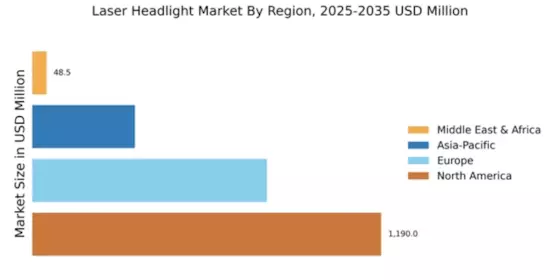
North America is witnessing significant growth in the laser headlight market, driven by increasing consumer demand for advanced automotive technologies and stringent safety regulations. The market size is projected at $800.0 million, reflecting a robust interest in high-performance lighting solutions. Regulatory bodies are promoting energy-efficient technologies, which further catalyzes market expansion. The shift towards electric vehicles (EVs) is also a key driver, as manufacturers seek to enhance vehicle aesthetics and functionality. The competitive landscape in North America is dominated by major players such as Ford and General Motors, alongside luxury brands like BMW and Audi. These companies are investing heavily in R&D to innovate and improve laser headlight technologies. The presence of a well-established automotive industry, coupled with consumer preference for premium features, positions North America as a critical market for laser headlights. As manufacturers continue to integrate these technologies, market dynamics are expected to evolve rapidly.

Europe : Automotive Hub of Innovation

Europe is a pivotal region for the laser headlight market, with a market size of $700.0 million. The growth is fueled by stringent EU regulations aimed at enhancing vehicle safety and energy efficiency. European manufacturers are at the forefront of adopting laser technology, driven by consumer demand for high-quality lighting solutions. The region's commitment to sustainability and innovation is evident in its regulatory frameworks, which encourage the adoption of advanced automotive technologies. Leading countries such as Germany, France, and the UK are home to key players like Audi, Mercedes-Benz, and Volkswagen. These companies are leveraging their technological expertise to develop cutting-edge laser headlight systems. The competitive landscape is characterized by a focus on premium features and customization, catering to a discerning consumer base. As the market evolves, collaboration between manufacturers and regulatory bodies will be crucial in shaping future developments.

Asia-Pacific : Emerging Market Powerhouse

Asia-Pacific is emerging as a powerhouse in the laser headlight market, with a market size of $800.0 million. The region's growth is driven by rapid urbanization, increasing disposable incomes, and a rising demand for advanced automotive technologies. Countries like Japan and China are leading the charge, with significant investments in R&D and manufacturing capabilities. The regulatory environment is also evolving, promoting energy-efficient lighting solutions that align with global sustainability goals. Japan and China are home to major automotive manufacturers such as Toyota and Nissan, who are actively integrating laser headlight technology into their vehicles. The competitive landscape is marked by innovation and collaboration, as companies strive to meet consumer expectations for quality and performance. As the market matures, the focus will shift towards enhancing user experience and integrating smart technologies into lighting systems.

Middle East and Africa : Emerging Market Potential

The Middle East and Africa (MEA) region presents significant growth opportunities in the laser headlight market, with a market size of $88.51 million. The growth is primarily driven by increasing vehicle ownership and a rising demand for advanced automotive technologies. As urbanization accelerates, consumers are becoming more aware of the benefits of high-performance lighting solutions. Regulatory frameworks are gradually evolving to support the adoption of energy-efficient technologies, which will further stimulate market growth. Countries like South Africa and the UAE are witnessing a surge in automotive sales, attracting key players to invest in the region. The competitive landscape is characterized by a mix of local and international manufacturers, all vying for market share. As the region continues to develop, the integration of laser headlight technology will play a crucial role in enhancing vehicle safety and aesthetics, positioning MEA as a promising market for future investments.

Key Players and Competitive Insights

The Laser Headlight Market is currently characterized by a dynamic competitive landscape, driven by technological advancements and increasing consumer demand for enhanced vehicle safety and aesthetics. Major players such as BMW (DE), Audi (DE), and Mercedes-Benz (DE) are at the forefront, focusing on innovation and strategic partnerships to solidify their market positions. These companies are not only investing heavily in research and development but are also exploring collaborations with tech firms to integrate advanced lighting technologies into their vehicles, thereby enhancing their competitive edge.

In terms of business tactics, companies are increasingly localizing manufacturing to reduce costs and improve supply chain efficiency. The market structure appears moderately fragmented, with several key players exerting considerable influence. This fragmentation allows for niche players to emerge, yet the collective strength of established brands like Volkswagen (DE) and Toyota (JP) continues to shape market dynamics, as they leverage their extensive distribution networks and brand loyalty to capture market share.

In November 2025, Audi (DE) announced a partnership with a leading semiconductor manufacturer to develop next-generation laser headlight systems. This strategic move is likely to enhance Audi's technological capabilities, allowing for more precise and adaptive lighting solutions that could significantly improve nighttime driving safety. Such innovations may position Audi as a leader in the premium segment of the market, appealing to consumers seeking cutting-edge technology.

Similarly, in October 2025, BMW (DE) unveiled its latest model featuring an advanced laser headlight system that adapts to driving conditions in real-time. This development underscores BMW's commitment to innovation and could potentially set a new standard in the automotive lighting sector. By prioritizing safety and user experience, BMW aims to differentiate itself in a competitive market increasingly focused on technological advancements.

In September 2025, Mercedes-Benz (DE) expanded its laser headlight offerings to include more affordable models, thereby broadening its customer base. This strategic decision reflects a growing trend towards inclusivity in high-tech automotive features, allowing more consumers to benefit from advanced lighting technologies. By making these innovations accessible, Mercedes-Benz is likely to enhance its market presence and appeal to a wider demographic.

As of December 2025, the Laser Headlight Market is witnessing trends such as digitalization, sustainability, and the integration of artificial intelligence. Strategic alliances are becoming increasingly pivotal, as companies recognize the need to collaborate to stay competitive. The shift from price-based competition to a focus on innovation and technology is evident, with firms prioritizing reliability in their supply chains. Looking ahead, competitive differentiation will likely hinge on the ability to innovate and adapt to evolving consumer preferences, suggesting a promising future for those who can effectively leverage these trends.

Key Companies in the Laser Headlight Market market include

Industry Developments

Marelli, an automotive industry mobility technology supplier, introduced the LeanLight headlamp and rear light concepts in January 2024. The products feature up to 20% fewer components, a 20% reduction in weight, and a 6 kg reduction in CO2 emissions when compared to conventional automotive illumination. The majority of systems utilizing Marelli's Lean platforms are pre-developed, allowing automobile manufacturers to personalize specific functionalities. This module-based platform strategy is intended to appeal to fleet purchasers and budget-conscious consumers on entry-level vehicles, brands, and trim levels.

The implementation of an innovative injection molding technique for the LeanLight results in decreased energy consumption and weight. 

In January 2023, KYOCERA SLD Laser, Inc. (KSLD), a global leader in the commercialization of laser light sources, announced the availability of the world’s first LaserLightTM Headlight Modules, which produce dual illumination with high brightness white light and Infrared for night vision and sensing safety and visibility enhancement in automotive mobility applications.

Additionally, a recently developed surface treatment solution obviates the necessity for a chemical coating, thereby further enhancing the sustainability advantages of the product. Concurrently with the LeanLight system, Marelli introduced the LeanDisplay portfolio at CES 2024. This system provides enhanced local dimming capabilities at a significantly reduced cost, alongside an improved environmental impact. Achieving a 40% reduction in weight and enhanced CO2 performance were accomplished via the implementation of a design-for-manufacturing strategy that led to the reduction of components by 60%, optimization of the backlight technology by integrating proprietary optics and LEDs, and supply chain localization.

Future Outlook

Laser Headlight Market Future Outlook

The Laser Headlight Market is projected to grow at a 30.53% CAGR from 2024 to 2035, driven by advancements in automotive technology, increasing safety regulations, and consumer demand for enhanced visibility.

New opportunities lie in:

  • Development of laser headlight retrofitting kits for existing vehicles.
  • Partnerships with automotive manufacturers for integrated laser lighting solutions.
  • Expansion into emerging markets with tailored laser headlight products.

By 2035, the Laser Headlight Market is expected to be a dominant segment in automotive lighting.

Market Segmentation

Laser Headlight Market End Use Outlook

  • Passenger Vehicles
  • Commercial Vehicles
  • Motorcycles
  • Heavy Machinery

Laser Headlight Market Light Type Outlook

  • Low Beam
  • High Beam
  • Adaptive Headlights
  • Daytime Running Lights

Laser Headlight Market Technology Outlook

  • Laser Diode
  • Solid State Laser
  • Fiber Laser
  • Semiconductor Laser

Laser Headlight Market Application Outlook

  • Automotive
  • Aerospace
  • Marine
  • Industrial
  • Consumer Electronics

Laser Headlight Market Sales Channel Outlook

  • OEM
  • Aftermarket
  • Online Retail
  • Physical Retail

Report Scope

MARKET SIZE 2024 2388.51(USD Million)
MARKET SIZE 2025 3117.77(USD Million)
MARKET SIZE 2035 44772.86(USD Million)
COMPOUND ANNUAL GROWTH RATE (CAGR) 30.53% (2024 - 2035)
REPORT COVERAGE Revenue Forecast, Competitive Landscape, Growth Factors, and Trends
BASE YEAR 2024
Market Forecast Period 2025 - 2035
Historical Data 2019 - 2024
Market Forecast Units USD Million
Key Companies Profiled BMW (DE), Audi (DE), Mercedes-Benz (DE), Toyota (JP), Volkswagen (DE), Porsche (DE), Ford (US), General Motors (US), Nissan (JP)
Segments Covered Application, End Use, Technology, Light Type, Sales Channel
Key Market Opportunities Advancements in automotive lighting technology drive demand for innovative solutions in the Laser Headlight Market.
Key Market Dynamics Technological advancements in laser headlight systems drive competitive dynamics and influence consumer preferences in automotive lighting.
Countries Covered North America, Europe, APAC, South America, MEA

Market Highlights

Author
Swapnil Palwe
Team Lead - Research

With a technical background as Bachelor's in Mechanical Engineering, with MBA in Operations Management , Swapnil has 6+ years of experience in market research, consulting and analytics with the tasks of data mining, analysis, and project execution. He is the POC for our clients, for their consulting projects running under the Automotive/A&D domain. Swapnil has worked on major projects in verticals such as Aerospace & Defense, Automotive and many other domain projects. He has worked on projects for fortune 500 companies' syndicate and consulting projects along with several government projects.

Leave a Comment

FAQs

How much is the Laser Headlight Market?

The Laser Headlight Market size is expected to be valued at USD 1,479.33 Million in 2022.

What is the growth rate of the laser headlight market?

The global market is projected to grow at a CAGR of 30.53% during the forecast period, 2024-2032.

Which region held the largest market share in the laser headlight market?

Europe had the largest share of the Laser Headlight Market.

Who are the key players in the laser headlight market?

The key players in the market are OSRAM, KYOCERA SLD LASER, ZKW, MAGNETI MARELLI, VALEO, LEDO AUTO, INFINEON TECHNOLOGIES, KOITO MANUFACTURING CO., LTD, BAYERISCHE MOTOREN WERKE AG, and AUDI AG.

Which vehicle type led the laser headlight market?

The passenger vehicle type led the laser headlight market in 2022.

Which technology type had the largest market share in the laser headlight market?

Intelligent technology type had the largest market share in the laser headlight market.

Download Free Sample

Kindly complete the form below to receive a free sample of this Report

Compare Licence

×
Features License Type
Single User Multiuser License Enterprise User
Price $4,950 $5,950 $7,250
Maximum User Access Limit 1 User Upto 10 Users Unrestricted Access Throughout the Organization
Free Customization
Direct Access to Analyst
Deliverable Format
Platform Access
Discount on Next Purchase 10% 15% 15%
Printable Versions