×
Request Free Sample ×

Kindly complete the form below to receive a free sample of this Report

* Please use a valid business email

Leading companies partner with us for data-driven Insights

clients tt-cursor
Hero Background

Law Enforcement Software Market

ID: MRFR/ICT/4979-HCR
100 Pages
Ankit Gupta
October 2025

Law Enforcement Software Market, by Component (Solution, Services), Deployment (On-Premise, Cloud), Solution (CAD, Jail Management, Incident Response, Digital Policing), Services (Implementation, Training and Support)— Forecast till 2035

Share:
Download PDF ×

We do not share your information with anyone. However, we may send you emails based on your report interest from time to time. You may contact us at any time to opt-out.

Law Enforcement Software Market Infographic
Purchase Options

Law Enforcement Software Market Summary

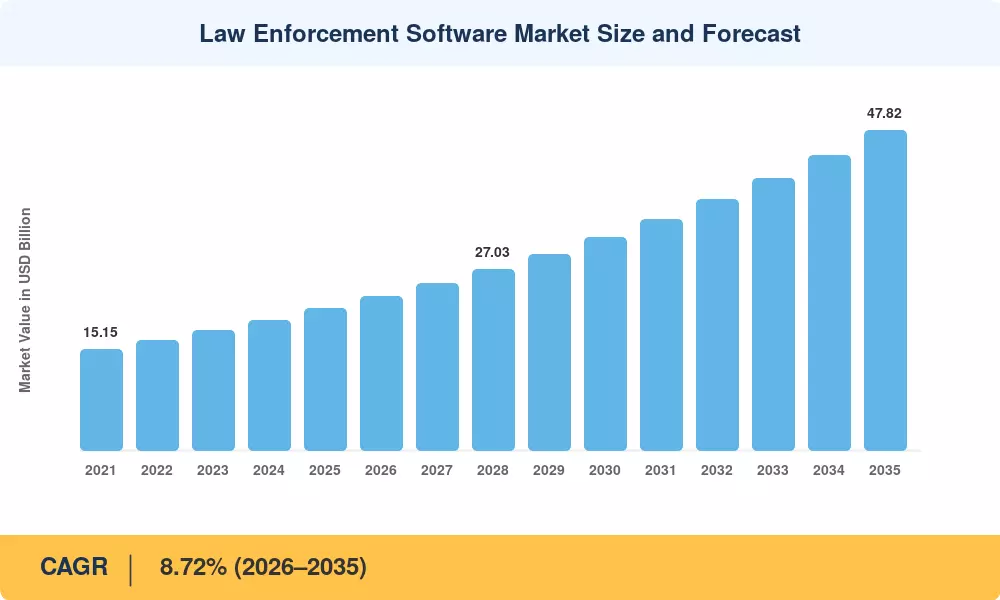
As per MRFR analysis, the Law Enforcement Software Market Size was estimated at 20.2 USD Billion in 2024. The Law Enforcement Software industry is projected to grow from 21.74 USD Billion in 2025 to 49.54 USD Billion by 2035, exhibiting a compound annual growth rate (CAGR) of 8.58 during the forecast period 2025 - 2035.

Key Market Trends & Highlights

The Law Enforcement Software Market is experiencing robust growth driven by technological advancements and increasing public safety demands.

  • The integration of Artificial Intelligence is transforming operational efficiencies in law enforcement agencies across North America.
  • Data transparency is becoming a critical focus, enhancing trust and accountability within law enforcement operations in the Asia-Pacific region.
  • Collaborative platforms for interagency communication are gaining traction, particularly in the Incident Management segment, which remains the largest market segment.
  • Rising crime rates and an increased focus on public safety are key drivers propelling the demand for cloud-based solutions in law enforcement software.

Market Size & Forecast

2024 Market Size 20.2 (USD Billion)
2035 Market Size 49.54 (USD Billion)
CAGR (2025 - 2035) 8.58%

Major Players

Motorola Solutions (US), Tyler Technologies (US), Palantir Technologies (US), Axon Enterprise (US), Verint Systems (US), CivicPlus (US), Zetron (US), Sierra Wireless (CA), NEC Corporation (JP)

Law Enforcement Software Market Trends

The Law Enforcement Software Market is currently experiencing a transformative phase, driven by advancements in technology and the increasing demand for efficient public safety solutions. As law enforcement agencies seek to enhance operational efficiency, the integration of artificial intelligence, data analytics, and cloud computing is becoming more prevalent. This shift not only streamlines processes but also improves decision-making capabilities, enabling agencies to respond more effectively to incidents. Furthermore, the growing emphasis on transparency and accountability within law enforcement is prompting the adoption of software solutions that facilitate better data management and reporting. In addition, the Law Enforcement Software Market is witnessing a rise in collaborative platforms that foster communication between various agencies. This trend appears to be fueled by the need for coordinated responses to complex challenges such as cybercrime and terrorism. As agencies increasingly recognize the value of sharing information and resources, the development of interoperable systems is likely to gain momentum. Overall, the landscape of the Law Enforcement Software Market is evolving, with a focus on innovation and collaboration to meet the demands of modern policing.

Integration of Artificial Intelligence

The incorporation of artificial intelligence into law enforcement software is reshaping how agencies operate. AI technologies enhance predictive policing, enabling law enforcement to anticipate criminal activities and allocate resources more effectively. This trend suggests a shift towards data-driven decision-making, which may lead to improved public safety outcomes.

Emphasis on Data Transparency

There is a growing focus on data transparency within the Law Enforcement Software Market. Agencies are increasingly adopting solutions that allow for better data management and reporting, which may enhance accountability and public trust. This trend indicates a movement towards more open and transparent policing practices.

Collaborative Platforms for Interagency Communication

The rise of collaborative platforms is facilitating improved communication among law enforcement agencies. These systems enable the sharing of information and resources, which is crucial for addressing complex issues such as cybercrime. This trend highlights the importance of interoperability in modern law enforcement operations.

Law Enforcement Software Market Drivers

Increasing Crime Rates

The Global Law Enforcement Software Market Industry is experiencing growth due to rising crime rates across various regions. As urbanization continues to expand, law enforcement agencies are increasingly adopting advanced software solutions to enhance their operational efficiency. For instance, cities with higher crime rates are investing in predictive policing tools, which utilize data analytics to forecast criminal activity. This trend is expected to drive the market's value to approximately 20.2 USD Billion in 2024, as agencies seek to leverage technology to combat crime effectively.

Technological Advancements

Rapid advancements in technology are significantly influencing the Global Law Enforcement Software Market Industry. Innovations such as artificial intelligence, machine learning, and big data analytics are being integrated into law enforcement software, enabling agencies to process vast amounts of data efficiently. These technologies facilitate real-time decision-making and improve investigative processes. As a result, the market is projected to grow at a CAGR of 7.35% from 2025 to 2035, potentially reaching 44.1 USD Billion by 2035. This growth reflects the increasing reliance on technology to enhance public safety.

Public Demand for Transparency

There is a growing public demand for transparency and accountability in law enforcement, which is influencing the Global Law Enforcement Software Market Industry. Citizens are increasingly advocating for the use of technology that promotes transparency in policing practices, such as body-worn cameras and data management systems. These tools not only enhance accountability but also improve community relations. As law enforcement agencies respond to these demands, the adoption of software solutions that facilitate transparency is likely to increase, further propelling market growth.

Government Initiatives and Funding

Government initiatives aimed at enhancing public safety are driving the Global Law Enforcement Software Market Industry. Various governments are allocating substantial budgets to modernize law enforcement agencies and improve their technological capabilities. For example, federal grants and funding programs are being established to support the acquisition of advanced software solutions. This financial backing encourages law enforcement agencies to invest in innovative technologies, thereby fostering market growth. The anticipated increase in government spending is expected to contribute significantly to the market's expansion in the coming years.

Integration of Cloud-Based Solutions

The integration of cloud-based solutions is transforming the Global Law Enforcement Software Market Industry. Cloud technology offers law enforcement agencies the ability to store and access data securely while facilitating collaboration among different departments. This shift towards cloud computing enhances operational efficiency and reduces costs associated with traditional IT infrastructure. As more agencies recognize the benefits of cloud solutions, the market is expected to witness a significant uptick in adoption rates, contributing to its overall growth trajectory.

Market Segment Insights

By Application: Incident Management (Largest) vs. Crime Analysis (Fastest-Growing)

The Law Enforcement Software Market is characterized by distinct segment values including Crime Analysis, Incident Management, Case Management, Evidence Management, and Reporting and Analytics. Among these, Incident Management holds the largest market share, driven by its crucial role in police department operations and operational efficiency. In contrast, Crime Analysis is emerging as the fastest-growing segment due to increasing demand for data-driven insights to combat crime effectively and improve public safety measures. Growth trends within this segment are influenced by advancements in technology, particularly in data analytics and incident reporting systems. Agencies are increasingly adopting software that integrates real-time data collection and processing capabilities, enhancing response times and resource allocation. Furthermore, the rise in cyber incidents and property crimes has heightened the focus on comprehensive incident management and crime analysis tools, positioning these segments for significant growth in the upcoming years.

Incident Management (Dominant) vs. Crime Analysis (Emerging)

Incident Management is a dominant force within the Law Enforcement Software Market, serving as the backbone for effective police operations. This segment is characterized by its comprehensive approach, encompassing everything from initial reporting to case closure. It facilitates streamlined communication between departments and ensures timely responses to incidents. On the other hand, Crime Analysis is rapidly emerging, fueled by the need for law enforcement agencies to leverage data analytics. This segment focuses on utilizing historical data, crime patterns, and predictive analysis to formulate strategic interventions, making it indispensable for modern policing. As agencies prioritize technology-driven solutions, the growth of Crime Analysis is expected to accelerate, complementing the established practices of Incident Management.

By Deployment Type: Cloud-Based (Largest) vs. On-Premises (Fastest-Growing)

In the Law Enforcement Software Market, cloud-based deployment has secured the largest market share, primarily due to its accessibility, scalability, and cost-effectiveness. This model enables law enforcement agencies to rapidly deploy software solutions without the overhead of physical infrastructure. In contrast, the on-premises deployment type, although smaller in share, is experiencing rapid growth as agencies aim to maintain control over their data and adhere to stringent security protocols, establishing a competitive position against cloud solutions.

Cloud-Based (Dominant) vs. On-Premises (Emerging)

Cloud-based law enforcement software is currently the dominant deployment type, characterized by its flexibility, real-time updates, and integration capabilities with various technologies. This segment addresses the need for accessible operations across different locations, enhancing collaboration among law enforcement units. On the other hand, on-premises solutions are emerging as agencies prioritize data privacy and compliance with internal regulations. While they often involve higher initial investments, they offer heightened security, thus appealing to organizations with significant data safeguarding requirements. As such, both deployment types are shaping the future of law enforcement operations, catering to varying agency needs.

By End User: Law Enforcement Agencies (Largest) vs. Private Security Firms (Fastest-Growing)

The Law Enforcement Software Market is primarily segmented into Law Enforcement Agencies, Government Agencies, Private Security Firms, and Judicial Institutions. Among these, Law Enforcement Agencies hold the largest market share due to their critical need for effective software solutions that enhance operational efficiency and ensure public safety. Private Security Firms have emerged as a significant counterpart, steadily increasing their market presence as businesses seek added security measures in a changing landscape. The growth of this segment is fueled by various trends, including the integration of advanced technologies such as artificial intelligence and machine learning in law enforcement solutions. There is a notable rise in private security firms adopting sophisticated software to protect assets and personnel, which points towards a shift in emphasis on proactive security instead of reactive measures. The heightened demand for smart analytics and real-time monitoring systems also plays a crucial role in driving this segment's expansion.

Law Enforcement Agencies (Dominant) vs. Judicial Institutions (Emerging)

Law Enforcement Agencies represent the dominant segment in the Law Enforcement Software Market, given their extensive utilization of software for case management, record keeping, and resource allocation. Their established presence and reliance on technology facilitate swift decision-making and operational transparency. In contrast, Judicial Institutions emerge as a growing segment that has begun to prioritize innovative software solutions for court management, case tracking, and streamlining communications. While traditional practices have long defined this segment, recent pressures for modernization and efficiency are prompting judicial entities to adopt software that improves appointment scheduling, case information dissemination, and enhances overall service delivery. This transition not only improves the functionality of judicial operations but also aligns with broader trends towards digitization in public services.

Get more detailed insights about Law Enforcement Software Market

Regional Insights

North America : Market Leader in Innovation

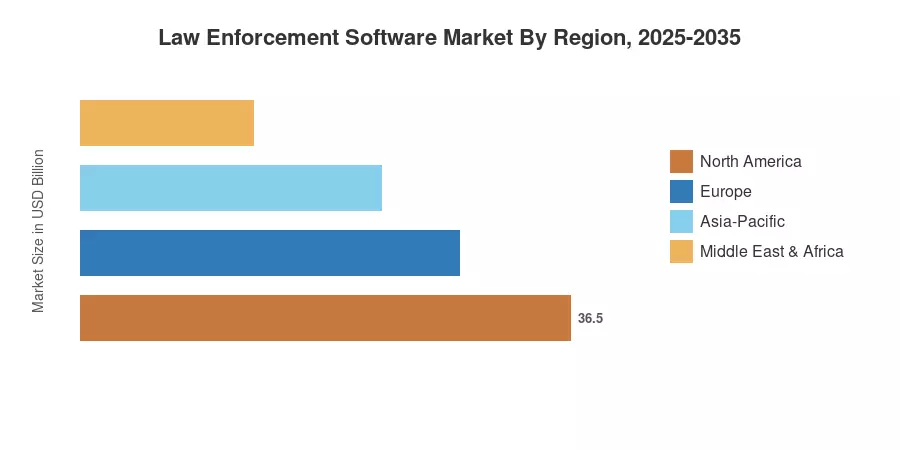
North America continues to lead the Law Enforcement Software Market, holding a significant share of 10.5 in 2024. The growth is driven by increasing investments in public safety technologies, rising crime rates, and the need for efficient data management systems. Regulatory support for advanced surveillance and analytics tools further fuels demand, as law enforcement agencies seek to enhance operational efficiency and community safety. The competitive landscape is robust, with key players like Motorola Solutions, Tyler Technologies, and Palantir Technologies dominating the market. The U.S. remains the largest contributor, supported by a strong focus on technological advancements and integration of AI in law enforcement. Canada also plays a vital role, with local firms like Sierra Wireless contributing to the market's growth. Overall, the region's commitment to innovation positions it as a global leader in law enforcement solutions.

Europe : Emerging Market with Growth Potential

Europe's Law Enforcement Software Market is valued at 5.5, reflecting a growing demand for advanced security solutions. Factors such as increasing cybercrime, regulatory mandates for data protection, and the need for interoperability among law enforcement agencies are driving this growth. The European Union's focus on enhancing public safety through technology is a significant catalyst for market expansion, encouraging investments in innovative software solutions. Leading countries in this region include the UK, Germany, and France, where local firms are increasingly collaborating with global players. The competitive landscape features companies like NEC Corporation and various regional startups, enhancing the market's dynamism. The presence of regulatory frameworks, such as the GDPR, further shapes the market, ensuring that software solutions comply with stringent data protection standards. "The integration of technology in law enforcement is essential for modern policing," states a report from the European Commission.

Asia-Pacific : Rapidly Growing Market Segment

The Asia-Pacific Law Enforcement Software Market, valued at 3.5, is witnessing rapid growth driven by urbanization, increasing crime rates, and government initiatives to enhance public safety. Countries like India, China, and Australia are investing heavily in law enforcement technologies, focusing on smart policing and data analytics. Regulatory frameworks are evolving to support the adoption of advanced software solutions, making the region a hotspot for innovation in law enforcement. China and India are leading the charge, with significant investments in surveillance and data management systems. The competitive landscape includes both local and international players, with companies like NEC Corporation making strides in the market. As governments prioritize public safety, the demand for integrated software solutions is expected to rise, positioning Asia-Pacific as a key player in the global law enforcement software landscape.

Middle East and Africa : Emerging Market with Challenges

The Middle East and Africa Law Enforcement Software Market is valued at 0.7, reflecting a nascent but growing interest in advanced law enforcement technologies. Factors such as rising crime rates, urbanization, and government initiatives to improve public safety are driving demand. However, challenges such as limited budgets and varying regulatory environments can hinder growth. Despite these obstacles, there is a clear trend towards adopting technology to enhance law enforcement capabilities. Countries like South Africa and the UAE are at the forefront, investing in software solutions to address security challenges. The competitive landscape is evolving, with both local and international firms vying for market share. As governments recognize the importance of technology in law enforcement, the market is expected to grow, albeit at a slower pace compared to other regions. "Investments in technology are crucial for enhancing security in the region," states a report from the African Union.

Key Players and Competitive Insights

The Law Enforcement Software Market is characterized by a dynamic competitive landscape, driven by technological advancements and increasing demand for enhanced public safety solutions. Key players such as Motorola Solutions (US), Tyler Technologies (US), and Palantir Technologies (US) are at the forefront, each adopting distinct strategies to solidify their market positions. Motorola Solutions (US) emphasizes innovation through the integration of AI and data analytics into its software offerings, while Tyler Technologies (US) focuses on regional expansion and partnerships with local law enforcement agencies to tailor solutions to specific community needs. Palantir Technologies (US) leverages its data integration capabilities to provide comprehensive analytics solutions, thereby enhancing operational efficiency for law enforcement agencies. Collectively, these strategies contribute to a competitive environment that is increasingly reliant on technological sophistication and tailored solutions.

In terms of business tactics, companies are increasingly localizing their operations to better serve regional markets, which appears to enhance responsiveness to local law enforcement needs. The market structure is moderately fragmented, with several players vying for dominance, yet the influence of major companies remains substantial. This competitive structure fosters innovation as companies strive to differentiate their offerings in a crowded marketplace.

In November 2025, Axon Enterprise (US) announced a strategic partnership with a leading AI firm to enhance its body camera technology, integrating advanced facial recognition capabilities. This move is likely to bolster Axon’s product offerings, positioning it as a leader in the integration of AI within law enforcement tools. The partnership underscores the growing importance of AI in enhancing operational capabilities and public safety.

In October 2025, Verint Systems (US) launched a new cloud-based analytics platform designed specifically for law enforcement agencies. This platform aims to streamline data collection and analysis, potentially improving decision-making processes. The introduction of this platform reflects Verint's commitment to digital transformation and its recognition of the need for scalable solutions in an increasingly data-driven environment.

In September 2025, CivicPlus (US) expanded its software suite to include community engagement tools that facilitate better communication between law enforcement and the public. This strategic move is indicative of a broader trend towards transparency and community involvement in policing, which may enhance public trust and cooperation.

As of December 2025, the competitive trends in the Law Enforcement Software Market are heavily influenced by digitalization, AI integration, and a growing emphasis on sustainability. Strategic alliances are becoming increasingly pivotal, as companies recognize the need to collaborate to enhance their technological capabilities. The competitive differentiation is likely to evolve from traditional price-based competition to a focus on innovation, technology integration, and supply chain reliability, suggesting a shift towards more sophisticated and sustainable solutions in law enforcement.

Key Companies in the Law Enforcement Software Market market include

Industry Developments

  • Q2 2024: Axon acquires Flock Safety in $1.2 billion deal to expand law enforcement technology portfolio Axon, a leading provider of law enforcement technology, announced the acquisition of Flock Safety for $1.2 billion, aiming to integrate Flock's automated license plate recognition and video analytics into Axon's suite of public safety solutions.
  • Q2 2024: Motorola Solutions Launches New CommandCentral Evidence 2024 Platform for Law Enforcement Agencies Motorola Solutions unveiled its latest CommandCentral Evidence 2024 platform, designed to streamline digital evidence management for law enforcement agencies, with enhanced AI-powered search and secure cloud storage.
  • Q3 2024: Coban Technologies and Genetec Announce Strategic Partnership to Deliver Integrated Law Enforcement Video Solutions Coban Technologies and Genetec formed a strategic partnership to offer integrated in-car and body-worn video solutions, enabling law enforcement agencies to unify video evidence management across platforms.
  • Q3 2024: ShotSpotter Wins Multi-Year Contract with City of Dallas for Gunshot Detection Software ShotSpotter secured a multi-year contract with the City of Dallas to deploy its gunshot detection software, expanding the city's use of real-time acoustic surveillance to support law enforcement response.
  • Q4 2024: Tyler Technologies Acquires JusticeTech to Enhance Law Enforcement Software Market Offerings Tyler Technologies completed the acquisition of JusticeTech, a provider of digital case management solutions, to strengthen its law enforcement and judicial software portfolio.
  • Q4 2024: Mark43 Raises $85 Million in Series D Funding to Accelerate Cloud-Based Law Enforcement Software Market Development Mark43, a cloud-native public safety software provider, announced an $85 million Series D funding round to support product innovation and expand its reach among law enforcement agencies.
  • Q1 2025: CivicEye Appoints Former FBI Executive as Chief Strategy Officer CivicEye, a law enforcement records management software company, appointed a former FBI executive as its new Chief Strategy Officer to drive growth and product strategy.
  • Q1 2025: Hexagon Launches Next-Generation Public Safety Platform for Law Enforcement Agencies Hexagon introduced its next-generation public safety platform, featuring advanced analytics and real-time data integration to support law enforcement operations and emergency response.
  • Q2 2025: Versaterm Public Safety Acquires SPIDR Tech to Expand Community Engagement Solutions Versaterm Public Safety acquired SPIDR Tech, a provider of automated customer service software for law enforcement, to enhance its offerings in community engagement and feedback.
  • Q2 2025: CentralSquare Technologies Wins Statewide Contract for Computer-Aided Dispatch Software in Florida CentralSquare Technologies was awarded a statewide contract to provide its computer-aided dispatch (CAD) software to law enforcement agencies across Florida, supporting emergency response coordination.
  • Q3 2025: Genetec Launches Clearance 2025, Upgraded Digital Evidence Management Platform for Law Enforcement Genetec released Clearance 2025, an upgraded digital evidence management platform with enhanced collaboration tools and AI-driven redaction features for law enforcement agencies.
  • Q3 2025: Callyo Partners with RapidSOS to Integrate Real-Time Location Data into Law Enforcement Communication Tools Callyo and RapidSOS announced a partnership to integrate real-time location data into Callyo's law enforcement communication tools, improving officer safety and emergency response.

Future Outlook

Law Enforcement Software Market Future Outlook

The Law Enforcement Software Market is projected to grow at 8.58% CAGR from 2024 to 2035, driven by advancements in technology, increasing crime rates, and the need for enhanced public safety.

New opportunities lie in:

  • Integration of AI-driven predictive policing tools
  • Development of mobile incident reporting applications
  • Expansion of cloud-based data management solutions

By 2035, the market is expected to be robust, driven by innovation and increasing demand for efficient law enforcement solutions.

Market Segmentation

Law Enforcement Software Market End User Outlook

  • Law Enforcement Agencies
  • Government Agencies
  • Private Security Firms
  • Judicial Institutions

Law Enforcement Software Market Application Outlook

  • Crime Analysis
  • Incident Management
  • Case Management
  • Evidence Management
  • Reporting and Analytics

Law Enforcement Software Market Deployment Type Outlook

  • On-Premises
  • Cloud-Based
  • Hybrid

Report Scope

MARKET SIZE 202420.2(USD Billion)
MARKET SIZE 202521.74(USD Billion)
MARKET SIZE 203549.54(USD Billion)
COMPOUND ANNUAL GROWTH RATE (CAGR)8.58% (2024 - 2035)
REPORT COVERAGERevenue Forecast, Competitive Landscape, Growth Factors, and Trends
BASE YEAR2024
Market Forecast Period2025 - 2035
Historical Data2019 - 2024
Market Forecast UnitsUSD Billion
Key Companies ProfiledMotorola Solutions (US), Tyler Technologies (US), Palantir Technologies (US), Axon Enterprise (US), Verint Systems (US), CivicPlus (US), Zetron (US), Sierra Wireless (CA), NEC Corporation (JP)
Segments CoveredApplication, Deployment Type, End User
Key Market OpportunitiesIntegration of artificial intelligence for predictive policing and enhanced data analysis in the Law Enforcement Software Market.
Key Market DynamicsRising demand for advanced analytics and artificial intelligence in law enforcement software enhances operational efficiency and decision-making.
Countries CoveredNorth America, Europe, APAC, South America, MEA

Market Highlights

Author
Ankit Gupta
Senior Research Analyst

Ankit Gupta is an analyst in market research industry in ICT and SEMI industry. With post-graduation in "Telecom and Marketing Management" and graduation in "Electronics and Telecommunication" vertical he is well versed with recent development in ICT industry as a whole. Having worked on more than 150+ reports including consultation for fortune 500 companies such as Microsoft and Rio Tinto in identifying solutions with respect to business problems his opinions are inclined towards mixture of technical and managerial aspects.

Leave a Comment

FAQs

Which key players are actively participating in the growth of the market?

IBM (US), Accenture (Ireland), Oracle (US), Motorola Solutions (US) are the key players actively participating in the growth of the market

What is the CAGR of the market?

8.60% is the CAGR of the market.

What is the valuation of the market calculated?

The market will be valuing USD 29.2 billion by 2030.

What are the segments involved in the study of the market?

The segments involved in the study of the market are component, solution, service, deployment model.

Mention the key driver of the market.

The increasing demand for mobile-based law enforcement software has been the main key driver of the market

Download Free Sample

Kindly complete the form below to receive a free sample of this Report

Compare Licence

×
Features License Type
Single User Multiuser License Enterprise User
Price $4,950 $5,950 $7,250
Maximum User Access Limit 1 User Upto 10 Users Unrestricted Access Throughout the Organization
Free Customization
Direct Access to Analyst
Deliverable Format
Platform Access
Discount on Next Purchase 10% 15% 15%
Printable Versions