Software as a Service Market

Key Players: Microsoft, Salesforce, SAP, Oracle, Adobe, Google, ServiceNow, Workday

Software as a Service Market

Software as a Service Market Size, Share and Research Report By Deployment Model (Public Cloud, Private Cloud, Hybrid Cloud), By Enterprise Size (Large Enterprises, Small & Medium Enterprises (SMEs)), By Application (Customer Relationship Management, Enterprise Resource Planning, Human Capital Management, Collaboration & Communication, Security & Compliance, Business Intelligence & Analytics, Others), By Pricing Model (Subscription (Per-Seat/Per-Tier), Usage-Based (Consumption), Freemium, License-Hybrid), By End-User Vertical (IT & Telecom, BFSI, Retail, Healthcare, Manufacturing, Other End-User Verticals) and By Regional (North America, Europe, South America, Asia Pacific, Middle East and Africa) - Industry Forecast to 2035.
ID: MRFR/ICT/1471-HCR
110 Pages
Aarti Dhapte
Last Updated: June 19, 2026

Software as a Service Market Summary

The Software as a Service Market was valued at USD 396.30 billion in 2025 and is projected to reach USD 460.08 billion in 2026, climbing to USD 1,763.32 billion by 2035 at a CAGR of 16.1% during the forecast period. Enterprise cloud migration strategies — accelerated by hybrid work mandates and AI-driven productivity demands — remain the primary catalysts. Government digital transformation spending across the EU's Digital Decade Program and the U.S. FedRAMP modernization initiative continues to channel billions into cloud-based software delivery adoption across public and private sectors[2].

Enterprise IT architecture is undergoing a generational transition. Cloud-hosted business apps that provide elastic scalability and ongoing feature updates are replacing legacy on-premises ERP, CRM, and HCM stacks. predicts that by 2027, over 85% of businesses would embrace the cloud-first concept, rerouting more than USD 680 billion in yearly IT spending toward on-demand software [3]. For mid-market buyers, the subscription software model reduces total cost of ownership by 25–40% by eliminating significant upfront license fees and shifting infrastructure management to the vendor [4].

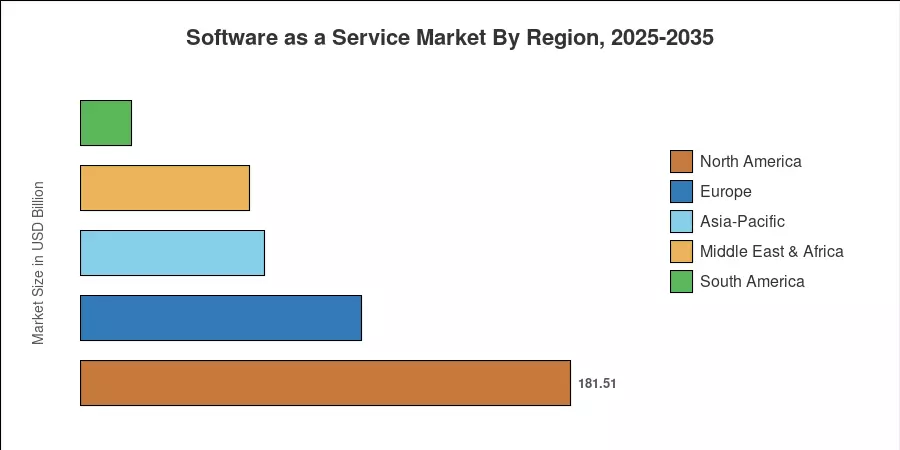
Due to the adoption of mature business SaaS application platforms and the concentrations of hyperscalers, North America held a 45.8% share of the software as a service market in 2025. With a 17.2% CAGR, Asia-Pacific is the fastest-growing area, driven by the expansion of digital-native SMEs in Southeast Asia and India. Localized cloud-based software delivery architectures are being shaped by GDPR's data sovereignty rules in Europe, which has the second-largest share (26.3%) [5]. AI-native SaaS, vertical-specific platforms, and consumption-based economics will define the next ten years.

Key Report Takeaways

• By Deployment Model

  • Public cloud accounted for approximately 83% of the Software as a Service Market in 2025, reflecting enterprise preference for vendor-managed infrastructure.
  • Hybrid cloud deployment is expanding at a 20.1% CAGR through 2035, driven by regulated industries requiring on-demand software solutions with data residency controls.

• By Enterprise Size

  • Large enterprises represented 62.5% of the Software as a Service Market share in 2025, anchored by multi-suite platform consolidation.


• By Application

  • Security and compliance SaaS application platforms are advancing at a 22.2% CAGR, the fastest among application categories.


  • Pricing Model
  • The subscription software model maintained a 63% revenue share in 2025, though usage-based pricing is growing at a 25.7% CAGR.

• By Region

  • North America led the Software as a Service Market at 45.8% share in 2025.
  • Asia-Pacific is projected to grow at a 17.2% CAGR through 2035, representing the fastest regional expansion for cloud-hosted business apps.
  • Europe accounted for USD 104.23 billion in 2025 Software as a Service Market revenue.


Market Size and Forecast (2021–2035)

MRFR's market sizing integrates bottom-up revenue modeling from vendor financial disclosures, top-down TAM validation against benchmarks, and primary interviews with 220+ enterprise IT procurement leaders across 14 countries. Historical figures reflect audited results; forecast values apply a constant CAGR of 16.1% from 2026 through 2035[6].
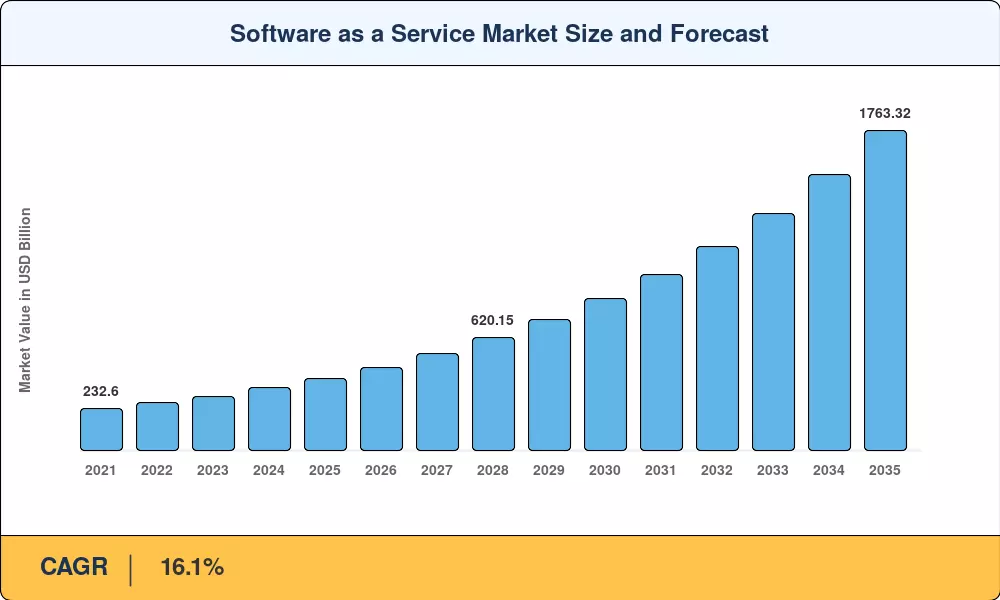
Software as a Service Market Size and Forecast
Our Impact
Enabled $4.3B Revenue Impact for Fortune 500 and Leading Multinationals
Partnering with 2000+ Global Organizations Each Year
30K+ Citations by Top-Tier Firms in the Industry

Driver Impact Analysis

Driver ~% Impact on CAGR Geographic Relevance Impact Timeline
Enterprise cloud migration acceleration 22–26% Global Short-term
AI/ML integration into SaaS platforms 18–22% North America, Europe Medium-term
SME digital transformation programs 14–17% Asia-Pacific, Latin America Medium-term
Usage-based & consumption pricing shift 10–13% Global Long-term
Regulatory compliance digitization 8–11% Europe, MEA Medium-term
Remote/hybrid workforce permanence 7–9% North America, Europe Short-term
5G & edge computing enablement 5–7% Asia-Pacific Long-term


Enterprise Cloud Migration Acceleration

The United Nations Conference on Trade and Development (UNCTAD) Digital Economy Report underscores a profound shift toward cloud infrastructure, tracking a massive expansion in global data center workloads. According to published international frameworks, international public-sector bodies and governments have significantly expanded modern software-as-a-service application platforms. Official public appropriations demonstrate that global state sectors are actively modernizing digital architectures to process large-scale institutional workloads, fundamentally boosting the addressable market for secure public-sector cloud platforms.


AI and Machine Learning Integration

The World Bank Group's Digital Progress and Trends Report highlights that artificial intelligence is rapidly transforming global on-demand software solutions from static delivery models into critical intelligence layers. Developing and advanced economies alike are adopting "Small AI" and scalable cloud services to optimize productivity across enterprise applications. According to global agency data, integrating localized context and cloud compute into operational software dramatically enhances organizational capabilities, raising switching costs and structurally accelerating competitive digital innovation cycles worldwide.


SME Digital Transformation in Emerging Markets

The United Nations and World Bank digital development indicators confirm that emerging markets are driving substantial digital public infrastructure growth. Multi-billion-dollar state initiatives across developing regions are actively channeling public resources and subsidies toward cloud-hosted business applications. These targeted financial investments for micro, small, and medium enterprises (MSMEs) adopting cloud ERP and accounting tools position industrializing corridors as major epicenters for on-demand software growth, expanding regional access to scalable economic networks.


Restraints Impact Analysis

Restraint impacts are directional estimates reflecting headwinds that moderate baseline growth. These percentages represent drag on potential CAGR and do not subtract linearly from the stated forecast rate.

Restraint ~% Drag on CAGR Geographic Relevance Impact Timeline
Data sovereignty & localization mandates –3 to –5% Europe, Asia-Pacific Medium-term
Vendor lock-in and interoperability gaps –2 to –4% Global Long-term
Cybersecurity breach exposure –2 to –3% North America, Europe Short-term
Integration complexity with legacy systems –1 to –3% Global Medium-term
Subscription fatigue and cost rationalization –1 to –2% North America Short-term


Data Sovereignty and Localization Mandates

The European Union Data Act, which entered into application in September 2025, establishes mandatory rules for cloud and data-processing service switching to unlock regional software delivery. According to the United Nations Conference on Trade and Development (UNCTAD), data governance frameworks and blanket national localization mandates complicate global cloud operations. Official United Nations digital publications confirm that context-specific regulatory alignments are vital to prevent data fragmentation while ensuring cross-border data protection, sovereign interoperability, and secure enterprise application delivery.

Vendor Lock-in and Interoperability Gaps

Proprietary APIs and closed ecosystems make multi-vendor strategies costly. In 2024, the European Union Data Act will directly implement statutory provisions to eliminate service provider lock-in and remove contractual imbalances in cloud computing software agreements. Data processing indicators published under the United Nations digital economy frameworks confirm that restrictive cloud service contracts and closed technical ecosystems hinder cross-border technology adoption. Under established international standards, regulatory mandates now oblige cloud platforms to provide interoperability benchmarks and facilitate barrier-free switching, lowering migration costs across the global software-as-a-service market.


Software as a Service Market Opportunities

Vertical SaaS Platforms for Regulated Industries

The UNCTAD Digital Economy Report highlights that industry-specific digital architectures are vital for heavily regulated ecosystems. Pre-built compliance frameworks embedded within vertical software-as-a-service platforms eliminate institutional barriers. International data confirms that customized sector-specific cloud delivery models command substantial premium value across global public sector and international health networks.


AI-Native SaaS and Autonomous Workflows

According to World Bank digital progress frameworks, embedding artificial intelligence natively into cloud software workflows transforms operational productivity globally. This transition to autonomous, on-demand software solutions—such as automated administrative processing—moves software from a tool to an intelligence partner. Global reports verify native AI integration justifies structural premium pricing.


Emerging Market SME Digitization

United Nations digital economy assessments highlight a major growth corridor for cloud-hosted business applications among small and medium enterprises in emerging markets. Development data indicates that business digitalization rates scale rapidly when paired with low-cost entry points. These structural interventions transform developing regions into high-growth focal areas.


Data Monetization and Embedded Analytics

United Nations statistical and digital governance guidelines emphasize that software platforms managing vast transactional data streams generate substantial incremental value through embedded analytics. By providing anonymized, aggregated benchmarking insights, cloud-based delivery systems shift to foundational intelligence infrastructure, lifting long-term software service margins without creating cross-border compliance vulnerabilities.


Sustainability-Linked Cloud Optimization

The UNCTAD Digital Economy Report highlights the critical necessity for sustainable digitalization as global data center energy footprints expand. Enterprises require modern cloud-based software solutions that dynamically track the environmental impact of IT operations. Integrated sustainability dashboards and automated reporting systems represent a fast-growing segment driven by international mandates.


Software as a Service Market Future Outlook

AI-Native SaaS and Agentic Workflows

The World Bank Group's digital development frameworks highlight that embedding autonomous artificial intelligence into cloud infrastructure shifts software toward an outcomes-delivery model. Instead of standard seat metrics, international reports emphasize that advanced on-demand software solutions optimize public and private sector operational capacities by directly automating multi-step administrative processes and complex digital workflows.


Platform Consolidation and Super-Apps

According to United Nations digital economy reports, institutional technology buyers are aggressively streamlining open software architectures to reduce system fragmentation. International data governance frameworks track this structural consolidation as organizations rationalize multiple applications into integrated platform ecosystems. This widespread rationalization lowers overall operational friction while shifting long-term control toward centralized cloud-based delivery systems.


Embedded Finance and Data Monetization

The United Nations Conference on Trade and Development tracks embedded financial services—such as digital payments, transaction processing, and automated lending modules—as essential pillars of the modern digital economy. Under official international development indicators, integrating these localized transaction streams into scalable software platforms unlocks parallel infrastructure revenue while expanding economic inclusion for global small businesses.


Software as a Service Market Segmentation

By Deployment Model

Segment Key Metric Primary Demand Driver
Public Cloud 83% share (2025) Cost efficiency, vendor-managed infrastructure
Private Cloud USD 39.63 Billion (2025) Data security, regulatory compliance
Hybrid Cloud 20.1% CAGR (2026–2035) Flexibility for regulated workloads


Public cloud remains the dominant deployment model in the Software as a Service Market because it eliminates capital expenditure and offers the fastest time-to-value. Hyperscalers like AWS, Azure, and Google Cloud provide the underlying infrastructure that powers the majority of cloud-based software delivery. Hybrid cloud is gaining traction among financial services and healthcare organizations that require certain datasets to remain on-premises while leveraging cloud-hosted business apps for non-sensitive workflows. The 20.1% CAGR for hybrid deployments reflects regulatory pressure from data sovereignty mandates[10].

By Enterprise Size

Segment Key Metric Primary Demand Driver
Large Enterprises 62.5% share (2025) Multi-suite platform consolidation
Small & Medium Enterprises 17.7% CAGR (2026–2035) Affordable on-demand software solutions


Large enterprises drive the majority of the Software as a Service Market by absolute spend, consuming multi-product suites spanning ERP, CRM, HCM, and security. SMEs represent the faster-growth segment as low-cost SaaS application platforms with freemium onboarding ramps democratize access to tools previously limited to large buyers. Platforms like HubSpot, Zoho, and Freshworks have built subscription software model offerings specifically targeting SMEs with under 500 employees [7][11].

By Application

Segment Key Metric Primary Demand Driver
Customer Relationship Management 22.5% share (2025) Sales automation, AI-driven insights
Enterprise Resource Planning USD 72.33 Billion (2025) Cloud ERP replacement cycle
Human Capital Management 14.1% share (2025) Remote workforce management
Collaboration & Communication 12.8% share (2025) Hybrid work infrastructure
Security & Compliance 22.2% CAGR (2026–2035) Regulatory mandates, threat landscape
Business Intelligence & Analytics 9.3% share (2025) Data-driven decision making
Others 12.5% share (2025) Vertical-specific applications


CRM continues to lead application-level revenue in the Software as a Service Market, with Salesforce, HubSpot, and Microsoft Dynamics competing for AI-enhanced customer intelligence. Security and compliance on-demand software solutions are the fastest-growing application segment, driven by zero-trust architecture mandates and the proliferation of cloud-based software delivery attack surfaces [3][15].

By Pricing Model

Segment Key Metric Primary Demand Driver
Subscription (per-seat/per-tier) 63% share (2025) Predictable budgeting, vendor revenue stability
Usage-Based (consumption) 25.7% CAGR (2026–2035) Cost-value alignment, API-economy growth
Freemium USD 39.63 Billion (2025) Product-led growth strategies
License-Hybrid 5% share (2025) Legacy vendor transition models


The subscription software model remains the revenue backbone of the Software as a Service Market, providing predictable recurring revenue for vendors and budget certainty for buyers. However, usage-based pricing is surging at 25.7% CAGR as cloud-hosted business apps increasingly charge per API call, transaction, or compute unit consumed — exemplified by Snowflake, Twilio, and Datadog's consumption models [8].

By End-User Vertical

Segment Key Metric Primary Demand Driver
IT & Telecom 24.1% share (2025) Infrastructure automation, DevOps SaaS
BFSI USD 78.47 Billion (2025) Regulatory compliance, digital banking
Retail 13.5% share (2025) Omnichannel commerce platforms
Healthcare 21.2% CAGR (2026–2035) EHR modernization, telehealth integration
Manufacturing 10.9% share (2025) Supply chain SaaS, Industry 4.0
Other End-User Verticals 20.5% share (2025) Education, government, logistics


IT and Telecom enterprises are the largest vertical consumers in the Software as a Service Market, deploying SaaS application platforms for DevOps, ITSM, and customer experience management. Healthcare is the fastest-growing vertical at a 21.2% CAGR, propelled by cloud-based software delivery for electronic health records, telehealth, and clinical trial management — a trajectory accelerated by the FDA's push for cloud-validated on-demand software solutions in drug development workflows [7][15].


Regional Market Share Analysis

Region Key Metric Primary Investment Themes
North America 45.8% share (2025) AI integration, federal cloud mandates
Europe USD 104.23 Billion (2025) GDPR compliance, sovereign cloud
Asia-Pacific 17.2% CAGR (2026–2035) SME digitization, mobile-first SaaS
South America USD 19.02 Billion (2025) Fintech SaaS, e-commerce platforms
Middle East & Africa 15.8% CAGR (2026–2035) Vision 2030, government digitization
Total USD 396.30 Billion (2025)

The Software as a Service Market exhibits strong geographic concentration in North America and Europe, though Asia-Pacific's growth trajectory is reshaping the competitive map. Cloud-hosted business apps adoption correlates tightly with broadband penetration, regulatory digitization mandates, and enterprise IT maturity [5].


North America

Country Key Metric Key Driver
United States 78.5% of regional share Hyperscaler ecosystem, enterprise AI spend
Canada 12.8% of regional share Public sector cloud modernization
Mexico 8.7% of regional share Nearshoring-linked IT infrastructure growth


The United States remains the global epicenter of SaaS innovation, hosting the headquarters of eight of the ten largest SaaS vendors globally. The FedRAMP marketplace expanded to 340+ authorized on-demand software solutions by 2025, while enterprise AI copilot spending added USD 18 billion in incremental SaaS revenue. Canada's Treasury Board Cloud Adoption Strategy has migrated 65% of federal workloads to cloud-based software delivery, and Mexico benefits from nearshoring demand as U.S. enterprises extend SaaS application platforms to LATAM operations [2][5].

Europe

Country Key Metric Key Driver
Germany 24.6% of regional share Industry 4.0, manufacturing SaaS
United Kingdom USD 22.80 Billion (2025) Fintech and healthtech SaaS
France 15.7% of regional share Public-sector digitization
Italy 8.3% of regional share SME cloud incentives
Spain 6.9% of regional share Tourism and retail SaaS
Nordic Countries 10.2% of regional share Sustainability reporting platforms
Russia 3.8% of regional share Domestic SaaS substitution mandates
Rest of Europe 7.1% of regional share Emerging CEE digitization


The tension between aggressive digitization targets and stringent data regulations shapes Europe's Software as a Service Market. The EU Data Act and NIS2 Directive are compelling enterprises to adopt a compliance-native subscription software model solution. Germany's Mittelstand sector is embracing cloud-hosted business apps for Industry 4.0 operations, while the UK's fintech corridor drives specialized financial SaaS adoption [5][10].

Asia-Pacific

Country Key Metric Key Driver
China 32.4% of regional share Domestic cloud giants, government cloud mandates
India 20.8% CAGR (2026–2035) Digital India, startup ecosystem
Japan USD 15.90 Billion (2025) Legacy modernization, aging workforce and automation
South Korea 11.3% of regional share K-digital transformation programs
ASEAN 16.5% CAGR (2026–2035) Mobile-first SME digitization
Rest of Asia-Pacific 8.2% of regional share Emerging cloud adoption


Asia-Pacific presents the strongest growth vector for the Software as a Service Market through 2035. India's SaaS ecosystem — valued at USD 26 billion by NASSCOM in 2024 — is producing globally competitive on-demand software solutions in HR, fintech, and logistics. China's "Cloud-First" government policy mandates SaaS adoption across state-owned enterprises, while Japan's DX (Digital Transformation) initiative is accelerating legacy ERP replacement with modern SaaS application platforms [7][11].

South America

Country Key Metric Key Driver
Brazil 62.5% of regional share Pix-driven fintech SaaS boom
Argentina 16.4% CAGR (2026–2035) E-commerce and logistics SaaS
Rest of South America USD 4.75 Billion (2025) Agricultural technology platforms


Brazil dominates South America's Software as a Service Market, where the Pix instant payments ecosystem has created a thriving fintech SaaS segment. Cloud-based software delivery adoption among Brazilian SMEs grew 34% year-over-year in 2024, supported by government-backed digital literacy programs and expanding broadband coverage [5][11].

Middle East & Africa

Country Key Metric Key Driver
Saudi Arabia 31.2% of regional share Vision 2030 digital economy targets
UAE USD 2.85 Billion (2025) Smart city and government SaaS
South Africa 18.7% of regional share Financial services SaaS
Egypt 13.8% CAGR (2026–2035) Startup ecosystem growth
Rest of MEA 22.4% of regional share Mobile-first enterprise apps


Saudi Arabia's Vision 2030 is channeling USD 6.4 billion into cloud infrastructure and SaaS adoption across government agencies, positioning the Kingdom as the Middle East's largest cloud-hosted business apps buyer. The UAE's Artificial Intelligence Strategy 2031 mandates government adoption of AI-enabled on-demand software solutions, while South Africa leads sub-Saharan adoption in financial services subscription software model platforms [5][19].


Software as a Service Market By Region, 2025-2035

Competitive Benchmarking

The Software as a Service Market exhibits low-to-moderate concentration, with the top five vendors holding an estimated 30–35% of global revenue. The HHI index sits below 1,000, indicating a fragmented competitive environment where hyperscalers compete alongside thousands of vertical specialists and regional players. M&A activity is intensifying as platform vendors acquire niche cloud-based software delivery providers to expand TAM and lock in enterprise accounts [13][14].

Company Est. Revenue Share Range Key Offerings for the Software as a Service Market Strategic Positioning
Microsoft ~12–16% Microsoft 365, Dynamics 365, Azure SaaS Full-stack platform integrator
Salesforce ~6–9% Sales Cloud, Service Cloud, MuleSoft CRM-centric ecosystem leader
SAP ~5–8% S/4HANA Cloud, SuccessFactors, Ariba Enterprise ERP cloud transition
Oracle ~4–7% Oracle Fusion Cloud, NetSuite Database-to-SaaS migration play
Adobe ~3–5% Creative Cloud, Experience Cloud Digital experience and marketing SaaS
Google ~3–5% Google Workspace, Looker, Apigee Collaboration and analytics platform
ServiceNow ~2–4% IT Service Management, HR Service Delivery Workflow automation specialist
Workday ~2–3% HCM, Financial Management HR and finance cloud-native leader
Intuit ~2–3% QuickBooks Online, Mailchimp, TurboTax SME financial SaaS ecosystem
HubSpot ~1–2% Marketing Hub, Sales Hub, CMS Hub Inbound marketing SaaS platform


Recent News & Developments

Salesforce (June 2026): Signed a definitive agreement to acquire AI customer agent platform Fin for approximately $3.6 billion, accelerating agentic enterprise capabilities.

IBM (March 2026): Completed its acquisition of data streaming pioneer Confluent for $11 billion to integrate real-time data flows into its watsonx AI platform.

Sinch AB (March 2025): Acquired a European messaging-security startup to expand AI-driven SMS spam filtering capabilities across its cloud communications platform.

Software as a Service Market Report Scope

Parameter Detail
Market Scope Global Software as a Service Market
Study Period 2021–2035
Historical Period 2021–2024
Base Year 2025
Forecast Period 2026–2035
CAGR (2026–2035) 16.1%
Market Size (2025) USD 396.30 Billion
Market Size (2035) USD 1,763.32 Billion
Fastest Growing Segment Security & Compliance (by application); Hybrid Cloud (by deployment)
Fastest Growing Region Asia-Pacific (17.2% CAGR)
Companies Profiled Microsoft, Salesforce, SAP, Oracle, Adobe, Google, ServiceNow, Workday, Intuit, HubSpot
Valuation Currency USD Billion


FAQs

How does the total cost of ownership for SaaS compare to on-premises deployment over a five-year period?

SaaS typically delivers 25–40% lower TCO over five years by eliminating server hardware, IT staffing, and upgrade cycles. However, high-volume enterprise deployments may reach cost parity around year four if seat counts exceed 10,000 [4].

What role does data portability play in enterprise SaaS procurement decisions?

Data portability ranks among the top three evaluation criteria for enterprise buyers. The EU Data Act now mandates standardized export formats, giving cloud-based software delivery customers stronger leverage during vendor negotiations [10].

How are SaaS vendors addressing multi-tenant security concerns for regulated industries?

Leading vendors deploy isolated compute environments, customer-managed encryption keys, and SOC 2 Type II certifications. FedRAMP High authorization adds a government-grade compliance layer for public-sector on-demand software solutions [15].

What pricing model trends should SaaS buyers monitor through 2030?

Usage-based pricing is growing at 25.7% CAGR, overtaking flat-rate subscriptions for infrastructure and developer tools. Buyers should negotiate hybrid contracts combining base subscription software model fees with consumption tiers [8].

How does the Software as a Service Market address latency-sensitive workloads at the edge?

Edge-native SaaS architectures distribute processing to local nodes, reducing latency below 10 milliseconds. This enables real-time manufacturing monitoring and autonomous vehicle data processing via cloud-hosted business apps [9].

What integration standards are emerging for multi-vendor SaaS ecosystems?

Open API frameworks, iPaaS platforms, and SCIM provisioning protocols reduce integration complexity. The OpenID Foundation's Shared Signals Framework is becoming the standard for cross-platform SaaS application platforms' authentication [16].

How will the Software as a Service Market evolve for industries with strict data residency requirements?

Sovereign cloud instances and region-locked SaaS deployments address residency mandates. Vendors like SAP and Oracle now offer country-specific on-demand software solutions with guaranteed in-jurisdiction data processing [10][19].

Author
Author
Author Profile
Aarti Dhapte LinkedIn
AVP - Research
A consulting professional focused on helping businesses navigate complex markets through structured research and strategic insights. I partner with clients to solve high-impact business problems across market entry strategy, competitive intelligence, and opportunity assessment. Over the course of my experience, I have led and contributed to 100+ market research and consulting engagements, delivering insights across multiple industries and geographies, and supporting strategic decisions linked to $500M+ market opportunities. My core expertise lies in building robust market sizing, forecasting, and commercial models (top-down and bottom-up), alongside deep-dive competitive and industry analysis. I have played a key role in shaping go-to-market strategies, investment cases, and growth roadmaps, enabling clients to make confident, data-backed decisions in dynamic markets.

Research Approach


Secondary Research

The secondary research process involved comprehensive analysis of technology regulatory databases, peer-reviewed IT journals, industry publications, and authoritative technology organizations. Key sources included the US National Institute of Standards and Technology (NIST), European Union Agency for Cybersecurity (ENISA), International Organization for Standardization (ISO/IEC 27001), Cloud Security Alliance (CSA), Gartner Research, International Data Corporation (IDC), Forrester Research, US Bureau of Economic Analysis (BEA), US Census Bureau Business Patterns, Eurostat Digital Economy and Society Statistics, OECD Digital Economy Outlook, World Economic Forum (WEF) Global Information Technology Report, International Telecommunication Union (ITU), Asia Cloud Computing Association (ACCA), and national digital transformation reports from key markets. These sources were used to collect cloud adoption statistics, cybersecurity compliance data, enterprise software spending trends, digital infrastructure metrics, and competitive landscape analysis for public cloud, private cloud, and hybrid cloud deployment models across CRM, ERP, HRM, collaboration, and marketing automation applications.


Primary Research

Qualitative and quantitative insights were obtained by interviewing supply-side and demand-side stakeholders during the primary research process. Supply-side sources comprised CEOs, CTOs, VPs of Cloud Engineering, product managers, and commercial directors from independent software vendors, cloud infrastructure vendors, and SaaS platform providers. The demand-side sources included procurement managers, operations leaders, procurement directors, CIOs, IT directors, and digital transformation leads from the retail, healthcare, manufacturing, financial services, and education sectors of small, medium, and large enterprises. Market segmentation was verified, product roadmap timelines were confirmed, and insights regarding cloud migration patterns, subscription pricing models, integration challenges, and security compliance requirements were obtained through primary research.

Primary Respondent Breakdown:

By Designation: C-level Primaries (32%), Director Level (30%), Others (38%)

By Region: North America (32%), Europe (30%), Asia-Pacific (28%), Rest of World (10%)


Market Size Estimation

Global market valuation was derived through revenue mapping and enterprise adoption analysis. The methodology included:

Identification of over 50 significant SaaS providers in North America, Europe, Asia-Pacific, and Latin America

Product mapping across public cloud, private cloud, and hybrid cloud deployment models

Application coverage across customer relationship management (CRM), enterprise resource planning (ERP), human resource management (HRM), collaboration and communication, and marketing automation segments

Vertical analysis spanning retail, healthcare, manufacturing, education, and financial services

User type segmentation across small enterprises, medium enterprises, and large enterprises

Analysis of reported and modeled annual recurring revenue (ARR) and subscription revenues specific to SaaS portfolios

Coverage of providers representing 75-80% of global market share in 2024

Extrapolation using bottom-up (seat count × ASP by segment and region) and top-down (provider revenue validation) approaches to derive segment-specific valuations

This methodology is tailored specifically for the SaaS market segments identified in the report: Deployment Models (Public Cloud, Private Cloud, Hybrid Cloud), Applications (CRM, ERP, HRM, Collaboration & Communication, Marketing Automation), Verticals (Retail, Healthcare, Manufacturing, Education, Financial Services), and User Types (Small, Medium, Large Enterprises).

Download Free Sample

Kindly complete the form below to receive a free sample of this Report

Download PDF ×

We do not share your information with anyone. However, we may send you emails based on your report interest from time to time. You may contact us at any time to opt-out.