Download Free Sample
Kindly complete the form below to receive a free sample of this Report
Leadership Development Consulting Services Market Research Report: Size, Share, Trend Analysis By Duration Outlook (Short-Term, Medium-Term, Long-Term, Ongoing Support, Intensive Programs) By Client Type Outlook (Corporations, Small and Medium Enterprises, Non-Profit Organizations, Government Agencies, Educational Institutions) By Service Type Outlook (Coaching, Training, Assessment, Consultation, Workshops) By Delivery Method Outlook (In-Person, Virtual, Hybrid, Self-Paced, Blended Learning) By Region (North America, Europe, APAC, South America, MEA) - Growth Outlook & Industry Forecast To 2035
As per MRFR analysis, the Leadership Development Consulting Services Market was estimated at 20.0 USD Billion in 2024. The Leadership Development Consulting Services industry is projected to grow from 20.87 USD Billion in 2025 to 32.0 USD Billion by 2035, exhibiting a compound annual growth rate (CAGR) of 4.37% during the forecast period 2025 - 2035.
The Leadership Development Consulting Services Market is experiencing a transformative shift towards personalized and technology-driven solutions.
| 2024 Market Size | 20.0 (USD Billion) |
| 2035 Market Size | 32.0 (USD Billion) |
| CAGR (2025 - 2035) | 4.37% |
Deloitte (US), McKinsey & Company (US), Boston Consulting Group (US), PwC (US), Korn Ferry (US), Accenture (IE), Bain & Company (US), Hay Group (US), FranklinCovey (US)
Our Impact
Enabled $4.3B Revenue Impact for Fortune 500 and Leading Multinationals
Partnering with 2000+ Global Organizations Each Year
30K+ Citations by Top-Tier Firms in the Industry
The Leadership Development Consulting Services Market is currently experiencing a dynamic evolution, driven by the increasing recognition of the importance of effective leadership in organizations. Companies are increasingly investing in tailored programs that not only enhance individual capabilities but also foster a culture of continuous improvement and innovation. This shift reflects a broader understanding that leadership development is not merely a training exercise but a strategic imperative that can influence organizational performance and employee engagement. As businesses navigate complex challenges, the demand for specialized consulting services that address unique leadership needs appears to be on the rise. Moreover, the Leadership Development Consulting Services Market is characterized by a growing emphasis on technology integration. Digital platforms and tools are being utilized to deliver training and development programs more efficiently, allowing for greater accessibility and flexibility. This trend suggests that organizations are seeking innovative solutions to engage their leaders in a rapidly changing environment. Additionally, the focus on diversity and inclusion within leadership development initiatives indicates a shift towards more holistic approaches that consider varied perspectives and experiences. Such developments may enhance the effectiveness of leadership programs and contribute to a more inclusive workplace culture.
The Leadership Development Consulting Services Market is witnessing a trend towards personalized learning experiences. Organizations are increasingly recognizing that one-size-fits-all approaches are often ineffective. Tailored programs that address specific leadership styles, challenges, and organizational contexts are becoming more prevalent, allowing leaders to develop skills that are directly applicable to their roles.
The integration of technology into leadership development initiatives is transforming the landscape of the Leadership Development Consulting Services Market. Digital tools and platforms facilitate remote learning, provide real-time feedback, and enable data-driven insights. This trend indicates a shift towards more flexible and scalable solutions that can adapt to the evolving needs of organizations.
There is a growing focus on diversity and inclusion within leadership development programs. Organizations are increasingly aware that diverse leadership teams can drive innovation and improve decision-making. As a result, consulting services are placing greater emphasis on creating inclusive environments that nurture diverse talent and perspectives, thereby enhancing overall organizational effectiveness.
The Leadership Development Consulting Services Market is experiencing a rising importance of soft skills in leadership training. As organizations recognize that technical expertise alone is insufficient for effective leadership, there is a growing emphasis on developing interpersonal skills, emotional intelligence, and communication abilities. Research indicates that leaders with strong soft skills are more likely to drive team performance and foster collaboration. Consequently, consulting services that focus on enhancing these skills are in high demand. This shift towards soft skills development is reshaping the Leadership Development Consulting Services Market, as organizations seek to cultivate well-rounded leaders.
The Leadership Development Consulting Services Market experiences a notable surge in demand for leadership skills across various sectors. Organizations increasingly recognize the necessity of effective leadership in navigating complex business environments. According to recent data, approximately 70 percent of organizations report that leadership development is a top priority. This trend is driven by the need for leaders who can inspire teams, drive innovation, and adapt to changing market conditions. As companies strive to enhance their competitive edge, they are investing significantly in leadership development programs, thereby propelling the growth of the Leadership Development Consulting Services Market.
The Leadership Development Consulting Services Market is increasingly shaped by the emphasis on data-driven decision making. Organizations are leveraging analytics to assess leadership effectiveness and identify areas for improvement. This trend indicates a growing demand for consulting services that provide insights based on data analysis. Companies are seeking to implement evidence-based leadership development strategies that align with their organizational goals. As the reliance on data continues to grow, the Leadership Development Consulting Services Market is likely to evolve, with a focus on integrating analytics into leadership training programs.
In the current landscape, the Leadership Development Consulting Services Market is significantly influenced by the focus on employee engagement and retention. Organizations are increasingly aware that effective leadership plays a crucial role in fostering a positive workplace culture. Data suggests that companies with strong leadership development initiatives experience 25 percent higher employee retention rates. As businesses strive to create environments where employees feel valued and engaged, the demand for consulting services that enhance leadership capabilities is likely to rise. This trend underscores the importance of leadership development in driving organizational success within the Leadership Development Consulting Services Market.
The Leadership Development Consulting Services Market is witnessing a transformation due to the shift towards remote and hybrid work models. This change necessitates new leadership approaches that can effectively manage distributed teams. Research indicates that organizations are increasingly seeking consulting services that specialize in remote leadership training. As leaders adapt to these new dynamics, the demand for tailored consulting services that address the unique challenges of remote work is likely to grow. This shift not only influences the types of training offered but also expands the scope of the Leadership Development Consulting Services Market.
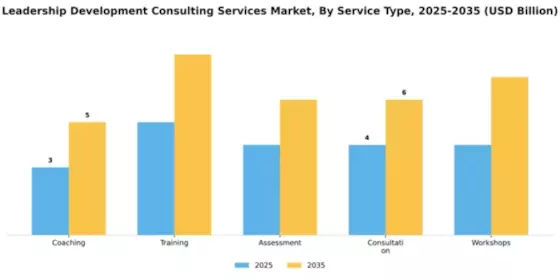
In the Leadership Development Consulting Services Market, various service types contribute to a diverse landscape. Coaching remains the largest segment, commanding a significant portion of the market share due to its personalized approach and effectiveness in enhancing leadership capabilities. Training follows closely, representing a dynamic sector with increasing demand fueled by organizational developments and a growing emphasis on employee skill enhancement. Other notable segment values, such as Assessment, Consultation, and Workshops, also play crucial roles in shaping the market, although they occupy smaller proportions compared to Coaching and Training. As organizations prioritize leadership development to improve overall performance, the growth trends for these service types have become apparent. Training is emerging as the fastest-growing segment, driven by the need for continuous learning and the adaptation of new skills in an ever-evolving business environment. Coaching remains relevant as leaders seek tailored strategies for personal and professional growth, while Assessment and Consultation are gaining traction as companies recognize their importance in identifying talent and structuring development programs. Workshops, offering interactive learning experiences, complement these growth dynamics, further propelling the segment's evolution.
Coaching (Dominant) vs. Training (Emerging)
Coaching is the dominant service in the Leadership Development Consulting Services Market, offering a personalized, one-on-one approach that resonates well with executives and emerging leaders alike. It focuses on enhancing individual capabilities, fostering self-awareness, and developing leadership skills that drive organizational success. Coaches often tailor their methods to meet specific client needs, making this service highly adaptable and effective. Contrasting this, Training is emerging as a vital service type as organizations increasingly prioritize skills enhancement through structured programs. With a shift towards blended learning environments that incorporate both in-person and virtual elements, Training is recognized for its scalability and accessibility. The growing recognition of the need for ongoing skills development in fast-paced business landscapes contributes to its rising popularity and demand.
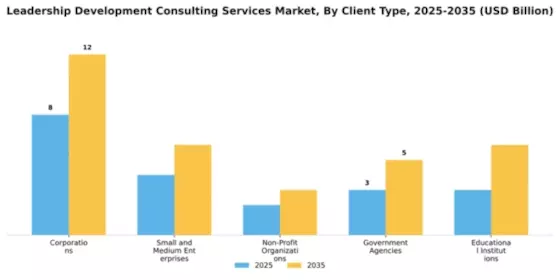
The Leadership Development Consulting Services Market showcases a diverse distribution among its client types. Corporations dominate significantly, constituting the largest segment as they typically have the resources and demand for comprehensive leadership training programs. This demand is fueled by the need for structured leadership pipelines and enhanced management effectiveness within larger organizational frameworks. In contrast, Small and Medium Enterprises (SMEs) are emerging as a powerful force in this segment, reflecting a growing trend towards investing in leadership development to remain competitive and agile in fast-changing markets. Growth trends indicate a robust appetite for leadership development among SMEs, attributed to a heightened awareness of the importance of skilled leadership for operational success. As these enterprises strive to build functional teams and retain talent, they are increasingly seeking tailored consulting services that resonate with their specific challenges. Furthermore, the pandemic has accelerated the need for adaptability, driving SMEs to innovate their leadership strategies, hence making them the fastest-growing client segment within the market.
Corporations: Dominant vs. Non-Profit Organizations: Emerging
Corporations stand as the dominant client type in the Leadership Development Consulting Services Market due to their substantial budgets and structured approach to leadership. They often engage consulting firms for customized programs aimed at developing their executive teams and nurturing future leaders to address evolving business challenges. Their prioritization of leadership aligns with long-term strategic goals, resulting in significant investment in various forms of leadership training. On the other hand, Non-Profit Organizations represent an emerging segment, increasingly realizing the value of effective leadership in driving mission success and social impact. These organizations often face unique challenges requiring specialized consulting services that cater to limited resources while still aiming for developmental growth. Consequently, the partnership between leadership consultants and non-profits is becoming more vital, supporting these organizations in creating influential leaders who are pivotal in navigating sectors driven by mission-centric goals.
In the Leadership Development Consulting Services Market, Leadership Skills emerge as the largest segment, commanding a significant market share due to its foundational importance in executive training. This segment focuses on enhancing individual capabilities necessary for effective leadership, thereby attracting substantial investment from organizations aiming to develop their leaders. Meanwhile, Change Management is recognized as the fastest-growing segment, driven by an increasing need for businesses to adapt to rapid market changes. This segment focuses on equipping leaders with the tools and strategies required to manage and lead through transitions effectively.
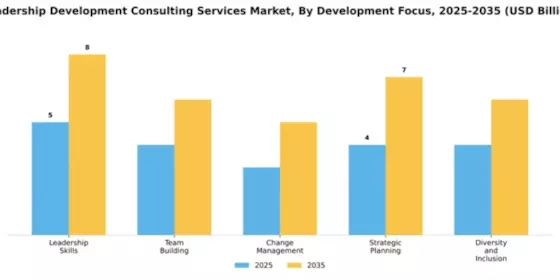
Leadership Skills: Traditional (Dominant) vs. Change Management (Emerging)
Leadership Skills remain the cornerstone of the Leadership Development Consulting Services Market. This segment is characterized by its comprehensive approach to building essential leadership capabilities, including communication, decision-making, and emotional intelligence. Organizations emphasize this area to ensure their leaders can navigate complex challenges successfully. In contrast, Change Management has surfaced as an emerging trend, increasingly vital in today's fast-paced business environment. This segment trains leaders to implement strategies that enhance organizational adaptability, fostering a culture of resilience and continuous improvement. As companies face rapid technological advancements and shifting market dynamics, the demand for Change Management training grows, positioning it as a promising focus area for development.
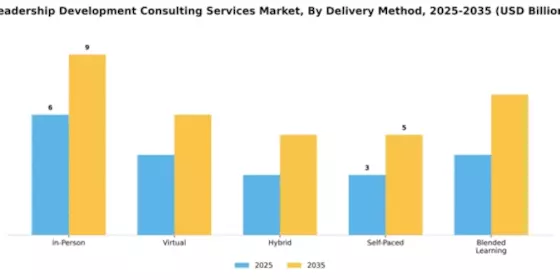
The Leadership Development Consulting Services Market shows a diverse share distribution across various delivery methods. In-Person sessions remain the largest segment, reflecting traditional preferences for face-to-face interaction, relationship building, and collaborative learning experiences. Conversely, the Virtual delivery method has seen a significant surge, especially in the post-pandemic landscape, driven by enhanced technological capabilities and the demand for flexibility in learning modalities.
In-Person (Dominant) vs. Virtual (Emerging)
In-Person delivery methods are dominant, as they foster immersive learning environments that facilitate personal connections and immediate feedback. Participants engage actively in workshops, which strengthens skill development and retention. However, the Virtual delivery method is rapidly emerging, attracting a growing base of learners who value the convenience and accessibility of online platforms. This method also allows for scalable training solutions and customization, appealing to organizations with geographically dispersed teams. The rise of new technologies and the emphasis on remote learning have accelerated this trend, marking Virtual methods as a key player in the future of leadership consulting.
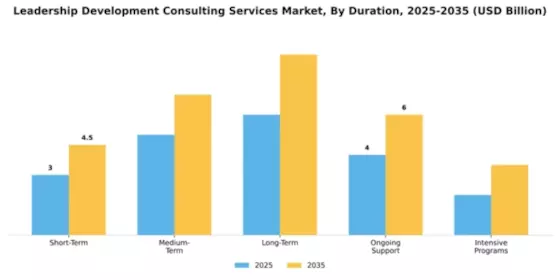
In the Leadership Development Consulting Services Market, the duration segments are categorized into Short-Term, Medium-Term, Long-Term, Ongoing Support, and Intensive Programs. Among these, Short-Term programs currently hold the largest market share, appealing to organizations looking for quick solutions to immediate leadership challenges. In contrast, the Long-Term segment is rapidly gaining traction, driven by companies recognizing the value of sustained leadership development efforts over time.
Short-Term (Dominant) vs. Long-Term (Emerging)
Short-Term leadership development programs are designed for quick engagement and immediate implementation, making them popular among companies facing urgent leadership gaps. These programs often focus on specific skills, targeting immediate organizational needs. On the other hand, Long-Term programs emphasize the cultivation of leadership talent over extended periods, promoting continuous learning and development. This segment is seeing increased demand as organizations aim to foster a more resilient leadership pipeline. The shift towards remote and hybrid working models is also influencing the design and delivery of these Long-Term programs, making them more flexible and accessible.
Get more detailed insights about Leadership Development Consulting Services Market Request Free Sample
North America continues to lead the Leadership Development Consulting Services market, holding a significant share of 10.0 in 2024. The region's growth is driven by a robust demand for innovative leadership strategies, particularly in technology and healthcare sectors. Regulatory support for workforce development and investment in employee training programs further catalyze market expansion. Companies are increasingly prioritizing leadership development to enhance organizational performance and adaptability. The competitive landscape in North America is characterized by the presence of major players such as Deloitte, McKinsey & Company, and PwC. These firms leverage advanced analytics and tailored solutions to meet diverse client needs. The U.S. remains the largest market, with Canada also showing promising growth. The focus on digital transformation and remote leadership training is reshaping service offerings, ensuring that firms remain agile in a rapidly changing environment.
Europe's Leadership Development Consulting Services market is valued at 5.0, reflecting a growing recognition of the importance of effective leadership in driving organizational success. Factors such as increasing globalization, regulatory frameworks promoting employee development, and a shift towards remote work are key growth drivers. The European Union's initiatives to enhance workforce skills and adaptability are also pivotal in shaping market dynamics. Leading countries in this region include the UK, Germany, and France, where firms are investing heavily in leadership training programs. The competitive landscape features key players like Accenture and Korn Ferry, who are adapting their services to meet the evolving needs of businesses. The emphasis on sustainability and ethical leadership is becoming increasingly important, influencing the strategies of consulting firms across Europe.
The Asia-Pacific region, with a market size of 3.0, is witnessing rapid growth in Leadership Development Consulting Services. This surge is driven by economic expansion, increasing corporate investments in human capital, and a rising awareness of the importance of leadership in achieving business objectives. Countries like China and India are at the forefront, with significant demand for tailored leadership programs that address local cultural nuances and business practices. The competitive landscape is evolving, with both The Leadership Development Consulting Services share. Firms such as FranklinCovey and Bain & Company are establishing a strong presence, focusing on innovative training methodologies. The region's diverse market demands are prompting consulting firms to adapt their offerings, ensuring they meet the unique needs of various industries and organizational structures.
The Middle East and Africa region, valued at 2.0, is gradually emerging in the Leadership Development Consulting Services market. The growth is fueled by increasing investments in human capital and a growing recognition of the need for effective leadership in both public and private sectors. Regulatory initiatives aimed at enhancing workforce skills and promoting leadership training are also contributing to market development. Countries like South Africa and the UAE are leading the charge, with a focus on developing local talent and addressing leadership gaps. The competitive landscape is characterized by a mix of international firms and local consultancies, each bringing unique insights and methodologies. The emphasis on cultural sensitivity and regional challenges is shaping the strategies of consulting firms operating in this diverse market.
The Leadership Development Consulting Services Market is characterized by a dynamic competitive landscape, driven by the increasing demand for effective leadership in organizations worldwide. Key players such as Deloitte (US), McKinsey & Company (US), and Korn Ferry (US) are at the forefront, each adopting distinct strategies to enhance their market positioning. Deloitte (US) emphasizes innovation through the integration of advanced analytics and digital tools, aiming to provide tailored solutions that meet the evolving needs of clients. Meanwhile, McKinsey & Company (US) focuses on strategic partnerships and collaborations, leveraging its extensive global network to deliver comprehensive leadership development programs. Korn Ferry (US) appears to be concentrating on expanding its service offerings, particularly in the realm of talent management and organizational design, thereby enhancing its competitive edge.The market structure is moderately fragmented, with numerous players vying for market share. This fragmentation is indicative of a diverse range of service offerings and client needs. Key business tactics employed by these firms include localizing services to cater to regional demands and optimizing their operational frameworks to enhance efficiency. The collective influence of these major players shapes the competitive environment, fostering a landscape where innovation and adaptability are paramount.In November Deloitte (US) announced the launch of a new digital leadership platform designed to enhance remote leadership capabilities. This strategic move underscores the firm's commitment to addressing the challenges posed by a rapidly changing work environment. By leveraging technology, Deloitte (US) aims to equip leaders with the necessary tools to navigate complex organizational dynamics, thereby reinforcing its position as a market leader.In October McKinsey & Company (US) entered into a strategic alliance with a leading technology firm to develop AI-driven leadership assessment tools. This collaboration is significant as it not only enhances McKinsey's service portfolio but also positions the company at the forefront of integrating technology into leadership development. The use of AI in assessments could potentially revolutionize how organizations identify and cultivate leadership talent.In September Korn Ferry (US) expanded its global footprint by acquiring a boutique consulting firm specializing in executive coaching. This acquisition is indicative of Korn Ferry's strategy to diversify its offerings and strengthen its market presence. By integrating specialized expertise, Korn Ferry (US) is likely to enhance its value proposition to clients seeking comprehensive leadership solutions.As of December the competitive trends in the Leadership Development Consulting Services Market are increasingly defined by digitalization, sustainability, and the integration of AI technologies. Strategic alliances are becoming more prevalent, as firms recognize the need to collaborate to stay competitive. Looking ahead, it is anticipated that competitive differentiation will evolve, shifting from traditional price-based competition to a focus on innovation, technological advancements, and supply chain reliability. This evolution suggests that firms that can effectively leverage these trends will likely secure a more robust position in the market.




The Leadership Development Consulting Services Market is projected to grow at a 4.37% CAGR from 2025 to 2035, driven by increasing demand for leadership skills and organizational transformation.
New opportunities lie in:
By 2035, the market is expected to be robust, reflecting evolving leadership needs globally.
| MARKET SIZE 2024 | 20.0(USD Billion) |
| MARKET SIZE 2025 | 20.87(USD Billion) |
| MARKET SIZE 2035 | 32.0(USD Billion) |
| COMPOUND ANNUAL GROWTH RATE (CAGR) | 4.37% (2025 - 2035) |
| REPORT COVERAGE | Revenue Forecast, Competitive Landscape, Growth Factors, and Trends |
| BASE YEAR | 2024 |
| Market Forecast Period | 2025 - 2035 |
| Historical Data | 2019 - 2024 |
| Market Forecast Units | USD Billion |
| Key Companies Profiled | Deloitte (US), McKinsey & Company (US), Boston Consulting Group (US), PwC (US), Korn Ferry (US), Accenture (IE), Bain & Company (US), Hay Group (US), FranklinCovey (US) |
| Segments Covered | Service Type, Client Type, Development Focus, Delivery Method, Duration |
| Key Market Opportunities | Integration of artificial intelligence in personalized leadership training programs. |
| Key Market Dynamics | Rising demand for personalized leadership training drives innovation and competition among consulting service providers. |
| Countries Covered | North America, Europe, APAC, South America, MEA |
As of 2024, the market valuation was 20.0 USD Billion.
The market is expected to reach a valuation of 32.0 USD Billion by 2035.
The expected CAGR for the market during this period is 4.37%.
The Training segment is projected to grow from 5.0 to 8.0 USD Billion.
Corporations are anticipated to dominate the market, with a projected valuation of 8.0 to 12.0 USD Billion.
Leadership Skills and Team Building are expected to be the primary focus areas, with valuations of 5.0 to 8.0 USD Billion and 4.0 to 6.0 USD Billion, respectively.
In-Person delivery is projected to lead with a valuation range of 6.0 to 9.0 USD Billion.
The Long-Term segment is likely to see significant growth, with projections of 6.0 to 9.0 USD Billion.
Prominent players include Deloitte, McKinsey & Company, and Boston Consulting Group, among others.
The market serves various organizations, with Small and Medium Enterprises projected to reach 4.0 to 6.0 USD Billion.


Kindly complete the form below to receive a free sample of this Report

“This is really good guys. Excellent work on a tight deadline. I will continue to use you going forward and recommend you to others. Nice job”


“Thanks. It’s been a pleasure working with you, please use me as reference with any other Intel employees.”


“Thanks for sending the report it gives us a good global view of the Betaïne market.”


“Thank you, this will be very helpful for OQS.”


“We found the report very insightful! we found your research firm very helpful. I'm sending this email to secure our future business.”


“I am very pleased with how market segments have been defined in a relevant way for my purposes (such as "Portable Freezers & refrigerators" and "last-mile"). In general the report is well structured. Thanks very much for your efforts.”


“I have been reading the first document or the study, ,the Global HVAC and FP market report 2021 till 2026. Must say, good info! I have not gone in depth at all parts, but got a good indication of the data inside!”


“We got the report in time, we really thank you for your support in this process. I also thank to all of your team as they did a great job.”


“The Automotive 48V ECU Components Procurement Intelligence Study” was a complex project, but the Market Research Future (MRFR) team handled it with quality, agility, and customer-centricity. They delivered all requested data on time and within the agreed scope. The team, including Shubhendra Anand and Rahul Gotadki, was always readily available to clarify questions and swiftly implement necessary adjustments, driving the project to a successful conclusion within a very demanding timeframe.
I would also like to specifically commend Akshay Agarwal for his responsiveness and support at every stage—from our initial inquiry on May 6th through to final delivery on June 18th. His dedication made the entire process seamless.”



