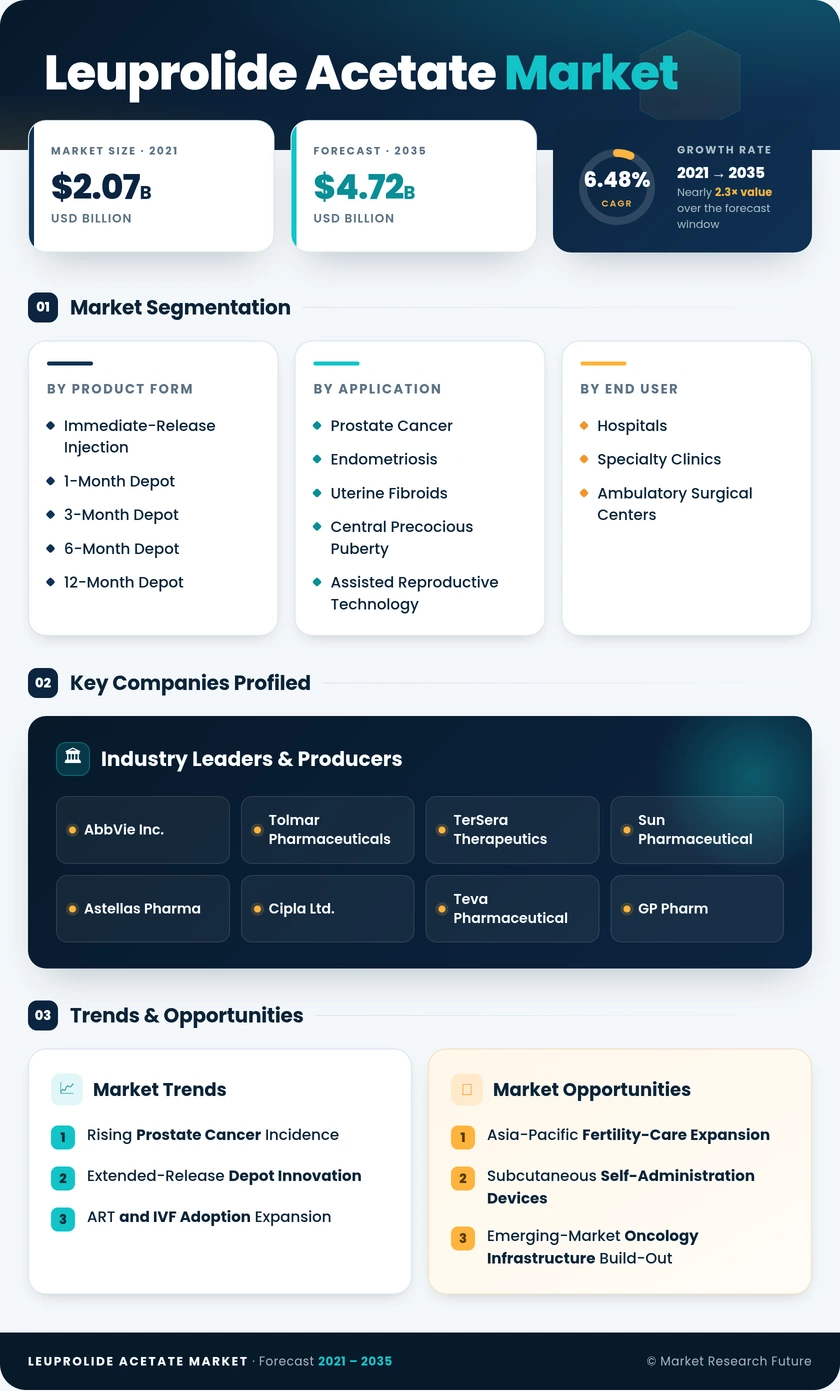
Segmentation Quick Reference
| Dimension | Sub-Segments | Dominant Segment | Fastest Growing Segment |
| Product Form | Immediate-Release Injection, 1-Month Depot, 3-Month Depot, 6-Month Depot, 12-Month Depot | 1-Month Depot | 6-Month Depot |
| Application | Prostate Cancer, Endometriosis, Uterine Fibroids, Central Precocious Puberty, Assisted Reproductive Leuprolide Acetate Market | Prostate Cancer | Assisted Reproductive Leuprolide Acetate Market |
| End User | Hospitals, Specialty Clinics, Ambulatory Surgical Centers | Hospitals | Specialty Clinics |
| Distribution Channel | Hospital Pharmacies, Retail Pharmacies, Online Pharmacies | Hospital Pharmacies | Online Pharmacies |
| Geography | North America, Europe, Asia-Pacific, South America, Middle East & Africa | North America | Asia-Pacific |
Market Segmentation Overview
By Product Form
| Sub-Segment | Key Trend |
| Immediate-Release Injection | Declining share as depot formulations dominate; niche use in ART protocols |
| 1-Month Depot | Largest volume segment; facing gradual share erosion to longer-acting depots |
| 3-Month Depot | Growing preference among urologists for intermediate-duration therapy |
| 6-Month Depot | Fastest-growing format; payer incentives favoring reduced visit frequency |
| 12-Month Depot | Emerging segment; early adoption in stable, long-term suppression patients |
Product form evolution reflects a clear trajectory toward longer-acting depot presentations that improve adherence and reduce healthcare resource utilization. The 1-month depot retains volume leadership, but payer and clinical momentum increasingly favors 3- to 6-month cycles.
By Application
| Sub-Segment | Key Trend |
| Prostate Cancer | Dominant revenue driver; sustained by aging demographics and screening expansion |
| Endometriosis | Growing diagnostic awareness driving specialist referrals and treatment initiation |
| Uterine Fibroids | Preoperative use expanding as laparoscopic surgery volumes rise |
| Central Precocious Puberty | Pediatric indication growth supported by earlier diagnosis protocols |
| Assisted Reproductive Leuprolide Acetate Market | Fastest-growing application; driven by global IVF adoption and fertility subsidies |
Prostate cancer remains the anchor indication, but ART is reshaping the application mix as global infertility treatment demand accelerates across both public and private healthcare systems.
By End User
| Sub-Segment | Key Trend |
| Hospitals | Dominant channel; institutional procurement through group purchasing organizations |
| Specialty Clinics | Fastest-growing; outpatient oncology and fertility center proliferation |
| Ambulatory Surgical Centers | Niche but growing; linked to day-case gynecological procedures |
Care delivery is gradually shifting from inpatient hospital settings to outpatient specialty clinics, particularly for routine depot administration in stable oncology and fertility patients.
By Distribution Channel
| Sub-Segment | Key Trend |
| Hospital Pharmacies | Largest channel; anchored by institutional supply-chain contracts |
| Retail Pharmacies | Stable share; patient pickup for pre-filled subcutaneous devices |
| Online Pharmacies | Fastest-growing; specialty e-pharmacy platforms with cold-chain capability |
Digital pharmacy platforms are gaining traction as patients and providers seek convenience in chronic-therapy fulfillment, though cold-chain requirements limit online channel expansion to established specialty e-pharmacies.