×
Request Free Sample ×

Kindly complete the form below to receive a free sample of this Report

* Please use a valid business email

Leading companies partner with us for data-driven Insights

clients tt-cursor
Hero Background

Lidocaine Hydrochloride Market

ID: MRFR/HC/40347-HCR
200 Pages
Garvit Vyas
October 2025

Lidocaine Hydrochloride Market Research Report By Application (Local Anesthesia, Topical Anesthesia, Regional Anesthesia, Nerve Block Anesthesia, Dental Anesthesia), By Formulation (Injection, Topical Gel, Cream, Ointment, Patch), By End Use (Hospitals, Clinics, Dental Practices, Ambulatory Surgical Centers, Home Care) andBy Regional (North America, Europe, South America, Asia Pacific, Middle East and Africa)- Forecast to 2035

Share:
Download PDF ×

We do not share your information with anyone. However, we may send you emails based on your report interest from time to time. You may contact us at any time to opt-out.

Lidocaine Hydrochloride Market Infographic
Purchase Options

Lidocaine Hydrochloride Market Summary

As per MRFR analysis, the Lidocaine Hydrochloride Market Size was estimated at 4.268 USD Billion in 2024. The Lidocaine Hydrochloride industry is projected to grow from 4.367 USD Billion in 2025 to 5.504 USD Billion by 2035, exhibiting a compound annual growth rate (CAGR) of 2.34 during the forecast period 2025 - 2035.

Key Market Trends & Highlights

The Lidocaine Hydrochloride Market is experiencing robust growth driven by increasing demand for pain management solutions.

  • The market is witnessing a rising demand in pain management, particularly in North America, which remains the largest market.
  • Innovations in formulation technologies are enhancing the efficacy and delivery of Lidocaine Hydrochloride Market, especially in the topical anesthesia segment.
  • Expansion into new therapeutic areas is evident, with Lidocaine Hydrochloride Market gaining traction in veterinary medicine and dental procedures.
  • Key market drivers include the increasing prevalence of chronic pain conditions and advancements in anesthetic techniques, particularly in the local anesthesia segment.

Market Size & Forecast

2024 Market Size 4.268 (USD Billion)
2035 Market Size 5.504 (USD Billion)
CAGR (2025 - 2035) 2.34%

Major Players

Pfizer Inc. (US), Mylan N.V. (NL), Hikma Pharmaceuticals PLC (GB), Teva Pharmaceutical Industries Ltd. (IL), Baxter International Inc. (US), AstraZeneca PLC (GB), Sandoz International GmbH (CH), Luitpold Pharmaceuticals Inc. (US)

Lidocaine Hydrochloride Market Trends

The Lidocaine Hydrochloride Market is currently experiencing a dynamic phase characterized by evolving applications and increasing demand across various sectors. This local anesthetic, widely utilized in medical procedures, is gaining traction in both surgical and non-surgical settings. The growing prevalence of chronic pain conditions and the rising number of outpatient procedures are contributing to the heightened interest in Lidocaine Hydrochloride Market. Furthermore, advancements in formulation technologies are enhancing its efficacy and safety profile, thereby expanding its therapeutic potential. As healthcare providers seek effective pain management solutions, the Lidocaine Hydrochloride Market appears poised for continued growth. In addition to its established role in anesthesia, Lidocaine Hydrochloride Market is finding new applications in dermatology and dentistry, which may further bolster its market presence. The increasing focus on patient comfort and satisfaction is driving innovations in delivery methods, such as topical formulations and injectable solutions. Moreover, regulatory bodies are actively evaluating and approving new formulations, which could lead to a broader range of products available in the market. Overall, the Lidocaine Hydrochloride Market seems to be on a trajectory of expansion, influenced by both clinical needs and technological advancements.

Rising Demand in Pain Management

The Lidocaine Hydrochloride Market is witnessing a surge in demand driven by the increasing prevalence of chronic pain conditions. As healthcare systems prioritize effective pain management strategies, Lidocaine Hydrochloride Market is becoming a preferred choice for both acute and chronic pain relief.

Innovations in Formulation Technologies

Advancements in formulation technologies are enhancing the delivery and efficacy of Lidocaine Hydrochloride Market. New delivery methods, including topical applications and sustained-release formulations, are being developed to improve patient outcomes and satisfaction.

Expansion into New Therapeutic Areas

The Lidocaine Hydrochloride Market is expanding into new therapeutic areas, particularly in dermatology and dentistry. This diversification is likely to create additional opportunities for growth as practitioners seek effective solutions for various medical conditions.

Lidocaine Hydrochloride Market Drivers

Advancements in Anesthetic Techniques

The Lidocaine Hydrochloride Market Industry is benefiting from advancements in anesthetic techniques that enhance the efficacy and safety of lidocaine applications. Innovations such as ultrasound-guided regional anesthesia and the development of new delivery systems are revolutionizing how lidocaine is administered. These techniques not only improve the precision of anesthetic delivery but also minimize potential side effects, thereby increasing patient satisfaction. Furthermore, the integration of lidocaine in combination therapies is gaining traction, as it can enhance the overall effectiveness of pain management protocols. The market is witnessing a shift towards more sophisticated anesthetic practices, which is likely to bolster the demand for lidocaine hydrochloride. As healthcare professionals continue to adopt these advanced techniques, the Lidocaine Hydrochloride Market Industry is expected to expand significantly.

Regulatory Support for Anesthetic Products

The Lidocaine Hydrochloride Market Industry is positively influenced by regulatory support for anesthetic products, which facilitates the approval and availability of lidocaine formulations. Regulatory agencies are increasingly recognizing the importance of effective pain management solutions, leading to streamlined approval processes for new lidocaine products. This supportive regulatory environment encourages innovation and the introduction of novel formulations, such as topical gels and injectable solutions, which cater to diverse patient needs. Furthermore, the emphasis on patient safety and efficacy in anesthetic practices aligns with regulatory initiatives, fostering confidence among healthcare providers in the use of lidocaine hydrochloride. As regulatory frameworks continue to evolve, the Lidocaine Hydrochloride Market Industry is likely to experience enhanced growth opportunities.

Increasing Prevalence of Chronic Pain Conditions

The Lidocaine Hydrochloride Market Industry is experiencing a notable surge due to the increasing prevalence of chronic pain conditions. Conditions such as arthritis, neuropathic pain, and fibromyalgia are becoming more common, leading to a heightened demand for effective pain management solutions. According to recent estimates, chronic pain affects a significant portion of the population, prompting healthcare providers to seek reliable anesthetic options. Lidocaine hydrochloride, known for its efficacy in pain relief, is increasingly utilized in various medical settings, including outpatient procedures and surgical interventions. This trend indicates a growing recognition of lidocaine's role in enhancing patient comfort and recovery, thereby driving the market forward. As healthcare systems adapt to the rising burden of chronic pain, the Lidocaine Hydrochloride Market Industry is poised for substantial growth.

Rising Demand for Local Anesthetics in Dental Procedures

The Lidocaine Hydrochloride Market Industry is experiencing growth driven by the rising demand for local anesthetics in dental procedures. Lidocaine is widely recognized as the standard anesthetic for various dental treatments, including extractions, root canals, and periodontal surgeries. The increasing number of dental procedures performed annually, coupled with a growing awareness of pain management in dentistry, is propelling the demand for lidocaine hydrochloride. Market data indicates that the dental segment accounts for a substantial share of the overall anesthetic market, with lidocaine being the preferred choice among dental practitioners. This trend underscores the importance of effective pain control in enhancing patient experiences and outcomes in dental care. As the dental industry continues to evolve, the Lidocaine Hydrochloride Market Industry is likely to see sustained growth.

Expansion of Lidocaine Hydrochloride in Veterinary Medicine

The Lidocaine Hydrochloride Market Industry is witnessing an expansion into veterinary medicine, where lidocaine is increasingly utilized for pain management in animals. The growing recognition of animal welfare and the need for effective pain control in veterinary practices are driving this trend. Lidocaine is employed in various procedures, including surgeries and diagnostic interventions, to ensure the comfort of animals during treatment. The veterinary sector is evolving, with a rising number of clinics adopting advanced pain management protocols, which include the use of lidocaine hydrochloride. This shift not only enhances the quality of care provided to animals but also reflects a broader trend towards the integration of effective anesthetic solutions in veterinary medicine. As this market segment continues to grow, the Lidocaine Hydrochloride Market Industry is expected to benefit significantly.
Market Segment Insights

By Application: Local Anesthesia (Largest) vs. Topical Anesthesia (Fastest-Growing)

In the Lidocaine Hydrochloride Market, the application segment is primarily dominated by Local Anesthesia, which accounts for the largest share, reflecting its widespread use in various surgical and medical procedures. Following closely is Topical Anesthesia, which has gained substantial traction, particularly in dermatological and minor procedures, benefiting from increased patient preferences for non-invasive treatment options and rising awareness about pain management.

Local Anesthesia (Dominant) vs. Topical Anesthesia (Emerging)

Local Anesthesia serves as the dominant application in the Lidocaine Hydrochloride Market, favored for its efficacy in providing pain relief during surgeries and invasive procedures. Its established role in hospitals and clinics positions it as a reliable choice among healthcare professionals. In contrast, Topical Anesthesia is emerging rapidly due to its applications in cosmetic procedures and minor treatments, emphasizing convenience and patient comfort. The growth of minimally invasive procedures and the increasing emphasis on aesthetic treatments are catalyzing the demand for topical anesthetics, making it a significant area of interest for manufacturers and healthcare providers.

By Formulation: Injection (Largest) vs. Topical Gel (Fastest-Growing)

In the Lidocaine Hydrochloride Market, the formulation segment is characterized by a diverse range of products, with injections commanding the largest share of the market. This preference is primarily attributed to the efficacy of injection formulations in providing rapid pain relief, which is crucial in clinical settings. Topical gels, while smaller in market share, are emerging as a popular alternative due to their ease of use and non-invasive application method, appealing particularly to patients seeking at-home pain management solutions.

Injection (Dominant) vs. Topical Gel (Emerging)

The injection formulation of Lidocaine Hydrochloride Market continues to be the dominant player in the market, favored for its fast-acting properties and widespread application in various medical procedures. It is particularly effective for local anesthesia in dental and minor surgical applications. Conversely, the topical gel formulation is emerging as a valuable alternative, particularly due to its user-friendly application and lower risk of systemic side effects. Patients and healthcare providers alike are gravitating toward topical gels for conditions requiring localized treatment, such as neuropathic pain. This growing trend is driven by a desire for convenient, non-invasive pain management options and is expected to witness a significant rise in adoption.

By End Use: Hospitals (Largest) vs. Dental Practices (Fastest-Growing)

In the Lidocaine Hydrochloride Market, the distribution of market share among various end-use segments reveals interesting dynamics. Hospitals hold the largest share, benefiting from their extensive patient base and advanced medical facilities. Clinics and ambulatory surgical centers follow, highlighting the demand for local care, while home care services are becoming increasingly relevant. Dental practices are rapidly emerging as prominent users of lidocaine, contributing significantly to the overall market landscape. Growth trends within this segment are driven by factors such as the increasing prevalence of surgical procedures and dental work, boosting demand for lidocaine as a local anesthetic. The enhanced focus on patient-centered care and minimal invasive procedures in healthcare facilities is also propelling the use of lidocaine. As populations age and healthcare access expands, the demand from various end-use sectors, particularly dental practices and home care, is expected to rise significantly.

Hospitals (Dominant) vs. Dental Practices (Emerging)

Hospitals remain the dominant end-user of lidocaine hydrochloride due to their capability to administer a wide range of surgical procedures that require effective anesthesia. They possess the infrastructure and resources to ensure a consistent supply of lidocaine, safeguarding patient care during critical interventions. Conversely, dental practices are emerging rapidly in the lidocaine ecosystem, driven by growing dental procedures and a higher awareness of oral health among patients. This segment is adopting more advanced formulations of lidocaine for better efficacy and improvement in patient satisfaction. As both segments evolve, hospitals will continue to lead, while dental practices carve out a significant niche, reflecting broader trends in health services and patient preferences.

Get more detailed insights about Lidocaine Hydrochloride Market

Regional Insights

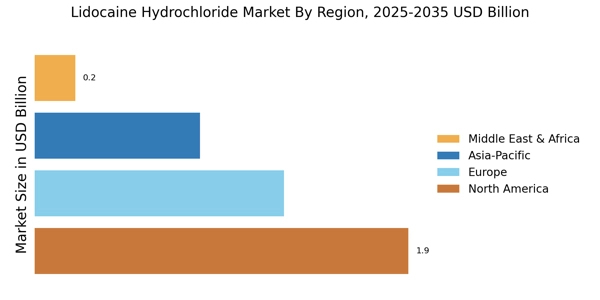
In the Global Lidocaine Hydrochloride Market, the regional landscape showcases distinct valuations across multiple areas, with North America leading the way. By 2024, North America is valued at 1.8 USD Billion, and this market continues to dominate, reaching 2.2 USD Billion by 2035, representing a significant share that underscores its advanced healthcare infrastructure and high demand for lidocaine applications.

Europe follows with a valuation of 1.0 USD Billion in 2024 and is expected to grow to 1.3 USD Billion by 2035, indicating its solid base for pharmaceutical innovations.The APAC region also presents notable growth, starting at 1.2 USD Billion in 2024 and projected to reach 1.5 USD Billion by 2035, driven by increasing medical procedures and healthcare investments. Meanwhile, South America shows a more modest increase from 0.2 USD Billion in 2024 to 0.25 USD Billion in 2035, reflecting emerging healthcare markets.

The MEA region, while currently valued at 0.07 USD Billion in 2024, is expected to reach 0.25 USD Billion by 2035, highlighting its potential for future growth through expanding healthcare access. Overall, the Global Lidocaine Hydrochloride Market revenue illustrates a diverse regional dynamic, with North America as a primary contributor and substantial growth potential in APAC and MEA.

Lidocaine Hydrochloride Market Regional Image

Key Players and Competitive Insights

The Global Lidocaine Hydrochloride Market exhibits a dynamic landscape characterized by a mixture of competitive forces, diverse product portfolios, and a range of therapeutic applications. Lidocaine hydrochloride, a local anesthetic and antiarrhythmic agent, is prominently utilized in various medical settings, thereby driving demand across multiple regions. The competition remains vigorous as industry players strive to enhance their market positions through innovative formulation developments, strategic partnerships, and expansion of distribution networks. Moreover, regulatory factors and increasing awareness regarding the safe usage of anesthetics considerably influence the market dynamics.

As the healthcare sector continues to evolve, players in this arena are compelled to adapt efficiently to changing market trends, customer needs, and technological advancements.Focusing on Par Pharmaceutical within the Global Lidocaine Hydrochloride Market, the company stands as a notable entity due to its robust market presence and commitment to quality. With a wide-ranging portfolio, Par Pharmaceutical has effectively leveraged its capacity to deliver high-quality lidocaine hydrochloride products, catering to various clinical requirements. The organization's rigorous research and development efforts underpin its advantage in the market, ensuring that it remains aligned with evolving healthcare standards and practices.

Par Pharmaceutical emphasizes the manufacturing of cost-effective solutions, which enhances accessibility, particularly in critical care settings. This unwavering focus on quality assurance and customer satisfaction bolsters Par Pharmaceutical’s reputation as a reliable supplier in the lidocaine hydrochloride sector, fostering strong relationships with healthcare professionals and entities.Sun Pharmaceutical Industries contributes significantly to the Global Lidocaine Hydrochloride Market with its expansive knowledge base and manufacturing capabilities. The company is recognized for its dedication to innovation and quality in production, which has a strong foothold in the anesthetic landscape.

Sun Pharmaceutical Industries not only adheres to stringent regulatory standards but also places emphasis on developing enhanced formulations that cater to a variety of clinical scenarios. With a commitment to research-driven strategies, the company seeks to address the increasing demand for effective anesthetic solutions while ensuring patient safety and treatment efficacy. By targeting diverse market segments and investing in medical advancements, Sun Pharmaceutical Industries continues to cultivate a competitive edge, maintaining its status as a key player within the global lidocaine hydrochloride domain.

Key Companies in the Lidocaine Hydrochloride Market market include

Industry Developments

  • Q2 2023: Pfizer Inc. introduced Xylocaine (lidocaine HCl) 4% Topical Spray in June 2023 to provide patients with postherpetic neuralgia with long-lasting pain relief. Pfizer launched a new 4% topical spray formulation of Xylocaine (lidocaine HCl) aimed at providing extended pain relief for patients suffering from postherpetic neuralgia.
  • Q2 2023: AstraZeneca plc and Hikma Pharmaceuticals partnered in April 2023 to commercialize the Xylocaine portfolio in a few emerging regions. AstraZeneca and Hikma Pharmaceuticals entered a partnership to commercialize the Xylocaine (lidocaine hydrochloride) product portfolio in select emerging markets, expanding access to the anesthetic.

Future Outlook

Lidocaine Hydrochloride Market Future Outlook

The Lidocaine Hydrochloride Market is projected to grow at a 2.34% CAGR from 2024 to 2035, driven by increasing demand in pain management and advancements in formulation technologies.

New opportunities lie in:

  • Expansion into emerging markets with tailored formulations
  • Development of combination therapies for enhanced efficacy
  • Investment in digital health platforms for remote patient monitoring

By 2035, the market is expected to solidify its position as a key player in pain management solutions.

Market Segmentation

Lidocaine Hydrochloride Market End Use Outlook

  • Hospitals
  • Clinics
  • Dental Practices
  • Ambulatory Surgical Centers
  • Home Care

Lidocaine Hydrochloride Market Application Outlook

  • Local Anesthesia
  • Topical Anesthesia
  • Regional Anesthesia
  • Nerve Block Anesthesia
  • Dental Anesthesia

Lidocaine Hydrochloride Market Formulation Outlook

  • Injection
  • Topical Gel
  • Cream
  • Ointment
  • Patch

Report Scope

MARKET SIZE 20244.268(USD Billion)
MARKET SIZE 20254.367(USD Billion)
MARKET SIZE 20355.504(USD Billion)
COMPOUND ANNUAL GROWTH RATE (CAGR)2.34% (2024 - 2035)
REPORT COVERAGERevenue Forecast, Competitive Landscape, Growth Factors, and Trends
BASE YEAR2024
Market Forecast Period2025 - 2035
Historical Data2019 - 2024
Market Forecast UnitsUSD Billion
Key Companies ProfiledMarket analysis in progress
Segments CoveredMarket segmentation analysis in progress
Key Market OpportunitiesGrowing demand for topical anesthetics in outpatient procedures drives Lidocaine Hydrochloride Market expansion.
Key Market DynamicsRising demand for Lidocaine Hydrochloride in pain management drives competitive dynamics and regulatory scrutiny in the pharmaceutical sector.
Countries CoveredNorth America, Europe, APAC, South America, MEA

Leave a Comment

FAQs

What is the projected market valuation of the Lidocaine Hydrochloride Market by 2035?

The Lidocaine Hydrochloride Market is projected to reach a valuation of 5.504 USD Billion by 2035.

What was the market valuation of Lidocaine Hydrochloride in 2024?

In 2024, the Lidocaine Hydrochloride Market was valued at 4.268 USD Billion.

What is the expected CAGR for the Lidocaine Hydrochloride Market during the forecast period 2025 - 2035?

The expected CAGR for the Lidocaine Hydrochloride Market during the forecast period 2025 - 2035 is 2.34%.

Which companies are considered key players in the Lidocaine Hydrochloride Market?

Key players in the Lidocaine Hydrochloride Market include Pfizer Inc., Mylan N.V., Hikma Pharmaceuticals PLC, and Teva Pharmaceutical Industries Ltd.

What segment of the Lidocaine Hydrochloride Market had the highest valuation in 2024?

In 2024, the Local Anesthesia segment had the highest valuation at 1.5 USD Billion.

How is the Lidocaine Hydrochloride Market segmented by formulation?

The Lidocaine Hydrochloride Market is segmented by formulation into Injection, Topical Gel, Cream, Ointment, and Patch.

What is the projected growth for the Dental Anesthesia segment by 2035?

The Dental Anesthesia segment is projected to grow from 0.368 USD Billion in 2024 to 0.504 USD Billion by 2035.

What end-use segment is expected to show significant growth in the Lidocaine Hydrochloride Market?

The Hospitals end-use segment is expected to grow from 1.5 USD Billion in 2024 to 1.9 USD Billion by 2035.

What formulation type is anticipated to dominate the Lidocaine Hydrochloride Market?

The Injection formulation type is anticipated to dominate the Lidocaine Hydrochloride Market, growing from 1.5 USD Billion in 2024 to 1.9 USD Billion by 2035.

How does the Lidocaine Hydrochloride Market's growth compare across different applications?

The Local Anesthesia application is expected to lead the market, with a growth from 1.5 USD Billion in 2024 to 1.9 USD Billion by 2035.

What is the projected market size of the Global Lidocaine Hydrochloride Market by 2035?

By 2035, the Global Lidocaine Hydrochloride Market is projected to reach a value of 1.2 billion USD.

What is the expected CAGR for the Global Lidocaine Hydrochloride Market from 2025 to 2035?

The expected CAGR for the Global Lidocaine Hydrochloride Market from 2025 to 2035 is 3.43%.

Which region is expected to dominate the Global Lidocaine Hydrochloride Market by 2035?

North America is expected to dominate the Global Lidocaine Hydrochloride Market with a projected value of 0.45 billion USD by 2035.

What is the market size of topical anesthetics in the Global Lidocaine Hydrochloride Market in 2024?

The market size for topical anesthetics in the Global Lidocaine Hydrochloride Market is valued at 0.35 billion USD in 2024.

What is the expected market value of dental anesthetics by 2035?

The expected market value of dental anesthetics in the Global Lidocaine Hydrochloride Market is 0.25 billion USD by 2035.

What is the expected market size for injection anesthetics in 2024?

Injection anesthetics are expected to have a market size of 0.25 billion USD in 2024.

Which application segment is expected to experience the highest growth rate in the Global Lidocaine Hydrochloride Market?

Topical anesthetics are expected to experience significant growth in the Global Lidocaine Hydrochloride Market from 2025 to 2035.

What are the expected market values for ophthalmic anesthetics by 2035?

The expected market value for ophthalmic anesthetics in the Global Lidocaine Hydrochloride Market by 2035 is 0.05 billion USD.

Download Free Sample

Kindly complete the form below to receive a free sample of this Report

Compare Licence

×
Features License Type
Single User Multiuser License Enterprise User
Price $4,950 $5,950 $7,250
Maximum User Access Limit 1 User Upto 10 Users Unrestricted Access Throughout the Organization
Free Customization
Direct Access to Analyst
Deliverable Format
Platform Access
Discount on Next Purchase 10% 15% 15%
Printable Versions