Research Methodology on Light Attack Reconnaissance Aircraft Market
Research Description:
In this research project, Market Research Future (MRFR) provides insight into the Light Attack Reconnaissance Aircraft Market. The report encompasses a thorough market analysis in terms of both qualitative and quantitative aspects. It gives an in-depth insight into the market trends and its expected growth in the estimated period of 2023 to 2030. To accomplish this, we have laid out a detailed research methodology, which includes a detailed primary and secondary market assessment, demand and supply ratio analysis, market segmentation, Porter Five analysis and a final market forecast from 2023 to 2030.
Research Objectives:
The objective of the research is to provide an in-depth analysis of the Light Attack Reconnaissance Aircraft Market in terms of its current and future trends. Specifically, the objectives of this research can be summarized as follows:
- To understand the overview of the Light Attack Reconnaissance Aircraft Market
- To study the market dynamics, factors influencing the market, and future trends of the global Light Attack Reconnaissance Aircraft Market.
- To analyze the market segmentation along with the current and future trends of the market segments.
- To determine the major vendors operating in the global Light Attack Reconnaissance Aircraft Market.
- To perform an exploratory study of the market to support the primary and secondary market analysis.
- To identify the latest technological advancements and their impact on the Light Attack Reconnaissance Aircraft Market.
Research Approach:
The research approach entails a comprehensive market analysis of the Light Attack Reconnaissance Aircraft Market. To do this, we have conducted a detailed primary and secondary data analysis. The primary data is collected from the various industry participants and their industry bodies. These data are used to conduct industry analysis and have been validated with secondary data collected from various sources.
The secondary data includes financial reports of the Light Attack Reconnaissance Aircraft Market, market reports, product and applications reports, conference papers, press releases, trade reports, and various other papers. We have followed the top-down and bottom-up approach to identify the market size. The top-down approach included product segmentation, and the bottom-up approach consisted of market share analysis of the region and application segments of the Light Attack Reconnaissance Aircraft Market.
Market Structure:
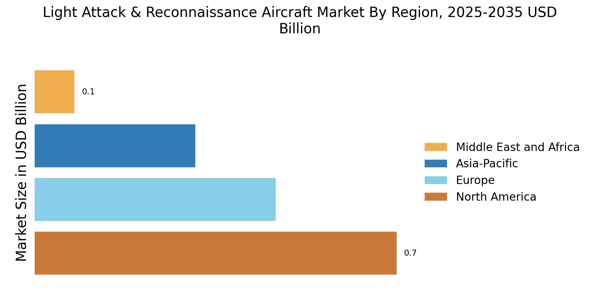
The global light attack reconnaissance aircraft market is segmented based on technology, platform, end-user, and region. Based on technology, the market is segmented into radio frequency reconnaissance aircraft, ultra-lightweight attack aircraft, optoelectronic reconnaissance, and others. Based on the platform, the market is segmented into fixed-wing and rotary-wing aircraft. Based on end-user, the market is segmented into governmental and industrial. Based on region, the market is segmented into North America, Europe, Asia-Pacific (APAC), and Rest of the World.
Data Collection Methods:
To provide an accurate estimation of the Light Attack Reconnaissance Aircraft Market, we have conducted an extensive primary and secondary data collection process. We have conducted interviews of light attack reconnaissance aircraft solution providers, and product and applications experts to gain an in-depth insight into the Light Attack Reconnaissance Aircraft Market.
Using secondary data and primary data, we have conducted a comprehensive market analysis of the Light Attack Reconnaissance Aircraft Market. We have made use of the latest market research programs to collect the most up-to-date market statistics and data. We have utilized various trade publications, reports, press releases, and industry body websites to gain further insights into the Light Attack Reconnaissance Aircraft Market.
To further validate the results obtained from the primary and secondary research, we have conducted an exploratory study. We have also conducted a regional comparison study to understand regional trends and market opportunities in the Light Attack Reconnaissance Aircraft Market.
Statistical Modelling Techniques
To provide an accurate market estimation, we have used the following statistical modelling techniques:
- Regression Analysis: To analyze the correlation between the various factors influencing the Light Attack Reconnaissance Aircraft Market.
- Clustering Analysis: To segment the market more accurately based on various factors such as end-user, platform, technology, and region.
- Time Series Analysis: To understand the market trends over a specific period.
- Principal Component Analysis: To reduce the complexity of the dataset and uncover the dominant factors influencing the Light Attack Reconnaissance Aircraft Market.
Data Validation and Triangulation:
Once the data and statistical models have been gathered, we validate them with the help of internal and external industry sources. This process is conducted to gain a high-quality market estimation. The primary sources are the industry participants, such as original equipment manufacturers, suppliers, technology providers, and other industry associations. The secondary sources are trade associations, market trend reports, and other published industry reports.
Market Forecast:
To estimate the market size, MRFR has followed the bottom-up and top-down approaches. The bottom-up approach includes the number of aircraft manufactured per region or platform. The top-down approach includes the overall market distribution in terms of end-user segments or application segments.
The overall market size for the Light Attack Reconnaissance Aircraft Market is calculated based on the sales volume of light attack reconnaissance aircraft in different regions. For the bottom-up approach, the region-wise market size regression analysis is provided. The data is further validated with the top-down approach, in which the total market size is made of end-user segments.
Finally, the market size estimation has been made after combining the actual data derived from the above-mentioned approaches. This figure has been further validated synchronously by utilizing internal data, triangulation method, and external research.
The data and market figures presented in the report are verified and assured by the research team in various steps, such as through internal auditing, web research, competitions, and historical studies.