Lighting Control System Market Summary
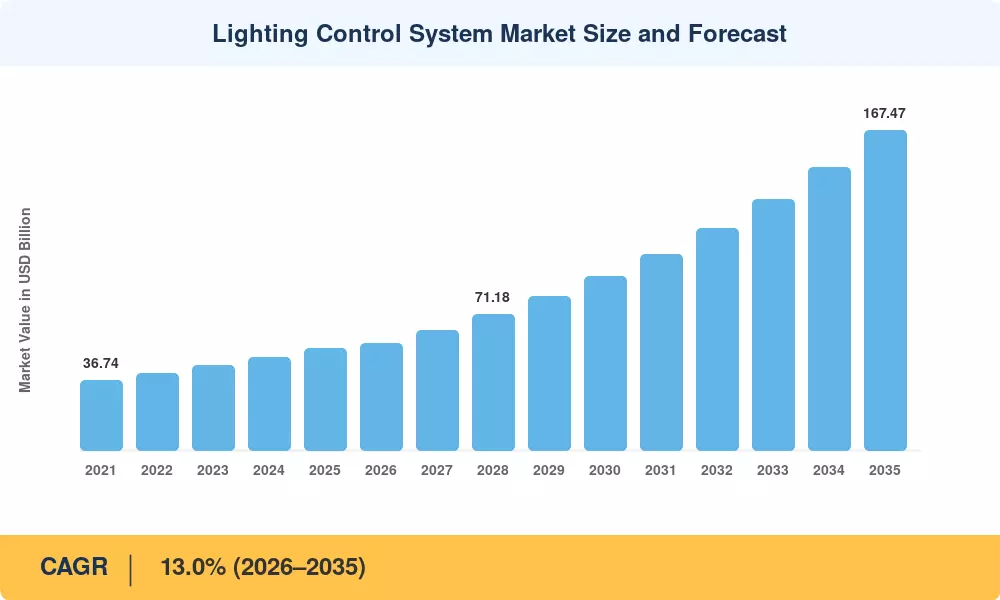
The Lighting Control System Market was valued at USD 53.32 billion in 2025 and is projected to reach USD 55.75 billion in 2026 before climbing to USD 167.47 billion by 2035, registering a CAGR of 13.0% during the 2026–2035 forecast period. This trajectory is anchored in tightening building energy codes — California's Title 24-2025 now mandates automatic shut-off and daylight harvesting for interior spaces above 2,500 square feet — and a global wave of commercial retrofit spending that the IEA estimates will exceed USD 80 billion annually by 2028 [1].
A technology shift is reshaping the sector. Legacy toggle-switch and timer-based systems are giving way to sensor-driven, network-connected platforms that treat luminaires as data endpoints rather than fixed overhead. LED driver costs fell roughly 18% between 2022 and 2024, accelerating this transition and making cloud-commissioned, multi-protocol ecosystems economically viable even for mid-size facilities [2]. Hardware still accounts for the majority of the Lighting Control System Market revenue, yet commissioning and analytics services are growing faster as multi-vendor deployments increase integration complexity.
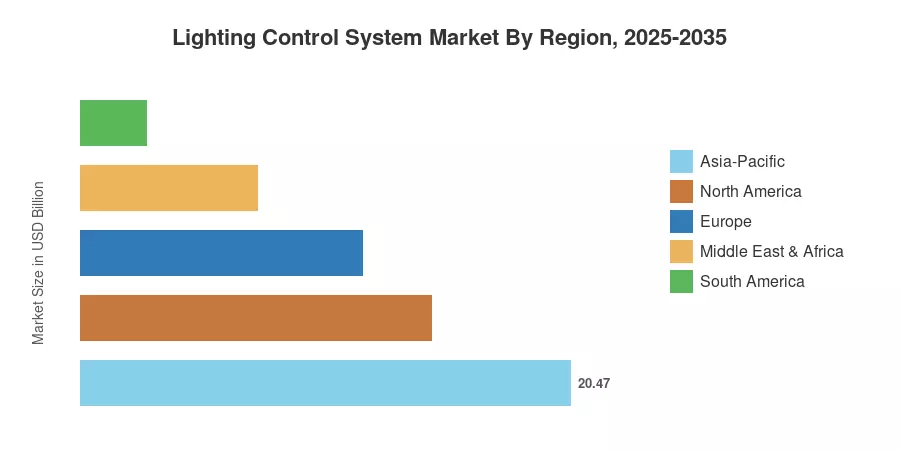
Asia-Pacific leads the Lighting Control System Market with a 38.4% revenue share in 2025, propelled by aggressive smart-city programs across China and India. The Middle East & Africa region is the fastest-growing at a projected 13.9% CAGR through 2035, fueled by Saudi Arabia's Vision 2030 infrastructure pipeline. North America holds the second-largest share at 27.5%, supported by stringent commercial building codes and strong retrofit activity. The decade ahead will be defined by convergence — where lighting, HVAC, and security share a single data backbone [3].
Key Report Takeaways
• By Offering
- Hardware dominated the Lighting Control System Market in 2025 with a 55.5% revenue share, driven by ongoing sensor and driver replacements across commercial buildings.
- Services are the fastest-growing offering segment, reflecting rising demand for system commissioning, cloud analytics, and managed lighting platforms.
• By Communication Protocol
- Wired communication protocols — including DALI and KNX — held a 64.8% share of the Lighting Control System Market in 2025.
- Wireless alternatives are expanding at a 13.7% CAGR through 2035, gaining traction in retrofit projects where rewiring is cost-prohibitive.
• By Installation Type
- Retrofit installations captured a 14.0% CAGR through 2035 in the Lighting Control System Market, outpacing new construction as policy mandates force existing buildings to upgrade.
• By Application
- Indoor deployments accounted for 68.0% of Lighting Control System Market sales in 2025, led by commercial office and retail environments.
• By Region
- Asia-Pacific commanded a 38.4% revenue share of the Lighting Control System Market in 2025, while the Middle East & Africa region is poised for the highest CAGR at 13.9%.
Market Size and Forecast (2021–2035)
Market Research Future employs a hybrid estimation framework integrating bottom-up revenue modelling from component-level shipment data with top-down validation against macroeconomic construction and energy-efficiency spending indicators. All forecast-period figures assume a constant-currency basis.