×
Request Free Sample ×

Kindly complete the form below to receive a free sample of this Report

* Please use a valid business email

Leading companies partner with us for data-driven Insights

clients tt-cursor
Hero Background

Liquid Crystal Polymers Market

ID: MRFR/CnM/1482-HCR
111 Pages
Chitranshi Jaiswal
October 2025

Liquid Crystal Polymers Market Research Report: By Type (Thermotropic, Lyotropic), By Application (Electronic & Electrical, Automotive, Consumer Goods, Surgical Device, Others) and By Regional (North America, Europe, South America, Asia Pacific, Middle East and Africa) - Forecast to 2035.

Share:
Download PDF ×

We do not share your information with anyone. However, we may send you emails based on your report interest from time to time. You may contact us at any time to opt-out.

Liquid Crystal Polymers Market Infographic
Purchase Options

Liquid Crystal Polymers Market Summary

As per MRFR analysis, the Liquid Crystal Polymers Market Size was estimated at 1630.0 USD Million in 2024. The Liquid Crystal Polymers industry is projected to grow from 1752.12 in 2025 to 3608.5 by 2035, exhibiting a compound annual growth rate (CAGR) of 7.49 during the forecast period 2025 - 2035.

Key Market Trends & Highlights

The Liquid Crystal Polymers Market is poised for robust growth driven by technological advancements and sustainability initiatives.

  • North America remains the largest market for liquid crystal polymers, driven by high demand in electrical components.
  • Asia-Pacific is the fastest-growing region, with increasing applications in automotive parts and electronics.
  • The electrical components segment leads the market, while automotive parts exhibit the fastest growth potential.
  • Technological advancements and rising demand for lightweight materials are key drivers propelling market expansion.

Market Size & Forecast

2024 Market Size 1630.0 (USD Million)
2035 Market Size 3608.5 (USD Million)
CAGR (2025 - 2035) 7.49%

Major Players

RTP Company (US), Celanese Corporation (US), Toray Industries (JP), Sumitomo Chemical (JP), Mitsubishi Gas Chemical (JP), BASF SE (DE), DuPont de Nemours, Inc. (US), SABIC (SA), LG Chem (KR)

Liquid Crystal Polymers Market Trends

The Liquid Crystal Polymers Market is currently experiencing a notable transformation, driven by advancements in technology and increasing demand across various sectors. These polymers, known for their unique properties such as high thermal stability and excellent mechanical strength, are finding applications in electronics, automotive, and medical devices. As industries continue to innovate, the need for materials that can withstand extreme conditions while maintaining performance is becoming more pronounced. This trend suggests a growing reliance on liquid crystal polymers, which are well-suited for high-performance applications. Moreover, sustainability concerns are influencing the Liquid Crystal Polymers Market, as manufacturers seek eco-friendly alternatives to traditional materials. The push for greener solutions is prompting research into bio-based liquid crystal polymers, which could potentially reduce environmental impact. This shift not only aligns with global sustainability goals but also opens new avenues for product development. As the market evolves, it appears poised for growth, with opportunities for innovation and expansion in various applications.

Technological Advancements

The Liquid Crystal Polymers Market is witnessing rapid technological advancements that enhance the performance and versatility of these materials. Innovations in processing techniques and formulations are enabling the development of new products that cater to specific industry needs. This trend indicates a shift towards more specialized applications, particularly in high-tech sectors.

Sustainability Initiatives

There is a growing emphasis on sustainability within the Liquid Crystal Polymers Market, as companies strive to reduce their environmental footprint. The exploration of bio-based and recyclable liquid crystal polymers reflects a commitment to eco-friendly practices. This trend suggests that sustainability will play a crucial role in shaping future product offerings.

Expanding Applications

The applications of liquid crystal polymers are expanding beyond traditional uses, particularly in the electronics and automotive industries. As these sectors evolve, the demand for materials that offer superior performance under challenging conditions is increasing. This trend indicates a broader acceptance of liquid crystal polymers in diverse applications, potentially driving market growth.

Liquid Crystal Polymers Market Drivers

Market Growth Projections

The Global Liquid Crystal Polymers Market Industry is poised for substantial growth, with projections indicating a market size of 1.63 USD Billion in 2024 and an anticipated increase to 3.61 USD Billion by 2035. The compound annual growth rate is estimated at 7.5% from 2025 to 2035, reflecting the increasing adoption of liquid crystal polymers across various sectors. This growth trajectory underscores the material's versatility and the expanding range of applications, from electronics to automotive and medical devices. As industries continue to innovate and seek advanced materials, the liquid crystal polymer market is likely to thrive.

Growth in Telecommunications

The telecommunications sector plays a pivotal role in shaping the Global Liquid Crystal Polymers Market Industry. With the expansion of 5G networks and the increasing demand for high-speed data transmission, liquid crystal polymers are becoming essential in the production of high-frequency components. Their unique properties, such as low dielectric constant and high thermal stability, make them ideal for applications in antennas and circuit boards. As the telecommunications infrastructure continues to evolve, the market is expected to witness significant growth, contributing to the overall expansion of the liquid crystal polymer segment in the coming years.

Rising Demand in Electronics

The Global Liquid Crystal Polymers Market Industry experiences a surge in demand driven by the electronics sector. Liquid crystal polymers are increasingly utilized in the manufacturing of high-performance electronic components, such as connectors and circuit boards, due to their excellent thermal stability and electrical insulation properties. In 2024, the market is projected to reach 1.63 USD Billion, reflecting the growing reliance on advanced materials in consumer electronics. As technology continues to evolve, the need for lightweight and durable materials is likely to propel the market further, with forecasts suggesting a compound annual growth rate of 7.5% from 2025 to 2035.

Advancements in Automotive Applications

The automotive industry significantly influences the Global Liquid Crystal Polymers Market Industry as manufacturers seek materials that enhance vehicle performance and efficiency. Liquid crystal polymers are increasingly employed in automotive components, including sensors and connectors, due to their lightweight nature and resistance to high temperatures. This trend aligns with the industry's shift towards electric vehicles, where weight reduction is paramount. The market's growth trajectory is expected to be robust, with projections indicating an increase to 3.61 USD Billion by 2035, driven by the ongoing innovation in automotive technologies and the demand for sustainable materials.

Emerging Applications in Medical Devices

The Global Liquid Crystal Polymers Market Industry is witnessing a notable expansion in the medical sector, where liquid crystal polymers are utilized in various applications, including diagnostic devices and surgical instruments. Their biocompatibility and chemical resistance make them suitable for medical environments. As healthcare technology advances, the demand for innovative materials that can withstand sterilization processes and provide reliable performance is increasing. This trend is likely to drive market growth, as manufacturers seek to incorporate liquid crystal polymers into new medical devices, thereby enhancing functionality and patient safety.

Sustainability and Eco-Friendly Materials

Sustainability concerns are increasingly influencing the Global Liquid Crystal Polymers Market Industry, as manufacturers and consumers alike prioritize eco-friendly materials. Liquid crystal polymers offer a potential solution due to their durability and recyclability. As industries strive to reduce their environmental footprint, the adoption of sustainable materials is becoming a key focus. This shift is likely to enhance the market's appeal, particularly among environmentally conscious consumers and businesses. The ongoing development of bio-based liquid crystal polymers could further catalyze growth, aligning with global sustainability goals and regulatory frameworks.
Market Segment Insights

By Application: Electrical Components (Largest) vs. Automotive Parts (Fastest-Growing)

The Liquid Crystal Polymers Market is experiencing diverse applications across various sectors, with Electrical Components holding the largest market share. This segment benefits from the rising demand for lightweight and high-performance materials in electronic devices, making it integral to various consumer electronics and communication systems. Conversely, Automotive Parts are emerging as the fastest-growing segment within this market. This growth can be attributed to increasing electrification in vehicles, leading to a surge in demand for advanced materials that enhance performance and safety in automotive manufacturing.

Electrical Components: Dominant vs. Automotive Parts: Emerging

Electrical Components are at the forefront of the Liquid Crystal Polymers Market, characterized by their exceptional insulating properties and thermal stability, making them ideal for use in high-frequency applications. These components are crucial in devices like smartphones, computers, and other electronic apparatus where reliability is paramount. On the other hand, Automotive Parts are rapidly advancing, driven by the push for electric vehicles and the integration of sophisticated technologies in automobiles. This segment is marked by innovation aimed at reducing weight without compromising safety, thus positioning it for significant growth opportunities in the evolving automotive landscape.

By End Use: Automotive (Largest) vs. Electronics (Fastest-Growing)

The Liquid Crystal Polymers (LCP) market shows a diverse distribution across various end-use sectors including Automotive, Electronics, Telecommunications, Healthcare, and Industrial applications. The Automotive sector leads the market, driven by its robust demand for lightweight and high-performance materials that enhance vehicle efficiency. Meanwhile, Electronics hold a significant share, bolstered by the increasing integration of LCPs in devices due to their excellent thermal stability and electrical insulation properties.

Automotive: Dominant vs. Electronics: Emerging

In the Liquid Crystal Polymers market, the Automotive segment is poised as the dominant force, capitalizing on the need for advanced materials that contribute to fuel efficiency and lower carbon emissions. Automotive applications leverage LCPs in various components such as connectors, sensors, and structural parts. On the other hand, the Electronics segment, marked as emerging, is experiencing rapid growth as consumer electronics manufacturers increasingly adopt LCPs for their beneficial properties. These polymers offer outstanding chemical resistance and dimensional stability, making them ideal for intricate electronic assemblies and high-frequency applications.

By Type: Thermotropic Liquid Crystal Polymers (Largest) vs. Lyotropic Liquid Crystal Polymers (Fastest-Growing)

In the Liquid Crystal Polymers Market, Thermotropic Liquid Crystal Polymers dominate the landscape, exhibiting the largest market share due to their wide-ranging applications in industries such as electronics and automotive. Lyotropic Liquid Crystal Polymers, while smaller in market share, are experiencing rapid growth and increasing adoption, particularly in advanced applications driven by technological advancements. The growth of Lyotropic Liquid Crystal Polymers is primarily fueled by the rising demand for high-performance materials that offer better thermal stability and mechanical properties. As industries continue to seek lightweight and durable alternatives, these emerging polymers are positioned as a solution. The advancements in processing technologies and growing applications in specialty fields such as medical devices further catalyze their rapid growth trajectory.

Thermotropic Liquid Crystal Polymers (Dominant) vs. Liquid Crystal Polymer Composites (Emerging)

Thermotropic Liquid Crystal Polymers have established themselves as the dominant force in the Liquid Crystal Polymers Market, largely due to their exceptional thermal properties and versatility. These materials are commonly used in electronic components, ensuring operational efficiency in demanding environments. In contrast, Liquid Crystal Polymer Composites are emerging as a notable segment, providing enhanced performance characteristics by combining traditional polymers with reinforcing materials. This results in improved strength, weight reduction, and tailored properties for specific applications, thus appealing to manufacturers looking for innovative solutions. As industries pivot towards more sustainable and high-performance materials, the market for Liquid Crystal Polymer Composites is rapidly evolving, attracting investment and attention.

By Form: Pellets (Largest) vs. Films (Fastest-Growing)

The Liquid Crystal Polymers Market is predominantly characterized by the 'Form' segment, which encompasses Pellets, Films, Fibers, and Sheets. Among these, Pellets hold the largest share, attributed to their widespread application in various industries, particularly in electronics and automotive, due to their desirable thermal and mechanical properties. Films, on the other hand, are gaining traction with the increasing demand for lightweight materials, particularly in the packaging and display sectors, driving their market presence significantly. Growth trends within this segment showcase a robust trajectory, with Films emerging as the fastest-growing sub-segment. The increasing focus on energy-efficient solutions and miniaturization in electronics is propelling the demand for high-performance films. Additionally, advancements in manufacturing processes are expected to further enhance the availability and functionality of LCP Films, reinforcing their growth in the upcoming years.

Pellets (Dominant) vs. Fibers (Emerging)

Pellets are recognized as the dominant form in the Liquid Crystal Polymers Market, favored for their excellent processability and versatile applications across various sectors, including telecommunications and automotive. The ability to mold and shape these pellets into complex components gives them a competitive edge. Conversely, Fibers represent an emerging segment characterized by their lightweight yet strong properties, ideal for applications in textiles and composite materials. The growing interest in sustainable materials and high-performance solutions has led to increased investments in Fiber development, setting the stage for them to capture a larger market share in the future. Their unique combination of strength-to-weight ratio is geared for applications in aerospace and automotive industries.

By Processing Technique: Injection Molding (Largest) vs. 3D Printing (Fastest-Growing)

The Liquid Crystal Polymers (LCP) market showcases a diverse landscape influenced by various processing techniques. Injection molding remains the dominant method, capturing significant market share due to its efficiency in producing intricate parts at scale. Extrusion is also prominent, mainly for applications that require continuous production of shapes. In contrast, blow molding and 3D printing are gradually carving out their niches, with 3D printing emerging as a key player offering customization and rapid prototyping capabilities.

Injection Molding: Dominant vs. 3D Printing: Emerging

Injection molding is recognized for its ability to produce high-precision components rapidly, making it the preferred choice in sectors requiring mass production such as automotive and electronics. This technique allows for complex designs and superior surface finishes, greatly enhancing product functionality. Conversely, 3D printing is revolutionizing the industry by enabling on-demand production and reduced waste, catering to bespoke applications and small batch runs. This emerging technique is particularly appealing in sectors like healthcare and aerospace, where customization and lighter materials are essential, thus positioning it as a fast-growing alternative in the processing techniques landscape.

Get more detailed insights about Liquid Crystal Polymers Market

Regional Insights

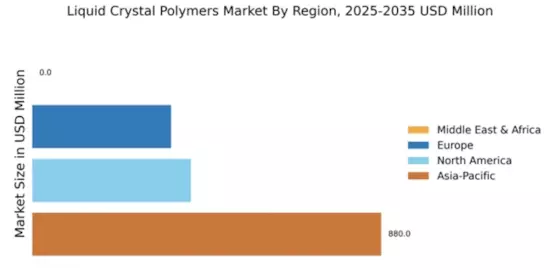
The Regional segmentation of the  Liquid Crystal Polymers Market reflects notable diversity in market valuations across different territories. In 2024, North America leads with a valuation of 0.48 USD Billion, expected to rise to 1.07 USD Billion by 2035, indicating a substantial growth trajectory attributed to advancements in technology and increasing demand for lightweight materials in electronics.

Europe follows closely, valued at 0.42 USD Billion in 2024 and projected to grow to 0.93 USD Billion by 2035, owing to stringent regulations driving innovation in material science.The Asia Pacific region is noteworthy, starting at 0.55 USD Billion in 2024 and expected to reach 1.23 USD Billion by 2035, largely due to rapid industrialization and a surge in consumer electronics production, thus becoming a significant market player.

South America and the Middle East and Africa are smaller markets, with valuations of 0.13 USD Billion and 0.05 USD Billion in 2024, respectively, but show potential growth opportunities as industries begin to embrace high-performance materials. Collectively, these regions underscore a comprehensive picture of the  Liquid Crystal Polymers Market, characterized by diverse growth patterns and varying levels of dominance, each influenced by regional market drivers and challenges.

Key Players and Competitive Insights

The Liquid Crystal Polymers Market is currently characterized by a dynamic competitive landscape, driven by innovation, sustainability, and strategic partnerships. Key players such as RTP Company (US), Celanese Corporation (US), and Toray Industries (JP) are actively shaping the market through their distinct operational focuses. RTP Company (US) emphasizes innovation in product development, particularly in high-performance applications, while Celanese Corporation (US) is concentrating on expanding its portfolio through strategic acquisitions and enhancing its manufacturing capabilities. Toray Industries (JP) is leveraging its technological expertise to develop advanced materials that cater to the growing demand for lightweight and durable components, particularly in the automotive and electronics sectors. Collectively, these strategies contribute to a competitive environment that is increasingly focused on technological advancement and market responsiveness.

In terms of business tactics, companies are localizing manufacturing to reduce lead times and optimize supply chains, which is crucial in a market that is moderately fragmented. This localization strategy not only enhances operational efficiency but also allows companies to better respond to regional demands. The competitive structure is influenced by the collective actions of these key players, who are increasingly collaborating to enhance their market positions while navigating the complexities of global supply chains.

In November 2025, RTP Company (US) announced the launch of a new line of liquid crystal polymer products designed specifically for high-temperature applications in the aerospace sector. This strategic move is significant as it positions RTP to capitalize on the growing demand for advanced materials in aerospace, where performance and reliability are paramount. By focusing on high-temperature applications, RTP Company is likely to strengthen its market share and enhance its reputation as a leader in innovation.

In October 2025, Celanese Corporation (US) completed the acquisition of a specialty polymer manufacturer, which is expected to bolster its capabilities in liquid crystal polymers. This acquisition is strategically important as it not only expands Celanese's product offerings but also enhances its technological expertise, allowing for greater innovation in product development. The integration of this new entity is anticipated to accelerate Celanese's growth trajectory in the liquid crystal polymers market.

In September 2025, Toray Industries (JP) entered into a partnership with a leading automotive manufacturer to develop next-generation lightweight materials. This collaboration is indicative of Toray's commitment to sustainability and innovation, as the automotive industry increasingly seeks to reduce weight for improved fuel efficiency. The partnership is likely to yield significant advancements in material technology, further solidifying Toray's position in the market.

As of December 2025, current competitive trends are heavily influenced by digitalization, sustainability, and the integration of AI technologies. Companies are increasingly forming strategic alliances to enhance their capabilities and market reach, reflecting a shift towards collaborative innovation. The competitive differentiation is evolving from traditional price-based competition to a focus on technological advancement, supply chain reliability, and sustainable practices. This transition suggests that companies that prioritize innovation and adaptability will likely emerge as leaders in the Liquid Crystal Polymers Market.

Key Companies in the Liquid Crystal Polymers Market market include

Industry Developments

  • Q2 2024: Celanese Announces Expansion of Liquid Crystal Polymer Production Capacity in China Celanese Corporation announced the opening of a new production line for liquid crystal polymers at its Nanjing, China facility, aimed at meeting growing demand from the electronics and automotive sectors.
  • Q1 2024: Sumitomo Chemical Launches New High-Performance Liquid Crystal Polymer for 5G Applications Sumitomo Chemical introduced a new grade of liquid crystal polymer designed for high-frequency, low-loss applications in 5G infrastructure, expanding its product portfolio for advanced electronics.
  • Q2 2024: Toray Industries Unveils Next-Generation LCP for Electric Vehicle Components Toray Industries announced the commercial launch of a next-generation liquid crystal polymer with enhanced heat resistance, targeting electric vehicle battery and powertrain applications.
  • Q3 2024: Polyplastics Expands LCP Resin Production in Malaysia Polyplastics Co., Ltd. completed an expansion of its liquid crystal polymer resin manufacturing facility in Malaysia, increasing capacity to support global electronics and automotive customers.
  • Q2 2024: Solvay Signs Supply Agreement for LCPs with Major European Automotive OEM Solvay announced a multi-year supply agreement to provide liquid crystal polymers for use in advanced automotive electrical systems to a leading European car manufacturer.
  • Q1 2025: Celanese Appoints New Head of Liquid Crystal Polymers Market Business Unit Celanese Corporation named a new executive to lead its global liquid crystal polymers business, signaling a strategic focus on innovation and market expansion.
  • Q2 2025: Toray Industries Announces Joint Venture with Local Partner in India for LCP Production Toray Industries formed a joint venture with an Indian partner to establish a new facility for liquid crystal polymer production, aiming to serve the fast-growing South Asian electronics market.
  • Q1 2024: Ueno Fine Chemicals Industry Launches Eco-Friendly LCP for Consumer Electronics Ueno Fine Chemicals Industry introduced a new environmentally friendly liquid crystal polymer designed for use in lightweight, recyclable consumer electronics components.
  • Q3 2024: Shanghai PRET Composites Opens New R&D Center for LCP Innovation Shanghai PRET Composites inaugurated a new research and development center focused on advancing liquid crystal polymer technologies for high-performance applications.
  • Q2 2025: Solvay Launches High-Temperature LCP for Aerospace Wiring Systems Solvay introduced a new high-temperature liquid crystal polymer specifically engineered for aerospace wiring and cable insulation, targeting increased safety and performance.
  • Q1 2025: Polyplastics Wins Major Contract to Supply LCPs for Next-Gen Smartphone Connectors Polyplastics secured a significant contract to supply liquid crystal polymers for use in next-generation smartphone connectors, reinforcing its position in the mobile electronics market.
  • Q3 2024: Toray Industries Receives Regulatory Approval for LCP Plant Expansion in Japan Toray Industries obtained regulatory approval to expand its liquid crystal polymer manufacturing plant in Japan, enabling increased output for domestic and export markets.

Future Outlook

Liquid Crystal Polymers Market Future Outlook

The Liquid Crystal Polymers Market is projected to grow at a 7.49% CAGR from 2024 to 2035, driven by advancements in electronics, automotive applications, and increasing demand for lightweight materials.

New opportunities lie in:

  • Development of high-performance LCPs for 5G telecommunications equipment.
  • Expansion into biodegradable LCPs for sustainable packaging solutions.
  • Investment in R&D for LCPs in medical device applications.

By 2035, the Liquid Crystal Polymers Market is expected to achieve robust growth and innovation.

Market Segmentation

Liquid Crystal Polymers Market Form Outlook

  • Pellets
  • Films
  • Fibers
  • Sheets

Liquid Crystal Polymers Market Type Outlook

  • Thermotropic Liquid Crystal Polymers
  • Lyotropic Liquid Crystal Polymers
  • Liquid Crystal Polymer Composites
  • Liquid Crystal Polymer Films

Liquid Crystal Polymers Market End Use Outlook

  • Automotive
  • Electronics
  • Telecommunications
  • Healthcare
  • Industrial

Liquid Crystal Polymers Market Application Outlook

  • Electrical Components
  • Automotive Parts
  • Consumer Electronics
  • Medical Devices
  • Aerospace Components

Liquid Crystal Polymers Market Processing Technique Outlook

  • Injection Molding
  • Extrusion
  • Blow Molding
  • 3D Printing

Report Scope

MARKET SIZE 20241630.0(USD Million)
MARKET SIZE 20251752.12(USD Million)
MARKET SIZE 20353608.5(USD Million)
COMPOUND ANNUAL GROWTH RATE (CAGR)7.49% (2024 - 2035)
REPORT COVERAGERevenue Forecast, Competitive Landscape, Growth Factors, and Trends
BASE YEAR2024
Market Forecast Period2025 - 2035
Historical Data2019 - 2024
Market Forecast UnitsUSD Million
Key Companies ProfiledRTP Company (US), Celanese Corporation (US), Toray Industries (JP), Sumitomo Chemical (JP), Mitsubishi Gas Chemical (JP), BASF SE (DE), DuPont de Nemours, Inc. (US), SABIC (SA), LG Chem (KR)
Segments CoveredApplication, End Use, Type, Form, Processing Technique
Key Market OpportunitiesGrowing demand for lightweight, high-performance materials in electronics and automotive sectors drives Liquid Crystal Polymers Market opportunities.
Key Market DynamicsRising demand for lightweight materials drives innovation and competition in the Liquid Crystal Polymers market.
Countries CoveredNorth America, Europe, APAC, South America, MEA

Market Highlights

Author
Chitranshi Jaiswal
Research Analyst Level I

In her 3 years of experience in the market research field, she has handled critical cross-domain projects. She has an in-depth knowledge of market estimation & analysis, problem-solving, primary as well as secondary research, and team management.She holds an engineering degree and is an MBA professional from a well-known university, capable of evaluating the market and competitive conditions. An exceptional strategist with excellent communication skills and a passion for delivering cutting-edge & practical insights for the market. Proficient in multi-tasking, and can successfully deal with competing demands, while maintaining complete confidentiality. Generated business through active client and project development, networking, and high-quality responses. Her knowledge and skills have helped in making solid business decisions, securing funding from investors, and avoiding business failures.

Leave a Comment

FAQs

What is the expected market size of the Liquid Crystal Polymers Market in 2024?

The Liquid Crystal Polymers Market is expected to be valued at 1.63 USD Billion in 2024.

What is the compound annual growth rate (CAGR) for the Liquid Crystal Polymers Market between 2025 and 2035?

Liquid Crystal Polymers Market is projected to register a CAGR of 7.49% from 2025-2035

Which region holds the largest market share for the Liquid Crystal Polymers Market in 2024?

In 2024, North America is projected to hold the largest market share with a valuation of 0.48 USD Billion.

What is the market size of the Liquid Crystal Polymers Market in the Asia Pacific region for 2024?

The Asia Pacific region is expected to have a market size of 0.55 USD Billion in 2024.

Who are the key players in the Liquid Crystal Polymers Market?

Major players in the market include Polyplastics, Mitsubishi Gas Chemical, and RTP Company, among others.

How much is the Lyotropic Liquid Crystal Polymers market expected to grow by 2035?

The Lyotropic Liquid Crystal Polymers market is projected to grow to 1.51 USD Billion by 2035.

What is the expected growth rate for the South America region within the Liquid Crystal Polymers Market?

The South America region is expected to grow from 0.13 USD Billion in 2024 to 0.29 USD Billion by 2035.

What challenges and opportunities exist in the Liquid Crystal Polymers Market?

The market presents various challenges and opportunities driven by technological advancements and increasing applications in industries.

Download Free Sample

Kindly complete the form below to receive a free sample of this Report

Compare Licence

×
Features License Type
Single User Multiuser License Enterprise User
Price $4,950 $5,950 $7,250
Maximum User Access Limit 1 User Upto 10 Users Unrestricted Access Throughout the Organization
Free Customization
Direct Access to Analyst
Deliverable Format
Platform Access
Discount on Next Purchase 10% 15% 15%
Printable Versions