×
Request Free Sample ×

Kindly complete the form below to receive a free sample of this Report

* Please use a valid business email

Leading companies partner with us for data-driven Insights

clients tt-cursor
Hero Background

High Temperature Thermoplastics Market

ID: MRFR/CnM/3531-HCR
138 Pages
Priya Nagrale
October 2025

High Temperature Thermoplastics Market Research Report- Resin Type (Fluoropolymers, High Performance Polyamides, Polyphenylene Sulfide, Sulfone Polymers, Liquid Crystal Polymers, Aromatic Ketone Polymers, Polyimide), Application– Forecast till 2035

Share:
Download PDF ×

We do not share your information with anyone. However, we may send you emails based on your report interest from time to time. You may contact us at any time to opt-out.

High Temperature Thermoplastics Market Infographic
Purchase Options

High Temperature Thermoplastics Market Summary

As per MRFR analysis, the High Temperature Thermoplastics Market Size was estimated at 7.65 USD Million in 2024. The High Temperature Thermoplastics industry is projected to grow from 8.04 in 2025 to 13.33 by 2035, exhibiting a compound annual growth rate (CAGR) of 5.18 during the forecast period 2025 - 2035.

Key Market Trends & Highlights

The High Temperature Thermoplastics Market is poised for substantial growth driven by diverse applications and technological advancements.

  • The aerospace sector continues to exhibit the largest demand for high temperature thermoplastics, particularly in North America.
  • Asia-Pacific emerges as the fastest-growing region, fueled by increasing industrialization and technological adoption.
  • The automotive segment is witnessing rapid growth, especially in automotive components, as manufacturers seek lightweight and durable materials.
  • Key market drivers include the rising demand in the automotive industry and the expansion of the aerospace sector, which are propelling market growth.

Market Size & Forecast

2024 Market Size 7.65 (USD Million)
2035 Market Size 13.33 (USD Million)
CAGR (2025 - 2035) 5.18%

Major Players

Solvay (BE), BASF (DE), DuPont (US), Victrex (GB), Evonik Industries (DE), Mitsubishi Chemical (JP), PolyOne (US), SABIC (SA), Toray Industries (JP), Celanese (US)

High Temperature Thermoplastics Market Trends

The High Temperature Thermoplastics Market is currently experiencing a notable evolution, driven by the increasing demand for materials that can withstand extreme conditions. Industries such as aerospace, automotive, and electronics are particularly focused on utilizing these advanced materials due to their superior thermal stability and mechanical properties. As manufacturers seek to enhance performance and durability, the adoption of high temperature thermoplastics is likely to expand, reflecting a shift towards more resilient and efficient solutions. Furthermore, the ongoing advancements in polymer technology appear to facilitate the development of new formulations, which may further broaden the application scope of these materials. In addition to the technological advancements, environmental considerations are becoming increasingly relevant in the High Temperature Thermoplastics Market. The push for sustainability is prompting manufacturers to explore bio-based alternatives and recycling methods, which could potentially reshape the market landscape. As regulatory frameworks evolve, companies are likely to adapt their strategies to align with these new standards, ensuring compliance while also meeting consumer expectations for greener products. Overall, the High Temperature Thermoplastics Market seems poised for growth, driven by innovation and a commitment to sustainability.

Growing Demand in Aerospace Sector

The aerospace industry is increasingly adopting high temperature thermoplastics due to their lightweight and durable characteristics. These materials are essential for components that must endure extreme temperatures and pressures, thereby enhancing overall aircraft performance.

Advancements in Polymer Technology

Recent innovations in polymer science are leading to the development of new high temperature thermoplastics with improved properties. These advancements may enable broader applications across various sectors, including automotive and electronics, where performance is critical.

Sustainability Initiatives

There is a rising emphasis on sustainability within the High Temperature Thermoplastics Market. Manufacturers are exploring eco-friendly materials and recycling options, which could influence product development and market dynamics in the coming years.

High Temperature Thermoplastics Market Drivers

Market Growth Projections

The Global High Temperature Thermoplastics Market Industry is projected to experience substantial growth, with estimates indicating a market size of 12.5 USD Billion in 2024. The anticipated compound annual growth rate of 6.5% from 2025 to 2035 suggests a robust expansion trajectory, driven by increasing demand across various sectors. The market's growth is likely to be fueled by advancements in material technology, rising applications in aerospace and automotive industries, and a growing emphasis on sustainability. By 2035, the market could potentially reach 25 USD Billion, reflecting the evolving landscape of high temperature thermoplastics and their critical role in modern manufacturing.

Increased Focus on Sustainability

The Global High Temperature Thermoplastics Market Industry is witnessing a shift towards sustainable practices, as manufacturers seek to reduce their environmental impact. High temperature thermoplastics offer the advantage of recyclability and longevity, making them appealing for industries aiming to adopt greener materials. Companies are increasingly investing in research and development to create bio-based thermoplastics that meet high-performance standards. This focus on sustainability not only aligns with global environmental goals but also enhances the market's appeal to eco-conscious consumers. As sustainability becomes a priority, the Global High Temperature Thermoplastics Market Industry is likely to experience growth, reflecting changing consumer preferences.

Rising Demand in Aerospace Sector

The Global High Temperature Thermoplastics Market Industry experiences a notable surge in demand from the aerospace sector, which increasingly favors lightweight and heat-resistant materials. High temperature thermoplastics, such as polyether ether ketone (PEEK) and polyphenylene sulfide (PPS), are utilized in aircraft components due to their superior thermal stability and mechanical properties. The industry's projected growth to 12.5 USD Billion in 2024 is largely driven by aerospace applications, where weight reduction is critical for fuel efficiency. As the aerospace sector continues to expand, the Global High Temperature Thermoplastics Market Industry is likely to witness sustained growth, potentially doubling to 25 USD Billion by 2035.

Advancements in Automotive Applications

The automotive industry increasingly adopts high temperature thermoplastics for components that require durability and resistance to extreme conditions. Materials like polyamide (PA) and polyetherimide (PEI) are gaining traction in automotive applications, particularly in electric vehicles where thermal management is crucial. The Global High Temperature Thermoplastics Market Industry is poised to benefit from this trend, as manufacturers seek to enhance vehicle performance while reducing weight. The anticipated compound annual growth rate of 6.5% from 2025 to 2035 indicates a robust future for these materials in automotive applications, reflecting a broader shift towards innovative materials in the automotive sector.

Technological Innovations in Material Science

The Global High Temperature Thermoplastics Market Industry benefits from ongoing technological innovations in material science, which enhance the performance and application range of thermoplastics. Recent advancements in processing techniques and material formulations have led to the development of thermoplastics with improved thermal stability and mechanical properties. These innovations enable manufacturers to explore new applications across various industries, including aerospace, automotive, and electronics. As companies continue to invest in research and development, the market is expected to expand, potentially reaching 25 USD Billion by 2035, driven by the introduction of next-generation high temperature thermoplastics.

Growth in Electronics and Electrical Applications

The Global High Temperature Thermoplastics Market Industry is significantly influenced by the electronics and electrical sectors, where materials must withstand high temperatures and provide electrical insulation. Thermoplastics such as PEEK and polyimide (PI) are increasingly utilized in connectors, insulators, and circuit boards. As electronic devices become more compact and powerful, the demand for materials that can endure elevated temperatures without compromising performance is rising. This trend is expected to contribute to the market's growth, with projections indicating a market size of 12.5 USD Billion in 2024, driven by the need for reliable and durable components in the electronics industry.
Market Segment Insights

By Application: Aerospace (Largest) vs. Automotive (Fastest-Growing)

The application segment of the High Temperature Thermoplastics Market is diverse, comprising notable sectors such as Aerospace, Automotive, Electronics, Industrial, and Medical. The Aerospace sector leads in market share, driven by demands for lightweight and heat-resistant materials in aircraft manufacturing. Following closely, the Automotive sector is witnessing significant growth, propelled by the increasing adoption of advanced materials aimed at improving fuel efficiency and safety in vehicles.

Aerospace: Dominant vs. Automotive: Emerging

The Aerospace sector stands out as the dominant application in the High Temperature Thermoplastics Market due to stringent safety and performance standards that necessitate specialized materials. High temperature thermoplastics, such as polyether ether ketone (PEEK), are essential for components exposed to extreme conditions. Conversely, the Automotive segment represents an emerging market trend, rapidly evolving as manufacturers look to lightweight thermoplastics to enhance vehicle performance and reduce emissions. Innovations in material science are providing solutions that meet the high-temperature requirements for critical automotive parts, positioning this sector for robust growth.

By End Use: Automotive Components (Largest) vs. Electrical Insulation (Fastest-Growing)

The high temperature thermoplastics market is prominently driven by diverse end-use applications, with Automotive Components holding the largest market share. This sector benefits from the robust automotive industry, which demands materials capable of withstanding high thermal stress. Following closely is Electrical Insulation, which is growing rapidly in response to escalating demands for advanced electrical applications that require high-performance materials. As technology progresses, the shift towards electric and hybrid vehicles further amplifies the significance of both segments.

Automotive Components (Dominant) vs. Electrical Insulation (Emerging)

The Automotive Components segment plays a crucial role in the high temperature thermoplastics market due to its extensive use in various vehicle parts such as exhaust systems and engine components. These materials are preferred for their thermal resistance and lightweight properties, enabling enhanced performance and fuel efficiency. Conversely, the Electrical Insulation segment is emerging rapidly as the need for high-performance insulating materials increases with advancements in electrical technologies. This segment caters mainly to electronics, telecommunications, and renewable energy sectors, where reliability under thermal stress is paramount. The growth in this area reflects broader industry trends towards electrification and the ongoing demand for efficient thermal management solutions.

By Material Type: Polyetheretherketone (Largest) vs. Polyphenylene Sulfide (Fastest-Growing)

In the High Temperature Thermoplastics Market, the material type segment showcases a diverse range of options, with Polyetheretherketone (PEEK) holding the largest share of this market. PEEK is renowned for its exceptional thermal and chemical resistance, making it a preferred choice in critical applications across aerospace, automotive, and medical sectors. Conversely, Polyphenylene Sulfide (PPS) emerges as the fastest-growing segment due to its lightweight nature and excellent mechanical properties, gaining traction in electrical and electronic applications. As industries continue to demand materials that can withstand extreme conditions without compromising performance, growth trends indicate a shift towards more specialized high-temperature thermoplastics. This is fueled by advancements in manufacturing techniques and a rising focus on weight reduction in transportation and structural applications. Moreover, the increasing emphasis on sustainability is implicated in the growth of high-performance thermoplastics, positioning segments like PPS favorably as companies seek eco-friendly solutions alongside high performance.

Polyetheretherketone (Dominant) vs. Polyphenylene Sulfide (Emerging)

Polyetheretherketone (PEEK) stands out as the dominant material in the High Temperature Thermoplastics Market due to its unparalleled thermal stability and mechanical strength, making it suitable for high-performance applications that require durability. Its resistance to chemicals and wear enables applications in industries like aerospace, automotive, and healthcare, where reliability is paramount. In contrast, Polyphenylene Sulfide (PPS) is an emerging player that offers unique advantages such as outstanding chemical resistance, high thermal stability, and ease of processing. The growing adoption of PPS in the electronics and automotive sectors is fueled by its light weight and dimensional stability under varying temperatures. As a result, while PEEK maintains a strong market position, PPS is quickly capturing interest as a versatile alternative for specialized applications.

By Processing Technique: Injection Molding (Largest) vs. 3D Printing (Fastest-Growing)

In the High Temperature Thermoplastics Market, the predominant processing technique is injection molding, which captures a significant share of the market due to its efficiency and capability to produce complex geometries. Close competitors include extrusion and compression molding, with steady market presence, while 3D printing is emerging rapidly, capturing attention for its innovative capabilities and customization options. As industries adapt to rapid changes, the impact of each technique on production processes will shape future trends. The growth of the High Temperature Thermoplastics Market is largely driven by the increasing demand for lightweight and durable materials across various sectors. Injection molding is benefitting from this trend, owing to its scalability and cost-effectiveness in large volume production. Conversely, 3D printing is witnessing exponential growth as manufacturers leverage its capabilities for rapid prototyping and small-batch production, highlighting a shift towards more adaptable processing techniques.

Injection Molding (Dominant) vs. 3D Printing (Emerging)

Injection molding holds a dominant position in the High Temperature Thermoplastics Market, characterized by its ability to produce intricate shapes with high precision, making it essential for automotive, aerospace, and electrical applications. This technique allows for high-volume production, leading to lower per-unit costs and reliability in meeting tight tolerances. On the other hand, 3D printing is an emerging processing technique that offers flexibility and rapid customization, catering to niche markets and short production runs. Its ability to reduce material waste and create complex designs that traditional methods cannot easily replicate gives it a strategic advantage in a market looking towards innovation and sustainability.

By Form: Films (Largest) vs. Granules (Fastest-Growing)

In the High Temperature Thermoplastics Market, the form segment encompasses various products including films, sheets, rods, pipes, and granules. Among these, films hold the largest market share due to their widespread application in industries such as automotive and electronics. Sheets and rods have significant usage as well but are eclipsed by the rapid adoption of films, which leverage advanced properties of high-temperature thermoplastics to enhance performance in demanding applications. Meanwhile, granules are emerging as the fastest-growing segment, owing to their versatility and ease of processing into final products, fueling increased interest from manufacturers seeking efficient production methods.

Films (Dominant) vs. Granules (Emerging)

Films have cemented their position as the dominant form in the High Temperature Thermoplastics Market thanks to their exceptional performance characteristics, including high thermal stability and resistance to chemical exposure, making them ideal for a range of applications. Their lightweight nature enhances product design flexibility, contributing to reduced energy consumption in applications like automotive and aerospace. In contrast, granules, categorized as an emerging segment, showcase a rapid growth trajectory. Their ability to be processed into various shapes and forms allows manufacturers to explore innovative applications and production methodologies. This adaptability aligns well with the ongoing trend toward lightweight materials, further driving the uptake of granules in the production of high-temperature thermoplastic components.

Get more detailed insights about High Temperature Thermoplastics Market

Regional Insights

North America : Market Leader in Thermoplastics

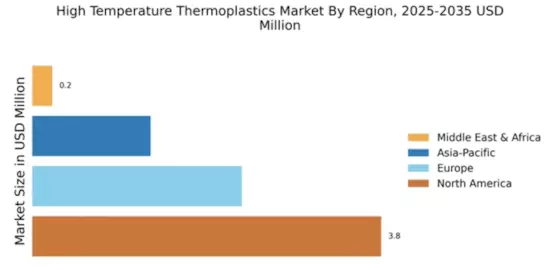
North America is poised to maintain its leadership in the High Temperature Thermoplastics market, holding a significant share of 3.83 billion in 2024. The region's growth is driven by robust demand from aerospace, automotive, and electronics sectors, alongside stringent regulations promoting advanced materials. The increasing focus on lightweight and high-performance materials is further propelling market expansion. The competitive landscape is characterized by the presence of major players such as DuPont, Solvay, and BASF, which are investing heavily in R&D to innovate and enhance product offerings. The U.S. and Canada are the leading countries, with a strong emphasis on sustainability and compliance with environmental regulations. This focus is expected to drive further growth in the region.

Europe : Innovation and Sustainability Focus

Europe's High Temperature Thermoplastics market is projected to reach 2.3 billion by 2025, driven by increasing demand in the automotive and aerospace industries. Regulatory frameworks emphasizing sustainability and performance are key growth catalysts. The European Union's Green Deal is pushing for the adoption of advanced materials, enhancing the market's potential. Leading countries like Germany, France, and the UK are at the forefront, with companies such as BASF and Evonik Industries leading innovation. The competitive landscape is marked by a strong emphasis on R&D, with firms focusing on developing eco-friendly thermoplastics. This commitment to sustainability is expected to further solidify Europe's position in the global market.

Asia-Pacific : Emerging Market Potential

The Asia-Pacific region is witnessing significant growth in the High Temperature Thermoplastics market, projected to reach 1.3 billion by 2025. This growth is fueled by increasing industrialization, particularly in countries like China and Japan, where demand for high-performance materials is surging. The region's expanding automotive and electronics sectors are key drivers, alongside supportive government policies promoting advanced manufacturing. China and Japan are leading the charge, with major players like Mitsubishi Chemical and Toray Industries investing in capacity expansion and innovation. The competitive landscape is evolving, with local manufacturers emerging to meet the growing demand. This dynamic environment positions Asia-Pacific as a critical player in The High Temperature Thermoplastics.

Middle East and Africa : Untapped Market Opportunities

The Middle East and Africa region, while currently holding a smaller market share of 0.22 billion, presents significant growth potential in the High Temperature Thermoplastics market. The region's development is driven by increasing investments in infrastructure and manufacturing, particularly in the UAE and South Africa. Regulatory initiatives aimed at enhancing industrial capabilities are also contributing to market growth. Countries like the UAE and South Africa are emerging as key players, with local firms beginning to invest in high-performance materials. The competitive landscape is still developing, but the presence of The High Temperature Thermoplastics expansion. This region's untapped potential makes it an area to watch in the coming years.

Key Players and Competitive Insights

The High Temperature Thermoplastics Market is currently characterized by a dynamic competitive landscape, driven by increasing demand across various sectors such as aerospace, automotive, and electronics. Key players are actively pursuing strategies that emphasize innovation, sustainability, and regional expansion to enhance their market positions. For instance, in November 2025, Solvay (BE) announced a new line of high-performance thermoplastics designed for aerospace applications, reflecting its commitment to innovation and addressing the growing need for lightweight materials in the industry. Similarly, BASF (DE) has focused on digital transformation initiatives, enhancing its production capabilities through advanced manufacturing technologies, which positions the company favorably in a market that increasingly values efficiency and sustainability.

The business tactics employed by these companies often include localizing manufacturing and optimizing supply chains to respond swiftly to market demands. The competitive structure of the market appears moderately fragmented, with several key players exerting substantial influence. This fragmentation allows for a diverse range of products and innovations, although it also intensifies competition among established firms and new entrants alike.

In October 2025, DuPont (US) unveiled a strategic partnership with a leading automotive manufacturer to develop high-temperature thermoplastic composites aimed at improving vehicle performance and fuel efficiency. This collaboration not only underscores DuPont's focus on innovation but also highlights the growing trend of partnerships within the industry to leverage complementary strengths. Furthermore, in September 2025, Victrex (GB) expanded its production capacity for PEEK (polyether ether ketone) materials, a move that is likely to enhance its competitive edge in the high-performance thermoplastics segment, particularly in the medical and aerospace sectors.

In August 2025, Evonik Industries (DE) launched a new range of high-temperature resistant polymers, targeting the electronics market. This strategic initiative indicates Evonik's intent to diversify its product offerings and cater to the evolving needs of high-tech industries, which increasingly require materials that can withstand extreme conditions. Such developments reflect a broader trend where companies are not only innovating but also adapting their product lines to meet specific industry requirements.

As of December 2025, the competitive trends within the High Temperature Thermoplastics Market are increasingly shaped by digitalization, sustainability, and the integration of AI technologies. Strategic alliances are becoming more prevalent, as companies recognize the value of collaboration in driving innovation and enhancing supply chain reliability. The competitive differentiation is likely to evolve from traditional price-based competition towards a focus on technological advancements and sustainable practices, suggesting that companies that prioritize innovation and adaptability will be better positioned to thrive in this rapidly changing market.

Key Companies in the High Temperature Thermoplastics Market market include

Industry Developments

  • Q2 2024: SABIC launches NORYL NHP8000VT3 for high-voltage EV battery protection SABIC introduced its new NORYL NHP8000VT3 high-temperature thermoplastic, designed to protect 800-volt power-train architectures in electric vehicles, offering enhanced tracking resistance and fire safety for battery housings.
  • Q2 2024: Bluebus integrates advanced thermoplastic battery housing in 2024 e-bus Bluebus announced the use of a new high-temperature thermoplastic battery housing in its 2024 electric bus model, reducing vehicle mass and exceeding fire-safety standards compared to traditional aluminum designs.
  • Q2 2024: Tesla specifies PEEK thermoplastic in Optimus-Gen2 humanoid robot Tesla revealed that its Optimus-Gen2 humanoid robot utilizes approximately 9 kg of PEEK, a high-temperature thermoplastic, to reduce weight and improve performance in demanding operational environments.

Intended Audience

    • High Temperature Thermoplastics Market Manufacturers
    • Traders and Distributors of High Temperature Thermoplastics Market
    • Production Process Industries
    • Potential Investors
    • Raw Material Suppliers
    • Nationalized Laboratory

Future Outlook

High Temperature Thermoplastics Market Future Outlook

The High Temperature Thermoplastics Market is projected to grow at a 5.18% CAGR from 2024 to 2035, driven by advancements in aerospace, automotive, and electronics sectors.

New opportunities lie in:

  • Development of high-performance composites for aerospace applications.
  • Expansion into emerging markets with tailored product offerings.
  • Investment in recycling technologies for sustainable thermoplastic solutions.

By 2035, the market is expected to solidify its position as a leader in high-performance materials.

Market Segmentation

High Temperature Thermoplastics Market Form Outlook

  • Films
  • Sheets
  • Rod
  • Pipes
  • Granules

High Temperature Thermoplastics Market End Use Outlook

  • Automotive Components
  • Electrical Insulation
  • Heat Shields
  • Structural Parts
  • Fluid Handling

High Temperature Thermoplastics Market Application Outlook

  • Aerospace
  • Automotive
  • Electronics
  • Industrial
  • Medical

High Temperature Thermoplastics Market Material Type Outlook

  • Polyetheretherketone
  • Polyphenylene Sulfide
  • Polyimide
  • Polyetherimide
  • Polyamide

High Temperature Thermoplastics Market Processing Technique Outlook

  • Injection Molding
  • Extrusion
  • Compression Molding
  • 3D Printing
  • Blow Molding

Report Scope

MARKET SIZE 20247.65(USD Million)
MARKET SIZE 20258.04(USD Million)
MARKET SIZE 203513.33(USD Million)
COMPOUND ANNUAL GROWTH RATE (CAGR)5.18% (2024 - 2035)
REPORT COVERAGERevenue Forecast, Competitive Landscape, Growth Factors, and Trends
BASE YEAR2024
Market Forecast Period2025 - 2035
Historical Data2019 - 2024
Market Forecast UnitsUSD Million
Key Companies ProfiledSolvay (BE), BASF (DE), DuPont (US), Victrex (GB), Evonik Industries (DE), Mitsubishi Chemical (JP), PolyOne (US), SABIC (SA), Toray Industries (JP), Celanese (US)
Segments CoveredApplication, End Use, Material Type, Processing Technique, Form
Key Market OpportunitiesGrowing demand for lightweight, high-performance materials in aerospace and automotive sectors drives High Temperature Thermoplastics Market expansion.
Key Market DynamicsRising demand for high-performance materials drives innovation and competition in the high temperature thermoplastics market.
Countries CoveredNorth America, Europe, APAC, South America, MEA

Market Highlights

Author
Priya Nagrale
Senior Research Analyst

With an experience of over five years in market research industry (Chemicals & Materials domain), I gather and analyze market data from diverse sources to produce results, which are then presented back to a client. Also, provide recommendations based on the findings. As a Senior Research Analyst, I perform quality checks (QC) for market estimations, QC for reports, and handle queries and work extensively on client customizations. Also, handle the responsibilities of client proposals, report planning, report finalization, and execution

Leave a Comment

FAQs

What is the forecast period of High Temperature Thermoplastics Market research report?

The forecast period for High Temperature Thermoplastics Market research report is 2025-2035.

Which region will lead the High Temperature Thermoplastics Market?

High Temperature Thermoplastics Market is dominated by APAC region.

Who are the key players in the High Temperature Thermoplastics Market?

The major players are BASF SE (Germany), Celanese Corporation (U.S.), Solvay (Belgium.), Arkema (France), Evonik Industries AG (Germany), DowDuPont ( U.S.), SABIC (Saudi Arabia), Victrex plc (U.K), Royal DSM (the Netherlands), and TORAY INDUSTRIES, INC (Japan) among others.

Download Free Sample

Kindly complete the form below to receive a free sample of this Report

Compare Licence

×
Features License Type
Single User Multiuser License Enterprise User
Price $4,950 $5,950 $7,250
Maximum User Access Limit 1 User Upto 10 Users Unrestricted Access Throughout the Organization
Free Customization
Direct Access to Analyst
Deliverable Format
Platform Access
Discount on Next Purchase 10% 15% 15%
Printable Versions