Lithium Hydroxide Market

Key Players: Albemarle Corporation, Tianqi Lithium, Ganfeng Lithium, SQM (Sociedad Química y Minera), Livent (Arcadium Lithium), Pilbara Minerals, Sigma Lithium, Nemaska Lithium

Lithium Hydroxide Market

Lithium Hydroxide Market Research Report: By Application (Batteries, Ceramic Glass, Lubricant Grease, Air conditioning), By End Use (Automotive, Electrical & Electronics, Marine, Aerospace) and By Regional (North America, Europe, South America, Asia Pacific, Middle East and Africa) - Forecast to 2035.
ID: MRFR/CnM/0482-HCR
111 Pages
Chitranshi Jaiswal
Last Updated: June 04, 2026
 

Lithium Hydroxide Market Summary

The Lithium Hydroxide Market reached an estimated 245.80 LCE kilotons in 2025 and is projected to grow from 302.60 LCE kilotons in 2026 to approximately 2,105.40 LCE kilotons by 2035, registering a CAGR of 24.80% during 2026–2035. This trajectory is anchored in aggressive EV battery chemicals procurement mandates and national battery manufacturing incentives—the U.S. Inflation Reduction Act alone allocated over USD 7 billion in advanced manufacturing credits for battery-grade lithium and cathode materials production through 2032 [2]. Automakers across North America and Europe locked in multi-year offtake agreements in 2024 to secure high-purity lithium processing chemicals, reflecting the urgency around supply chain de-risking.

Extraction technology is a big change, and supply is accelerating. Direct lithium extraction (DLE) is a game-changer, replacing evaporation ponds, reducing production timelines from 18 months to less than 90 days, and increasing recovery rates to greater than 90%. The governments of Argentina, Chile, and Australia pledged a total of more than USD 3.2 billion in DLE pilot programs in the year 2023-2024[3]. This innovation makes it possible to produce higher-purity rechargeable battery materials at a reduced environmental cost, changing the competitive economics of lithium-ion battery manufacturing across three continents.


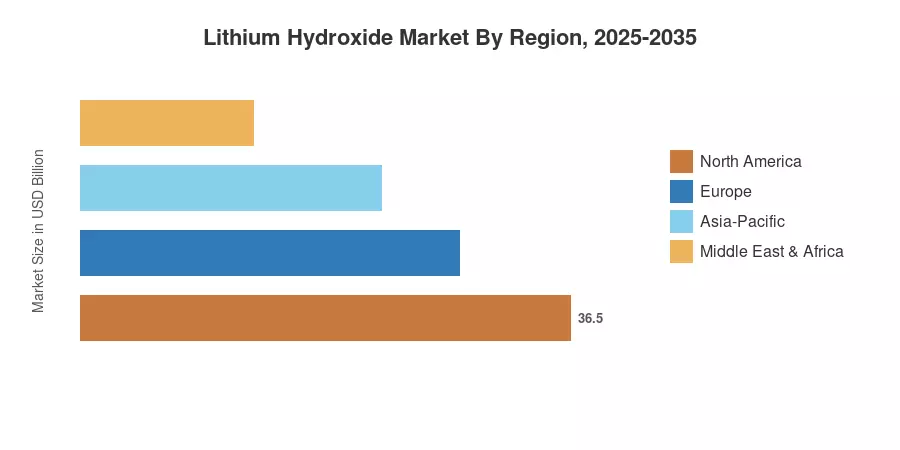
Asia-Pacific dominates the Lithium Hydroxide Market with roughly 42.50% of global consumption in 2025, driven by China's integrated cathode materials supply chain and South Korea's aggressive battery gigafactory expansion. The region also posts the fastest growth at a 28.90% CAGR through 2035. Europe holds the second-largest position at approximately 23.10% share, propelled by the EU Battery Regulation mandating domestic energy storage materials sourcing. North America follows closely, with policy-driven reshoring creating new capacity corridors across Nevada, North Carolina, and Quebec. The Lithium Hydroxide Market is poised for a decade of structural expansion as electrification targets tighten worldwide.


Key Report Takeaways

• By Application

  • Lithium-ion batteries commanded 66.70% of 2025 volume, reflecting their dominance across EV battery chemicals and consumer electronics applications
  • Lubricating grease applications are projected to grow at a 12.40% CAGR through 2035 as industrial demand for specialty lithium compounds stabilizes

• By Grade

  • Battery-grade lithium captured the largest share of the Lithium Hydroxide Market in 2025, advancing at a 26.80% CAGR through 2035


• By Form


  • Anhydrous form records the fastest growth at 27.10% CAGR, driven by next-generation cathode materials requiring ultra-low moisture content

• By End-Use Industry

  • Automotive accounted for 52.80% of 2025 consumption as electric vehicle battery materials procurement scaled rapidly
  • Energy storage systems represent the fastest-growing end use in the Lithium Hydroxide Market at a 26.50% CAGR

• By Region

  • Asia-Pacific leads with 42.50% share and a 28.90% CAGR, anchored by China's lithium processing chemicals infrastructure
  • North America is the second-fastest-growing region, supported by IRA-driven reshoring of rechargeable battery compounds manufacturing


Lithium Hydroxide Market Size and Forecast (2021–2035)

MRFR's market sizing combines bottom-up production capacity tracking across 47 active and planned lithium hydroxide facilities with top-down demand modeling tied to global EV production schedules, grid-scale energy storage materials deployment pipelines, and industrial grease consumption data. Historical figures (2021–2024) use verified shipment and customs data; the 2025 base year blends Q1–Q3 actuals with Q4 projections. Forecast values (2026–2035) apply the calibrated 24.80% CAGR, adjusted for capacity commissioning timelines and feedstock price normalization assumptions.
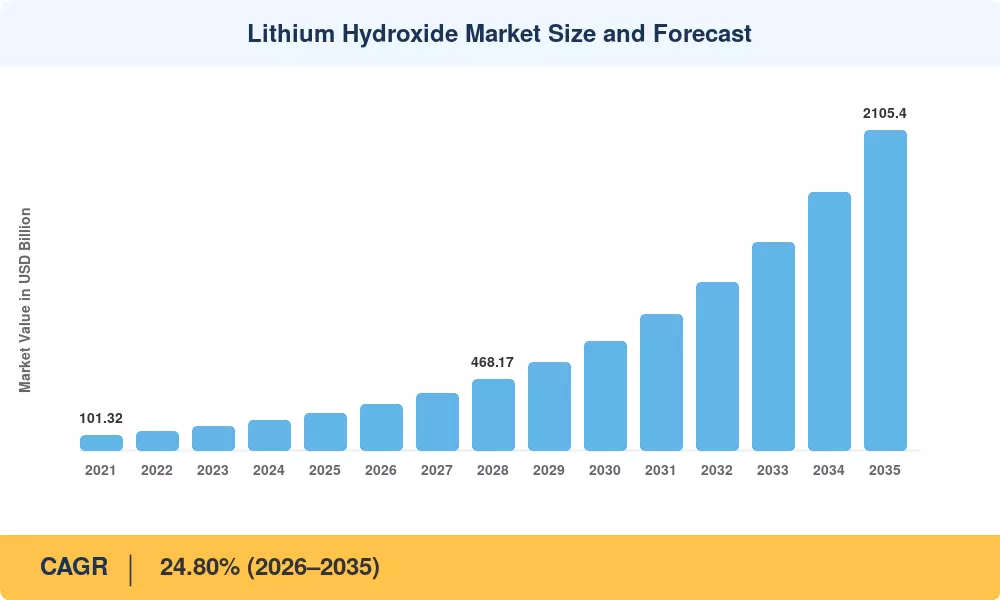
Lithium Hydroxide Market Size and Forecast
Our Impact
Enabled $4.3B Revenue Impact for Fortune 500 and Leading Multinationals
Partnering with 2000+ Global Organizations Each Year
30K+ Citations by Top-Tier Firms in the Industry
 

Driver Impact Analysis

Driver ~% Impact on CAGR Geographic Relevance Impact Timeline
EV production scale-up ~30% Global Short-term (≤2 yr)
Battery gigafactory commissioning ~22% Asia-Pacific, Europe Medium-term (2–4 yr)
DLE technology commercialization ~15% South America, Australia Medium-term (2–4 yr)
Grid-scale energy storage deployment ~12% North America, Europe Long-term (≥4 yr)
High-nickel cathode chemistry transition ~10% Global Short-term (≤2 yr)
Government reshoring incentives ~7% North America Medium-term (2–4 yr)
Solid-state battery R&D ~4% Japan, South Korea Long-term (≥4 yr)


EV Production Scale-Up and Electric Vehicle Battery Materials Demand

Global EV sales surpassed 17.5 million units in 2024, a 28% increase year-over-year, and the International Energy Agency projects 40 million annual sales by 2030 under stated policies [6]. Each high-nickel NMC811 battery pack requires approximately 0.8–1.0 kg of lithium hydroxide per kWh, meaning a single 75-kWh EV pack consumes roughly 60–75 kg of battery-grade lithium compound. This volume relationship makes the Lithium Hydroxide Market directly proportional to EV penetration rates, and automakers, including BMW, Hyundai, and General Motors, signed binding procurement contracts worth over USD 12 billion collectively during 2024 to secure electric vehicle battery materials supply chains through 2030 [6].

Battery Gigafactory Commissioning Wave

Worldwide, around 180 gigafactories for lithium-ion batteries are under construction or in the advanced planning stage, with a combined annual capacity of more than 5,500 GWh by 2030 [8]. This pipeline is about 65% China, 18% Europe, 12% North America. Each GWh of NMC cathode manufacture takes between 700-800 metric tons of lithium hydroxide, fueling a great demand for lithium processing chemicals. CATL, BYD, Samsung SDI, and LG Energy Solution aim to add more than 900 GWh of additional capacity between 2025 and 2028 [8].


Direct Lithium Extraction Technology Commercialization

DLE technologies are shifting the supply curve for the Lithium Hydroxide Market by unlocking brine resources previously considered uneconomical. The U.S. Department of Energy committed USD 62 million through the Critical Minerals Research Initiative to fund DLE pilot projects in Nevada and Arkansas, targeting 90%+ lithium recovery rates compared to 40–50% from conventional solar evaporation [3]. In Argentina, YPF Litio and Eramet began commercial DLE operations in 2024, each targeting 24,000 tonnes LCE annual capacity. These projects deliver rechargeable battery compounds with higher purity and a 60–70% smaller water footprint, addressing both supply constraints and ESG mandates simultaneously [3].

High-Nickel Cathode Chemistry Transition

The industry’s transition from NMC532 and NMC622 to NMC811 and NCA cathode materials has doubled lithium hydroxide intensity per cell compared to previous lithium carbonate-based chemistries. Battery-grade lithium hydroxide is necessary for the sintering of high nickel cathodes due to its lower decomposition temperature (450 °C vs. 750 °C for carbonate) that retains the integrity of the crystal structure. This chemistry preference is a structural demand driver for the Lithium Hydroxide market, locking in consumption growth irrespective of overall battery capacity additions.


Restraints Impact Analysis

The restraint impacts below are directional estimates of drag on the headline CAGR. They reflect potential moderation rather than absolute demand destruction, and actual impact depends on market response dynamics.

Restraint ~% Drag on CAGR Geographic Relevance Impact Timeline
Feedstock price volatility ~(–4%) Global Short-term (≤2 yr)
Lithium carbonate substitution in LFP cells ~(–3%) China Medium-term (2–4 yr)
Permitting and environmental regulatory delays ~(–2.5%) South America, Australia Long-term (≥4 yr)
Sodium-ion battery competition ~(–1.5%) China, India Long-term (≥4 yr)
Geopolitical supply chain concentration risk ~(–1%) Global Medium-term (2–4 yr)


Feedstock Price Volatility

Lithium hydroxide spot prices swung from USD 81,500 per metric ton in late 2022 to approximately USD 22,500 per metric ton by mid-2023—a 72% collapse that destabilized project financing across the specialty lithium compounds value chain [5]. This volatility forces junior miners to defer final investment decisions, delays commissioning timelines by 12–18 months, and increases the cost of capital for lithium processing chemicals capacity expansions. While long-term offtake contracts partially mitigate buyer risk, the Lithium Hydroxide Market remains exposed to speculative trading cycles that disconnect price signals from fundamental supply-demand balances.

LFP Cathode and Lithium Carbonate Substitution

China's dominant LFP battery chemistry—accounting for over 60% of domestic EV battery production in 2024—uses lithium carbonate rather than lithium hydroxide as the primary lithium input [12]. As LFP technology gains traction in Europe and North America through cost-competitive models from BYD and Tesla, the addressable demand for the Lithium Hydroxide Market faces partial displacement. The counter-trend toward high-nickel NMC in premium vehicles limits this drag, but budget-segment electrification increasingly favors carbonate-based cathode materials.

Permitting and Environmental Delays

Mine permitting timelines in Chile, Australia, and Argentina average 5–7 years from discovery to production, creating a structural lag between demand growth and new supply for energy storage materials [13]. Environmental opposition to brine extraction in South America's Lithium Triangle has stalled multiple projects, including delays at the Cauchari-Olaroz expansion and permitting challenges in Bolivia's Uyuni basin. These bottlenecks constrain the Lithium Hydroxide Market supply response precisely when demand acceleration is steepest.


Lithium Hydroxide Market Opportunities

Lithium Hydroxide Recycling and Urban Mining

Battery recycling presents a high-value circular economy opportunity for the Lithium Hydroxide Market. With over 2.5 million metric tons of spent lithium-ion batteries expected to reach end-of-life by 2030, hydrometallurgical recycling can recover 95%+ of lithium content as battery-grade lithium hydroxide [16]. Companies such as Li-Cycle, Redwood Materials, and Brunp Recycling are scaling closed-loop processes that reduce virgin feedstock dependency and address ESG mandates for rechargeable battery compounds traceability

Grid-Scale Energy Storage Expansion

The global energy storage materials pipeline surpassed 1,200 GWh of announced projects in 2024, with NMC-based grid batteries requiring lithium hydroxide inputs growing at 35%+ annually [10]. U.S. utility-scale deployments under FERC Order 2222 and the EU's REPowerEU storage targets create demand corridors independent of the automotive cycle, diversifying the Lithium Hydroxide Market revenue base

Solid-State Battery Commercialization

Solid-state batteries require ultra-high-purity lithium hydroxide (99.9%+) for sulfide and oxide electrolyte synthesis. Toyota, QuantumScape, and Samsung SDI collectively committed over USD 8 billion to solid-state commercialization timelines targeting 2027–2029 volume production [11]. This premium-grade demand creates a new value tier within the specialty lithium compounds segment

Emerging Market Lithium Processing Hubs

Countries including Zimbabwe, the Democratic Republic of Congo, and India are establishing domestic lithium processing, ,and chemical conversion capacity to capture downstream value from raw spodumene and brine resources. India's National Mission on Minerals committed USD 640 million to establish two lithium hydroxide conversion plants by 2028 [17]. These investments diversify global supply geography for the Lithium Hydroxide Market and reduce concentration risk

Digital Supply Chain and Blockchain Traceability

Automakers are demanding that electric vehicle battery materials be fully traceable from mine to cathode, a standard that is being imposed by the EU Battery Passport rule from 2027. Digital platforms that employ blockchain for provenance tracking of battery-grade lithium offer monetizable data services and premium pricing for certified sustainable supply


Lithium Hydroxide Market Future Outlook

Electrification Supercycle and Cathode Chemistry Evolution

The global EV fleet is projected to surpass 250 million vehicles by 2035, according to IEA's Net Zero scenario, requiring over 1,800 LCE kilotons of lithium hydroxide equivalent annually for cathode materials production alone [6]. High-nickel chemistries (NMC811, NCA, NCMA) will dominate premium vehicle segments, ensuring that the Lithium Hydroxide Market captures a growing share of total lithium demand relative to carbonate. Next-generation single-crystal cathode processes demand tighter impurity specifications, pushing battery-grade lithium quality thresholds toward 99.9% purity.

Supply Chain Regionalization and De-Risking

Geopolitical tensions between the U.S. and China are fragmenting lithium processing chemicals supply chains into competing trade blocs. By 2030, North America and Europe together target 40% self-sufficiency in lithium hydroxide conversion—up from under 5% in 2023 [2]. This regionalization creates parallel investment cycles for the Lithium Hydroxide Market, with IRA-subsidized U.S. plants, EU-mandated European capacity, and continued Chinese expansion all contributing to a structurally tighter global balance for energy storage materials.

ESG, Carbon Accounting, and Battery Passport Requirements

The EU Battery Passport, in force from 2027, will require digital lifecycle documentation for all batteries marketed in Europe, including carbon footprint declarations for lithium hydroxide inputs [7]. Producers with fewer Scope 1–3 emissions, notably those employing renewable-powered DLE or geothermal brine extraction, fetch premiums of 8–15% relative to conventionally processed rechargeable battery chemicals. This ESG difference is changing the competitive dynamics of the Lithium Hydroxide Market, favoring integrated producers with proven sustainability credentials.


AI-Driven Process Optimization and Digital Twins

Advanced AI and digital twin technologies are entering lithium processing chemicals operations, reducing conversion energy intensity by 15–20% and improving yield optimization. Albemarle and SQM deployed machine learning-based process control systems in 2024 that reduced off-spec production by 30%, directly improving battery-grade lithium output consistency [18]. These digital capabilities become competitive differentiators as the Lithium Hydroxide Market rewards producers who deliver consistently high-purity specialty lithium compounds at scale.


Lithium Hydroxide Market Segmentation

By Application

Segment Key Metric Primary Demand Driver
Lithium-Ion Batteries 66.70% share (2025) EV and grid-scale energy storage materials deployment
Lubricating Grease 12.40% CAGR (2026–2035) Industrial machinery and aviation grease demand
Other Applications 8.30% share (2025) Ceramics, glass, and chemical synthesis


The Lithium Hydroxide Market is overwhelmingly driven by lithium ion batteries demand, which consumed approximately 66.70% of global output in 2025. This concentration reflects the cathode materials industry's preference for lithium hydroxide in high-nickel formulations—NMC811 and NCA chemistries that deliver superior energy density for electric vehicle battery materials. Each percentage-point increase in global EV penetration translates to roughly 12,000–15,000 additional tonnes of lithium hydroxide demand, creating a near-linear relationship between automotive electrification and market volume.

Lubricating grease remains a resilient secondary application, with lithium-based greases representing over 70% of the global industrial grease market. While growth rates are modest compared to rechargeable battery compounds applications, stable demand from aerospace, mining equipment, and heavy manufacturing provides a floor for lithium hydroxide consumption independent of battery cycle dynamics.

By Grade

Segment Key Metric Primary Demand Driver
Battery Grade 26.80% CAGR (2026–2035) Cathode materials purity requirements (≥56.5% LiOH·H₂O)
Technical Grade 9.20% share (2025) CO₂ scrubbing and specialty lithium compounds applications
Industrial Grade 6.50% share (2025) Ceramic glazing and polymer catalysis


Battery grade lithium dominates the Lithium Hydroxide Market by value, commanding premium pricing due to stringent impurity specifications required by cathode manufacturers. Sodium, calcium, and iron content must fall below 50 ppm for qualification by tier-one battery producers, and only a handful of global conversion facilities consistently meet these thresholds. Technical grade material serves industrial chemistry applications including carbon dioxide absorption in submarine and spacecraft life-support systems, while industrial grade supplies glass and ceramics manufacturing.

By Form

Segment Key Metric Primary Demand Driver
Monohydrate 68.50% share (2025) Standard lithium processing chemicals form for NMC cathodes
Anhydrous 27.10% CAGR (2026–2035) Advanced cathode materials requiring ultra-low moisture


Monohydrate (LiOH·H₂O) leads the Lithium Hydroxide Market because most existing cathode production lines are optimized for this form. Anhydrous lithium hydroxide is gaining traction as next-generation solid-state and high-voltage cathode materials demand moisture-free precursors. The conversion from monohydrate to anhydrous adds processing cost but delivers superior electrochemical performance, and several lithium ion batteries manufacturers are redesigning precursor specifications to accommodate anhydrous inputs by 2028.

By End-Use Industry

Segment Key Metric Primary Demand Driver
Automotive 52.80% share (2025) Electric vehicle battery materials for passenger and commercial EVs
Energy Storage Systems 26.50% CAGR (2026–2035) Grid-scale energy storage materials deployment
Consumer Electronics 11.80% share (2025) Smartphones, laptops, and portable rechargeable battery compounds
Other Industries 7.90% share (2025) Aerospace, defense, marine lithium processing chemicals applications


Automotive end use dominates the Lithium Hydroxide Market at 52.80% of 2025 consumption, a share that will expand as EV penetration targets of 50%+ new vehicle sales across major markets approach reality by 2030–2035 [6]. Energy storage systems represent the highest-growth end use, with utility-scale battery deployments requiring battery-grade lithium inputs growing at 26.50% CAGR as renewable intermittency solutions become commercially essential.


Regional Market Share Analysis

Region Key Metric Primary Investment Themes
Asia-Pacific 42.50% share (2025) Gigafactory integration; cathode materials self-sufficiency
Europe 23.10% share (2025) Battery Regulation compliance; domestic energy storage materials
North America 19.80% share (2025) IRA manufacturing credits; DLE technology deployment
South America 9.40% share (2025) Upstream extraction; DLE pilot programs
Middle East & Africa 5.20% share (2025) Emerging mining; green hydrogen integration
Total 100%

The Lithium Hydroxide Market exhibits a concentrated regional structure, with Asia-Pacific accounting for the majority of global consumption and conversion capacity. Regional demand patterns reflect distinct policy environments, automotive production footprints, and access to lithium processing chemicals feedstock.


North America

Country Key Metric Key Driver
US 14.20% of global volume IRA Section 45X manufacturing credits for battery grade lithium
Canada 3.80% of global volume Quebec lithium processing chemicals corridor development
Mexico 1.80% of global volume Nearshoring of electric vehicle battery materials supply chains


North America's Lithium Hydroxide Market growth is policy-driven. The IRA's 45X Advanced Manufacturing Production Credit provides USD 3,541 per metric ton of electrode-active lithium hydroxide produced domestically, catalyzing over USD 5 billion in announced U.S. conversion capacity from Albemarle, Piedmont Lithium, and Ioneer [2]. Canada's critical minerals strategy positions Quebec as a processing hub, with Nemaska Lithium's Bécancour plant targeting 34,000 tonnes annual capacity by 2027. Mexico's growing automotive sector creates downstream pull for rechargeable battery compounds as Tesla and BMW expand assembly operations in Nuevo León and San Luis Potosí.

Europe

Country Key Metric Key Driver
Germany 27.50% CAGR (2026–2035) BASF and AMG Lithium conversion investments
UK 6.10% of European share Britishvolt successor projects; Cornish lithium extraction
France 8.40% of European share Imerys hard-rock lithium project in Allier region
Italy 4.20% of European share Stellantis cathode materials procurement
Spain 5.80% of European share Extremadura Mining brine extraction
Nordic Countries 9.50% of European share Green energy-powered lithium ion batteries manufacturing
Russia 2.80% of European share Limited due to sanctions on specialty lithium compounds trade
Rest of Europe 12.20% CAGR (2026–2035) Emerging battery recycling infrastructure


The EU Battery Regulation mandates minimum recycled content thresholds for lithium in batteries sold in Europe starting 2031, creating structural demand for domestically processed lithium hydroxide [7]. Germany leads European conversion investment, with BASF's Schwarzheide cathode materials precursor plant requiring 15,000+ tonnes of lithium hydroxide annually. Across the continent, the Lithium Hydroxide Market benefits from the European Battery Alliance's target to build 30+ gigafactories by 2030, representing over 800 GWh of combined capacity that will consume substantial volumes of electric vehicle battery materials.

Asia-Pacific

Country Key Metric Key Driver
China 58.40% of regional share Integrated lithium processing chemicals value chain
India 26.30% CAGR (2026–2035) National Mission on Minerals investment
Japan 7.80% of regional share Solid-state battery R&D demand for specialty lithium compounds
South Korea 12.50% of regional share Samsung SDI and LG cathode materials expansion
ASEAN 22.80% CAGR (2026–2035) Emerging lithium ion batteries assembly in Thailand and Indonesia
Rest of Asia-Pacific 4.90% of regional share Australia upstream spodumene processing


Asia-Pacific's dominance in the Lithium Hydroxide Market rests on China's vertically integrated supply chain, where Tianqi Lithium, Ganfeng Lithium, and SQM's joint ventures operate conversion capacity exceeding 350,000 tonnes LCE annually [8]. South Korea's battery manufacturers—Samsung SDI, LG Energy Solution, and SK On—have collectively contracted over 200,000 tonnes of annual battery-grade lithium supply through 2030. Japan's focus on solid-state battery development creates premium-tier demand for ultra-high-purity rechargeable battery compounds, with Panasonic and Toyota piloting production lines requiring 99.95% grade material [11].

South America

Country Key Metric Key Driver
Brazil 3.20% of global share Hard-rock pegmatite processing in Minas Gerais
Argentina 18.90% CAGR (2026–2035) DLE brine extraction scale-up in Jujuy and Salta provinces
Rest of South America 2.10% of global share Chile's SQM and Albemarle Atacama operations


South America contributes the most critical upstream feedstock for the Lithium Hydroxide Market, with the Lithium Triangle (Argentina, Bolivia, Chile) holding over 55% of global brine resources [13]. Argentina's DLE investments by YPF Litio, Eramet, and Lithium Americas are shifting the region from raw concentrate export to domestic lithium processing and chemical conversion. Chile's new lithium governance framework, implemented in 2024, prioritizes state-backed partnerships for energy storage materials value addition.

Middle East & Africa

Country Key Metric Key Driver
Saudi Arabia 15.20% CAGR (2026–2035) Vision 2030 battery manufacturing initiatives
UAE 2.60% of regional share Trading hub for specialty lithium compounds
South Africa 3.80% of regional share Emerging pegmatite mining operations
Egypt 1.40% of regional share Early-stage exploration activities
Rest of MEA 21.50% CAGR (2026–2035) Zimbabwe Bikita Minerals hard-rock expansion


The Middle East and Africa region represents the smallest but fastest-emerging segment of the Lithium Hydroxide Market, driven by Zimbabwe's Bikita Minerals expansion and new pegmatite discoveries in the Democratic Republic of Congo [17]. Saudi Arabia's Lucid Motors partnership and NEOM advanced manufacturing zone signal growing demand for electric vehicle battery materials in the Gulf, while South Africa's established mining infrastructure offers a potential lithium processing chemicals conversion corridor linking African hard-rock supply to European demand.


Lithium Hydroxide Market By Region, 2025-2035
 

Competitive Benchmarking

The Lithium Hydroxide Market exhibits high concentration, with the top five producers accounting for an estimated 55–65% of global conversion capacity. The Herfindahl-Hirschman Index (HHI) falls in the moderately concentrated range (~1,800–2,200), reflecting the dominance of integrated Chinese producers alongside a handful of Western competitors scaling conversion facilities. Vertical integration—from brine or spodumene extraction through battery-grade lithium conversion—defines the strategic advantage in this market, as integrated players control feedstock costs and quality consistency.

Company Est. Revenue Share Range Key Offerings Strategic Positioning
Albemarle Corporation ~12–16% Battery grade LiOH from Silver Peak, Kemerton Largest Western producer; IRA-supported U.S. expansion
Tianqi Lithium ~10–14% Integrated spodumene-to-LiOH; cathode materials precursors Chinese leader; Kwinana (Australia) conversion plant
Ganfeng Lithium ~9–13% LiOH monohydrate and anhydrous; rechargeable battery compounds recycling Vertical integration from mining to battery manufacturing
SQM (Sociedad Química y Minera) ~8–11% Brine-sourced LiOH; specialty lithium compounds Chilean Atacama brine; JV with Codelco
Livent (Arcadium Lithium) ~6–9% High-purity battery grade lithium hydroxide Merged with Allkem; Bessemer City, NC expansion
Pilbara Minerals ~3–6% Spodumene concentrate; downstream lithium processing chemicals JVs Australian hard-rock leader; P680 expansion project
Sigma Lithium ~2–4% Green lithium concentrate from Grota do Cirilo ESG-differentiated Brazilian producer
Nemaska Lithium ~2–4% Battery grade LiOH from Whabouchi Quebec lithium hydroxide conversion hub
Eramet ~1–3% DLE-based LiOH in Argentina French industrial group; Centenario-Ratones DLE project
Mineral Resources ~1–3% Spodumene processing and lithium ion batteries feedstock Australian diversified mining; downstream JVs with partners


Recent News & Developments


  • EU Commission (September 2024): Published final technical standards for the Battery Passport regulation, mandating carbon footprint declarations for all lithium hydroxide inputs in batteries sold in Europe from 2027 [7]
  • SQM (July 2024): Signed a strategic partnership with Codelco to jointly develop new brine blocks in the Atacama Desert, targeting 180,000 tonnes annual lithium hydroxide equivalent capacity by 2030 [21]


  • Pilbara Minerals (January 2024): Commissioned the P680 expansion at its Pilgangoora operation, increasing spodumene concentrate output to 680,000 dry metric tonnes per year for downstream lithium hydroxide conversion [22]


Lithium Hydroxide Market Report Scope

Parameter Detail
Market Scope Global Lithium Hydroxide Market by application, grade, form, end-use industry, and region
Study Period 2021–2035
CAGR 24.80% (2026–2035)
Market Size (2025) 245.80 LCE Kilotons
Market Size (2035) 2,105.40 LCE Kilotons
Fastest Growing Segment Anhydrous form (27.10% CAGR); Asia-Pacific (28.90% CAGR)
Companies Profiled 10 (Albemarle, Tianqi, Ganfeng, SQM, Livent/Arcadium, Pilbara, Sigma, Nemaska, Eramet, Mineral Resources)
Valuation Unit LCE Kilotons (volume); USD for select value analyses


FAQs

What purity specifications must lithium hydroxide meet for qualification by major cathode producers?

Tier-one cathode producers require battery-grade lithium hydroxide with a minimum 56.5% LiOH·H₂O assay and sodium, calcium, and iron impurities below 50 ppm. Fewer than 15 global conversion facilities consistently meet these thresholds.

How does feedstock price volatility affect lithium hydroxide procurement contracts?

Most automakers now use hybrid pricing—fixed-floor plus index-linked adjustments—to hedge against the 72% spot price swings seen in 2022–2023. This structure shifts volume risk to producers while capping buyer exposure [5].

What role does the Lithium Hydroxide Market play in solid-state battery development?

Solid-state electrolyte synthesis requires 99.95%+ purity lithium hydroxide, creating a premium-grade tier above standard battery specifications. Toyota and Samsung SDI target a combined 40,000-tonne annual demand by 2029 [11].

How do DLE technologies change the cost structure of the Lithium Hydroxide Market?

DLE reduces extraction-to-product timelines from 18 months to under 90 days and improves lithium recovery from 40% to above 90%. Capital intensity runs 20–30% lower than conventional pond operations [3].

What supply chain risks should buyers monitor in the Lithium Hydroxide Market?

China controls over 65% of global conversion capacity, creating concentration risk. IRA and EU Battery Regulation incentives are diversifying supply, but meaningful Western capacity won't reach scale before 2028 [15].

How does recycled lithium hydroxide compare to virgin material in quality?

Hydrometallurgical recycling achieves 95%+ lithium recovery with purity matching virgin battery grade specifications. Commercial-scale recycling from Li-Cycle and Redwood Materials is expected by 2026–2027 [16].

What differentiates monohydrate from anhydrous lithium hydroxide in the Lithium Hydroxide Market?

Monohydrate contains one water molecule per formula unit and suits current NMC cathode lines. Anhydrous form eliminates moisture, offering superior performance for advanced high-voltage cathode chemistries.


Author
Author
Author Profile
Chitranshi Jaiswal LinkedIn
Team Lead - Research
Chitranshi is a Team Leader in the Chemicals & Materials (CnM) and Energy & Power (EnP) domains, with 6+ years of experience in market research. She leads and mentors teams to deliver cross-domain projects that equip clients with actionable insights and growth strategies. She is skilled in market estimation, forecasting, competitive benchmarking, and both primary & secondary research, enabling her to turn complex data into decision-ready insights. An engineer and MBA professional, she combines technical expertise with strategic acumen to solve dynamic market challenges. Chitranshi has successfully managed projects that support market entry, investment planning, and competitive positioning, while building strong client relationships. Certified in Advanced Excel & Power BI she leverages data-driven approaches to ensure accuracy, clarity, and impactful outcomes.

Research Approach


Secondary Research

The secondary research process involved comprehensive analysis of regulatory databases, industry publications, mining and chemical processing journals, energy sector reports, and authoritative government and international organizations. Key sources included the US Geological Survey (USGS), International Energy Agency (IEA), US Department of Energy (DOE), European Commission Directorate-General for Energy, China Ministry of Industry and Information Technology (MIIT), Australian Bureau of Statistics, Chilean Ministry of Mining, Argentina Secretary of Mining, International Renewable Energy Agency (IRENA), International Battery Association, US Environmental Protection Agency (EPA), European Chemicals Agency (ECHA), National Institute of Standards and Technology (NIST), International Organization for Standardization (ISO), World Bank Commodity Markets, OECD Trade Statistics, UN Comtrade Database, BP Statistical Review of World Energy, Benchmark Mineral Intelligence, S&P Global Commodity Insights, Fastmarkets, Asian Metal, and national geological surveys from key lithium-producing nations (Australia, Chile, Argentina, China).

Market landscape analysis for battery-grade and industrial-grade lithium hydroxide across batteries, ceramic glass, lubricant grease, and air conditioning applications; data on electric vehicle adoption; projections for battery demand; pricing trends; regulatory frameworks for critical minerals; and data on lithium reserves and production were gathered from these sources.


Primary Research

To gather both qualitative and quantitative information, the primary research process involved interviewing players from both the supply and demand sides. CEOs, VPs of operations, chief geologists, plant managers, and commercial directors from chemical processors, battery cathode manufacturers, and lithium mining businesses were among the supply-side sources. The demand side included technical directors from the ceramic glass, lubricant, and HVAC industries as well as procurement heads from automobile OEMs, battery pack makers, and energy storage system integrators. Data on supply chain dynamics, long-term offtake agreements, pricing mechanism changes from contract to spot markets, and validated market segmentation and capacity expansion timetables were all derived from primary research.

Primary Respondent Breakdown:

By Designation: C-level Primaries (32%), Director Level (31%), Others (37%)

By Region: North America (32%), Europe (30%), Asia-Pacific (33%), Rest of World (5%)


Market Size Estimation

Global market valuation was derived through production capacity mapping and demand volume analysis. The methodology included:

Identification of 50+ key producers and processors across Australia, Chile, Argentina, China, North America, and Europe

Product mapping across battery-grade lithium hydroxide (monohydrate and anhydrous), industrial-grade lithium hydroxide, and specialty grades for ceramic glass and lubricant applications

Analysis of reported and modeled annual production capacities and utilization rates specific to lithium hydroxide operations

Coverage of producers representing 75-80% of global production capacity in 2024

Extrapolation using bottom-up (EV battery demand × lithium content per kWh × hydroxide preference ratio by cathode chemistry) and top-down (producer revenue validation) approaches to derive segment-specific valuations, incorporating spodumene conversion rates, brine extraction yields, and direct shipping ore trade flows

Download Free Sample

Kindly complete the form below to receive a free sample of this Report

Download PDF ×

We do not share your information with anyone. However, we may send you emails based on your report interest from time to time. You may contact us at any time to opt-out.