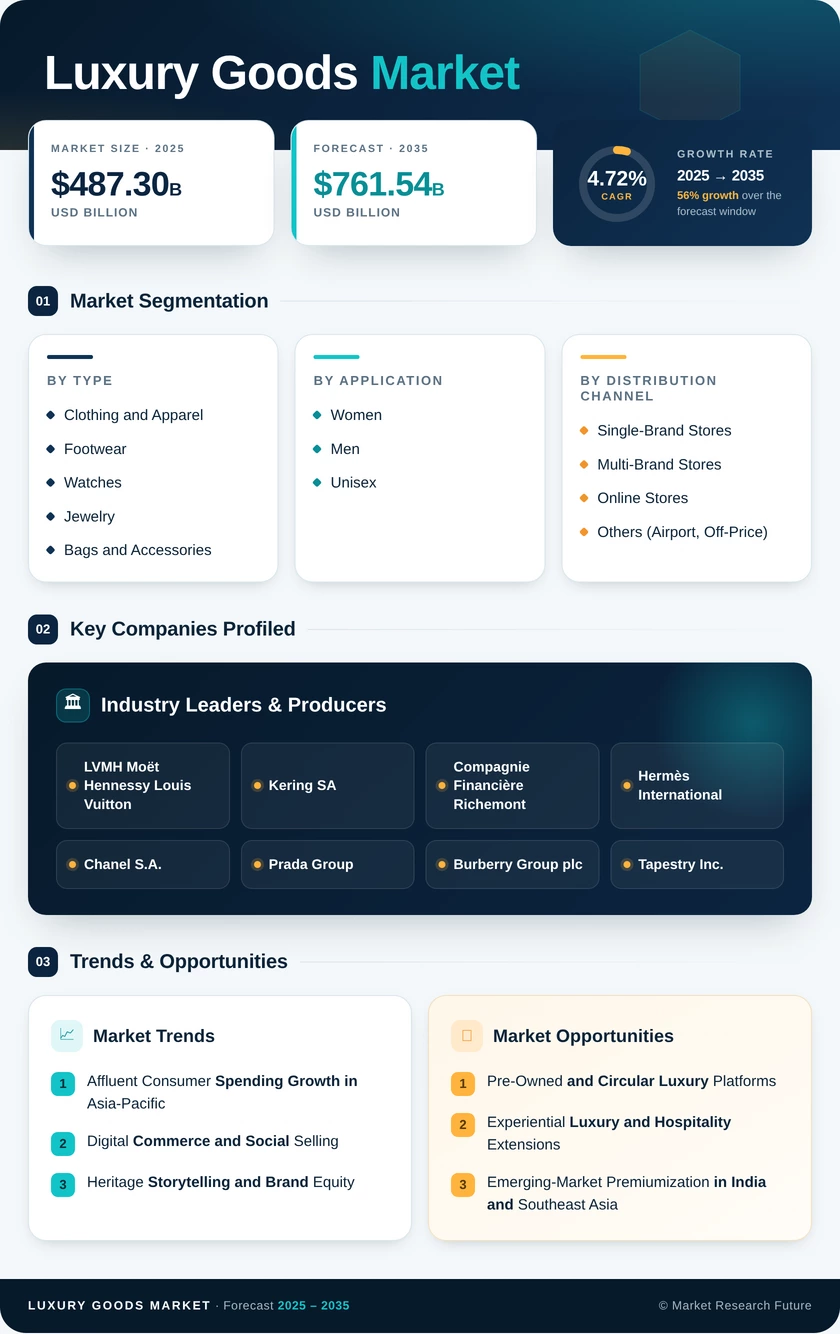
Luxury Goods Market

ID: MRFR/CG/10109-HCR
128 Pages
Sakshi Gupta
Last Updated: June 11, 2026
Global Luxury Goods Market Size, Share, Industry Trend & Analysis Research Report: By Product Type (Clothing and Apparel, Footwear, Watches, Jewelry, Bags and Accessories, Others), By End User (Women, Men, Unisex), By Distribution Channel (Single-Brand Stores, Multi-Brand Stores, Online Stores, Others), By Geography (North America, Europe, Asia-Pacific, South America, Middle East & Africa) - Forecast to 2035.
Download PDF ×

We do not share your information with anyone. However, we may send you emails based on your report interest from time to time. You may contact us at any time to opt-out.

  1. 1 Market Overview |
    1. 1.1 Study Assumptions & Market Definition |
    2. 1.2 Scope of the Study |
    3. 1.3 Research Methodology
  2. 2 Market Summary & Key Takeaways
  3. 3 Market Dynamics |
    1. 3.1 Market Drivers Analysis | |
      1. 3.1.1 Affluent Consumer Spending Growth in Asia-Pacific | |
      2. 3.1.2 Digital Commerce and Social Selling | |
      3. 3.1.3 Heritage Storytelling and Brand Equity | |
      4. 3.1.4 Tourism Recovery and Travel Retail | |
      5. 3.1.5 Premiumization in Menswear and Grooming | |
      6. 3.1.6 Investment-Driven Watch and Jewelry Purchases | |
      7. 3.1.7 Gen-Z Entry into High-End Fashion and Accessories |
    2. 3.2 Market Restraints Analysis | |
      1. 3.2.1 Counterfeit and Grey-Market Proliferation | |
      2. 3.2.2 Macroeconomic Slowdowns and Recession Risk | |
      3. 3.2.3 Regulatory Scrutiny on Sustainability Claims | |
      4. 3.2.4 Currency Volatility in Emerging Economies | |
      5. 3.2.5 Consumer Fatigue from Over-Extension of Brand Lines |
    3. 3.3 Market Opportunity Analysis | |
      1. 3.3.1 Pre-Owned and Circular Luxury Platforms | |
      2. 3.3.2 Experiential Luxury and Hospitality Extensions | |
      3. 3.3.3 Emerging-Market Premiumization in India and Southeast Asia | |
      4. 3.3.4 Data-Driven Personalization and Clienteling | |
      5. 3.3.5 Blockchain Authentication and Digital Product Passports |
    4. 3.4 Industry Value Chain Analysis |
    5. 3.5 Porter's Five Forces Analysis
  4. 4 Global Luxury Goods Market Size & Forecast (2021–2035) |
    1. 4.1 Historical Market Size (2021–2025) |
    2. 4.2 Current & Forecast Market Size (2026–2035) |
    3. 4.3 Market Size by Revenue (USD Billion) |
    4. 4.4 Year-over-Year Growth Analysis
  5. 5 Segmentation Analysis |
    1. 5.1 By Product Type | |
      1. 5.1.1 Clothing and Apparel | |
      2. 5.1.2 Footwear | |
      3. 5.1.3 Watches | |
      4. 5.1.4 Jewelry | |
      5. 5.1.5 Bags and Accessories | |
      6. 5.1.6 Others (Fragrances, Cosmetics) |
    2. 5.2 By End User | |
      1. 5.2.1 Women | |
      2. 5.2.2 Men | |
      3. 5.2.3 Unisex |
    3. 5.3 By Distribution Channel | |
      1. 5.3.1 Single-Brand Stores | |
      2. 5.3.2 Multi-Brand Stores | |
      3. 5.3.3 Online Stores | |
      4. 5.3.4 Others (Airport, Off-Price)
  6. 6 Regional Analysis |
    1. 6.1 North America | |
      1. 6.1.1 United States | |
      2. 6.1.2 Canada | |
      3. 6.1.3 Mexico |
    2. 6.2 Europe | |
      1. 6.2.1 Germany | |
      2. 6.2.2 United Kingdom | |
      3. 6.2.3 France | |
      4. 6.2.4 Italy | |
      5. 6.2.5 Spain | |
      6. 6.2.6 Nordic Countries | |
      7. 6.2.7 Russia | |
      8. 6.2.8 Rest of Europe |
    3. 6.3 Asia-Pacific | |
      1. 6.3.1 China | |
      2. 6.3.2 India | |
      3. 6.3.3 Japan | |
      4. 6.3.4 South Korea | |
      5. 6.3.5 ASEAN | |
      6. 6.3.6 Rest of Asia-Pacific |
    4. 6.4 South America | |
      1. 6.4.1 Brazil | |
      2. 6.4.2 Argentina | |
      3. 6.4.3 Rest of South America |
    5. 6.5 Middle East & Africa | |
      1. 6.5.1 Saudi Arabia | |
      2. 6.5.2 UAE | |
      3. 6.5.3 South Africa | |
      4. 6.5.4 Egypt | |
      5. 6.5.5 Rest of MEA
  7. 7 Competitive Landscape |
    1. 7.1 Market Share Analysis (2025) |
    2. 7.2 Competitive Benchmarking Matrix |
    3. 7.3 Company Profiles | |
      1. 7.3.1 LVMH Moët Hennessy Louis Vuitton | |
      2. 7.3.2 Kering SA | |
      3. 7.3.3 Compagnie Financière Richemont | |
      4. 7.3.4 Hermès International | |
      5. 7.3.5 Chanel S.A. | |
      6. 7.3.6 Prada Group | |
      7. 7.3.7 Burberry Group plc | |
      8. 7.3.8 Tapestry Inc. | |
      9. 7.3.9 Capri Holdings | |
      10. 7.3.10 Rolex SA
  8. 8 Future Outlook & Strategic Recommendations (2026–2035) |
    1. 8.1 AI-Powered Personalization at Scale |
    2. 8.2 Sustainability and Traceable Supply Chains |
    3. 8.3 The Rise of "Quiet Luxury" and Cultural Relevance |
    4. 8.4 Metaverse, Digital Fashion, and NFT-Backed Collectibles
  9. 9 Recent Developments & News
  10. 10 Frequently Asked Questions (FAQs)
  11. 11 Report Scope & Methodology |
    1. 11.1 Study Period & Base Year |
    2. 11.2 Data Sources & Citations |
    3. 11.3 Abbreviations
  12. 12 LIST OF TABLES |
  13. TABLE 1 Global Luxury Goods Market Size & Forecast, by Revenue (USD Billion), 2021–2035 |
  14. TABLE 2 Global Luxury Goods Market – Year-over-Year Growth Analysis, 2021–2035 |
  15. TABLE 3 Global Luxury Goods Market – Driver Impact Analysis, 2026–2035 |
  16. TABLE 4 Global Luxury Goods Market – Restraint Impact Analysis, 2026–2035 |
  17. TABLE 5 Global Luxury Goods Market Size, by Product Type, 2021–2035 (USD Billion) |
  18. TABLE 6 Global Luxury Goods Market Size, by End User, 2021–2035 (USD Billion) |
  19. TABLE 7 Global Luxury Goods Market Size, by Distribution Channel, 2021–2035 (USD Billion) |
  20. TABLE 8 Global Luxury Goods Market Size, by Region, 2021–2035 (USD Billion) |
  21. TABLE 9 North America Luxury Goods Market Size, by Country, 2021–2035 (USD Billion) |
  22. TABLE 10 Europe Luxury Goods Market Size, by Country, 2021–2035 (USD Billion) |
  23. TABLE 11 Asia-Pacific Luxury Goods Market Size, by Country, 2021–2035 (USD Billion) |
  24. TABLE 12 South America Luxury Goods Market Size, by Country, 2021–2035 (USD Billion) |
  25. TABLE 13 Middle East & Africa Luxury Goods Market Size, by Country, 2021–2035 (USD Billion) |
  26. TABLE 14 Competitive Benchmarking Matrix – Global Luxury Goods Market, 2025 |
  27. TABLE 15 Company Profiles – Key Players, Global Luxury Goods Market |
  28. TABLE 16 Recent Developments & Strategic Announcements, 2023–2025 |
  29. TABLE 17 Report Scope & Methodology Summary |
  30. TABLE 18 Detailed Sources and Citations |
  31. TABLE 19 North America Luxury Goods Market Size, by Product Type, 2021–2035 (USD Billion) |
  32. TABLE 20 North America Luxury Goods Market Size, by End User, 2021–2035 (USD Billion) |
  33. TABLE 21 North America Luxury Goods Market Size, by Distribution Channel, 2021–2035 (USD Billion) |
  34. TABLE 22 Europe Luxury Goods Market Size, by Product Type, 2021–2035 (USD Billion) |
  35. TABLE 23 Europe Luxury Goods Market Size, by End User, 2021–2035 (USD Billion) |
  36. TABLE 24 Europe Luxury Goods Market Size, by Distribution Channel, 2021–2035 (USD Billion) |
  37. TABLE 25 Asia-Pacific Luxury Goods Market Size, by Product Type, 2021–2035 (USD Billion) |
  38. TABLE 26 Asia-Pacific Luxury Goods Market Size, by End User, 2021–2035 (USD Billion) |
  39. TABLE 27 Asia-Pacific Luxury Goods Market Size, by Distribution Channel, 2021–2035 (USD Billion) |
  40. TABLE 28 South America Luxury Goods Market Size, by Product Type, 2021–2035 (USD Billion) |
  41. TABLE 29 South America Luxury Goods Market Size, by End User, 2021–2035 (USD Billion) |
  42. TABLE 30 South America Luxury Goods Market Size, by Distribution Channel, 2021–2035 (USD Billion) |
  43. TABLE 31 Middle East & Africa Luxury Goods Market Size, by Product Type, 2021–2035 (USD Billion) |
  44. TABLE 32 Middle East & Africa Luxury Goods Market Size, by End User, 2021–2035 (USD Billion) |
  45. TABLE 33 Middle East & Africa Luxury Goods Market Size, by Distribution Channel, 2021–2035 (USD Billion)
  46. 13 LIST OF FIGURES |
  47. FIGURE 1 Luxury Goods Market Dynamics – Drivers, Restraints, Opportunities |
  48. FIGURE 2 Industry Value Chain Analysis – Global Luxury Goods Market |
  49. FIGURE 3 Porter's Five Forces Analysis – Global Luxury Goods Market |
  50. FIGURE 4 Global Luxury Goods Market Size Trend & Forecast (USD Billion), 2021–2035 |
  51. FIGURE 5 Global Luxury Goods Market Share, by Product Type, 2025 (%) |
  52. FIGURE 6 Global Luxury Goods Market Share, by End User, 2025 (%) |
  53. FIGURE 7 Global Luxury Goods Market Share, by Distribution Channel, 2025 (%) |
  54. FIGURE 8 Global Luxury Goods Market Share, by Region, 2025 (%) |
  55. FIGURE 9 North America Luxury Goods Market Size Trend (USD Billion), 2021–2035 |
  56. FIGURE 10 Europe Luxury Goods Market Size Trend (USD Billion), 2021–2035 |
  57. FIGURE 11 Asia-Pacific Luxury Goods Market Size Trend (USD Billion), 2021–2035 |
  58. FIGURE 12 South America Luxury Goods Market Size Trend (USD Billion), 2021–2035 |
  59. FIGURE 13 Middle East & Africa Luxury Goods Market Size Trend (USD Billion), 2021–2035 |
  60. FIGURE 14 Competitive Landscape – Market Share of Key Players, 2025 (%) |
  61. FIGURE 15 Competitive Positioning Matrix – Global Luxury Goods Market

Segmentation Quick Reference

DimensionSub-SegmentsDominant SegmentFastest Growing Segment
Product TypeClothing and Apparel, Footwear, Watches, Jewelry, Bags and Accessories, OthersClothing and ApparelWatches
End UserWomen, Men, UnisexWomenMen
Distribution ChannelSingle-Brand Stores, Multi-Brand Stores, Online Stores, OthersSingle-Brand StoresOnline Stores
GeographyNorth America, Europe, Asia-Pacific, South America, Middle East & AfricaEuropeAsia-Pacific


Market Segmentation Overview

By Product Type

Sub-SegmentKey Trend
Clothing and ApparelGender-fluid collections and direct-to-consumer drops driving volume
FootwearLuxury sneaker collaborations bridging streetwear and couture
WatchesInvestment-grade timepieces and certified pre-owned programs gaining traction
JewelryLab-grown diamond disruption alongside traditional fine jewelry demand
Bags and AccessoriesWaitlist-based scarcity models sustaining price premiums
Others (Fragrances, Cosmetics)Niche perfumery and clean beauty formulations entering premium tier


Clothing and apparel remains the revenue anchor, while watches and bags command the highest average transaction values — making product-type segmentation a critical lens for understanding revenue composition across the Luxury Goods Market.

By End User

Sub-SegmentKey Trend
WomenCross-category loyalty driving repeat purchasing and brand advocacy
MenMenswear premiumization expanding from formal to casual and grooming
UnisexGender-neutral collections attracting Gen-Z consumers globally


Women continue to represent the majority of luxury purchases, but the male segment is closing the gap at an accelerated pace as brands invest in dedicated menswear creative directors and standalone boutiques.

By Distribution Channel

Sub-SegmentKey Trend
Single-Brand StoresFlagship experiential investments exceeding USD 50 million per location
Multi-Brand StoresDepartment-store concession model under pressure from DTC shifts
Online StoresSocial commerce and mobile-first checkout accelerating digital adoption
Others (Airport, Off-Price)Travel-retail luxury concessions expanding in Gulf and APAC hubs


Single-brand stores remain the primary revenue channel, but online stores are rapidly gaining share as digital infrastructure matures and consumer comfort with purchasing high-value items remotely increases.

By Geography

Sub-SegmentKey Trend
North AmericaResilient demand anchored by US department stores and digital DTC
EuropeHeritage tourism and artisanal manufacturing driving sustained dominance
Asia-PacificWealth creation in China and India reshaping global demand patterns
South AmericaBrazil-centric premiumization with currency-hedged pricing strategies
Middle East & AfricaMega-project retail developments and zero-tax shopping corridors


Europe's established infrastructure and cultural capital sustain its leading position, while Asia-Pacific's rapid wealth accumulation is positioning the region as the primary growth engine for the next decade.