Malaysia Freight Logistics Market Summary
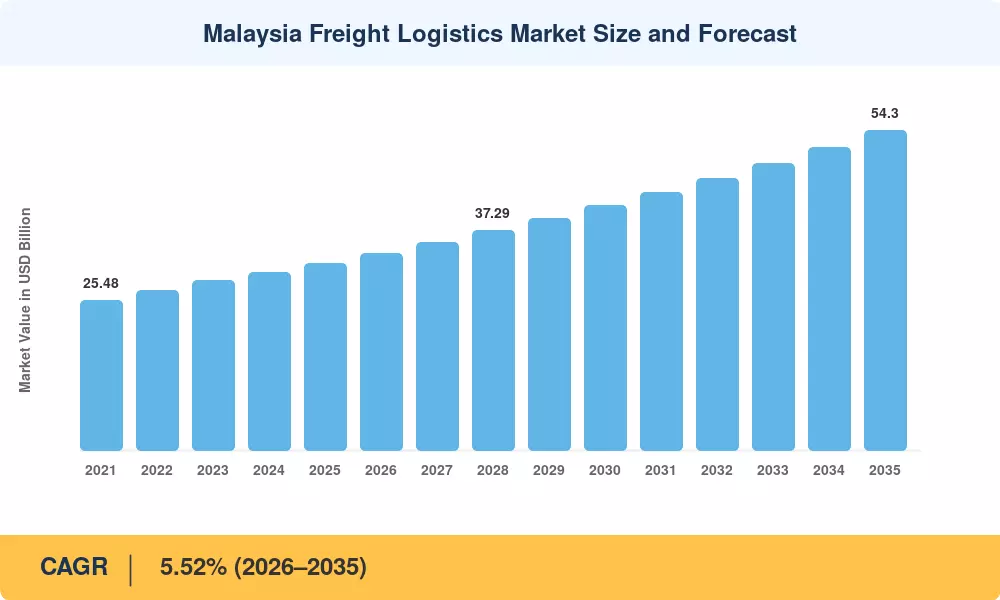
The Malaysia Freight Logistics Market reached an estimated USD 31.74 Billion in 2025 and is projected to grow from USD 33.49 Billion in 2026 to USD 54.30 Billion by 2035, registering a CAGR of 5.52% during 2026–2035. Port Klang's ascent among the world's busiest container terminals and sustained foreign direct investment — which topped MYR 400 Billion (approximately USD 88 Billion) in approved projects during 2024 — are anchoring new demand for cross-border forwarding, advanced warehousing, and specialized carrier partnerships [1][2]. The National Transport Policy 2019–2030 and targeted diesel subsidy restructuring have jointly reduced cost volatility for haulage operators, supporting steady capacity expansion across road, rail, and maritime corridors.
Digitalization is reshaping how shippers, forwarders, and carriers interact within the Malaysia Freight Logistics Market. Legacy paper-based customs declarations and manual load planning are giving way to the National Single Window (NSW) platform, AI-driven route optimization, and real-time cargo tracking. The government has committed over MYR 9 Billion to the East Coast Rail Link (ECRL), which upon completion will slash freight transit time between Kuantan Port and Port Klang by roughly 50%, directly linking the South China Sea coast to the Strait of Malacca [3][4].
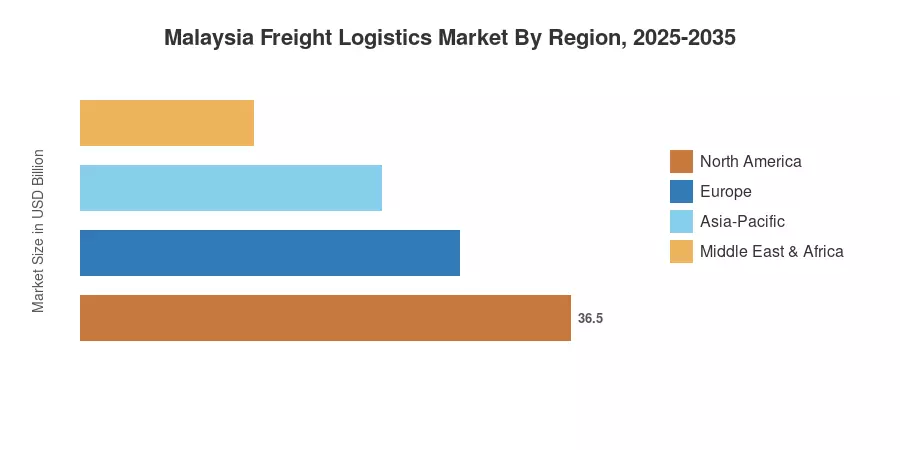
Within Malaysia's domestic landscape, the Central Region — anchored by Selangor, Kuala Lumpur, and Port Klang — commands roughly 44.6% of total freight throughput, driven by dense manufacturing clusters and the country's primary container gateway. The Southern Region, centered on Johor and its proximity to Singapore, is expanding at the fastest clip, propelled by the Johor–Singapore Special Economic Zone announced in late 2024. The Northern Region, led by Penang's electronics manufacturing corridor, holds a significant share and continues to attract semiconductor-related freight volumes [5][6]. By 2035, the Malaysia Freight Logistics Market is poised to solidify the nation's standing as a top-tier ASEAN logistics hub.
Key Report Takeaways
• By Logistics Function
- Freight transport accounted for 51.2% of the Malaysia Freight Logistics Market in 2025, reflecting the dominance of road and sea modes in domestic and intra-regional cargo movement.
- Courier, express, and parcel (CEP) services are forecast to expand at a 6.30% CAGR over 2026–2035, propelled by e-commerce penetration exceeding 35% of retail sales.
• By End User Industry
- Manufacturing captured approximately 42.1% of the Malaysia Freight Logistics Market in 2025, underpinned by semiconductor, automotive, and petrochemical supply chains.
- Wholesale and retail trade is on track to register a 5.90% CAGR through 2035 as modern trade formats and direct-to-consumer fulfillment models gain traction.
• By Economic Region
- The Central Region held 44.6% of the Malaysia Freight Logistics Market, benefiting from Port Klang and KLIA's air cargo facilities.
- The Southern Region is the fastest-growing corridor with a projected CAGR of 6.35%, bolstered by new cross-border infrastructure with Singapore.
Market Size and Forecast (2021–2035)
Market Research Future's estimates draw on customs trade data from Malaysia's Royal Customs Department, port throughput statistics, carrier financial disclosures, and primary interviews with forwarding executives. Historical values (2021–2024) reflect actual reported throughput, while forecasts (2026–2035) apply calibrated trend-line modeling anchored to the 2025 base year.