×
Hero Background
English
Chinese
French
Japanese
Korean
German
Spanish

Male Breast Cancer Market Share

ID: MRFR/Pharma/5043-HCR
100 Pages
Rahul Gotadki
October 2025

Global Male Breast Cancer Market Research Report Information By Type (Infiltrating Ductal Carcinoma, Inflammatory Breast Cancer, Paget Disease, Ductal Carcinoma), by Diagnosis (Mammography, Biopsy, Pet Scan, Others), by Treatment (Local, Systemic) – Forecast Till 2035

Share:
Download PDF ×

We do not share your information with anyone. However, we may send you emails based on your report interest from time to time. You may contact us at any time to opt-out.

Male Breast Cancer Market Infographic
Purchase Options

Market Share

Male Breast Cancer Market Share Analysis

In the competitive landscape of Male Breast Cancer Market, market share positioning strategies are important. Companies in this niche have adopted numerous approaches to securing and improving their market shares as male breast cancer is gaining awareness as well as a growing market for related products.

One key approach is differentiation where companies try to make their products or services different from those of other companies in the male breast cancer market. For instance, such differentiation may involve developing unique features, offering specialized treatments or making distinct marketing campaigns that resonate with the particular requirements and worries of men who have experienced breast cancer. This enables firms to stand out among competitors thus drawing a loyal customer base and securing an edge against others.

Another effective strategy is cost leadership whereby companies concentrate on being the cheapest option in the male breast cancer market. Streamlining manufacturing processes, negotiating favorable supplier contracts and using cost-effective channels of distribution can be part of this strategy. Through provision of quality goods or services at a lower price relative to rivals, organizations are able to capture large number of price-sensitive customers.

This has led to increased investment in research and development by various organizations operating within this industry with an aim of producing cutting-edge products or services. By remaining at the forefront of technological advancements and medical breakthroughs, firms can be seen as industry leaders. Apart from attracting new customers who seek latest solutions; innovative ways help establish reputation for excellence and forwardness in handling men’s needs regarding these maladies.

Strategic alliances have become more common in Male Breast Cancer Market nowadays than ever before. In order to strengthen their position, companies are joining hands with research institutions, healthcare providers as well as advocacy groups among others. These relationships have resulted to knowledge sharing, large patient pool access points as well as creation comprehensive remedies which address diverse issues linked with male patients experiencing such conditions such as male breast cancers. Such collaborations boost enterprise share and align towards enhanced solutions for prostate health challenges.

Marketing activities also play an important role when it comes to market share positioning. Companies are investing in targeted and impactful marketing campaigns that raise awareness about male breast cancer and promote their products or services. This goes a long way towards building a strong brand that attracts customers and establishes trust within the market. Therefore, these companies have moved their advertising to different platforms including social media, seminars, influencers’ endorsement for the target audience in order to cement their place in Male Breast Cancer Market.

Moreover, customer centric strategies are growing in prominence as companies put patients first. These include tailoring products and services to meet men’s individual needs with regards to breast cancer so as to provide excellent customer support services or engage in patient education programs among others. As a result of concentrating on their clients’ welfare and satisfaction, they create loyalty which generates positive word-of-mouth hence expanding the market coverage.


Author
Rahul Gotadki
Assistant Manager

He holds an experience of about 7+ years in Market Research and Business Consulting, working under the spectrum of Life Sciences and Healthcare domains. Rahul conceptualizes and implements a scalable business strategy and provides strategic leadership to the clients. His expertise lies in market estimation, competitive intelligence, pipeline analysis, customer assessment, etc. In addition to the above, his other responsibility includes strategic tracking of high growth markets & advising clients on the potential areas of focus they could direct their business initiatives

Leave a Comment

FAQs

What is the current market valuation of the Male Breast Cancer Market?

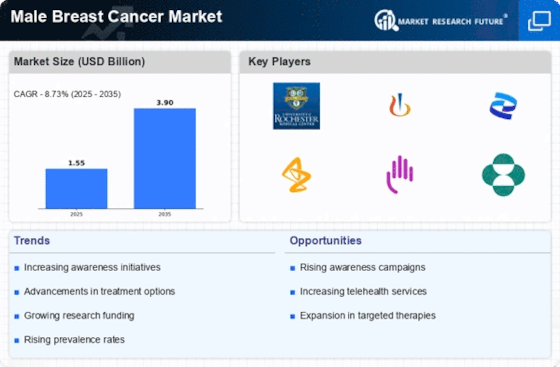
The market valuation of the Male Breast Cancer Market was 1.555 USD Billion in 2024.

What is the projected market size for the Male Breast Cancer Market by 2035?

The projected market size for the Male Breast Cancer Market is 3.904 USD Billion by 2035.

What is the expected CAGR for the Male Breast Cancer Market during the forecast period?

The expected CAGR for the Male Breast Cancer Market during the forecast period 2025 - 2035 is 8.73%.

Which companies are the key players in the Male Breast Cancer Market?

Key players in the Male Breast Cancer Market include Roche, Novartis, Pfizer, AstraZeneca, Bristol-Myers Squibb, Merck & Co., Eli Lilly and Company, Amgen, and GSK.

What are the main types of male breast cancer and their market valuations?

The main types include Ductal Carcinoma in Situ valued at 1.505 USD Billion and Infiltrating Ductal Carcinoma valued at 1.649 USD Billion.

Market Summary

As per MRFR analysis, the Male Breast Cancer Market Size was estimated at 1.555 USD Billion in 2024. The Male Breast Cancer industry is projected to grow from 1.691 USD Billion in 2025 to 3.904 USD Billion by 2035, exhibiting a compound annual growth rate (CAGR) of 8.73 during the forecast period 2025 - 2035.

Key Market Trends & Highlights

The Male Breast Cancer Market is experiencing a notable shift towards increased awareness and advanced treatment options.

  • North America remains the largest market for male breast cancer, driven by heightened awareness and improved healthcare access.
  • The Asia-Pacific region is emerging as the fastest-growing market, reflecting a surge in awareness and education initiatives.
  • Infiltrating Ductal Carcinoma continues to dominate the market, while Ductal Carcinoma in Situ is witnessing rapid growth due to evolving treatment paradigms.
  • Rising incidence rates and improved diagnostic techniques are key drivers propelling market expansion.

Market Size & Forecast

2024 Market Size 1.555 (USD Billion)
2035 Market Size 3.904 (USD Billion)
CAGR (2025 - 2035) 8.73%
Largest Regional Market Share in 2024 Americas

Major Players

<p>Roche (CH), Novartis (CH), Pfizer (US), AstraZeneca (GB), Bristol-Myers Squibb (US), Merck & Co. (US), Eli Lilly and Company (US), Amgen (US), GSK (GB)</p>

Market Trends

The Male Breast Cancer Market is currently experiencing a notable evolution, driven by a combination of increasing awareness and advancements in treatment options. As more individuals become informed about the condition, the stigma surrounding male breast cancer appears to diminish, leading to earlier diagnoses and improved outcomes. This shift in perception is likely to encourage more men to seek medical advice, thereby expanding the patient population and fostering a more robust market environment. Furthermore, ongoing research into targeted therapies and personalized medicine is paving the way for innovative treatment modalities, which may enhance the quality of care for affected individuals. In addition to the growing awareness, the Male Breast Cancer Market is also influenced by the rising prevalence of risk factors associated with the disease. Factors such as genetic predisposition and lifestyle choices are becoming increasingly recognized, prompting healthcare providers to focus on preventive measures and early detection strategies. This proactive approach could potentially lead to a more comprehensive understanding of male breast cancer, ultimately benefiting patients through tailored treatment plans. As the market continues to evolve, collaboration among stakeholders, including researchers, healthcare professionals, and advocacy groups, is essential to drive progress and improve patient outcomes.

Increased Awareness and Education

The Male Breast Cancer Market is witnessing a surge in awareness campaigns aimed at educating the public about the disease. These initiatives are crucial in dispelling myths and encouraging early detection, which may lead to better treatment outcomes.

Advancements in Treatment Options

Innovations in medical research are contributing to the development of new therapies specifically targeting male breast cancer. These advancements may provide patients with more effective treatment choices, enhancing their chances of recovery.

Focus on Risk Factor Management

There is a growing emphasis on understanding and managing risk factors associated with male breast cancer. This trend suggests that healthcare providers are increasingly prioritizing preventive measures and personalized care strategies.

Male Breast Cancer Market Market Drivers

Rising Incidence Rates

The Male Breast Cancer Market is witnessing a notable increase in incidence rates, which appears to be driven by a combination of genetic predispositions and environmental factors. Recent data indicates that the incidence of male breast cancer has been rising, with estimates suggesting that approximately 2,650 new cases are diagnosed annually. This increase in cases necessitates enhanced awareness and treatment options, thereby propelling the Male Breast Cancer Market forward. As more men are diagnosed, the demand for specialized healthcare services, including screening and treatment, is likely to grow. This trend may also lead to increased funding for research and development, further stimulating the market.

Growing Support Networks

The establishment of support networks and advocacy groups is playing a pivotal role in the Male Breast Cancer Market. These organizations are dedicated to raising awareness, providing resources, and offering emotional support to men diagnosed with breast cancer. The presence of such networks not only helps in disseminating information about the disease but also encourages men to seek timely medical attention. As these support systems expand, they are likely to foster a more informed patient population, which may lead to increased screening and treatment uptake, thereby positively influencing the Male Breast Cancer Market.

Increased Research Funding

The Male Breast Cancer Market is experiencing a surge in research funding, which is essential for advancing treatment options and understanding the disease better. Government and private organizations are increasingly recognizing the need for focused research on male breast cancer, leading to a rise in grants and financial support for clinical trials. This influx of funding is likely to accelerate the development of innovative therapies and improve patient outcomes. As research progresses, new treatment modalities may emerge, further enhancing the Male Breast Cancer Market and providing hope for affected individuals.

Evolving Treatment Paradigms

The Male Breast Cancer Market is undergoing a transformation due to evolving treatment paradigms. Traditional treatment options, such as surgery and radiation, are being complemented by targeted therapies and immunotherapy, which show promise in improving patient outcomes. The introduction of personalized medicine, tailored to the genetic profile of the tumor, is likely to enhance treatment efficacy. As more treatment options become available, the Male Breast Cancer Market is expected to expand, catering to a diverse range of patient needs and preferences. This evolution in treatment approaches may also lead to increased collaboration among healthcare providers, researchers, and pharmaceutical companies.

Improved Diagnostic Techniques

Advancements in diagnostic techniques are significantly impacting the Male Breast Cancer Market. Enhanced imaging technologies, such as digital mammography and MRI, are becoming more accessible, allowing for earlier detection of male breast cancer. Early diagnosis is crucial, as it can lead to better treatment outcomes and survival rates. The market is likely to benefit from the integration of these advanced diagnostic tools into routine healthcare practices. Furthermore, the development of genetic testing for BRCA mutations in men is expected to increase awareness and facilitate early intervention, thereby driving growth in the Male Breast Cancer Market.

Market Segment Insights

By Type: Infiltrating Ductal Carcinoma (Largest) vs. Ductal Carcinoma in Situ (Fastest-Growing)

<p>In the Male Breast Cancer Market, Infiltrating Ductal Carcinoma holds the largest market share, significantly impacting treatment decisions and management. This subtype accounts for the majority of male breast cancer cases, creating a significant emphasis on targeted therapies and clinical guidelines tailored for male patients. In contrast, Ductal Carcinoma in Situ, while smaller in terms of market presence, is rapidly growing as a recognized condition in men, leading to increased awareness and diagnosis rates that are altering treatment landscapes. The growth trends for these segment values reveal a complex interplay of factors. The rising prevalence of male breast cancer and the increasing awareness of symptoms contribute to the growth of Ductal Carcinoma in Situ, as healthcare professionals become more vigilant in diagnosing this condition in men. Additionally, advancements in screening technologies and treatment options fuel interest in understanding and addressing these specific types of cancer, driving overall market growth and enhancing the focus on unconventional presentations in male patients.</p>

<p>Infiltrating Ductal Carcinoma (Dominant) vs. Paget’s Disease of the Nipple (Emerging)</p>

<p>Infiltrating Ductal Carcinoma is the dominant type in the Male Breast Cancer Market, characterized by its aggressive nature and potential to spread beyond the ducts of the breast. This subtype is primarily recognized for requiring intensive treatment regimens, including surgery, chemotherapy, and targeted therapies, making it a focal point for ongoing research. Paget's Disease of the Nipple, while considered an emerging type of male breast cancer, is less common but prompts significant attention due to its unique presentation. It often presents with nipple discharge and skin changes, leading to misdiagnosis or late diagnosis. As awareness grows regarding Paget's Disease, it is increasingly recognized as an important condition within the male breast cancer spectrum, highlighting the need for targeted education and management.</p>

By Diagnosis: Mammography (Largest) vs. Biopsy (Fastest-Growing)

<p>In the Male Breast Cancer Market, the diagnosis segment is led by Mammography, which has established itself as the largest contributor due to its broad utilization and effectiveness in early detection. Following Mammography, various biopsy techniques such as Fine Needle Aspiration Biopsy and Core Biopsy play crucial roles, capturing significant shares of the market as essential tools for confirming malignancy in suspected cases. Other diagnosis methods like PET scans and MRI scans offer supplementary options that are gaining traction among practitioners and patients alike. Market growth in the diagnosis segment is largely driven by advancements in imaging technologies and increasing awareness about male breast cancer. The demand for earlier and more accurate detection methods is propelling the adoption of biopsies as they provide definitive diagnosis through tissue sampling. Moreover, the trend toward personalized medicine further motivates innovation and improvements in diagnostic methodologies, positioning biopsy techniques as key areas of growth within the market.</p>

<p>Imaging: Mammography (Dominant) vs. MRI Scan (Emerging)</p>

<p>Mammography stands out as the dominant imaging technique in the diagnosis of male breast cancer due to its established reputation, effectiveness in early-stage detection, and comprehensive screening capabilities. It is widely adopted in clinical settings, providing a necessary foundation for subsequent diagnostic procedures. Conversely, MRI scans are emerging as an important complement, particularly for assessing more complex cases and high-risk individuals. With improved resolution and the ability to detect abnormalities that other methods might miss, MRI is gaining acceptance as a vital tool in the diagnostic arsenal, appealing to both healthcare providers and patients seeking thorough examinations. This shift indicates a growing trend towards multi-modality imaging approaches in male breast cancer diagnostics.</p>

By Treatment: Local Treatments (Largest) vs. Systemic Treatments (Fastest-Growing)

<p>In the Male Breast Cancer Market, the treatment segment is predominantly characterized by the local treatment options, which hold a significant market share. Local treatments, such as surgical interventions and radiation therapy, are often the first line of defense and are widely utilized by healthcare professionals. Systemic Treatments, which include chemotherapy and hormonal therapies, while having a smaller market presence, are swiftly gaining traction due to increased awareness and advancements in treatment options.</p>

<p>Treatments: Local (Dominant) vs. Systemic (Emerging)</p>

<p>Local treatments are currently the dominant approach in addressing male breast cancer, providing targeted and immediate relief through methods like lumpectomy and mastectomy. They are often preferred due to their effectiveness in localized disease management and their role in integrated treatment plans. On the other hand, systemic treatments are emerging rapidly as essential components in modern therapies. With significant advancements in personalized medicine, these treatments have become more appealing, especially among younger patients. Innovations in drug formulations and supportive care strategies are driving their expanded use, making them a vital focus area for research and development.</p>

By Local Treatments: Surgery (Largest) vs. Radiation Therapy (Fastest-Growing)

<p>In the Male Breast Cancer Market, the local treatments segment is primarily composed of Surgery and Radiation Therapy. Surgery holds the largest share of this segment, reflecting its long-established role in the treatment of male breast cancer. Typically, surgical options include mastectomy and lumpectomy, which remain critical in the management of localized tumors. On the other hand, Radiation Therapy, while not dominating the market share like Surgery, plays an increasingly important role as a complementary treatment following surgical intervention, especially in cases of early-stage breast cancer.</p>

<p>Surgery: Dominant vs. Radiation Therapy: Emerging</p>

<p>Surgery is the dominant treatment modality in the Male Breast Cancer Market, primarily used to remove malignant tissue, often leading to significant improvements in patient outcomes. It is considered a standard approach and typically includes various surgical options tailored to the type and stage of cancer. Conversely, Radiation Therapy is emerging as a faster-growing option for patients, particularly in post-operative settings. Advances in techniques like intensity-modulated radiation therapy (IMRT) have improved its efficacy, making it a preferred choice for minimizing recurrence. This treatment option is frequently recommended for patients who are not suitable candidates for surgery, highlighting its crucial role in comprehensive breast cancer care.</p>

By Surgery: Mastectomy (Largest) vs. Breast-Conserving Surgery (Fastest-Growing)

<p>In the Male Breast Cancer Market, the surgery segment is primarily dominated by mastectomy procedures, accounting for the largest market share. Mastectomy involves the complete removal of breast tissue and is often preferred for aggressive cancer types and larger tumors. Conversely, breast-conserving surgery, which allows for the preservation of breast tissue, is gaining momentum, particularly among patients seeking less invasive treatment options. Lymph nodes biopsy, while crucial for staging and treatment planning, holds a smaller share of the market compared to the other two surgical approaches.</p>

<p>Surgery Type: Mastectomy (Dominant) vs. Breast-Conserving Surgery (Emerging)</p>

<p>Mastectomy remains the dominant surgical option in the Male Breast Cancer Market segment, largely due to its effectiveness in removing cancerous tissues entirely, which is essential for advanced-stage cancers. Its position in the market is bolstered by the rigorous treatment protocols that emphasize complete tumor removal. On the other hand, breast-conserving surgery is emerging as a preferred choice among patients advocating for more conservative treatment options, reflecting shifting patient preferences towards preserving bodily integrity. This emerging trend is driven by increasing awareness of the psychological benefits associated with maintaining breast aesthetics, as well as advancements in surgical techniques that minimize tissue removal while ensuring effective cancer control.</p>

By Systemic Treatments: Chemotherapy (Largest) vs. Hormone Therapy (Fastest-Growing)

<p>In the Male Breast Cancer Market, systemic treatments are crucial for patient management, with chemotherapy dominating the market due to its proven efficacy in shrinking tumors and prolonging survival rates. Hormone therapy, while holding a smaller market share, has gained traction rapidly as a preferred option for hormone receptor-positive cases, positioning itself as a key player in treatment protocols. Targeted therapy follows closely behind, emerging as a promising alternative with its innovative approach to attack cancer cells while sparing healthy tissues. The growth trends in systemic treatments for male breast cancer are primarily driven by increasing awareness among healthcare professionals about male breast cancer and a growing understanding of the importance of personalized treatment. Advances in research and clinical studies advocate the efficacy of various systemic treatments, prompting medical professionals to tailor therapies to individual patient profiles. This dynamic remains pivotal as pharmaceutical innovations pave the way for better treatment outcomes, with hormone therapy particularly rising as a focal point in the evolving treatment landscape.</p>

<p>Chemotherapy: Dominant vs. Hormone Therapy: Emerging</p>

<p>Chemotherapy is recognized as the dominant systemic treatment in the Male Breast Cancer Market, primarily due to its comprehensive approach to tackling cancer cells and its historical usage across various cancer types. It remains a backbone of treatment regimens, particularly for aggressive cancer types. In contrast, hormone therapy has emerged as a significant contender, especially among patients with hormone receptor-positive tumors. This therapy's gentle approach helps minimize side effects while effectively managing the disease. The growth of hormone therapy is supported by its increasing endorsement in clinical guidelines, making it a highly recommended option for a specific subset of male breast cancer patients. The focus on developing targeted hormone therapies signifies its rising relevance and potential for extensive adoption in clinical settings.</p>

By Chemotherapy: Adjuvant Therapy (Largest) vs. Neoadjuvant Therapy (Fastest-Growing)

<p>In the Male Breast Cancer Market, the chemotherapy segment is primarily divided into Adjuvant Therapy and Neoadjuvant Therapy. Adjuvant Therapy holds the largest market share within this segment, being the standard treatment following surgery aimed at eliminating residual cancer cells, thereby reducing recurrence risk. Neoadjuvant Therapy, on the other hand, is gaining traction as a pre-surgical treatment option that helps in tumor reduction, enabling more effective surgical interventions and improving patient outcomes.</p>

<p>Chemotherapy: Adjuvant Therapy (Dominant) vs. Neoadjuvant Therapy (Emerging)</p>

<p>Adjuvant Therapy is characterized as the dominant segment within the Male Breast Cancer Market, known for its substantial adoption post-operative treatment to enhance survival rates. This segment benefits from established protocols and strong clinical backing. In contrast, Neoadjuvant Therapy is emerging as a significant force, driven by advancements in precision medicine and a focus on personalized treatment approaches. Its ability to shrink tumors pre-surgery fosters willingness among healthcare professionals to adopt this method, thus enhancing its market presence. As oncologists prioritize tailored treatments, the demand for Neoadjuvant Therapy is expected to grow, reflecting its potential to transform patient care.</p>

By Hormone Therapy: Hormone Therapy via Drugs (Largest) vs. Orchiectomy (Fastest-Growing)

<p>In the Male Breast Cancer Market, hormone therapy via drugs holds a substantial market share, being recognized as the largest segment. This trend reflects a shift towards pharmaceutical interventions for managing male breast cancer, leveraging various drug combinations that effectively target hormone receptors. Enhanced awareness and advancements in drug formulations contribute to its strong market presence, as more patients prefer drug therapies that offer convenience and reduced side effects. The growth trends in this market show a significant surge in the use of orchiectomy as a treatment option, propelled by its emerging recognition as an effective castration method for hormone-sensitive tumors. The focus on personalized medicine and the increasing incidence of male breast cancer are driving factors, as more healthcare providers explore various therapeutic regimes to optimize patient outcomes.</p>

<p>Hormone Therapy via Drugs (Dominant) vs. Orchiectomy (Emerging)</p>

<p>Hormone therapy via drugs stands out as the dominant treatment strategy in the Male Breast Cancer Market, primarily due to its efficacy and minimal invasiveness. This approach utilizes targeted therapies that directly interact with hormone receptors to inhibit cancer cell growth, offering patients a more manageable treatment process. In contrast, orchiectomy, while gaining momentum as an emerging method, involves surgical removal of the testes to significantly lower testosterone levels. With rising awareness about male breast cancer and improved surgical techniques, orchiectomy is progressively being viewed as an effective option, particularly for advanced cases, emphasizing a dual approach in hormone management within this niche market.</p>

By Targeted Therapy: For HER2 Positive Breast Cancer (Largest) vs. For Hormone Receptor Positive Breast Cancer (Fastest-Growing)

<p>The Male Breast Cancer Market has seen significant segmentation regarding targeted therapies, with HER2 Positive Breast Cancer taking the lead due to its high prevalence and effective targeted treatment options. This segment accounts for a substantial portion of the overall market share, showcasing the critical need for specific therapies that can address HER2 positive cases effectively. Conversely, the Hormone Receptor Positive Breast Cancer segment is rapidly gaining traction, propelled by rising awareness and advancements in hormonal therapy, appealing to a growing population of patients seeking effective treatment options.</p>

<p>Targeted Therapy: HER2 Positive (Dominant) vs. Hormone Receptor Positive (Emerging)</p>

<p>HER2 Positive targeted therapy is firmly established as the dominant approach in the Male Breast Cancer Market due to its targeted nature, offering specific and effective treatment for patients with HER2 overexpression. This segment benefits from robust clinical data supporting treatment efficacy and the availability of tailored therapies. On the other hand, Hormone Receptor Positive targeted therapy is emerging, driven by increasing incidences of these cancer types and advancements in hormonal therapy technologies. While it currently holds a smaller market share, demand is expected to accelerate as new therapies develop, foreshadowing a promising future for this segment.</p>

Get more detailed insights about Male Breast Cancer Market Research Report – Forecast to 2035

Regional Insights

Key Companies in the Male Breast Cancer Market market include

Industry Developments

Future Outlook

Male Breast Cancer Market Future Outlook

<p>The Male Breast Cancer Market is projected to grow at an 8.73% CAGR from 2024 to 2035, driven by advancements in treatment options, increased awareness, and improved diagnostic technologies.</p>

New opportunities lie in:

  • <p>Development of targeted therapies for male-specific breast cancer subtypes.</p>
  • <p>Expansion of telehealth services for remote patient monitoring and consultations.</p>
  • <p>Investment in awareness campaigns to educate healthcare providers and patients.</p>

<p>By 2035, the Male Breast Cancer Market is expected to achieve substantial growth and innovation.</p>

Market Segmentation

Male Breast Cancer Market Type Outlook

  • Ductal Carcinoma in Situ
  • Paget’s Disease of the Nipple
  • Inflammatory Breast Cancer
  • Infiltrating Ductal Carcinoma

Male Breast Cancer Market Surgery Outlook

  • Mastectomy
  • Breast-Conserving Surgery
  • Lymph Nodes Biopsy

Male Breast Cancer Market Diagnosis Outlook

  • Mammography
  • Biopsy
  • Fine Needle Aspiration Biopsy
  • Core Biopsy
  • Excisional Biopsy
  • PET Scan
  • CT Scan
  • MRI Scan
  • Other Tests

Male Breast Cancer Market Treatment Outlook

  • Local Treatments
  • Systemic Treatments

Male Breast Cancer Market Chemotherapy Outlook

  • Adjuvant Therapy
  • Neoadjuvant Therapy

Male Breast Cancer Market Hormone Therapy Outlook

  • Using Drugs
  • Orchiectomy (Castration)

Male Breast Cancer Market Local Treatments Outlook

  • Surgery
  • Radiation Therapy

Male Breast Cancer Market Targeted Therapy Outlook

  • For HER2 Positive Breast Cancer
  • For Hormone Receptor Positive Breast Cancer
  • For Cancer with BRCA Mutations

Male Breast Cancer Market Systemic Treatments Outlook

  • Chemotherapy
  • Hormone Therapy
  • Targeted Therapy

Report Scope

MARKET SIZE 20241.555(USD Billion)
MARKET SIZE 20251.691(USD Billion)
MARKET SIZE 20353.904(USD Billion)
COMPOUND ANNUAL GROWTH RATE (CAGR)8.73% (2024 - 2035)
REPORT COVERAGERevenue Forecast, Competitive Landscape, Growth Factors, and Trends
BASE YEAR2024
Market Forecast Period2025 - 2035
Historical Data2019 - 2024
Market Forecast UnitsUSD Billion
Key Companies ProfiledMarket analysis in progress
Segments CoveredMarket segmentation analysis in progress
Key Market OpportunitiesAdvancements in targeted therapies and personalized medicine enhance treatment options in the Male Breast Cancer Market.
Key Market DynamicsRising awareness and advancements in treatment options are reshaping the Male Breast Cancer Market landscape.
Countries CoveredNorth America, Europe, APAC, South America, MEA

FAQs

What is the current market valuation of the Male Breast Cancer Market?

The market valuation of the Male Breast Cancer Market was 1.555 USD Billion in 2024.

What is the projected market size for the Male Breast Cancer Market by 2035?

The projected market size for the Male Breast Cancer Market is 3.904 USD Billion by 2035.

What is the expected CAGR for the Male Breast Cancer Market during the forecast period?

The expected CAGR for the Male Breast Cancer Market during the forecast period 2025 - 2035 is 8.73%.

Which companies are the key players in the Male Breast Cancer Market?

Key players in the Male Breast Cancer Market include Roche, Novartis, Pfizer, AstraZeneca, Bristol-Myers Squibb, Merck & Co., Eli Lilly and Company, Amgen, and GSK.

What are the main types of male breast cancer and their market valuations?

The main types include Ductal Carcinoma in Situ valued at 1.505 USD Billion and Infiltrating Ductal Carcinoma valued at 1.649 USD Billion.

  1. SECTION I: EXECUTIVE SUMMARY AND KEY HIGHLIGHTS
    1. EXECUTIVE SUMMARY
      1. Market Overview
      2. Key Findings
      3. Market Segmentation
      4. Competitive Landscape
      5. Challenges and Opportunities
      6. Future Outlook
  2. SECTION II: SCOPING, METHODOLOGY AND MARKET STRUCTURE
    1. MARKET INTRODUCTION
      1. Definition
      2. Scope of the study
    2. RESEARCH METHODOLOGY
      1. Overview
      2. Data Mining
      3. Secondary Research
      4. Primary Research
      5. Forecasting Model
      6. Market Size Estimation
      7. Data Triangulation
      8. Validation
  3. SECTION III: QUALITATIVE ANALYSIS
    1. MARKET DYNAMICS
      1. Overview
      2. Drivers
      3. Restraints
      4. Opportunities
    2. MARKET FACTOR ANALYSIS
      1. Value chain Analysis
      2. Porter's Five Forces Analysis
      3. COVID-19 Impact Analysis
  4. SECTION IV: QUANTITATIVE ANALYSIS
    1. Healthcare, BY Type (USD Billion)
      1. Ductal Carcinoma in Situ
      2. Paget’s Disease of the Nipple
      3. Inflammatory Breast Cancer
      4. Infiltrating Ductal Carcinoma
    2. Healthcare, BY Diagnosis (USD Billion)
      1. Mammography
      2. Biopsy
      3. Fine Needle Aspiration Biopsy
      4. Core Biopsy
      5. Excisional Biopsy
      6. PET Scan
      7. CT Scan
      8. MRI Scan
      9. Other Tests
    3. Healthcare, BY Treatment (USD Billion)
      1. Local Treatments
      2. Systemic Treatments
    4. Healthcare, BY Local Treatments (USD Billion)
      1. Surgery
      2. Radiation Therapy
    5. Healthcare, BY Surgery (USD Billion)
      1. Mastectomy
      2. Breast-Conserving Surgery
      3. Lymph Nodes Biopsy
    6. Healthcare, BY Systemic Treatments (USD Billion)
      1. Chemotherapy
      2. Hormone Therapy
      3. Targeted Therapy
    7. Healthcare, BY Chemotherapy (USD Billion)
      1. Adjuvant Therapy
      2. Neoadjuvant Therapy
    8. Healthcare, BY Hormone Therapy (USD Billion)
      1. Using Drugs
      2. Orchiectomy (Castration)
    9. Healthcare, BY Targeted Therapy (USD Billion)
      1. For HER2 Positive Breast Cancer
      2. For Hormone Receptor Positive Breast Cancer
      3. For Cancer with BRCA Mutations
    10. Healthcare, BY Region (USD Billion)
      1. North America
      2. Europe
      3. APAC
      4. South America
      5. MEA
  5. SECTION V: COMPETITIVE ANALYSIS
    1. Competitive Landscape
      1. Overview
      2. Competitive Analysis
      3. Market share Analysis
      4. Major Growth Strategy in the Healthcare
      5. Competitive Benchmarking
      6. Leading Players in Terms of Number of Developments in the Healthcare
      7. Key developments and growth strategies
      8. Major Players Financial Matrix
    2. Company Profiles
      1. Roche (CH)
      2. Novartis (CH)
      3. Pfizer (US)
      4. AstraZeneca (GB)
      5. Bristol-Myers Squibb (US)
      6. Merck & Co. (US)
      7. Eli Lilly and Company (US)
      8. Amgen (US)
      9. GSK (GB)
    3. Appendix
      1. References
      2. Related Reports
  6. LIST OF FIGURES
    1. MARKET SYNOPSIS
    2. NORTH AMERICA MARKET ANALYSIS
    3. US MARKET ANALYSIS BY TYPE
    4. US MARKET ANALYSIS BY DIAGNOSIS
    5. US MARKET ANALYSIS BY TREATMENT
    6. US MARKET ANALYSIS BY LOCAL TREATMENTS
    7. US MARKET ANALYSIS BY SURGERY
    8. US MARKET ANALYSIS BY SYSTEMIC TREATMENTS
    9. US MARKET ANALYSIS BY CHEMOTHERAPY
    10. US MARKET ANALYSIS BY HORMONE THERAPY
    11. US MARKET ANALYSIS BY TARGETED THERAPY
    12. CANADA MARKET ANALYSIS BY TYPE
    13. CANADA MARKET ANALYSIS BY DIAGNOSIS
    14. CANADA MARKET ANALYSIS BY TREATMENT
    15. CANADA MARKET ANALYSIS BY LOCAL TREATMENTS
    16. CANADA MARKET ANALYSIS BY SURGERY
    17. CANADA MARKET ANALYSIS BY SYSTEMIC TREATMENTS
    18. CANADA MARKET ANALYSIS BY CHEMOTHERAPY
    19. CANADA MARKET ANALYSIS BY HORMONE THERAPY
    20. CANADA MARKET ANALYSIS BY TARGETED THERAPY
    21. EUROPE MARKET ANALYSIS
    22. GERMANY MARKET ANALYSIS BY TYPE
    23. GERMANY MARKET ANALYSIS BY DIAGNOSIS
    24. GERMANY MARKET ANALYSIS BY TREATMENT
    25. GERMANY MARKET ANALYSIS BY LOCAL TREATMENTS
    26. GERMANY MARKET ANALYSIS BY SURGERY
    27. GERMANY MARKET ANALYSIS BY SYSTEMIC TREATMENTS
    28. GERMANY MARKET ANALYSIS BY CHEMOTHERAPY
    29. GERMANY MARKET ANALYSIS BY HORMONE THERAPY
    30. GERMANY MARKET ANALYSIS BY TARGETED THERAPY
    31. UK MARKET ANALYSIS BY TYPE
    32. UK MARKET ANALYSIS BY DIAGNOSIS
    33. UK MARKET ANALYSIS BY TREATMENT
    34. UK MARKET ANALYSIS BY LOCAL TREATMENTS
    35. UK MARKET ANALYSIS BY SURGERY
    36. UK MARKET ANALYSIS BY SYSTEMIC TREATMENTS
    37. UK MARKET ANALYSIS BY CHEMOTHERAPY
    38. UK MARKET ANALYSIS BY HORMONE THERAPY
    39. UK MARKET ANALYSIS BY TARGETED THERAPY
    40. FRANCE MARKET ANALYSIS BY TYPE
    41. FRANCE MARKET ANALYSIS BY DIAGNOSIS
    42. FRANCE MARKET ANALYSIS BY TREATMENT
    43. FRANCE MARKET ANALYSIS BY LOCAL TREATMENTS
    44. FRANCE MARKET ANALYSIS BY SURGERY
    45. FRANCE MARKET ANALYSIS BY SYSTEMIC TREATMENTS
    46. FRANCE MARKET ANALYSIS BY CHEMOTHERAPY
    47. FRANCE MARKET ANALYSIS BY HORMONE THERAPY
    48. FRANCE MARKET ANALYSIS BY TARGETED THERAPY
    49. RUSSIA MARKET ANALYSIS BY TYPE
    50. RUSSIA MARKET ANALYSIS BY DIAGNOSIS
    51. RUSSIA MARKET ANALYSIS BY TREATMENT
    52. RUSSIA MARKET ANALYSIS BY LOCAL TREATMENTS
    53. RUSSIA MARKET ANALYSIS BY SURGERY
    54. RUSSIA MARKET ANALYSIS BY SYSTEMIC TREATMENTS
    55. RUSSIA MARKET ANALYSIS BY CHEMOTHERAPY
    56. RUSSIA MARKET ANALYSIS BY HORMONE THERAPY
    57. RUSSIA MARKET ANALYSIS BY TARGETED THERAPY
    58. ITALY MARKET ANALYSIS BY TYPE
    59. ITALY MARKET ANALYSIS BY DIAGNOSIS
    60. ITALY MARKET ANALYSIS BY TREATMENT
    61. ITALY MARKET ANALYSIS BY LOCAL TREATMENTS
    62. ITALY MARKET ANALYSIS BY SURGERY
    63. ITALY MARKET ANALYSIS BY SYSTEMIC TREATMENTS
    64. ITALY MARKET ANALYSIS BY CHEMOTHERAPY
    65. ITALY MARKET ANALYSIS BY HORMONE THERAPY
    66. ITALY MARKET ANALYSIS BY TARGETED THERAPY
    67. SPAIN MARKET ANALYSIS BY TYPE
    68. SPAIN MARKET ANALYSIS BY DIAGNOSIS
    69. SPAIN MARKET ANALYSIS BY TREATMENT
    70. SPAIN MARKET ANALYSIS BY LOCAL TREATMENTS
    71. SPAIN MARKET ANALYSIS BY SURGERY
    72. SPAIN MARKET ANALYSIS BY SYSTEMIC TREATMENTS
    73. SPAIN MARKET ANALYSIS BY CHEMOTHERAPY
    74. SPAIN MARKET ANALYSIS BY HORMONE THERAPY
    75. SPAIN MARKET ANALYSIS BY TARGETED THERAPY
    76. REST OF EUROPE MARKET ANALYSIS BY TYPE
    77. REST OF EUROPE MARKET ANALYSIS BY DIAGNOSIS
    78. REST OF EUROPE MARKET ANALYSIS BY TREATMENT
    79. REST OF EUROPE MARKET ANALYSIS BY LOCAL TREATMENTS
    80. REST OF EUROPE MARKET ANALYSIS BY SURGERY
    81. REST OF EUROPE MARKET ANALYSIS BY SYSTEMIC TREATMENTS
    82. REST OF EUROPE MARKET ANALYSIS BY CHEMOTHERAPY
    83. REST OF EUROPE MARKET ANALYSIS BY HORMONE THERAPY
    84. REST OF EUROPE MARKET ANALYSIS BY TARGETED THERAPY
    85. APAC MARKET ANALYSIS
    86. CHINA MARKET ANALYSIS BY TYPE
    87. CHINA MARKET ANALYSIS BY DIAGNOSIS
    88. CHINA MARKET ANALYSIS BY TREATMENT
    89. CHINA MARKET ANALYSIS BY LOCAL TREATMENTS
    90. CHINA MARKET ANALYSIS BY SURGERY
    91. CHINA MARKET ANALYSIS BY SYSTEMIC TREATMENTS
    92. CHINA MARKET ANALYSIS BY CHEMOTHERAPY
    93. CHINA MARKET ANALYSIS BY HORMONE THERAPY
    94. CHINA MARKET ANALYSIS BY TARGETED THERAPY
    95. INDIA MARKET ANALYSIS BY TYPE
    96. INDIA MARKET ANALYSIS BY DIAGNOSIS
    97. INDIA MARKET ANALYSIS BY TREATMENT
    98. INDIA MARKET ANALYSIS BY LOCAL TREATMENTS
    99. INDIA MARKET ANALYSIS BY SURGERY
    100. INDIA MARKET ANALYSIS BY SYSTEMIC TREATMENTS
    101. INDIA MARKET ANALYSIS BY CHEMOTHERAPY
    102. INDIA MARKET ANALYSIS BY HORMONE THERAPY
    103. INDIA MARKET ANALYSIS BY TARGETED THERAPY
    104. JAPAN MARKET ANALYSIS BY TYPE
    105. JAPAN MARKET ANALYSIS BY DIAGNOSIS
    106. JAPAN MARKET ANALYSIS BY TREATMENT
    107. JAPAN MARKET ANALYSIS BY LOCAL TREATMENTS
    108. JAPAN MARKET ANALYSIS BY SURGERY
    109. JAPAN MARKET ANALYSIS BY SYSTEMIC TREATMENTS
    110. JAPAN MARKET ANALYSIS BY CHEMOTHERAPY
    111. JAPAN MARKET ANALYSIS BY HORMONE THERAPY
    112. JAPAN MARKET ANALYSIS BY TARGETED THERAPY
    113. SOUTH KOREA MARKET ANALYSIS BY TYPE
    114. SOUTH KOREA MARKET ANALYSIS BY DIAGNOSIS
    115. SOUTH KOREA MARKET ANALYSIS BY TREATMENT
    116. SOUTH KOREA MARKET ANALYSIS BY LOCAL TREATMENTS
    117. SOUTH KOREA MARKET ANALYSIS BY SURGERY
    118. SOUTH KOREA MARKET ANALYSIS BY SYSTEMIC TREATMENTS
    119. SOUTH KOREA MARKET ANALYSIS BY CHEMOTHERAPY
    120. SOUTH KOREA MARKET ANALYSIS BY HORMONE THERAPY
    121. SOUTH KOREA MARKET ANALYSIS BY TARGETED THERAPY
    122. MALAYSIA MARKET ANALYSIS BY TYPE
    123. MALAYSIA MARKET ANALYSIS BY DIAGNOSIS
    124. MALAYSIA MARKET ANALYSIS BY TREATMENT
    125. MALAYSIA MARKET ANALYSIS BY LOCAL TREATMENTS
    126. MALAYSIA MARKET ANALYSIS BY SURGERY
    127. MALAYSIA MARKET ANALYSIS BY SYSTEMIC TREATMENTS
    128. MALAYSIA MARKET ANALYSIS BY CHEMOTHERAPY
    129. MALAYSIA MARKET ANALYSIS BY HORMONE THERAPY
    130. MALAYSIA MARKET ANALYSIS BY TARGETED THERAPY
    131. THAILAND MARKET ANALYSIS BY TYPE
    132. THAILAND MARKET ANALYSIS BY DIAGNOSIS
    133. THAILAND MARKET ANALYSIS BY TREATMENT
    134. THAILAND MARKET ANALYSIS BY LOCAL TREATMENTS
    135. THAILAND MARKET ANALYSIS BY SURGERY
    136. THAILAND MARKET ANALYSIS BY SYSTEMIC TREATMENTS
    137. THAILAND MARKET ANALYSIS BY CHEMOTHERAPY
    138. THAILAND MARKET ANALYSIS BY HORMONE THERAPY
    139. THAILAND MARKET ANALYSIS BY TARGETED THERAPY
    140. INDONESIA MARKET ANALYSIS BY TYPE
    141. INDONESIA MARKET ANALYSIS BY DIAGNOSIS
    142. INDONESIA MARKET ANALYSIS BY TREATMENT
    143. INDONESIA MARKET ANALYSIS BY LOCAL TREATMENTS
    144. INDONESIA MARKET ANALYSIS BY SURGERY
    145. INDONESIA MARKET ANALYSIS BY SYSTEMIC TREATMENTS
    146. INDONESIA MARKET ANALYSIS BY CHEMOTHERAPY
    147. INDONESIA MARKET ANALYSIS BY HORMONE THERAPY
    148. INDONESIA MARKET ANALYSIS BY TARGETED THERAPY
    149. REST OF APAC MARKET ANALYSIS BY TYPE
    150. REST OF APAC MARKET ANALYSIS BY DIAGNOSIS
    151. REST OF APAC MARKET ANALYSIS BY TREATMENT
    152. REST OF APAC MARKET ANALYSIS BY LOCAL TREATMENTS
    153. REST OF APAC MARKET ANALYSIS BY SURGERY
    154. REST OF APAC MARKET ANALYSIS BY SYSTEMIC TREATMENTS
    155. REST OF APAC MARKET ANALYSIS BY CHEMOTHERAPY
    156. REST OF APAC MARKET ANALYSIS BY HORMONE THERAPY
    157. REST OF APAC MARKET ANALYSIS BY TARGETED THERAPY
    158. SOUTH AMERICA MARKET ANALYSIS
    159. BRAZIL MARKET ANALYSIS BY TYPE
    160. BRAZIL MARKET ANALYSIS BY DIAGNOSIS
    161. BRAZIL MARKET ANALYSIS BY TREATMENT
    162. BRAZIL MARKET ANALYSIS BY LOCAL TREATMENTS
    163. BRAZIL MARKET ANALYSIS BY SURGERY
    164. BRAZIL MARKET ANALYSIS BY SYSTEMIC TREATMENTS
    165. BRAZIL MARKET ANALYSIS BY CHEMOTHERAPY
    166. BRAZIL MARKET ANALYSIS BY HORMONE THERAPY
    167. BRAZIL MARKET ANALYSIS BY TARGETED THERAPY
    168. MEXICO MARKET ANALYSIS BY TYPE
    169. MEXICO MARKET ANALYSIS BY DIAGNOSIS
    170. MEXICO MARKET ANALYSIS BY TREATMENT
    171. MEXICO MARKET ANALYSIS BY LOCAL TREATMENTS
    172. MEXICO MARKET ANALYSIS BY SURGERY
    173. MEXICO MARKET ANALYSIS BY SYSTEMIC TREATMENTS
    174. MEXICO MARKET ANALYSIS BY CHEMOTHERAPY
    175. MEXICO MARKET ANALYSIS BY HORMONE THERAPY
    176. MEXICO MARKET ANALYSIS BY TARGETED THERAPY
    177. ARGENTINA MARKET ANALYSIS BY TYPE
    178. ARGENTINA MARKET ANALYSIS BY DIAGNOSIS
    179. ARGENTINA MARKET ANALYSIS BY TREATMENT
    180. ARGENTINA MARKET ANALYSIS BY LOCAL TREATMENTS
    181. ARGENTINA MARKET ANALYSIS BY SURGERY
    182. ARGENTINA MARKET ANALYSIS BY SYSTEMIC TREATMENTS
    183. ARGENTINA MARKET ANALYSIS BY CHEMOTHERAPY
    184. ARGENTINA MARKET ANALYSIS BY HORMONE THERAPY
    185. ARGENTINA MARKET ANALYSIS BY TARGETED THERAPY
    186. REST OF SOUTH AMERICA MARKET ANALYSIS BY TYPE
    187. REST OF SOUTH AMERICA MARKET ANALYSIS BY DIAGNOSIS
    188. REST OF SOUTH AMERICA MARKET ANALYSIS BY TREATMENT
    189. REST OF SOUTH AMERICA MARKET ANALYSIS BY LOCAL TREATMENTS
    190. REST OF SOUTH AMERICA MARKET ANALYSIS BY SURGERY
    191. REST OF SOUTH AMERICA MARKET ANALYSIS BY SYSTEMIC TREATMENTS
    192. REST OF SOUTH AMERICA MARKET ANALYSIS BY CHEMOTHERAPY
    193. REST OF SOUTH AMERICA MARKET ANALYSIS BY HORMONE THERAPY
    194. REST OF SOUTH AMERICA MARKET ANALYSIS BY TARGETED THERAPY
    195. MEA MARKET ANALYSIS
    196. GCC COUNTRIES MARKET ANALYSIS BY TYPE
    197. GCC COUNTRIES MARKET ANALYSIS BY DIAGNOSIS
    198. GCC COUNTRIES MARKET ANALYSIS BY TREATMENT
    199. GCC COUNTRIES MARKET ANALYSIS BY LOCAL TREATMENTS
    200. GCC COUNTRIES MARKET ANALYSIS BY SURGERY
    201. GCC COUNTRIES MARKET ANALYSIS BY SYSTEMIC TREATMENTS
    202. GCC COUNTRIES MARKET ANALYSIS BY CHEMOTHERAPY
    203. GCC COUNTRIES MARKET ANALYSIS BY HORMONE THERAPY
    204. GCC COUNTRIES MARKET ANALYSIS BY TARGETED THERAPY
    205. SOUTH AFRICA MARKET ANALYSIS BY TYPE
    206. SOUTH AFRICA MARKET ANALYSIS BY DIAGNOSIS
    207. SOUTH AFRICA MARKET ANALYSIS BY TREATMENT
    208. SOUTH AFRICA MARKET ANALYSIS BY LOCAL TREATMENTS
    209. SOUTH AFRICA MARKET ANALYSIS BY SURGERY
    210. SOUTH AFRICA MARKET ANALYSIS BY SYSTEMIC TREATMENTS
    211. SOUTH AFRICA MARKET ANALYSIS BY CHEMOTHERAPY
    212. SOUTH AFRICA MARKET ANALYSIS BY HORMONE THERAPY
    213. SOUTH AFRICA MARKET ANALYSIS BY TARGETED THERAPY
    214. REST OF MEA MARKET ANALYSIS BY TYPE
    215. REST OF MEA MARKET ANALYSIS BY DIAGNOSIS
    216. REST OF MEA MARKET ANALYSIS BY TREATMENT
    217. REST OF MEA MARKET ANALYSIS BY LOCAL TREATMENTS
    218. REST OF MEA MARKET ANALYSIS BY SURGERY
    219. REST OF MEA MARKET ANALYSIS BY SYSTEMIC TREATMENTS
    220. REST OF MEA MARKET ANALYSIS BY CHEMOTHERAPY
    221. REST OF MEA MARKET ANALYSIS BY HORMONE THERAPY
    222. REST OF MEA MARKET ANALYSIS BY TARGETED THERAPY
    223. KEY BUYING CRITERIA OF HEALTHCARE
    224. RESEARCH PROCESS OF MRFR
    225. DRO ANALYSIS OF HEALTHCARE
    226. DRIVERS IMPACT ANALYSIS: HEALTHCARE
    227. RESTRAINTS IMPACT ANALYSIS: HEALTHCARE
    228. SUPPLY / VALUE CHAIN: HEALTHCARE
    229. HEALTHCARE, BY TYPE, 2024 (% SHARE)
    230. HEALTHCARE, BY TYPE, 2024 TO 2035 (USD Billion)
    231. HEALTHCARE, BY DIAGNOSIS, 2024 (% SHARE)
    232. HEALTHCARE, BY DIAGNOSIS, 2024 TO 2035 (USD Billion)
    233. HEALTHCARE, BY TREATMENT, 2024 (% SHARE)
    234. HEALTHCARE, BY TREATMENT, 2024 TO 2035 (USD Billion)
    235. HEALTHCARE, BY LOCAL TREATMENTS, 2024 (% SHARE)
    236. HEALTHCARE, BY LOCAL TREATMENTS, 2024 TO 2035 (USD Billion)
    237. HEALTHCARE, BY SURGERY, 2024 (% SHARE)
    238. HEALTHCARE, BY SURGERY, 2024 TO 2035 (USD Billion)
    239. HEALTHCARE, BY SYSTEMIC TREATMENTS, 2024 (% SHARE)
    240. HEALTHCARE, BY SYSTEMIC TREATMENTS, 2024 TO 2035 (USD Billion)
    241. HEALTHCARE, BY CHEMOTHERAPY, 2024 (% SHARE)
    242. HEALTHCARE, BY CHEMOTHERAPY, 2024 TO 2035 (USD Billion)
    243. HEALTHCARE, BY HORMONE THERAPY, 2024 (% SHARE)
    244. HEALTHCARE, BY HORMONE THERAPY, 2024 TO 2035 (USD Billion)
    245. HEALTHCARE, BY TARGETED THERAPY, 2024 (% SHARE)
    246. HEALTHCARE, BY TARGETED THERAPY, 2024 TO 2035 (USD Billion)
    247. BENCHMARKING OF MAJOR COMPETITORS
  7. LIST OF TABLES
    1. LIST OF ASSUMPTIONS
    2. North America MARKET SIZE ESTIMATES; FORECAST
      1. BY TYPE, 2025-2035 (USD Billion)
      2. BY DIAGNOSIS, 2025-2035 (USD Billion)
      3. BY TREATMENT, 2025-2035 (USD Billion)
      4. BY LOCAL TREATMENTS, 2025-2035 (USD Billion)
      5. BY SURGERY, 2025-2035 (USD Billion)
      6. BY SYSTEMIC TREATMENTS, 2025-2035 (USD Billion)
      7. BY CHEMOTHERAPY, 2025-2035 (USD Billion)
      8. BY HORMONE THERAPY, 2025-2035 (USD Billion)
      9. BY TARGETED THERAPY, 2025-2035 (USD Billion)
    3. US MARKET SIZE ESTIMATES; FORECAST
      1. BY TYPE, 2025-2035 (USD Billion)
      2. BY DIAGNOSIS, 2025-2035 (USD Billion)
      3. BY TREATMENT, 2025-2035 (USD Billion)
      4. BY LOCAL TREATMENTS, 2025-2035 (USD Billion)
      5. BY SURGERY, 2025-2035 (USD Billion)
      6. BY SYSTEMIC TREATMENTS, 2025-2035 (USD Billion)
      7. BY CHEMOTHERAPY, 2025-2035 (USD Billion)
      8. BY HORMONE THERAPY, 2025-2035 (USD Billion)
      9. BY TARGETED THERAPY, 2025-2035 (USD Billion)
    4. Canada MARKET SIZE ESTIMATES; FORECAST
      1. BY TYPE, 2025-2035 (USD Billion)
      2. BY DIAGNOSIS, 2025-2035 (USD Billion)
      3. BY TREATMENT, 2025-2035 (USD Billion)
      4. BY LOCAL TREATMENTS, 2025-2035 (USD Billion)
      5. BY SURGERY, 2025-2035 (USD Billion)
      6. BY SYSTEMIC TREATMENTS, 2025-2035 (USD Billion)
      7. BY CHEMOTHERAPY, 2025-2035 (USD Billion)
      8. BY HORMONE THERAPY, 2025-2035 (USD Billion)
      9. BY TARGETED THERAPY, 2025-2035 (USD Billion)
    5. Europe MARKET SIZE ESTIMATES; FORECAST
      1. BY TYPE, 2025-2035 (USD Billion)
      2. BY DIAGNOSIS, 2025-2035 (USD Billion)
      3. BY TREATMENT, 2025-2035 (USD Billion)
      4. BY LOCAL TREATMENTS, 2025-2035 (USD Billion)
      5. BY SURGERY, 2025-2035 (USD Billion)
      6. BY SYSTEMIC TREATMENTS, 2025-2035 (USD Billion)
      7. BY CHEMOTHERAPY, 2025-2035 (USD Billion)
      8. BY HORMONE THERAPY, 2025-2035 (USD Billion)
      9. BY TARGETED THERAPY, 2025-2035 (USD Billion)
    6. Germany MARKET SIZE ESTIMATES; FORECAST
      1. BY TYPE, 2025-2035 (USD Billion)
      2. BY DIAGNOSIS, 2025-2035 (USD Billion)
      3. BY TREATMENT, 2025-2035 (USD Billion)
      4. BY LOCAL TREATMENTS, 2025-2035 (USD Billion)
      5. BY SURGERY, 2025-2035 (USD Billion)
      6. BY SYSTEMIC TREATMENTS, 2025-2035 (USD Billion)
      7. BY CHEMOTHERAPY, 2025-2035 (USD Billion)
      8. BY HORMONE THERAPY, 2025-2035 (USD Billion)
      9. BY TARGETED THERAPY, 2025-2035 (USD Billion)
    7. UK MARKET SIZE ESTIMATES; FORECAST
      1. BY TYPE, 2025-2035 (USD Billion)
      2. BY DIAGNOSIS, 2025-2035 (USD Billion)
      3. BY TREATMENT, 2025-2035 (USD Billion)
      4. BY LOCAL TREATMENTS, 2025-2035 (USD Billion)
      5. BY SURGERY, 2025-2035 (USD Billion)
      6. BY SYSTEMIC TREATMENTS, 2025-2035 (USD Billion)
      7. BY CHEMOTHERAPY, 2025-2035 (USD Billion)
      8. BY HORMONE THERAPY, 2025-2035 (USD Billion)
      9. BY TARGETED THERAPY, 2025-2035 (USD Billion)
    8. France MARKET SIZE ESTIMATES; FORECAST
      1. BY TYPE, 2025-2035 (USD Billion)
      2. BY DIAGNOSIS, 2025-2035 (USD Billion)
      3. BY TREATMENT, 2025-2035 (USD Billion)
      4. BY LOCAL TREATMENTS, 2025-2035 (USD Billion)
      5. BY SURGERY, 2025-2035 (USD Billion)
      6. BY SYSTEMIC TREATMENTS, 2025-2035 (USD Billion)
      7. BY CHEMOTHERAPY, 2025-2035 (USD Billion)
      8. BY HORMONE THERAPY, 2025-2035 (USD Billion)
      9. BY TARGETED THERAPY, 2025-2035 (USD Billion)
    9. Russia MARKET SIZE ESTIMATES; FORECAST
      1. BY TYPE, 2025-2035 (USD Billion)
      2. BY DIAGNOSIS, 2025-2035 (USD Billion)
      3. BY TREATMENT, 2025-2035 (USD Billion)
      4. BY LOCAL TREATMENTS, 2025-2035 (USD Billion)
      5. BY SURGERY, 2025-2035 (USD Billion)
      6. BY SYSTEMIC TREATMENTS, 2025-2035 (USD Billion)
      7. BY CHEMOTHERAPY, 2025-2035 (USD Billion)
      8. BY HORMONE THERAPY, 2025-2035 (USD Billion)
      9. BY TARGETED THERAPY, 2025-2035 (USD Billion)
    10. Italy MARKET SIZE ESTIMATES; FORECAST
      1. BY TYPE, 2025-2035 (USD Billion)
      2. BY DIAGNOSIS, 2025-2035 (USD Billion)
      3. BY TREATMENT, 2025-2035 (USD Billion)
      4. BY LOCAL TREATMENTS, 2025-2035 (USD Billion)
      5. BY SURGERY, 2025-2035 (USD Billion)
      6. BY SYSTEMIC TREATMENTS, 2025-2035 (USD Billion)
      7. BY CHEMOTHERAPY, 2025-2035 (USD Billion)
      8. BY HORMONE THERAPY, 2025-2035 (USD Billion)
      9. BY TARGETED THERAPY, 2025-2035 (USD Billion)
    11. Spain MARKET SIZE ESTIMATES; FORECAST
      1. BY TYPE, 2025-2035 (USD Billion)
      2. BY DIAGNOSIS, 2025-2035 (USD Billion)
      3. BY TREATMENT, 2025-2035 (USD Billion)
      4. BY LOCAL TREATMENTS, 2025-2035 (USD Billion)
      5. BY SURGERY, 2025-2035 (USD Billion)
      6. BY SYSTEMIC TREATMENTS, 2025-2035 (USD Billion)
      7. BY CHEMOTHERAPY, 2025-2035 (USD Billion)
      8. BY HORMONE THERAPY, 2025-2035 (USD Billion)
      9. BY TARGETED THERAPY, 2025-2035 (USD Billion)
    12. Rest of Europe MARKET SIZE ESTIMATES; FORECAST
      1. BY TYPE, 2025-2035 (USD Billion)
      2. BY DIAGNOSIS, 2025-2035 (USD Billion)
      3. BY TREATMENT, 2025-2035 (USD Billion)
      4. BY LOCAL TREATMENTS, 2025-2035 (USD Billion)
      5. BY SURGERY, 2025-2035 (USD Billion)
      6. BY SYSTEMIC TREATMENTS, 2025-2035 (USD Billion)
      7. BY CHEMOTHERAPY, 2025-2035 (USD Billion)
      8. BY HORMONE THERAPY, 2025-2035 (USD Billion)
      9. BY TARGETED THERAPY, 2025-2035 (USD Billion)
    13. APAC MARKET SIZE ESTIMATES; FORECAST
      1. BY TYPE, 2025-2035 (USD Billion)
      2. BY DIAGNOSIS, 2025-2035 (USD Billion)
      3. BY TREATMENT, 2025-2035 (USD Billion)
      4. BY LOCAL TREATMENTS, 2025-2035 (USD Billion)
      5. BY SURGERY, 2025-2035 (USD Billion)
      6. BY SYSTEMIC TREATMENTS, 2025-2035 (USD Billion)
      7. BY CHEMOTHERAPY, 2025-2035 (USD Billion)
      8. BY HORMONE THERAPY, 2025-2035 (USD Billion)
      9. BY TARGETED THERAPY, 2025-2035 (USD Billion)
    14. China MARKET SIZE ESTIMATES; FORECAST
      1. BY TYPE, 2025-2035 (USD Billion)
      2. BY DIAGNOSIS, 2025-2035 (USD Billion)
      3. BY TREATMENT, 2025-2035 (USD Billion)
      4. BY LOCAL TREATMENTS, 2025-2035 (USD Billion)
      5. BY SURGERY, 2025-2035 (USD Billion)
      6. BY SYSTEMIC TREATMENTS, 2025-2035 (USD Billion)
      7. BY CHEMOTHERAPY, 2025-2035 (USD Billion)
      8. BY HORMONE THERAPY, 2025-2035 (USD Billion)
      9. BY TARGETED THERAPY, 2025-2035 (USD Billion)
    15. India MARKET SIZE ESTIMATES; FORECAST
      1. BY TYPE, 2025-2035 (USD Billion)
      2. BY DIAGNOSIS, 2025-2035 (USD Billion)
      3. BY TREATMENT, 2025-2035 (USD Billion)
      4. BY LOCAL TREATMENTS, 2025-2035 (USD Billion)
      5. BY SURGERY, 2025-2035 (USD Billion)
      6. BY SYSTEMIC TREATMENTS, 2025-2035 (USD Billion)
      7. BY CHEMOTHERAPY, 2025-2035 (USD Billion)
      8. BY HORMONE THERAPY, 2025-2035 (USD Billion)
      9. BY TARGETED THERAPY, 2025-2035 (USD Billion)
    16. Japan MARKET SIZE ESTIMATES; FORECAST
      1. BY TYPE, 2025-2035 (USD Billion)
      2. BY DIAGNOSIS, 2025-2035 (USD Billion)
      3. BY TREATMENT, 2025-2035 (USD Billion)
      4. BY LOCAL TREATMENTS, 2025-2035 (USD Billion)
      5. BY SURGERY, 2025-2035 (USD Billion)
      6. BY SYSTEMIC TREATMENTS, 2025-2035 (USD Billion)
      7. BY CHEMOTHERAPY, 2025-2035 (USD Billion)
      8. BY HORMONE THERAPY, 2025-2035 (USD Billion)
      9. BY TARGETED THERAPY, 2025-2035 (USD Billion)
    17. South Korea MARKET SIZE ESTIMATES; FORECAST
      1. BY TYPE, 2025-2035 (USD Billion)
      2. BY DIAGNOSIS, 2025-2035 (USD Billion)
      3. BY TREATMENT, 2025-2035 (USD Billion)
      4. BY LOCAL TREATMENTS, 2025-2035 (USD Billion)
      5. BY SURGERY, 2025-2035 (USD Billion)
      6. BY SYSTEMIC TREATMENTS, 2025-2035 (USD Billion)
      7. BY CHEMOTHERAPY, 2025-2035 (USD Billion)
      8. BY HORMONE THERAPY, 2025-2035 (USD Billion)
      9. BY TARGETED THERAPY, 2025-2035 (USD Billion)
    18. Malaysia MARKET SIZE ESTIMATES; FORECAST
      1. BY TYPE, 2025-2035 (USD Billion)
      2. BY DIAGNOSIS, 2025-2035 (USD Billion)
      3. BY TREATMENT, 2025-2035 (USD Billion)
      4. BY LOCAL TREATMENTS, 2025-2035 (USD Billion)
      5. BY SURGERY, 2025-2035 (USD Billion)
      6. BY SYSTEMIC TREATMENTS, 2025-2035 (USD Billion)
      7. BY CHEMOTHERAPY, 2025-2035 (USD Billion)
      8. BY HORMONE THERAPY, 2025-2035 (USD Billion)
      9. BY TARGETED THERAPY, 2025-2035 (USD Billion)
    19. Thailand MARKET SIZE ESTIMATES; FORECAST
      1. BY TYPE, 2025-2035 (USD Billion)
      2. BY DIAGNOSIS, 2025-2035 (USD Billion)
      3. BY TREATMENT, 2025-2035 (USD Billion)
      4. BY LOCAL TREATMENTS, 2025-2035 (USD Billion)
      5. BY SURGERY, 2025-2035 (USD Billion)
      6. BY SYSTEMIC TREATMENTS, 2025-2035 (USD Billion)
      7. BY CHEMOTHERAPY, 2025-2035 (USD Billion)
      8. BY HORMONE THERAPY, 2025-2035 (USD Billion)
      9. BY TARGETED THERAPY, 2025-2035 (USD Billion)
    20. Indonesia MARKET SIZE ESTIMATES; FORECAST
      1. BY TYPE, 2025-2035 (USD Billion)
      2. BY DIAGNOSIS, 2025-2035 (USD Billion)
      3. BY TREATMENT, 2025-2035 (USD Billion)
      4. BY LOCAL TREATMENTS, 2025-2035 (USD Billion)
      5. BY SURGERY, 2025-2035 (USD Billion)
      6. BY SYSTEMIC TREATMENTS, 2025-2035 (USD Billion)
      7. BY CHEMOTHERAPY, 2025-2035 (USD Billion)
      8. BY HORMONE THERAPY, 2025-2035 (USD Billion)
      9. BY TARGETED THERAPY, 2025-2035 (USD Billion)
    21. Rest of APAC MARKET SIZE ESTIMATES; FORECAST
      1. BY TYPE, 2025-2035 (USD Billion)
      2. BY DIAGNOSIS, 2025-2035 (USD Billion)
      3. BY TREATMENT, 2025-2035 (USD Billion)
      4. BY LOCAL TREATMENTS, 2025-2035 (USD Billion)
      5. BY SURGERY, 2025-2035 (USD Billion)
      6. BY SYSTEMIC TREATMENTS, 2025-2035 (USD Billion)
      7. BY CHEMOTHERAPY, 2025-2035 (USD Billion)
      8. BY HORMONE THERAPY, 2025-2035 (USD Billion)
      9. BY TARGETED THERAPY, 2025-2035 (USD Billion)
    22. South America MARKET SIZE ESTIMATES; FORECAST
      1. BY TYPE, 2025-2035 (USD Billion)
      2. BY DIAGNOSIS, 2025-2035 (USD Billion)
      3. BY TREATMENT, 2025-2035 (USD Billion)
      4. BY LOCAL TREATMENTS, 2025-2035 (USD Billion)
      5. BY SURGERY, 2025-2035 (USD Billion)
      6. BY SYSTEMIC TREATMENTS, 2025-2035 (USD Billion)
      7. BY CHEMOTHERAPY, 2025-2035 (USD Billion)
      8. BY HORMONE THERAPY, 2025-2035 (USD Billion)
      9. BY TARGETED THERAPY, 2025-2035 (USD Billion)
    23. Brazil MARKET SIZE ESTIMATES; FORECAST
      1. BY TYPE, 2025-2035 (USD Billion)
      2. BY DIAGNOSIS, 2025-2035 (USD Billion)
      3. BY TREATMENT, 2025-2035 (USD Billion)
      4. BY LOCAL TREATMENTS, 2025-2035 (USD Billion)
      5. BY SURGERY, 2025-2035 (USD Billion)
      6. BY SYSTEMIC TREATMENTS, 2025-2035 (USD Billion)
      7. BY CHEMOTHERAPY, 2025-2035 (USD Billion)
      8. BY HORMONE THERAPY, 2025-2035 (USD Billion)
      9. BY TARGETED THERAPY, 2025-2035 (USD Billion)
    24. Mexico MARKET SIZE ESTIMATES; FORECAST
      1. BY TYPE, 2025-2035 (USD Billion)
      2. BY DIAGNOSIS, 2025-2035 (USD Billion)
      3. BY TREATMENT, 2025-2035 (USD Billion)
      4. BY LOCAL TREATMENTS, 2025-2035 (USD Billion)
      5. BY SURGERY, 2025-2035 (USD Billion)
      6. BY SYSTEMIC TREATMENTS, 2025-2035 (USD Billion)
      7. BY CHEMOTHERAPY, 2025-2035 (USD Billion)
      8. BY HORMONE THERAPY, 2025-2035 (USD Billion)
      9. BY TARGETED THERAPY, 2025-2035 (USD Billion)
    25. Argentina MARKET SIZE ESTIMATES; FORECAST
      1. BY TYPE, 2025-2035 (USD Billion)
      2. BY DIAGNOSIS, 2025-2035 (USD Billion)
      3. BY TREATMENT, 2025-2035 (USD Billion)
      4. BY LOCAL TREATMENTS, 2025-2035 (USD Billion)
      5. BY SURGERY, 2025-2035 (USD Billion)
      6. BY SYSTEMIC TREATMENTS, 2025-2035 (USD Billion)
      7. BY CHEMOTHERAPY, 2025-2035 (USD Billion)
      8. BY HORMONE THERAPY, 2025-2035 (USD Billion)
      9. BY TARGETED THERAPY, 2025-2035 (USD Billion)
    26. Rest of South America MARKET SIZE ESTIMATES; FORECAST
      1. BY TYPE, 2025-2035 (USD Billion)
      2. BY DIAGNOSIS, 2025-2035 (USD Billion)
      3. BY TREATMENT, 2025-2035 (USD Billion)
      4. BY LOCAL TREATMENTS, 2025-2035 (USD Billion)
      5. BY SURGERY, 2025-2035 (USD Billion)
      6. BY SYSTEMIC TREATMENTS, 2025-2035 (USD Billion)
      7. BY CHEMOTHERAPY, 2025-2035 (USD Billion)
      8. BY HORMONE THERAPY, 2025-2035 (USD Billion)
      9. BY TARGETED THERAPY, 2025-2035 (USD Billion)
    27. MEA MARKET SIZE ESTIMATES; FORECAST
      1. BY TYPE, 2025-2035 (USD Billion)
      2. BY DIAGNOSIS, 2025-2035 (USD Billion)
      3. BY TREATMENT, 2025-2035 (USD Billion)
      4. BY LOCAL TREATMENTS, 2025-2035 (USD Billion)
      5. BY SURGERY, 2025-2035 (USD Billion)
      6. BY SYSTEMIC TREATMENTS, 2025-2035 (USD Billion)
      7. BY CHEMOTHERAPY, 2025-2035 (USD Billion)
      8. BY HORMONE THERAPY, 2025-2035 (USD Billion)
      9. BY TARGETED THERAPY, 2025-2035 (USD Billion)
    28. GCC Countries MARKET SIZE ESTIMATES; FORECAST
      1. BY TYPE, 2025-2035 (USD Billion)
      2. BY DIAGNOSIS, 2025-2035 (USD Billion)
      3. BY TREATMENT, 2025-2035 (USD Billion)
      4. BY LOCAL TREATMENTS, 2025-2035 (USD Billion)
      5. BY SURGERY, 2025-2035 (USD Billion)
      6. BY SYSTEMIC TREATMENTS, 2025-2035 (USD Billion)
      7. BY CHEMOTHERAPY, 2025-2035 (USD Billion)
      8. BY HORMONE THERAPY, 2025-2035 (USD Billion)
      9. BY TARGETED THERAPY, 2025-2035 (USD Billion)
    29. South Africa MARKET SIZE ESTIMATES; FORECAST
      1. BY TYPE, 2025-2035 (USD Billion)
      2. BY DIAGNOSIS, 2025-2035 (USD Billion)
      3. BY TREATMENT, 2025-2035 (USD Billion)
      4. BY LOCAL TREATMENTS, 2025-2035 (USD Billion)
      5. BY SURGERY, 2025-2035 (USD Billion)
      6. BY SYSTEMIC TREATMENTS, 2025-2035 (USD Billion)
      7. BY CHEMOTHERAPY, 2025-2035 (USD Billion)
      8. BY HORMONE THERAPY, 2025-2035 (USD Billion)
      9. BY TARGETED THERAPY, 2025-2035 (USD Billion)
    30. Rest of MEA MARKET SIZE ESTIMATES; FORECAST
      1. BY TYPE, 2025-2035 (USD Billion)
      2. BY DIAGNOSIS, 2025-2035 (USD Billion)
      3. BY TREATMENT, 2025-2035 (USD Billion)
      4. BY LOCAL TREATMENTS, 2025-2035 (USD Billion)
      5. BY SURGERY, 2025-2035 (USD Billion)
      6. BY SYSTEMIC TREATMENTS, 2025-2035 (USD Billion)
      7. BY CHEMOTHERAPY, 2025-2035 (USD Billion)
      8. BY HORMONE THERAPY, 2025-2035 (USD Billion)
      9. BY TARGETED THERAPY, 2025-2035 (USD Billion)
    31. PRODUCT LAUNCH/PRODUCT DEVELOPMENT/APPROVAL
    32. ACQUISITION/PARTNERSHIP

Male Breast Cancer Market Segmentation

Market Segmentation Overview

  • Detailed segmentation data will be available in the full report
  • Comprehensive analysis by multiple parameters
  • Regional and country-level breakdowns
  • Market size forecasts by segment
Infographic

Free Sample Request

Kindly complete the form below to receive a free sample of this Report

Get Free Sample

Customer Strories

Compare Licence

×
Features License Type
Single User Multiuser License Enterprise User
Price $4,950 $5,950 $7,250
Maximum User Access Limit 1 User Upto 10 Users Unrestricted Access Throughout the Organization
Free Customization
Direct Access to Analyst
Deliverable Format
Platform Access
Discount on Next Purchase 10% 15% 15%
Printable Versions