×
Request Free Sample ×

Kindly complete the form below to receive a free sample of this Report

Leading companies partner with us for data-driven Insights

clients tt-cursor
Hero Background

Malware Protection Market

ID: MRFR/ICT/20295-HCR
128 Pages
Aarti Dhapte
October 2025

Malware Protection Market Research Report: Information By Component (Solution And Services), By Deployment (Cloud And On-Premise), By Organization Size (SMEs And Large Enterprises), By Application (Endpoint Protection, Network Protection, Database Protection, Web Protection, And Email Protection), By Industry Vertical (BFSI, IT & Telecom, Government & Defense, Retail, Education, Healthcare & Life sciences, And Others), And By Region (North America, Europe, Asia-Pacific, And Rest Of The World) –Market Forecast Till 2035.

Share:
Download PDF ×

We do not share your information with anyone. However, we may send you emails based on your report interest from time to time. You may contact us at any time to opt-out.

Malware Protection Market Infographic
Purchase Options

Malware Protection Market Summary

As per MRFR analysis, the Malware Protection Market Size was estimated at 24.6 USD Billion in 2024. The Malware Protection industry is projected to grow from 29.03 USD Billion in 2025 to 151.96 USD Billion by 2035, exhibiting a compound annual growth rate (CAGR) of 18.0 during the forecast period 2025 - 2035.

Key Market Trends & Highlights

The Malware Protection Market is experiencing robust growth driven by technological advancements and evolving cyber threats.

  • AI-driven solutions are increasingly being integrated into malware protection strategies, enhancing threat detection and response capabilities.
  • Cloud security remains the largest segment, reflecting a heightened focus on protecting data in cloud environments across various industries.
  • The Asia-Pacific region is emerging as the fastest-growing market, driven by rapid digital transformation and increasing cyber threats.
  • The growing cyber threat landscape and rising regulatory requirements are significant drivers propelling the demand for comprehensive malware protection solutions.

Market Size & Forecast

2024 Market Size 24.6 (USD Billion)
2035 Market Size 151.96 (USD Billion)
CAGR (2025 - 2035) 18.0%

Major Players

Symantec (US), McAfee (US), Trend Micro (JP), Kaspersky Lab (RU), Bitdefender (RO), Panda Security (ES), ESET (SK), Sophos (GB), Webroot (US), Fortinet (US)

Malware Protection Market Trends

The Malware Protection Market is currently experiencing a dynamic evolution, driven by the increasing sophistication of cyber threats and the growing reliance on digital infrastructure across various sectors. Organizations are becoming more aware of the potential risks associated with malware, leading to heightened demand for robust protection solutions. This market encompasses a wide range of products and services designed to detect, prevent, and mitigate malware attacks, which can have devastating consequences for businesses and individuals alike. As technology advances, the landscape of malware continues to shift, prompting continuous innovation in protective measures. In addition to traditional antivirus software, the Malware Protection Market now includes advanced solutions such as endpoint detection and response, threat intelligence platforms, and cloud-based security services. The integration of artificial intelligence and machine learning into these solutions appears to enhance their effectiveness, allowing for real-time threat detection and response. Furthermore, regulatory compliance and data privacy concerns are likely to drive organizations to invest in comprehensive malware protection strategies. As the market evolves, it is essential for stakeholders to remain vigilant and adaptable to the changing threat landscape, ensuring that they are equipped with the necessary tools to safeguard their digital assets.

Rise of AI-Driven Solutions

The integration of artificial intelligence into malware protection tools is becoming increasingly prevalent. These AI-driven solutions are designed to analyze vast amounts of data, enabling them to identify and respond to threats more effectively than traditional methods. This trend suggests a shift towards more proactive security measures, where systems can learn from past incidents and adapt to new threats in real-time.

Increased Focus on Cloud Security

As organizations migrate to cloud environments, the need for specialized malware protection tailored for cloud applications is growing. This trend indicates a recognition of the unique vulnerabilities associated with cloud computing, prompting the development of solutions that can secure data and applications hosted in the cloud. Consequently, businesses are prioritizing cloud security as a critical component of their overall cybersecurity strategy.

Regulatory Compliance and Data Privacy

With the rise of stringent data protection regulations, organizations are increasingly compelled to adopt comprehensive malware protection measures. This trend highlights the importance of compliance in shaping security strategies, as businesses seek to avoid penalties and protect sensitive information. As regulations evolve, the Malware Protection Market is likely to see a surge in demand for solutions that ensure adherence to these legal requirements.

Malware Protection Market Drivers

Growing Cyber Threat Landscape

The Malware Protection Market is experiencing a surge in demand due to the escalating cyber threat landscape. As organizations increasingly rely on digital infrastructure, the frequency and sophistication of cyberattacks have risen dramatically. In 2025, it is estimated that cybercrime will cost businesses over 10 trillion dollars annually, highlighting the urgent need for robust malware protection solutions. This alarming trend compels organizations to invest in advanced security measures to safeguard sensitive data and maintain operational integrity. Consequently, the Malware Protection Market is poised for substantial growth as businesses prioritize cybersecurity to mitigate risks associated with malware attacks.

Rising Regulatory Requirements

The Malware Protection Market is also being shaped by the increasing regulatory requirements surrounding data protection and privacy. Governments and regulatory bodies are implementing stringent laws to ensure that organizations protect sensitive information from cyber threats. For instance, regulations such as the General Data Protection Regulation (GDPR) and the California Consumer Privacy Act (CCPA) mandate that businesses adopt robust security measures, including malware protection. As compliance becomes a critical concern, organizations are compelled to invest in advanced malware protection solutions to avoid hefty fines and reputational damage. This regulatory landscape is expected to drive significant growth in the Malware Protection Market.

Increased Adoption of Remote Work

The shift towards remote work has significantly influenced the Malware Protection Market. As more employees work from home, the attack surface for cybercriminals has expanded, leading to a heightened demand for effective malware protection solutions. In 2025, it is projected that over 30% of the workforce will be remote, necessitating enhanced security measures to protect against potential threats. Organizations are increasingly recognizing the importance of securing remote access points and ensuring that employees have the necessary tools to defend against malware. This trend is likely to drive growth in the Malware Protection Market as companies seek to implement comprehensive security strategies.

Growing Awareness of Cybersecurity Risks

There is a notable increase in awareness regarding cybersecurity risks among businesses and consumers, which is significantly impacting the Malware Protection Market. As high-profile data breaches and cyberattacks make headlines, organizations are becoming more proactive in addressing their security needs. In 2025, surveys indicate that over 70% of businesses plan to increase their cybersecurity budgets, reflecting a growing recognition of the importance of malware protection. This heightened awareness is likely to drive demand for comprehensive security solutions, as organizations strive to protect their assets and maintain customer trust. The Malware Protection Market stands to benefit from this trend as investments in cybersecurity continue to rise.

Technological Advancements in Security Solutions

Technological advancements are playing a pivotal role in shaping the Malware Protection Market. Innovations such as artificial intelligence, machine learning, and behavioral analytics are enhancing the effectiveness of malware detection and response. These technologies enable security solutions to identify and neutralize threats in real-time, thereby reducing the risk of data breaches. In 2025, it is anticipated that the integration of AI-driven solutions will account for a substantial portion of the malware protection market, as organizations seek to leverage cutting-edge technology to bolster their defenses. This trend indicates a promising future for the Malware Protection Market as it adapts to evolving cyber threats.

Market Segment Insights

By Component: Solutions (Largest) vs. Services (Fastest-Growing)

In the Malware Protection Market, the 'Solutions' segment holds a significant market share, establishing its prominence among various offerings. With a variety of robust software solutions utilized for protecting systems against malware threats, this segment covers a vast range of technologies, catering to diverse consumer needs. The demand for comprehensive and efficient malware protection solutions continues to rise, contributing to its strong market presence in recent years. On the other hand, the 'Services' segment is experiencing a rapid growth trend as organizations increasingly opt for managed security services to protect against evolving malware threats. This shift can be attributed to the rising complexity of cyber threats and the growing need for expert support to mitigate risks effectively. The demand for proactive monitoring, incident response, and strategic security consulting is driving the expansion of this segment in the malware protection landscape.

Solutions: Software (Dominant) vs. Services: Managed Security (Emerging)

In the Malware Protection Market, the 'Solutions' value, specifically software, reigns as the dominant form of cybersecurity defense against malware attacks. These software solutions encompass a range of applications, from traditional antivirus to advanced heuristics and intelligent threat detection systems. Their resilience in combatting malware is coupled with continuous updates, harnessing cloud technology for real-time monitoring and protection. Conversely, the managed security services represent an emerging trend, characterized by third-party providers delivering outsourced cybersecurity protocols. This growing segment offers tailored services that include around-the-clock monitoring and immediate threat response, fulfilling the need for enhanced security measures. As organizations recognize the importance of having expert-backed defenses, this segment is gaining momentum.

By Deployment: Cloud (Largest) vs. On-Premise (Fastest-Growing)

The Malware Protection Market exhibits a clear preference towards cloud deployment, which currently holds the largest share among the deployment types. Organizations are increasingly adopting cloud-based solutions due to their convenience, scalability, and often superior security measures. In contrast, on-premise deployment, while traditionally favored for sensitive data handling, is now witnessing a significant shift as more companies seek flexible, cost-effective solutions that cloud technology offers.

Deployment Strategy: Cloud (Dominant) vs. On-Premise (Emerging)

Cloud deployment stands as the dominant force in the malware protection landscape, utilized by a large spectrum of organizations seeking seamless updates and robust security features without the burden of extensive on-site infrastructure. As companies continue to navigate digital transformation, they appreciate the agility, easy accessibility, and centralized management that cloud solutions provide. Meanwhile, on-premise deployments are emerging as a preferred choice for enterprises with stringent regulatory compliance requirements, or with legacy systems that necessitate an in-house solution. These businesses value control and customizability, though they face challenges in scalability and maintaining up-to-date defenses against evolving cyber threats.

By Organization Size: Large Enterprises (Largest) vs. SMEs (Fastest-Growing)

In the Malware Protection Market, Large Enterprises currently hold a significant share due to their extensive IT resources and higher budgets allocated to cybersecurity. They face more complex security threats and therefore invest heavily in comprehensive malware protection solutions to safeguard their vast networks and data. SMEs, on the other hand, are rapidly increasing their adoption of malware protection solutions, driven by the increasing awareness of cyber threats and the rising importance of cybersecurity in their operations. Growth trends indicate that while Large Enterprises continue to dominate market share, SMEs are emerging as the fastest-growing segment. As cyber threats evolve, SMEs are seeking cost-effective and robust malware protection solutions to enhance their security posture without compromising their growth. The expanding digital landscape and increasing regulations compel SMEs to prioritize cybersecurity investments, further fueling their growth in the market.

Large Enterprises (Dominant) vs. SMEs (Emerging)

Large Enterprises in the Malware Protection Market are characterized by their robust infrastructure and significant investment in advanced security solutions. They rely on comprehensive malware protection strategies to defend against sophisticated cyber threats, often employing in-house IT security teams and engaging with leading security vendors for tailored solutions. In contrast, SMEs represent an emerging force in the market, increasingly seeking to adopt scalable and affordable malware protection solutions. Despite limited resources, these organizations recognize the critical importance of cybersecurity and are transitioning from basic protection to more sophisticated measures. This indicates a shift in focus towards proactive security measures, making SMEs a vibrant segment poised for rapid growth in the malware protection landscape.

By Application: Endpoint Protection (Largest) vs. Network Protection (Fastest-Growing)

The Malware Protection Market showcases significant diversity across its application segments, primarily led by Endpoint Protection, which captures the largest share due to its critical role in securing individual devices. Following closely is Network Protection, which is gaining momentum as organizations increasingly recognize the need to safeguard their entire networks from potential threats. Other segments such as Database, Web, and Email Protection hold notable positions as well, catering to specialized security needs.

Endpoint Protection (Dominant) vs. Network Protection (Emerging)

Endpoint Protection, amongst the dominant segments, serves as the first line of defense by securing endpoints, including PCs, laptops, and mobile devices, from malware and other threats. Its prevalence stems from the increase in remote work and BYOD policies. In contrast, Network Protection is marked as an emerging segment, driven by the expansion of cloud technologies and the growing complexity of network architectures. Organizations are increasingly investing in network-level protections, making it the fastest-growing application segment as businesses desire comprehensive protection against evolving cyber threats.

By Industry Vertical: BFSI (Largest) vs. IT & Telecom (Fastest-Growing)

In the Malware Protection Market, the industry verticals reflect significant disparities in market share distribution. The BFSI sector holds the largest market share due to its stringent security requirements and high-value transactions, driving its continuous investments in malware protection solutions. The IT and Telecom sectors, while smaller in share, are witnessing rapid growth as organizations in these fields increasingly prioritize cybersecurity to protect sensitive data and maintain customer trust.

BFSI: Dominant vs. IT & Telecom: Emerging

The BFSI sector, characterized by its heavy reliance on digital infrastructure, demands robust malware protection to safeguard against threats that could compromise financial transactions and customer data. This segment is dominant in the market, driving innovations and leading the demand for sophisticated malware defenses. Meanwhile, the IT and Telecom sectors are emerging as strong contenders, fueled by the proliferation of cloud services and increasing cyber threats. Companies in this sector are rapidly adopting innovative malware protection technologies to counteract vulnerabilities, thus experiencing impressive growth and positioning themselves as critical players in the cybersecurity landscape.

Get more detailed insights about Malware Protection Market

Regional Insights

North America : Cybersecurity Leader

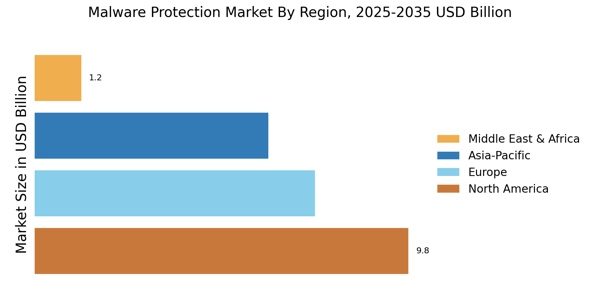
North America remains the largest market for malware protection, accounting for approximately 40% of the global share. The region's growth is driven by increasing cyber threats, stringent regulatory frameworks, and a high adoption rate of advanced security solutions. The demand for comprehensive cybersecurity measures is further fueled by the rise in remote work and digital transformation initiatives across various sectors. The United States is the leading country in this market, with major players like Symantec, McAfee, and Fortinet headquartered there. Canada follows as the second-largest market, benefiting from similar trends in cybersecurity awareness and regulatory compliance. The competitive landscape is characterized by continuous innovation and partnerships among key players to enhance their service offerings and address evolving threats.

Europe : Regulatory Focus

Europe is witnessing significant growth in the malware protection market, holding approximately 30% of the global share. The region's growth is propelled by stringent regulations such as the General Data Protection Regulation (GDPR) and increasing awareness of cybersecurity threats among businesses and consumers. The demand for robust malware protection solutions is further enhanced by the rise in cyberattacks targeting critical infrastructure and personal data. Leading countries in this market include Germany, the UK, and France, with a strong presence of key players like Kaspersky Lab and Bitdefender. The competitive landscape is marked by a focus on compliance and innovation, as companies strive to meet regulatory requirements while providing effective solutions. The collaboration between public and private sectors is also crucial in enhancing cybersecurity measures across the region.

Asia-Pacific : Emerging Market Potential

Asia-Pacific is emerging as a significant player in the malware protection market, accounting for approximately 25% of the global share. The region's growth is driven by rapid digitalization, increasing internet penetration, and a surge in cyber threats. Governments are also implementing regulations to enhance cybersecurity frameworks, which further stimulates market demand for malware protection solutions. Countries like Japan, China, and India are at the forefront of this growth, with a mix of local and international players like Trend Micro and ESET competing in the market. The competitive landscape is characterized by a focus on innovation and tailored solutions to meet the diverse needs of businesses across various sectors. As organizations increasingly recognize the importance of cybersecurity, investments in malware protection are expected to rise significantly.

Middle East and Africa : Growing Awareness

The Middle East and Africa region is gradually developing its malware protection market, holding about 5% of the global share. The growth is driven by increasing awareness of cybersecurity threats and the need for robust protection measures across various sectors. Governments are beginning to implement regulations aimed at enhancing cybersecurity, which is expected to catalyze market growth in the coming years. Leading countries in this region include South Africa, the UAE, and Saudi Arabia, where the presence of key players like Sophos and Fortinet is notable. The competitive landscape is evolving, with a focus on local partnerships and tailored solutions to address specific regional challenges. As businesses increasingly prioritize cybersecurity, the demand for effective malware protection solutions is anticipated to rise significantly.

Malware Protection Market Regional Image

Key Players and Competitive Insights

Leading market players are investing heavily in research and development in order to expand their product lines, which will help the Malware Protection Market grow even more. Market participants are also undertaking a variety of strategic activities to expand their footprint, with important market developments including new product launches, contractual agreements, mergers and acquisitions, higher investments, and collaboration with other organizations. To expand and survive in a more competitive and rising market climate, the Malware Protection industry must offer cost-effective items.

Manufacturing locally to minimize operational costs is one of the key business tactics used by manufacturers in the Malware Protection industry to benefit clients and increase the market sector. In recent years, the Malware Protection industry has offered some of the most significant advantages to technology. Major players in the Malware Protection Market include Broadcom. Inc., Intel Corporation, Bitdefender SRL, SentinelOne. Inc., FireEye. Inc., Kaspersky Lab, Akaimai Technologies Inc., Sophos Group PLC (Thoma Bravo), Trend Micro. Inc., Zscaler. Inc., Malwarebytes. Inc., McAfee. LLC, Symantec Corporation, Trend Micro Incorporated, IBM Corporation, Thales, Morphisec Ltd., Datto.

Inc., Veritas, Acronis International GmbH, CyberArk Software Ltd., and others are attempting to increase market demand by investing in research and development operations.

Intel Corporation is a worldwide corporation and technology company based in Santa Clara, California, and registered in Delaware. Companies develop revolutionary technology that enhances everyone's quality of life on the earth. Silicon Valley is where Intel placed its silicon. Intel is using its resources, reach, and scale to help its customers take full advantage of the potential of digital technology today. In January 2023, Chipmaker Intel and Cyber security company Check Point Software Technologies expanded their previous partnership to provide hardware-level defense against ransomware, which is currently one of the most prevalent security threats.

Akamai Technologies, Inc. is an American firm that offers content delivery network (CDN), cybersecurity, DDoS mitigation, and cloud services. Cambridge, Massachusetts, is home to Akamai's headquarters. The company's massively distributed edge and cloud platform, Akamai Connected Cloud, makes it simple for enterprises to create and manage workloads and applications while bringing experiences closer to people and putting dangers farther away. In June 2022, To protect online apps and APIs from malicious uploads, Akamai Technologies, Inc. announced the release of its Malware Protection Market service.

By detecting and preventing malware at the network edge, Akamai's most recent product improves its already excellent Web Application and API Protection (WAAP) services. By using this proactive measure, dangerous software is stopped before it may inadvertently damage the target systems and isn't allowed to activate and spread throughout the network.

Key Companies in the Malware Protection Market market include

Industry Developments

September 2023: Zscaler, Inc. revealed a partnership with CrpowdStrike and Imprivata to offer medical institutions a zero-trust cybersecurity solution for the device to the cloud. Zscaler's recent integration with the Imprivata Digital Identity Platform offers visibility, threat prevention, and traceability for end-to-end, multi-user, shared device access management, helping organizations comply with regulatory requirements.

June 2023: Libyan Spider, a platform that specializes in cloud hosting, and Monarx partnered to introduce cutting-edge malware prevention into the Libyan Spider ecosystem. Through this partnership, Monarx provides the platform with highly scalable signatureless scanning technology.

Future Outlook

Malware Protection Market Future Outlook

The Malware Protection Market is projected to grow at an 18.0% CAGR from 2024 to 2035, driven by increasing cyber threats, regulatory compliance, and technological advancements.

New opportunities lie in:

  • Development of AI-driven malware detection systems
  • Expansion of subscription-based security services
  • Integration of malware protection in IoT devices

By 2035, the market is expected to be robust, reflecting substantial growth and innovation.

Market Segmentation

Malware Protection Market Component Outlook

  • Solutions
  • Services

Malware Protection Market Deployment Outlook

  • Cloud
  • On-Premise

Malware Protection Market Application Outlook

  • Endpoint Protection
  • Network Protection
  • Database Protection
  • Web Protection
  • Email Protection

Malware Protection Market Industry Vertical Outlook

  • BFSI
  • IT & Telecom
  • Government & Defense
  • Retail
  • Education
  • Healthcare & Life Sciences
  • Others

Malware Protection Market Organization Size Outlook

  • SMEs
  • Large Enterprises

Report Scope

MARKET SIZE 202424.6(USD Billion)
MARKET SIZE 202529.03(USD Billion)
MARKET SIZE 2035151.96(USD Billion)
COMPOUND ANNUAL GROWTH RATE (CAGR)18.0% (2024 - 2035)
REPORT COVERAGERevenue Forecast, Competitive Landscape, Growth Factors, and Trends
BASE YEAR2024
Market Forecast Period2025 - 2035
Historical Data2019 - 2024
Market Forecast UnitsUSD Billion
Key Companies ProfiledMarket analysis in progress
Segments CoveredMarket segmentation analysis in progress
Key Market OpportunitiesIntegration of artificial intelligence enhances threat detection in the Malware Protection Market.
Key Market DynamicsRising cyber threats drive demand for advanced malware protection solutions and regulatory compliance across various sectors.
Countries CoveredNorth America, Europe, APAC, South America, MEA

Leave a Comment

FAQs

What is the current valuation of the Malware Protection Market?

As of 2024, the Malware Protection Market was valued at 24.6 USD Billion.

What is the projected market size for the Malware Protection Market by 2035?

The market is expected to reach a valuation of 151.96 USD Billion by 2035.

What is the expected CAGR for the Malware Protection Market during the forecast period?

The expected CAGR for the Malware Protection Market from 2025 to 2035 is 18.0%.

Which companies are considered key players in the Malware Protection Market?

Key players include Symantec, McAfee, Trend Micro, Kaspersky Lab, and Bitdefender, among others.

What are the main components of the Malware Protection Market?

The main components are Solutions and Services, each valued at 12.3 USD Billion in 2024.

How is the Malware Protection Market segmented by deployment type?

The market is segmented into Cloud and On-Premise, with valuations of 9.84 USD Billion and 14.76 USD Billion, respectively.

Download Free Sample

Kindly complete the form below to receive a free sample of this Report

Compare Licence

×
Features License Type
Single User Multiuser License Enterprise User
Price $4,950 $5,950 $7,250
Maximum User Access Limit 1 User Upto 10 Users Unrestricted Access Throughout the Organization
Free Customization
Direct Access to Analyst
Deliverable Format
Platform Access
Discount on Next Purchase 10% 15% 15%
Printable Versions