×
Request Free Sample ×

Kindly complete the form below to receive a free sample of this Report

* Please use a valid business email

Leading companies partner with us for data-driven Insights

clients tt-cursor
Hero Background

Manganese Market

ID: MRFR/CnM/6255-CR
111 Pages
Anshula Mandaokar
December 2025

Manganese Market Research Report By Type (High Carbon Ferromanganese, Medium Carbon Ferromanganese, Low Carbon Ferromanganese, Silicon-Manganese, Electrolyte Manganese Metal, Electrolyte Manganese Dioxide), By Manganese Application (Coloring Agent, Oxidizing Agent, Alloying Additive, Polarizer, Others) By Grade (Low Grade Manganese Ore (Below 35% Mn), Medium Grade Manganese Ore (35%-44% Mn), High Grade Manganese Ore (More than 44% Mn), By End Use (Steel, Batteries, Non-Ferrous Alloys, Chemicals, Glass, Others), By Grade X End-Use (Low Grade... read more

Share:
Download PDF ×

We do not share your information with anyone. However, we may send you emails based on your report interest from time to time. You may contact us at any time to opt-out.

Manganese Market Infographic
Purchase Options

Manganese Market Summary

As per Market Research Future analysis, the Global Manganese Market Size was estimated at 9792.09 USD Million in 2024. The Genset industry is projected to grow from 10456.97 USD Million in 2025 to 18007.78 USD Million by 2035, exhibiting a compound annual growth rate (CAGR) of 5.6 % during the forecast period 2025 - 2035.

Key Market Trends & Highlights

The Manganese Market is experiencing robust growth driven by the rising demand from the steel industry continues to drive market growth, as manganese remains an essential alloying element for improving steel strength, hardness, and durability. The expanding construction, automotive, and infrastructure sectors are significantly boosting consumption.

  • Increasing use of manganese in battery technologies, particularly in lithium-ion and emerging lithium-manganese-iron-phosphate (LMFP) chemistries, is accelerating market expansion. The rapid growth of electric vehicles (EVs) and energy storage systems (ESS) is creating new long-term demand opportunities.
  • High production and operational costs, coupled with supply-chain fluctuations, remain major restraints for the market. Variability in ore quality, mining logistics, and price volatility in key producing countries can impact profitability and supply stability.
  • Growing adoption of high-purity manganese products, driven by heightened environmental policies, stricter emission regulations, and rising demand for cleaner energy technologies. This shift is strengthening investment in refining and production of high-purity manganese sulfate (HPMSM) for battery applications.
  • Technological advancements in mining automation, AI-enabled resource estimation, and process optimization are supporting higher production efficiency. The integration of digital tools across mining and processing operations is improving ore recovery rates, lowering operational risks, and enabling sustainable manganese extraction.

Market Size & Forecast

2024 Market Size 9792.09 (USD Million)
2035 Market Size 18007.78 (USD Million)
CAGR (2025 - 2035) 5.6 %

Major Players

Eramet, South32, MOIL Limited, Jupiter Mines, LHG Mining, OM Holdings Limited, United Manganese of Kalahari, Assmang Proprietary Limited, Anglo American, and AML Holdings LLC.

Manganese Market Trends

Manganese Market Trends

The Manganese Market is undergoing a major transformation, driven by the rapid expansion of the steel industry, advancements in battery technologies, and rising industrial demand worldwide. As global infrastructure development accelerates and the automotive and construction sectors continue to grow, the need for high-quality manganese as a critical alloying element in steelmaking is increasing significantly. Manganese’s essential role in improving steel durability, hardness, and wear resistance makes it indispensable across manufacturing, heavy engineering, transportation, and structural applications. A substantial shift is also taking place in the energy storage landscape. With the rise of electric vehicles (EVs), grid-scale storage systems, and clean energy initiatives, high-purity manganese sulfate (HPMSM) is witnessing strong demand. The growing adoption of lithium-ion and advanced LMFP battery chemistries is positioning manganese as a crucial material for next-generation battery performance, cost-efficiency, and safety. This transition toward energy-efficient and sustainable technologies is reshaping consumption patterns across the global manganese value chain.

Technological progress across mining and processing operations is further influencing market direction. Automation, AI-driven mineral exploration, and advanced refining technologies are enabling better ore recovery, enhanced product purity, and reduced operational costs. These innovations are allowing producers to increase output while maintaining stricter environmental and quality standards. As sustainability expectations rise, manganese mining companies are also adopting greener extraction practices and investing in low-emission, energy-efficient production methods. Furthermore, global supply chain diversification and strategic resource security initiatives are impacting the manganese market. Countries are increasingly focusing on localized supply, vertical integration, and long-term agreements to ensure stable access to manganese—especially high-purity grades needed for battery manufacturing. This trend is contributing to a broader push toward energy independence, material resilience, and reduced reliance on limited geographic sources of high-grade ore. Overall, the Manganese Market is positioned for substantial expansion, driven by industrial growth, technological innovation, the accelerating shift toward electrification, and rising demand for high-performance materials across modern applications.

Increased Demand for Customization

Manufacturers and end-users are increasingly seeking manganese products tailored to specific applications—whether for steel alloys, specialty chemicals, or battery-grade materials. This includes customized purity levels, particle sizes, and processing specifications to meet diverse industrial, automotive, and energy storage performance requirements.

Focus on Sustainability and Emissions Compliance

With stricter mining regulations and growing environmental awareness, companies are prioritizing sustainable manganese extraction, low-emission processing technologies, and eco-friendly refining methods. This trend reflects the rising importance of carbon reduction, responsible sourcing, and compliance with global sustainability standards in the manganese supply chain.

Integration with Smart & Emerging Technologies

The Manganese Market is seeing increased integration of advanced technologies—such as AI-enabled exploration, automated ore sorting, digital monitoring of mining operations, and data-driven process optimization. These innovations enhance operational efficiency, reduce waste, improve ore recovery, and support real-time decision-making, aligning with the industry's push toward smarter, more resilient production systems.

Manganese Market Drivers

Rising Steel Production

The global steel industry continues to be one of the most critical pillars of industrial development, with crude steel production reaching 1,884.6 million tonnes in 2024. Despite short-term fluctuations driven by economic cycles, energy prices, and regional geopolitical pressures, steel remains indispensable across construction, infrastructure, automotive, machinery, shipbuilding, and energy sectors. Emerging economies—particularly India, Southeast Asia, the Middle East, and parts of Africa—are experiencing strong urbanization-led demand, while developed markets focus on modernization, green energy systems, and manufacturing reshoring. Even with minor declines in some regions, the broader structural demand for steel remains stable due to global investments in transportation networks, renewable power installations, industrial capacity expansion, and housing. As steel consumption grows and evolves, the need for high-quality alloying materials becomes increasingly important to achieve performance, durability, and efficiency targets in end-use applications. long-term supply strategies.

Manganese plays an indispensable role in the global steelmaking value chain, making it one of the most strategically significant industrial metals. Around 85–90% of all manganese produced globally is consumed by the steel industry in the form of ferromanganese, silicomanganese, and other refining alloys. Manganese is critical for steel deoxidation, desulphurization, and alloying, enhancing tensile strength, toughness, wear resistance, and hardenability. Without manganese, large-scale steel production would be technically and economically unfeasible, as it prevents hot shortness and allows impurities to be effectively controlled during smelting. The shift toward higher-strength, specialty, and low-carbon steels further increases reliance on manganese alloys. As electric arc furnace (EAF) capacity expands globally—particularly in India, the U.S., Türkiye, and Europe—the demand for manganese will continue to scale, since EAF scrap melting requires significant manganese additions. Overall, rising steel production and the evolving steel grade mix firmly position manganese as a critical input material in the global metallurgical and industrial ecosystem.

Rising Global Ev Adoption

The rapid expansion in global EV sales remains the strongest structural force driving manganese consumption, especially for high-purity manganese sulfate used in cathode materials. Between 2023 and 2024, China continued to dominate with BEV sales rising from 5.4 million to 6.4 million and PHEVs surging from 2.7 million to 4.9 million, creating immense pressure on battery mineral supply chains. Europe maintained stable BEV sales at 2.2 million, while the US market grew moderately from 1.1 to 1.2 million BEVs. Rest-of-world markets also expanded, from 0.8 to 1.0 million BEVs and 0.2 to 0.3 million PHEVs, broadening global manganese demand geographically. This rising EV penetration directly increases manganese deployment in batteries. According to Adamas Intelligence, global manganese deployed in EV batteries reached 19,131 tonnes in Q3 2023 (up 30% YoY), and 7,048 tonnes in Nov 2023 alone (up 23% YoY). This reflects unprecedented scaling of manganese-rich cathodes in global EV production. Although average manganese per battery is falling, total manganese consumption continues rising sharply because of rapidly increasing EV volumes.

As global EV sales surpassed 15 million units in 2024, the cumulative demand for battery-grade manganese has moved from a niche component to one of the most strategically important minerals for the clean mobility transition. Manganese is an essential stabilizing component in several major EV battery chemistries, including Nickel–Manganese–Cobalt (NMC) and Lithium Manganese Oxide (LMO), while also gaining importance in emerging chemistries such as LMFP (Lithium Manganese Iron Phosphate) and high-manganese NMx formulations. These chemistries together accounted for tens of thousands of tonnes of manganese deployment in EVs in 2023–2024. Adamas Intelligence data shows manganese in the average EV battery stood at ~2.7 kg from Jan–Apr 2025, with BEVs averaging ~4.2 kg, despite an 18–21% annual decline due to rising LFP adoption. Yet total manganese use grew because EV production volumes rose significantly. \

Technologically, manganese improves thermal stability, enhances structural integrity of cathodes, and supports cost-effective high-energy chemistries that reduce reliance on cobalt. LMFP—an advanced derivative of LFP—achieves higher energy density by integrating manganese, enabling automakers to competitively position mid-range EVs. SFA Oxford estimates LMFP cathodes may require 50–60 kg of manganese per vehicle in their active material, making them strategically important for mass-market EVs. As battery manufacturers scale output for grid storage, two-wheeler electrification, and cost-sensitive EV segments, manganese remains central to cathode innovation and global supply-chain planning. High-manganese cathode technologies are emerging as a pivotal enabler of global EV affordability, safety, and performance. These chemistries reduce dependence on expensive cobalt and geopolitically sensitive nickel while offering improved thermal stability—an essential requirement as EVs transition toward longer range and ultra-fast charging. As the mass-market EV segment expands, OEMs are increasingly shifting toward manganese-rich cathodes that offer competitive energy density at lower cost. This shift aligns with global EV adoption patterns, where annual EV sales grew beyond 15 million units in 2024, driven heavily by China’s BEV and PHEV boom.

Growing Demand In Green Steel Initiatives

The global steel industry is under unprecedented pressure to decarbonize, and this directly enhances the strategic relevance of manganese. In 2024, every tonne of steel produced emitted an average of 2.18 tonnes of CO₂e, with total sector emissions reaching 4.1 billion tonnes CO₂e, accounting for 7–8% of global anthropogenic GHG emissions. The traditional BF–BOF route, which still dominates global steelmaking, emits 2.66 t CO₂e per tonne, far higher than Scrap–EAF (0.71 t) or DRI–EAF (1.66 t). Green steel initiatives seek to reduce these emissions through low-carbon ironmaking, renewable-powered electric arc furnaces, hydrogen-based DRI, and enhanced recycling.

In all these pathways, manganese becomes increasingly essential as a performance-enabling alloy. High-manganese steels offer enhanced strength, ductility, and wear resistance, allowing steelmakers to maintain or improve mechanical properties while transitioning to green production routes. Moreover, as scrap usage rises in EAF-based green steel, manganese additions are required to correct chemistry and compensate for impurities. Therefore, the shift from carbon-intensive to low-carbon steelmaking processes significantly elevates manganese demand, making it a critical metallurgical ingredient in the global decarbonization roadmap.

Hydrogen-based DRI and renewable electricity-powered EAFs are emerging as cornerstone technologies for green steel, and both rely heavily on manganese to achieve desired metallurgical performance. As the industry moves away from coke-based blast furnaces toward DRI–EAF routes, emissions drop significantly—from 2.66 t CO₂e/tonne (BF–BOF) to 1.66 t CO₂e/tonne (DRI–EAF)—with the potential for near-zero emissions when using green hydrogen and renewable electricity. However, DRI/EAF steelmaking produces different impurity profiles and requires higher alloying additions to reach the mechanical performance of BF–BOF steel. Manganese plays a critical role by acting as a deoxidizer, desulfurizer, and strengthening alloy, making it indispensable for producing high-quality green steel.

Market Segment Insights

By Application: Alloying Additive (Largest) vs. Polarizer (Fastest-Growing)

In terms of application, the Manganese Market reflects distinct usage patterns. Alloying Additives hold the largest market share due to their widespread use in steel manufacturing, automotive components, construction materials, and industrial alloys. Their importance in strengthening, hardening, and improving corrosion resistance drives large-scale adoption. Meanwhile, Polarizer applications are the fastest-growing segment, supported by the expanding electronics and renewable energy sectors, where manganese-based polarizers are used in displays, batteries, and optical devices.

Alloying Additive (Dominant) vs. Polarizer (Emerging)   

Alloying Additives dominate the market due to massive demand from steel and industrial production. Polarizers are emerging rapidly as consumer electronics, energy storage solutions, and display technologies expand globally.

By Grade: High Grade Manganese Ore (Largest) vs. Low Grade Manganese Ore (Fastest-Growing)

In the grade segment, High Grade Manganese Ore (more than 44% Mn) accounts for the largest share because of its high efficiency, superior metallurgical properties, and preference in steelmaking and battery-grade production. Low Grade Manganese Ore (below 35% Mn) is the fastest-growing segment, driven by rising beneficiation technologies, cost-effective production, and growing demand in chemical and fertilizer industries.

High Grade (Dominant) vs. Low Grade (Emerging)  

High Grade Ore dominates the market due to its superior quality and suitability for high-performance applications. Low Grade Ore is emerging as improved processing techniques make it viable across new industrial and chemical applications.

By End Use Industry: Steel (Largest) vs. Batteries (Fastest-Growing)

The end-use segment shows clear differentiation in demand patterns. The steel industry holds the largest share, as manganese is a critical alloying element used to enhance strength, toughness, and wear resistance in steel production. Its integral role in infrastructure, construction, and automotive applications drives consistent demand. In contrast, the battery industry is the fastest-growing segment, fueled by accelerating adoption of lithium-ion and next-generation manganese-rich batteries for electric vehicles, grid storage, and consumer electronics.

Steel (Dominant) vs. Batteries (Emerging)   

The steel sector dominates the Manganese Market due to long-standing, large-scale usage. The battery sector is emerging rapidly as global electrification trends and renewable energy storage create substantial new opportunities.

Get more detailed insights about Manganese Market

Regional Insights

North America: Mature Market with Stable Industrial Demand

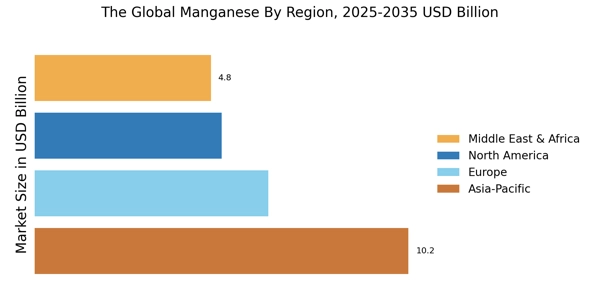
North America accounts for approximately 26% of the global Manganese Market and is characterized by mature, steady demand driven by the steelmaking, industrial manufacturing, and advanced battery materials sectors. The United States dominates the regional market, followed by Canada, supported by well-established steel producers, automotive manufacturers, and growing interest in high-purity manganese for EV battery applications. While traditional manganese consumption remains tied to alloy production, the region is increasingly shifting toward high-purity manganese sulfate (HPMSM) for energy storage technologies. Environmental regulations and sustainability commitments are pushing manufacturers toward cleaner mining and processing techniques. Overall, North America remains a stable and technology-forward market with consistent investment in material innovation and supply-chain resilience.

Europe: Balanced Market Influenced by Regulatory Standards

Europe holds around 20% of the global Manganese Market, with growth driven by steel production, automotive manufacturing, renewable energy expansion, and rising demand for battery-grade manganese. Countries such as Germany, the UK, and France lead the region, supported by strong industrial ecosystems and increasing investments in EV manufacturing and battery gigafactories. Strict environmental and mining regulations are shaping market behavior, encouraging the adoption of sustainable extraction techniques, recycling initiatives, and advanced processing technologies. While Europe maintains a stable market base, the region’s focus on reducing carbon emissions and strengthening domestic battery supply chains is accelerating interest in high-purity manganese materials.

Asia-Pacific: Largest & Fastest-Growing Region

Asia-Pacific is the largest and fastest-growing region, accounting for roughly 40% of the global Manganese Market. The region’s expansion is driven by rapid industrialization, massive infrastructure development, and the dominance of global steel production—particularly in China and India. China is the world’s largest consumer and producer of manganese, while India continues to expand its steel and battery manufacturing capacities. The region also plays a critical role in the EV supply chain, with increasing investments in high-purity manganese sulfate for battery cathode production. Japan, South Korea, Indonesia, and Australia contribute significantly through mining, processing, and manufacturing operations. Strong demand across construction, automotive, heavy machinery, and energy storage sectors ensures Asia-Pacific remains the primary hub for global manganese consumption and production.

Middle East & Africa: Emerging Market with Strong Resource Potential

The Middle East & Africa accounts for about 12% of the global Manganese Market and is emerging as a key supplier and growth region due to abundant mineral resources and expanding industrial sectors. South Africa is one of the world’s largest producers of manganese ore, playing a pivotal role in global supply. The region’s market growth is supported by mining activities, steel production, infrastructure development, and increased export demand. Countries in the Middle East, including the UAE and Saudi Arabia, are also investing in advanced materials and industrial diversification, contributing to rising manganese consumption. Off-grid mining operations, resource-rich environments, and increasing foreign investments drive opportunities for both extraction and processing. As infrastructure and industrialization advance across the region, the demand for manganese—especially for steel and battery applications—is expected to strengthen significantly.

Manganese Market Regional Image

Key Players and Competitive Insights

Key Players and Competitive Insights

The global manganese market is characterized by a moderately concentrated competitive landscape, where a limited number of resource-rich regions dominate the supply of manganese ore, giving these areas a strategic advantage in the industry. These regions are not only endowed with abundant manganese deposits but also benefit from favorable geological conditions and established mining infrastructure, which allow them to maintain a steady and cost-effective production of both low- and high-grade ores. This natural advantage ensures that certain countries consistently hold significant influence over the global manganese supply, affecting both price trends and long-term market stability. Beyond raw ore production, the market is increasingly shaped by sophisticated downstream players who focus on the development and supply of value-added manganese products, including high-purity electrolytic manganese metal, battery-grade manganese compounds, and specialized manganese alloys. These downstream players often differentiate themselves through advanced technologies, quality control, and customized solutions for industrial applications, which include steelmaking, electronics, energy storage, chemical & others.

Refining and processing capacity for manganese is gradually becoming more geographically diversified, as new facilities are established in regions with growing industrial demand. Despite this expansion, established industrial hubs continue to dominate the production of high-purity manganese metal and specialized compounds. Advanced refining processes, such as electrolytic and chemical methods, allow producers to achieve high levels of purity and performance, meeting the stringent requirements of applications in battery technology and high-performance alloys. Competition in the market is therefore not limited to the sheer volume of mined ore but extends to technological capabilities, process efficiency, and the ability to produce low-impurity, high-performance manganese products. Companies increasingly invest in research and development to improve energy efficiency, reduce environmental impact, and enhance product quality, reflecting the growing importance of innovation as a competitive differentiator. Strategic considerations also play a critical role in market positioning. Long-term supply agreements, partnerships with end-users, and investments in emerging sectors, particularly the electric vehicle and renewable energy industries, are becoming key factors in maintaining a competitive edge. Producers that can secure stable and reliable demand from these rapidly growing markets are better positioned to mitigate price volatility and market uncertainty. At the same time, external factors such as geopolitical risks, infrastructure limitations, regulatory changes, and environmental policies significantly influence how manganese producers operate and expand globally. 

Many of these factors are tied to the classification of manganese as a critical mineral, which subjects its production and trade to closer scrutiny by governments seeking to ensure supply chain security. Producers must navigate complex international regulations, tariffs, and environmental compliance requirements while simultaneously meeting the growing global demand for sustainable and ethically sourced manganese products.  Overall, the competitive landscape of the global manganese market is defined by a combination of natural resource distribution, technological capability, strategic market positioning, and regulatory dynamics.

Key Companies in the Manganese Market market include

Industry Developments

  • In 2025, Eramet advanced its high-purity manganese sulfate (HPMSM) production initiatives, completing pilot-scale qualification for EV battery applications and partnering with European battery manufacturers to secure long-term supply agreements.
  • In 2025, South32 implemented a major sustainability upgrade at its Australian Manganese operations, integrating renewable energy and low-carbon processing technologies to reduce its carbon footprint and align with global decarbonization targets.
  • In 2025, OM Holdings Limited expanded its manganese alloy capacity in Malaysia, introducing energy-efficient furnaces designed to reduce operational costs and meet tightening global emission regulations.

Future Outlook

Manganese Market Future Outlook

The Manganese Market is projected to grow at a CAGR of around 5.6% from 2024 to 2035, driven by expanding steel production, rapid industrialization, and the accelerating adoption of manganese-based battery materials for electric vehicles and energy storage systems. The rising emphasis on clean energy technologies, sustainable mining practices, and high-purity manganese sulfate (HPMSM) development is reshaping market opportunities across the value chain.

New opportunities lie in:

  • Growing demand for high-purity manganese sulfate (HPMSM) for lithium-ion and advanced LMFP battery chemistries, driven by the global shift toward electric mobility and renewable energy storage.

  • Increasing investment in sustainable and low-emission manganese extraction and processing technologies, enabling companies to meet stringent environmental regulations and reduce operational carbon footprints.

  • Advancements in automation, digital mining, and AI-driven ore processing, which allow producers to improve yield, optimize resource utilization, enhance safety, and lower production costs.

  • Expansion into value-added manganese products, including refined alloys, specialty chemicals, and battery-grade materials, particularly in regions developing domestic supply chains for EV and energy-storage manufacturing.

By 2035, the Manganese Market is expected to evolve into a core pillar of global industrial and clean-energy ecosystems, supporting high-performance steel production, next-generation battery technologies, large-scale infrastructure development, and sustainable material supply chains across key regions worldwide.

Market Segmentation

Manganese Type Outlook

  • High Carbon Ferromanganese
  • Medium Carbon Ferromanganese
  • Low Carbon Ferromanganese
  • Silicon-Manganese
  • Electrolyte Manganese Metal
  • Electrolyte Manganese Dioxide

Manganese Grade Outlook

  • Low Grade Manganese Ore (Below 35% Mn)
  • Medium Grade Manganese Ore (35%-44% Mn)
  • High Grade Manganese Ore (More than 44% Mn)

Manganese Application Outlook

  • Coloring Agent
  • Oxidizing Agent
  • Alloying Additive
  • Polarizer
  • Others

Manganese End Use Industry Outlook

  • Steel
  • Batteries
  • Non-Ferrous Alloys
  • Chemicals
  • Glass
  • Others

Manganese Grade X End-Use Industry Outlook

  • Low Grade Manganese Ore (Below 35% Mn)
  • Medium Grade Manganese Ore (35%-44% Mn)
  • High Grade Manganese Ore (More than 44% Mn)

Report Scope

Market Size 2024

9792.09 (USD Million)

Market Size 2025

10456.97 (USD Million)

Market Size 2035

18007.78 (USD Million)

Compound Annual Growth Rate (CAGR)

5.6 % (2025 - 2035)


Report Coverage

Revenue Forecast, Competitive Landscape, Growth Factors, and Trends

Base Year

2024

Market Forecast Period

2025 - 2035

Historical Data

2019 - 2024

Market Forecast Units

USD Million

Key Companies Profiled

Eramet, South32, MOIL Limited, Jupiter Mines, LHG Mining, OM Holdings Limited, United Manganese of Kalahari, Assmang Proprietary Limited, Anglo American, and AML Holdings LLC.

Segments Covered

By Type, By Application, By Grade, By End Use Industry, By Grade X End-Use Industry

Key Market Opportunities

Development of high-purity low-carbon ferroalloys for advanced steels; High-Manganese Battery Cathodes; Expansion of Value-Added Manganese Products

Key Market Dynamics

Rising Steel Production; Growing Demand in Green Steel Initiatives; Mining Expansion in Africa & Latin America; Rising Global EV Adoption

Countries Covered

North America, Europe, APAC, South America, MEA

Market Highlights

Author
Anshula Mandaokar
Team Lead - Research

Anshula Mandaokar holds an academic degree in Chemical Engineering and has been contributing to the field for more than 5 years. She has expertise in Market Research and Business Consulting and serves as a Team Lead for a reputed Market Research firm under the Chemicals and Materials domain spectrum. She has worked on multiple projects, generating explicit results in a quick turnaround time. Her understanding of data interpretation justifies her role as a leader.

Leave a Comment

FAQs

What is the current valuation of The Global Manganese as of 2024?

The Global Manganese was valued at 9792.09 USD Billion in 2024.

What is the projected market valuation for The Global Manganese in 2035?

The market is projected to reach a valuation of 18007.78 USD Billion by 2035.

What is the expected CAGR for The Global Manganese during the forecast period 2025 - 2035?

The expected CAGR for The Global Manganese during the forecast period 2025 - 2035 is 5.6%.

Who are the key players in The Global Manganese?

Key players in the market include Groupe Eramet, South32, Assmang, Vale S.A., Manganese Metal Company, Tshipi é Ntle Manganese Mining, OM Holdings Ltd, and Ferroglobe PLC.

What are the main segments of The Global Manganese by type?

The main segments by type include High Carbon Ferromanganese, Medium Carbon Ferromanganese, Low Carbon Ferromanganese, Silico-Manganese, Electrolyte Manganese Metal, and Electrolyte Manganese Dioxide.

What is the valuation range for High Carbon Ferromanganese in 2025?

The valuation range for High Carbon Ferromanganese is projected to be between 10.0 and 17.0 USD Billion.

Download Free Sample

Kindly complete the form below to receive a free sample of this Report

Compare Licence

×
Features License Type
Single User Multiuser License Enterprise User
Price $4,950 $5,950 $7,250
Maximum User Access Limit 1 User Upto 10 Users Unrestricted Access Throughout the Organization
Free Customization
Direct Access to Analyst
Deliverable Format
Platform Access
Discount on Next Purchase 10% 15% 15%
Printable Versions