×
Request Free Sample ×

Kindly complete the form below to receive a free sample of this Report

* Please use a valid business email

Leading companies partner with us for data-driven Insights

clients tt-cursor
Hero Background

Manufacturing Sector Market

ID: MRFR/Equip/65442-HCR
200 Pages
Garvit Vyas
December 2025

Manufacturing Sector Market Research Report Information By End Use (Consumer Goods, Industrial Equipment, Construction Materials, Medical Devices), By Technology (Automation Technology, Robotics Technology, 3D Printing Technology, Computer Numerical Control Technology), By Application (Automotive Manufacturing, Aerospace Manufacturing, Electronics Manufacturing, Machinery Manufacturing), By Process Type (Additive Manufacturing, Subtractive Manufacturing, Forming Processes, Casting Processes), By Material Type (Metals, Plastics, Composites, Ceramics) and By Regional - Forecast to 2035

Share:
Download PDF ×

We do not share your information with anyone. However, we may send you emails based on your report interest from time to time. You may contact us at any time to opt-out.

manufacturing sector Market Infographic
Purchase Options

Manufacturing Sector Market Summary

As per MRFR analysis, the Manufacturing Sector market was estimated at 20000.0 USD Billion in 2024. The manufacturing industry is projected to grow from 20750.0 USD Billion in 2025 to 30000.0 USD Billion by 2035, exhibiting a compound annual growth rate (CAGR) of 3.75 during the forecast period 2025 - 2035.

Key Market Trends & Highlights

The manufacturing sector market is currently experiencing a transformative shift towards smart technologies and sustainability.

  • The adoption of smart manufacturing technologies is reshaping operational efficiencies across various industries.
  • Sustainability initiatives are becoming increasingly critical, particularly in North America, as companies strive for eco-friendly practices.
  • Resilience in supply chains is a focal point, especially in the Asia-Pacific region, where rapid growth is observed.
  • Technological advancements and rising demand for customization are driving growth in automotive manufacturing and medical devices segments.

Market Size & Forecast

2024 Market Size 20000.0 (USD Billion)
2035 Market Size 30000.0 (USD Billion)
CAGR (2025 - 2035) 3.75%

Major Players

General Electric (US), Siemens (DE), Honeywell (US), Boeing (US), 3M (US), Caterpillar (US), ABB (CH), Rockwell Automation (US), Schneider Electric (FR), Hitachi (JP)

Our Impact
Enabled $4.3B Revenue Impact for Fortune 500 and Leading Multinationals
Partnering with 2000+ Global Organizations Each Year
30K+ Citations by Top-Tier Firms in the Industry

Manufacturing Sector Market Trends

The manufacturing sector market is currently experiencing a transformative phase characterized by rapid technological advancements and evolving consumer demands. Automation and digitalization are reshaping production processes, leading to enhanced efficiency and reduced operational costs. Companies are increasingly adopting smart manufacturing practices, integrating Internet of Things (IoT) devices and artificial intelligence (AI) to optimize supply chains and improve product quality. This shift not only streamlines operations but also fosters innovation, enabling manufacturers to respond swiftly to market changes and consumer preferences. Moreover, sustainability has emerged as a pivotal focus within the manufacturing sector market. Organizations are prioritizing eco-friendly practices, seeking to minimize their environmental footprint while meeting regulatory requirements. This trend is driving investments in renewable energy sources and sustainable materials, as manufacturers aim to align with global sustainability goals. As the landscape continues to evolve, the manufacturing sector market appears poised for growth, with companies that embrace these changes likely to gain a competitive edge in the future.

Adoption of Smart Manufacturing

The manufacturing sector market is witnessing a significant shift towards smart manufacturing. This trend involves the integration of advanced technologies such as IoT and AI into production processes. By leveraging these technologies, manufacturers can enhance operational efficiency, reduce waste, and improve product quality. The focus on data-driven decision-making is likely to reshape traditional manufacturing paradigms.

Sustainability Initiatives

Sustainability has become a central theme in the manufacturing sector market. Companies are increasingly adopting eco-friendly practices to reduce their environmental impact. This includes the use of renewable energy sources, sustainable materials, and waste reduction strategies. As consumers become more environmentally conscious, manufacturers that prioritize sustainability may enhance their brand reputation and customer loyalty.

Resilience in Supply Chains

The manufacturing sector market is also focusing on building resilient supply chains. Companies are recognizing the importance of flexibility and adaptability in their operations. By diversifying suppliers and investing in technology, manufacturers aim to mitigate risks associated with supply chain disruptions. This trend suggests a proactive approach to ensuring continuity and reliability in production.

Market Segment Insights

By Application: Automotive Manufacturing (Largest) vs. Aerospace Manufacturing (Fastest-Growing)

The automotive manufacturing sector holds the largest market share within the application segment of the manufacturing market, attributable to the high demand for vehicles and rapid advancements in automotive technologies. The growth of electric vehicles and sustainable manufacturing practices are further solidifying its position. In contrast, aerospace manufacturing, while smaller in market share, is recognized as the fastest-growing segment, driven by rising air travel demand and technological innovations in aircraft design and production processes.

Automotive Manufacturing (Dominant) vs. Aerospace Manufacturing (Emerging)

Automotive manufacturing operates on a scale significantly larger than aerospace, primarily due to the widespread reliance on both personal and commercial vehicles. Market leaders prioritize efficiency and innovation, integrating advanced robotics and artificial intelligence in production. On the other hand, aerospace manufacturing has gained attention as an emerging vertical, benefiting from increased investments in eco-friendly aviation technologies and rising global air traffic. The vertical faces unique challenges, such as high R&D costs and regulatory compliance, but continues to evolve rapidly, promising potential growth as the aviation industry adapts to new market demands.

By End Use: Consumer Goods (Largest) vs. Medical Devices (Fastest-Growing)

In the manufacturing sector market, the end use segment showcases a diverse distribution across various industries. The consumer goods sector holds the largest market share, driven by a consistent demand for packaged products and household items. This sector's prominence is largely due to its vast range of applications, from food and beverages to personal care products, which continue to sustain its leadership position in the market. On the other hand, the medical devices segment is emerging rapidly as the fastest-growing category. Factors contributing to this surge include an increasing aging population, advancements in healthcare technology, and the rising prevalence of chronic diseases. The demand for innovative medical solutions and devices is propelling this segment's growth, making it a focal point for investment and development within the manufacturing sector.

Consumer Goods (Dominant) vs. Medical Devices (Emerging)

The consumer goods segment represents a dominant force in the manufacturing sector, characterized by its extensive product range that meets everyday needs. This segment benefits from economies of scale, allowing manufacturers to leverage large production volumes to reduce costs and optimize supply chains. Popular trends such as sustainability and eco-friendliness are becoming increasingly important, prompting innovation in product design and materials. In contrast, the medical devices sector is classified as an emerging market segment, showcasing high potential for disruptive technologies and growth. Factors like regulatory shifts and rising healthcare expenditure are driving investments in this segment. The emphasis on quality, safety, and advanced features in medical devices makes this sector distinct, catering to a niche market that prioritizes innovation and precision.

By Process Type: Additive Manufacturing (Largest) vs. Subtractive Manufacturing (Fastest-Growing)

In the manufacturing sector, the market share distribution among various process types showcases the significant dominance of Additive Manufacturing, which is recognized for its ability to create complex geometries and reduce material waste. Following closely, Subtractive Manufacturing has remained a key player, benefiting from its established methodologies and practices. Forming Processes and Casting Processes also play vital roles but contribute lesser shares compared to the leading segments, reflecting specific applications within the market.

Additive Manufacturing (Dominant) vs. Forming Processes (Emerging)

Additive Manufacturing stands out as the dominant process in the current landscape, offering innovative solutions that enable rapid prototyping and customization. This segment is fueled by advancements in materials and technologies, allowing for high precision and low production costs. On the other hand, Forming Processes are emerging as a competitive area, leveraging traditional manufacturing techniques alongside enhanced efficiencies and enhanced material properties. Demand for lightweight materials in industries such as automotive and aerospace is driving the growth of forming processes, indicating a potential shift in market dynamics.

By Material Type: Metals (Largest) vs. Plastics (Fastest-Growing)

The manufacturing sector market exhibits a diverse distribution of material types, predominantly featuring metals, which hold the largest market share due to their applications in construction, automotive, and machinery. In contrast, plastics are rapidly gaining ground, supported by their versatility and compatibility with modern manufacturing technologies. This shift reflects changing consumer preferences toward lighter, more adaptable materials.

Metals (Dominant) vs. Composites (Emerging)

Metals remain the dominant material type in the manufacturing sector, prized for their strength, durability, and recyclability. They are widely used across industries, providing robust solutions for structural and functional components. In comparison, composites are emerging as a notable segment, leveraging innovative materials that combine plastics with fibers to achieve superior performance characteristics. Their light weight and increased resistance to environmental stressors position them favorably for growing applications in industries such as aerospace and automotive, where efficiency and performance are paramount.

By Technology: Automation Technology (Largest) vs. 3D Printing Technology (Fastest-Growing)

In the manufacturing sector, the technology segment showcases a diverse array of innovations. Automation Technology holds a significant share, contributing substantially to operational efficiency. This segment enables manufacturers to streamline production processes through advanced machinery and software, thus leading to enhanced productivity. On the other hand, 3D Printing Technology is emerging rapidly, capturing increased interest as industries recognize its potential for customization and reduced lead times. This innovation is especially transforming sectors like aerospace and healthcare by enabling on-demand production.

Manufacturing Technology: Automation Technology (Dominant) vs. 3D Printing Technology (Emerging)

Automation Technology stands out as the dominant force within the manufacturing sector, characterized by its ability to integrate complex processes and enhance precision. This technology facilitates a seamless flow of production lines, improving overall efficiency and reducing human error. Companies leveraging automation frequently report significant gains in output and quality. Conversely, 3D Printing Technology is seen as the emerging player, offering unique advantages like rapid prototyping and material versatility. This technology empowers manufacturers to create tailor-made components with less material waste, making it increasingly attractive for industries seeking innovation and sustainability.

Get more detailed insights about Manufacturing Sector Market

Regional Insights

North America : Manufacturing Powerhouse

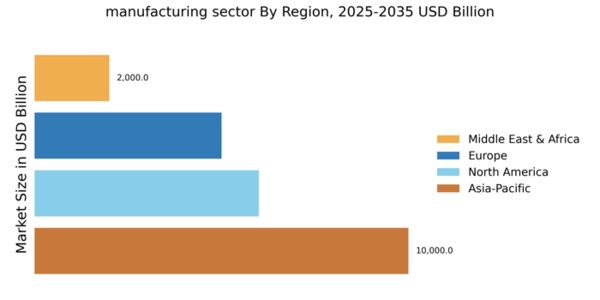
North America is poised for significant growth in the manufacturing sector, driven by technological advancements and a skilled workforce. The region's market size is projected at $6000.0 million, reflecting a robust demand for innovative manufacturing solutions. Regulatory support, including incentives for automation and sustainability, is further catalyzing growth. The focus on reshoring and supply chain resilience is also contributing to the sector's expansion. The United States leads the North American market, with key players like General Electric, Honeywell, and Boeing driving innovation and competitiveness. The presence of advanced manufacturing technologies, such as IoT and AI, enhances operational efficiency. Additionally, the region's strong infrastructure and investment in R&D position it favorably against global competitors, ensuring a dynamic manufacturing landscape.

Europe : Innovation and Sustainability Focus

Europe's manufacturing sector is undergoing a transformation, with a market size of $5000.0 million. The region is focusing on sustainability and digitalization, driven by stringent regulations and consumer demand for eco-friendly products. The European Green Deal and Industry 4.0 initiatives are pivotal in shaping the future of manufacturing, promoting innovation and reducing carbon footprints. This regulatory environment is fostering a shift towards more sustainable practices across industries. Germany, France, and Italy are leading the charge in Europe, with major players like Siemens and Schneider Electric at the forefront. The competitive landscape is characterized by a strong emphasis on R&D and collaboration between industry and academia. The presence of advanced manufacturing technologies, such as robotics and automation, is enhancing productivity and efficiency, positioning Europe as a leader in the global manufacturing arena.

Asia-Pacific : Emerging Manufacturing Hub

Asia-Pacific is the largest manufacturing market globally, with a market size of $10000.0 million. The region's growth is fueled by rapid industrialization, urbanization, and a burgeoning middle class demanding diverse products. Countries like China and India are at the forefront, supported by favorable government policies and investments in infrastructure. The region's focus on technology adoption, including automation and smart manufacturing, is further driving demand and efficiency in production processes. China remains the dominant player in the Asia-Pacific manufacturing landscape, with significant contributions from Japan and South Korea. Key players such as Hitachi and ABB are leveraging advanced technologies to enhance competitiveness. The competitive environment is marked by a mix of large multinational corporations and agile local firms, creating a dynamic ecosystem that fosters innovation and growth in the manufacturing sector.

Middle East and Africa : Emerging Market Potential

The Middle East and Africa (MEA) region is witnessing a gradual growth in the manufacturing sector, with a market size of $2000.0 million. This growth is driven by diversification efforts away from oil dependency, with governments investing in manufacturing as a key economic driver. Initiatives aimed at enhancing local production capabilities and attracting foreign investment are pivotal in shaping the sector's future. The region's young population and increasing urbanization are also contributing to rising demand for manufactured goods. Countries like South Africa and the UAE are leading the way in the MEA manufacturing landscape, with a focus on sectors such as automotive and consumer goods. The presence of key players and investments in technology are enhancing the region's competitiveness. However, challenges such as infrastructure deficits and regulatory hurdles remain, necessitating strategic initiatives to unlock the full potential of the manufacturing sector.

Manufacturing Sector Market Regional Image

Key Players and Competitive Insights

The manufacturing sector market is currently characterized by a dynamic competitive landscape, driven by technological advancements, sustainability initiatives, and a focus on operational efficiency. Major players such as General Electric (US), Siemens (DE), and Honeywell (US) are strategically positioning themselves through innovation and digital transformation. For instance, General Electric (US) has been emphasizing its digital industrial strategy, integrating IoT and AI into its manufacturing processes, which enhances productivity and reduces operational costs. Siemens (DE) continues to invest heavily in automation and smart manufacturing solutions, thereby reinforcing its competitive edge in the European market. Collectively, these strategies not only enhance their market presence but also shape the competitive environment by pushing other players to adopt similar innovations.Key business tactics within the manufacturing sector include localizing production to meet regional demands and optimizing supply chains for greater efficiency. The market structure appears moderately fragmented, with a mix of large multinational corporations and smaller niche players. The influence of key players is substantial, as their strategic initiatives often set industry standards and drive competitive dynamics.
In November Honeywell (US) announced a partnership with a leading tech firm to develop advanced automation solutions aimed at enhancing manufacturing efficiency. This collaboration is likely to bolster Honeywell's position in the market by integrating cutting-edge technologies that streamline operations and reduce costs. Such strategic moves indicate a trend towards collaborative innovation, which may redefine competitive advantages in the sector.
In October Siemens (DE) unveiled a new sustainability initiative focused on reducing carbon emissions across its manufacturing facilities. This initiative not only aligns with global sustainability goals but also positions Siemens as a leader in environmentally responsible manufacturing. The strategic importance of this move lies in its potential to attract environmentally conscious clients and investors, thereby enhancing Siemens' market appeal.
In September General Electric (US) expanded its manufacturing capabilities in Asia by establishing a new facility dedicated to renewable energy technologies. This expansion reflects GE's commitment to diversifying its product offerings and tapping into the growing demand for sustainable energy solutions. The strategic significance of this development is profound, as it positions GE to capitalize on emerging market trends while reinforcing its global footprint.
As of December current competitive trends in the manufacturing sector are heavily influenced by digitalization, sustainability, and AI integration. Strategic alliances are increasingly shaping the landscape, as companies recognize the value of collaboration in driving innovation. Looking ahead, competitive differentiation is likely to evolve from traditional price-based competition to a focus on technological innovation, supply chain reliability, and sustainable practices. This shift suggests that companies that prioritize these aspects will be better positioned to thrive in an increasingly complex market.

Key Companies in the Manufacturing Sector Market include

Future Outlook

Manufacturing Sector Market Future Outlook

The manufacturing sector market is projected to grow at a 3.75% CAGR from 2025 to 2035, driven by technological advancements, sustainability initiatives, and increased automation.

New opportunities lie in:

  • Investment in smart manufacturing technologies to enhance operational efficiency. Development of sustainable materials to meet regulatory demands. Expansion into emerging markets to capture new customer bases.

By 2035, the manufacturing sector is expected to achieve robust growth, driven by innovation and strategic market positioning.

Market Segmentation

manufacturing sector Market End Use Outlook

  • Consumer Goods
  • Industrial Equipment
  • Construction Materials
  • Medical Devices

manufacturing sector Market Technology Outlook

  • Automation Technology
  • Robotics Technology
  • 3D Printing Technology
  • Computer Numerical Control Technology

manufacturing sector Market Application Outlook

  • Automotive Manufacturing
  • Aerospace Manufacturing
  • Electronics Manufacturing
  • Machinery Manufacturing

manufacturing sector Market Process Type Outlook

  • Additive Manufacturing
  • Subtractive Manufacturing
  • Forming Processes
  • Casting Processes

manufacturing sector Market Material Type Outlook

  • Metals
  • Plastics
  • Composites
  • Ceramics

Report Scope

MARKET SIZE 2024 20000.0(USD Billion)
MARKET SIZE 2025 20750.0(USD Billion)
MARKET SIZE 2035 30000.0(USD Billion)
COMPOUND ANNUAL GROWTH RATE (CAGR) 3.75% (2025 - 2035)
REPORT COVERAGE Revenue Forecast, Competitive Landscape, Growth Factors, and Trends
BASE YEAR 2024
Market Forecast Period 2025 - 2035
Historical Data 2019 - 2024
Market Forecast Units USD Billion
Key Companies Profiled General Electric (US), Siemens (DE), Honeywell (US), Boeing (US), 3M (US), Caterpillar (US), ABB (CH), Rockwell Automation (US), Schneider Electric (FR), Hitachi (JP)
Segments Covered Application, End Use, Process Type, Material Type, Technology
Key Market Opportunities Adoption of advanced automation technologies to enhance efficiency in the manufacturing sector market.
Key Market Dynamics Technological advancements drive automation and efficiency, reshaping competitive dynamics in the manufacturing sector.
Countries Covered North America, Europe, APAC, South America, MEA
Leave a Comment
Download Free Sample

Kindly complete the form below to receive a free sample of this Report

Compare Licence

×
Features License Type
Single User Multiuser License Enterprise User
Price $4,950 $5,950 $7,250
Maximum User Access Limit 1 User Upto 10 Users Unrestricted Access Throughout the Organization
Free Customization
Direct Access to Analyst
Deliverable Format
Platform Access
Discount on Next Purchase 10% 15% 15%
Printable Versions