Maritime Safety System Market
Maritime Safety System Market Summary
As per Market Research Future analysis, the Maritime Safety System Market Size was estimated at 33.7 USD Billion in 2024. The Maritime Safety System industry is projected to grow from 36.06 USD Billion in 2025 to 70.95 USD Billion by 2035, exhibiting a compound annual growth rate (CAGR) of 7.0% during the forecast period 2025 - 2035
Key Market Trends & Highlights
The Maritime Safety System Market is poised for robust growth driven by technological advancements and regulatory compliance.
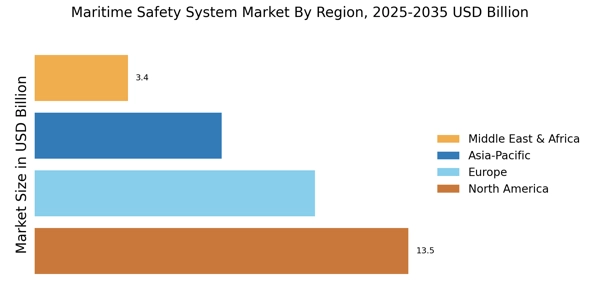
- North America remains the largest market for maritime safety systems, reflecting a strong emphasis on regulatory compliance and safety standards.
- Asia-Pacific is emerging as the fastest-growing region, fueled by increasing maritime trade and investment opportunities.
- Solutions dominate the market as the largest segment, while services are rapidly gaining traction as the fastest-growing segment.
- Technological advancements and a rising focus on human factors are key drivers propelling the market forward.
Market Size & Forecast
| 2024 Market Size | 33.7 (USD Billion) |
| 2035 Market Size | 70.95 (USD Billion) |
| CAGR (2025 - 2035) | 7.0% |
Major Players
Wärtsilä (FI), Raytheon Technologies (US), Thales Group (FR), Kongsberg Gruppen (NO), Northrop Grumman (US), General Dynamics (US), Bae Systems (GB), DNV GL (NO), Furuno Electric (JP)
Maritime Safety System Market Trends
The Maritime Safety System Market is currently experiencing a transformative phase, driven by advancements in technology and increasing regulatory requirements. The integration of innovative solutions such as automated navigation systems, real-time monitoring, and enhanced communication tools appears to be reshaping the landscape of maritime safety.singly prioritizing the implementation of robust safety measures to mitigate risks associated with maritime operations. This shift is likely influenced by a growing awareness of environmental concerns and the need for sustainable practices within the industry.
Moreover, the emphasis on training and education for maritime personnel is gaining traction. Organizations are recognizing that well-trained crews are essential for the effective operation of safety systems. This focus on human factors, alongside technological advancements, suggests a holistic approach to maritime safety. As the market evolves, collaboration among various stakeholders, including government agencies, private companies, and international organizations, is expected to play a crucial role in shaping future developments. The Maritime Safety System Market is poised for growth, with potential opportunities emerging from the integration of cutting-edge technologies and a commitment to enhancing safety protocols.
Technological Advancements
The Maritime Safety System Market is witnessing a surge in technological innovations. Enhanced navigation systems, automated vessel monitoring, and advanced communication tools are becoming increasingly prevalent. These developments not only improve operational efficiency but also significantly reduce the likelihood of accidents at sea. Technological integration, including advanced satellite data processing, is a key driver for growth within the long range identification tracking market. Additionally, Rapid advancements in maritime safety technology allow vessel operators to leverage predictive analytics for proactive hazard detection and incident prevention.
Regulatory Compliance
There is a growing emphasis on adhering to international safety regulations within the Maritime Safety System Market. Governments and regulatory bodies are implementing stricter guidelines to ensure that maritime operations meet safety standards. This trend is likely to drive investments in safety systems and technologies.
Focus on Human Factors
The importance of human factors in maritime safety is gaining recognition. Training and education for maritime personnel are being prioritized to ensure that crews are well-equipped to handle safety systems effectively. This trend indicates a shift towards a more comprehensive approach to safety, integrating both technology and human expertise.
Maritime Safety System Market Drivers
Regulatory Compliance and Safety Standards
The Maritime Safety System Market is significantly influenced by stringent regulatory compliance and safety standards imposed by various maritime authorities. These regulations are designed to ensure the safety of vessels, crew, and cargo, thereby fostering a culture of safety within the industry. Compliance with international standards such as the International Maritime Organization's (IMO) regulations is essential for maritime operators. As of 2025, it is estimated that compliance-related expenditures will account for nearly 15% of total operational costs for maritime companies. This emphasis on regulatory adherence drives investment in advanced safety systems, as companies seek to avoid penalties and enhance their reputational standing in the market.
Emerging Markets and Investment Opportunities
The Maritime Safety System Market is witnessing a shift towards emerging markets, which presents new investment opportunities. Countries with expanding maritime sectors are increasingly investing in safety systems to enhance their operational capabilities and meet international safety standards. For instance, regions in Asia and Africa are experiencing rapid growth in their shipping industries, leading to a demand for advanced maritime safety technologies. It is projected that investments in these emerging markets will contribute to a significant portion of the overall market growth, potentially reaching a valuation of several billion dollars by 2030. This trend indicates a promising future for stakeholders in the maritime safety sector.
Increased Focus on Human Factors in Maritime Safety
The Maritime Safety System Market is increasingly recognizing the importance of human factors in enhancing safety outcomes. Human error remains a leading cause of maritime accidents, prompting a shift towards systems that prioritize crew training, situational awareness, and decision-making processes. As a result, there is a growing demand for safety systems that incorporate human factors engineering principles. This trend is reflected in the development of simulation-based training programs and user-friendly interfaces that facilitate better interaction between crew members and safety systems. By addressing human factors, the industry aims to reduce incidents and improve overall safety performance.
Rising Maritime Trade and Transportation Activities
The Maritime Safety System Market is poised for growth due to the rising maritime trade and transportation activities. As global trade continues to expand, the volume of cargo transported by sea is increasing, necessitating enhanced safety measures to protect vessels and their crews. Recent statistics indicate that maritime trade is expected to grow by approximately 4% annually, leading to a heightened focus on safety systems that can accommodate larger and more complex shipping operations. This trend underscores the need for robust maritime safety systems that can effectively manage the risks associated with increased shipping traffic and ensure compliance with safety regulations.
Technological Advancements in Maritime Safety Systems
The Maritime Safety System Market is experiencing a surge in technological advancements that enhance safety protocols and operational efficiency. Innovations such as automated navigation systems, real-time monitoring, and advanced communication technologies are becoming increasingly prevalent. For instance, the integration of artificial intelligence and machine learning into maritime safety systems allows for predictive analytics, which can foresee potential hazards and mitigate risks. According to recent data, the market for maritime safety technologies is projected to grow at a compound annual growth rate of approximately 6.5% over the next five years. This growth is indicative of the industry's commitment to adopting cutting-edge solutions that not only comply with safety regulations but also improve overall maritime operations.
Market Segment Insights
By Offering: Solutions (Largest) vs. Services (Fastest-Growing)
In the Maritime Safety System Market, the offering segment is primarily divided into Solutions and Services, with Solutions holding the largest market share. This segment includes a wide array of safety technologies and systems designed to enhance maritime security and operational efficiency. Services, on the other hand, although smaller in share, are witnessing significant growth driven by increased demand for maintenance, upgrade, and training services associated with safety systems. This trend reflects the industry's shift towards a more comprehensive approach to maritime safety, emphasizing both technology and support. The growth of Services is particularly noteworthy as it responds to the evolving regulatory environment and the rising need for skilled personnel to operate advanced maritime safety systems. Factors such as the increasing frequency of maritime incidents and the need for compliance with international safety standards are propelling the demand for these offerings. Additionally, the expansion of the global shipping industry and the integration of cutting-edge technologies like AI and IoT into maritime safety systems are further driving the growth of Services, positioning them as a critical component of the overall safety ecosystem in the maritime sector.
Solutions (Dominant) vs. Services (Emerging)
Solutions in the Maritime Safety System Market are characterized by advanced technological capabilities designed to ensure the highest level of safety on maritime operations. They encompass a range of products, such as integrated navigation systems, collision avoidance systems, and emergency response technologies, which provide a comprehensive safety framework. As the dominant segment, Solutions cater to large-scale shipping companies and regulatory bodies, offering tailored packages that enhance safety protocols and efficiency. In contrast, Services are emerging rapidly, focusing on developing training programs, regular maintenance, and system upgrades, making them essential for the operational longevity of Safety Solutions. As the market evolves, both segments are expected to complement each other, with Services playing an increasingly vital role in supporting Solutions and driving continued growth in the market.

By Security Type: Port & Critical Infrastructure Security (Largest) vs. Coastal Security (Fastest-Growing)
The Maritime Safety System Market displays a diverse distribution of security types, with Port & Critical Infrastructure Security dominating the landscape. This segment encompasses the protection of key maritime facilities, ensuring the safety of critical assets and personnel. Coastal Security follows closely, providing essential defense for coastal areas against threats like smuggling, illegal migration, and terrorism. Vessel Security and Crew Security contribute significantly as well, ensuring the safety of ships and their onboard personnel. The segment is characterized by a multifaceted approach to maritime safety, addressing various security challenges faced in the maritime industry. In terms of growth trends, Coastal Security is emerging as the fastest-growing segment, driven by increasing concerns over national security and rising incidents of illegal activities in coastal waters. Technological advancements and the need for enhanced surveillance systems are propelling this segment's growth. Additionally, Port & Critical Infrastructure Security remains critical as urbanization and globalization increase the reliance on maritime transport. Furthermore, the focus on sustainability and environmental safety is notably influencing security measures in the maritime sector, enhancing the demand for innovative solutions across all security types.
Port & Critical Infrastructure Security (Dominant) vs. Coastal Security (Emerging)
Port & Critical Infrastructure Security stands as the dominant force in the maritime safety segment due to its vital role in safeguarding essential maritime assets and facilities. This segment encapsulates the safety of harbors, terminals, and other critical infrastructure that is pivotal for global trade and transport. In contrast, Coastal Security is gaining traction as an emerging segment, responding to evolving threats and increasing illegal activities along coastlines. Coastal Security focuses on the protection of coastal areas from smuggling, piracy, and terrorism, highlighting an adaptive response to contemporary maritime challenges. Both segments are influenced by advancements in technology, with increased investments in surveillance, asset tracking systems, and integrated security solutions enhancing their effectiveness in protecting maritime interests.
By System: Automatic Identification System (AIS) (Largest) vs. Ship Security Reporting System (Fastest-Growing)
The Maritime Safety System Market features a diverse array of systems, among which the Automatic Identification System (AIS) holds the largest market share. AIS has become an integral part of maritime operations, providing essential data for ship navigation safety and collision avoidance. The Ship Security Reporting System has emerged as a rapidly growing segment due to increasing global security concerns and regulatory mandates. These systems together form the backbone of maritime safety, paving the way for enhanced security measures across the industry. Growth trends show a marked increase in the adoption of advanced technological systems, driven by regulations and the need for improved maritime security. The emergence of new threats in maritime operations is prompting operators to invest in systems like the Ship Security Reporting System, which is witnessing significant growth. Additionally, systems such as the Global Maritime Distress Safety System (GMDSS) are also evolving, refining their capabilities to accommodate modern communication technologies. This growth trajectory is supported by innovation and increased awareness of maritime safety protocols among stakeholders.
AIS (Dominant) vs. Ship Security Reporting System (Emerging)
The Automatic Identification System (AIS) is a critical component of maritime safety, enabling ongoing tracking and identification of vessels at sea. It is widely adopted due to its effectiveness in preventing maritime accidents and ensuring secure vessel operation. On the other hand, the Ship Security Reporting System is an emerging segment that is experiencing rapid growth. This system is specifically designed to enhance the safety and security of maritime operations through timely reporting of security incidents. As the maritime industry faces increased scrutiny and the necessity for robust security measures, the Ship Security Reporting System is gaining attention, promising to play a vital role in future developments in maritime safety alongside established systems like AIS.
By Application: Loss Prevention & Detection (Largest) vs. Search & Rescue (Fastest-Growing)
In the Maritime Safety System Market, the application segment is diverse, comprising various functionalities such as Loss Prevention & Detection, Security & Safety Management, and others. Loss Prevention & Detection remains the largest segment, capturing the most market share due to its critical role in preventing incidents and protecting assets. Following closely are Monitoring & Tracking and Security & Safety Management, which are essential for operational efficiency, while Environment Protection and Communication Management round out the key applications in this market. The growth trends within the Maritime Safety System Market indicate a strong upward trajectory, particularly for Search & Rescue applications, which are rapidly gaining traction as global shipping activities increase. The rising focus on maritime security, combined with advancements in technology and the increasing need for effective response mechanisms to piracy and other threats, drives this segment’s performance. As regulatory demands intensify, the integration of cutting-edge technologies in Loss Prevention & Detection is expected to sustain its prominent position while emerging applications will likely witness significant growth, reflecting the evolving landscape of maritime safety needs.
Loss Prevention & Detection (Dominant) vs. Search & Rescue (Emerging)
Loss Prevention & Detection is a dominant application in the Maritime Safety System Market, characterized by its emphasis on minimizing risks associated with maritime operations. This segment focuses on technologies and protocols designed to detect hazards and prevent losses during marine activities. Key players continually innovate to enhance system reliability and effectiveness, ensuring compliance with safety regulations while protecting valuable assets at sea. The growing complexity of maritime operations has made this segment essential. On the other hand, Search & Rescue represents an emerging application driven by an increase in maritime incidents and maritime traffic. This segment leverages advanced communication systems and location tracking to optimize rescue operations. With innovations such as drones and automated systems being integrated, the efficiency and effectiveness of Search & Rescue efforts are significantly improved. This application’s growth reflects shifts in industry priorities, emphasizing rapid response capabilities and the need for robust safety management systems.


By End User: Government & Defense (Largest) vs. Shipping Companies (Fastest-Growing)
In the Maritime Safety System Market, the distribution of market share among various end user segments shows that Government and Defense hold the largest portion due to the consistent demand for safety systems to protect national waters and maintain maritime security. This segment benefits from significant investments in technology and infrastructure to ensure compliance with safety regulations. Conversely, the shipping companies segment represents the fastest-growing area in the market, driven by the increasing need for enhanced safety and efficiency in global trade. With the rise of e-commerce and international shipping, companies are adopting innovative safety solutions, improving their operational capabilities and meeting regulatory demands. This growth reflects a shift in focus towards incorporating advanced technologies in maritime safety systems.
Government & Defense (Dominant) vs. Shipping Companies (Emerging)
The Government and Defense segment is dominant in the maritime safety system market, characterized by its focus on reliability, compliance with international regulations, and long-term contracts. This segment prioritizes advanced technology integration and rigorous safety protocols, making it a cornerstone of maritime safety initiatives globally. It often influences market trends due to its substantial purchasing power and tendency to set standards for other sectors. On the other hand, the Shipping Companies segment is emerging rapidly as businesses seek to enhance safety measures and optimize fleet management. Innovating with technologies such as real-time monitoring and risk assessment, they are redefining their operational frameworks, becoming key players in the maritime safety ecosystem as they respond to evolving consumer demands and regulatory pressures.
Regional Insights
North America : Leading Innovation and Technology
North America is the largest market for Maritime Safety Systems, holding approximately 40% of the global share. The region's growth is driven by stringent regulatory frameworks, increasing maritime trade, and advancements in technology. The U.S. Coast Guard and other regulatory bodies are pushing for enhanced safety measures, which further fuels demand for innovative safety solutions. The focus on cybersecurity in maritime operations is also a significant catalyst for growth. The United States is the leading country in this sector, with major players like Raytheon Technologies and Northrop Grumman leading the charge. Canada also plays a vital role, focusing on improving its maritime infrastructure and safety protocols. The competitive landscape is characterized by a mix of established firms and emerging startups, all vying for a share of this lucrative market.
Europe : Regulatory Frameworks Driving Growth
Europe is the second-largest market for Maritime Safety Systems, accounting for approximately 30% of the global market share. The region benefits from robust regulatory frameworks established by the European Maritime Safety Agency (EMSA) and other national authorities. These regulations mandate the implementation of advanced safety systems, driving demand across various maritime sectors. The increasing focus on environmental sustainability also propels the adoption of innovative safety technologies. Leading countries in Europe include Germany, France, and Norway, where companies like Thales Group and DNV GL are prominent. The competitive landscape is marked by collaboration between public and private sectors, enhancing the development of cutting-edge safety solutions. The presence of key players and a strong emphasis on research and development further solidify Europe's position in the maritime safety market.
Asia-Pacific : Emerging Markets and Growth Potential
Asia-Pacific is witnessing rapid growth in the Maritime Safety Systems market, holding around 20% of the global share. The region's expansion is driven by increasing maritime trade, investments in port infrastructure, and a growing emphasis on safety regulations. Countries like China and India are enhancing their maritime capabilities, leading to a surge in demand for advanced safety systems. Government initiatives aimed at improving maritime safety standards are also significant growth catalysts. China is the largest market in the region, followed by India and Japan. The competitive landscape features both local and international players, including Kongsberg Gruppen and Furuno Electric. The presence of these key players, along with government support for technological advancements, positions Asia-Pacific as a promising market for maritime safety solutions. The region's focus on innovation and safety compliance is expected to drive further growth.
Middle East and Africa : Resource-Rich and Growing Demand
The Middle East and Africa region is emerging as a significant player in the Maritime Safety Systems market, holding approximately 10% of the global share. The growth is primarily driven by increasing maritime activities, oil and gas exploration, and a rising focus on safety regulations. Countries like the UAE and South Africa are investing heavily in maritime infrastructure, which is expected to boost demand for safety systems. Regulatory bodies are also beginning to implement stricter safety standards, further catalyzing market growth. The UAE is leading the market in this region, with a growing number of local and international companies entering the sector. The competitive landscape is characterized by partnerships and collaborations aimed at enhancing safety technologies. Key players are increasingly focusing on adapting their solutions to meet the unique challenges of the region, positioning the Middle East and Africa as a market with significant untapped potential.
Key Players and Competitive Insights
In August Wärtsilä (Finland) announced a partnership with a leading technology firm to develop an AI-driven maritime safety platform. This strategic move is likely to enhance predictive maintenance capabilities, thereby reducing operational risks and improving safety outcomes for maritime operators. The integration of AI into safety systems could redefine operational protocols, positioning Wärtsilä as a frontrunner in the digital transformation of maritime safety.
In September Raytheon Technologies (United States) unveiled a new suite of integrated safety solutions aimed at enhancing situational awareness for maritime operators. This launch underscores the company's commitment to innovation and reflects a broader trend towards comprehensive safety solutions that combine hardware and software. By enhancing situational awareness, Raytheon Technologies is likely to improve decision-making processes for maritime operators, thereby elevating safety standards across the industry.
In July Thales Group (France) secured a contract to provide advanced navigation and safety systems for a major shipping line. This contract not only reinforces Thales's market position but also highlights the growing demand for sophisticated safety solutions in the maritime sector. The strategic importance of this contract lies in its potential to enhance operational safety and efficiency for the shipping line, thereby setting a precedent for future contracts in the industry.
As of October current trends in the Maritime Safety System Market are increasingly defined by digitalization, sustainability, and the integration of artificial intelligence. Strategic alliances among key players are shaping the competitive landscape, fostering innovation and collaborative solutions. Looking ahead, it appears that competitive differentiation will evolve from traditional price-based competition to a focus on technological innovation, reliability in supply chains, and enhanced safety protocols. This shift may redefine the parameters of success in the maritime safety sector, emphasizing the importance of adaptability and forward-thinking strategies.
Key Companies in the Maritime Safety System Market include
Industry Developments
- Q2 2024: Wärtsilä launches new maritime safety platform to enhance vessel situational awareness Wärtsilä announced the launch of a new integrated maritime safety platform designed to improve situational awareness and emergency response for commercial vessels. The platform combines advanced sensors, real-time analytics, and automated alerting to support compliance with evolving international safety regulations.
- Q2 2024: Kongsberg Digital and DNV partner to develop next-generation maritime safety training solutions Kongsberg Digital and DNV entered a strategic partnership to co-develop digital training solutions focused on maritime safety, leveraging simulation technology and regulatory expertise to address the growing demand for crew competency in complex operational environments.
- Q3 2024: Saab wins contract to supply maritime safety systems for new European port security project Saab AB announced it has secured a contract to deliver advanced maritime safety and surveillance systems for a major European port security initiative, aiming to enhance threat detection and response capabilities across multiple terminals.
- Q3 2024: Japan’s Furuno Electric appoints new CEO to accelerate maritime safety technology innovation Furuno Electric Co., Ltd. named a new Chief Executive Officer, citing a strategic focus on expanding its maritime safety technology portfolio and strengthening its position in the global navigation and safety systems market.
- Q4 2024: Wärtsilä opens new maritime safety R&D center in Singapore Wärtsilä inaugurated a new research and development center in Singapore dedicated to maritime safety systems, aiming to foster innovation in digital safety solutions and support the region’s growing maritime sector.
- Q4 2024: Navico Group acquires Norwegian maritime safety tech startup Navico Group completed the acquisition of a Norwegian startup specializing in AI-powered maritime safety monitoring, expanding its portfolio of digital safety solutions for commercial and recreational vessels.
- Q1 2025: Raytheon Technologies awarded contract to upgrade US Coast Guard maritime safety systems Raytheon Technologies announced it has been awarded a contract to modernize the US Coast Guard’s maritime safety infrastructure, including the deployment of advanced radar and communication systems to improve coastal surveillance and emergency response.
- Q1 2025: Maritime safety startup SeaGuard raises $30 million in Series B funding SeaGuard, a startup developing AI-driven maritime safety and compliance solutions, closed a $30 million Series B funding round led by international investors to accelerate product development and global expansion.
- Q2 2025: ABB Marine & Ports launches new emergency shutdown system for LNG carriers ABB Marine & Ports introduced a next-generation emergency shutdown system for LNG carriers, designed to enhance onboard safety and meet stricter international safety standards for hazardous cargo transport.
- Q2 2025: Thales and Singapore Maritime Authority sign MoU to develop smart port safety solutions Thales and the Maritime and Port Authority of Singapore signed a Memorandum of Understanding to jointly develop and pilot smart safety solutions for port operations, focusing on real-time risk monitoring and automated incident response.
- Q3 2025: L3Harris Technologies secures contract for integrated maritime safety systems in Middle East L3Harris Technologies announced a contract win to supply integrated maritime safety and surveillance systems for a Middle Eastern government, supporting coastal security and emergency management initiatives.
- Q3 2025: UK’s Ocean Infinity announces IPO to fund expansion of autonomous maritime safety fleet Ocean Infinity, a UK-based marine robotics company, announced its initial public offering to raise capital for expanding its fleet of autonomous vessels equipped with advanced maritime safety and search-and-rescue technologies.
Maritime Safety System Market
Future Outlook
Maritime Safety System Market Future Outlook
The Maritime Safety System Market is projected to grow at a 7.0% CAGR from 2025 to 2035, driven by technological advancements, regulatory compliance, and increasing maritime traffic.
New opportunities lie in:
- Integration of AI-driven predictive maintenance solutions Development of advanced vessel tracking and monitoring systems Expansion of training programs for maritime safety personnel
By 2035, the market is expected to be robust, reflecting substantial growth and innovation.
Market Segmentation
Maritime Safety System Market System Outlook
- Ship Security Reporting System
- Automatic Identification System (AIS)
- Global Maritime Distress Safety System (GMDSS)
- Long Range Tracking and Identification (LRIT) System
- Vessel Monitoring and Management System
- Other Systems
Maritime Safety System Market End User Outlook
- Government & Defense
- Marine & Construction
- Oil & Gas
- Shipping & Transportation
- Shipping Companies
- Ship Crews
- Passengers & Cargo Owners
Maritime Safety System Market Offering Outlook
- Solutions
- Services
Maritime Safety System Market Application Outlook
- Loss prevention & detection
- Security & Safety Management
- Counter piracy
- Monitoring & Tracking
- Environment Protection
- Search & Rescue
- Communication Management
- Other Applications
Maritime Safety System Market Security Type Outlook
- Port & Critical Infrastructure Security
- Coastal Security
- Vessel Security
- Crew Security
- Cargo and Containers Safety
- Ship system and equipment (SSE) Safety
- Other Security Types
Report Scope
| MARKET SIZE 2024 | 33.7(USD Billion) |
| MARKET SIZE 2025 | 36.06(USD Billion) |
| MARKET SIZE 2035 | 70.95(USD Billion) |
| COMPOUND ANNUAL GROWTH RATE (CAGR) | 7.0% (2025 - 2035) |
| REPORT COVERAGE | Revenue Forecast, Competitive Landscape, Growth Factors, and Trends |
| BASE YEAR | 2024 |
| Market Forecast Period | 2025 - 2035 |
| Historical Data | 2019 - 2024 |
| Market Forecast Units | USD Billion |
| Key Companies Profiled | Wärtsilä (FI), Raytheon Technologies (US), Thales Group (FR), Kongsberg Gruppen (NO), Northrop Grumman (US), General Dynamics (US), Bae Systems (GB), DNV GL (NO), Furuno Electric (JP) |
| Segments Covered | Offering |
| Key Market Opportunities | Integration of advanced analytics and artificial intelligence in Maritime Safety System Market enhances risk management capabilities. |
| Key Market Dynamics | Rising regulatory standards and technological advancements drive innovation in the Maritime Safety System market. |
| Countries Covered | North America, Europe, APAC, South America, MEA |
FAQs
What is the current valuation of the Maritime Safety System Market?
The Maritime Safety System Market was valued at 33.7 USD Billion in 2024.
What is the projected market size for the Maritime Safety System Market by 2035?
The market is projected to reach 70.95 USD Billion by 2035.
What is the expected CAGR for the Maritime Safety System Market during the forecast period?
The expected CAGR for the Maritime Safety System Market from 2025 to 2035 is 7.0%.
Which companies are considered key players in the Maritime Safety System Market?
Key players include Wärtsilä, Raytheon Technologies, Thales Group, and Kongsberg Gruppen, among others.
What are the main segments of the Maritime Safety System Market?
The main segments include Offering, Security Type, System, Application, and End User.
How much is the Offering segment projected to grow by 2035?
The Offering segment, which includes Solutions and Services, is expected to grow from 33.7 USD Billion in 2024 to a higher valuation by 2035.
What is the projected valuation for the Vessel Security segment by 2035?
What applications are driving growth in the Maritime Safety System Market?
How does the Government & Defense sector contribute to the Maritime Safety System Market?
What trends are influencing the Maritime Safety System Market in 2025?
Research Approach
Secondary Research
The secondary research process involved comprehensive analysis of maritime regulatory databases, industry publications, technical standards documentation, and authoritative maritime organizations. Key sources included the International Maritime Organization (IMO) databases, International Convention for the Safety of Life at Sea (SOLAS) regulatory frameworks, International Labour Organization (ILO) maritime safety conventions, U.S. Coast Guard (USCG) maritime safety statistics, European Maritime Safety Agency (EMSA) incident reports, National Maritime Intelligence-Integration Office (NMIO) threat assessments, Baltic and International Maritime Council (BIMCO) industry guidelines, International Association of Marine Insurers (IUMI) claims data, International Chamber of Shipping (ICS) annual reports, International Transport Workers' Federation (ITF) safety surveys, S. Bureau of Transportation Statistics (BTS) waterborne commerce data, UN Conference on Trade and Development (UNCTAD) maritime transport reviews, International Maritime Bureau (IMB) piracy reports, ** Lloyd's List Intelligence** vessel tracking data, DNV Maritime safety trend reports, and national maritime administrations from key shipping nations (Panama Maritime Authority, Maritime and Port Authority of Singapore, UK Maritime and Coastguard Agency).
For ship security reporting systems, automated identification systems (AIS), global maritime distress safety systems (GMDSS), long-range tracking and identification (LRIT) systems, and integrated vessel monitoring platforms, these sources were used to gather data on vessel traffic, regulatory compliance, incident analysis reports, technology adoption trends, and competitive landscape analysis.
Primary Research
In order to gather both qualitative and quantitative insights, supply-side and demand-side stakeholders were interviewed during the primary research process. CEOs, VPs of marine Technology, heads of Regulatory Compliance, and commercial directors from manufacturers of navigation equipment, marine software, and safety systems were examples of supply-side sources. Fleet safety managers, port authority operations directors, coast guard commanders, maritime cybersecurity officers, and procurement leaders from commercial shipping lines, offshore operators, port authorities, and naval defense organizations were examples of demand-side sources. Market segmentation, technological roadmap dates, and information on system integration trends, procurement cycles, and regulatory compliance expenditures were all verified by primary research.
Primary Respondent Breakdown:
By Designation: C-level Primaries (32%), Director Level (31%), Others (37%)
By Region: North America (32%), Europe (30%), Asia-Pacific (33%), Rest of World (5%)
Market Size Estimation
System deployment analysis and revenue mapping were used to determine the global market valuation. The methodology comprised:
Finding more than fifty important manufacturers in North America, Europe, Asia-Pacific, and Scandinavia
Product mapping between vessel monitoring systems, AIS transponders, GMDSS equipment, LRIT terminals, integrated maritime safety platforms, and ship security reporting systems
Examination of reported and projected yearly income for portfolios of marine safety systems
Coverage of producers accounting for 75–80% of the world market in 2024
Extrapolating segment-specific valuations utilizing top-down (manufacturer revenue validation) and bottom-up (vessel count × system penetration rate × ASP by area) methods
Kindly complete the form below to receive a free sample of this Report
Customer Stories
“This is really good guys. Excellent work on a tight deadline. I will continue to use you going forward and recommend you to others. Nice job”
“Thanks. It’s been a pleasure working with you, please use me as reference with any other Intel employees.”
“Thanks for sending the report it gives us a good global view of the Betaïne market.”
“Thank you, this will be very helpful for OQS.”
“We found the report very insightful! we found your research firm very helpful. I'm sending this email to secure our future business.”
“I am very pleased with how market segments have been defined in a relevant way for my purposes (such as "Portable Freezers & refrigerators" and "last-mile"). In general the report is well structured. Thanks very much for your efforts.”
“I have been reading the first document or the study, ,the Global HVAC and FP market report 2021 till 2026. Must say, good info! I have not gone in depth at all parts, but got a good indication of the data inside!”
“We got the report in time, we really thank you for your support in this process. I also thank to all of your team as they did a great job.”