Medical Aesthetics Market Summary
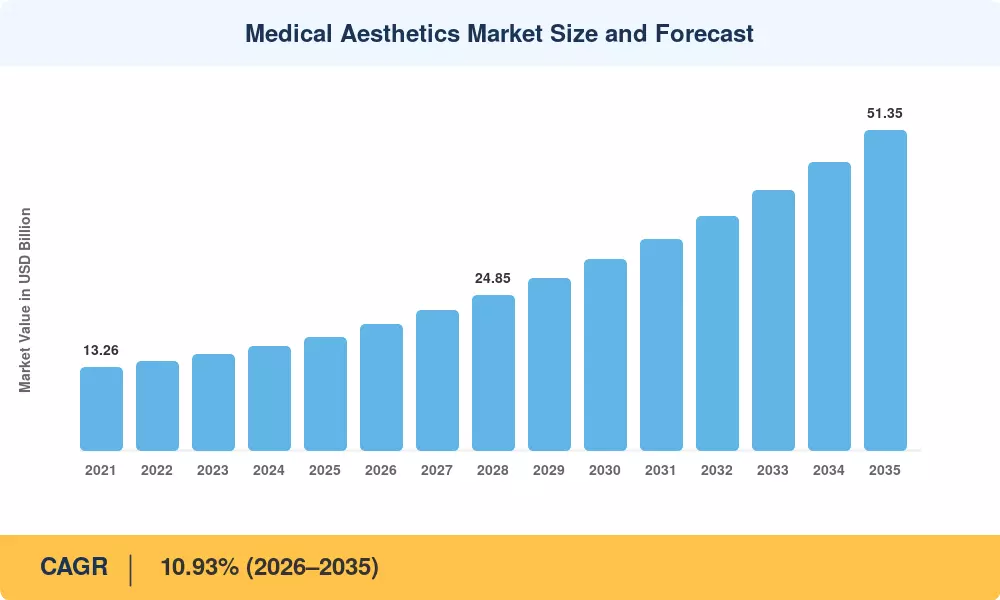
The Medical Aesthetics Market reached USD 18.20 Billion in 2025 and is projected to grow from USD 20.19 Billion in 2026 to USD 51.35 Billion by 2035, registering a CAGR of 10.93% during the forecast period (2026–2035). Rising demand for minimally invasive body-sculpting and skin-rejuvenation procedures, combined with regulatory streamlining by the U.S. FDA and the European CE-marking framework, has created a durable growth runway. Government health-insurance expansions in several Asian economies are further widening patient access to elective procedures.
Technology transformation is reshaping the Medical Aesthetics Market at its core. Legacy single-function laser platforms are giving way to multi-modal energy systems that combine radiofrequency, high-intensity focused ultrasound (HIFU), and pulsed-light modalities on a single console. AbbVie alone channeled an estimated USD 1.2 Billion into aesthetics R&D between 2023 and 2025, while AI-guided treatment-planning software now enables practitioners to customize energy delivery protocols in real time [2]. These shifts are compressing procedure times and broadening the addressable patient population beyond traditional demographics.
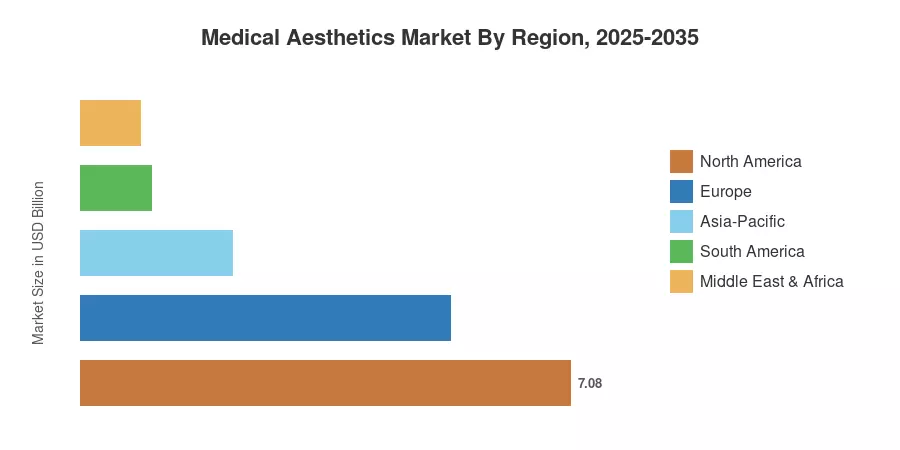
North America commanded roughly 38.9% of global Medical Aesthetics Market revenue in 2025, anchored by high per-capita spending on elective procedures and mature reimbursement pathways. Asia-Pacific stands as the fastest-growing region, forecast to advance at a 12.01% CAGR through 2035, driven by expanding middle-class populations in China and India. Europe held the second-largest share at approximately 29.4%, supported by strong clinical standards and cross-border medical tourism. The convergence of device innovation, regulatory harmonization, and shifting consumer attitudes toward preventive aesthetics positions this market for sustained double-digit expansion over the next decade.
Key Report Takeaways
• By Device Type
- Energy-based aesthetic devices accounted for 48.5% of the Medical Aesthetics Market revenue in 2025, reflecting the dominance of laser, radiofrequency, and ultrasound platforms across clinical settings.
- Non-energy-based devices — including injectables and implant systems — are expected to grow at a 13.24% CAGR through 2035, outpacing energy-based segments as next-generation biologics gain traction.
• By Procedure Type
- Non-surgical and minimally invasive treatments captured 51.2% of spending in 2025, underscoring a clear consumer preference for procedures with shorter recovery windows.
- Surgical procedures are projected to expand at a 13.55% CAGR through 2035, fueled by innovation in fat-transfer techniques and hybrid surgical-energy workflows.
• By Application
- Facial aesthetics represented 25.4% of the Medical Aesthetics Market revenue in 2025, remaining the largest application segment globally.
- Body contouring is forecast to achieve a 14.35% CAGR through 2035, the highest among application sub-segments.
• By End User
- Clinics and dermatology offices held a 42.8% share of the Medical Aesthetics Market in 2025, serving as the primary point of care for both energy-based and injectable treatments.
- Medical spas are set to expand at a 14.41% CAGR through 2035, propelled by the mainstreaming of aesthetic wellness.
• By Region
- North America led with 38.9% of global revenue in 2025, while Asia-Pacific is expected to deliver an 12.01% CAGR through 2035.
Medical Aesthetics Market Size and Forecast (2021–2035)
Market Research Future's estimates are derived from primary interviews with device manufacturers, clinic operators, and regulatory bodies, triangulated against distributor sell-through data and publicly filed financial results. Historical values (2021–2024) reflect reported market performance; 2025 is the base year; 2026–2035 values are forward projections at a 10.93% CAGR.