Medical Alert Systems Market (2025 - 2035)

Medical Alert Systems Market Research Report: Size, Share, Trend Analysis By System Type (Personal Emergency Response Systems (PERS), Nurse Call Systems (NCS), Ambulatory Auto Alert Systems, Automated Airborne Flight Alert System, and Smart Belt), By offering (Hardware, Software, and Services), By Connection Type (Wired, and Wireless), By Technology (Two-Way Voice Systems, Unmonitored Medical Alert Systems, Medical Alert Alarm (Button) System, and IP-Based Systems), By Applications (Home-Based Users, Senior Living Facilities/Senior Care Centers, and Assisted Living Facilities) And By Region (North America, Europe, Asia-Pacific, And Rest Of The World) - Growth Outlook & Industry Forecast 2025 To 2035
ID: MRFR/MED/8522-CR
209 Pages
Rahul Gotadki, Satyendra Maurya
Last Updated: July 09, 2026
Medical Alert Systems Market
Market Size
Forecast Period2025-2035
CAGR (2025-2035)6.20%
2025 Market SizeUSD 10.89 Billion
2035 Market SizeUSD 19.87 Billion
Key Players
Koninklijke Philips N.V.
Medical Guardian LLC
Life Alert Emergency Response Inc.
ADT Inc.
Bay Alarm Medical
MobileHelp LLC
Opportunities
  • AI-Driven Predictive Fall Prevention
  • Emerging-Market Community-Care Programs
  • Data Monetization Through Insurer Analytics

Medical Alert Systems Market Summary

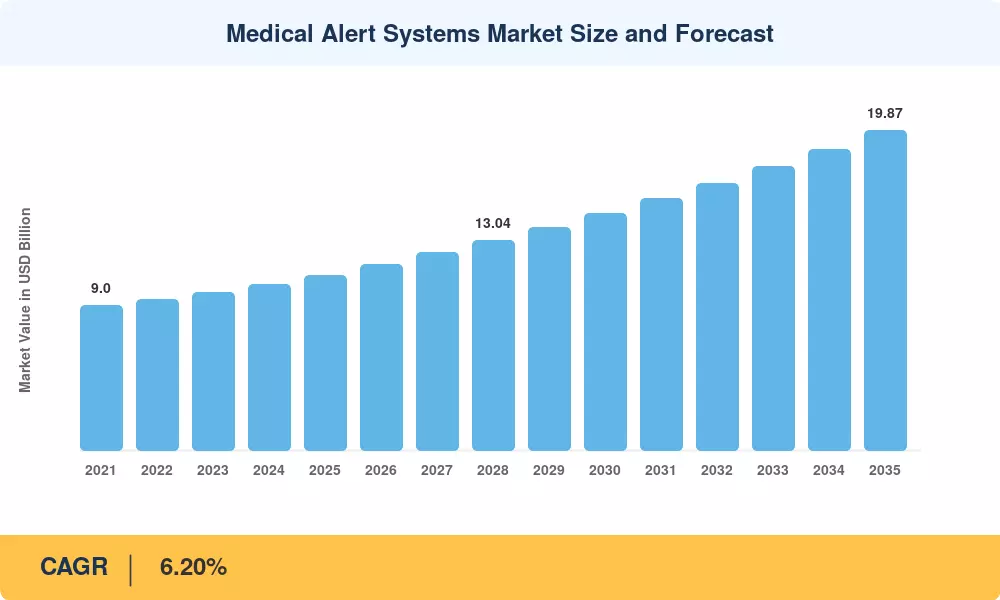
The Medical Alert Systems Market reached USD 10.89 Billion in 2025 and is projected to climb to USD 19.87 Billion by 2035, registering a 6.20% CAGR across the 2026–2035 forecast window. Two intersecting forces are accelerating adoption: Medicare Advantage plan expansions that now reimburse personal emergency response hardware as a supplemental benefit, and employer duty-of-care mandates requiring lone-worker monitoring across oil-and-gas, utilities, and home-healthcare sectors [1]. These policy catalysts convert what was once a consumer-pay niche into a payer-funded growth channel with predictable subscription economics.

Technology-wise, the Medical Alert Systems Market is transitioning from legacy landline-tethered units to cellular- and GPS-enabled platforms that pair with voice assistants and remote patient monitoring hubs. Vendors are investing heavily in 4G LTE base stations and cloud-hosted triage dashboards; an estimated USD 1.3 billion in cumulative R&D flowed into connected PERS hardware between 2022 and 2024 [2]. This shift allows insurers to quantify avoided emergency-department visits, creating a measurable ROI narrative that broadens reimbursement eligibility.

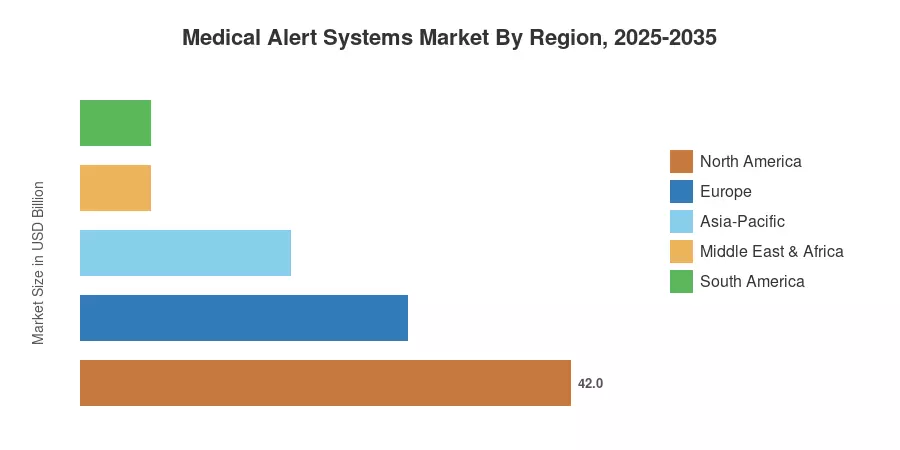
North America commands roughly 42% of global revenue, anchored by the United States' large Medicare-eligible population and well-established monitoring-center infrastructure. Asia-Pacific represents the fastest-growing region at a projected 7.45% CAGR, driven by Japan's super-aged demographics and China's expanding community-care pilot programs [3]. Europe holds the second-largest share near 28%, underpinned by the United Kingdom's NHS telecare contracts and Germany's aging-in-place subsidies. As 5G rollouts compress alert-to-dispatch latency below five seconds, the Medical Alert Systems Market is positioned for a decade of compounding growth.


Key Report Takeaways

• By Type

  • Landline PERS accounted for 52.1% of the Medical Alert Systems Market share in 2025, sustained by an installed base of home-based subscribers on copper networks.
  • Mobile PERS is expected to register a 6.52% CAGR through 2035, powered by cellular miniaturization and caregiver-app integration.

• By End User

  • Hospitals and clinics represented 56.9% of the Medical Alert Systems Market revenue in 2025, reflecting institutional procurement cycles.
  • Senior housing and assisted living facilities are forecast to expand at a 6.85% CAGR, driven by regulatory mandates for on-premises emergency response.

• By Region

  • North America generated USD 4.57 billion in 2025 revenue, led by the United States' Medicare supplemental benefit programs.
  • Asia-Pacific is projected to achieve a 7.45% CAGR through 2035.


Medical Alert Systems Market Size and Forecast (2021–2035)

Market Research Future employs a triangulated approach combining bottom-up revenue modeling from device-shipment databases, top-down validation against payer-reimbursement records, and primary interviews with monitoring-center operators across 22 countries.
Medical Alert Systems Market Size and Forecast
Our Impact
Enabled $4.3B Revenue Impact for Fortune 500 and Leading Multinationals
Partnering with 2000+ Global Organizations Each Year
30K+ Citations by Top-Tier Firms in the Industry

Driver Impact Analysis

Driver ~% Impact on CAGR Geographic Relevance Impact Timeline
Aging population and rising fall incidence +1.4% Global Long-term (≥4 yr)
Medicare Advantage supplemental benefit expansion +1.1% North America Short-term (≤2 yr)
4G/5G cellular migration replacing landline infrastructure +0.9% Global Medium-term (2–4 yr)
Integration with remote patient monitoring platforms +0.8% North America, Europe Medium-term (2–4 yr)
Employer lone-worker safety mandates +0.6% Europe, North America Short-term (≤2 yr)
AI-powered fall-detection algorithm improvements +0.5% Global Long-term (≥4 yr)
Insurer value-based care incentives +0.4% North America Medium-term (2–4 yr)


Aging Population and Fall Prevalence

According to estimates from the World Health Organization, 684,000 fatal falls happen globally each year, with those over 60 making up the vast majority [1]. A structural demand floor for the medical alert systems market will be created by the fact that one in six persons on the planet will be 60 or older by 2030. While the U.S. Census Bureau predicts that the number of Americans over 65 will top 80 million by 2040, Japan's 65-plus group now makes up more than 29% of the country's overall population [10]. Higher PERS penetration rates are directly correlated with every percentage point increase in the elderly share.


Medicare Advantage Supplemental Benefit Expansion

CMS's 2019 expansion of Medicare Advantage supplemental benefits allowed plans to cover personal emergency response devices as a non-medical benefit, and subsequent 2023 rule updates broadened eligibility criteria further [4]. By 2025, an estimated 38% of Medicare Advantage plans included PERS coverage, channeling predictable per-member-per-month revenue to device vendors and monitoring centers. This institutional funding mechanism reduces consumer out-of-pocket friction and accelerates the Medical Alert Systems Market's shift toward payer-subsidized distribution.

Cellular Network Migration

The 3G sunset — completed across all major U.S. carriers by early 2023 — forced a fleet-wide hardware refresh, pushing subscribers toward 4G LTE-enabled units with enhanced data throughput [5]. Verizon, AT&T, and T-Mobile collectively decommissioned over 70,000 cell towers' 3G radios, making backward-compatible devices obsolete. This one-time migration event created a replacement cycle worth an estimated USD 850 million in cumulative device revenue between 2022 and 2025, while simultaneously opening the door for richer cloud-based monitoring features in the Medical Alert Systems Market.

Remote Patient Monitoring Integration

Payers and health systems are bundling alert devices inside broader RPM kits that track vitals, medication adherence, and activity levels [6]. The CMS Remote Therapeutic Monitoring billing codes (CPT 98975–98981) allow providers to bill for ongoing PERS-connected monitoring, transforming alert hardware from a one-time sale into a recurring revenue stream. This convergence pushes the Medical Alert Systems Market toward platform-based models where the device is the gateway, not the product.


Restraints Impact Analysis

Restraint ~% Impact on CAGR Geographic Relevance Impact Timeline
Smartphone-based substitution by younger seniors –0.5% North America, Europe Medium-term (2–4 yr)
High monthly monitoring fees and subscriber churn –0.4% Global Short-term (≤2 yr)
Privacy and data-security concerns –0.3% Europe, North America Long-term (≥4 yr)
Limited broadband in rural and developing regions –0.3% South America, MEA, Asia-Pacific Long-term (≥4 yr)
Reimbursement coverage gaps outside North America –0.2% Europe, Asia-Pacific Medium-term (2–4 yr)


Smartphone-Based Substitution

Apple's fall-detection feature (available on Apple Watch since Series 4) and Google's Personal Safety app have normalized passive emergency alerting on consumer electronics that seniors already own [11]. While dedicated PERS devices offer superior monitoring-center triage and battery life, the perceived adequacy of a smartwatch erodes willingness-to-pay among tech-literate adults aged 65–75. This substitution pressure compresses margins in the Medical Alert Systems Market's consumer-direct channel, where acquisition costs already run USD 80–120 per subscriber.

Subscriber Churn and Monitoring Costs

Monthly monitoring fees ranging from USD 25 to USD 55 create recurring cost sensitivity, particularly among fixed-income seniors without supplemental payer coverage [12]. Industry-average churn sits near 2.5–3.0% per month for consumer-direct channels, meaning vendors must continuously reinvest in acquisition marketing. The Medical Alert Systems Market's overall growth rate would be meaningfully higher if churn-reduction strategies — such as caregiver engagement dashboards and proactive wellness calls — achieved wider adoption.


Medical Alert Systems Market Opportunities

AI-Driven Predictive Fall Prevention

Machine-learning models trained on accelerometer and gait data can flag deteriorating balance 48–72 hours before a fall event, shifting the value proposition from reactive alerting to proactive intervention [8]. Vendors that embed edge-AI chips in wearable pendants can sell this predictive capability as a premium tier, improving subscriber lifetime value and reducing insurer claim costs.

Emerging-Market Community-Care Programs

China's "9073" elder-care policy targets 90% of seniors aging at home, creating a potential addressable base exceeding 180 million individuals by 2030 [3]. India's Ayushman Bharat Digital Mission and Brazil's SUS-linked home-health expansions present parallel greenfield opportunities for low-cost, cellular-based Medical Alert Systems Market entrants.

Data Monetization Through Insurer Analytics

Aggregated, de-identified PERS usage data — including alert frequency, response times, and mobility trends — carries significant actuarial value for long-term-care insurers and Medicare Advantage risk-adjustment models [9]. Vendors that build HIPAA-compliant data-sharing pipelines can generate incremental SaaS revenue without additional hardware shipments.

Lone-Worker Safety Compliance

The European Union's updated Lone Worker Directive and OSHA's General Duty Clause create employer liability for workers operating in isolation — from home-healthcare aides to field technicians [7]. The Medical Alert Systems Market can expand its addressable market by 15–20% by repositioning cellular PERS devices as occupational-safety compliance tools.

Voice-Assistant and Smart-Home Convergence

Integration with Amazon Alexa, Google Home, and Apple HomeKit ecosystems allows PERS devices to function as ambient health monitors rather than single-purpose panic buttons. This convergence reduces stigma among seniors resistant to wearing a medical pendant and opens co-marketing partnerships with consumer-electronics retailers.


Medical Alert Systems Market Future Outlook

AI and Ambient Intelligence Integration

By 2030, the majority of high-end PERS devices will have on-device neural processors that can discern between benign movements and actual falls with over 98% accuracy [8]. The Medical Alert Systems Market will be able to accommodate greater subscriber density without corresponding personnel increases because of this transition from rule-based to AI-driven detection, which will reduce false-alarm rates, which are currently 30–40% industry-wide, and raise monitoring-centre efficiency.


Platform Economics and Subscription Bundling

The market for medical alert systems is shifting toward platform models where revenue is concentrated in monthly monitoring, data analytics, and caregiver-coordination SaaS layers and hardware margins are almost zero. In line with the economics of connected-car platforms, expect leading suppliers to provide packaged packages that include medicine delivery systems, RPM sensors, alert devices, and telehealth access for a single monthly charge per member [6].


Silver Economy and Consumer Destigmatization

As baby boomers — the most digitally engaged retiree cohort in history — age into the primary PERS demographic, product design will pivot from clinical-looking pendants to lifestyle wearables indistinguishable from consumer fitness trackers [17]. This destigmatization expands the addressable market beyond fall-risk populations to active seniors who value peace-of-mind connectivity during travel, outdoor recreation, and solo living.

ESG and Social-Impact Reporting

Elderly safety outcomes are among the social-impact indicators that institutional investors are increasingly using to assess healthcare enterprises. Health systems with social determinants of health mandates will give preference to PERS vendors who produce standardized information on fall injury reduction, emergency response times, and avoidable hospitalization rates. These vendors will also attract ESG-linked funding [18].


Medical Alert Systems Market Segmentation

By Type

Segment Key Metric Primary Demand Driver
Landline PERS 52.1% share (2025) Large installed base in single-family homes
Mobile PERS 6.52% CAGR (2026–2035) Cellular miniaturization, on-the-go coverage
Other Types USD 0.87 Billion (2025) Satellite-linked and hybrid Wi-Fi devices


Landline PERS remains the largest segment within the Medical Alert Systems Market, sustained by a mature subscriber base of home-bound seniors who rely on traditional copper-line infrastructure. Monitoring centers have optimized their dispatch protocols around landline connectivity, creating switching costs that slow migration. However, as telecom providers retire POTS (Plain Old Telephone Service) lines — the FCC approved accelerated copper retirement in 2022 — this segment faces structural headwinds that will gradually erode its share through the forecast period [5].

Mobile PERS is the fastest-growing type segment, driven by compact LTE-enabled devices that pair with smartphone caregiver apps. Products like cellular pendants with built-in GPS and two-way voice allow subscribers to receive protection outside the home, addressing a critical coverage gap that landline systems cannot fill. The Medical Alert Systems Market's mobile segment benefits from declining cellular-module costs, which fell roughly 35% between 2020 and 2024 [2].

By End User

Segment Key Metric Primary Demand Driver
Hospitals & Clinics 56.9% share (2025) Institutional procurement and discharge-planning programs
Senior Housing & Assisted Living 6.85% CAGR (2026–2035) Regulatory mandates for on-premises alerting
Home-Based Users USD 2.85 Billion (2025) Consumer-direct sales and payer-subsidized distribution
Others 4.8% share (2025) Employer lone-worker programs, rehabilitation centers


Hospitals and clinics represent the dominant end-user segment, deploying PERS devices as part of post-discharge care bundles aimed at reducing 30-day readmission rates — a metric tied directly to CMS reimbursement penalties [4]. The Medical Alert Systems Market draws significant institutional volume from accountable-care organizations that view emergency-response devices as cost-avoidance tools.

Senior housing and assisted living facilities constitute the fastest-growing end-user group, as state licensing agencies increasingly mandate emergency-call capabilities in every resident unit. This regulatory pull creates a captive procurement channel with high contract-renewal rates and low churn.

By Component

Segment Key Metric Primary Demand Driver
Hardware 12.5% share (2025) Device replacement cycles driven by network transitions
Software & Services 7.05% CAGR (2026–2035) Monitoring subscriptions, cloud analytics, caregiver apps


Software and services represent the highest-growth component segment in the Medical Alert Systems Market, reflecting the industry's transition from hardware-centric revenue to recurring subscription income. Monitoring-center services, caregiver notification platforms, and insurer analytics dashboards collectively generate over 85% of vendor gross margins. Hardware, while essential, is increasingly subsidized or offered at cost to acquire subscribers, mirroring the razor-and-blade economics common in connected-device industries.


Regional Market Share Analysis

Region Revenue Share (2025) Primary Investment Themes
North America 42.0% Medicare Advantage PERS coverage, 5G migration
Europe 28.0% NHS telecare contracts, lone-worker compliance
Asia-Pacific 18.0% Super-aged demographics, government elder-care programs
South America 6.0% Public-health digitization, urban telehealth
Middle East & Africa 6.0% Smart-city initiatives, private healthcare expansion
Total 100.0%

The Medical Alert Systems Market exhibits significant geographic concentration, with North America and Europe together accounting for approximately 70% of global revenue. Asia-Pacific is the fastest-growing region, fueled by rapidly aging populations in Japan and China.


North America

Country Key Metric Key Driver
United States 78.5% of regional share Medicare Advantage supplemental benefit coverage
Canada 6.30% CAGR (2026–2035) Provincial home-care funding increases
Mexico USD 0.18 Billion (2025) Private insurance and urban hospital adoption


The United States dominates the Medical Alert Systems Market in North America through an extensive network of UL-listed monitoring centers and payer-subsidized distribution. Canada's provinces are expanding home-care budgets by 6–8% annually, driving institutional PERS procurement [15].

Europe

Country Key Metric Key Driver
Germany 24.2% of regional share Pflegeversicherung (care insurance) subsidies
United Kingdom 5.90% CAGR (2026–2035) NHS Technology Enabled Care Services program
France USD 0.41 Billion (2025) APA (Allocation Personnalisée d'Autonomie) funding
Italy 12.8% of regional share Municipal elder-care service expansion
Spain 5.75% CAGR (2026–2035) Teleasistencia Domiciliaria program
Nordic Countries USD 0.29 Billion (2025) High digital-health adoption rates
Russia 3.1% of regional share Limited public funding, private-pay dominant
Rest of Europe 5.50% CAGR (2026–2035) EU-funded digital-health pilots


Germany leads European adoption through its statutory care-insurance system, which reimburses emergency-response devices for individuals assessed at Pflegegrad 1 or above [15]. The UK's NHS has contracted telecare services covering over 1.7 million users, making it the single largest institutional buyer in Europe.

Asia-Pacific

Country Key Metric Key Driver
China USD 0.52 Billion (2025) "9073" community-care policy rollout
India 8.10% CAGR (2026–2035) Ayushman Bharat Digital Mission
Japan 31.4% of regional share 29%+ population aged 65 and older
South Korea 5.95% CAGR (2026–2035) National Health Insurance coverage expansion
ASEAN USD 0.14 Billion (2025) Private hospital and resort-care demand
Rest of Asia-Pacific 6.40% CAGR (2026–2035) Urbanization-driven telehealth adoption


Japan anchors Asia-Pacific revenue for the Medical Alert Systems Market, where municipal governments subsidize emergency-response equipment for households with elderly residents living alone. China's entry into this space is accelerating; pilot programs in Shanghai and Guangzhou have deployed over 300,000 subsidized PERS units since 2022 [3].

South America

Country Key Metric Key Driver
Brazil 58.5% of regional share SUS-linked home-health program expansion
Argentina 6.10% CAGR (2026–2035) Private prepaid health plan (obra social) coverage
Rest of South America USD 0.11 Billion (2025) Early-stage market development


Brazil's Unified Health System (SUS) is piloting PERS integration within its Estratégia Saúde da Família community-health program, targeting municipalities with high elderly-isolation indices [14].

Middle East & Africa

Country Key Metric Key Driver
Saudi Arabia 28.3% of regional share Vision 2030 smart-city healthcare integration
UAE 7.20% CAGR (2026–2035) Abu Dhabi and Dubai smart-hospital mandates
South Africa USD 0.09 Billion (2025) Private healthcare sector adoption
Egypt 5.80% CAGR (2026–2035) Universal health insurance rollout
Rest of MEA 4.8% of regional share Limited infrastructure, nascent demand


Saudi Arabia's Vision 2030 healthcare transformation includes smart-home elder-care components that create procurement channels for the Medical Alert Systems Market in the Gulf Cooperation Council corridor [16].


Medical Alert Systems Market By Region, 2025-2035

Competitive Benchmarking

The Medical Alert Systems Market exhibits moderate concentration with an estimated HHI of approximately 1,100. The top five players collectively hold an estimated 35–45% revenue share. Differentiation increasingly centers on monitoring-center response quality, cloud-platform integration, and caregiver-experience design rather than device hardware specifications alone.

Company Est. Revenue Share Range Key Offerings Strategic Positioning
Koninklijke Philips N.V. (Lifeline) ~8–12% HomeSafe, GoSafe, institutional RPM bundles Integrated health-technology ecosystem
Medical Guardian LLC ~6–9% Mini Guardian, Active Guardian, Family Guardian Consumer-direct with caregiver app focus
Life Alert Emergency Response Inc. ~5–8% In-home and on-the-go alert systems Brand recognition and national TV advertising
ADT Inc. ~4–7% Medical Alert Plus, Health & Senior Safety Cross-sell from home-security subscriber base
Bay Alarm Medical ~4–6% SOS All-in-One, In-Home system, GPS tracker Cost-competitive with no long-term contracts
MobileHelp LLC ~3–5% MobileHelp Touch, Smart, Duo Cellular-first product portfolio
Tunstall Healthcare Group ~3–5% Lifeline Vi+, Connected Health platform European institutional and NHS contracts
Connect America ~2–4% Medical Alert Classic, Mobile Alert Monitoring-center scale across 50 states
LogicMark Inc. ~2–4% Freedom Alert, Guardian Alert 911 FDA-listed devices, VA distribution
Mytrex Inc. ~1–3% iHelp+ series Budget-tier direct-to-consumer channel


Recent News & Developments


  • Medical Guardian (January 2025): Expanded its monitoring-center network to four U.S. facilities, targeting sub-20-second average response times for the Medical Alert Systems Market's consumer segment [19].
  • ADT Inc. (September 2024): Acquired a majority stake in a PERS-focused health-tech startup to integrate medical alerting into its 6.5-million-subscriber home-security platform [20].
  • Tunstall Healthcare (June 2024): Secured a five-year NHS England Technology Enabled Care Services framework contract valued at an estimated GBP 120 million [21].
  • LogicMark Inc. (April 2024): Received FDA 510(k) clearance for its next-generation cellular pendant with integrated SpO₂ monitoring, merging alert and vitals-capture functionality [22].
  • CMS (January 2024): Finalized the 2024 Medicare Advantage rule expanding supplemental benefit flexibility, enabling more plans to cover PERS devices without cost-sharing [4].
  • Bay Alarm Medical (October 2023): Launched a GPS-enabled smartwatch alert device targeting active seniors, broadening its product portfolio beyond traditional pendant form factors [23].


Medical Alert Systems Market Report Scope

Parameter Detail
Market Scope Medical Alert Systems / Personal Emergency Response Systems — devices, software, and monitoring services
Study Period 2021–2035
CAGR 6.20%
Base Year 2025 USD 10.89 Billion
Forecast 2035 USD 19.87 Billion
Fastest Growing Segment (Type) Mobile PERS (6.52% CAGR)
Fastest Growing Segment (End User) Senior Housing & Assisted Living (6.85% CAGR)
Fastest Growing Region Asia-Pacific (7.45% CAGR)
Companies Profiled 10
Valuation Currency USD Billion


FAQs

How do professional monitoring centers differ from self-monitored alert systems in terms of emergency outcomes?
Professional monitoring centers staffed by trained operators reduce average emergency-response times by 40–60% compared to self-monitored setups that rely on family contacts [12]. The triage capability also lowers unnecessary EMS dispatches.
What battery-life benchmarks should procurement teams evaluate when selecting PERS devices?
Leading cellular PERS devices offer 72–120 hours of standby battery life, while GPS-enabled mobile units typically range from 24–48 hours under active tracking [2]. Procurement teams should prioritize devices with low-battery caregiver alerts.
How does UL 2560 certification influence purchasing decisions for medical alert hardware?
UL 2560 is the primary safety standard for PERS equipment in North America, covering signal transmission reliability and backup-power requirements [5]. Certified products receive preferential formulary placement from Medicare Advantage plans.
What role do caregiver mobile applications play in reducing subscriber churn?
Caregiver apps that provide real-time location sharing and activity summaries improve family engagement, reducing monthly churn by an estimated 0.5–0.8 percentage points [19]. Engaged caregivers also drive referral-based subscriber acquisition.
Can medical alert devices integrate with electronic health record systems?
Select vendors now offer HL7 FHIR-compatible APIs that push alert events and vitals data directly into EHR platforms [6]. This integration supports care-coordination workflows within accountable-care organizations.
What waterproofing standards matter for PERS devices used in bathrooms?
Devices rated IP67 or higher withstand submersion up to one meter for 30 minutes, which is critical since bathrooms account for roughly 80% of in-home fall injuries [1]. Most premium pendants now meet this standard.
How are vendors addressing false-alarm rates in automatic fall-detection systems?
Advanced accelerometer-plus-barometric-pressure sensor fusion, combined with edge-AI classification, has reduced false-positive rates from 40% to under 10% in latest-generation devices [8]. Continuous algorithm updates via OTA firmware further improve accuracy.    
What is the current size of the medical alert systems market?
The medical alert systems market reached USD 10.89 billion in 2025 and is projected to reach USD 19.87 billion by 2035.
What is the CAGR of the medical alert systems market?
The medical alert systems market is projected to grow at a CAGR of 6.20% during the forecast period 2026–2035.
Which region leads the medical alert systems market?
North America holds the largest share at 42.0%, while Asia-Pacific is the fastest-growing region at 7.45% CAGR.
Author
Author
Author Profile
Rahul Gotadki LinkedIn
Research Manager
He holds an experience of about 9+ years in Market Research and Business Consulting, working under the spectrum of Life Sciences and Healthcare domains. Rahul conceptualizes and implements a scalable business strategy and provides strategic leadership to the clients. His expertise lies in market estimation, competitive intelligence, pipeline analysis, customer assessment, etc.
Co-Author
Co-Author Profile
Satyendra Maurya LinkedIn
Research Analyst
An accomplished research analyst with high proficiency in market forecasting, data visualization, competitive benchmarking, and others. He holds a pronounced track record in research and consulting projects for sectors such as life sciences, medical devices, and healthcare IT. His capabilities in qualitative and quantitative analysis have resulted in positive client outcomes. Working on niche market trends, opportunities, sales, and forecasted value is part of his skill set.

Research Approach


Secondary Research

The secondary research process involved comprehensive analysis of regulatory databases, peer-reviewed medical and gerontechnology journals, clinical publications, and authoritative health and aging organizations. Key sources included the US Food & Drug Administration (FDA) 510(k) Premarket Notification Database for personal emergency response system (PERS) classifications, the Federal Communications Commission (FCC) Part 68 regulations for communications devices, the Centers for Disease Control and Prevention (CDC) National Center for Injury Prevention and Control (WISQARS), the National Center for Health Statistics (NCHS) Vital Statistics System, and the Centers for Medicare & Medicaid Services (CMS) Durable Medical Equipment coverage policies.

Additional authoritative sources comprised the Administration for Community Living (ACL) Falls Prevention Program databases, the National Council on Aging (NCOA) Falls Free® Initiative surveys, AARP Research (Home and Community Preferences Survey), the National Institute on Aging (NIA) Health and Retirement Study, and the Consumer Technology Association (CTA) AgeTech market data. International data sources included the World Health Organization (WHO) Global Health Observatory and Ageing Reports, Eurostat Disability Statistics for elderly needs and assistance, the Organisation for Economic Co-operation and Development (OECD) Health Statistics, and the Japan Ministry of Health, Labour and Welfare (MHLW) Priority Fields in Technologies for Long-term Care reports. Industry-specific sources included the American Health Care Association/National Center for Assisted Living (AHCA/NCAL) workforce and technology reports, LeadingAge Center for Aging Services Technologies (CAST) adoption surveys, the National Association for Home Care & Hospice (NAHC) Basic Statistics About Home Care, and the Bureau of Labor Statistics (BLS) Home Healthcare Services data. These sources were used to collect aging demographic statistics, fall incidence and mortality data, regulatory approval pathways, reimbursement policies, technology adoption trends, and senior living facility capacity metrics for personal emergency response systems, nurse call systems, smart belt technologies, and mobile health monitoring devices.


Primary Research

To gather both qualitative and quantitative insights, supply-side and demand-side stakeholders were interviewed during the primary research phase. CEOs, VPs of Product Development, heads of regulatory affairs, and commercial directors from OEMs, emergency response monitoring centers, and manufacturers of medical alert systems were examples of supply-side sources. Demand-side sources included geriatric care managers, home healthcare agency administrators, procurement leads from assisted living facilities, medical directors of aging services organizations, chief technology officers (CTOs) at senior living communities, and directors of nursing at skilled nursing facilities. Primary research confirmed product pipeline timelines for AI-enabled fall detection and smart home integration, validated market segmentation across system types (ambulatory auto alert, nurse call systems, and PERS), and collected information on resident/caregiver user experience preferences, reimbursement dynamics, and barriers to technology adoption.

Primary Respondent Breakdown:

By Designation: C-level Primaries (32%), Director Level (30%), Others (38%)

By Region: North America (38%), Europe (25%), Asia-Pacific (28%), Rest of World (9%)


Market Size Estimation

Global market valuation was derived through revenue mapping, device shipment analysis, and monitoring service subscription tracking. The methodology included:

Identification of 50+ key manufacturers and monitoring service providers across North America, Europe, Asia-Pacific, and Latin America

Product mapping across personal emergency response systems (PERS), nurse call systems (NCS), ambulatory auto alert systems, automated airborne flight alert systems, and smart belt technologies

Analysis of reported and modeled annual revenues specific to medical alert system portfolios, including hardware sales and recurring monthly monitoring fees

Coverage of manufacturers and service providers representing 75-80% of global market share in 2024

Extrapolation using bottom-up (subscriber volume × Average Revenue Per User by country/region) and top-down (manufacturer revenue validation) approaches to derive segment-specific valuations across home-based users, senior living facilities, and assisted living center end-markets

Download Free Sample

Kindly complete the form below to receive a free sample of this Report

Download PDF ×

We do not share your information with anyone. However, we may send you emails based on your report interest from time to time. You may contact us at any time to opt-out.
















