Medical Gloves Market (2026 - 2035)

Medical Gloves Market Research Report By Product Type (Disposable Gloves, Reusable Gloves, Surgical Gloves, Examination Gloves), By Material (Latex, Nitrile, Vinyl, Polyethylene), By End User (Hospitals, Clinics, Diagnostic Laboratories, Home Healthcare), By Application (Surgical Procedures, Examinations, Research Facilities, Food Handling) and By Regional (North America, Europe, South America, Asia Pacific, Middle East and Africa) - Growth & Industry Forecast 2025 To 2035
ID: MRFR/MED/8229-HCR
200 Pages
Rahul Gotadki, Kinjoll Dey
Last Updated: June 26, 2026
Medical Gloves Market
Market Size
Forecast Period2026-2035
CAGR (2026-2035)10.3%
2025 Market SizeUSD 14.46 Billion
2035 Market SizeUSD 38.54 Billion
Key Players
Top Glove Corporation
Hartalega Holdings
Supermax Corporation
Kossan Rubber Industries
Sri Trang Gloves
Ansell Limited
Opportunities
  • Biodegradable and Eco-Friendly Glove Formulations
  • Emerging-Market Penetration in Sub-Saharan Africa
  • Cleanroom and Pharmaceutical-Grade Expansion

Medical Gloves Market Summary

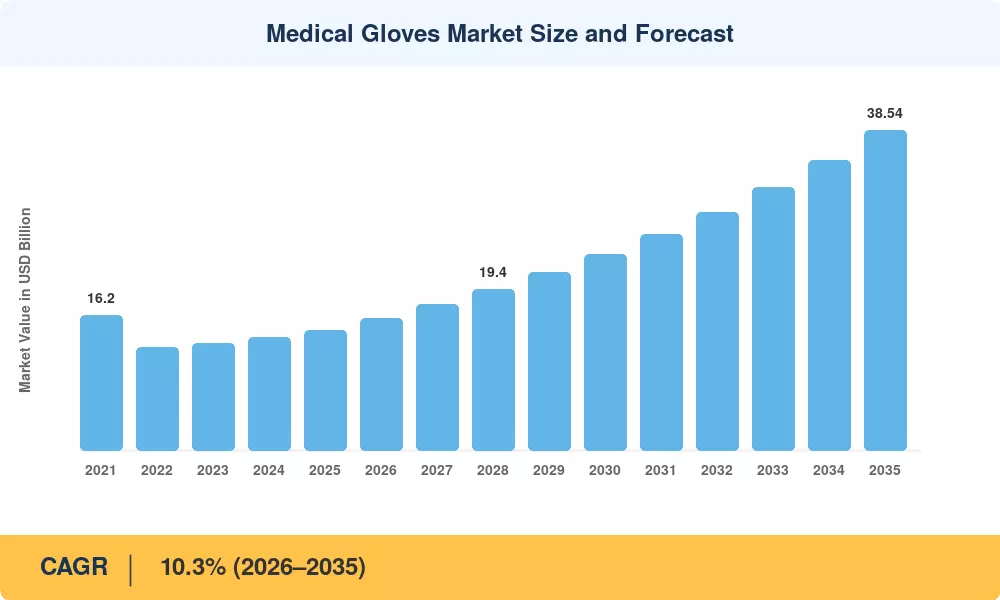
The Global Medical Gloves Market size was valued at USD 14.46 Billion in 2025, and the market is projected to grow from USD 15.95 Billion in 2026 to USD 38.54 Billion by 2035, registering a CAGR of 10.3% during the forecast period 2026–2035. Two catalysts anchor this trajectory: the World Health Organization's updated hand hygiene guidelines, which now mandate single-use glove changes between every patient touchpoint, and hospital procurement budgets that have nearly doubled their personal protective equipment line items since 2020 [1]. Together, these structural forces convert what was once a commoditized consumable into a strategic supply-chain priority for health systems worldwide.

The market for medical gloves is fundamentally changing due to material science. Modern nitrile and neoprene compounds, which reduce the danger of latex-protein allergies and increase puncture resistance, are gradually displacing legacy natural-rubber formulas that dominated procurement lists for decades. In an effort to lessen reliance on imports from Southeast Asia, European Union governments funded an estimated USD 340 million in domestic glove manufacturing incentives between 2023 and 2025 [2]. Even as material criteria become more stringent, automated high-speed dipping lines can now make up to 45,000 gloves per hour, reducing unit costs.

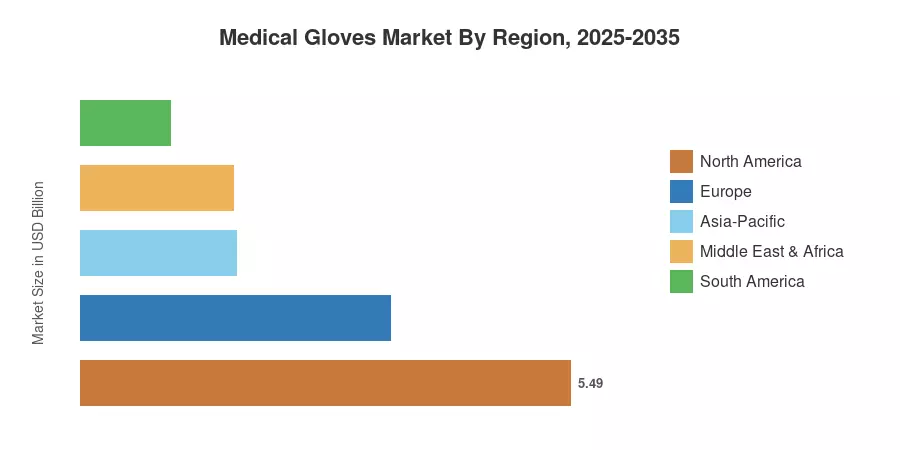
Due to strict FDA device-listing regulations and high per-capita healthcare spending, North America holds around 38% of the medical gloves market. The fastest-growing region is Asia-Pacific, which is expected to increase at a 12.1% CAGR through 2035 thanks to the implementation of universal health care in Indonesia and India. Due to EU Medical Device Regulation compliance deadlines, Europe has the second-largest stake, at roughly 24%. Manufacturers who can increase capacity while adhering to stricter environmental and quality standards will be rewarded in the upcoming 10 years.


Key Report Takeaways

• By Type

  • Non-powdered gloves captured the leading revenue share of the Medical Gloves Market in 2025, reflecting global regulatory bans on powdered variants.
  • Powdered gloves are projected to grow at a modest 6.8% CAGR through 2035 as demand persists in select price-sensitive emerging markets.

• By Material

  • Nitrile gloves accounted for approximately 51.4% of the Medical Gloves Market in 2025, driven by allergy-free performance and chemical resistance.
  • Neoprene gloves represent the fastest-growing material segment, forecast to register a CAGR of 13.1% through 2035.

• By Region

  • North America retained the dominant position in the Medical Gloves Market with a 38% share in 2025.
  • Asia-Pacific is set to expand at the highest regional CAGR of 12.1%, supported by rising surgical volumes and healthcare infrastructure investments.


Medical Gloves Market Size and Forecast (2021–2035)

Market sizing combines bottom-up manufacturer revenue analysis with top-down demand modeling across hospital networks, outpatient clinics, diagnostic laboratories, and pharmaceutical cleanrooms. Historical figures (2021–2024) are derived from audited annual reports and customs trade data; forecast values (2026–2035) employ a regression-adjusted compound growth model validated against procurement volume trends.
Medical Gloves Market Size and Forecast
Our Impact
Enabled $4.3B Revenue Impact for Fortune 500 and Leading Multinationals
Partnering with 2000+ Global Organizations Each Year
30K+ Citations by Top-Tier Firms in the Industry

Driver Impact Analysis

Driver ~% Impact on CAGR Geographic Relevance Impact Timeline
Infection prevention mandates 22–25% Global Short-term (≤2 yr)
Surgical volume recovery post-pandemic 15–18% North America, Europe Short-term
Nitrile material transition 14–16% Global Medium-term (2–4 yr)
Emerging-market hospital buildouts 12–14% Asia-Pacific, South America Long-term (≥4 yr)
Biopharma cleanroom expansion 10–12% North America, Europe Medium-term
Automated manufacturing scale-up 8–10% Southeast Asia Long-term
ESG procurement scoring 5–7% Europe, North America Medium-term


Infection Prevention Mandates

The WHO's 2024 update to its core infection prevention and control guidelines expanded the mandatory glove-use checklist from 12 clinical procedures to 19, effectively increasing per-patient glove consumption by an estimated 30% in compliant facilities [1]. Joint Commission accreditation standards in the United States now tie glove compliance rates directly to hospital performance scores, creating financial consequences for non-adherence. This regulatory tightening converts voluntary adoption into compulsory procurement, establishing a durable floor under Medical Gloves Market volume growth.

Surgical Volume Recovery

Elective surgery backlogs accumulated during 2020–2022 continue to clear across OECD health systems, with orthopedic and cardiovascular procedure volumes running 8–12% above pre-pandemic baselines as of late 2024 [4]. Each additional surgical procedure consumes an average of 4.2 pairs of gloves, translating directly into incremental unit demand. Health ministries in Germany, Japan, and Canada have allocated supplemental theatre budgets through 2027, sustaining this tailwind for the Medical Gloves Market across multiple fiscal cycles.

Nitrile Material Transition

Nitrile butadiene rubber offers superior chemical splash resistance and eliminates Type I latex allergies, making it the preferred formulation for hospitals seeking to reduce occupational health claims [11]. Malaysia's Rubber Industry Smallholders Development Authority reported that nitrile glove output grew 18% year-over-year in 2024, outpacing natural-rubber glove production for the first time. This crossover point signals a structural shift in the Medical Gloves Market, with procurement officers consolidating orders around nitrile-only contracts that simplify inventory management.

Emerging-Market Hospital Buildouts

India's Ayushman Bharat health-insurance expansion added 120 million new beneficiaries between 2023 and 2025, generating first-time hospital utilization for populations previously outside the formal healthcare system [7]. Indonesia's Ministry of Health approved the construction of 78 new district hospitals under its 2025–2030 infrastructure plan. Each facility opening creates a recurring Medical Gloves Market demand stream measured in millions of pairs annually, compounding the regional growth differential over the forecast period.


Restraints Impact Analysis

The restraint impacts below represent estimated drag on growth momentum and are directional rather than additive. They reflect supply-side, regulatory, and macroeconomic headwinds identified through manufacturer interviews and trade-flow analysis.

Restraint ~% Drag on CAGR Geographic Relevance Impact Timeline
Raw-material price volatility -3 to -5% Global Short-term
Environmental disposal concerns -2 to -3% Europe, North America Medium-term
Trade tariffs and import restrictions -2 to -4% North America, China Short-term
Overcapacity risk from pandemic-era investments -2 to -3% Southeast Asia Short-term
Reusable glove substitution in low-risk settings -1 to -2% Europe Long-term


Raw-Material Price Volatility

Global procurement of medical-grade nitrile butadiene rubber remains highly vulnerable to input fluctuations. According to trade records from the USITC, the United States consumes up to 100 billion individual gloves annually. Rapid price volatility in essential upstream feedstocks like acrylonitrile creates immediate margin compression, directly disrupting fixed contract pricing mechanisms throughout international healthcare distribution channels.


Environmental Disposal Concerns

Improper disposable glove use significantly increases global healthcare waste streams. A comprehensive analysis by the World Health Organization reported that an initial emergency procurement initiative alone dispatched 1.5 billion personal protective equipment items, weighing approximately 87,000 tonnes. The resulting waste highlights the environmental burden, forcing worldwide hospital networks to optimize usage patterns across procurement operations.


Trade Tariffs and Import Restrictions

The United States imposed anti-dumping duties of up to 287% on Chinese-origin nitrile gloves in 2024, redirecting trade flows toward Thai and Malaysian suppliers [14]. While Southeast Asian producers benefit from this reallocation, overall import costs for US distributors rose an estimated 15–20%, and lead times lengthened by two to four weeks. These trade frictions fragment the Medical Gloves Market and penalize health systems reliant on diversified sourcing.


Medical Gloves Market Opportunities

Biodegradable and Eco-Friendly Glove Formulations

Global health infrastructure increasingly prioritizes sustainable procurement to minimize environmental impact. The World Health Organization's guidance on climate-resilient, environmentally sustainable healthcare facilities encourages purchasing protocols that evaluate product life cycles. Manufacturers integrating plant-based formulations or accelerated-biodegradation properties align directly with these international initiatives, capturing preferential positioning within institutional and green hospital procurement frameworks.


Emerging-Market Penetration in Sub-Saharan Africa

Per capita healthcare resource allocation in Sub-Saharan Africa remains historically low compared to developed regions. According to World Health Organization health expenditure tracking data, individual healthcare spending in the African region averages less than 40 dollars annually. Expanding formal insurance systems and public healthcare access corridors will structurally scale recurring clinical consumable requirements across regional health centers.


Cleanroom and Pharmaceutical-Grade Expansion

Expanding global manufacturing capacity for specialized biopharmaceuticals, including advanced mRNA vaccine platforms, requires strict environmental contamination controls. World Health Organization good manufacturing practices for sterile medicinal products mandate rigorous cleanroom classification compliance. These protocols require staff to execute frequent, mandatory personal protective equipment changes, driving exceptionally high volumetric consumption of specialized, high-margin examination gloves.


Digital Supply-Chain Platforms and Data Monetization

Modern health systems leverage cloud-based logistics architectures to optimize volatile clinical inventories. The United Nations highlights that digitized supply chain monitoring significantly reduces essential medical commodity stockouts and eliminates carrying redundancies. Integrating data-driven procurement dashboards allows medical glove suppliers to secure sticky institutional partnerships and steady operational demand pipelines by streamlining volatile hospital inventory cycles.


Surgical Robotics Compatibility

The deployment of robotic-assisted surgical systems alters traditional operating room barrier requirements. World Health Organization surgical safety frameworks place paramount importance on maintaining sterile field continuity during complex mechanical interventions. Co-developing thin-gauge, highly tactile gloves compatible with robotic interfaces isolates medical glove manufacturers from broader commodity pricing pressures through specialized, non-substitutable hospital contract bundles.


Medical Gloves Market Future Outlook

Automation and Smart Manufacturing

Global production architectures increasingly deploy advanced automation frameworks to optimize output reliability. According to the United Nations Industrial Development Organization, adopting digitalized manufacturing models directly enhances resource efficiency across volatile supply lines. Integrating specialized automated inspection systems streamlines factory processes, mitigating post-production defects and ensuring high-volume capacity alignment across international healthcare protective wear infrastructure.

Sustainability and Circular-Economy Models

Managing single-use medical items creates compounding pressures on the worldwide waste infrastructure. World Health Organization guidance on environmentally sustainable healthcare facilities encourages alternative procurement frameworks to minimize clinical waste streams. Manufacturers adopting advanced polymers or polymer-recovering initiatives align directly with the United Nations Environment Programs, positioning their operations favorably within modern green institutional purchasing systems.


Regulatory Convergence and Quality Harmonization

The International Medical Device Regulators Forum is working toward mutual recognition agreements that would allow a single quality-management audit to satisfy FDA, EU MDR, and TGA requirements simultaneously [2]. Harmonization could reduce regulatory compliance costs by 25–30% for manufacturers selling across multiple jurisdictions and accelerate new-product launch timelines from 18 months to under 10. For the Medical Gloves Market, this convergence will lower barriers for mid-sized producers currently confined to single-region sales.

Supply-Chain Resilience and Geographic Diversification

The geographical concentration of personal protective equipment production exposes global health systems to structural supply shocks. World Health Organization evaluations of pandemic-era supply chains highlighted severe vulnerabilities stemming from regional export limitations. Consequently, international agencies actively advocate for localized procurement corridors, driving global initiatives to diversify manufacturing infrastructure across emerging processing regions.


Medical Gloves Market Segmentation

By Type

Segment Key Metric Primary Demand Driver
Non-Powdered 86% share (2025) FDA and EU regulatory bans on powdered gloves
Powdered CAGR 6.8% (2026–2035) Residual demand in cost-sensitive markets


Non-powdered gloves dominate the Medical Gloves Market after the US FDA's 2017 ban on powdered surgical and examination gloves, which was reinforced by similar European and ASEAN regulations through 2024. Cornstarch powder, once valued for ease of donning, was linked to granulomatous peritonitis and airborne latex-protein sensitization, prompting a near-universal shift to polymer-coated interiors. Powdered variants persist in parts of South Asia and Sub-Saharan Africa, where price sensitivity outweighs regulatory enforcement capacity.

By Material

Segment Key Metric Primary Demand Driver
Nitrile Gloves 51.4% share (2025) Allergy elimination and chemical resistance
Natural Rubber Gloves USD 4.05 Billion (2025) Cost advantage in high-volume settings
Vinyl Gloves CAGR 7.2% (2026–2035) Short-duration, low-risk procedures
Neoprene Gloves CAGR 13.1% (2026–2035) Surgical-grade latex alternative
Other Materials USD 0.62 Billion (2025) Specialty applications


Nitrile gloves command the largest share of the Medical Gloves Market because they combine puncture resistance roughly three times greater than vinyl with a protein-free composition that eliminates Type I hypersensitivity reactions [11]. Hospital pharmacy committees increasingly specify nitrile as the default across all departments, simplifying SKU management. Neoprene gloves represent the fastest-growing material category, driven by surgeons' preference for their elasticity and tactile sensitivity during microsurgical procedures, where the sterile surgical gloves specification demands precise finger dexterity.

By Application

Segment Key Metric Primary Demand Driver
Medical Examination 67% share (2025) Routine clinical assessments, diagnostic sampling
Surgery USD 3.18 Billion (2025) Sterility requirements, high per-procedure use
Chemotherapy CAGR 12.6% (2026–2035) Oncology drug handling safety standards
Other Applications 8% share (2025) Laboratory, dental, home care


Due to the high amount of non-surgical patient encounters in both acute care and outpatient settings, medical examination gloves make up the largest application category in the market. The need for chemotherapy gloves is increasing as the number of cancer treatments worldwide rises. Gloves must adhere to specific permeability criteria in order to guarantee occupational safety when handling cytotoxic drugs. In contrast to common chemical testing frameworks such as EN 16523-1, the strict ASTM D6978 standard establishes a strict protective floor by calculating a 30-minute minimum breakthrough time using a highly sensitive detection threshold of $0.01\ \mu\text{g/cm}^2\text{/min}$.


By Sterility

Segment Key Metric Primary Demand Driver
Non-Sterile 76% share (2025) Examination, diagnostics and general procedures
Sterile CAGR 11.4% (2026–2035) Surgical and cleanroom environments


Non-sterile gloves constitute the bulk of volume in the Medical Gloves Market because the majority of clinical touchpoints — vital-sign checks, medication administration, wound dressing changes — do not require sterile barriers. Sterile gloves grow at a premium-driven CAGR as surgical volumes recover and biopharma cleanroom buildouts create new demand pockets with stringent sterility assurance level requirements.


Regional Market Share Analysis

Region Key Metric Primary Investment Themes
North America 38% share (2025) FDA compliance, GPO consolidation
Europe USD 3.47 Billion (2025) EU MDR adoption, sustainability mandates
Asia-Pacific 12.1% CAGR (2026–2035) Hospital buildouts, domestic manufacturing
South America 7% share (2025) Import substitution, public health programs
Middle East & Africa 11.8% CAGR (2026–2035) Healthcare modernization, Vision 2030
Total USD 14.46 Billion (2025)

The Medical Gloves Market exhibits significant regional variation shaped by regulatory stringency, healthcare infrastructure maturity, and domestic manufacturing capacity. North America leads in value, Asia-Pacific leads in volume growth, and each region presents distinct strategic dynamics for suppliers and distributors.


North America

Country Key Metric Key Driver
US 78% of regional share FDA 510(k) device requirements
Canada CAGR 9.4% Provincial procurement reform
Mexico USD 0.42 Billion (2025) Nearshoring medical supply chains


The US anchors North America's position in the Medical Gloves Market through a combination of high procedural volumes — over 50 million inpatient surgeries annually — and rigorous FDA quality standards that favor premium-priced products [1]. Canada's group purchasing organizations are consolidating vendor lists, compressing the supplier base from over 30 to under 12 between 2023 and 2026. Mexico is emerging as a nearshore distribution hub, with three major Asian glove manufacturers opening bonded warehouses in Monterrey and Guadalajara during 2024 [14].

Europe

Country Key Metric Key Driver
Germany 22% of the regional share Hospital density, DIN standards
UK CAGR 10.8% NHS procurement overhaul
France USD 0.49 Billion (2025) Public hospital modernization
Italy 11% of regional share Surgical tourism growth
Spain CAGR 9.6% Primary care expansion
Nordic Countries USD 0.28 Billion (2025) Sustainability-first procurement
Russia 8% of regional share Import-substitution policies
Rest of Europe CAGR 9.2% EU convergence funding


Europe's Medical Gloves Market is evolving rapidly under the EU Medical Device Regulation, which reclassified certain examination gloves as Class I devices requiring updated conformity assessments by 2027 [2]. Germany's hospital sector, the continent's largest, consumes approximately 4.8 billion gloves annually. The UK's NHS Supply Chain shifted to a dual-source procurement model in 2024, mandating that hospitals maintain contracts with at least two approved glove suppliers to prevent single-source dependency.

Asia-Pacific

Country Key Metric Key Driver
China USD 1.12 Billion (2025) Domestic consumption and export manufacturing
India CAGR 13.5% Ayushman Bharat universal coverage
Japan 18% of regional share Aging population, high surgical rates
South Korea CAGR 10.6% Advanced hospital infrastructure
ASEAN USD 0.58 Billion (2025) Manufacturing hub and rising local demand
Rest of Asia-Pacific CAGR 11.2% Healthcare access expansion


Asia-Pacific represents both the manufacturing engine and the fastest-growing consumption zone for the Medical Gloves Market. Malaysia alone produces roughly 65% of global nitrile glove output, while Thailand contributes an additional 18% [8]. India's domestic demand is accelerating as 150,000 new primary health centres roll out under the Pradhan Mantri Ayushman Bharat Health Infrastructure Mission, each facility generating baseline consumable requirements that did not previously exist in the procurement pipeline [7].

South America

Country Key Metric Key Driver
Brazil 62% of regional share SUS public health system
Argentina CAGR 9.8% Private clinic expansion
Rest of South America USD 0.16 Billion (2025) Pan-American Health Org programs


Brazil's Sistema Único de Saúde procures over 2.5 billion gloves annually through centralized federal tenders, making it the single largest government buyer in the Medical Gloves Market outside the United States [7]. Argentina's private healthcare sector is growing at 11% per year, creating parallel demand channels that favour premium nitrile products. Regional trade agreements within Mercosur have reduced import duties on medical consumables by 4 percentage points since 2023, lowering landed costs for Southeast Asian exporters.

Middle East & Africa

Country Key Metric Key Driver
Saudi Arabia 28% of the regional share Vision 2030 hospital investments
UAE CAGR 12.4% Medical tourism, regulatory upgrades
South Africa USD 0.18 Billion (2025) Public health infrastructure
Egypt CAGR 11.6% Universal Health Insurance Law
Rest of MEA 22% of the regional share NGO-funded health programs


Saudi Arabia's Vision 2030 healthcare pillar includes 38 new hospital projects scheduled for completion by 2030, each translating into multi-year consumable procurement pipelines that bolster the Medical Gloves Market in the region [7]. The UAE's Dubai Health Authority mandates annual glove quality audits aligned with EN 455 standards, elevating the regulatory bar above most Middle Eastern peers. Sub-Saharan African demand remains fragmented but is expanding through WHO-funded infection prevention campaigns that include glove distribution as a core component.


Medical Gloves Market By Region, 2025-2035

Competitive Benchmarking

The Medical Gloves Market exhibits high concentration, with the top five manufacturers holding an estimated 52–58% combined revenue share. The Herfindahl-Hirschman Index for the sector sits in the moderately concentrated range (~1,400–1,700), reflecting the dominance of large-scale Malaysian and Thai producers alongside a tail of regional specialists. Strategic differentiation increasingly revolves around material innovation, sustainability credentials, and vertical integration from polymer compounding through finished packaging.

Company Est. Revenue Share Range Key Offerings for the Medical Gloves Market Strategic Positioning
Top Glove Corporation ~12–15% Nitrile, latex, vinyl examination and surgical gloves World's largest glove producer; capacity-driven cost leader
Hartalega Holdings ~9–12% Premium nitrile gloves, antimicrobial coatings Technology-led differentiation; automated production
Supermax Corporation ~5–8% Own-brand and OEM examination gloves Dual-brand strategy targeting value and premium tiers
Kossan Rubber Industries ~4–7% Technical-grade nitrile, cleanroom gloves Pharma and semiconductor cleanroom specialist
Sri Trang Gloves ~5–8% Natural rubber and nitrile gloves Vertically integrated rubber plantation to glove
Ansell Limited ~6–9% Surgical, examination, and chemotherapy gloves Global brand premium; safety-science positioning
Cardinal Health ~4–6% Private-label surgical and examination gloves Distribution-network advantage across US hospitals
Medline Industries ~3–5% Full PPE portfolio, including examination gloves Integrated supply-chain partnerships with health systems
Semperit Group (Sempermed) ~2–4% Examination and surgical gloves for EU markets European regulatory compliance expertise
Intco Medical Technology ~3–5% Nitrile and vinyl gloves, recyclable packaging Fast-growing Chinese producer; sustainability focus


Recent News & Developments

Ansell - (April 2024) -- Acquired Kimberly-Clark's Personal Protective Equipment business to expand its global supply footprint across the healthcare product market.

INTCO Medical - (April 2025) -- Launched new Syntex synthetic latex gloves providing improved elasticity, puncture resistance, and chemical protection for clinical settings.

Semperit - (March 2024) -- Launched skySense, a new examination and protective glove expanding its medical portfolio to meet specific healthcare safety demands.


Medical Gloves Market Report Scope

Parameter Detail
Market Scope Global Medical Gloves Market across all clinical and cleanroom applications
Study Period 2021–2035
CAGR 10.3% (2026–2035)
Base Year Size USD 14.46 Billion (2025)
Forecast Endpoint USD 38.54 Billion (2035)
Fastest Growing Segment Neoprene gloves by material; Asia-Pacific by region
Companies Profiled 10 (Top Glove, Hartalega, Supermax, Kossan, Sri Trang, Ansell, Cardinal Health, Medline, Semperit, Intco Medical)
Valuation Currency USD Billion


FAQs

How do group purchasing organizations influence glove procurement pricing?
GPOs aggregate hospital demand to negotiate volume discounts of 15–25%, compressing manufacturer margins but guaranteeing multi-year purchase commitments [6]. Suppliers must balance price concessions against capacity assurance to retain GPO contracts.
What shelf-life challenges affect medical glove inventory management?
Nitrile gloves maintain certified performance for up to five years, while natural rubber degrades within three years under standard storage [11]. Hospitals rotating high volumes rarely encounter expiry, but low-turnover facilities risk write-offs.
How does accelerated-aging testing shape regulatory approval timelines?
The FDA requires real-time and accelerated-aging data demonstrating consistent tensile strength and barrier integrity over the claimed shelf life [19]. This testing typically adds 6–12 months to 510(k) submission timelines.
What role do antimicrobial glove coatings play in infection control?
Chlorhexidine and silver-ion interior coatings reduce bacterial transfer by up to 70% during doffing, lowering secondary contamination risk [22]. Adoption remains limited to ICU and surgical settings due to cost premiums of 30–40%.
How are sustainability certifications affecting tender outcomes?
EU hospital tenders now allocate up to 20% of evaluation scores to ESG criteria, favoring manufacturers with ISO 14001 and carbon-neutral certifications [13]. Uncertified suppliers increasingly lose bids regardless of price competitiveness.
What quality differences exist between gloves produced on single-dip versus double-dip lines?
Double-dip processes produce thicker, more uniform barriers with 40% higher puncture resistance, preferred for surgical and chemotherapy applications [11]. Single-dip lines offer speed and cost advantages for high-volume examination gloves.
How is the shift to direct-to-hospital sales channels affecting distributor margins?
Large manufacturers now sell 25–35% of output directly, bypassing traditional distributors and compressing intermediary margins by 8–12 percentage points [6]. Distributors are responding by adding value-added services like inventory-management software.    
Author
Author
Author Profile
Rahul Gotadki LinkedIn
Research Manager
He holds an experience of about 9+ years in Market Research and Business Consulting, working under the spectrum of Life Sciences and Healthcare domains. Rahul conceptualizes and implements a scalable business strategy and provides strategic leadership to the clients. His expertise lies in market estimation, competitive intelligence, pipeline analysis, customer assessment, etc.
Co-Author
Co-Author Profile
Kinjoll Dey LinkedIn
Senior Research Analyst
He is an extremely curious individual currently working in Healthcare and Medical Devices Domain. Kinjoll is comfortably versed in data centric research backed by healthcare educational background. He leverages extensive data mining and analytics tools such as Primary and Secondary Research, Statistical Analysis, Machine Learning, Data Modelling. His key role also involves Technical Sales Support, Client Interaction and Project management within the Healthcare team. Lastly, he showcases extensive affinity towards learning new skills and remain fascinated in implementing them.

Research Approach


Secondary Research

The secondary research process involved comprehensive analysis of regulatory databases, peer-reviewed healthcare journals, medical device publications, and authoritative occupational health organizations. Key sources included the US Food & Drug Administration (FDA) Medical Device Database, Occupational Safety and Health Administration (OSHA) Bloodborne Pathogens Standards, National Institute for Occupational Safety and Health (NIOSH), Centers for Disease Control and Prevention (CDC) Healthcare Infection Control Guidelines, World Health Organization (WHO) Infection Prevention and Control Global Guidelines, European Commission Personal Protective Equipment (PPE) Regulations (EU) 2016/425, ASTM International Standards (F3352-22 for nitrile gloves, D3578 for rubber gloves), International Organization for Standardization (ISO 11193 for single-use medical gloves), Malaysian Rubber Board (MRB) Industry Statistics, Thailand's Department of Industrial Works, China National Medical Products Administration (NMPA), Health Policy and Technology Institute (HPTI) reports, Eurostat Healthcare Consumption Database, and national health ministry procurement reports from key manufacturing and consumption markets. These sources were utilized to collect production volume data, regulatory approval pathways, occupational safety compliance requirements, infection control protocol statistics, raw material pricing trends, and trade flow analysis for latex, nitrile, vinyl, and polyethylene glove technologies.


Primary Research

To gather both qualitative and quantitative insights, supply-side and demand-side stakeholders were interviewed during the primary research phase. CEOs, COOs, heads of regulatory compliance, and commercial directors from medical glove manufacturers, OEM suppliers, and raw material polymer makers were examples of supply-side sources. Clinical directors from outpatient clinics, laboratory safety officers from diagnostic chains, procurement heads from hospital systems, infection control experts, and supply chain managers from group purchasing organizations (GPOs) were examples of demand-side sources. Primary research confirmed capacity expansion timelines for nitrile and latex production facilities, validated market segmentation across disposable and reusable categories, and collected information on healthcare procurement trends, bulk pricing strategies, inventory management dynamics, and adherence to changing ASTM and EN 455 standards.

Primary Respondent Breakdown:

By Designation: C-level Primaries (32%), Director Level (30%), Others (38%)

By Region: North America (32%), Europe (25%), Asia-Pacific (35%), Rest of World (8%)


Market Size Estimation

Global market valuation was derived through revenue mapping and production volume analysis. The methodology included:

Identification of 50+ key manufacturers across Malaysia, Thailand, China, Indonesia, North America, and Europe, capturing both established players and emerging regional producers

Product mapping across latex, nitrile, vinyl, and polyethylene material categories, with specific segmentation by powder-free versus powdered formulations

Analysis of reported and modeled annual revenues specific to medical glove portfolios, including direct sales and distributor channel revenues

Coverage of manufacturers representing 75-80% of global market share in 2024, with particular emphasis on top Malaysian and Thai producers

Extrapolation using bottom-up (production volume × ex-factory ASP by country of origin) and top-down (manufacturer revenue validation, GPO contract values, and hospital procurement spend analysis) approaches to derive segment-specific valuations for surgical versus examination applications

Validation against Malaysian Rubber Board export statistics, Thai glove association production reports, and US FDA import data to ensure accuracy in volume estimations

Download Free Sample

Kindly complete the form below to receive a free sample of this Report

Download PDF ×

We do not share your information with anyone. However, we may send you emails based on your report interest from time to time. You may contact us at any time to opt-out.
















