Medical Suction Device Market (2026 - 2035)

Medical Suction Devices Market Research Report By Device Type (Portable Suction Devices, Wall-Mounted Suction Devices, Suction Accessories), By Application (Surgical Procedures, Chronic Respiratory Diseases, Emergency Care, Dental Procedures), By End Use (Hospitals, Ambulatory Surgical Centers, Home Care Settings, Dental Clinics), By Technology (Electric Suction Devices, Manual Suction Devices, Battery-Operated Suction Devices) and By Region (North America, Europe, South America, Asia Pacific, Middle East and Africa) - Growth & Industry Forecast 2025 To 2035
ID: MRFR/MED/0103-CR
128 Pages
Vikita Thakur, Kinjoll Dey
Last Updated: July 22, 2026
Medical Suction Device Market
Market Size
Forecast Period2026-2035
CAGR (2026-2035)5.90%
2025 Market SizeUSD 19.90 Billion
2035 Market SizeUSD 35.30 Billion
Key Players
Medela AG
Allied Healthcare Products
Drive DeVilbiss Healthcare
Cardinal Health
Olympus Corporation
ATMOS MedizinTechnik
Opportunities
  • Connected Suction Platforms and Data-Driven Services
  • Home-Care and Post-Acute Suction Expansion
  • Emerging-Market Greenfield Hospital Programmes

Medical Suction Device Market Summary

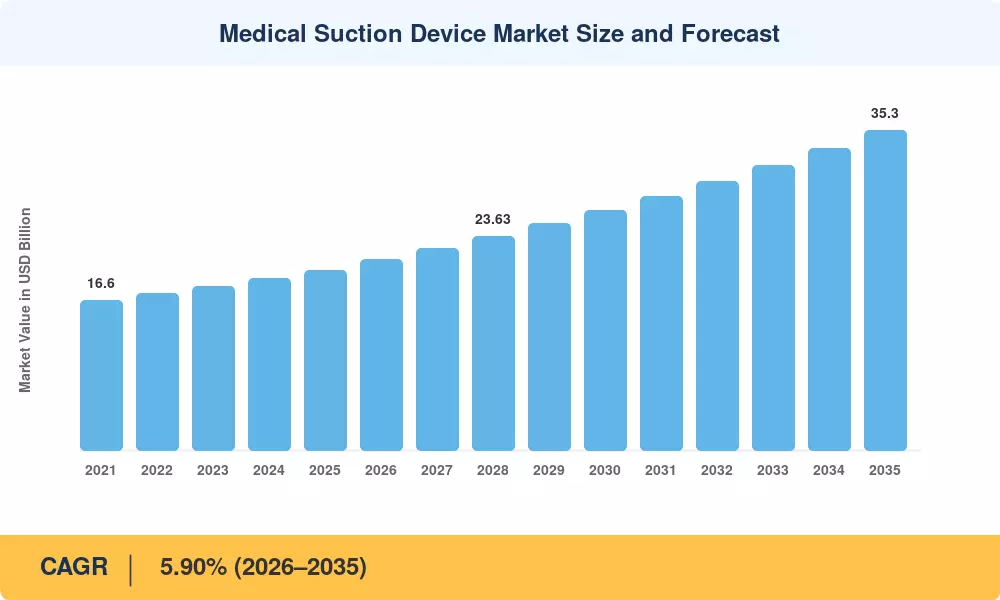
The Medical Suction Devices Market stood at USD 19.90 Billion in 2025, entering its forecast trajectory at USD 21.07 Billion in 2026 and projected to reach USD 35.30 Billion by 2035 at a 5.90% CAGR. Two catalysts underpin this expansion: the WHO's 2024 Global Patient Safety Action Plan, which mandates standardized suction protocols in 194 member states [1], and cumulative hospital capital-equipment spending that topped USD 480 Billion globally in 2024 [2]. Chronic respiratory disease prevalence — affecting roughly 545 million people worldwide — keeps airway-clearance procurement cycles short and replacement demand steady [3].

A technology shift is reshaping procurement priorities across the Medical Suction Devices Market. Legacy glass-jar, manual-pump units are giving way to closed-circuit, digitally monitored systems with antimicrobial tubing and automated usage logging. The U.S. Centers for Medicare & Medicaid Services (CMS) finalized ventilator-associated-event quality measures in 2024 that link reimbursement penalties to infection benchmarks, accelerating adoption of single-use canister designs and HEPA-filtered exhaust pathways [4]. Capital commitments to smart suction platforms exceeded USD 1.2 Billion across the top five OEMs between 2023 and 2025 [5].

North America commands a 45.20% revenue share, anchored by dense acute-care infrastructure and value-based purchasing incentives. Asia-Pacific is the fastest-growing region at a 7.50% CAGR, fuelled by India's Ayushman Bharat hospital expansion and China's county-hospital upgrade program. Europe holds the second-largest position with a 26.80% share, driven by EU MDR compliance spending and aging demographics. As ambulatory surgery volumes rise and home-care reimbursement pathways broaden, the Medical Suction Devices Market is poised for sustained capital-cycle renewal through 2035.


Key Report Takeaways

• By Type

  • AC-powered suction units held a 48.10% share of the Medical Suction Devices Market in 2025, reflecting entrenched wall-outlet infrastructure in acute-care settings.
  • Battery-powered units are forecast to expand at a 7.20% CAGR through 2035, driven by emergency-response and home-care adoption.

• By Portability

  • Wall-mounted systems led the Medical Suction Devices Market with a 49.50% share in 2025, supported by central-vacuum plumbing in new hospital builds.
  • Hand-held and portable configurations are set to grow at an 8.80% CAGR, reflecting field-care and disaster-readiness procurement.

• By Application

  • Airway-clearance devices accounted for USD 7.38 Billion in 2025 revenue, underpinned by chronic obstructive pulmonary disease (COPD) prevalence.
  • Surgical applications represented the largest application segment by share, benefiting from rising global procedure volumes.

• By End User

  • Hospitals captured a 45.30% share in 2025 across the Medical Suction Devices Market.
  • Home healthcare settings are expected to post a 9.30% CAGR through 2035, the fastest among end-user categories.

• By Region

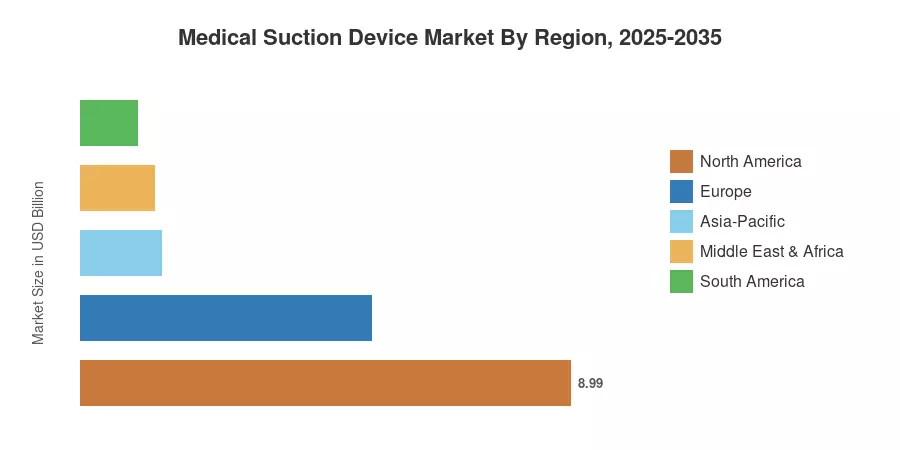
  • North America generated USD 8.99 Billion in 2025 revenue.
  • Asia-Pacific is projected to grow at a 7.50% CAGR, outpacing all other regions in the Medical Suction Devices Market.


Medical Suction Devices Market Size and Forecast (2021–2035)

Market Research Future's sizing framework triangulates bottom-up equipment-shipment data with top-down macroeconomic health-expenditure indicators. Historical figures (2021–2024) draw on customs trade databases, OEM revenue filings, and hospital capital-expenditure surveys. Forecast values apply a calibrated compound annual growth rate anchored to procedure-volume trajectories, reimbursement-policy shifts, and OEM capacity-expansion disclosures.
Medical Suction Device Market Size and Forecast
Our Impact
Enabled $4.3B Revenue Impact for Fortune 500 and Leading Multinationals
Partnering with 2000+ Global Organizations Each Year
30K+ Citations by Top-Tier Firms in the Industry

Driver Impact Analysis

Driver ~% Impact on CAGR Geographic Relevance Impact Timeline
Rising global surgical volumes +1.4% Global Long-term (≥4 yr)
Chronic respiratory disease burden +1.1% Global Long-term (≥4 yr)
Home-care reimbursement expansion +0.9% North America, Europe Medium-term (2–4 yr)
Infection-control regulatory tightening +0.8% North America, EU Short-term (≤2 yr)
Portable/battery technology advances +0.7% Global Medium-term (2–4 yr)
Emerging-market hospital construction +0.6% Asia-Pacific, MEA Long-term (≥4 yr)
Smart-device connectivity mandates +0.4% North America, Europe Medium-term (2–4 yr)


Rising Global Surgical Volumes

By 2024, there were more than 360 million inpatient surgical procedures performed worldwide; as low- and middle-income nations overcome access gaps, the Lancet Commission on Global Surgery predicts that number will rise to 430 million by 2030 [2]. There is a nearly linear link between procedure growth and suction-unit demand in the medical suction devices market since every operating room needs at least two suction endpoints: one for the surgical field and one for airway control. Between 2022 and 2025, the United States alone saw the construction of 1,200 new ambulatory surgery centers (ASCs), each of which represented a separate equipment order [11].


Chronic Respiratory Disease Burden

The Global Burden of Disease 2023 update [3] states that over 545 million people are affected by COPD, bronchiectasis, and cystic fibrosis combined. In extreme situations, airway-clearance suction devices are prescribed for daily secretion management, creating a recurrent stream of consumables (filters, tubing, and canisters) that supports aftermarket income. The Medical Suction Devices Market's addressable patient pool was increased in 2024 when home-suction reimbursement codes were added by national health systems in the UK and Germany [8].


Infection-Control Regulatory Tightening

CMS's updated Inpatient Quality Reporting programme now penalises hospitals up to 3% of Medicare DRG payments for elevated ventilator-associated pneumonia rates [4]. Closed-circuit suction catheter systems and antimicrobial canister liners directly mitigate these risks, converting regulatory pressure into accelerated replacement cycles. The European Medicines Agency's harmonised sterility guidance, effective January 2025, imposes comparable standards on suction consumables sold across the EU single market [7].

Emerging-Market Hospital Construction

India's Ayushman Bharat Health Infrastructure Mission committed INR 641 Billion (approximately USD 7.7 Billion) to establish 1,50,000 health-and-wellness centres and upgrade district hospitals [9]. China's 14th Five-Year Plan earmarked CNY 130 Billion for county-hospital modernization, with suction infrastructure included in standard operating-theatre fit-out specifications. These programmes anchor long-term volume growth for the Medical Suction Devices Market across Asia-Pacific.


Restraints Impact Analysis

Restraint-impact estimates follow the same directional methodology described in Section 4 and are not subtracted directly from the headline CAGR.

Restraint ~% Impact on CAGR Geographic Relevance Impact Timeline
Price sensitivity in public-tender markets –0.6% Asia-Pacific, South America Long-term (≥4 yr)
Reprocessing and reuse of consumables –0.5% Europe, Asia-Pacific Medium-term (2–4 yr)
Supply-chain concentration for vacuum pumps –0.4% Global Short-term (≤2 yr)
Regulatory divergence across emerging markets –0.3% MEA, South America Medium-term (2–4 yr)
Slow capital-cycle turnover in rural facilities –0.3% Global Long-term (≥4 yr)


Price Sensitivity in Public-Tender Markets

OEM margins are compressed by 15–25% in comparison to private-market pricing when government-run hospitals in India, Brazil, and Southeast Asia purchase suction equipment through lowest-price tenders [12]. This dynamic restricts the addressable market for premium-tier products in the Medical Suction Devices Market and deters R&D investment in features like digital flow monitoring. Only minimal suction requirements are included in WHO essential-equipment lists, thereby limiting public procurement to commodity-grade goods.


Reprocessing and Reuse of Consumables

Single-use suction canisters and tubing sets are refurbished by third-party reprocessors in Europe and some areas of Asia for resale for 40–60% of the OEM retail price [13]. Aftermarket revenue, which normally makes up 30–35% of an OEM's lifetime device economics, is diverted by this approach. The EU MDR strengthened traceability standards for reprocessed devices, but member state enforcement is still inconsistent, which keeps the grey-market route alive.


Supply-Chain Concentration for Vacuum Pumps

Approximately 65% of medical-grade diaphragm and rotary-vane pumps originate from three manufacturers in Germany and Japan [14]. Logistics disruptions — from port congestion to semiconductor shortages affecting pump-controller boards — can delay finished-device shipments by 8–12 weeks, creating order backlogs that temporarily suppress revenue recognition in the Medical Suction Devices Market.


Medical Suction Device Market Opportunities

Connected Suction Platforms and Data-Driven Services

Embedding IoT sensors into suction units enables real-time canister-fill monitoring, predictive maintenance alerts, and automated compliance logging. OEMs can monetize these data streams through subscription-based analytics dashboards sold to hospital biomedical-engineering departments. Early movers report 20% higher consumable-attachment rates when devices are paired with cloud platforms [5].

Home-Care and Post-Acute Suction Expansion

Medicare's expanded durable-medical-equipment (DME) reimbursement for home suction units, effective 2025, covers tracheostomy and COPD patients transitioning out of acute care [8]. The home-healthcare end-user segment is forecast to post a 9.30% CAGR through 2035, making it the single fastest-growing channel in the Medical Suction Devices Market. Lightweight, lithium-ion-powered devices with noise levels below 50 dB are critical to capturing this opportunity.

Emerging-Market Greenfield Hospital Programmes

Sub-Saharan Africa operates roughly 1.3 hospital beds per 1,000 people versus the WHO-recommended 3.0 [16]. National health-infrastructure bonds in Nigeria, Kenya, and Ethiopia collectively target 15,000 new beds by 2030, each requiring suction provisioning. Suppliers willing to localize assembly or offer deferred-payment financing can secure multi-year sole-source contracts.

Single-Use Closed-Circuit Systems

Ventilator-associated-event penalties and rising antimicrobial resistance are accelerating the shift from reusable to single-use suction circuits in intensive-care units [4]. The single-use segment currently represents under 20% of consumable revenue but is growing at roughly twice the rate of reusable systems, creating a high-margin consumables tailwind for OEMs that control canister and tubing manufacturing.

Battery-Density Improvements and Dual-Power Architectures

Lithium-iron-phosphate cell costs fell below USD 70 per kWh in 2024, enabling portable suction units with run times exceeding four hours on a single charge [10]. Dual-power (AC/DC) architectures address grid-instability concerns in South Asia and Sub-Saharan Africa while meeting disaster-preparedness standards in developed markets.


Medical Suction Device Market Future Outlook

AI-Enabled Predictive Maintenance and Autonomous Operation

Machine-learning algorithms trained on suction-flow, vacuum-pressure, and canister-fill data will enable predictive maintenance alerts that reduce unplanned downtime by an estimated 30% [5]. By the early 2030s, autonomous suction-intensity modulation — adjusting vacuum levels in real time based on tissue-proximity sensors — could become standard in robotic surgery suites, reshaping product-development roadmaps across the Medical Suction Devices Market.

Platform Economics and Consumable-as-a-Service Models

OEMs are beginning to mirror the razor-and-blade model, placing capital equipment at reduced upfront cost in exchange for multi-year consumable contracts. This platform approach stabilizes recurring revenue for manufacturers and converts hospital procurement from episodic capital expenditure to predictable operational expenditure. Market Research Future estimates that consumable-service contracts could represent 40% of total Medical Suction Devices Market revenue by 2033.

Decentralized Care and Portable Electrification

The shift toward ambulatory, home-based, and field-care delivery demands suction units that operate reliably off-grid. Lithium-iron-phosphate battery packs now deliver four-plus hours of continuous suction at clinically effective vacuum levels, and solar-charging accessories are entering clinical trials in East Africa [10]. Disaster-preparedness procurement by FEMA and equivalent agencies in Japan and Australia will sustain demand for ruggedized portable units.

Sustainability and Circular-Economy Pressures

Hospital sustainability officers are evaluating cradle-to-cradle lifecycle analyses for suction consumables. The EU's proposed Green Deal Industrial Plan includes medical devices within Scope 3 emissions-reporting requirements effective 2028, incentivizing OEMs to develop recyclable canisters and biodegradable tubing [21]. Companies that preemptively integrate design-for-recycling into their product lines will gain a competitive edge in the Medical Suction Devices Market during the second half of the forecast period.


Medical Suction Device Market Segmentation

By Type

Segment Key Metric Primary Demand Driver
AC-Powered 48.10% share (2025) Entrenched wall-outlet infrastructure
Battery-Powered 7.20% CAGR (2026–2035) Field-care and home-use expansion
Manual / Other USD 3.66 Billion (2025) Low-resource and emergency settings


AC-powered units remain the backbone of the Medical Suction Devices Market in hospital operating theatres and ICUs, where continuous high-flow suction is non-negotiable. These systems benefit from centralized vacuum supply lines in new-build facilities and typically command higher unit prices due to integrated flow-regulation electronics. Battery-powered units are closing the performance gap as lithium-ion cell costs decline; dual-power models that switch seamlessly between AC and battery modes are gaining traction in ambulatory surgery centres and emergency departments where uninterrupted suction during patient transfers is critical [10].

By Portability

Segment Key Metric Primary Demand Driver
Wall-Mounted 49.50% share (2025) Central-vacuum hospital plumbing
Hand-Held / Portable 8.80% CAGR (2026–2035) Disaster readiness and home care
Trolley / Cart-Mounted USD 3.72 Billion (2025) Procedural-room flexibility


Wall-mounted systems dominate institutional settings because they connect directly to building-integrated vacuum pipelines, eliminating the need for on-device motors and reducing noise levels. Portable and hand-held units, however, are the growth story — emergency medical services, home-care agencies, and military medical teams all require compact, battery-operated suction. The Medical Suction Devices Market is seeing a convergence trend where trolley-mounted units incorporate detachable portable modules, giving clinicians both high-flow stationary capability and grab-and-go mobility in a single purchase.

By Application

Segment Key Metric Primary Demand Driver
Airway Clearance USD 7.38 Billion (2025) COPD and tracheostomy prevalence
Surgical Applications 42.30% share (2025) Rising procedure volumes
Other Applications 5.40% CAGR (2026–2035) Wound care and liposuction growth


Surgical applications constitute the largest share, driven by the sheer volume of procedures requiring intra-operative fluid and tissue aspiration. Airway-clearance devices, while slightly smaller in share, generate disproportionate consumable revenue because chronic patients use them daily. The Medical Suction Devices Market also captures emerging demand from aesthetic procedures — liposuction aspirators and fat-transfer systems — which are growing at double-digit rates in markets such as Brazil, South Korea, and the UAE.

By End User

Segment Key Metric Primary Demand Driver
Hospitals 45.30% share (2025) High acuity; multi-department demand
Home Healthcare Settings 9.30% CAGR (2026–2035) Reimbursement expansion; aging demographics
Other End Users USD 5.23 Billion (2025) ASCs, clinics, EMS, military


Hospitals remain the largest purchaser within the Medical Suction Devices Market, with procurement cycles tied to operating-theatre renovation schedules and infection-control compliance deadlines. Home healthcare is the fastest-growing end-user segment, propelled by Medicare DME code expansions and patient-preference trends favouring recovery at home. Ambulatory surgery centres, dental clinics, and emergency medical services round out the "other" category, collectively accounting for a quarter of global revenue.


Regional Market Share Analysis

Region Key Metric Primary Investment Themes
North America 45.20% share (2025) Value-based purchasing; ASC expansion
Europe USD 5.33 Billion (2025) EU MDR compliance; aging demographics
Asia-Pacific 7.50% CAGR (2026–2035) Hospital construction; universal health coverage
South America USD 1.05 Billion (2025) Public-tender procurement modernization
Middle East & Africa 6.80% CAGR (2026–2035) Greenfield hospital builds; medical tourism
Total USD 19.90 Billion (2025)

The Medical Suction Devices Market exhibits a mature-growth profile in North America and Europe, with higher-velocity expansion across Asia-Pacific and select Middle Eastern and African corridors.


North America

Country Key Metric Key Driver
US 78.5% of regional share CMS quality penalties; ASC build-out
Canada 5.20% CAGR (2026–2035) Provincial home-care formulary expansion
Mexico USD 0.62 Billion (2025) IMSS hospital modernization programme


The US dominates North America's Medical Suction Devices Market, driven by over 6,100 acute-care hospitals and the highest per-capita surgical rate globally [11]. CMS value-based purchasing adjustments have converted suction-system upgrades from discretionary capital projects into compliance imperatives. Canada's provincial health authorities added portable suction devices to home-care equipment lists in Ontario and British Columbia during 2024, while Mexico's IMSS allocated MXN 18 Billion for operating-theatre refurbishment across 260 facilities [17].

Europe

Country Key Metric Key Driver
Germany 24.3% of regional share MedTech hub; DRG reimbursement incentives
UK 5.60% CAGR (2026–2035) NHS equipment-replacement framework
France USD 0.74 Billion (2025) AP-HP hospital renovation cycle
Italy 4.90% CAGR (2026–2035) PNRR healthcare investment
Spain USD 0.39 Billion (2025) Autonomous-community procurement reform
Nordic Countries 5.30% CAGR (2026–2035) Centralized procurement efficiency
Russia USD 0.31 Billion (2025) Import-substitution policy
Rest of Europe 4.70% CAGR (2026–2035) EU cohesion-fund health projects


Germany anchors European demand thanks to its dense hospital network and leadership in medical-device manufacturing. Italy's National Recovery and Resilience Plan (PNRR) earmarked EUR 15.6 Billion for healthcare facility upgrades, with operating-theatre suction infrastructure included in standard fit-out packages [18]. The UK's NHS Long Term Plan prioritizes equipment standardization, creating framework agreements that favour OEMs offering wall-mounted and portable suction units under a single contract.

Asia-Pacific

Country Key Metric Key Driver
China 35.8% of regional share County-hospital upgrade programme
India 8.90% CAGR (2026–2035) Ayushman Bharat infrastructure mission
Japan USD 0.58 Billion (2025) Aging population; long-term-care demand
South Korea 6.40% CAGR (2026–2035) Digital-hospital investments
ASEAN USD 0.41 Billion (2025) Medical-tourism facility expansion
Rest of Asia-Pacific 7.10% CAGR (2026–2035) Universal health coverage rollouts


China's 14th Five-Year Plan mandated suction-system installation in every county-level hospital emergency department, underpinning a procurement wave estimated at 120,000 units between 2023 and 2027 [9]. India's rapid private-hospital expansion — led by chains such as Apollo and Fortis — complements public-sector demand from the Ayushman Bharat programme. Japan's super-aging society drives home-suction prescriptions for tracheostomy patients, positioning the country as a high-value niche within the Medical Suction Devices Market.

South America

Country Key Metric Key Driver
Brazil 58.2% of regional share SUS hospital recapitalization
Argentina 5.10% CAGR (2026–2035) Private-clinic investment recovery
Rest of South America USD 0.19 Billion (2025) Multilateral health-financing programmes


Brazil's Unified Health System (SUS) launched a BRL 4.5 Billion equipment-renewal programme in 2024 targeting secondary and tertiary hospitals, with suction devices listed among priority capital items [19]. Argentina's private healthcare sector is rebounding from macroeconomic contraction, directing fresh investment toward surgical-suite upgrades in Buenos Aires and Córdoba. The Medical Suction Devices Market in the broader region benefits from Pan American Health Organization technical-assistance programmes that standardize procurement specifications.

Middle East & Africa

Country Key Metric Key Driver
Saudi Arabia 30.5% of regional share Vision 2030 healthcare megaprojects
UAE 7.20% CAGR (2026–2035) Medical-tourism infrastructure
South Africa USD 0.18 Billion (2025) NHI pilot rollout
Egypt 6.50% CAGR (2026–2035) Universal health insurance expansion
Rest of MEA USD 0.21 Billion (2025) NGO and multilateral facility builds


Saudi Arabia's Vision 2030 healthcare pillar targets 20,000 additional hospital beds by 2030, each requiring centralized and portable suction provisioning [20]. The UAE continues to attract medical tourists, prompting private hospital operators such as NMC Health and Mediclinic to invest in premium operating-theatre suites. South Africa's National Health Insurance pilot, launched in 2024, is funnelling public capital into primary-care facility upgrades, expanding the addressable footprint of the Medical Suction Devices Market across sub-Saharan Africa.


Medical Suction Device Market By Region, 2025-2035

Competitive Benchmarking

The Medical Suction Devices Market exhibits medium concentration; the top five players account for an estimated 38–44% of global revenue, while a long tail of regional specialists and consumable-focused firms fragments the remainder. The Herfindahl-Hirschman Index sits in the 800–1,200 range, indicating a moderately competitive structure. Differentiation hinges on vacuum-performance specifications, portability features, consumable lock-in strategies, and service-network breadth.

Company Est. Revenue Share Range Key Offerings for Medical Suction Devices Market Strategic Positioning
Medela AG ~8–11% Hospital and home-care suction systems; closed-circuit canisters Vertically integrated; strong home-care channel
Allied Healthcare Products ~6–9% Aspirator pumps; portable field-suction units North America-focused; EMS and military channels
Drive DeVilbiss Healthcare ~5–8% Portable and stationary suction devices; respiratory accessories Broad DME distribution; value-tier pricing
Cardinal Health ~5–7% Surgical suction tubing and canister systems Consumable-centric; GPO contract access
Olympus Corporation ~4–6% Endoscopic suction/irrigation systems Premium surgical-suite integration
ATMOS MedizinTechnik ~3–5% Thoracic drainage; OR suction workstations European specialty focus; ENT leadership
Precision Medical ~3–5% Continuous and intermittent suction regulators US hospital-supply chain; regulatory agility
Integra LifeSciences ~3–5% Neurosurgical suction instruments; wound drainage Specialty surgical niches
SSCOR Inc. ~2–4% Emergency portable suction; DuCanto catheter systems EMS and pre-hospital segment leader
Laerdal Medical ~2–4% Compact suction units; training simulators Education-integrated sales model


Recent News & Developments

  • Medela AG (March 2025): Launched the Thopaz+ Digital Chest Drainage System with integrated suction analytics, targeting ICU and thoracic-surgery units across Europe and North America [5].


  • Cardinal Health (October 2024): Signed a five-year consumable-supply agreement with Premier Inc., covering suction canisters and tubing for over 4,400 US hospitals [22].
  • CMS (July 2024): Finalized updates to the Inpatient Quality Reporting programme linking ventilator-associated-event metrics to DRG payment adjustments, effective fiscal year 2025 [4].
  • ATMOS MedizinTechnik (April 2024): Opened a new clean-room manufacturing facility in Lenzkirch, Germany, doubling production capacity for surgical-suction workstations [23].
  • Olympus Corporation (November 2023): Acquired a minority stake in a Japanese robotics start-up developing automated suction-irrigation modules for laparoscopic platforms [24].
  • Laerdal Medical (August 2023): Partnered with the WHO to distribute 50,000 compact suction units to primary-care facilities in sub-Saharan Africa under the Essential Equipment Initiative [16].


Medical Suction Device Market Report Scope

Parameter Detail
Market Scope Global Medical Suction Devices Market (devices, consumables, accessories)
Study Period 2021–2035
CAGR (Forecast) 5.90% (2026–2035)
Base Year Size USD 19.90 Billion (2025)
Forecast Endpoint USD 35.30 Billion (2035)
Fastest Growing Segment Home Healthcare Settings (9.30% CAGR)
Companies Profiled 10 (see Section 10)
Valuation Currency USD Billion


FAQs

What sterilization standards should procurement teams verify before purchasing suction canisters?
Look for ISO 11137 (radiation sterilization) or ISO 11135 (ethylene oxide) certification on packaging labels. Confirm the manufacturer's validated shelf life matches your facility's inventory turnover cycle [7].
How do closed-circuit suction catheters reduce total cost of ownership compared with open systems?
Closed-circuit designs cut ventilator-circuit disconnections, reducing ventilator-associated pneumonia rates by up to 40% and the associated treatment costs [4]. Lower infection penalties and fewer consumable changeovers offset the higher per-unit price.
What battery chemistries currently dominate portable suction devices, and which are emerging?
Lithium-ion cells power most current portable units. Lithium-iron-phosphate chemistry is gaining ground because it offers longer cycle life and better thermal stability at comparable weight [10].
How should facilities in regions with unreliable power grids specify suction equipment?
Specify dual-power (AC/DC) units with automatic failover and a minimum four-hour battery runtime. Verify that vacuum performance at battery end-of-charge meets the facility's clinical suction-pressure requirements [10].
What role do group purchasing organizations play in shaping competitive dynamics in this space?
GPOs aggregate demand across member hospitals, negotiating volume discounts that can compress OEM margins by 15–25% [22]. Winning a GPO contract secures multi-year revenue visibility but limits pricing flexibility.
Are there specific cybersecurity considerations for IoT-enabled suction devices?
Connected suction units transmitting patient-adjacent data must comply with FDA pre-market cybersecurity guidance (2023) and the EU Cyber Resilience Act. Facilities should require signed firmware updates and network segmentation [5].
How does the Medical Suction Devices Market differ in paediatric versus adult care settings?
Paediatric suction requires lower vacuum pressures (60–100 mmHg versus 150–200 mmHg for adults) and smaller-bore tubing. Devices with adjustable pressure regulators serve both populations and reduce SKU proliferation [6].    
Author
Author
Author Profile
Vikita Thakur LinkedIn
Senior Research Analyst
She holds an experience of about 5+ years in market research and business consulting projects for sectors such as life sciences, medical devices, and healthcare IT. She possesses a robust background in data analysis, market estimation, competitive intelligence, pipeline analysis market trend identification, and consumer behavior insights. Her expertise lies in technical Sales support, client interaction and project management, designing and implementing market research studies, conducting competitive analysis, and synthesizing complex data into actionable recommendations that drive business growth.
Co-Author
Co-Author Profile
Kinjoll Dey LinkedIn
Senior Research Analyst
He is an extremely curious individual currently working in Healthcare and Medical Devices Domain. Kinjoll is comfortably versed in data centric research backed by healthcare educational background. He leverages extensive data mining and analytics tools such as Primary and Secondary Research, Statistical Analysis, Machine Learning, Data Modelling. His key role also involves Technical Sales Support, Client Interaction and Project management within the Healthcare team. Lastly, he showcases extensive affinity towards learning new skills and remain fascinated in implementing them.

Research Approach


Secondary Research

The secondary research process involved comprehensive analysis of regulatory databases, peer-reviewed clinical journals, medical device industry publications, and authoritative health technology organizations. Key sources included the US Food & Drug Administration (FDA) Center for Devices and Radiological Health (CDRH) 510(k) clearances and PMA approvals, European Medicines Agency (EMA) Medical Device Regulation (MDR) databases, Health Canada Medical Devices Active Licence Listing (MDALL), Therapeutic Goods Administration (TGA) Australia, Pharmaceuticals and Medical Devices Agency (PMDA) Japan, and National Medical Products Administration (NMPA) China. Clinical and epidemiological data were sourced from the Centers for Disease Control and Prevention (CDC) National Hospital Ambulatory Medical Care Survey (NHAMCS), National Center for Health Statistics (NCHS) surgical procedure databases, World Health Organization (WHO) Global Health Observatory respiratory disease statistics, Organisation for Economic Co-operation and Development (OECD) Health Statistics, and Centers for Medicare & Medicaid Services (CMS) procedure utilization data.

Industry-specific sources included the Advanced Medical Technology Association (AdvaMed), Medical Device Manufacturers Association (MDMA), Health Industry Distributors Association (HIDA), Association of periOperative Registered Nurses (AORN) surgical volume reports, American Association for Respiratory Care (AARC) clinical practice guidelines, European Association of Hospital Pharmacists (EAHP), and Japan Federation of Medical Devices Associations (JFMDA). These sources were used to collect device approval data, surgical and respiratory procedure statistics, hospital procurement patterns, infection control protocols, and competitive landscape analysis for portable suction units, wall-mounted systems, suction canisters, and battery-operated emergency devices.


Primary Research

Primary Respondent Breakdown:

By Designation: C-level Primaries (30%), Director Level (40%), Others (30%)

By Region: North America (32%), Europe (30%), Asia-Pacific (28%), Rest of World (10%)


Market Size Estimation

Global market valuation was derived through revenue mapping, surgical procedure volume analysis, and respiratory disease prevalence modeling. The methodology included:

Identification of 50+ key manufacturers across North America, Europe, Asia-Pacific, Latin America, and Middle East & Africa specializing in portable suction devices, wall-mounted surgical suction systems, and disposable accessories (canisters, tubing, filters)

Product mapping across electric suction devices (AC-powered), manual suction units (hand-operated), battery-operated portable devices, and suction accessories (collection canisters, bacterial filters, suction catheters) by application area (surgical procedures, airway management, wound drainage, dental extraction)

Analysis of reported and modeled annual revenues specific to suction and vacuum device portfolios, including both capital equipment sales and recurring revenue from disposable consumables

Coverage of manufacturers representing 75-80% of global market share in 2024, including market leaders in critical care suction, emergency transport devices, and home healthcare aspirators

Extrapolation using bottom-up (procedure volume × ASP by country across surgical, emergency, and respiratory indications) and top-down (manufacturer revenue validationand distributor shipment data) approaches to derive segment-specific valuations for hospital inpatient, ASC, home care, and dental clinic end-use settings

Download Free Sample

Kindly complete the form below to receive a free sample of this Report

Download PDF ×

We do not share your information with anyone. However, we may send you emails based on your report interest from time to time. You may contact us at any time to opt-out.
















