Medium Voltage Drives Market (2026 - 2035)

Medium Voltage Drives Market Size, Share & Growth Analysis Report By Voltage Rating (3.3 kV, 6.6 kV, 11 kV and above), By Application (Pumps, Fans & Blowers, Compressors, Conveyors & Mills, Extruders & Other), By End-Use Industry (Oil & Gas, Mining & Metals, Water & Wastewater, Power Generation, Cement & Building Materials, Others (Pulp, Chemical, Marine)) and By Regional (North America, Europe, South America, Asia Pacific, Middle East and Africa) โ€“ Industry Growth & Forecast to 2035
ID: MRFR/EnP/9730-HCR
200 Pages
Snehal Singh
Last Updated: June 29, 2026
Medium Voltage Drives Market
Market Size
Forecast Period2026-2035
CAGR (2026-2035)6.5%
2025 Market SizeUSD 4.80 Billion
2035 Market SizeUSD 9.01 Billion
Key Players
ABB
Siemens
Danfoss
Schneider Electric
Mitsubishi Electric
Rockwell Automation
Opportunities
  • Retrofit and Upgrade of Legacy Motor Systems
  • Green Hydrogen and Desalination Plants
  • Data Monetization through Drive-Embedded Analytics

Medium Voltage Drives Market Summary

The Medium Voltage Drives Market reached an estimated USD 4.80 billion in 2025 and is projected to grow from USD 5.11 billion in 2026 to USD 9.01 billion by 2035, registering a CAGR of 6.5% during the 2026โ€“2035 forecast period. Two forces are converging to fuel this expansion: tightening global efficiency mandates โ€” the EU's revised Ecodesign Regulation (EU 2019/1781) now requires IE4 motor efficiency across a broader power range โ€” and accelerating capital spending on industrial electrification, which the IEA pegged at over USD 135 billion globally in 2024 alone [1]. Together, these catalysts are making medium voltage drives a non-negotiable component of modern heavy-industry infrastructure.

Legacy fixed-speed motor systems, which still account for roughly 60% of installed medium voltage motor capacity worldwide, are being displaced by variable frequency drive technology that cuts energy consumption by 20โ€“40% in centrifugal-load applications [2]. The U.S. Department of Energy estimates that motors above 375 kW represent nearly 30% of total industrial electricity demand, positioning the Medium Voltage Drives Market at the center of the industrial decarbonization conversation [3].

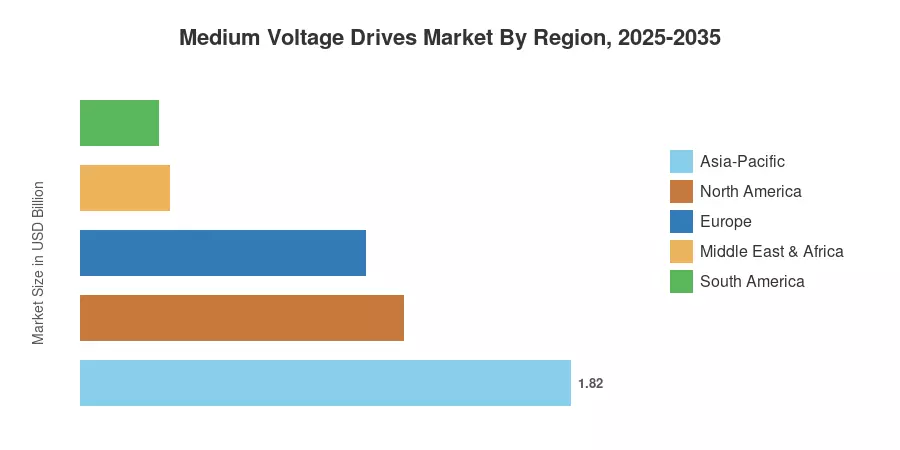
Asia-Pacific commands the largest share of the Medium Voltage Drives Market at approximately 38% of global revenue, driven by China's aggressive infrastructure and mining modernization programs. The region also registers the fastest CAGR at roughly 7.4%. Europe holds the second-largest share, near 22%, supported by stringent efficiency directives, while North America accounts for about 25% of the total. The next decade will see retrofit demand and digitalization of legacy plants open new growth corridors across every region.

ย 

Key Report Takeaways

โ€ข By Voltage Rating

  • The 3.3 kV segment dominates the Medium Voltage Drives Market with approximately 42% revenue share in 2025, owing to its prevalence in water and wastewater pumping and general industrial processes.
  • The 6.6 kV segment is forecast to grow at a CAGR of 7.1% through 2035, propelled by large-scale mining conveyor and compressor installations.
  • The 11 kV-and-above category is gaining traction in power generation and petrochemical applications, contributing an estimated USD 0.58 billion in 2025.

โ€ข By Application

  • Pumps represent the single largest application within the Medium Voltage Drives Market, commanding roughly 34% of revenue.
  • Fans and blowers rank second, generating an estimated USD 1.20 billion in 2025.
  • Compressor applications are expanding at a CAGR of 7.3%, the fastest among application segments, driven by LNG and petrochemical expansion.

โ€ข By Region

  • Asia-Pacific leads with a 38% share of the Medium Voltage Drives Market in 2025.
  • North America contributes approximately USD 1.20 billion and benefits from aging plant retrofit cycles.
  • The Middle East & Africa region is forecast to grow at a CAGR of 6.9%, anchored by oil and gas capital expenditure.

ย 

Market Size and Forecast (2021โ€“2035)

Market Research Future's sizing methodology triangulates bottom-up equipment shipment data from leading OEMs, top-down industrial motor electricity consumption models derived from IEA and EIA databases, and validated demand-side interviews across 12 end-use verticals. Historical figures (2021โ€“2024) reflect confirmed shipment revenues; the base year (2025) is a composite estimate; and forecast values (2026โ€“2035) apply a modeled 6.5% CAGR adjusted for cyclical capital expenditure patterns [4].
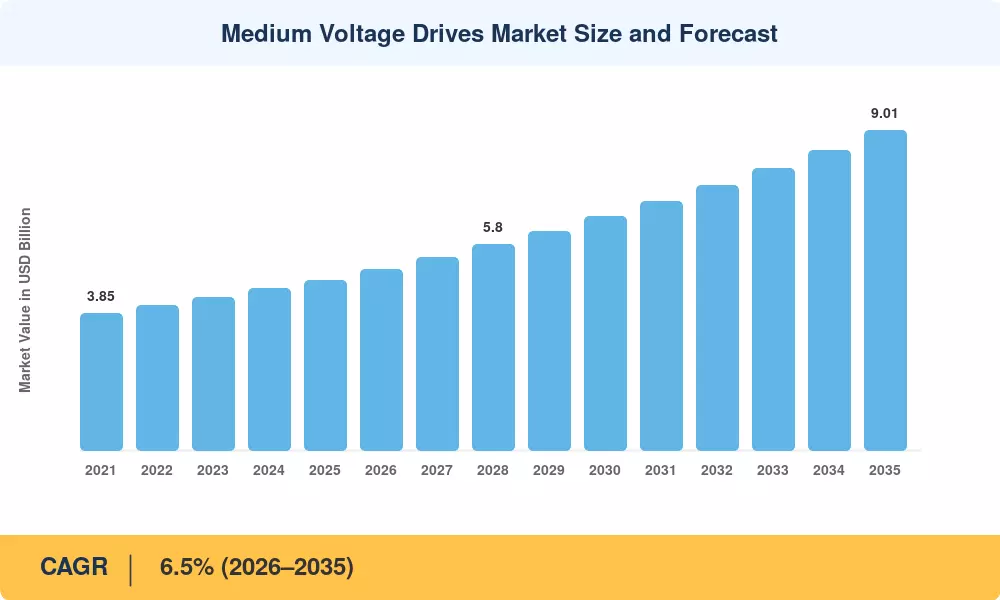
Medium Voltage Drives Market Size and Forecast
Our Impact
Enabled $4.3B Revenue Impact for Fortune 500 and Leading Multinationals
Partnering with 2000+ Global Organizations Each Year
30K+ Citations by Top-Tier Firms in the Industry

Driver Impact Analysis

Driver ~% Impact on CAGR Geographic Relevance Impact Timeline
Industrial energy efficiency mandates +1.4% Global Short-term
Mining & minerals electrification +1.1% APAC, LATAM, MEA Medium-term
Oil & gas mid-stream expansion +0.9% N. America, MEA Medium-term
Water infrastructure modernization +0.7% Global Long-term
Digital twin and predictive maintenance adoption +0.6% N. America, Europe Medium-term
Renewable integration (green hydrogen, desalination) +0.5% Europe, MEA Long-term
Aging installed base replacement cycle +0.8% N. America, Europe Short-term

ย 

Industrial Energy Efficiency Mandates

Governments worldwide are ratcheting motor-system efficiency standards. The EU's Ecodesign Regulation (EU 2019/1781), effective from July 2023 for motors between 75 kW and 200 kW, now pushes compliance into medium voltage territory. China's GB 18613-2020 standard mirrors this trajectory. The IEA estimates that motor-driven systems consume roughly 45% of global electricity, and deploying variable speed drives on just half of eligible medium voltage motors could save over 200 TWh per year [1]. This policy pressure is the single largest driver of the Medium Voltage Drives Market, converting what was historically a discretionary efficiency upgrade into a regulatory compliance requirement.

Mining and Minerals Electrification

The global push toward battery metals โ€” lithium, copper, nickel, cobalt โ€” is driving record capital expenditure in mining. BloombergNEF projects that mining CAPEX for energy-transition minerals will exceed USD 90 billion cumulatively through 2030 [8]. Medium voltage drives are essential for conveyors, crushers, and mill drives in these operations, and greenfield mine designs now default to variable speed drive configurations for all loads above 300 kW. This is particularly impactful in Australia, Chile, and the Democratic Republic of Congo.

Oil and Gas Mid-Stream Expansion

Pipeline compressor stations and LNG liquefaction trains represent high-value opportunities for the Medium Voltage Drives Market. The U.S. alone approved over 15 GW of new LNG export capacity between 2023 and 2025, each train requiring multiple 5โ€“15 MW compressor drives [6]. Across the Middle East, Saudi Aramco and ADNOC are expanding downstream processing capacity with fully electric motor-driven compression, replacing gas turbine mechanical drives.

Aging Installed Base Replacement Cycle

An estimated 40% of installed medium voltage drives in North America and Europe were commissioned before 2010, placing them beyond typical 15-year lifecycle windows [11]. Spare-part obsolescence and rising maintenance costs are forcing operators to invest in replacement units. The U.S. Department of Energy's Better Plants Program has documented 25โ€“35% energy savings when legacy fixed-speed systems are replaced with modern drives, providing a compelling ROI case that typically achieves payback within 18โ€“30 months [3].

ย 

Restraints Impact Analysis

The restraint impacts below are directional negatives on market growth. They do not sum to an offset of the overall CAGR and should be read as qualitative indicators of headwind severity.

Restraint ~% Impact on CAGR Geographic Relevance Impact Timeline
High upfront capital cost โ€“0.8% Global Short-term
Grid power quality and harmonic distortion concerns โ€“0.5% Global Medium-term
Shortage of specialized commissioning engineers โ€“0.4% APAC, MEA, LATAM Short-term
Supply chain bottlenecks for IGBT modules โ€“0.3% Global Short-term
Competition from high-voltage direct-drive systems โ€“0.2% Europe, N. America Long-term

ย 

High Upfront Capital Cost

A complete medium voltage drive system โ€” including transformer, drive cabinet, cooling infrastructure, and harmonic filters โ€” can cost USD 150โ€“500 per kilowatt depending on topology and voltage class, placing total project costs for a single 5 MW installation between USD 750,000 and USD 2.5 million. While lifecycle energy savings typically justify the investment within two to three years, many asset owners in cost-sensitive markets still perceive the initial expenditure as prohibitive, particularly when budgets compete with other operational priorities.

Grid Harmonic Distortion

Medium voltage drives inject harmonic currents into distribution networks. IEEE 519-2022 sets total harmonic distortion limits at the point of common coupling, often requiring expensive multi-pulse transformer configurations or active front-end rectifiers that add 15โ€“25% to system cost [13]. In regions with weak grid infrastructure, utilities may impose even stricter connection requirements, delaying project approvals and raising compliance expenses.

Skilled Workforce Shortage

Commissioning and maintaining medium voltage drive systems requires specialized high-voltage electrical training that is in short supply globally. The International Labour Organization estimates a 14% deficit of qualified electrical engineers in emerging economies, directly constraining deployment speed in fast-growing markets across Southeast Asia and sub-Saharan Africa [14].

ย 

Medium Voltage Drives Market Opportunities

Retrofit and Upgrade of Legacy Motor Systems

EPRI estimates that there are more than 1.5 million medium voltage motors in use worldwide without variable speed control [11]. The TAM of retrofitting these installations is >USD 8 billion at todayโ€™s drive pricing. In North America alone, the average age of installed industrial motors is over 18 years, which is providing a long-term replacement wave that will continue to support the Medium Voltage Drives Market until 2035.

ย 

Green Hydrogen and Desalination Plants

Medium voltage drives are an important enabling technology, as large-scale green hydrogen electrolyzers use compressor and pump drives in the 3.3โ€“11 kV range. The EU REPowerEU plan aims to produce 10 million tons of home green hydrogen by 2030, which implies hundreds of huge electrolyser sites, each with auxiliary systems rated in the MV range [7].

ย 

Data Monetization through Drive-Embedded Analytics

Modern drives with edge computing functionality can continuously gather motor vibration, temperature and power quality data. For instance, ABB and Siemens are establishing subscription-based predictive maintenance services on top of this data stream, enabling recurring revenue models that can generate 5-8% incremental margin over and beyond hardware sales [10].

ย 

Emerging Market Infrastructure Expansion

Indiaโ€™s Smart Cities Mission and Africaโ€™s continental infrastructure initiative (PIDA) are investing more than USD 50 billion in water treatment, power production and industrial zones between 2024 and 2030 [9]. These greenfield projects specify modern driving technology from the outset, avoiding the retrofit cost barrier. Medium Voltage Drives Market to grab a substantial share as these programs proceed from planning to procurement

a

Mining Decarbonization Mandates

Major mining companies including BHP, Rio Tinto, and Glencore have committed to reducing Scope 1 and 2 emissions by 30โ€“50% before 2030 [8]. Electrifying diesel-driven haul trucks, conveyors, and grinding mills with medium voltage drive systems is one of the most capital-efficient abatement levers, with documented COโ‚‚ reductions of 20โ€“35% per installation.

ย 

Medium Voltage Drives Market Future Outlook

AI-Driven Predictive Maintenance and Autonomous Motor Control

Artificial intelligence is transforming drive systems from standalone speed controllers into intelligent motor management platforms. By 2030, an estimated 35% of newly commissioned medium voltage drives will include embedded machine learning algorithms capable of detecting bearing degradation, winding insulation breakdown, and process anomalies 48โ€“72 hours before failure [10]. This shift will reduce unplanned downtime costs โ€” currently estimated at USD 50 billion per year across global heavy industry โ€” by 15โ€“25%.

Electrification Supercycle in Mining and Heavy Industry

The International Energy Agency projects that global demand for copper, lithium, and rare earth elements will grow 2โ€“4x by 2035, requiring proportional expansion of extraction and processing capacity [7]. Every new mine, smelter, and refinery built during this supercycle will specify medium voltage drives as standard equipment for loads above 200 kW. The Medium Voltage Drives Market is positioned to capture an outsized share of this capital expenditure wave.

Grid Integration and Power Quality as a Service

As renewable penetration exceeds 40% in major grids, power quality management becomes critical. Advanced medium voltage drives with active front-end technology can function as dynamic grid stabilizers, absorbing voltage fluctuations and providing reactive power compensation. IRENA forecasts that global renewable capacity will reach 17 TW by 2035, creating persistent demand for grid-friendly industrial loads [17].

Circular Economy and Drive Lifecycle Extension

OEMs are introducing modular drive architectures that allow individual power cell replacement without full system changeover, extending drive lifespans from 15 to 25+ years. Siemens' and ABB's trade-in programs recondition returned power modules for secondary markets, reducing e-waste and lowering the total cost of ownership by an estimated 20% [18]. This model aligns with ESG reporting requirements under the EU Corporate Sustainability Reporting Directive.

ย 

Medium Voltage Drives Market Segmentation

By Voltage Rating

Segment Key Metric Primary Demand Driver
3.3 kV 42% market share Water/wastewater, general industry
6.6 kV CAGR 7.1% Mining conveyors, LNG compression
11 kV and above USD 0.58 B (2025) Power generation, petrochemicals

ย 

The 3.3 kV segment anchors the Medium Voltage Drives Market because it addresses the broadest range of industrial motor ratings, typically covering loads from 200 kW to 3 MW. Applications span municipal water pumping, HVAC systems in large commercial complexes, and process fans in cement and steel plants. Its relative affordability compared to higher-voltage alternatives ensures sustained adoption across both developed and emerging economies.

Higher voltage classes โ€” 6.6 kV and 11 kV โ€” serve specialized heavy-industry applications where motor ratings exceed 5 MW. The 6.6 kV segment is the fastest growing within the Medium Voltage Drives Market, driven by greenfield mining projects and LNG liquefaction trains that require high-power compressor drives with superior harmonic performance.

By Application

Segment Key Metric Primary Demand Driver
Pumps 34% market share Water infrastructure, oil pipeline
Fans & Blowers USD 1.20 B (2025) Cement, power plant ID/FD fans
Compressors CAGR 7.3% LNG, gas transmission, refrigeration
Conveyors & Mills USD 0.62 B (2025) Mining, bulk material handling
Extruders & Other CAGR 5.8% Plastics, rubber processing

ย 

Pumps generate the largest application revenue within the Medium Voltage Drives Market, reflecting the sheer volume of centrifugal pump installations across water utilities, oil pipelines, and district cooling systems globally. Variable speed control on centrifugal pumps yields 20โ€“40% energy savings compared to throttle-valve regulation, making the ROI argument exceptionally strong for end users [2].

Compressor drives are attracting the most new investment, with LNG terminal operators increasingly specifying electric motor-driven compression to reduce carbon intensity. A single LNG train can require four to six compressor drive systems rated between 8 MW and 30 MW, representing contract values of USD 5โ€“20 million per installation [6].

By End-Use Industry

Segment Key Metric Primary Demand Driver
Oil & Gas 26% market share Pipeline, refinery, LNG
Mining & Metals CAGR 7.6% Electrification mandates
Water & Wastewater USD 0.72 B (2025) Infrastructure stimulus
Power Generation 14% market share Auxiliary systems, FGD
Cement & Building Materials CAGR 5.9% Kiln and mill modernization
Others (Pulp, Chemical, Marine) USD 0.38 B (2025) Diverse industrial demand

ย 

Oil and gas remains the highest-revenue end-use vertical for the Medium Voltage Drives Market, reflecting the sector's concentration of large rotating equipment requiring precise speed control. Mining and metals are closing the gap rapidly, registering the highest segment CAGR as global decarbonization commitments compel operators to replace diesel mechanical systems with electric drive solutions [8].

ย 

Regional Market Share Analysis

Region Key Metric Primary Investment Themes
Asia-Pacific 38% global share Mining, infrastructure, manufacturing
North America USD 1.20 B (2025) Retrofit, LNG, water infrastructure
Europe 22% global share Efficiency mandates, green hydrogen
Middle East & Africa CAGR 6.9% Oil & gas, desalination, mining
South America USD 0.29 B (2025) Mining, pulp & paper
Total USD 4.80 B ย 

The Medium Voltage Drives Market exhibits distinct regional dynamics shaped by industrialization maturity, energy policy, and resource endowment. Asia-Pacific dominates in absolute terms, while the Middle East & Africa region is gaining momentum.

ย 

Asia-Pacific

Country Key Metric Key Driver
China 48% of APAC revenue Industrial modernization, coal-to-electric transition
India CAGR 8.2% Smart Cities Mission, water infrastructure
Japan USD 0.18 B Process automation upgrades
Australia 12% of APAC revenue Mining electrification
South Korea CAGR 5.8% Semiconductor fab and shipbuilding expansion

ย 

China's "Made in China 2025" initiative and subsequent industrial upgrading programs have driven massive adoption of variable speed drives across cement, steel, and petrochemical sectors. India is the fastest-growing country-level market, with the Jal Jeevan Mission alone creating demand for hundreds of medium voltage pump drives across rural water supply systems [5].

North America

Country Key Metric Key Driver
United States 78% of regional revenue LNG, aging infrastructure, DOE programs
Canada CAGR 6.1% Oil sands, mining
Mexico USD 0.07 B Manufacturing nearshoring

ย 

The United States accounts for the vast majority of North American demand within the Medium Voltage Drives Market, with the Inflation Reduction Act's Section 48C tax credits providing up to 30% investment incentives for energy-efficient industrial equipment upgrades [3]. Canada's oil sands operations continue to electrify extraction processes, reducing flaring and diesel dependency.

Europe

Country Key Metric Key Driver
Germany 28% of European revenue Chemicals, automotive manufacturing
United Kingdom CAGR 6.3% Offshore wind, water utilities
France USD 0.14 B Nuclear auxiliary systems
Rest of Europe 35% of European revenue Nordic mining, Iberian renewables

ย 

Europe's regulatory environment is the most prescriptive globally for motor efficiency. The Ecodesign Regulation directly expands the addressable market for the Medium Voltage Drives Market by mandating efficiency improvements that are practically achievable only through variable speed drive technology [1].

South America

Country Key Metric Key Driver
Brazil 62% of regional revenue Mining (iron ore, bauxite), sugar/ethanol
Chile CAGR 7.5% Copper mining electrification
Rest of South America USD 0.04 B Oil & gas, agriculture

ย 

Chile's copper mining sector is a standout growth engine for the Medium Voltage Drives Market in South America, with Codelco and BHP committing over USD 12 billion to mine electrification programs through 2030 [8].

Middle East & Africa

Country/Sub-Region Key Metric Key Driver
Saudi Arabia 35% of MEA revenue Vision 2030, NEOM, desalination
UAE CAGR 7.0% Downstream petrochemicals
South Africa USD 0.06 B Mining, power generation
Rest of MEA 28% of MEA revenue Sub-Saharan infrastructure

ย 

Saudi Arabia's Vision 2030 is driving large-scale desalination plant construction requiring high-capacity pump drives, while NEOM's industrial zone will incorporate full electric drive systems across all process plants. The Medium Voltage Drives Market in this region benefits from strong government-backed capital programs with long procurement pipelines [9].

ย 

Medium Voltage Drives Market By Region, 2025-2035

Competitive Benchmarking

The Medium Voltage Drives Market is moderately concentrated, with an estimated Herfindahl-Hirschman Index of approximately 1,200โ€“1,400. The top five players โ€” ABB, Siemens, Danfoss (through its Vacon legacy), Schneider Electric, and Mitsubishi Electric โ€” collectively hold an estimated 55โ€“62% revenue share. Competition intensifies in the mid-power range (1โ€“5 MW), where regional manufacturers from China and India are gaining ground on price. Differentiation increasingly centers on digital services, harmonic performance, and lifecycle support rather than hardware specifications alone.

Company Est. Revenue Share Range Key Offerings for Medium Voltage Drives Market Strategic Positioning
ABB ~14โ€“17% ACS6080, ACS5000 Full-spectrum portfolio, digital services leader
Siemens ~13โ€“16% SINAMICS GM150, GH150, Perfect Harmony Strong in mining and process industries
Danfoss ~8โ€“11% VACON NXP, iC7 series Energy efficiency specialist, HVAC focus
Schneider Electric ~6โ€“9% Altivar Process ATV6000 Integrated automation and power management
Mitsubishi Electric ~5โ€“8% MELLCON series Dominant in Japan, expanding in APAC
Rockwell Automation ~4โ€“6% PowerFlex 7000 North America industrial automation
WEG ~3โ€“5% MVW3000 Latin America leader, competitive pricing
Hitachi ~3โ€“5% SJ700D-MV Rail traction crossover, Japanese market
Nidec (Leroy-Somer) ~2โ€“4% Commander MV Integrated motor-drive packages
Toshiba ~2โ€“3% T300MVi Utility and power generation specialist

ย 

ย 

Recent News & Developments

ย 

ย 

ย 

ย 

ย 

ย 

  • WEG (December 2023): Opened a new medium voltage drive manufacturing facility in Jaraguรก do Sul, Brazil, doubling production capacity and reducing lead times for Latin American customers [Ref: WEG press release].
  • U.S. Department of Energy (September 2023): Released updated Motor Systems Market Assessment confirming that medium voltage drives deliver average energy savings of 28% across surveyed industrial installations [3].

ย 

Medium Voltage Drives Market Report Scope

Parameter Detail
Market Scope Global Medium Voltage Drives Market covering drives rated 2.3 kV to 13.8 kV
Study Period 2021โ€“2035
CAGR (Forecast) 6.5% (2026โ€“2035)
Base Year Market Size USD 4.80 Billion (2025)
Forecast Year Market Size USD 9.01 Billion (2035)
Fastest Growing Segment Mining & Metals (by end use); 6.6 kV (by voltage)
Companies Profiled ABB, Siemens, Danfoss, Schneider Electric, Mitsubishi Electric, Rockwell Automation, WEG, Hitachi, Nidec, Toshiba
Valuation Currency USD (constant 2025 dollars)

ย 

ย 

FAQs

What payback period should buyers expect when replacing fixed-speed motors with medium voltage drives?
Most installations achieve payback within 18โ€“30 months through energy savings of 20โ€“40%, depending on duty cycle and electricity tariffs [3]. Higher-utilization assets such as pipeline pumps see faster returns.
How do active front-end drives differ from conventional diode-front-end units in grid compliance?
Active front-end drives regenerate braking energy to the grid and maintain near-unity power factor, meeting IEEE 519 harmonic limits without external filters [13]. They cost 15โ€“20% more but eliminate secondary equipment.
What cybersecurity risks apply to network-connected medium voltage drive systems?
Connected drives expose industrial control surfaces to network-based threats, requiring IEC 62443 zone segmentation and encrypted communication protocols [10]. Operators should implement defense-in-depth architectures with regular firmware patching.
How does altitude affect medium voltage drive performance and derating?
Standard drives are rated for installations up to 1,000 meters above sea level. Above that, air density drops reduce cooling capacity, requiring derating of approximately 1% per 100 meters or oversized cooling systems [12].
What criteria differentiate cell-based topologies from two-level designs for applications above 4 MW?
Cell-based architectures offer superior harmonic performance and output voltage quality without large filters, making them preferred for high-power applications. Two-level designs cost less but require bulky output filtering [13].
Are medium voltage drives viable for explosion-proof (Ex-rated) hazardous area installations?
Yes, but the drive cabinet itself is typically installed outside the hazardous zone in a pressurized or purged enclosure, with only the motor located in the classified area. ATEX and IECEx certifications govern specific configurations [Ref: IECEx].
What role do silicon carbide power modules play in next-generation medium voltage drives?
SiC devices enable higher switching frequencies and reduced cooling requirements, shrinking drive footprint by up to 30%. Commercial availability at 3.3 kV ratings is expanding, though costs remain 2โ€“3x higher than silicon IGBTs [15]. ย  ย 
Author
Author
Author Profile
Snehal Singh LinkedIn
Manager - Research
High acumen in analyzing complex macro & micro markets with more than 6 years of work experience in the field of market research. By implementing her analytical skills in forecasting and estimation into market research reports, she has expertise in Packaging, Construction, and Equipment domains. She handles a team size of 20-25 resources and ensures smooth running of the projects, associated marketing activities, and client servicing.

Research Approach

ย 

Secondary Research

The secondary research process involved comprehensive analysis of regulatory databases, technical standards repositories, industry publications, and authoritative energy organizations. Key sources included the International Energy Agency (IEA), US Department of Energy (DOE), European Commission Directorate-General for Energy, International Electrotechnical Commission (IEC), Institute of Electrical and Electronics Engineers (IEEE), National Electrical Manufacturers Association (NEMA), German Electrical and Electronic Manufacturers' Association (ZVEI), China Electrical Equipment Industry Association (CEEIA), International Council on Large Electric Systems (CIGRE), US Energy Information Administration (EIA), Eurostat Energy Database, International Renewable Energy Agency (IRENA), World Energy Council, Organisation for Economic Co-operation and Development (OECD) Industrial Statistics, and national energy ministry reports from key markets. These sources were used to collect industrial automation statistics, energy efficiency regulations, grid modernization data, electrification trends, and competitive landscape analysis for voltage drives across 2-4 kV AC, 4-6 kV AC, 6-8 kV AC, 8-10 kV AC, and 10-12 kV AC segments, as well as cooling technologies (air-cooled, water-cooled, hybrid-cooled) and enclosure types (open, enclosed, outdoor, explosion-proof).

ย 

Primary Research

In order to gather both qualitative and quantitative insights, supply-side and demand-side stakeholders were interviewed during the primary research process. CEOs, VPs of Product Development, engineering directors, and commercial heads from system integrators, medium voltage drive manufacturers, and component suppliers were examples of supply-side sources. Plant managers, chief engineers, procurement directors from oil and gas facilities, water treatment facilities, mining operations, electricity production utilities, chemical processing facilities, and manufacturing plants were examples of demand-side sources. Primary research verified product development schedules, validated market segmentation across pumping, compressing, conveying, mixing, and crushing applications, and collected data on pricing strategies, after-sales service dynamics, and adoption patterns of vector control, V/f control, direct torque control, sensorless control, and flux vector control technologies.

Primary Respondent Breakdown:

By Designation: C-level Primaries (28%), Director Level (32%), Others (40%)

By Region: North America (32%), Europe (30%), Asia-Pacific (28%), Rest of World (10%)

ย 

Market Size Estimation

Global market valuation was derived through revenue mapping and installation base analysis. The methodology included:

Identification of 50+ key manufacturers across North America, Europe, Asia-Pacific, Latin America, and Middle East & Africa

Product mapping across 1-2 MW, 2-4 MW, 4-6 MW, 6-8 MW, and 8-10 MW power ranges

Analysis of reported and modeled annual revenues specific to medium voltage drive portfolios

Coverage of manufacturers representing 75-80% of global market share in 2024

Extrapolation using bottom-up (unit shipments ร— ASP by voltage level and region) and top-down (manufacturer revenue validation) approaches to derive segment-specific valuations for oil & gas, water & wastewater, mining, power generation, and chemical end-use industries

Download Free Sample

Kindly complete the form below to receive a free sample of this Report

Download PDF ×

We do not share your information with anyone. However, we may send you emails based on your report interest from time to time. You may contact us at any time to opt-out.