Mercaptan Market
Mercaptan Market Summary
As per Market Research Future analysis, the Mercaptan Market Size was estimated at 2.11 USD Billion in 2024. The Mercaptan industry is projected to grow from 2.205 USD Billion in 2025 to 3.432 USD Billion by 2035, exhibiting a compound annual growth rate (CAGR) of 4.52% during the forecast period 2025 - 2035
Key Market Trends & Highlights
The Mercaptan Market is experiencing robust growth driven by diverse applications and regulatory support.
- The demand for mercaptans in odorization applications is witnessing significant growth, particularly in North America.
- Methyl mercaptan remains the largest segment, while ethyl mercaptan is emerging as the fastest-growing segment in the market.
- The Asia-Pacific region is currently the fastest-growing market for mercaptans, driven by industrial expansion and increasing chemical production.
- Key market drivers include rising demand in chemical manufacturing and regulatory support for chemical safety, which are propelling market growth.
Market Size & Forecast
| 2024 Market Size | 2.11 (USD Billion) |
| 2035 Market Size | 3.432 (USD Billion) |
| CAGR (2025 - 2035) | 4.52% |
Major Players
Chevron Phillips Chemical Company (US), BASF SE (DE), Royal Dutch Shell (NL), Eastman Chemical Company (US), Arkema S.A. (FR), Huntsman Corporation (US), SABIC (SA), Mitsui Chemicals, Inc. (JP), Kraton Corporation (US)
Mercaptan Market Trends
The Mercaptan Market is currently experiencing a dynamic phase characterized by evolving applications and increasing demand across various sectors. This compound, known for its distinctive odor, is primarily utilized in the production of odorants for natural gas, ensuring safety by providing a detectable scent. Additionally, mercaptans find applications in the manufacturing of chemicals, pharmaceuticals, and agricultural products, indicating a diverse range of uses that contribute to market growth. The rising awareness regarding safety measures in gas distribution and the expanding chemical industry are likely to drive further interest in mercaptan products. Moreover, the Mercaptan Market appears to be influenced by regulatory frameworks that emphasize environmental safety and health standards. As industries adapt to these regulations, there is a potential shift towards more sustainable production methods. This transition may lead to innovations in mercaptan synthesis and application, enhancing the overall market landscape. The interplay between regulatory pressures and technological advancements suggests that stakeholders must remain agile to capitalize on emerging opportunities while addressing challenges related to compliance and sustainability.
Growing Demand in Odorization
The Mercaptan Market is witnessing an increase in demand for odorants used in natural gas. This trend is driven by heightened safety regulations and the necessity for detectable scents in gas distribution, ensuring public safety.
Diverse Industrial Applications
Mercaptans are being utilized in various industries, including pharmaceuticals and agriculture. This diversification indicates a broadening scope of applications, which may enhance market resilience and growth potential.
Sustainability and Regulatory Compliance
The market is likely to be shaped by evolving regulations focused on environmental safety. Companies may need to adopt sustainable practices in mercaptan production, potentially leading to innovations and improved market positioning.
Mercaptan Market Drivers
Expansion in the Petrochemical Sector
The Mercaptan Market is poised for growth due to the expansion of the petrochemical sector. Mercaptans are integral in producing various petrochemical products, including plastics and synthetic fibers. The petrochemical industry has been witnessing a robust growth trajectory, with an estimated CAGR of 5% anticipated in the coming years. This growth is largely attributed to the rising demand for plastics in packaging, automotive, and construction applications. As petrochemical companies seek to enhance product performance and sustainability, the incorporation of mercaptans in their processes is likely to increase. This trend suggests a promising outlook for the Mercaptan Market as it aligns with the evolving needs of the petrochemical sector.
Regulatory Support for Chemical Safety
The Mercaptan Market is also influenced by regulatory support aimed at enhancing chemical safety. Governments and regulatory bodies are increasingly implementing stringent safety standards for chemical handling and usage, particularly in industries such as oil and gas, chemicals, and pharmaceuticals. This regulatory environment is driving the adoption of mercaptans as odorants and stabilizers, ensuring compliance with safety protocols. The market for mercaptans is expected to grow as companies prioritize safety measures to adhere to these regulations. Furthermore, the emphasis on chemical safety is likely to encourage innovation in mercaptan applications, thereby expanding the market opportunities within the Mercaptan Market.
Rising Demand in Chemical Manufacturing
The Mercaptan Market is experiencing a notable increase in demand due to its essential role in chemical manufacturing processes. Mercaptans are utilized as intermediates in the production of various chemicals, including pharmaceuticals and agrochemicals. The market for these chemicals is projected to grow at a compound annual growth rate (CAGR) of approximately 4.5% over the next few years. This growth is driven by the expanding pharmaceutical sector, which increasingly relies on mercaptans for synthesizing active pharmaceutical ingredients. Furthermore, the agrochemical industry is also leveraging mercaptans for the production of pesticides and herbicides, thereby enhancing their efficacy. As a result, the rising demand in chemical manufacturing is likely to bolster the Mercaptan Market significantly.
Increasing Use in Natural Gas Processing
The Mercaptan Market is significantly influenced by the increasing use of mercaptans in natural gas processing. Mercaptans serve as odorants, providing a distinct smell to natural gas, which is otherwise odorless. This application is crucial for safety, as it allows for the detection of gas leaks. The demand for natural gas is on the rise, with projections indicating a growth rate of around 3% annually in the energy sector. Consequently, the need for effective odorization methods is becoming more pronounced. As natural gas consumption increases, the Mercaptan Market is expected to expand in tandem, driven by the necessity for safety measures in gas distribution and usage.
Technological Advancements in Production
Technological advancements in the production of mercaptans are contributing to the growth of the Mercaptan Market. Innovations in synthesis methods and production efficiency are enabling manufacturers to produce mercaptans at lower costs while maintaining high quality. These advancements are crucial as they allow for the scaling up of production to meet the rising demand across various industries. Moreover, the development of greener production techniques is gaining traction, aligning with global sustainability goals. As companies adopt these technologies, the Mercaptan Market is likely to benefit from increased production capacity and reduced environmental impact, fostering a more competitive market landscape.
Market Segment Insights
By Type: Methyl Mercaptan (Largest) vs. Ethyl Mercaptan (Fastest-Growing)
In the Mercaptan Market, Methyl Mercaptan holds the largest market share due to its widespread applications in the production of various chemicals and materials, including pesticides, pharmaceuticals, and flavoring agents. Following closely is Ethyl Mercaptan, which, while not as dominant, has been experiencing rapid growth driven by increasing demand in gas odorization and chemical synthesis.
Methyl Mercaptan (Dominant) vs. Propyl Mercaptan (Emerging)
Methyl Mercaptan is predominantly used as an intermediate in the chemical synthesis chain due to its versatility and key role in creating other mercaptans and thiols. Its established usage in agricultural applications significantly cements its dominant position in the market. In contrast, Propyl Mercaptan is considered an emerging player, primarily favored for its role as a stabilizer and in the production of odorants. The unique properties of Propyl Mercaptan make it increasingly attractive for new applications, enhancing its growth potential and capturing a significant share of interest from various industries.
By Application: Pesticides (Largest) vs. Jet Fuels and Plastics (Fastest-Growing)
In the Mercaptan Market, the application segment is significantly diversified, with each segment holding its unique share. Among these, the pesticides application stands out as the largest segment, leveraging the increasing demand for crop protection and yield enhancement. On the other hand, jet fuels and plastics are positioned as the fastest-growing segment, attributed to rising advancements in synthetic materials and fuel efficiency requirements.
Pesticides (Dominant) vs. Jet Fuels and Plastics (Emerging)
Pesticides represent a dominant application in the Mercaptan Market primarily due to their critical role in agricultural practices. As the global population grows, the need for effective pest control to safeguard crop yields is paramount. This segment benefits from innovations in formulation and environmental safety regulations that enhance its market presence. Conversely, jet fuels and plastics are emerging as a significant area of growth, driven by the ongoing transformation in transportation and packaging sectors. The innovative use of mercaptans in producing lightweight and durable materials adapts to market demands for improved performance and sustainability. Companies are increasingly investing in research and development to optimize these applications further, ensuring they meet evolving consumer needs.
Regional Insights
North America : Chemical Innovation Leader
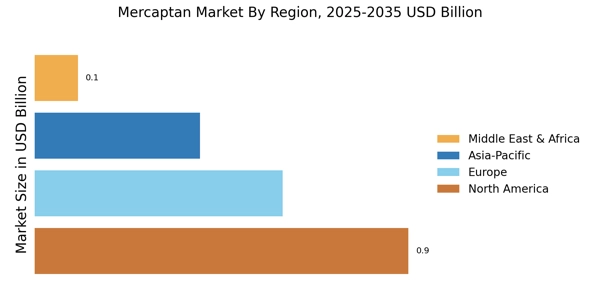
North America is witnessing robust growth in the mercaptan market, driven by increasing demand from the oil and gas sector and stringent environmental regulations promoting cleaner technologies. The region holds approximately 45% of the global market share, making it the largest market for mercaptans. The U.S. leads this growth, supported by advancements in chemical manufacturing and a focus on sustainable practices. Key players such as Chevron Phillips Chemical Company and Eastman Chemical Company dominate the landscape, leveraging their extensive distribution networks and innovative product offerings. The competitive environment is characterized by strategic partnerships and investments in R&D, ensuring a steady supply of high-quality mercaptans. The U.S. is expected to maintain its leadership position, with Canada also contributing significantly to market dynamics.
Europe : Regulatory-Driven Market Growth
Europe is emerging as a significant player in the mercaptan market, driven by stringent regulations aimed at reducing emissions and promoting the use of cleaner chemicals. The region accounts for approximately 30% of the global market share, with Germany and France being the largest contributors. The European market is characterized by a strong focus on sustainability and innovation, which is propelling demand for mercaptans in various applications. Leading companies like BASF SE and Arkema S.A. are at the forefront of this growth, investing heavily in sustainable practices and product development. The competitive landscape is marked by collaborations and partnerships aimed at enhancing product offerings and expanding market reach. As regulatory frameworks continue to evolve, the European mercaptan market is poised for further growth, driven by innovation and compliance with environmental standards.
Asia-Pacific : Emerging Market Potential
Asia-Pacific is rapidly becoming a key player in the mercaptan market, driven by industrial growth and increasing demand from the petrochemical sector. The region holds approximately 20% of the global market share, with China and Japan leading the charge. The growth is fueled by rising urbanization and industrialization, which are creating a higher demand for mercaptans in various applications, including agriculture and pharmaceuticals. Countries like China are witnessing significant investments in chemical manufacturing, with key players such as Mitsui Chemicals, Inc. and SABIC expanding their operations. The competitive landscape is evolving, with local manufacturers emerging alongside established global players. As the region continues to develop, the mercaptan market is expected to grow, supported by government initiatives aimed at boosting the chemical industry.
Middle East and Africa : Resource-Rich Market Dynamics
The Middle East and Africa region is characterized by its rich natural resources, which are driving the mercaptan market's growth. The region holds approximately 5% of the global market share, with countries like Saudi Arabia and South Africa leading in production and consumption. The growth is primarily driven by the oil and gas industry, which utilizes mercaptans in various applications, including odorization and chemical synthesis. Key players such as Huntsman Corporation are actively involved in the market, leveraging the region's abundant resources to enhance production capabilities. The competitive landscape is marked by a mix of local and international companies, all vying for market share. As the region continues to develop its chemical industry, the mercaptan market is expected to see gradual growth, supported by increasing industrial activities and investments in infrastructure.
Key Players and Competitive Insights
Key Companies in the Mercaptan Market include
Industry Developments
In July 2024, BASF presents Haptex 4.0: A promising alternative to synthetic leather which is eco-friendly. Materials that were made of Haptex 4.0 and PET fabric can be recycled together and integrated into an innovative formulation and recycling technical pathway that eliminates the need for a layer peel-off process. One of the reasons why this is possible is the reuse of the layers. Like in the previous models, Haptex 4.0 also meets the requirements of strict volatile organic compounds (VOC) regulations since no organic solvent is incorporated into the production process.
This also greatly reduces the time and complexity of the synthetic leather production cycle.
In 2023, BASF announced the growth of the production volume of specialty chemicals including mercaptans in Ludwigshafen site to meet the increasing needs in the agricultural market segment.
In 2023, Merck Arkema showcased a newly developed mercaptan, which is biodegradable and geared towards the agrochemical sector, proving its dedication to sustainable practices.
In 2023, Evonik structure introduced high-performance mercaptans to target high specialty chemical applications stating their focus on the reduction of environmental impact.
Future Outlook
Mercaptan Market Future Outlook
The Mercaptan Market is projected to grow at a 4.52% CAGR from 2025 to 2035, driven by increasing demand in the petrochemical and energy sectors.
New opportunities lie in:
- Development of eco-friendly mercaptan production methods.
- Expansion into emerging markets with rising energy needs.
- Investment in advanced storage and transportation solutions.
By 2035, the Mercaptan Market is expected to achieve robust growth, reflecting evolving industry dynamics.
Market Segmentation
Mercaptan Market Type Outlook
- Methyl Mercaptan
- Ethyl Mercaptan
- Propyl Mercaptan
- Butyl Mercaptan
- Octyl Mercaptan
- Dodecyl Mercaptan
- Others
Mercaptan Market Application Outlook
- Pesticides
- Jet Fuels and Plastics
- Natural Gas
- Food and Nutrition
- Animal Feed
- Others
Report Scope
| MARKET SIZE 2024 | 2.11(USD Billion) |
| MARKET SIZE 2025 | 2.205(USD Billion) |
| MARKET SIZE 2035 | 3.432(USD Billion) |
| COMPOUND ANNUAL GROWTH RATE (CAGR) | 4.52% (2025 - 2035) |
| REPORT COVERAGE | Revenue Forecast, Competitive Landscape, Growth Factors, and Trends |
| BASE YEAR | 2024 |
| Market Forecast Period | 2025 - 2035 |
| Historical Data | 2019 - 2024 |
| Market Forecast Units | USD Billion |
| Key Companies Profiled | Chevron Phillips Chemical Company (US), BASF SE (DE), Royal Dutch Shell (NL), Eastman Chemical Company (US), Arkema S.A. (FR), Huntsman Corporation (US), SABIC (SA), Mitsui Chemicals, Inc. (JP), Kraton Corporation (US) |
| Segments Covered | Type, Application, Region |
| Key Market Opportunities | Growing demand for eco-friendly alternatives in the Mercaptan Market presents significant innovation opportunities. |
| Key Market Dynamics | Rising demand for mercaptans in the petrochemical industry drives innovation and competitive dynamics. |
| Countries Covered | North America, Europe, APAC, South America, MEA |
Market Highlights
FAQs
What is the current valuation of the Mercaptan Market as of 2024?
The Mercaptan Market was valued at 2.11 USD Billion in 2024.
What is the projected market valuation for Mercaptan by 2035?
The market is projected to reach 3.432 USD Billion by 2035.
What is the expected CAGR for the Mercaptan Market during the forecast period?
The expected CAGR for the Mercaptan Market from 2025 to 2035 is 4.52%.
Which companies are considered key players in the Mercaptan Market?
Key players include Chevron Phillips Chemical Company, BASF SE, Royal Dutch Shell, and others.
What are the primary types of mercaptans and their market values?
Methyl Mercaptan and Ethyl Mercaptan lead the market, valued at 0.63 and 0.42 USD Billion respectively in 2024.
How does the application of mercaptans in natural gas compare to other applications?
Natural gas applications were valued at 0.6 USD Billion in 2024, indicating strong demand compared to other sectors.
What is the market value of Ethyl Mercaptan in 2024?
What is the projected growth for Butyl Mercaptan from 2024 to 2035?
Which application segment is anticipated to grow the most by 2035?
What is the market value of Dodecyl Mercaptan in 2024?
Kindly complete the form below to receive a free sample of this Report
Customer Stories
“This is really good guys. Excellent work on a tight deadline. I will continue to use you going forward and recommend you to others. Nice job”
“Thanks. It’s been a pleasure working with you, please use me as reference with any other Intel employees.”
“Thanks for sending the report it gives us a good global view of the Betaïne market.”
“Thank you, this will be very helpful for OQS.”
“We found the report very insightful! we found your research firm very helpful. I'm sending this email to secure our future business.”
“I am very pleased with how market segments have been defined in a relevant way for my purposes (such as "Portable Freezers & refrigerators" and "last-mile"). In general the report is well structured. Thanks very much for your efforts.”
“I have been reading the first document or the study, ,the Global HVAC and FP market report 2021 till 2026. Must say, good info! I have not gone in depth at all parts, but got a good indication of the data inside!”
“We got the report in time, we really thank you for your support in this process. I also thank to all of your team as they did a great job.”