×
Request Free Sample ×

Kindly complete the form below to receive a free sample of this Report

* Please use a valid business email

Leading companies partner with us for data-driven Insights

clients tt-cursor
Hero Background

Metal Cutting Tools Market

ID: MRFR/Equip/6687-CR
187 Pages
Snehal Singh
July 2019

Metal Cutting Tools Market Research Report Information By Material Type (Cemented Carbide, High-Speed Steel, Ceramics, Polycrystalline Diamond, and Others), By Application (Milling, Turning, Drilling, and Others), By Industry (Automotive, Aerospace & Defense, Construction, Oil & Gas, Power Generation, and Others), and By Region (North America, Europe, Asia-Pacific, and Rest Of The World) – Market Forecast Till 2035

Share:
Download PDF ×

We do not share your information with anyone. However, we may send you emails based on your report interest from time to time. You may contact us at any time to opt-out.

Metal Cutting Tools Market Infographic
Purchase Options

Metal Cutting Tools Market Summary

As per Market Research Future analysis, the Metal Cutting Tools Market Size was estimated at 84715.2 USD Billion in 2024. The Metal Cutting Tools industry is projected to grow from 89645.83 in 2025 to 157840.19 by 2035, exhibiting a compound annual growth rate (CAGR) of 5.82% during the forecast period 2025 - 2035.

Key Market Trends & Highlights

The Metal Cutting Tools Market is poised for robust growth driven by technological advancements and increasing demand across various sectors.

  • Technological advancements are reshaping the Metal Cutting Tools Market, enhancing efficiency and precision in manufacturing processes.
  • North America remains the largest market, while the Asia-Pacific region is emerging as the fastest-growing area for metal cutting tools.
  • The machining segment continues to dominate the market, whereas the drilling segment is experiencing rapid growth due to rising applications.
  • Key market drivers include the rising demand from the automotive sector and the increased focus on automation in manufacturing.

Market Size & Forecast

2024 Market Size 84715.2 (USD Billion)
2035 Market Size 157840.19 (USD Billion)
CAGR (2025 - 2035) 5.82%

Major Players

Sandvik (SE), Kennametal (US), Seco Tools (SE), Mitsubishi Materials (JP), Iscar (IL), Walter (DE), Gühring (DE), Tungaloy (JP), Kyocera (JP)

Metal Cutting Tools Market Trends

The Metal Cutting Tools Market is currently experiencing a dynamic evolution, driven by advancements in technology and increasing demand across various industries. The integration of automation and smart manufacturing processes appears to be reshaping the landscape, as companies seek to enhance efficiency and precision in their operations. Furthermore, the growing emphasis on sustainability and eco-friendly practices is influencing the development of innovative materials and designs in cutting tools. This shift not only addresses environmental concerns but also aligns with the broader trends of resource optimization and waste reduction. In addition, the Metal Cutting Tools Market is witnessing a surge in the adoption of advanced materials, such as carbide and high-speed steel, which are known for their durability and performance. The rise of additive manufacturing and hybrid machining techniques suggests a potential transformation in how metal cutting tools are produced and utilized. As industries continue to evolve, the market is likely to adapt, fostering new opportunities for growth and innovation. Overall, the Metal Cutting Tools Market is poised for a promising future, characterized by technological advancements and a commitment to sustainability.

Technological Advancements

The Metal Cutting Tools Market is increasingly influenced by rapid technological advancements. Innovations such as computer numerical control (CNC) machine tools and automation are enhancing precision and efficiency in manufacturing processes. These developments enable manufacturers to produce complex geometries with greater accuracy, thereby meeting the evolving demands of various sectors.

Sustainability Initiatives

Sustainability initiatives are becoming a focal point within the Metal Cutting Tools Market. Companies are prioritizing eco-friendly materials and processes to reduce their environmental footprint. This trend reflects a broader commitment to sustainable practices, as industries seek to balance productivity with environmental responsibility.

Emerging Markets

Emerging markets are playing a crucial role in the expansion of the Metal Cutting Tools Market. As industrialization accelerates in regions such as Asia-Pacific and Latin America, the demand for cutting tools is expected to rise. This growth presents opportunities for manufacturers to tap into new customer bases and adapt their offerings to meet local needs.

Metal Cutting Tools Market Drivers

Focus on Sustainability

Sustainability has become a crucial consideration in the Metal Cutting Tools Industry, as manufacturers seek to minimize their environmental impact. The adoption of eco-friendly materials and processes is gaining traction, leading to the development of cutting tools that are not only efficient but also sustainable. This focus on sustainability is likely to drive innovation and investment in the market, as companies strive to meet regulatory requirements and consumer expectations. The market's growth trajectory, from 84715.2 USD Billion in 2024 to 157301.2 USD Billion by 2035, reflects the increasing importance of sustainable practices in the metal cutting tools sector.

Technological Advancements

The Metal Cutting Tools Industry is experiencing rapid technological advancements, which are enhancing the efficiency and precision of metal cutting processes. Innovations such as CNC machines and advanced materials like carbide and ceramic are becoming increasingly prevalent. These technologies not only improve productivity but also reduce waste, thereby contributing to cost savings for manufacturers. As a result, the market is projected to grow significantly, with a valuation of 84715.2 USD Billion in 2024 and an anticipated increase to 157301.2 USD Billion by 2035, reflecting a robust CAGR of 5.79% from 2025 to 2035.

Growth in Aerospace and Defense

The aerospace and defense industries are pivotal to the Global Metal Cutting Tools Industry, driven by the need for lightweight and durable components. As these sectors expand, the demand for precision-engineered parts increases, necessitating advanced cutting tools that can handle complex geometries and high-performance materials. This trend is likely to propel market growth, with projections indicating a rise from 84715.2 USD Billion in 2024 to 157301.2 USD Billion by 2035. The CAGR of 5.79% from 2025 to 2035 underscores the importance of these industries in shaping the future of metal cutting tools.

Increased Manufacturing Activities

The resurgence of manufacturing activities globally is a significant driver for the Metal Cutting Tools Industry. Countries are increasingly investing in infrastructure and industrial development, leading to heightened demand for metal cutting tools. This growth is particularly evident in emerging economies, where manufacturing sectors are expanding rapidly. As a result, the market is projected to grow from 84715.2 USD Billion in 2024 to 157301.2 USD Billion by 2035, indicating a robust CAGR of 5.79% from 2025 to 2035. The expansion of manufacturing capabilities is likely to further stimulate demand for advanced cutting tools.

Rising Demand from Automotive Sector

The automotive sector is a primary driver of the Metal Cutting Tools Industry, as manufacturers seek to produce high-quality components with precision. The ongoing shift towards electric vehicles (EVs) necessitates advanced metal cutting tools that can handle new materials and designs. This demand is expected to bolster market growth, as automotive manufacturers increasingly invest in state-of-the-art machining technologies. The industry's expansion is evident in the projected market value, which is set to reach 84715.2 USD Billion in 2024, with further growth anticipated as the automotive sector evolves.
Market Segment Insights

By Application: Machining (Largest) vs. Drilling (Fastest-Growing)

In the Metal Cutting Tools Market, the application segments are dominated by machining, which holds the largest market share. This segment encompasses a variety of machining processes that employ metal cutting tools to shape, cut, and finish materials. Following machining are drilling and milling, which also capture significant portions of the market, driven by demand in various industrial applications. Each segment reflects its unique share within the broader market landscape, showing how different applications leverage metal cutting tools to achieve efficiency and precision. The growth trends indicate that while machining remains a stronghold, drilling tools is emerging as the fastest-growing segment. Several factors contribute to this trend, including increased automation in manufacturing processes and a rise in the aerospace and automotive sectors, where precision drilling is vital. The push for lightweight materials in construction further escalates the need for efficient drilling tools, projecting continued growth in the coming years.

Machining (Dominant) vs. Drilling (Emerging)

The machining segment is characterized by its extensive use across different industrial applications, positioning itself as the dominant force in the Metal Cutting Tools Market. This segment encompasses various processes including turning, grinding, and milling, which are essential for comprehensive material shaping and finishing. Meanwhile, drilling is recognized as an emerging segment, driven by advancements in technology and the increasing demand for precision tools. This segment's growth is supported by the rise in industries requiring complex drilling operations, such as aerospace and automotive manufacturing. The focus on efficiency and the push for innovative tool designs enhance the competitiveness of both segments in a rapidly evolving market.

By Material Type: Carbide (Largest) vs. High-Speed Steel (Fastest-Growing)

In the Metal Cutting Tools Market, the material type segment is characterized by a varied distribution of market shares among prominent players. Carbide tools dominate the market due to their superior hardness and wear resistance, making them suitable for a wide range of applications. In contrast, High-Speed Steel has been gaining traction, primarily due to its cost-effectiveness and versatility in applications such as general machining and tool manufacturing, leading to a growing interest among manufacturers.

High-Speed Steel (Dominant) vs. Cobalt (Emerging)

High-Speed Steel is renowned in the metal cutting tools sector for its exceptional performance in cutting and shaping materials at high speeds. Its ability to retain hardness at elevated temperatures enhances its appeal for various machining processes, making it a staple among tool manufacturers. Cobalt, on the other hand, is emerging as a noteworthy alternative due to its unique properties, such as improved toughness and wear resistance when alloyed with other metals. The increasing demand for high-performance tools in specialized applications is paving the way for cobalt tools to gain traction, though they currently hold a smaller market share compared to High-Speed Steel.

By End Use Industry: Automotive (Largest) vs. Aerospace (Fastest-Growing)

In the Metal Cutting Tools Market, the automotive sector commands the largest share due to its ongoing demand for precision-engineered components. This industry consistently drives the need for advanced metal cutting technologies, which facilitates the production of high-quality automotive parts. Following closely, sectors like aerospace, construction, manufacturing, and electronics contribute significantly, with the aerospace segment emerging as a critical player due to an increase in air travel and innovations in aircraft design.

Automotive: Dominant vs. Aerospace: Emerging

The automotive industry remains a dominant force in the Metal Cutting Tools Market, leveraging cutting-edge technology to enhance manufacturing efficiency. This segment emphasizes precision and durability, necessitating robust metal cutting tools that can withstand high volumes of production. Conversely, the aerospace industry is marked as an emerging sector, propelled by advancements in lightweight materials and increased aircraft production capacities. The demand for specialized cutting tools in aerospace applications is rising as manufacturers focus on incorporating composite materials, thereby creating opportunities for innovation and growth in this niche segment.

Get more detailed insights about Metal Cutting Tools Market

Regional Insights

North America : Manufacturing Powerhouse

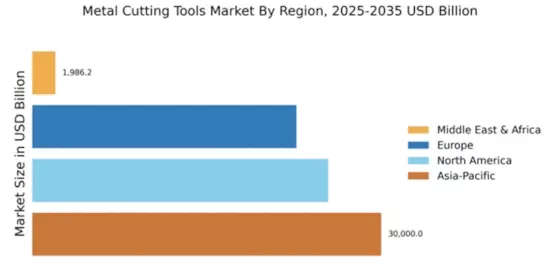
North America is witnessing robust growth in the metal cutting tools market, driven by advancements in manufacturing technologies and increasing demand from the automotive and aerospace sectors. The market size reached $25,429.0 million in 2025, reflecting a significant share in the global landscape. Regulatory support for manufacturing innovation and sustainability initiatives further catalyzes market expansion, positioning the region as a leader in metal cutting solutions. The competitive landscape is characterized by key players such as Kennametal and Sandvik, which dominate the market with innovative product offerings. The U.S. remains the largest contributor, supported by a strong industrial base and investment in R&D. The presence of established companies fosters a dynamic environment, encouraging new entrants and technological advancements, ensuring North America retains its competitive edge in the global market.

Europe : Innovation and Sustainability Focus

Europe's metal cutting tools market is evolving, driven by a strong emphasis on innovation and sustainability. The market size is estimated at €22,643.0 million in 2025, reflecting a significant share of the global market. Regulatory frameworks promoting eco-friendly manufacturing practices and technological advancements are key growth drivers. The region's commitment to reducing carbon footprints is shaping demand for advanced cutting tools that enhance efficiency and sustainability. Leading countries like Germany and Sweden are at the forefront, with companies such as Seco Tools and Walter leading the charge in innovation. The competitive landscape is marked by a mix of established players and emerging startups, fostering a vibrant ecosystem. The presence of strong industrial sectors, particularly in automotive and aerospace, further supports market growth, ensuring Europe remains a critical player in The Metal Cutting Tools.

Asia-Pacific : Emerging Powerhouse

Asia-Pacific is the largest market for metal cutting tools, with a market size of $30,715.0 million in 2025, showcasing its dominance in the global landscape. The region's growth is fueled by rapid industrialization, increasing manufacturing activities, and a rising demand for precision tools in various sectors, including automotive and electronics. Government initiatives aimed at boosting manufacturing capabilities and foreign investments are further propelling market expansion. Countries like China, Japan, and India are leading the charge, with significant contributions from key players such as Mitsubishi Materials and Tungaloy. The competitive landscape is characterized by a mix of local and international companies, driving innovation and technological advancements. The region's focus on enhancing production efficiency and quality is crucial for maintaining its competitive edge in the global market, ensuring sustained growth in the metal cutting tools sector.

Middle East and Africa : Resource-Rich Frontier

The Middle East and Africa region is emerging as a potential market for metal cutting tools, with a market size of $1,828.2 million in 2025. The growth is driven by increasing industrial activities, particularly in oil and gas, construction, and manufacturing sectors. Government initiatives aimed at diversifying economies and enhancing local manufacturing capabilities are key catalysts for market development. The region's rich natural resources provide a foundation for growth in the metal cutting tools market. Countries like South Africa and the UAE are leading the way, with investments in infrastructure and manufacturing driving demand for advanced cutting tools. The competitive landscape is still developing, with opportunities for both local and international players to establish a foothold. As the region continues to invest in industrialization, the demand for high-quality metal cutting tools is expected to rise, presenting significant growth opportunities for market participants.

Key Players and Competitive Insights

The Metal Cutting Tools Market is currently characterized by a dynamic competitive landscape, driven by technological advancements and increasing demand across various manufacturing sectors. Key players such as Sandvik (SE), Kennametal (US), and Seco Tools (SE) are strategically positioned to leverage innovation and operational efficiency. Sandvik (SE) focuses on enhancing its product portfolio through continuous research and development, while Kennametal (US) emphasizes digital transformation and smart manufacturing solutions. Seco Tools (SE) is actively pursuing partnerships to expand its global footprint, thereby shaping a competitive environment that is increasingly reliant on technological prowess and strategic collaborations.

The market structure appears moderately fragmented, with a mix of established players and emerging companies vying for market share. Key business tactics include localizing manufacturing to reduce lead times and optimize supply chains, which are critical in meeting the demands of a rapidly evolving market. The collective influence of these major players fosters a competitive atmosphere where innovation and operational excellence are paramount.

In November 2025, Sandvik (SE) announced the launch of its new line of high-performance cutting tools designed specifically for the aerospace industry. This strategic move is significant as it not only diversifies Sandvik's product offerings but also positions the company to capitalize on the growing demand for precision-engineered components in aerospace manufacturing. The introduction of these tools is expected to enhance operational efficiency for clients, thereby reinforcing Sandvik's market leadership.

In October 2025, Kennametal (US) unveiled its latest digital platform aimed at optimizing tool management and enhancing customer engagement. This initiative reflects Kennametal's commitment to integrating advanced technologies into its operations, which could potentially streamline processes and improve customer satisfaction. By focusing on digital solutions, Kennametal is likely to strengthen its competitive edge in an increasingly tech-driven market.

In September 2025, Seco Tools (SE) entered into a strategic partnership with a leading additive manufacturing firm to develop hybrid manufacturing solutions. This collaboration is indicative of Seco's forward-thinking approach, as it seeks to combine traditional machining with innovative additive techniques. Such a strategy not only broadens Seco's capabilities but also positions the company to meet the evolving needs of its customers in a competitive landscape that values versatility and innovation.

As of December 2025, current competitive trends in the Metal Cutting Tools Market are heavily influenced by digitalization, sustainability, and the integration of artificial intelligence (AI) into manufacturing processes. Strategic alliances are increasingly shaping the landscape, enabling companies to pool resources and expertise. Looking ahead, competitive differentiation is likely to evolve from traditional price-based competition to a focus on innovation, technological advancements, and supply chain reliability. This shift underscores the importance of adaptability and forward-thinking strategies in maintaining a competitive advantage.

Key Companies in the Metal Cutting Tools Market market include

Industry Developments

August 2022: Sandvik purchased P. Rieger Werkzeugfabrik AG and Sphinx Tools Ltd, a producer of precision solid round tools based in Switzerland. Sandvik aims to improve its position in the market for round cutting tools with this acquisition.

June 2022: Milwaukee Tools unveiled its cutting-edge wrecker combined with NITRUS CARBIDE SAWZALL Blad, which is perfect for use in remodelling and demolition tasks at building sites and is designed to work more effectively on a wide range of metals.

Future Outlook

Metal Cutting Tools Market Future Outlook

The Metal Cutting Tools Market is projected to grow at a 5.82% CAGR from 2024 to 2035, driven by technological advancements, increasing automation, and rising demand in manufacturing sectors.

New opportunities lie in:

  • Development of smart cutting tools with IoT integration
  • Expansion into emerging markets with tailored product lines
  • Investment in sustainable manufacturing processes and materials

By 2035, the Metal Cutting Tools Market is expected to achieve robust growth and innovation.

Market Segmentation

Metal Cutting Tools Market Application Outlook

  • Machining
  • Drilling
  • Milling
  • Turning
  • Grinding

Metal Cutting Tools Market Material Type Outlook

  • High-Speed Steel
  • Carbide
  • Ceramic
  • Cobalt
  • Cermet

Metal Cutting Tools Market End Use Industry Outlook

  • Automotive
  • Aerospace
  • Construction
  • Manufacturing
  • Electronics

Report Scope

MARKET SIZE 2024 84715.2(USD Billion)
MARKET SIZE 2025 89645.83(USD Billion)
MARKET SIZE 2035 157840.19(USD Billion)
COMPOUND ANNUAL GROWTH RATE (CAGR) 5.82% (2024 - 2035)
REPORT COVERAGE Revenue Forecast, Competitive Landscape, Growth Factors, and Trends
BASE YEAR 2024
Market Forecast Period 2025 - 2035
Historical Data 2019 - 2024
Market Forecast Units USD Billion
Key Companies Profiled Sandvik (SE), Kennametal (US), Seco Tools (SE), Mitsubishi Materials (JP), Iscar (IL), Walter (DE), Gühring (DE), Tungaloy (JP), Kyocera (JP)
Segments Covered Application, Material Type, End Use Industry
Key Market Opportunities Integration of advanced materials and automation technologies in the Metal Cutting Tools Market.
Key Market Dynamics Technological advancements drive innovation in metal cutting tools, enhancing efficiency and precision across various industries.
Countries Covered North America, Europe, APAC, South America, MEA

Market Highlights

Author
Snehal Singh
Assistant Manager - Research

High acumen in analyzing complex macro & micro markets with more than 6 years of work experience in the field of market research. By implementing her analytical skills in forecasting and estimation into market research reports, she has expertise in Packaging, Construction, and Equipment domains. She handles a team size of 20-25 resources and ensures smooth running of the projects, associated marketing activities, and client servicing.

Leave a Comment

FAQs

How much is the Metal Cutting Tools market?

The Metal Cutting Tools market size was valued at USD 79,920.0 Billion in 2023.

What is the growth rate of the Metal Cutting Tools market?

The global market is projected to grow at a CAGR of 5.8% during the forecast period, 2024-2032.

Which region held the largest market share in the Metal Cutting Tools market?

North America had the largest share in the global market

Who are the key players in the Metal Cutting Tools market?

The key players in the market are Fanuc America Corporation, Hitachi Metals, Amada Machine Tools Co. Ltd., Tungaloy Corporation, BIG Kaiser Precision Tooling Inc., Tiangong International Co., Sandvik, Komatsu Ltd., Ingersoll Cutting Tool Company, Kennametal, and Doosan Machine Tools Co. Ltd.

Download Free Sample

Kindly complete the form below to receive a free sample of this Report

Compare Licence

×
Features License Type
Single User Multiuser License Enterprise User
Price $4,950 $5,950 $7,250
Maximum User Access Limit 1 User Upto 10 Users Unrestricted Access Throughout the Organization
Free Customization
Direct Access to Analyst
Deliverable Format
Platform Access
Discount on Next Purchase 10% 15% 15%
Printable Versions