Metal Expansion Joints Market
Metal Expansion Joints Market Summary
As per Market Research Future analysis, the Metal Expansion Joints Market Size was estimated at 1.962 USD Billion in 2024. The Metal Expansion Joints industry is projected to grow from USD 2.03 Billion in 2025 to USD 2.862 Billion by 2035, exhibiting a compound annual growth rate (CAGR) of 3.49% during the forecast period 2025 - 2035
Key Market Facts 2025-2035
| Metric | 2025 Value | 2035 Projection | CAGR |
|---|---|---|---|
| Global Market Size | USD 2.03B | USD 2.86B | 3.49% |
| Asia-Pacific | USD 4.78B (50%) | USD 12.91B | 10.4% ← DOMINANT |
| Middle East | USD 1.43B (15%) | USD 3.87B | 10.6% ← FASTEST |
| North America | USD 1.43B (15%) | USD 3.87B | 10.0% |
| Material | 2025 Share | CAGR | Key Driver |
|---|---|---|---|
| Stainless Steel | 68.4% | 10.4% | Power plant steam lines, refineries |
| Nickel Alloys | 18.2% | 10.8% | LNG cryogenic service |
| Carbon Steel | 13.4% | 9.7% | HVAC, low-corrosion apps |
| Application | 2025 Share | CAGR | Key Driver |
|---|---|---|---|
| Power Generation | 42.3% | 10.7% | Steam turbines, HRSG systems |
| Oil & Gas Industry | 28.7% | 10.3% | LNG terminals, pipelines |
| Petrochemical | 18.6% | 10.1% | Ethylene crackers |
| Piping Systems | 10.4% | 9.8% | District heating networks |
| Diameter Range | 2025 Share | CAGR | Key Driver |
|---|---|---|---|
| 12-24 inches | 32.1% | 10.5% | Power plant ducting |
| 24-36 inches | 26.4% | 10.6% | Large refinery piping |
| 36+ inches | 22.6% | 10.9% | LNG tank connections |
| Up to 6 inches | 18.9% | 9.6% | HVAC instrumentation |
| Pressure Rating | 2025 Share | CAGR | Key Driver |
|---|---|---|---|
| 151-300 psi | 38.4% | 10.4% | Steam turbine crossovers |
| 301-600 psi | 28.7% | 10.2% | Refinery hydrocrackers |
| 600+ psi | 22.1% | 10.8% | High-pressure gas lines |
| End Connection | 2025 Share | CAGR | Key Driver |
|---|---|---|---|
| Flanged | 58.4% | 10.3% | ASME B16.5 standard piping |
| Welded | 28.7% | 10.1% | High-pressure applications |
| Slip-On | 12.9% | 9.8% | Maintenance ease |
- Asia-Pacific (50%): China 1,200 GW coal/gas capacity addition, India 500 GW RE target
- Middle East (10.6% CAGR): Qatar LNG expansion (126MTPA), Saudi Aramco Jazan refinery
- North America: US LNG export terminals (140MTPA), shale gas processing plants
- Power plant expansion (+4.8% CAGR impact): Global 3,500 GW capacity addition
- LNG infrastructure boom (+3.2% CAGR impact): 500MTPA capacity by 2035
- Petrochemical supercracker (+2.1% CAGR impact): Middle East 50% global ethylene
Key Market Trends & Highlights
The Metal Expansion Joints Market is poised for growth driven by technological advancements and increasing industrial demand.
- North America remains the largest market for metal expansion joints, driven by robust industrial activity.
- The Asia-Pacific region is emerging as the fastest-growing market, fueled by rapid infrastructure development and urbanization.
- Stainless steel continues to dominate the market as the largest segment, while nickel alloys are gaining traction as the fastest-growing segment.
- Key market drivers include increasing demand from industrial sectors and the need for compliance with regulatory safety standards.
Market Size & Forecast
| 2024 Market Size | 1.962 (USD Billion) |
| 2035 Market Size | 2.862 (USD Billion) |
| CAGR (2025 - 2035) | 3.49% |
Major Players
Flexicraft Industries (US), EagleBurgmann (DE), Witzenmann (DE), Metraflex (US), Senior Flexonics (US), Kurt J. Lesker Company (US), Hose Master (US), Klinger (AT)
Metal Expansion Joints Market Trends
The Metal Expansion Joints Market is currently experiencing a notable evolution, driven by various factors that influence its growth trajectory. The increasing demand for flexible piping systems across diverse industries, such as oil and gas, power generation, and chemical processing, appears to be a primary catalyst. These sectors require components that can accommodate thermal expansion and contraction, thereby enhancing system reliability and longevity. Furthermore, advancements in manufacturing technologies and materials are likely to contribute to the development of more efficient and durable expansion joints, which may further stimulate market expansion. In addition, the growing emphasis on sustainability and energy efficiency is shaping the Metal Expansion Joints Market. Industries are increasingly seeking solutions that not only meet operational requirements but also align with environmental standards. This trend suggests a shift towards the adoption of eco-friendly materials and designs that minimize waste and energy consumption. As a result, manufacturers are likely to innovate and adapt their offerings to meet these evolving demands, positioning themselves favorably in a competitive landscape. Overall, the Metal Expansion Joints Market is poised for growth, driven by technological advancements and a focus on sustainability.
Technological Advancements
The Metal Expansion Joints Market is witnessing a surge in technological innovations that enhance product performance and reliability. Manufacturers are increasingly investing in research and development to create advanced materials and designs that can withstand extreme conditions. This trend indicates a commitment to improving the durability and efficiency of expansion joints, which is essential for meeting the rigorous demands of various industries.
Sustainability Initiatives
There is a growing trend towards sustainability within the Metal Expansion Joints Market, as companies strive to reduce their environmental impact. This shift is prompting manufacturers to explore eco-friendly materials and production processes. The emphasis on sustainable practices not only aligns with regulatory requirements but also appeals to environmentally conscious consumers, potentially influencing purchasing decisions.
Diverse Application Areas
The Metal Expansion Joints Market is expanding into a variety of application areas, reflecting the versatility of these components. Industries such as aerospace, automotive, and construction are increasingly recognizing the importance of expansion joints in their systems. This diversification suggests that the market may continue to grow as new sectors adopt these solutions to enhance operational efficiency and safety.
Metal Expansion Joints Market Drivers
Growth in Renewable Energy Sector
The Metal Expansion Joints Market is poised to benefit from the growth in the renewable energy sector. As countries invest in sustainable energy sources such as wind, solar, and hydroelectric power, the demand for reliable piping systems that can withstand thermal fluctuations is increasing. Metal expansion joints play a crucial role in these systems, ensuring the integrity and efficiency of energy generation processes. The renewable energy sector is projected to expand significantly, which will likely drive the demand for metal expansion joints. This trend indicates a shift towards more sustainable practices, further solidifying the position of the Metal Expansion Joints Market in the evolving energy landscape.
Increasing Demand from Industrial Sectors
The Metal Expansion Joints Market is experiencing a surge in demand from various industrial sectors, particularly in oil and gas, power generation, and chemical processing. These sectors require reliable solutions to accommodate thermal expansion and contraction in piping systems. As industries expand and modernize, the need for durable and efficient metal expansion joints becomes paramount. According to recent data, the oil and gas sector alone accounts for a substantial share of the market, driven by ongoing infrastructure projects and the need for maintenance of existing systems. This trend indicates a robust growth trajectory for the Metal Expansion Joints Market, as companies seek to enhance operational efficiency and reduce downtime.
Regulatory Compliance and Safety Standards
The Metal Expansion Joints Market is significantly influenced by stringent regulatory compliance and safety standards across various sectors. Governments and regulatory bodies are increasingly mandating the use of high-quality materials and components in industrial applications to ensure safety and reliability. This has led to a heightened focus on the quality and performance of metal expansion joints. Companies are compelled to invest in advanced technologies and materials to meet these standards, thereby driving market growth. The emphasis on safety not only enhances the reputation of manufacturers but also contributes to the overall expansion of the Metal Expansion Joints Market, as compliance becomes a critical factor in procurement decisions.
Rising Infrastructure Development Projects
The Metal Expansion Joints Market is experiencing growth due to rising infrastructure development projects worldwide. Urbanization and population growth are driving the need for new transportation, water supply, and energy infrastructure. These projects often require robust piping systems that can accommodate thermal expansion and contraction, making metal expansion joints essential components. Recent data suggests that infrastructure spending is expected to increase, particularly in emerging economies, which will likely boost the demand for metal expansion joints. This trend underscores the importance of the Metal Expansion Joints Market in supporting the development of critical infrastructure, thereby enhancing its growth prospects.
Technological Innovations in Manufacturing
Technological innovations in manufacturing processes are reshaping the Metal Expansion Joints Market. Advances in materials science and engineering have led to the development of more resilient and efficient expansion joints. For instance, the introduction of high-performance alloys and advanced welding techniques has improved the durability and performance of these components. Furthermore, automation in manufacturing processes has enhanced production efficiency, allowing for quicker turnaround times and reduced costs. As manufacturers adopt these innovations, they are better positioned to meet the evolving demands of various industries, thereby fostering growth in the Metal Expansion Joints Market. This trend suggests a promising future as technology continues to evolve.
Market Segment Insights
By Material: Stainless Steel (Largest) vs. Nickel Alloys (Fastest-Growing)
In the Metal Expansion Joints Market, the material segment is dominated by stainless steel, which has established its prominence due to its excellent corrosion resistance, high strength, and adaptability in various applications. Carbon steel and copper alloys also account for notable shares, while titanium alloys and nickel alloys are emerging players. These materials cater to industry-specific requirements, with stainless steel being favored in high-stress environments such as petrochemical and power generation. On the other hand, nickel alloys have been recognized as the fastest-growing segment. Their growth is attributed to their exceptional performance in extreme temperature and corrosive environments, making them ideal for aerospace and chemical processing applications. The increasing demand for durable and high-performance materials is driving the evolution of these segments in the market.
Materials: Stainless Steel (Dominant) vs. Nickel Alloys (Emerging)
Stainless steel remains the dominant player in the Metal Expansion Joints Market due to its remarkable properties, including resistance to rust, strength, and versatility in various industrial applications. It is widely used in sectors where reliable function under thermal expansion is crucial, such as oil and gas, marine, and construction. In contrast, nickel alloys are gaining traction as an emerging material in this market segment, thanks to their ability to withstand harsh conditions and corrosive environments. They are particularly favored in the aerospace industry for their outstanding mechanical properties at elevated temperatures. As industries increasingly require advanced materials to meet stringent performance demands, the growth potential for nickel alloys is substantial.
By Diameter: 6 to 12 inches (Largest) vs. 24 to 36 inches (Fastest-Growing)
In the Metal Expansion Joints Market, the distribution of the diameter segments reveals a significant preference for the 6 to 12 inches range. This segment captures the largest share, as it serves a wide array of applications across industries such as oil and gas, automotive, and manufacturing. Conversely, the segments of 24 to 36 inches are gaining traction, reflecting the growing demand for larger joints in high-pressure environments.
6 to 12 inches (Dominant) vs. 24 to 36 inches (Emerging)
The 6 to 12 inches diameter segment is characterized by its versatility and widespread adoption across various industries. This size range is preferred for standard applications due to its compatibility with typical piping systems and flexibility in installation. On the other hand, the 24 to 36 inches segment is emerging rapidly, driven by the increasing need for heavy-duty expansion joints that can withstand substantial thermal and pressure fluctuations. This segment appeals to sectors seeking reliability and durability, making it a significant area of interest for manufacturers looking to innovate.
By End Connection: Flanged (Largest) vs. Welded (Fastest-Growing)
In the Metal Expansion Joints Market, the segment distribution highlights Flanged connections as the most dominant type, commanding a significant share among end connection options. Flanged joints are favored for their ease of installation and robust performance under varying thermal and pressure conditions, making them a preferred choice for industrial applications. In contrast, Welded expansions are witnessing rapid adoption, fueled by stringent demands for high-strength integrity in applications where bolted joints may falter under extreme conditions.
Flanged (Dominant) vs. Welded (Emerging)
Flanged expansion joints represent the cornerstone of the Metal Expansion Joints Market, recognized for their versatility and reliability across numerous applications. They facilitate easy maintenance and replaceability while providing excellent adaptability to pipeline configurations. On the other hand, Welded joints, though emerging, are becoming more popular due to their enhanced strength and the ability to withstand higher pressures and temperatures without leakage. This is particularly appealing in sectors like oil and gas and chemical processing, where safety and performance are paramount. As industries continue to innovate and set higher operational standards, the preference for welded connections is surging.
By Application: Piping Systems (Largest) vs. Oil and Gas Industry (Fastest-Growing)
In the Metal Expansion Joints Market, the application segment is characterized by distinct areas of demand, with piping systems commanding a significant share due to their extensive use in various industries. This segment includes numerous installations primarily focused on accommodating thermal expansion in pipelines across diverse sectors. Following closely, the oil and gas industry is emerging as a rapidly growing application area, driven by increased exploration and production activities, necessitating effective thermal and movement compensation solutions.
Piping Systems (Dominant) vs. Oil and Gas Industry (Emerging)
Piping systems represent the dominant application within the metal expansion joints market attributed to their critical role in various industrial processes. These systems are essential for ensuring structural integrity by preventing damage caused by thermal expansion and contraction. With broadened applications in manufacturing and construction, piping systems stand strong against fluctuating thermal conditions. Conversely, the oil and gas industry is seen as an emerging sector, fueled by a heightened focus on energy security and sustainable energy production. The integration of expansion joints in drilling and offshore platforms underscores their growing importance in maintaining pipeline safety and efficiency, thus presenting lucrative opportunities for growth.
By Pressure Rating: Up to 50 psi (Largest) vs. 600 psi or above (Fastest-Growing)
In the Metal Expansion Joints Market, the pressure rating segment displays a diverse distribution of market shares among its various classes. The segment 'Up to 50 psi' currently holds the largest market share, as it caters to a wide array of industries such as HVAC, plumbing, and other low-pressure applications. Trailing behind, the '51 to 150 psi' and '151 to 300 psi' segments represent significant portions of the market, benefitting from the growing demand in industrial applications that require robust yet flexible solutions for pressure containment. The segment '600 psi or above' is noted for its rapid growth, driven by the increasing need for high-performance materials in demanding applications like oil and gas, power generation, and process industries. As industries strive for safety and efficiency under higher pressure conditions, the demand for high-rated expansion joints is projected to soar, thus reshaping the dynamics of the market. The evolution of technology and material science is likely to redefine the offerings in this segment, enhancing their performance and reliability.
Up to 50 psi (Dominant) vs. 600 psi or above (Emerging)
The 'Up to 50 psi' segment in the Metal Expansion Joints Market is characterized by its widespread application across various industries, particularly in HVAC and plumbing, where costs and installation ease are critical. This segment provides solutions that accommodate minimal expansion and contraction needs, thus ensuring seamless integration within existing systems. Conversely, the '600 psi or above' segment is emerging as a critical component in sectors demanding higher safety specifications and performance capabilities. With improvements in manufacturing techniques and material compositions, this segment is gaining traction in high-stakes industries like oil and gas, where reliability is non-negotiable. As manufacturers innovate and push boundaries, both segments are likely to coexist, catering to different market needs.
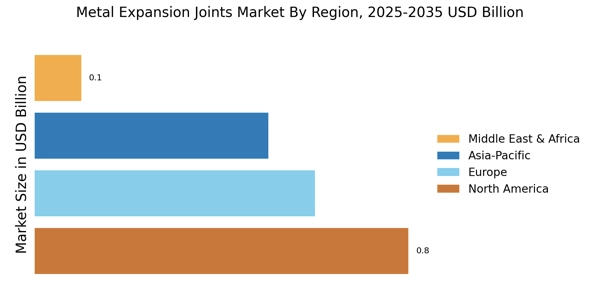
Regional Insights
North America : Market Leader in Innovation
North America is the largest market for metal expansion joints, holding approximately 40% of the global market share. The region's growth is driven by increasing demand from the oil and gas, chemical, and power generation sectors. Regulatory support for infrastructure development and energy efficiency initiatives further catalyze market expansion. The U.S. is the primary contributor, followed by Canada, which is experiencing a surge in industrial activities. The competitive landscape in North America is characterized by the presence of key players such as Flexicraft Industries, Metraflex, and Senior Flexonics. These companies are focusing on innovation and product development to meet the evolving needs of various industries. The market is also witnessing strategic partnerships and collaborations aimed at enhancing product offerings and expanding market reach. Overall, the region is poised for sustained growth, driven by technological advancements and increasing industrialization.
Europe : Emerging Market with Regulations
Europe is the second-largest market for metal expansion joints, accounting for approximately 30% of the global market share. The region's growth is propelled by stringent regulations aimed at enhancing safety and efficiency in industrial processes. Countries like Germany and the UK are leading the market, driven by their robust manufacturing sectors and increasing investments in infrastructure. The European Union's directives on emissions and energy efficiency are significant catalysts for market growth. Germany stands out as a key player in the European market, with companies like Witzenmann and EagleBurgmann leading the charge. The competitive landscape is marked by a focus on innovation and sustainability, with manufacturers investing in advanced technologies to meet regulatory requirements. The presence of established players and a growing emphasis on eco-friendly solutions are expected to drive further growth in the region.
Asia-Pacific : Rapidly Growing Industrial Sector
Asia-Pacific is witnessing rapid growth in the metal expansion joints market, holding approximately 25% of the global market share. The region's growth is driven by increasing industrialization, urbanization, and infrastructure development, particularly in countries like China and India. Government initiatives aimed at boosting manufacturing and energy efficiency are significant growth drivers. The rising demand for energy and the expansion of the chemical and petrochemical industries further contribute to market dynamics. China is the largest market in the region, with a strong presence of local manufacturers and increasing foreign investments. The competitive landscape is characterized by a mix of established players and emerging companies, focusing on innovation and cost-effective solutions. The presence of key players such as Klinger and local manufacturers is expected to enhance market competition and drive growth in the coming years.
Middle East and Africa : Resource-Rich Market Potential
The Middle East and Africa region is gradually emerging as a significant market for metal expansion joints, holding approximately 5% of the global market share. The growth is primarily driven by increasing investments in oil and gas, petrochemicals, and infrastructure projects. Countries like Saudi Arabia and the UAE are leading the market, supported by government initiatives aimed at diversifying economies and enhancing industrial capabilities. The region's rich natural resources provide a solid foundation for market expansion. The competitive landscape in the Middle East and Africa is characterized by a mix of local and international players. Companies are focusing on establishing partnerships and collaborations to enhance their market presence. The demand for high-quality and durable expansion joints is on the rise, driven by the need for efficient industrial processes. As the region continues to develop, opportunities for growth in the metal expansion joints market are expected to increase significantly.
Key Players and Competitive Insights
In August EagleBurgmann (DE) announced the launch of a new line of metal expansion joints designed specifically for the aerospace sector. This strategic move not only diversifies their product portfolio but also positions them to capture a growing segment of the market that demands high-performance components. The aerospace industry’s stringent requirements for reliability and safety make this a significant development, potentially enhancing EagleBurgmann's competitive edge.
In September Metraflex (US) entered into a strategic partnership with a leading energy company to develop advanced expansion joint solutions tailored for renewable energy applications. This collaboration underscores Metraflex's commitment to sustainability and innovation, aligning with global trends towards cleaner energy solutions. Such partnerships are likely to enhance their market visibility and foster innovation in product development.Additionally, in October 2025, Senior Flexonics (US) announced an investment in a new manufacturing facility aimed at increasing production capacity for their metal expansion joints. This investment reflects a proactive approach to meet rising demand and improve operational efficiency. By enhancing their manufacturing capabilities, Senior Flexonics is likely to strengthen its position in the market, particularly in sectors that require rapid delivery and high-quality products.
As of October the Metal Expansion Joints Market is witnessing trends that emphasize digitalization, sustainability, and the integration of advanced technologies such as AI. Strategic alliances are increasingly shaping the competitive landscape, allowing companies to pool resources and expertise. The shift from price-based competition to a focus on innovation, technology, and supply chain reliability is becoming evident. Companies that can effectively differentiate themselves through these avenues are likely to thrive in this evolving market.
Key Companies in the Metal Expansion Joints Market include
Industry Developments
The metal expansion joints market is projected to grow from $1.96 billion in 2024 to $2.77 billion by 2032, exhibiting a CAGR of 3.49%. This growth can be attributed to rising demand from industries such as power generation, oil and gas, and chemicals, as well as increasing infrastructure development. Recent news and developments include the launch of new products by key players like Trelleborg and the acquisition of Garlock Sealing Technologies by Enpro Industries. These developments indicate a growing focus on innovation and consolidation in the industry.
Future Outlook
Metal Expansion Joints Market Future Outlook
The Metal Expansion Joints Market is projected to grow at a 3.49% CAGR from 2025 to 2035, driven by industrial expansion, infrastructure development, and technological advancements.
New opportunities lie in:
- Development of customized expansion joints for niche applications. Expansion into emerging markets with tailored product offerings. Integration of smart technology for real-time monitoring and maintenance.
By 2035, the market is expected to achieve robust growth, reflecting evolving industrial needs.
Market Segmentation
Metal Expansion Joints Market Diameter Outlook
- Up to 6 inches
- 6 to 12 inches
- 12 to 24 inches
- 24 to 36 inches
- 36 inches or above
Metal Expansion Joints Market Material Outlook
- Stainless Steel
- Carbon Steel
- Nickel Alloys
- Copper Alloys
- Titanium Alloys
Metal Expansion Joints Market Application Outlook
- Piping Systems
- Nuclear Power Plants
- Oil and Gas Industry
- Petrochemical Industry
- Power Generation
Metal Expansion Joints Market End Connection Outlook
- Flanged
- Welded
- Slip-On
- Threaded
- Grooved
Metal Expansion Joints Market Pressure Rating Outlook
- Up to 50 psi
- 51 to 150 psi
- 151 to 300 psi
- 301 to 600 psi
- 600 psi or above
Report Scope
| MARKET SIZE 2024 | 1.962(USD Billion) |
| MARKET SIZE 2025 | 2.03(USD Billion) |
| MARKET SIZE 2035 | 2.862(USD Billion) |
| COMPOUND ANNUAL GROWTH RATE (CAGR) | 3.49% (2025 - 2035) |
| REPORT COVERAGE | Revenue Forecast, Competitive Landscape, Growth Factors, and Trends |
| BASE YEAR | 2024 |
| Market Forecast Period | 2025 - 2035 |
| Historical Data | 2019 - 2024 |
| Market Forecast Units | USD Billion |
| Key Companies Profiled | Flexicraft Industries (US), EagleBurgmann (DE), Witzenmann (DE), Metraflex (US), Senior Flexonics (US), Kurt J. Lesker Company (US), Hose Master (US), Klinger (AT) |
| Segments Covered | Material, Diameter, End Connection, Application, Pressure Rating, Regional |
| Key Market Opportunities | Growing demand for lightweight materials in aerospace and automotive sectors enhances Metal Expansion Joints Market opportunities. |
| Key Market Dynamics | Rising demand for durable materials drives innovation and competition in the metal expansion joints market. |
| Countries Covered | North America, Europe, APAC, South America, MEA |
FAQs
What is the current valuation of the Metal Expansion Joints Market?
The market valuation reached 1.962 USD Billion in 2024.
What is the projected market size for the Metal Expansion Joints Market by 2035?
The market is expected to grow to 2.862 USD Billion by 2035.
What is the expected CAGR for the Metal Expansion Joints Market during the forecast period?
The anticipated CAGR for the market from 2025 to 2035 is 3.49%.
Which materials dominate the Metal Expansion Joints Market?
Stainless steel, carbon steel, and nickel alloys are among the leading materials, with stainless steel valued at 0.8 to 1.2 USD Billion.
What diameter segments are available in the Metal Expansion Joints Market?
Diameter segments include 'Up to 6 inches' and '6 to 12 inches', valued at 0.3924 to 0.5634 USD Billion and 0.5886 to 0.8436 USD Billion, respectively.
What are the primary applications of Metal Expansion Joints?
Key applications include the oil and gas industry, valued at 0.6 to 0.9 USD Billion, and the petrochemical industry, valued at 0.4 to 0.6 USD Billion.
Which companies are considered key players in the Metal Expansion Joints Market?
Prominent players include Flexicraft Industries, EagleBurgmann, and Witzenmann, among others.
What end connection types are prevalent in the Metal Expansion Joints Market?
Flanged and welded end connections are significant, with flanged connections valued at 0.5 to 0.7 USD Billion.
How does the pressure rating segment affect the Metal Expansion Joints Market?
Pressure ratings such as '51 to 150 psi' and '151 to 300 psi' are crucial, with each segment valued at 0.588 to 0.842 USD Billion.
What trends are influencing the growth of the Metal Expansion Joints Market?
Kindly complete the form below to receive a free sample of this Report
Customer Stories
“This is really good guys. Excellent work on a tight deadline. I will continue to use you going forward and recommend you to others. Nice job”
“Thanks. It’s been a pleasure working with you, please use me as reference with any other Intel employees.”
“Thanks for sending the report it gives us a good global view of the Betaïne market.”
“Thank you, this will be very helpful for OQS.”
“We found the report very insightful! we found your research firm very helpful. I'm sending this email to secure our future business.”
“I am very pleased with how market segments have been defined in a relevant way for my purposes (such as "Portable Freezers & refrigerators" and "last-mile"). In general the report is well structured. Thanks very much for your efforts.”
“I have been reading the first document or the study, ,the Global HVAC and FP market report 2021 till 2026. Must say, good info! I have not gone in depth at all parts, but got a good indication of the data inside!”
“We got the report in time, we really thank you for your support in this process. I also thank to all of your team as they did a great job.”