×
Request Free Sample ×

Kindly complete the form below to receive a free sample of this Report

* Please use a valid business email

Leading companies partner with us for data-driven Insights

clients tt-cursor
Hero Background

Mexico Drone Camera Market

ID: MRFR/SEM/55779-HCR
200 Pages
Aarti Dhapte
October 2025

Mexico Drone Camera Market Research Report By Resolution Type (12 MP, 12 to 20 MP, 20 to 32 MP, 32 MP & Above), By Application (Photography & Videography, Thermal Imaging, Surveillance), By Type (SD Camera, HD Camera), and By End-user (Commercial, Military, Homeland security)-Forecast to 2035

Share:
Download PDF ×

We do not share your information with anyone. However, we may send you emails based on your report interest from time to time. You may contact us at any time to opt-out.

Mexico Drone Camera Market Infographic
Purchase Options

Mexico Drone Camera Market Summary

As per analysis, the Mexico drone camera market is projected to grow from USD 0.595 Billion in 2025 to USD 7.59 Billion by 2035, exhibiting a compound annual growth rate (CAGR) of 29.0% during the forecast period (2025 - 2035).

Key Market Trends & Highlights

The Mexico drone camera market is experiencing robust growth driven by technological advancements and increasing recreational use.

  • Aerial photography remains the largest segment, reflecting a strong demand for high-quality imaging solutions.
  • Agricultural monitoring is the fastest-growing segment, indicating a rising interest in precision farming technologies.
  • The commercial sector dominates the market, while recreational use is rapidly gaining traction among consumers.
  • Key market drivers include technological advancements in imaging and increased investment in drone technology.

Market Size & Forecast

2024 Market Size 0.461 (USD Billion)
2035 Market Size 7.59 (USD Billion)
CAGR (2025 - 2035) 29.0%

Major Players

DJI (CN), Parrot (FR), Yuneec (CN), Autel Robotics (CN), Skydio (US), Walkera (CN), Aerialtronics (NL), SenseFly (CH), 3D Robotics (US)

Mexico Drone Camera Market Trends

The Mexico drone camera market is currently experiencing a notable evolution, driven by advancements in technology and increasing applications across various sectors. The integration of high-resolution imaging capabilities into drones has enhanced their utility in fields such as agriculture, real estate, and environmental monitoring. As the demand for aerial photography and videography rises, businesses and individuals alike are recognizing the potential of drone cameras to provide unique perspectives and valuable insights. Furthermore, regulatory frameworks in Mexico are gradually adapting to accommodate the growing use of drones, which may facilitate market expansion and innovation. In addition to technological advancements, the Mexico drone camera market is influenced by a burgeoning interest in recreational drone usage. Enthusiasts are increasingly drawn to the capabilities of drone cameras for personal projects, travel documentation, and creative expression. This trend is likely to foster a community of users who share knowledge and experiences, further promoting the adoption of drone technology. As the market continues to mature, it appears poised for growth, with opportunities for both established companies and new entrants to capitalize on emerging trends and consumer preferences.

Technological Advancements in Imaging

The Mexico drone camera market is witnessing rapid technological advancements, particularly in imaging capabilities. Enhanced sensors and stabilization technologies are enabling drones to capture high-quality images and videos, which are increasingly sought after in sectors like agriculture and real estate. This trend suggests a shift towards more sophisticated drone models that cater to professional users.

Regulatory Developments

Regulatory frameworks governing drone usage in Mexico are evolving to keep pace with the market's growth. Recent initiatives by government agencies aim to streamline the approval process for drone operations, which may encourage more businesses to adopt drone technology. This regulatory support could potentially enhance the market's attractiveness to both domestic and international players.

Rising Popularity of Recreational Use

The recreational segment of the Mexico drone camera market is expanding as more individuals explore the creative possibilities offered by drone photography. This trend indicates a growing community of hobbyists who utilize drone cameras for personal projects, travel, and artistic endeavors. As awareness increases, the market may see a surge in demand for user-friendly drone models.

Market Segment Insights

By Application: Aerial Photography (Largest) vs. Agricultural Monitoring (Fastest-Growing)

In the Mexico drone camera market, the application segment exhibits a diverse distribution of use cases, with Aerial Photography holding the largest market share. Following closely are Agricultural Monitoring, Infrastructure Inspection, Search and Rescue, and Environmental Monitoring, each showcasing unique applications driven by specific industry needs. Aerial Photography leverages the expansive demand in real estate and media, while Agricultural Monitoring progressively attracts attention for its efficiency and data accuracy in crop management and yield assessment. The growth trends in this segment are underscored by technological advancements, regulatory support, and increased adoption across various sectors. Aerial Photography is bolstered by the booming tourism and media industries, while Agricultural Monitoring sees rapid adoption due to the agricultural sector's focus on precision farming. Infrastructure Inspection and Search and Rescue applications are growing steadily as safety regulations increase, creating a favorable environment for drone integration across sectors. Overall, the convergence of innovative technology and market needs positively impacts the growth trajectories of these applications in Mexico's drone camera market.

Aerial Photography (Dominant) vs. Search and Rescue (Emerging)

Aerial Photography has established itself as the dominant application within Mexico's drone camera market, catering primarily to industries such as real estate and media production. Its appealing visuals and cost-effective solutions have revolutionized how marketing and content creation are approached. Meanwhile, Search and Rescue is an emerging application gaining traction due to its critical role in emergency and disaster response operations. This segment's growth is driven by increasing investments in public safety technologies and a growing recognition of drones as effective tools in life-saving missions. Both segments showcase the adaptability of drone technology, focusing on enhancing situational awareness and operational efficiency, yet they address fundamentally different market needs.

By End Use: Commercial (Largest) vs. Recreational (Fastest-Growing)

In the Mexico drone camera market, the end-use segment is distinctly characterized by the dominance of the commercial sector, which captures a significant share of the overall market. This sector includes applications in agriculture, infrastructure inspection, and media production, reflecting the growing integration of drone technology in commercial operations. Meanwhile, recreational use of drone cameras has emerged as a rapidly expanding segment, catering to hobbyists and enthusiasts who are increasingly adopting this technology for personal enjoyment and creativity.

Commercial (Dominant) vs. Recreational (Emerging)

The commercial segment of the Mexico drone camera market stands out as the dominant force, driven by its extensive applications across various industries, including agriculture, real estate, and entertainment. Companies leverage drone cameras for aerial photography, land surveys, and promotional content, highlighting their practical benefits. In contrast, the recreational segment is characterized by its ascending popularity among consumers, spurred by advancements in technology that enhance accessibility and affordability. The growing interest in aerial photography and videography among hobbyists has led to an increasing number of entry-level drone models, fostering greater user engagement and market penetration in this emerging sector.

By Camera Type: Digital Single-Lens Reflex (Largest) vs. Mirrorless (Fastest-Growing)

In the Mexico drone camera market, the 'Digital Single-Lens Reflex' (DSLR) cameras dominate with the largest market share, primarily due to their popularity amongst professional photographers and content creators. They offer superior image quality, extensive lens options, and advanced features that cater to high-end users. Following DSLR is the 'Mirrorless' segment, which has been quickly gaining traction among enthusiasts and professionals for its compact design and exceptional video capabilities, appealing to a new generation of creators seeking portability without sacrificing performance.

Camera Type: Digital Single-Lens Reflex (Dominant) vs. Mirrorless (Emerging)

Digital Single-Lens Reflex (DSLR) cameras are known for their robust performance, reliability, and versatility, making them the dominant choice in the Mexico drone camera market. Their ability to deliver exceptional image quality and extensive manual controls attracts both amateur and professional photographers alike. In contrast, the Mirrorless camera segment, although emerging, is rapidly adapting to evolving user preferences, providing innovative features like 4K video, faster autofocus, and a wide range of adaptable lenses. This shift toward mirrorless technology showcases changing consumer needs towards lightweight equipment while retaining high-quality output in aerial photography and videography.

By Technology: 4K Video (Largest) vs. Optical Zoom (Fastest-Growing)

In the Mexico drone camera market, the technology segment presents a distinct distribution of market share across its various values, with 4K video capabilities commanding the largest portion. Users are increasingly drawn to the clarity and high-definition qualities of 4K technology, which is widely adopted in both recreational and professional applications. On the other hand, optical zoom technology is rapidly gaining traction and is recognized as the fastest-growing segment, fueled by enhanced consumer demand for versatility in capturing long-range shots without compromising image quality. Analysis of growth trends reveals that the dominant 4K video technology remains at the forefront due to its extensive usage in aerial photography and videography. Meanwhile, optical zoom technology's expansion can be attributed to advancements in optical systems and increasing consumer interest in drone capabilities. As users become more skilled in drone utilization, the need for diverse photographic options encourages rapid growth in the optical zoom segment, positioning it as a key player in future developments.

Technology: 4K Video (Dominant) vs. Optical Zoom (Emerging)

In the current landscape of the Mexico drone camera market, 4K video technology is a dominant force, providing unparalleled video quality and detail that meets the demands of both amateur and professional creators. Its widespread acceptance stems from its ability to deliver stunning visual content, particularly for videography enthusiasts and filmmakers who prioritize quality. Conversely, optical zoom technology is emerging rapidly due to its utility in various applications, allowing users to capture distant subjects with intricate detail. This segment appeals particularly to photographers who require flexibility to shoot from afar without compromising on image resolution. The growth of advanced optical systems has significantly bolstered this technology's position, enabling it to take advantage of the burgeoning consumer interest in versatile drone features.

By Payload Capacity: Medium (Largest) vs. Lightweight (Fastest-Growing)

In the Mexico drone camera market, the payload capacity segment is increasingly vital as it directly influences the functionality and application of drones. The medium payload capacity drones hold the largest market share, primarily due to their versatility and capability to undertake a wide range of tasks, from aerial photography to agricultural monitoring. Lightweight drones, while having a smaller market share, are gaining traction and appeal among consumers for their portability and ease of use.

Medium (Dominant) vs. Lightweight (Emerging)

Medium payload capacity drones dominate the market in Mexico, providing a balanced approach suitable for various applications without compromising on performance. These drones can carry heavier camera equipment, enabling high-quality imaging and video capture, which is essential for professional users. On the other hand, lightweight drones are emerging as a popular choice among hobbyists and casual users due to their affordability and user-friendliness. They offer decent performance for recreational purposes, although they lack the extensive capabilities of medium payload drones, making them an ideal entry point into drone technology.

Get more detailed insights about Mexico Drone Camera Market

Key Players and Competitive Insights

The drone camera market exhibits a dynamic competitive landscape, characterized by rapid technological advancements and increasing demand across various sectors, including agriculture, surveillance, and entertainment. Key players such as DJI (CN), Parrot (FR), and Autel Robotics (CN) are at the forefront, leveraging innovation and strategic partnerships to enhance their market positions. DJI (CN) continues to dominate with its extensive product range and robust distribution network, while Parrot (FR) focuses on niche applications, particularly in agricultural monitoring. Autel Robotics (CN) emphasizes user-friendly designs and competitive pricing, which collectively shape a competitive environment that is both vibrant and challenging.

In terms of business tactics, companies are increasingly localizing manufacturing to mitigate supply chain disruptions and enhance responsiveness to market demands. The market structure appears moderately fragmented, with several players vying for market share, yet a few dominant firms maintain significant influence. This competitive structure fosters innovation, as companies strive to differentiate their offerings through advanced features and enhanced customer experiences.

In November 2025, DJI (CN) announced the launch of its latest drone model, which integrates AI-driven features for enhanced obstacle avoidance and automated flight paths. This strategic move not only reinforces DJI's commitment to innovation but also positions the company to capture a larger share of the growing commercial drone market, where such capabilities are increasingly sought after. The introduction of this model is likely to set new benchmarks for performance and usability in the industry.

In October 2025, Parrot (FR) entered into a partnership with a leading agricultural technology firm to develop specialized drone solutions tailored for precision farming. This collaboration underscores Parrot's strategic focus on niche markets and highlights the potential for drones to revolutionize agricultural practices. By aligning with a technology partner, Parrot (FR) aims to enhance its product offerings and expand its customer base in the agricultural sector.

In September 2025, Autel Robotics (CN) expanded its operations into the Latin American market, establishing a regional headquarters in Mexico. This strategic expansion is indicative of Autel's ambition to tap into emerging markets and capitalize on the increasing demand for drone technology in various applications. By localizing its presence, Autel Robotics (CN) is likely to improve its service delivery and customer engagement in the region.

As of December 2025, current trends in the drone camera market are heavily influenced by digitalization, sustainability, and the integration of AI technologies. Strategic alliances are becoming increasingly pivotal, as companies seek to enhance their technological capabilities and market reach. The competitive differentiation is expected to evolve, shifting from price-based competition to a focus on innovation, advanced technology, and supply chain reliability. This transition suggests that companies that prioritize R&D and strategic partnerships will likely emerge as leaders in the evolving landscape.


Key Companies in the Mexico Drone Camera Market market include

Industry Developments

In recent months, the Mexico Drone Camera Market has seen significant advancements and developments. Companies such as DJI and Autel Robotics continue to lead the sector, focusing on innovative drone technologies catering to various applications, including agriculture and surveillance.

In July 2023, Vantage Robotics announced the launch of their latest drone model designed specifically for environmental monitoring, which garnered attention for its cutting-edge camera technology.

Furthermore, in August 2023, Insitu, a subsidiary of Boeing, entered into a partnership with the Mexican government to enhance border security operations using advanced drone systems. This collaboration illustrates a growing emphasis on public safety and surveillance applications within the market.

The valuation of companies in the Mexican drone camera segment has experienced a positive trend; according to industry reports, the market was estimated at USD 36 million in 2022 and is projected to reach USD 75 million by 2025, driven by increased demand in sectors such as agriculture and infrastructure inspection.

Notably, discussions surrounding potential mergers and acquisitions have emerged, particularly involving Airobotics and Parrot, as both companies seek to expand their footprint in the region and capitalize on Mexico's favorable regulations for drone usage.

Future Outlook

Mexico Drone Camera Market Future Outlook

The Mexico drone camera market is poised for growth at 29.0% CAGR from 2024 to 2035, driven by technological advancements, increased demand in agriculture, and enhanced regulatory frameworks.

New opportunities lie in:

  • Development of specialized agricultural drone cameras for precision farming.
  • Integration of AI analytics for real-time data processing in drone footage.
  • Expansion of drone camera rental services for commercial projects.

By 2035, the market is expected to be robust, driven by innovation and diverse applications.

Market Segmentation

Mexico Drone Camera Market End Use Outlook

  • Commercial
  • Government
  • Military
  • Recreational

Mexico Drone Camera Market Technology Outlook

  • Optical Zoom
  • Thermal Imaging
  • 4K Video
  • Stabilization

Mexico Drone Camera Market Application Outlook

  • Aerial Photography
  • Agricultural Monitoring
  • Infrastructure Inspection
  • Search and Rescue
  • Environmental Monitoring

Mexico Drone Camera Market Camera Type Outlook

  • Digital Single-Lens Reflex
  • Mirrorless
  • Compact
  • Action Camera

Mexico Drone Camera Market Payload Capacity Outlook

  • Lightweight
  • Medium
  • Heavyweight

Report Scope

MARKET SIZE 20240.461(USD Billion)
MARKET SIZE 20250.595(USD Billion)
MARKET SIZE 20357.59(USD Billion)
COMPOUND ANNUAL GROWTH RATE (CAGR)29.0% (2024 - 2035)
REPORT COVERAGERevenue Forecast, Competitive Landscape, Growth Factors, and Trends
BASE YEAR2024
Market Forecast Period2025 - 2035
Historical Data2019 - 2024
Market Forecast UnitsUSD Billion
Key Companies ProfiledDJI (CN), Parrot (FR), Yuneec (CN), Autel Robotics (CN), Skydio (US), Walkera (CN), Aerialtronics (NL), SenseFly (CH), 3D Robotics (US)
Segments CoveredApplication, End Use, Camera Type, Technology, Payload Capacity
Key Market OpportunitiesGrowing demand for aerial photography in agriculture and real estate sectors in the Mexico drone camera market.
Key Market DynamicsRising demand for aerial photography drives innovation and competition in Mexico's drone camera market.
Countries CoveredMexico

Leave a Comment

FAQs

What is the expected market size of the Mexico Drone Camera Market in 2024?

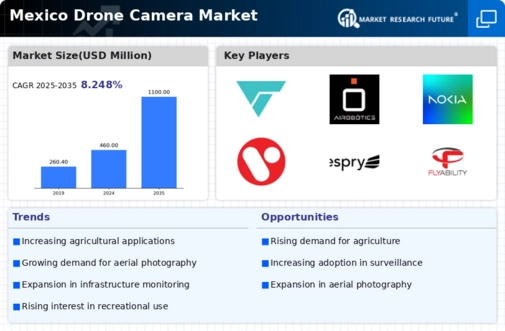
The Mexico Drone Camera Market is expected to be valued at 460.0 million USD in 2024.

What is the projected market size for the Mexico Drone Camera Market by 2035?

By 2035, the Mexico Drone Camera Market is projected to reach a value of 1100.0 million USD.

What is the expected compound annual growth rate (CAGR) for the Mexico Drone Camera Market from 2025 to 2035?

The expected CAGR for the Mexico Drone Camera Market from 2025 to 2035 is 8.248%.

Which resolution type is predicted to have the highest market value in 2035?

In 2035, the '12 to 20 MP' resolution type is predicted to have the highest market value at 350.0 million USD.

What is the market value for the 12 MP resolution type in 2024?

The market value for the 12 MP resolution type is anticipated to be 80.0 million USD in 2024.

Who are the key players in the Mexico Drone Camera Market?

Key players include Wingcopter, Airobotics, Nokia, and DJI among others.

What value is expected for the 20 to 32 MP resolution type in 2035?

The expected value for the 20 to 32 MP resolution type by 2035 is 300.0 million USD.

What key trend is expected to drive the growth of the Mexico Drone Camera Market?

Increasing applications of drone cameras in sectors such as agriculture and surveillance are key growth drivers.

How has the market for drone cameras in Mexico changed over the past few years?

The market has shown a significant increase, reflecting growing interest and investment in drone technology.

What is the expected market value for the 32 MP and above resolution type by 2035?

The market value for the 32 MP and above resolution type is expected to reach 250.0 million USD by 2035.

Download Free Sample

Kindly complete the form below to receive a free sample of this Report

Compare Licence

×
Features License Type
Single User Multiuser License Enterprise User
Price $4,950 $5,950 $7,250
Maximum User Access Limit 1 User Upto 10 Users Unrestricted Access Throughout the Organization
Free Customization
Direct Access to Analyst
Deliverable Format
Platform Access
Discount on Next Purchase 10% 15% 15%
Printable Versions