×
Hero Background
English
Chinese
French
Japanese
Korean
German
Spanish

Microbial Lipase Market Trends

ID: MRFR/FnB/4856-HCR
128 Pages
Snehal Singh
October 2025

Microbial Lipase Market Research Report Information by Source (Bacteria, Fungi), Form (Liquid, Powder), Application (Cleaning Agents, Animal Feed, Dairy Products, Bakery Products, Confectionery, Others), and Region (North America, Europe, Asia-Pacific, and Rest of the World) - Forecast till 2035

Share:
Download PDF ×

We do not share your information with anyone. However, we may send you emails based on your report interest from time to time. You may contact us at any time to opt-out.

Microbial Lipase Market Infographic
Purchase Options

Market Trends

Key Emerging Trends in the Microbial Lipase Market

The microbial lipase market is undergoing significant trends, reflecting the increasing demand for enzyme technologies in various industries, including food and beverages, pharmaceuticals, and biofuels. Microbial lipases, produced by microorganisms like bacteria and fungi, play a crucial role in catalyzing the hydrolysis of fats and oils, making them valuable in diverse applications. One prevailing trend in the microbial lipase market is the growing demand for clean-label and enzyme-based solutions in the food and beverage industry. As consumers seek natural and sustainable alternatives, microbial lipases find applications in cheese production, baking, and flavor enhancement. This trend aligns with the broader movement towards cleaner ingredient lists and the reduction of chemical additives in food products.

Moreover, the dairy industry is a key driver for the microbial lipase market, with lipases playing a vital role in the development of various cheese varieties. Microbial lipases contribute to the flavor and texture of cheeses by breaking down fats into free fatty acids and other compounds. This trend is particularly pronounced in the production of specialty and artisanal cheeses, where microbial lipases are employed to create unique and distinctive flavor profiles. The versatility of microbial lipases in cheese manufacturing positions them as essential enzymes in the dairy sector.

Additionally, the pharmaceutical industry is contributing to the growth of the microbial lipase market, particularly in the development of lipid-based drug formulations. Microbial lipases are used to improve the solubility and bioavailability of lipophilic drugs, enhancing their therapeutic efficacy. This trend aligns with the pharmaceutical industry's focus on advanced drug delivery systems and the optimization of drug formulations for better patient outcomes.

Furthermore, the market is witnessing innovation in microbial lipase products, with a focus on enhancing their stability, activity, and specificity. Advances in enzyme engineering and biotechnology are driving the development of tailored lipases that can meet the specific needs of different industries. From lipases with improved heat resistance for industrial processes to enzymes with enhanced flavor-modifying capabilities in the food industry, the innovation trend is expanding the application potential of microbial lipases.

Sustainability is emerging as a key trend in the microbial lipase market, with consumers and manufacturers prioritizing environmentally friendly practices. Enzymes, including microbial lipases, offer sustainable alternatives to traditional chemical processes, as they are biodegradable and often require milder reaction conditions. Brands are increasingly adopting enzyme technologies in their production processes to reduce the environmental impact and improve the overall sustainability of their operations. This sustainability trend reflects the industry's commitment to eco-friendly solutions and resonates with environmentally conscious consumers.

Moreover, the microbial lipase market is experiencing a regional diversification, with different regions showcasing varying levels of adoption and demand. Europe stands out as a significant market, driven by the region's strong emphasis on clean-label and sustainable food production. North America is also witnessing substantial growth, influenced by the demand for enzyme solutions in the pharmaceutical and food industries. This regional variation in demand is shaping market dynamics, with manufacturers tailoring their strategies to cater to the specific preferences and trends in different parts of the world.

Author
Snehal Singh
Assistant Manager - Research

High acumen in analyzing complex macro & micro markets with more than 6 years of work experience in the field of market research. By implementing her analytical skills in forecasting and estimation into market research reports, she has expertise in Packaging, Construction, and Equipment domains. She handles a team size of 20-25 resources and ensures smooth running of the projects, associated marketing activities, and client servicing.

Leave a Comment

Market Summary

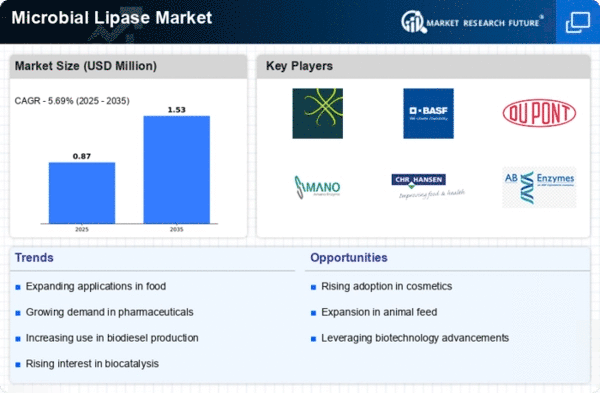
As per MRFR analysis, the Microbial Lipase Market Size was estimated at 0.826 USD Million in 2024. The Microbial Lipase industry is projected to grow from 0.883 in 2025 to 1.53 by 2035, exhibiting a compound annual growth rate (CAGR) of 5.69 during the forecast period 2025 - 2035.

Key Market Trends & Highlights

The Microbial Lipase Market is experiencing robust growth driven by diverse applications and technological advancements.

  • The North American region remains the largest market for microbial lipase, primarily due to its extensive food processing industry.
  • Asia-Pacific is identified as the fastest-growing region, reflecting increasing investments in biotechnology and sustainable practices.
  • The food industry represents the largest segment, while the biofuels sector is emerging as the fastest-growing segment in the microbial lipase market.
  • Key market drivers include the rising demand in personal care products and the expansion in the biofuel sector, which are significantly influencing market dynamics.

Market Size & Forecast

2024 Market Size 0.826 (USD Million)
2035 Market Size 1.53 (USD Million)
CAGR (2025 - 2035) 5.69%
Largest Regional Market Share in 2024 North America

Major Players

<p>Novozymes (DK), BASF (DE), DuPont (US), Amano Enzyme (JP), Chr. Hansen (DK), AB Enzymes (DE), Roche (CH), Biocatalysts (GB), Enzyme Development Corporation (US)</p>

Market Trends

The Microbial Lipase Market is currently experiencing a notable transformation, driven by the increasing demand for enzymes in various industries, including food, pharmaceuticals, and biofuels. This shift appears to be influenced by the growing awareness of the benefits associated with microbial lipases, such as their ability to enhance flavor profiles in food products and improve the efficiency of biocatalytic processes. Furthermore, the trend towards sustainable practices is prompting manufacturers to seek environmentally friendly alternatives, which microbial lipases can provide. As a result, the market is likely to witness a surge in innovation, with companies investing in research and development to create more effective and versatile enzyme formulations. In addition, the Microbial Lipase Market seems to be benefiting from advancements in biotechnology, which facilitate the production of these enzymes through fermentation processes. This technological evolution not only enhances yield but also reduces production costs, making microbial lipases more accessible to a broader range of applications. Moreover, the increasing prevalence of dietary preferences that favor plant-based and organic products is likely to further propel the demand for microbial lipases, as they align with the clean label movement. Overall, the market appears poised for growth, with various factors converging to create a favorable environment for microbial lipase applications across multiple sectors.

Rising Demand in Food Industry

The food sector is increasingly adopting microbial lipases to enhance flavors and improve the quality of various products. This trend indicates a shift towards using natural enzymes as alternatives to synthetic additives, aligning with consumer preferences for healthier options.

Sustainability and Eco-Friendly Practices

There is a growing emphasis on sustainable production methods within the Microbial Lipase Market. Companies are exploring environmentally friendly processes, which may lead to the development of biodegradable products and reduced environmental impact.

Technological Advancements in Biotechnology

Innovations in biotechnology are facilitating the efficient production of microbial lipases. Enhanced fermentation techniques are likely to improve enzyme yields and reduce costs, making these products more accessible for diverse applications.

Microbial Lipase Market Market Drivers

Increasing Applications in Biofuels

The Global Microbial Lipase Market Industry is increasingly benefiting from the rising applications of microbial lipases in biofuel production. As the world seeks alternative energy sources, microbial lipases facilitate the transesterification process in biodiesel production, converting fats and oils into usable fuel. This trend aligns with global efforts to reduce carbon emissions and promote renewable energy. The growing emphasis on sustainable energy solutions is likely to bolster the market, as industries adopt microbial lipases to enhance biofuel production efficiency, thereby expanding their market share.

Growing Awareness of Health Benefits

The Global Microbial Lipase Market Industry is also experiencing growth due to the increasing awareness of health benefits associated with microbial lipases. These enzymes are recognized for their potential to aid in digestion and improve nutrient absorption, particularly in dietary supplements and functional foods. As consumers become more health-conscious, the demand for products containing microbial lipases is expected to rise. This trend may lead to a broader acceptance of microbial lipases in the health and wellness sector, further driving market expansion.

Expansion in Food and Beverage Sector

The Global Microbial Lipase Market Industry is witnessing substantial growth due to the expansion of the food and beverage sector. Microbial lipases are extensively utilized in food processing, particularly in the production of cheese, dairy products, and baked goods. Their ability to enhance flavor and texture makes them indispensable in this industry. As the global population continues to rise, the demand for processed food is expected to increase, potentially driving the market value to 1122.4 USD Million by 2035. This growth trajectory highlights the importance of microbial lipases in meeting consumer preferences for high-quality food products.

Rising Demand for Biodegradable Products

The Global Microbial Lipase Market Industry experiences a notable surge in demand for biodegradable products, driven by increasing environmental awareness. As consumers and manufacturers alike shift towards sustainable alternatives, microbial lipases play a crucial role in the production of biodegradable plastics and detergents. This trend is expected to contribute significantly to the market, with projections indicating a market value of 590.0 USD Million in 2024. The growing preference for eco-friendly products is likely to propel the adoption of microbial lipases, further enhancing their market presence.

Technological Advancements in Enzyme Production

Technological advancements in enzyme production are significantly influencing the Global Microbial Lipase Market Industry. Innovations in fermentation technology and genetic engineering have led to the development of more efficient microbial strains capable of producing lipases with enhanced activity and stability. These advancements not only improve production yields but also reduce costs, making microbial lipases more accessible to various industries. As a result, the market is poised for growth, with a projected CAGR of 6.02% from 2025 to 2035, indicating a robust future for microbial lipases in diverse applications.

Market Segment Insights

By Application: Food Industry (Largest) vs. Biofuels (Fastest-Growing)

<p>The microbial lipase market is notably diversified across various applications, with the food industry commanding the largest share due to its extensive use in baking, <a href="https://www.marketresearchfuture.com/reports/dairy-market-11483" target="_blank">dairy</a>, and other food processing sectors. The position is strengthened by increasing consumer demand for convenience and ready-to-eat food products, which require effective fat modification processes. Other segments like cosmetics and pharmaceuticals also contribute significantly but remain relatively smaller compared to food applications. In contrast, biofuels demonstrate the fastest growth within the microbial lipase sector. The shift towards renewable energy sources drives innovation and investment in this area. The increasing focus on sustainability, coupled with government initiatives supporting biofuel production, positions the biofuels segment for notable expansion in the coming years.</p>

<p>Food Industry: Dominant vs. Biofuels: Emerging</p>

<p>The food industry stands as the dominant application of microbial lipase, leveraging the enzyme's properties for fat hydrolysis and flavor enhancement. Its established market ensures continuous demand as manufacturers seek to improve the quality and shelf-life of processed foods. On the other hand, biofuels represent an emerging opportunity, driven by the rise in eco-friendly energy solutions. Microbial lipases play a crucial role in transesterifying triglycerides into biodiesel, contributing to a sustainable energy future. As environmental concerns escalate, investments in biofuel technologies are likely to grow, positioning this segment as a robust competitor in the microbial lipase landscape.</p>

By Source: Bacteria (Largest) vs. Fungi (Fastest-Growing)

<p>In the Microbial Lipase Market, the source segment is primarily dominated by bacteria, which holds a significant share due to its widespread usage in various applications, including food processing and detergent industries. However, fungi are emerging as the fastest-growing segment, driven by their unique production capabilities and higher stability in different environments. This competitive landscape indicates a dynamic shift where traditional sources are being supplemented by innovative biological processes.</p>

<p>Bacteria (Dominant) vs. Fungi (Emerging)</p>

<p>Bacteria have been the cornerstone of microbial lipase production, offering high enzyme activity and cost-effectiveness. Their dominance stems from established applications across multiple industries, particularly in the food sector. In contrast, fungi are becoming the emerging force in this market segment, gaining attention for their ability to produce specialized lipases that are effective in extreme conditions. This shift reflects a growing interest in biotechnological advancements to harness the unique benefits fungi present, ensuring their market position continues to strengthen as demand rises for versatile enzyme solutions.</p>

By Form: Liquid (Largest) vs. Powder (Fastest-Growing)

<p>In the Microbial Lipase Market, the distribution among the form segments reveals that Liquid lipases capture the largest market share, driven by their versatility and ease of use in various applications, such as food processing and biotechnological advancements. Powder and Granular forms, while smaller in share, have been increasingly recognized for their specific applications, catering to niche markets that require concentrated lipase solutions.</p>

<p>Form: Liquid (Dominant) vs. Powder (Emerging)</p>

<p>Liquid microbial lipases are the dominant form segment, favored for their ease of incorporation in various industrial processes, especially in food production. Their ability to offer consistent performance and effective results contributes significantly to their strong market position. In contrast, Powder lipases are emerging rapidly within specialized applications and industries that demand higher concentrations or customized enzyme properties. Their powdered form allows for longer shelf life and targeted use cases, appealing particularly to manufacturers looking for innovative solutions to enhance efficiency in their operations.</p>

By Functionality: Thermostable (Largest) vs. Alkaline (Fastest-Growing)

<p>The Microbial Lipase Market showcases a diverse functionality segment characterized by thermostable, acidic, alkaline, and neutral lipases. Currently, thermostable lipases dominate this segment, commanding the largest share due to their robust performance at elevated temperatures. This makes them highly sought after in industrial applications, including food processing and biofuels. Meanwhile, alkaline lipases are witnessing rapid adoption, capturing attention as the fastest-growing segment, propelled by their increasing utility in detergent formulations and environmental applications.</p>

<p>Functionality: Thermostable (Dominant) vs. Alkaline (Emerging)</p>

<p>Thermostable lipases are recognized for their stability at high temperatures, making them indispensable in various industries where heat processes are prevalent. They cater to key sectors such as food, biofuels, and pharmaceuticals due to their efficiency and reliability. In contrast, alkaline lipases are emerging as a vital component in cleaner production technologies and laundry detergents, capitalizing on an eco-friendly approach to degreasing and stain removal. Their rapid growth aligns with market trends favoring sustainable and biodegradable solutions, highlighting their importance in future developments within the microbial lipase sector.</p>

Get more detailed insights about Microbial Lipase Market Research Report - Forecast till 2035

Regional Insights

North America : Market Leader in Innovation

North America holds a commanding 40% share of the microbial lipase market, driven by robust demand in food, pharmaceuticals, and biofuels. The region benefits from advanced research facilities and a strong regulatory framework that encourages innovation. Increasing consumer awareness regarding health and nutrition is further propelling market growth, alongside a shift towards sustainable production methods. The United States and Canada are the leading countries in this sector, hosting major players like DuPont and Novozymes. The competitive landscape is characterized by significant investments in R&D and strategic partnerships among key players. The presence of established companies ensures a steady supply of high-quality microbial lipases, catering to diverse industrial applications.

Europe : Regulatory Support and Growth

Europe accounts for 25% of the microbial lipase market, supported by stringent regulations that promote the use of biocatalysts in various industries. The European Union's Green Deal and sustainability initiatives are driving demand for eco-friendly enzymes, enhancing market growth. Additionally, the increasing adoption of microbial lipases in food processing and pharmaceuticals is contributing to this upward trend. Germany, France, and the UK are at the forefront of this market, with companies like BASF and Chr. Hansen leading the charge. The competitive landscape is marked by innovation and collaboration among industry players, ensuring a diverse range of products. The presence of regulatory bodies further strengthens the market, fostering a conducive environment for growth.

Asia-Pacific : Rapid Growth and Adoption

Asia-Pacific holds a 15% share of the microbial lipase market, driven by increasing industrialization and a growing food processing sector. Countries like China and India are witnessing a surge in demand for microbial lipases, fueled by rising consumer preferences for natural and organic products. The region's regulatory environment is gradually evolving to support biotechnological advancements, further enhancing market potential. China and Japan are the leading countries in this market, with key players such as Amano Enzyme and Biocatalysts making significant contributions. The competitive landscape is characterized by a mix of local and international companies, fostering innovation and product diversification. As the region continues to embrace biotechnological solutions, the microbial lipase market is poised for substantial growth.

Middle East and Africa : Emerging Market Potential

The Middle East and Africa represent a nascent market for microbial lipases, with a mere 1% share. However, the region is gradually recognizing the potential of biocatalysts in various applications, including food and cosmetics. The growth is driven by increasing investments in biotechnology and a rising demand for sustainable solutions. Regulatory frameworks are still developing, but there is a growing interest in adopting microbial lipases for industrial use. Countries like South Africa and the UAE are beginning to explore the benefits of microbial lipases, albeit at a slower pace. The competitive landscape is still emerging, with few key players present. However, as awareness grows and investments increase, the market is expected to expand, presenting opportunities for both local and international companies.

Key Players and Competitive Insights

The Microbial Lipase Market is currently characterized by a dynamic competitive landscape, driven by increasing demand for biocatalysts across various industries, including food, pharmaceuticals, and biofuels. Key players such as Novozymes (DK), BASF (DE), and DuPont (US) are strategically positioned to leverage their extensive research and development capabilities, focusing on innovation and sustainability. These companies are actively pursuing partnerships and collaborations to enhance their product offerings and expand their market reach, thereby shaping a competitive environment that emphasizes technological advancement and eco-friendly solutions.

In terms of business tactics, companies are increasingly localizing manufacturing to reduce supply chain vulnerabilities and optimize operational efficiency. The market structure appears moderately fragmented, with several players vying for market share. However, the collective influence of major companies like Amano Enzyme (JP) and Chr. Hansen (DK) is significant, as they contribute to setting industry standards and driving competitive practices.

In November 2025, Novozymes (DK) announced a strategic partnership with a leading food manufacturer to develop a new line of microbial lipases tailored for plant-based products. This collaboration is expected to enhance product performance and meet the growing consumer demand for plant-based alternatives, thereby positioning Novozymes as a frontrunner in this niche segment. The strategic importance of this move lies in its potential to capture a larger share of the rapidly expanding plant-based food market.

In October 2025, BASF (DE) unveiled a new microbial lipase product designed specifically for the detergent industry, which is anticipated to improve cleaning efficiency at lower temperatures. This innovation not only aligns with the increasing consumer preference for energy-efficient products but also reinforces BASF's commitment to sustainability. The introduction of this product could significantly enhance BASF's competitive edge in the detergent market, where performance and environmental impact are critical factors.

In September 2025, DuPont (US) expanded its microbial lipase portfolio through the acquisition of a biotechnology firm specializing in enzyme production. This acquisition is likely to bolster DuPont's capabilities in enzyme development and enhance its market position. The strategic importance of this acquisition lies in its potential to accelerate innovation and provide DuPont with a broader range of solutions to meet diverse customer needs across various sectors.

As of December 2025, current competitive trends in the Microbial Lipase Market are increasingly defined by digitalization, sustainability, and the integration of artificial intelligence in product development. Strategic alliances are becoming more prevalent, as companies recognize the value of collaboration in driving innovation and enhancing market presence. Looking ahead, competitive differentiation is expected to evolve, shifting from price-based competition to a focus on innovation, technological advancements, and supply chain reliability. This transition underscores the importance of developing unique, high-quality products that meet the evolving demands of consumers and industries alike.

Key Companies in the Microbial Lipase Market market include

Industry Developments

Future Outlook

Microbial Lipase Market Future Outlook

<p>The Microbial Lipase Market is projected to grow at a 5.69% CAGR from 2024 to 2035, driven by increasing demand in food processing, biofuels, and pharmaceuticals.</p>

New opportunities lie in:

  • <p>Expansion into emerging markets with tailored enzyme solutions.</p>
  • <p>Development of eco-friendly microbial lipases for sustainable applications.</p>
  • <p>Strategic partnerships with food manufacturers for customized enzyme formulations.</p>

<p>By 2035, the Microbial Lipase Market is expected to achieve robust growth and diversification.</p>

Market Segmentation

Microbial Lipase Market Form Outlook

  • Liquid
  • Powder
  • Granular

Microbial Lipase Market Source Outlook

  • Bacteria
  • Fungi
  • Yeast

Microbial Lipase Market Application Outlook

  • Food Industry
  • Cosmetics
  • Pharmaceuticals
  • Biofuels
  • Detergents

Microbial Lipase Market Functionality Outlook

  • Thermostable
  • Acidic
  • Alkaline
  • Neutral

Report Scope

MARKET SIZE 20240.826(USD Million)
MARKET SIZE 20250.883(USD Million)
MARKET SIZE 20351.53(USD Million)
COMPOUND ANNUAL GROWTH RATE (CAGR)5.69% (2024 - 2035)
REPORT COVERAGERevenue Forecast, Competitive Landscape, Growth Factors, and Trends
BASE YEAR2024
Market Forecast Period2025 - 2035
Historical Data2019 - 2024
Market Forecast UnitsUSD Million
Key Companies ProfiledNovozymes (DK), BASF (DE), DuPont (US), Amano Enzyme (JP), Chr. Hansen (DK), AB Enzymes (DE), Roche (CH), Biocatalysts (GB), Enzyme Development Corporation (US)
Segments CoveredApplication, Source, Form, Functionality
Key Market OpportunitiesGrowing demand for sustainable biocatalysts in food and biofuel industries drives Microbial Lipase Market expansion.
Key Market DynamicsRising demand for sustainable biocatalysts drives innovation and competition in the microbial lipase market.
Countries CoveredNorth America, Europe, APAC, South America, MEA

FAQs

  1. 1 EXECUTIVE SUMMARY
    1. Market Attractiveness
    2. Analysis
  2. Global Microbial Lipase Market, by Source
  3. Global Microbial Lipase Market, by Form
  4. Global Microbial
  5. Lipase Market, by Application
  6. Global Microbial Lipase Market, by Region
  7. MARKET INTRODUCTION
    1. Definition
    2. Scope of the Study
    3. Market Structure
    4. Key Buying Criteria
    5. Macro Factor Indicator
    6. Analysis
  8. RESEARCH METHODOLOGY
    1. Research Process
    2. Primary Research
    3. Secondary Research
    4. Market Size Estimation
    5. Forecast Model
    6. List of Assumptions
  9. MARKET DYNAMICS
    1. Introduction
    2. Drivers
    3. Restraints
    4. Opportunities
    5. Challenges
  10. MARKET FACTOR ANALYSIS
    1. Value Chain Analysis
    2. Supply Chain Analysis
    3. Porter’s Five Forces Model
  11. Bargaining Power of Suppliers
  12. Bargaining Power of Buyers
  13. Threat of New Entrants
  14. Threat of Substitutes
  15. Intensity of Rivalry
  16. GLOBAL MICROBIAL LIPASE
  17. MARKET, BY SOURCE
    1. Introduction
    2. Fungi
  18. Fungi: Market Estimates & Forecast, by Region/Country, 2020-2027
    1. Bacteria
      1. Bacteria: Market Estimates
    2. & Forecast, by Region/Country, 2020-2027
  19. GLOBAL MICROBIAL LIPASE MARKET, BY FORM
    1. Introduction
    2. Liquid
      1. Liquid: Market
    3. Estimates & Forecast, by Region/Country, 2020-2027
    4. Powder
      1. Powder: Market Estimates & Forecast, by
    5. Region/Country, 2020-2027
  20. GLOBAL MICROBIAL LIPASE MARKET, BY APPLICATION
    1. Introduction
    2. Cleaning Agents
      1. Cleaning Agents:
  21. Market Estimates & Forecast, by Region/Country, 2020-2027
    1. Animal Feed
      1. Animal Feed: Market Estimates
    2. & Forecast, by Region/Country, 2020-2027
    3. Dairy Products
      1. Dairy Products: Market Estimates & Forecast,
    4. by Region/Country, 2020-2027
    5. Bakery Products
      1. Bakery Products: Market Estimates & Forecast, by Region/Country,
    6. Confectionery
  22. Confectionery: Market Estimates & Forecast, by Region/Country, 2020-2027
    1. Others
      1. Others: Market
    2. Estimates & Forecast, by Region/Country, 2020-2027
  23. GLOBAL MICROBIAL LIPASE MARKET, BY REGION
    1. Introduction
    2. North America
      1. Market Estimates
      2. Market Estimates & Forecast, by Form, 2020-2027
      3. Market Estimates
      4. Market Estimates & Forecast, by Country,
    3. & Forecast, by Source, 2020-2027
    4. & Forecast, by Application, 2020-2027
    5. US
  24. Market Estimates & Forecast, by Source, 2020-2027
  25. Market Estimates & Forecast, by Form,
  26. Market Estimates & Forecast, by Application, 2020-2027
  27. Canada
  28. Market Estimates & Forecast, by Source,
  29. Market Estimates & Forecast, by Form, 2020-2027
    1. Mexico
  30. Market Estimates & Forecast, by Application,
  31. Market Estimates & Forecast, by Source, 2020-2027
  32. Market Estimates & Forecast, by Form,
  33. Market Estimates & Forecast, by Application, 2020-2027
    1. Europe
      1. Market Estimates & Forecast, by Source,
  34. Market Estimates & Forecast, by Form, 2020-2027
  35. Market Estimates & Forecast, by Application,
  36. Market Estimates & Forecast, by Country, 2020-2027
  37. Germany
  38. Market Estimates & Forecast, by Source,
  39. Market Estimates & Forecast, by Form, 2020-2027
    1. UK
  40. Market Estimates & Forecast, by Application,
  41. Market Estimates & Forecast, by Source, 2020-2027
  42. Market Estimates & Forecast, by Form,
  43. Market Estimates & Forecast, by Application, 2020-2027
  44. France
  45. Market Estimates & Forecast, by Source,
  46. Market Estimates & Forecast, by Form, 2020-2027
    1. Spain
  47. Market Estimates & Forecast, by Application,
  48. Market Estimates & Forecast, by Source, 2020-2027
  49. Market Estimates & Forecast, by Form,
  50. Market Estimates & Forecast, by Application, 2020-2027
  51. Italy
  52. Market Estimates & Forecast, by Source,
  53. Market Estimates & Forecast, by Form, 2020-2027
    1. Rest of Europe
  54. Market Estimates & Forecast, by Application,
  55. Market Estimates & Forecast, by Source, 2020-2027
  56. Market Estimates & Forecast, by Form,
  57. Market Estimates & Forecast, by Application, 2020-2027
    1. Asia-Pacific
      1. Market Estimates & Forecast, by Source,
  58. Market Estimates & Forecast, by Form, 2020-2027
  59. Market Estimates & Forecast, by Application,
  60. Market Estimates & Forecast, by Country, 2020-2027
  61. China
  62. Market Estimates & Forecast, by Source,
  63. Market Estimates & Forecast, by Form, 2020-2027
    1. Japan
  64. Market Estimates & Forecast, by Application,
  65. Market Estimates & Forecast, by Source, 2020-2027
  66. Market Estimates & Forecast, by Form,
  67. Market Estimates & Forecast, by Application, 2020-2027
  68. India
  69. Market Estimates & Forecast, by Source,
  70. Market Estimates & Forecast, by Form, 2020-2027
    1. Australia & New Zealand
    2. & Forecast, by Form, 2020-2027
    3. Rest of Asia-Pacific
  71. Market Estimates & Forecast, by Application,
  72. Market Estimates & Forecast, by Source, 2020-2027
  73. Market Estimates
  74. Market Estimates & Forecast, by Application,
  75. Market Estimates & Forecast, by Source, 2020-2027
  76. Market Estimates & Forecast, by Form,
  77. Market Estimates & Forecast, by Application, 2020-2027
    1. Rest of the World
      1. Market Estimates & Forecast, by Source,
  78. Market Estimates & Forecast, by Form, 2020-2027
  79. Market Estimates & Forecast, by Application,
  80. Market Estimates & Forecast, by Region, 2020-2027
  81. South America
  82. Market Estimates & Forecast, by Source,
  83. Market Estimates & Forecast, by Form, 2020-2027
    1. Middle East
  84. Market Estimates & Forecast, by Application,
  85. Market Estimates & Forecast, by Source, 2020-2027
  86. Market Estimates & Forecast, by Form,
  87. Market Estimates & Forecast, by Application, 2020-2027
  88. Africa
  89. Market Estimates & Forecast, by Source,
  90. Market Estimates & Forecast, by Form, 2020-2027
  91. Market Estimates & Forecast, by Application,
  92. COMPETITIVE LANDSCAPE
    1. Introduction
    2. Competitive Benchmarking
    3. Development Share Analysis
    4. Key Developments & Growth Strategies
  93. COMPANY PROFILES
    1. Novozymes AS (Denmark)
      1. Company Overview
      2. Financial Overview
      3. Products Offered
      4. Key Developments
      5. SWOT Analysis
      6. Key Strategies
    2. Koninklijke DSM
      1. Company Overview
      2. Financial Overview
      3. Products Offered
      4. Key Developments
      5. SWOT Analysis
      6. Key Strategies
    3. N.V. (Netherlands)
    4. Company Overview
    5. Financial Overview
    6. Products Offered
    7. Key Developments
    8. SWOT Analysis
    9. Key Strategies
    10. Chr. Hansen A/S (Denmark)
    11. Amano Enzyme USA Co., Ltd. (US)
      1. Company Overview
      2. Financial Overview
      3. Products Offered
      4. Key Developments
      5. SWOT Analysis
      6. Key Strategies
    12. Associated British
      1. Company Overview
      2. Financial Overview
      3. Products Offered
      4. Key Developments
      5. SWOT Analysis
      6. Key Strategies
    13. Foods Limited (UK)
    14. Company Overview
    15. Financial Overview
    16. Products Offered
    17. Key Developments
    18. SWOT Analysis
    19. Key Strategies
    20. DowDupont Inc. (US)
    21. Company Overview
    22. Financial Overview
    23. Products Offered
    24. Key Developments
    25. SWOT Analysis
    26. Key Strategies
    27. Advanced Enzymes (India)
    28. Enzyme Development Corporation (US)
      1. Company Overview
      2. Financial Overview
      3. Products Offered
      4. Key Developments
      5. SWOT Analysis
      6. Key Strategies
    29. Creative Enzymes
      1. Company Overview
      2. Financial Overview
      3. Products Offered
      4. Key Developments
      5. SWOT Analysis
      6. Key Strategies
    30. (US)
    31. Company Overview
    32. Financial Overview
    33. Products Offered
    34. Key Developments
    35. SWOT Analysis
    36. Key Strategies
    37. Meito Sangyo Co., Ltd. (Japan)
    38. Aumgene Biosciences (India)
      1. Company Overview
      2. Financial Overview
      3. Products Offered
      4. Key Developments
      5. SWOT Analysis
      6. Key Strategies
    39. Biocatalysts Ltd
    40. (UK)
    41. Company Overview
    42. Financial Overview
    43. Products Offered
    44. Key Developments
    45. SWOT Analysis
    46. Key Strategies
    47. APPENDIX
    48. General Forms & References
    49. List of Abbreviation
  94. LIST OF TABLES
  95. Global Microbial Lipase Market, by Region, 2020–2027
    1. (USD Million)
    2. TABLE
  96. Global Microbial Lipase Market, by Source, 2020–2027 (USD Million)
  97. Global Microbial
  98. Lipase Market, by Form, 2020–2027 (USD Million)
  99. Global Microbial Lipase Market, by Application,
  100. North America: Microbial Lipase Market, by Country, 2020–2027
    1. (USD Million)
    2. TABLE
  101. North America: Microbial Lipase Market, by Source, 2020–2027 (USD Million)
  102. North
  103. America: Microbial Lipase Market, by Form, 2020–2027 (USD Million)
  104. North America:
  105. Microbial Lipase Market, by Application, 2020–2027 (USD Million)
  106. US: Microbial
  107. Lipase Market, by Source, 2020–2027 (USD Million)
  108. US: Microbial Lipase Market, by Form, 2020–2027
    1. (USD Million)
    2. TABLE
  109. US: Microbial Lipase Market, by Application, 2020–2027 (USD Million)
  110. Canada: Microbial
  111. Lipase Market, by Source, 2020–2027 (USD Million)
  112. Canada: Microbial Lipase Market, by Form,
  113. Canada: Microbial Lipase Market, by Application, 2020–2027
    1. (USD Million)
    2. TABLE
  114. Mexico: Microbial Lipase Market, by Source, 2020–2027 (USD Million)
  115. Mexico: Microbial
  116. Lipase Market, by Form, 2020–2027 (USD Million)
  117. Mexico: Microbial Lipase Market, by Application,
  118. Europe: Microbial Lipase Market, by Country, 2020–2027
    1. (USD Million)
    2. TABLE
  119. Europe: Microbial Lipase Market, by Source, 2020–2027 (USD Million)
  120. Europe: Microbial
  121. Lipase Market, by Form, 2020–2027 (USD Million)
  122. Europe: Microbial Lipase Market, by Application,
  123. Germany: Microbial Lipase Market, by Source, 2020–2027
    1. (USD Million)
    2. TABLE
  124. Germany: Microbial Lipase Market, by Form, 2020–2027 (USD Million)
  125. Germany: Microbial
  126. Lipase Market, by Application, 2020–2027 (USD Million)
  127. France: Microbial Lipase
  128. Market, by Source, 2020–2027 (USD Million)
  129. France: Microbial Lipase Market, by Form,
  130. France: Microbial Lipase Market, by Application, 2020–2027
    1. (USD Million)
    2. TABLE
  131. Italy: Microbial Lipase Market, by Source, 2020–2027 (USD Million)
  132. Italy: Microbial
  133. Lipase Market, by Form, 2020–2027 (USD Million)
  134. Italy: Microbial Lipase Market, by Application,
  135. Spain: Microbial Lipase Market, by Source, 2020–2027
    1. (USD Million)
    2. TABLE
  136. Spain: Microbial Lipase Market, by Form, 2020–2027 (USD Million)
  137. Spain: Microbial
  138. Lipase Market, by Application, 2020–2027 (USD Million)
  139. UK: Microbial Lipase
  140. Market, by Source, 2020–2027 (USD Million)
  141. UK: Microbial Lipase Market, by Form, 2020–2027
    1. (USD Million)
    2. TABLE
  142. UK: Microbial Lipase Market, by Application, 2020–2027 (USD Million)
  143. Rest of Europe:
  144. Microbial Lipase Market, by Source, 2020–2027 (USD Million)
  145. Rest of Europe: Microbial
  146. Lipase Market, by Form, 2020–2027 (USD Million)
  147. Rest of Europe: Microbial Lipase Market,
    1. by Application, 2020–2027 (USD Million)
  148. Asia-Pacific: Microbial Lipase Market, by
    1. Country, 2020–2027 (USD Million)
  149. Asia-Pacific: Microbial Lipase Market, by Source,
  150. Asia-Pacific: Microbial Lipase Market, by Form, 2020–2027
    1. (USD Million)
    2. TABLE
  151. Asia-Pacific: Microbial Lipase Market, by Application, 2020–2027 (USD Million)
  152. China:
  153. Microbial Lipase Market, by Source, 2020–2027 (USD Million)
  154. China: Microbial Lipase
  155. Market, by Form, 2020–2027 (USD Million)
  156. China: Microbial Lipase Market, by Application,
  157. India: Microbial Lipase Market, by Source, 2020–2027
    1. (USD Million)
    2. TABLE
  158. India: Microbial Lipase Market, by Form, 2020–2027 (USD Million)
  159. India: Microbial
  160. Lipase Market, by Application, 2020–2027 (USD Million)
  161. Japan: Microbial Lipase
  162. Market, by Source, 2020–2027 (USD Million)
  163. Japan: Microbial Lipase Market, by Form,
  164. Japan: Microbial Lipase Market, by Application, 2020–2027
    1. (USD Million)
    2. TABLE
  165. Rest of Asia-Pacific: Microbial Lipase Market, by Source, 2020–2027 (USD
    1. Million)
    2. TABLE
  166. Rest of Asia-Pacific: Microbial Lipase Market, by Form, 2020–2027 (USD
    1. Million)
    2. TABLE
  167. Rest of Asia-Pacific: Microbial Lipase Market, by Application, 2020–2027
    1. (USD Million)
    2. TABLE
  168. Rest of the World (RoW): Microbial Lipase Market, by Country, 2020–2027
    1. (USD Million)
    2. TABLE
  169. Rest of the World (RoW): Microbial Lipase Market, by Source, 2020–2027
    1. (USD Million)
    2. TABLE
  170. Rest of the World (RoW): Microbial Lipase Market, by Form, 2020–2027 (USD
    1. Million)
    2. TABLE
  171. Rest of the World (RoW): Microbial Lipase Market, by Application, 2020–2027
    1. (USD Million)
    2. TABLE
  172. South America: Microbial Lipase Market, by Source, 2020–2027 (USD Million)
  173. South
  174. America: Microbial Lipase Market, by Form, 2020–2027 (USD Million)
  175. South America:
  176. Microbial Lipase Market, by Application, 2020–2027 (USD Million)
  177. Middle East:
  178. Microbial Lipase Market, by Source, 2020–2027 (USD Million)
  179. Middle East: Microbial
  180. Lipase Market, by Form, 2020–2027 (USD Million)
  181. Middle East: Microbial Lipase Market, by
    1. Application, 2020–2027 (USD Million)
  182. Africa: Microbial Lipase Market, by Source,
  183. Africa: Microbial Lipase Market, by Form, 2020–2027
    1. (USD Million)
    2. TABLE
  184. Africa: Microbial Lipase Market, by Application, 2020–2027 (USD Million)
  185. LIST OF FIGURES
  186. Global Microbial
    1. Lipase Market Segmentation
  187. Forecast Research Methodology
  188. Five Forces Analysis of the Global Microbial
    1. Lipase Market
    2. FIGURE
  189. Value Chain of the Global Microbial Lipase Market
  190. Share of the Global Microbial Lipase Market
    1. in 2020, by Country (%)
  191. Global Microbial Lipase Market, by Region, 2020–2027,
  192. Global Microbial
  193. Lipase Market Size, by Source, 2020
  194. Share of the Global Microbial Lipase Market, by
    1. Source, 2020–2027 (%)
  195. Global Microbial Lipase Market Size, by Form, 2020
  196. Share of the
  197. Global Microbial Lipase Market, by Form, 2020–2027 (%)
  198. Global Microbial Lipase Market Size, by
    1. Application, 2020
    2. FIGURE
  199. Share of the Global Microbial Lipase Market, by Application, 2020–2027
    1. (%)

Microbial Lipase Market Segmentation

Market Segmentation Overview

  • Detailed segmentation data will be available in the full report
  • Comprehensive analysis by multiple parameters
  • Regional and country-level breakdowns
  • Market size forecasts by segment
Infographic

Free Sample Request

Kindly complete the form below to receive a free sample of this Report

Get Free Sample

Customer Strories

Compare Licence

×
Features License Type
Single User Multiuser License Enterprise User
Price $4,950 $5,950 $7,250
Maximum User Access Limit 1 User Upto 10 Users Unrestricted Access Throughout the Organization
Free Customization
Direct Access to Analyst
Deliverable Format
Platform Access
Discount on Next Purchase 10% 15% 15%
Printable Versions