Microgrid as a Service Market Summary
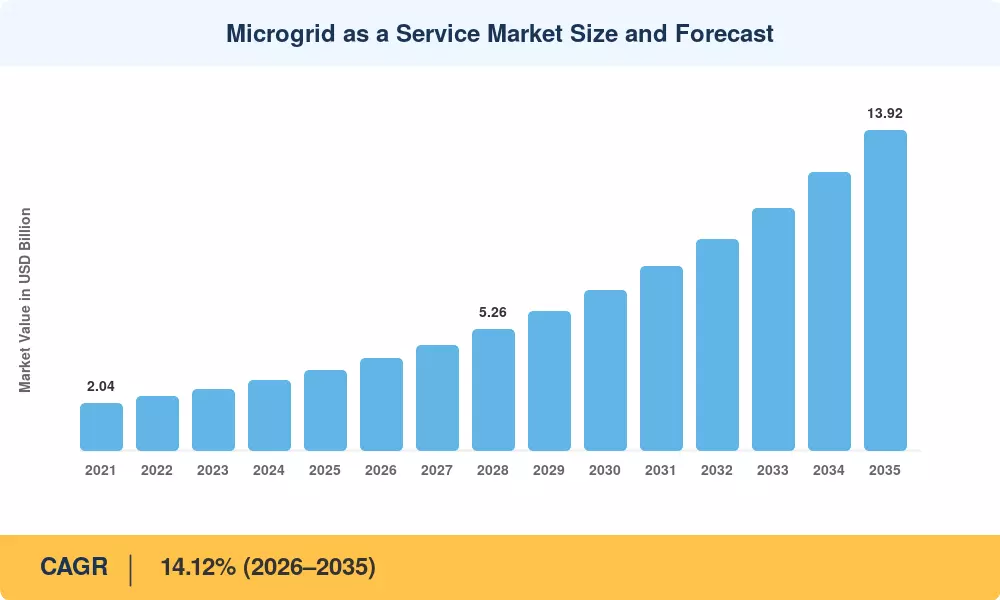
The Microgrid as a Service Market reached an estimated USD 3.47 billion in 2025 and is projected to grow from USD 3.96 billion in 2026 to USD 13.92 billion by 2035, registering a CAGR of 14.12% across the forecast period (2026–2035). This acceleration is anchored in escalating grid vulnerability — the U.S. Department of Energy allocated over USD 3.5 billion through the Grid Resilience and Innovation Partnerships (GRIP) program in 2024 alone, while the European Commission earmarked EUR 1.2 billion for distributed energy management infrastructure under REPowerEU [1][2]. These policy-driven capital injections are transforming how enterprises procure backup and primary power.
A fundamental shift is underway from centralized diesel-backup architectures toward integrated renewable microgrid technology platforms that combine solar, battery storage, and intelligent microgrid control systems. Legacy standby generators — which still account for roughly 40% of backup capacity in commercial buildings — are being displaced by energy-as-a-service platforms that bundle design, financing, and ongoing operation into a single subscription. The U.S. National Renewable Energy Laboratory (NREL) estimates that smart grid solutions paired with on-site storage can reduce facility energy costs by 20–30% while cutting Scope 2 emissions by up to 50% [3][4].
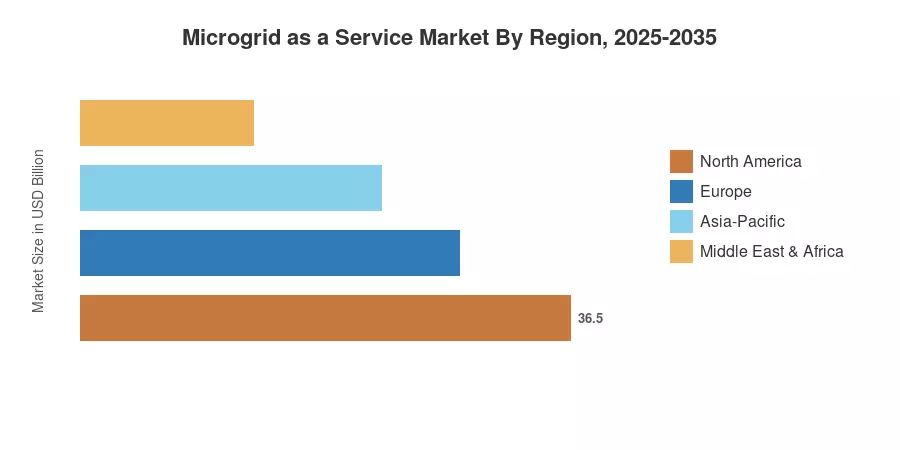
Asia-Pacific commands the largest regional share at approximately 34% of the Microgrid as a Service Market, driven by India's Green Energy Corridor program and China's aggressive distributed generation targets. Asia-Pacific also serves as the fastest-growing region, posting a CAGR above 15.8% through 2035. North America follows with roughly 28% share, buoyed by federal resilience grants and state-level clean energy mandates Europe holds the third position, with demand shaped by REPowerEU and rising industrial electrification. The Microgrid as a Service Market is set to evolve rapidly as decarbonization urgency intensifies globally.
Key Report Takeaways
• By Service Type
- Software as a Service commands the leading share at approximately 31% of the Microgrid as a Service Market, reflecting enterprise preference for cloud-based distributed energy management platforms
- Monitoring and Control Services is the fastest-growing segment with a projected CAGR of 16.3%, as real-time microgrid control systems become critical for hybrid asset optimization
- Operation and Maintenance Services is valued at roughly USD 0.83 billion in 2025, underscoring recurring revenue potential in the Microgrid as a Service Market
• By End-User Vertical
- Industrial end users account for the largest segment share at approximately 38%, driven by uninterrupted power requirements for manufacturing and data center operations
- Government vertical is expanding at a CAGR of 15.1%, propelled by federal resilience mandates and defense-sector microgrid deployments
- The residential and Commercial vertical is projected to reach USD 1.18 billion by 2035 as energy-as-a-service platforms scale to multi-tenant buildings
• By Region
- Asia-Pacific leads the Microgrid as a Service Market with 34% share, powered by smart grid solutions investments across India, China, and ASEAN economies
- North America holds approximately 28% share, shaped by DOE grants and state renewable portfolio standards
- The Middle East & Africa is projected to grow at a CAGR of 13.5%, reflecting the Gulf states' push toward energy diversification
Market Size and Forecast (2021–2035)
MARKET RESEARCH FUTURE (MRFR) 's market sizing integrates primary interviews with over 120 industry stakeholders, proprietary bottom-up modeling by service type and end-user vertical, and triangulation against published data from IEA, DOE, and IRENA. Historical figures (2021–2024) reflect reported revenues; forecast projections (2026–2035) apply the calibrated 14.12% CAGR with adjustments for anticipated policy shifts and technology cost curves.