×
Request Free Sample ×

Kindly complete the form below to receive a free sample of this Report

* Please use a valid business email

Leading companies partner with us for data-driven Insights

clients tt-cursor
Hero Background

Military Airborne Radar Market

ID: MRFR/AD/4461-CR
257 Pages
Swapnil Palwe
December 2024

Military Airborne Radar Market Research Report Information by Type (Surveillance Early Warning Radar, Airborne Warning and Control System (AEACS), Missile Warning Radars, Targeting and Reconnaissance Radars, Fire Control Radars (FCR), Navigational Radars, Weather Radars), Component (Antenna, Transmitter, Receiver, Power Amplifier) Range (Short Range, Medium Range, and Long Range) Application (Manned Aircraft {Fixed Wing, Rotary Wing}, Unmanned Aircraft System (UAS){Male, Hale, Tactical}) Aircraft Type (Fighter Aircraft, Attack Aircraft, Mari... read more

Share:
Download PDF ×

We do not share your information with anyone. However, we may send you emails based on your report interest from time to time. You may contact us at any time to opt-out.

Military Airborne Radar Market Infographic
Purchase Options

Military Airborne Radar Market Summary

As per MRFR analysis, the Military Airborne Radar Market Size was estimated at 2687.78 USD Million in 2024. The Military Airborne Radar industry is projected to grow from 2854.96 USD Million in 2025 to 5220.03 USD Million by 2035, exhibiting a compound annual growth rate (CAGR) of 6.22 during the forecast period 2025 - 2035.

Key Market Trends & Highlights

The Military Airborne Radar Market is poised for substantial growth driven by technological advancements and geopolitical factors.

  • North America remains the largest market for military airborne radar, driven by robust defense budgets and advanced technological capabilities.
  • The Asia-Pacific region is emerging as the fastest-growing market, reflecting increasing defense expenditures and regional security concerns.
  • Surveillance radar systems dominate the market, while targeting radar systems are experiencing the fastest growth due to evolving military strategies.
  • Technological advancements in radar systems and geopolitical tensions are key drivers propelling market expansion.

Market Size & Forecast

2024 Market Size 2687.78 (USD Million)
2035 Market Size 5220.03 (USD Million)
CAGR (2025 - 2035) 6.22%

Major Players

Northrop Grumman (US), Raytheon Technologies (US), Lockheed Martin (US), Thales Group (FR), BAE Systems (GB), Leonardo (IT), Hensoldt (DE), Elbit Systems (IL), Saab (SE)
Military Airborne Radar Market Trends

The Military Airborne Radar Market is currently experiencing a transformative phase, driven by advancements in technology and increasing defense budgets across various nations. The integration of cutting-edge technologies such as artificial intelligence and machine learning into radar systems appears to enhance their capabilities, allowing for improved target detection and tracking. Furthermore, the growing emphasis on situational awareness and the need for effective surveillance systems in military operations suggest a robust demand for sophisticated airborne radar solutions. As nations prioritize modernization of their defense systems, the Military Airborne Radar Market is likely to witness substantial growth in the coming years. In addition to technological advancements, geopolitical tensions and regional conflicts are influencing the dynamics of the Military Airborne Radar Market. Countries are investing heavily in upgrading their military capabilities, which includes the procurement of advanced radar systems. This trend indicates a shift towards more integrated and versatile radar solutions that can operate in diverse environments. Moreover, the increasing focus on unmanned aerial vehicles (UAVs) and their integration with radar technology may further propel market expansion. Overall, the Military Airborne Radar Market is poised for significant evolution, driven by innovation and strategic defense initiatives.

Technological Advancements

The Military Airborne Radar Market is witnessing rapid technological advancements, particularly in the integration of artificial intelligence and machine learning. These innovations enhance radar performance, enabling more accurate target detection and tracking capabilities.

Geopolitical Influences

Geopolitical tensions are shaping the Military Airborne Radar Market, as nations prioritize defense spending to bolster their military capabilities. This trend leads to increased investments in advanced radar systems to ensure national security.

Integration with UAVs

The growing use of unmanned aerial vehicles (UAVs) in military operations is influencing the Military Airborne Radar Market. The integration of radar technology with UAVs enhances surveillance and reconnaissance capabilities, driving demand for advanced radar solutions.

Military Airborne Radar Market Drivers

Market Growth Projections

The Global Military Airborne Radar Industry is projected to experience substantial growth over the next decade. With a market value of 2.69 USD Billion in 2024, it is expected to reach 5.22 USD Billion by 2035. This growth trajectory indicates a compound annual growth rate of 6.22% from 2025 to 2035. Factors contributing to this growth include technological advancements, increasing defense budgets, and rising geopolitical tensions. The market's expansion reflects the critical role of airborne radar systems in modern military operations, highlighting the ongoing demand for enhanced surveillance and reconnaissance capabilities.

Increasing Defense Budgets

Globally, defense budgets are on the rise, which is a critical driver for the Global Military Airborne Radar Industry. Countries are allocating more resources to enhance their military capabilities, including airborne radar systems. For example, nations like the United States and China are investing heavily in upgrading their military fleets, which includes advanced radar technologies. This increase in defense spending is projected to contribute to the market's growth, with estimates suggesting it could reach 5.22 USD Billion by 2035. The compound annual growth rate of 6.22% from 2025 to 2035 indicates a robust demand for these systems.

Emerging Markets and Defense Modernization

Emerging markets are increasingly focusing on defense modernization, which significantly impacts the Global Military Airborne Radar Industry. Countries in Asia-Pacific and the Middle East are investing in upgrading their military technologies, including airborne radar systems. For instance, nations like India and Saudi Arabia are enhancing their defense capabilities to address regional security challenges. This modernization trend is likely to drive demand for advanced radar systems, as these countries seek to bolster their military readiness. The anticipated growth in these markets is expected to contribute to the overall expansion of the industry.

Geopolitical Tensions and Security Concerns

Geopolitical tensions and security concerns are pivotal factors influencing the Global Military Airborne Radar Industry. As nations face increasing threats from regional conflicts and terrorism, there is a heightened need for advanced surveillance and reconnaissance capabilities. Countries are prioritizing the development and acquisition of airborne radar systems to enhance situational awareness and response times. This trend is evident in various military exercises and operations that emphasize the importance of radar technology. The ongoing conflicts in various regions underscore the necessity for robust military capabilities, further propelling market growth.

Technological Advancements in Radar Systems

The Global Military Airborne Radar Industry is experiencing a surge in technological advancements, particularly in radar systems. Innovations such as phased array radar and synthetic aperture radar are enhancing detection capabilities and target tracking. For instance, the integration of artificial intelligence and machine learning algorithms is improving the accuracy and efficiency of radar systems. This trend is expected to drive the market significantly, as nations invest in modernizing their military capabilities. The market is projected to reach 2.69 USD Billion in 2024, reflecting a growing emphasis on advanced radar technologies.

Integration of Unmanned Aerial Vehicles (UAVs)

The integration of unmanned aerial vehicles (UAVs) into military operations is reshaping the Global Military Airborne Radar Industry. UAVs equipped with advanced radar systems are enhancing reconnaissance and surveillance capabilities, providing real-time data to military commanders. This integration allows for more efficient operations and improved situational awareness. As military forces worldwide adopt UAV technology, the demand for airborne radar systems that can operate in conjunction with these platforms is likely to increase. This trend reflects a broader shift towards modern warfare tactics, emphasizing the importance of radar systems in contemporary military strategies.

Market Segment Insights

By Application: Surveillance (Largest) vs. Targeting (Fastest-Growing)

The Military Airborne Radar Market exhibits a diverse application spectrum, dominated primarily by the Surveillance segment, which captures the largest share of the market. Following Surveillance, Targeting and Navigation segments also hold significant portions, but to a lesser degree. Weather Monitoring and Search and Rescue serve as niche applications, yet they play a vital role in enhancing operational effectiveness in various missions. As military operations evolve, the need for advanced radar applications becomes increasingly important in strategic environments.

Surveillance: Dominant vs. Targeting: Emerging

Surveillance applications in military airborne radar continue to dominate the market due to their critical role in intelligence gathering and situational awareness. This segment benefits from advanced technologies that allow for enhanced detection, tracking, and identification of targets, contributing to its stable demand. On the other hand, the Targeting segment is emerging rapidly as militaries worldwide adopt precision weaponry that relies heavily on accurate targeting systems. The evolution of this segment is driven by technological advancements in radar capabilities, which support multi-target engagement and minimize collateral damage. As such, the growth in Targeting applications complements the established Surveillance segment, indicating a robust future for both areas.

By Technology: Phased Array Radar (Largest) vs. Synthetic Aperture Radar (Fastest-Growing)

In the Military Airborne Radar Market, Phased Array Radar holds the largest share, primarily due to its superior tracking capabilities and adaptability in various combat scenarios. This technology allows for rapid beam steering, making it highly effective for target acquisition and tracking over wide areas, especially in complex environments. Meanwhile, Synthetic Aperture Radar is recognized as the fastest-growing segment due to advancements in detection efficiency and imaging capabilities, which enhance reconnaissance and surveillance operations. Its ability to provide high-resolution images regardless of weather conditions has significantly bolstered its adoption in military applications.

Technology: Phased Array Radar (Dominant) vs. Synthetic Aperture Radar (Emerging)

Phased Array Radar is celebrated for its high performance and versatility, providing continuous coverage and quick response times essential for modern military operations. Its dominance can be attributed to its deployment on numerous advanced aircraft, providing a tactical advantage in aerial engagements. Conversely, Synthetic Aperture Radar emerges as a crucial technology due to its enhanced imaging and detection capabilities, allowing for detailed ground mapping and surveillance. This technology enhances situational awareness and intelligence gathering, proving indispensable for air forces increasingly reliant on high-quality data for operational planning.

By End Use: Military Aviation (Largest) vs. Defense Forces (Fastest-Growing)

The Military Airborne Radar Market exhibits a diverse distribution of segments, with Military Aviation leading the charge in terms of market share. This segment embodies the core applications of radar technology used for surveillance, targeting, and intelligence gathering in air operations. In contrast, the Defense Forces segment represents a rapidly expanding area, characterized by increasing investments in advanced radar systems to enhance operational capabilities and readiness across the globe. As nations modernize their defense infrastructure, the demand for sophisticated airborne radar solutions within military applications escalates. Market growth within these segments can be attributed to various factors, including advancements in radar technology, the integration of AI, and the evolving geostrategic landscape that emphasizes air superiority. Defense Forces are witnessing accelerated adoption of innovative radar systems as military agencies seek to improve threat detection, surveillance, and reconnaissance capabilities. Furthermore, rising geopolitical tensions are prompting nations to allocate more resources towards enhancing airborne radar systems, driving robust growth in the Military Aviation segment and fostering the emergence of new opportunities for the Defense Forces segment as well.

Military Aviation (Dominant) vs. Intelligence Agencies (Emerging)

Military Aviation plays a dominant role in the Military Airborne Radar Market due to its extensive utilization of radar systems for various airborne applications, including tracking, surveillance, and tactical operations. This segment benefits from a well-established infrastructure and consistent investment by military organizations worldwide. Meanwhile, the Intelligence Agencies segment is emerging as a significant force, increasingly requiring advanced radar solutions to aid in intelligence gathering and analysis. As these agencies seek enhanced situational awareness and reconnaissance capabilities, they are increasingly turning to innovative airborne radar technologies to meet their operational needs. The growth of this segment is driven by the rising importance of intelligence in current security environments, enabling agencies to stay ahead of potential threats.

Get more detailed insights about Military Airborne Radar Market

Regional Insights

North America : Market Leader in Innovation

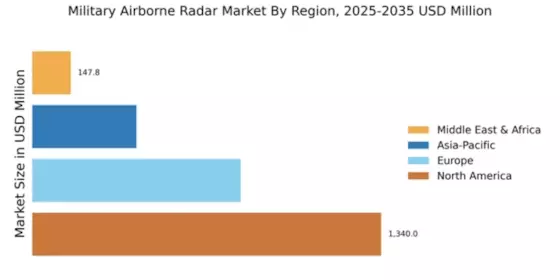
North America continues to lead the Military Airborne Radar Market, holding a significant market share of 1340.0M in 2024. The region's growth is driven by increasing defense budgets, technological advancements, and a focus on modernization of military capabilities. Regulatory support from government initiatives further catalyzes demand, ensuring that North America remains at the forefront of military radar technology. The competitive landscape is characterized by major players such as Northrop Grumman, Raytheon Technologies, and Lockheed Martin, which are heavily investing in R&D to enhance radar capabilities. The U.S. government’s commitment to defense spending and innovation fosters a robust environment for these companies, ensuring their dominance in the global market. With a strong emphasis on advanced technologies, North America is set to maintain its leadership position in the coming years.

Europe : Growing Defense Investments

Europe is witnessing a significant transformation in its Military Airborne Radar Market, with a market size of 800.0M in 2024. The region's growth is propelled by increasing defense expenditures and collaborative efforts among EU nations to enhance military capabilities. Regulatory frameworks are evolving to support joint defense initiatives, which are crucial for maintaining regional security and technological advancement. Leading countries such as France, Germany, and the UK are at the forefront of this market, with key players like Thales Group and BAE Systems driving innovation. The competitive landscape is marked by partnerships and collaborations aimed at developing next-generation radar systems. As Europe continues to invest in defense, the market is expected to expand, reflecting a commitment to modernizing military assets and enhancing operational effectiveness.

Asia-Pacific : Emerging Market Potential

The Asia-Pacific region is emerging as a significant player in the Military Airborne Radar Market, with a market size of 400.0M in 2024. The growth is driven by rising defense budgets, geopolitical tensions, and the need for advanced surveillance systems. Countries in this region are increasingly prioritizing military modernization, supported by government policies aimed at enhancing national security and technological capabilities. Key players in the region include Elbit Systems and Saab, which are focusing on developing innovative radar solutions tailored to regional needs. Countries like India, Japan, and Australia are investing heavily in defense technologies, creating a competitive landscape that fosters collaboration and innovation. As the demand for advanced military systems grows, the Asia-Pacific market is poised for substantial growth in the coming years.

Middle East and Africa : Strategic Defense Developments

The Middle East and Africa region is gradually expanding its Military Airborne Radar Market, with a market size of 147.78M in 2024. The growth is driven by increasing security concerns, regional conflicts, and a focus on enhancing military capabilities. Governments are investing in advanced technologies to address these challenges, supported by international partnerships and collaborations. Countries like the UAE and South Africa are leading the way in defense investments, with key players such as Hensoldt and Leonardo actively participating in the market. The competitive landscape is characterized by a mix of local and international firms, all vying to provide cutting-edge radar solutions. As the region continues to prioritize defense spending, the market is expected to grow, reflecting a commitment to improving national security and operational readiness.

Key Players and Competitive Insights

The Military Airborne Radar Market is characterized by a dynamic competitive landscape, driven by technological advancements and increasing defense budgets across various nations. Key players such as Northrop Grumman (US), Raytheon Technologies (US), and Thales Group (FR) are at the forefront, each adopting distinct strategies to enhance their market positioning. Northrop Grumman (US) emphasizes innovation in radar technology, focusing on advanced signal processing and sensor fusion capabilities. Meanwhile, Raytheon Technologies (US) is actively pursuing partnerships to expand its product offerings and enhance its technological edge. Thales Group (FR) is concentrating on regional expansion, particularly in Europe and Asia, to capitalize on emerging defense markets. Collectively, these strategies contribute to a competitive environment that is increasingly focused on technological superiority and strategic collaborations.

In terms of business tactics, companies are localizing manufacturing and optimizing supply chains to enhance operational efficiency and reduce costs. The market structure appears moderately fragmented, with several key players holding substantial market shares while also facing competition from smaller, specialized firms. This fragmentation allows for a diverse range of products and innovations, fostering a competitive atmosphere where companies must continuously adapt to maintain their market positions.

In November 2025, Northrop Grumman (US) announced a significant partnership with a leading European defense contractor to co-develop next-generation airborne radar systems. This collaboration is poised to leverage both companies' technological strengths, potentially leading to enhanced capabilities in electronic warfare and surveillance. The strategic importance of this partnership lies in its potential to create a more robust product offering that meets the evolving demands of modern warfare.

In October 2025, Raytheon Technologies (US) unveiled a new radar system designed for unmanned aerial vehicles (UAVs), showcasing its commitment to innovation in the airborne radar sector. This development is particularly noteworthy as it aligns with the increasing reliance on UAVs in military operations, suggesting that Raytheon is positioning itself to capture a growing segment of the market. The introduction of this system may enhance operational flexibility and effectiveness for military clients.

In September 2025, Thales Group (FR) secured a contract with a Southeast Asian nation to supply advanced airborne radar systems, marking a significant step in its regional expansion strategy. This contract not only reinforces Thales's presence in a key market but also highlights the increasing demand for sophisticated radar technologies in defense applications. The strategic importance of this contract lies in its potential to establish long-term relationships with regional defense forces, thereby enhancing Thales's competitive standing.

As of December 2025, current trends in the Military Airborne Radar Market indicate a strong emphasis on digitalization, sustainability, and the integration of artificial intelligence (AI) into radar systems. Strategic alliances are increasingly shaping the competitive landscape, allowing companies to pool resources and expertise to drive innovation. Looking ahead, competitive differentiation is likely to evolve from traditional price-based competition to a focus on technological advancements, reliability in supply chains, and the ability to deliver cutting-edge solutions. This shift underscores the importance of innovation and adaptability in maintaining a competitive edge in the rapidly changing defense sector.

Key Companies in the Military Airborne Radar Market market include

Industry Developments

  • In July 2023, Elbit Systems has unveiled the Nano SPEAR™ at The Paris Airshow, an advanced, digital and miniature system designed as a countermeasure against radar-guided air-to-air and surface-to-air missiles that threaten aircrews and their platforms.
  • In August 2023, MAG Aerospace and L3Harris Technologies secure a U.S. Army contract to deliver advanced ISR aircraft for the ATHENA-R program. The Bombardier Global 6500-based system aims to enhance long-range precision capabilities amidst evolving global threats.
  • In July 2023, L3Harris Technologies and ELTA Systems expanded their partnership to offer advanced Airborne Early Warning and Control (AEW&C) solutions using Bombardier Global 6500 aircraft, integrating ELTA's cutting-edge AEW systems for enhanced operational efficiency and multi-domain mission capabilities.


Future Outlook

Military Airborne Radar Market Future Outlook

The Military Airborne Radar Market is projected to grow at a 6.22% CAGR from 2024 to 2035, driven by advancements in technology, increasing defense budgets, and rising demand for surveillance capabilities.

New opportunities lie in:

  • Development of advanced phased array radar systems for enhanced detection capabilities.
  • Integration of artificial intelligence for predictive maintenance and operational efficiency.
  • Expansion into emerging markets with tailored radar solutions for regional defense needs.

By 2035, the Military Airborne Radar Market is expected to be robust, reflecting substantial growth and innovation.

Market Segmentation

Military Airborne Radar Market End Use Outlook

  • Military Aviation
  • Defense Forces
  • Intelligence Agencies
  • Research and Development

Military Airborne Radar Market Technology Outlook

  • Phased Array Radar
  • Synthetic Aperture Radar
  • Pulse-Doppler Radar
  • Frequency Modulated Continuous Wave Radar

Military Airborne Radar Market Application Outlook

  • Surveillance
  • Targeting
  • Navigation
  • Weather Monitoring
  • Search and Rescue

Report Scope

MARKET SIZE 20242687.78(USD Million)
MARKET SIZE 20252854.96(USD Million)
MARKET SIZE 20355220.03(USD Million)
COMPOUND ANNUAL GROWTH RATE (CAGR)6.22% (2024 - 2035)
REPORT COVERAGERevenue Forecast, Competitive Landscape, Growth Factors, and Trends
BASE YEAR2024
Market Forecast Period2025 - 2035
Historical Data2019 - 2024
Market Forecast UnitsUSD Million
Key Companies ProfiledNorthrop Grumman (US), Raytheon Technologies (US), Lockheed Martin (US), Thales Group (FR), BAE Systems (GB), Leonardo (IT), Hensoldt (DE), Elbit Systems (IL), Saab (SE)

Segments CoveredApplication, Technology, End Use
Key Market OpportunitiesIntegration of advanced artificial intelligence in Military Airborne Radar systems enhances target detection and tracking capabilities.
Key Market DynamicsTechnological advancements drive competition in the Military Airborne Radar Market, enhancing capabilities and operational effectiveness.
Countries CoveredNorth America, Europe, APAC, South America, MEA

Market Highlights

Author
Swapnil Palwe
Team Lead - Research

With a technical background as Bachelor's in Mechanical Engineering, with MBA in Operations Management , Swapnil has 6+ years of experience in market research, consulting and analytics with the tasks of data mining, analysis, and project execution. He is the POC for our clients, for their consulting projects running under the Automotive/A&D domain. Swapnil has worked on major projects in verticals such as Aerospace & Defense, Automotive and many other domain projects. He has worked on projects for fortune 500 companies' syndicate and consulting projects along with several government projects.

Leave a Comment

FAQs

How much is the Military Airborne Radar market?

The Military Airborne Radar Market size is expected to be valued at USD 2530.38005883409 Million in 2023.

What is the growth rate of the Military Airborne Radar market?

The global market is projected to grow at a CAGR of 6.2% during the forecast period, 2025-2034.

Which region held the largest market share in the Military Airborne Radar market?

North America had the largest share of the global market.

Who are the key players in the Military Airborne Radar market?

The key players in the market are Lockheed Martin Corporation, Thales S.A., Northrop, Grumman Corporation, Israel Aerospace Industries Ltd., RTX Corporation, Elbit Systems Ltd.

Which type, the Military Airborne Radar market?

The Airborne Warning and Control System (AWACS) dominated the market in 2023.

Download Free Sample

Kindly complete the form below to receive a free sample of this Report

Compare Licence

×
Features License Type
Single User Multiuser License Enterprise User
Price $4,950 $5,950 $7,250
Maximum User Access Limit 1 User Upto 10 Users Unrestricted Access Throughout the Organization
Free Customization
Direct Access to Analyst
Deliverable Format
Platform Access
Discount on Next Purchase 10% 15% 15%
Printable Versions