×
Request Free Sample ×

Kindly complete the form below to receive a free sample of this Report

Leading companies partner with us for data-driven Insights

clients tt-cursor
Hero Background

Military GNSS Receivers Market

ID: MRFR/AD/22057-HCR
128 Pages
Sejal Akre
October 2025

Military GNSS Receivers Market Research Report By Frequency Band (L1, L2, L5, Galileo E1, BeiDou B1), By Signal Type (GPS, GLONASS, Galileo, BeiDou, QZSS), By Accuracy Level (High Accuracy, Medium Accuracy, Low Accuracy), By Application (Navigation, Guidance, Targeting, Surveillance, Electronic Warfare), By Platform (Ground Vehicles, Airborne, Naval, Handheld, Unmanned Systems) and By Regional (North America, Europe, South America, Asia Pacific, Middle East and Africa) - Forecast to 2035

Share:
Download PDF ×

We do not share your information with anyone. However, we may send you emails based on your report interest from time to time. You may contact us at any time to opt-out.

Military GNSS Receivers Market Infographic
Purchase Options

Military GNSS Receivers Market Summary

As per MRFR analysis, the Military GNSS Receivers Market Size was estimated at 27.54 USD Billion in 2024. The Military GNSS Receivers industry is projected to grow from 28.53 USD Billion in 2025 to 40.52 USD Billion by 2035, exhibiting a compound annual growth rate (CAGR) of 3.57 during the forecast period 2025 - 2035.

Key Market Trends & Highlights

The Military GNSS Receivers Market is poised for substantial growth driven by technological advancements and geopolitical factors.

  • North America remains the largest market for military GNSS receivers, reflecting robust defense spending and modernization efforts.
  • Asia-Pacific is emerging as the fastest-growing region, fueled by increasing military investments and regional security concerns.
  • The L1 segment continues to dominate the market, while the L5 segment is gaining traction due to its enhanced capabilities and performance.
  • Rising demand for precision navigation and increased defense budgets are key drivers propelling market expansion.

Market Size & Forecast

2024 Market Size 27.54 (USD Billion)
2035 Market Size 40.52 (USD Billion)
CAGR (2025 - 2035) 3.57%

Major Players

Lockheed Martin (US), Northrop Grumman (US), Raytheon Technologies (US), Thales Group (FR), Leonardo S.p.A. (IT), BAE Systems (GB), General Dynamics (US), L3Harris Technologies (US), Rockwell Collins (US)

Military GNSS Receivers Market Trends

The Military GNSS Receivers Market is currently experiencing a transformative phase, driven by advancements in technology and increasing demand for precision navigation systems. Military applications require high levels of accuracy and reliability, which has led to the development of sophisticated GNSS receivers that can operate in challenging environments. The integration of multi-frequency capabilities and anti-jamming features appears to be a focal point for manufacturers, as these enhancements significantly improve operational effectiveness. Furthermore, the growing emphasis on modernization within defense sectors worldwide suggests a robust future for this market, as nations seek to upgrade their navigation systems to maintain strategic advantages. In addition to technological advancements, geopolitical factors are influencing the Military GNSS Receivers Market. Nations are increasingly investing in indigenous capabilities to reduce reliance on foreign systems, which may lead to a rise in domestic production of GNSS technologies. This trend indicates a shift towards self-sufficiency in military navigation solutions, potentially reshaping the competitive landscape. As the market evolves, collaboration between government entities and private sector firms is likely to foster innovation, ensuring that military forces are equipped with cutting-edge navigation tools that meet contemporary operational demands.

Technological Advancements

The Military GNSS Receivers Market is witnessing rapid technological progress, particularly in the areas of multi-frequency reception and enhanced anti-jamming capabilities. These innovations are crucial for ensuring reliable navigation in contested environments, where traditional systems may falter. Manufacturers are focusing on developing receivers that can seamlessly integrate with other military systems, thereby enhancing overall operational efficiency.

Geopolitical Influences

Geopolitical dynamics are playing a significant role in shaping the Military GNSS Receivers Market. Nations are increasingly prioritizing the development of indigenous navigation solutions to mitigate dependence on foreign technologies. This trend may lead to a surge in domestic production and innovation, as countries strive to bolster their defense capabilities and ensure strategic autonomy.

Increased Investment in Modernization

There is a noticeable trend towards modernization within military forces globally, which is driving demand for advanced GNSS receivers. As defense budgets expand, investments are being directed towards upgrading existing navigation systems. This modernization effort is likely to enhance the operational readiness of military units, ensuring they are equipped with the latest technology to address contemporary challenges.

Military GNSS Receivers Market Drivers

Increased Defense Budgets

The Military GNSS Receivers Market is benefiting from increased defense budgets across various nations. Governments are recognizing the strategic importance of advanced navigation systems in maintaining national security and enhancing military capabilities. As defense spending rises, there is a corresponding increase in investment in modern military technologies, including GNSS receivers. Reports indicate that defense budgets in several countries are expected to grow by an average of 3% annually over the next few years, which will likely lead to a surge in demand for sophisticated GNSS solutions. This trend underscores the critical role that military GNSS receivers play in contemporary defense strategies.

Emergence of Autonomous Systems

The emergence of autonomous systems is reshaping the Military GNSS Receivers Market. As military operations increasingly incorporate unmanned systems, the demand for precise and reliable GNSS receivers is surging. Autonomous vehicles, drones, and robotic systems require advanced navigation solutions to operate effectively in diverse environments. The integration of GNSS technology with these systems enhances their operational capabilities, allowing for improved mission execution and reduced risk to personnel. The market is projected to expand as military organizations invest in the development and deployment of autonomous systems, indicating a transformative shift in military operations and the corresponding need for advanced GNSS receivers.

Integration of Advanced Technologies

The integration of advanced technologies into the Military GNSS Receivers Market is a significant driver of growth. Innovations such as anti-jamming capabilities, multi-frequency reception, and enhanced signal processing are becoming standard features in military GNSS receivers. These advancements not only improve the accuracy and reliability of navigation systems but also ensure that military forces can operate effectively in environments where traditional GNSS signals may be compromised. The market is witnessing a shift towards receivers that can seamlessly integrate with other military systems, such as drones and autonomous vehicles, thereby enhancing overall operational efficiency. This trend indicates a robust future for the Military GNSS Receivers Market.

Rising Demand for Precision Navigation

The Military GNSS Receivers Market is experiencing a notable increase in demand for precision navigation systems. This demand is driven by the need for accurate positioning and timing in military operations, which are critical for mission success. As military operations become more complex, the requirement for reliable GNSS receivers that can function in contested environments is paramount. The market is projected to grow at a compound annual growth rate of approximately 6.5% over the next five years, reflecting the increasing reliance on advanced navigation technologies. Furthermore, the integration of GNSS with other navigation systems enhances operational capabilities, making these receivers indispensable for modern military applications.

Geopolitical Tensions and Security Concerns

Geopolitical tensions and security concerns are driving the Military GNSS Receivers Market as nations seek to bolster their defense capabilities. The ongoing conflicts and territorial disputes have heightened the need for reliable navigation systems that can operate under various conditions. Military forces are increasingly investing in GNSS technology to ensure operational readiness and effectiveness in potential conflict scenarios. The market is expected to see a rise in demand for receivers that can provide secure and accurate positioning data, particularly in regions with high levels of uncertainty. This geopolitical landscape suggests a sustained growth trajectory for the Military GNSS Receivers Market.

Market Segment Insights

By Frequency Band: L1 (Largest) vs. L5 (Fastest-Growing)

In the Military GNSS Receivers Market, the frequency bands are crucial for positioning and navigation capabilities. The L1 frequency band holds the largest share among the segments, being widely used for a variety of military applications due to its reliable performance and established infrastructure. Following closely are the L2 and BeiDou B1 bands, which are gaining traction, while Galileo E1 offers competitive features that appeal to military users seeking advanced technology in GNSS receivers. The L5 band, although currently smaller, is recognized for its potential to drive future advancements in accuracy and signal integrity, making it a point of interest for developers and defense agencies alike.

Frequency Band: L1 (Dominant) vs. L5 (Emerging)

L1 dominates the Military GNSS Receivers Market as it provides the fundamental signals necessary for basic positioning tasks. Its long-established use in military operations ensures familiarity and reliability, essential in defense scenarios. Conversely, L5 is emerging as a significant player, designed to offer improved accuracy and performance in challenging environments with its advanced signal structure. As military applications demand higher precision and resilience against interference, L5's growing adoption reflects the market's shift towards embracing next-generation technology. The synergy between these segments highlights a transitional phase where L1's reliability coexists with L5's innovative capabilities.

By Signal Type: GPS (Largest) vs. Galileo (Fastest-Growing)

The Military GNSS Receivers Market showcases a dynamic competition among various signal types, with GPS holding the largest market share due to its established reliability and widespread adoption. GLONASS and BeiDou are also prominent players, while Galileo is emerging with increasing traction in military applications. QZSS remains a niche component, but it offers unique advantages, particularly in Japan and surrounding regions, enhancing resilience and accuracy. In recent years, the growth trajectory of the Military GNSS Receivers Market has been significantly influenced by technological advancements and strategic military initiatives. The demand for multi-constellation GNSS receivers has surged as militaries strive for improved accuracy, reliability, and jamming resistance. The push towards modernization and enhanced situational awareness systems further propels the adoption of innovative technologies like Galileo, making it a fast-growing segment as nations seek to diversify their positioning capabilities.

GPS (Dominant) vs. Galileo (Emerging)

GPS is the dominant signal type in the Military GNSS Receivers Market, known for its reliability and extensive infrastructure, making it the preferred choice for military applications requiring consistent accuracy and performance. It forms the backbone of military navigation systems globally. Conversely, Galileo is recognized as an emerging contender, offering enhanced capabilities such as improved accuracy and resilience against jamming. Its integration with existing systems is gaining momentum, as various military organizations begin to appreciate its unique advantages. This positions Galileo as a prospective leader in the future military navigation landscape, addressing the increasing demand for advanced positioning technologies.

By Accuracy Level: High Accuracy (Largest) vs. Medium Accuracy (Fastest-Growing)

In the Military GNSS Receivers Market, High Accuracy receivers dominate the market share, driven by their essential role in precision-guided operations. These devices provide enhanced positional accuracy crucial for military applications. In contrast, Medium Accuracy receivers are gaining momentum due to increasing demand for cost-effective solutions that still maintain reliable performance in various military scenarios. This shift is evident as defense sectors are increasingly investing in versatile GNSS solutions that bridge the gap between cost and performance.

High Accuracy (Dominant) vs. Medium Accuracy (Emerging)

High Accuracy GNSS receivers are characterized by their ability to deliver superior positional precision, making them the preference for critical military applications such as missile guidance and land navigation. Their robust performance under challenging conditions ensures they remain the dominant force in the market. Conversely, Medium Accuracy receivers are emerging as a popular choice among military units seeking budget-friendly alternatives that still offer sufficient reliability for less critical operations. This duality in segment preference reflects a broader trend where military organizations are balancing operational demands with budget constraints, fostering innovation and diversification in GNSS technology.

By Application: Navigation (Largest) vs. Electronic Warfare (Fastest-Growing)

In the Military GNSS Receivers Market, the application segment is led by Navigation, which captures the largest share among military applications due to its critical role in positioning and strategical operations. Following Navigation, Guidance and Targeting applications hold significant portions of the market, facilitating precision strikes and troop movements. On the other hand, Surveillance and Electronic Warfare represent emerging yet essential functions, leveraging advanced GNSS technologies for mission efficacy and information superiority.

Guidance (Dominant) vs. Electronic Warfare (Emerging)

Guidance systems in the Military GNSS Receivers Market remain dominant by providing vital support for military operations, ensuring accurate targeting and mission execution. They are extensively utilized in ballistic missile systems and precision-guided munitions, which rely on GNSS for enhanced targeting accuracy. Meanwhile, Electronic Warfare is rapidly emerging, driven by the increasing need to counteract enemy navigation systems and gain tactical advantages. This segment focuses on disrupting or deceiving potential adversaries by employing GNSS jamming techniques and alternative positioning solutions. As military strategy evolves towards more tech-intensive operations, these segments are expected to see significant advancements.

By Platform: Ground Vehicles (Largest) vs. Airborne (Fastest-Growing)

The Military GNSS Receivers Market's platform segment is primarily dominated by Ground Vehicles, which constitute the largest share due to their extensive utilization in defense operations. Military forces globally continue to invest significantly in enhancing the capabilities of ground platforms, ensuring accuracy and reliability in various terrains and combat scenarios. On the other hand, Airborne systems are emerging as the fastest-growing segment within the platform category. The increasing need for precise navigation in aerial military operations is driving rapid advancements in airborne GNSS technologies, attracting significant investment and development efforts from defense contractors and manufacturers.

Ground Vehicles (Dominant) vs. Unmanned Systems (Emerging)

Ground Vehicles remain the dominant platform in the Military GNSS Receivers Market, benefiting from their critical role in personnel transportation, logistics, and combat operations. These systems are designed to withstand challenging environments and deliver real-time positioning data, making them indispensable for modern military strategy. In contrast, Unmanned Systems represent an emerging segment, gaining traction due to advancements in robotic technology and autonomous operations. Their ability to perform reconnaissance and intelligence-gathering tasks without risking human lives makes them increasingly valuable for military applications. As technology progresses, the integration of GNSS in unmanned platforms is expected to enhance operational efficiency and effectiveness, positioning them for significant growth in the coming years.

Get more detailed insights about Military GNSS Receivers Market

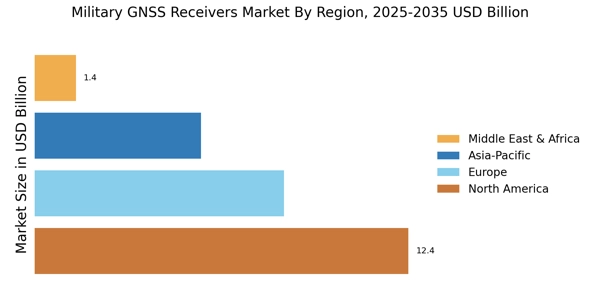
Regional Insights

North America : Defense Innovation Leader

North America is the largest market for military GNSS receivers, holding approximately 45% of the global market share. The region's growth is driven by increasing defense budgets, technological advancements, and a focus on enhancing military capabilities. Regulatory support from government agencies, such as the Department of Defense, further catalyzes market expansion, ensuring compliance with stringent standards and fostering innovation. The United States is the leading country in this sector, with major players like Lockheed Martin, Northrop Grumman, and Raytheon Technologies dominating the landscape. The competitive environment is characterized by continuous R&D investments and strategic partnerships. Canada also plays a significant role, contributing to the market with its defense initiatives and collaborations with U.S. firms, enhancing regional capabilities.

Europe : Strategic Defense Collaborations

Europe is witnessing significant growth in the military GNSS receivers market, accounting for approximately 30% of the global share. The demand is driven by increasing geopolitical tensions and the need for enhanced navigation systems in defense operations. Regulatory frameworks established by the European Union and NATO promote interoperability and standardization, further boosting market growth and innovation in military technologies. Leading countries in this region include France, Germany, and the United Kingdom, where companies like Thales Group and BAE Systems are key players. The competitive landscape is marked by collaborations between nations and defense contractors, focusing on developing advanced GNSS technologies. The European market is also characterized by a strong emphasis on research and development, ensuring that military forces are equipped with cutting-edge navigation solutions.

Asia-Pacific : Emerging Defense Market

Asia-Pacific is emerging as a significant player in the military GNSS receivers market, holding around 20% of the global market share. The region's growth is fueled by increasing defense expenditures, modernization of military forces, and the rising need for accurate navigation systems. Countries are investing in advanced technologies to enhance their defense capabilities, supported by government initiatives and strategic partnerships with global defense firms. Key players in this region include countries like India, Japan, and Australia, where local and international companies are collaborating to develop advanced GNSS solutions. The competitive landscape is evolving, with a focus on indigenous manufacturing and technology transfer. The presence of major global players, such as L3Harris Technologies and Rockwell Collins, further strengthens the market, driving innovation and enhancing regional capabilities.

Middle East and Africa : Defense Modernization Efforts

The Middle East and Africa region is gradually increasing its share in the military GNSS receivers market, currently holding about 5% of the global market. The growth is driven by rising defense budgets, regional conflicts, and a focus on modernizing military capabilities. Governments are prioritizing investments in advanced technologies, including GNSS systems, to enhance operational effectiveness and ensure national security. Leading countries in this region include the United Arab Emirates and South Africa, where defense spending is on the rise. The competitive landscape features both local and international players, with companies seeking to establish partnerships to enhance their technological capabilities. The presence of global firms is also notable, as they collaborate with regional governments to develop tailored solutions that meet specific defense needs.

Military GNSS Receivers Market Regional Image

Key Players and Competitive Insights

Major players in the Military GNSS receivers Market industry are constantly innovating and developing new technologies to meet the evolving needs of the military. Leading Military Gnss Receivers Market players are investing heavily in research and development to stay ahead of the competition. The Military Gnss Receivers Market is highly competitive, with a number of major players vying for market share. Some of the key players in the market include Northrop Grumman, Lockheed Martin, Raytheon, BAE Systems, and Thales.

These companies offer a wide range of Military Gnss Receivers Market products and services, and they are constantly innovating to meet the changing needs of the military.One of the leading competitors in the Military GNSS Receivers Market is Northrop Grumman. The company offers a wide range of Military GNSS Receivers Market products and services, including GPS receivers, inertial navigation systems, and integrated navigation systems. Northrop Grumman's Military Gnss Receivers Market products are used in a variety of military applications, including precision guidance, navigation, and targeting.

The company is also a major supplier of Military Gnss Receivers Market products to the US military.Another major competitor in the Military GNSS Receivers Market is Lockheed Martin. The company offers a wide range of Military GNSS Receivers Market products and services, including GPS receivers, inertial navigation systems, and integrated navigation systems. Lockheed Martin's Military Gnss Receivers Market products are used in a variety of military applications, including precision guidance, navigation, and targeting. The company is also a major supplier of Military Gnss Receivers Market products to the US military.

Key Companies in the Military GNSS Receivers Market market include

Industry Developments

The Military GNSS Receivers Market is projected to grow from USD 25.67 billion in 2023 to USD 35.2 billion by 2032, at a CAGR of 3.57%. The market growth is attributed to rising demand for advanced navigation and positioning systems in military applications, increasing adoption of GNSS-based technologies in defense systems, and growing investments in military modernization programs. Recent developments in the market include the integration of artificial intelligence and machine learning into GNSS receivers, advancements in anti-jamming and anti-spoofing technologies, and the development of multi-constellation GNSS receivers.

Key players in the market are investing in research and development to enhance the performance and capabilities of their products. The market is expected to witness significant growth in the Asia-Pacific region due to increasing defense spending and the adoption of advanced technologies by regional militaries.

Future Outlook

Military GNSS Receivers Market Future Outlook

The Military GNSS Receivers Market is projected to grow at a 3.57% CAGR from 2024 to 2035, driven by advancements in technology, increased defense budgets, and the demand for precision navigation.

New opportunities lie in:

  • Development of advanced anti-jamming GNSS technologies
  • Integration of GNSS with autonomous military systems
  • Expansion of GNSS-based training and simulation solutions

By 2035, the Military GNSS Receivers Market is expected to be robust, reflecting sustained growth and innovation.

Market Segmentation

Military GNSS Receivers Market Platform Outlook

  • Ground Vehicles
  • Airborne
  • Naval
  • Handheld
  • Unmanned Systems

Military GNSS Receivers Market Application Outlook

  • Navigation
  • Guidance
  • Targeting
  • Surveillance
  • Electronic Warfare

Military GNSS Receivers Market Signal Type Outlook

  • GPS
  • GLONASS
  • Galileo
  • BeiDou
  • QZSS

Military GNSS Receivers Market Accuracy Level Outlook

  • High Accuracy
  • Medium Accuracy
  • Low Accuracy

Military GNSS Receivers Market Frequency Band Outlook

  • L1
  • L2
  • L5
  • Galileo E1
  • BeiDou B1

Report Scope

MARKET SIZE 202427.54(USD Billion)
MARKET SIZE 202528.53(USD Billion)
MARKET SIZE 203540.52(USD Billion)
COMPOUND ANNUAL GROWTH RATE (CAGR)3.57% (2024 - 2035)
REPORT COVERAGERevenue Forecast, Competitive Landscape, Growth Factors, and Trends
BASE YEAR2024
Market Forecast Period2025 - 2035
Historical Data2019 - 2024
Market Forecast UnitsUSD Billion
Key Companies ProfiledMarket analysis in progress
Segments CoveredMarket segmentation analysis in progress
Key Market OpportunitiesIntegration of advanced anti-jamming technologies enhances resilience in Military GNSS Receivers Market.

Key Market DynamicsTechnological advancements and regulatory changes drive innovation and competition in the Military GNSS Receivers market.
Countries CoveredNorth America, Europe, APAC, South America, MEA

Leave a Comment

FAQs

What is the projected market valuation for the Military GNSS Receivers Market in 2035?

The projected market valuation for the Military GNSS Receivers Market in 2035 is 40.52 USD Billion.

Download Free Sample

Kindly complete the form below to receive a free sample of this Report

Compare Licence

×
Features License Type
Single User Multiuser License Enterprise User
Price $4,950 $5,950 $7,250
Maximum User Access Limit 1 User Upto 10 Users Unrestricted Access Throughout the Organization
Free Customization
Direct Access to Analyst
Deliverable Format
Platform Access
Discount on Next Purchase 10% 15% 15%
Printable Versions