Military Laser Systems Market Summary
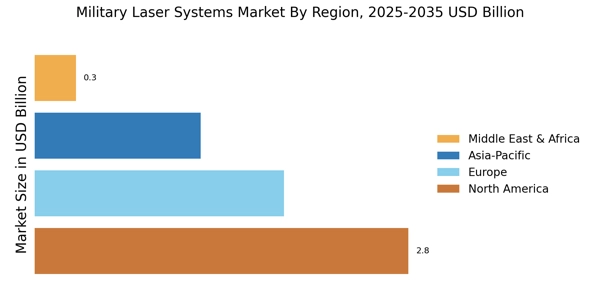
As per Market Research Future analysis, the Military Laser Systems Market was estimated at 6.194 USD Billion in 2024. The Military Laser Systems industry is projected to grow from 6.731 USD Billion in 2025 to 15.46 USD Billion by 2035, exhibiting a compound annual growth rate (CAGR) of 8.67% during the forecast period 2025 - 2035. North America holds the largest share of the global Military Laser Systems Market in 2025, driven by the region's leading position in global military expenditure, technological advancements in laser-based weapon systems, and the presence of major manufacturers such as Lockheed Martin and Northrop Grumman. The United States is the leading country within North America in the Military Laser Systems Market in 2025, dominating the regional share at approximately 85%, primarily due to significant defense R&D spending, DARPA-led laser weapons development programs, and high demand from the U.S. Army, Navy, and Air Force. Defensive Countermeasures dominate the Military Laser Systems Market as the largest application segment in 2025, holding the largest market share due to the increasing use of laser systems in electronic warfare for homeland security and the protection of aircraft from heat-seeking missiles and other aerial threats.
Key Market Trends & Highlights
The Military Laser Systems Market is poised for substantial growth driven by technological advancements and increasing defense investments.
- North America remains the largest market for military laser systems, driven by robust defense budgets and technological innovation.
- The Asia-Pacific region is emerging as the fastest-growing market, reflecting heightened security concerns and military modernization efforts.
- Laser designators continue to dominate the market, while solid-state lasers are experiencing rapid growth due to their efficiency and versatility.
- Key market drivers include the growing demand for precision weapons and advancements in laser technology, which are shaping the future of military capabilities.
Market Size & Forecast
| 2024 Market Size | 6.194 (USD Billion) |
| 2035 Market Size | 15.46 (USD Billion) |
| CAGR (2025 - 2035) | 8.67% |
Major Players
Lockheed Martin (US), Northrop Grumman (US), Raytheon Technologies (US), BAE Systems (GB), General Dynamics (US), L3Harris Technologies (US), Thales Group (FR), Leonardo (IT), Rheinmetall (DE), Elbit Systems(IL)