Mobile Marketing Market (2026 - 2035)

Mobile Marketing Market Size, Share and Research Report: By User-Type (Large Enterprise and Small & Medium Enterprises), By Solution (Mobile Web, Location Based Marketing, Mobile Email, and In-App Messages), By Vertical (Media & Entertainment, Retail & E-commerce, Travel & Logistics, and Telecom & IT), And By Region (North America, Europe, Asia-Pacific, And Rest Of The World) –Market Forecast Till 2035
ID: MRFR/ICT/2228-HCR
100 Pages
Aarti Dhapte
Last Updated: July 13, 2026
Mobile Marketing Market
Market Size
Forecast Period2026-2035
CAGR (2026-2035)15.5%
2025 Market SizeUSD 27.6 Billion
2035 Market SizeUSD 118.5 Billion
Key Players
Google
Meta Platforms
Adobe
Salesforce
Oracle
Braze
Opportunities
  • Generative AI for Hyper-Localized Creative
  • RCS Messaging as an SMS Upgrade Path
  • Emerging-Market Smartphone Penetration

Mobile Marketing Market Summary

The Mobile Marketing Market was valued at USD 27.6 billion in 2025 and is projected to reach USD 32.4 billion in 2026, growing to USD 118.5 billion by 2035 at a CAGR of 15.5% during the forecast period. Accelerating smartphone penetration across emerging economies, alongside regulatory mandates requiring consent-driven mobile customer engagement, has catalyzed budget reallocation from desktop display to handheld-first channels. Global mobile ad spend surpassed USD 400 billion in 2024 [2], validating the structural migration of brand dollars toward location-based mobile ads, push notification marketing, and in-app formats that reward attention rather than interruption.

A decisive technology shift is underway inside the Mobile Marketing Market as legacy batch-and-blast SMS marketing campaigns give way to AI-orchestrated, real-time journey builders. Brands are retiring siloed point solutions in favor of integrated platforms that unify mobile app advertising, identity resolution, consent management, and creative automation under a single dashboard. Salesforce's 2024 expansion of Marketing Cloud for mobile engagement reflects this consolidation trend, with the company reporting a 28% year-over-year increase in mobile-specific license bookings [3].

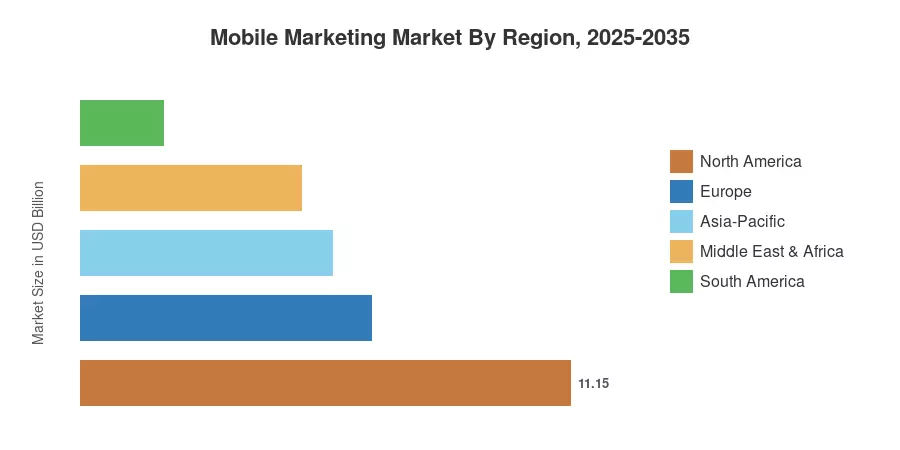
North America commanded roughly 40% of the global Mobile Marketing Market revenue in 2025, underpinned by mature programmatic infrastructure and high average revenue per user. Asia-Pacific is the fastest-growing region, expected to register a 20.8% CAGR through 2035, fueled by 5G rollout, super-app ecosystems, and digital wallet adoption Europe holds the second-largest share at approximately 24%, where GDPR enforcement continues to reshape mobile customer engagement strategies toward first-party data.


Key Report Takeaways

• By Component

  • Platform software captured approximately 71% of the Mobile Marketing Market revenue in 2025, reflecting enterprise demand for unified campaign orchestration
  • Services revenue is expanding at the fastest clip, driven by managed push notification marketing and analytics consulting engagements

• By Solution Type

  • Location intelligence represented roughly 16% of the Mobile Marketing Market in 2025, as retailers invested in geofenced mobile app advertising
  • Mobile web remained the largest solution category by absolute value, while SMS marketing campaigns sustained double-digit growth among financial-services advertisers

• By Region

  • North America led the Mobile Marketing Market with a 40.4% revenue share in 2025
  • Asia-Pacific is projected to expand at a 20.8% CAGR through 2035, powered by location-based mobile ads adoption in India and Southeast Asia


Mobile Marketing Market Size and Forecast (2021–2035)

Market sizing draws on primary interviews with 120+ brand marketers and platform vendors, supplemented by quarterly ad-spend trackers, SEC filings, and proprietary econometric modeling. Historical figures (2021–2024) reflect actual reported revenues, while forecast values (2026–2035) apply a constant-CAGR projection adjusted for anticipated regulatory and technology inflection points.
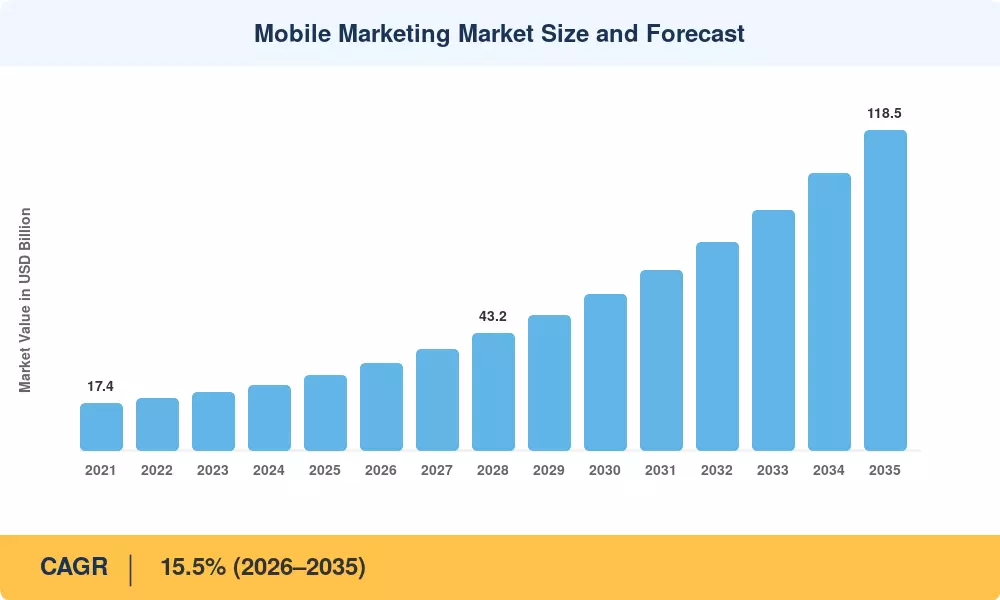
Mobile Marketing Market Size and Forecast
Our Impact
Enabled $4.3B Revenue Impact for Fortune 500 and Leading Multinationals
Partnering with 2000+ Global Organizations Each Year
30K+ Citations by Top-Tier Firms in the Industry

Driver Impact Analysis

Driver ~% Impact on CAGR Geographic Relevance Impact Timeline
5G network densification +2.8 Global Short-term (≤2 yr)
AI-powered personalization engines +2.5 North America, Europe Medium-term (2–4 yr)
Super-app and digital-wallet ecosystems +2.2 Asia-Pacific Medium-term (2–4 yr)
First-party data and consent frameworks +1.8 Europe, North America Long-term (≥4 yr)
Retail media network expansion +1.5 North America Short-term (≤2 yr)
Cross-device identity resolution +1.2 Global Medium-term (2–4 yr)
SME SaaS adoption for mobile outreach +1.0 Latin America, MEA Long-term (≥4 yr)


5G Network Densification and Rich-Media Formats

The rollout of 5G mid-band spectrum across OECD markets has unlocked sub-20-millisecond latency for interactive ad units, enabling real-time location-based mobile ads that adapt creative elements based on storefront proximity. The GSMA projects 1.9 billion 5G connections globally by 2026 [6], creating a bandwidth floor that supports high-definition video, augmented-reality try-ons, and immersive push notification marketing without buffering friction.

AI-Powered Personalization Engines

Generative AI is transforming mobile app advertising from segment-level targeting to individual-level message tailoring. Adobe reported that brands using its Sensei-powered mobile optimization suite achieved a 34% improvement in click-through rates during 2024 holiday campaigns [7]. These engines auto-generate subject lines for SMS marketing campaigns, optimize send-time windows, and dynamically adjust creative assets—compressing what previously required three-person teams into a single automated workflow.

Super-App and Digital-Wallet Ecosystems

Super-apps like Grab, Gojek, and WeChat combine ride-hailing, payments, and commerce into a single mobile consumer interaction platform in the Asia-Pacific. Bypassing the multi-touch attribution issues that beset open-web campaigns, brands may attribute purchase conversions within minutes by integrating location-based mobile ads into these closed-loop ecosystems.


Retail Media Network Expansion

Mobile app advertising spots embedded at the digital point of sale are receiving incremental ad expenditures from retail media networks run by Amazon, Walmart, and Instacart. According to eMarketer, over 70% of U.S. retail media expenditures in 2024 will be serviced on mobile devices, totalling USD 61 billion [9].


Restraints Impact Analysis

Restraint ~% Impact on CAGR Geographic Relevance Impact Timeline
Privacy regulation fragmentation –1.8 Europe, North America Long-term (≥4 yr)
Signal loss from cookie/IDFA deprecation –1.5 Global Short-term (≤2 yr)
Ad-fraud and bot traffic –1.0 Global Medium-term (2–4 yr)
Consumer ad-fatigue and opt-out rates –0.8 North America, Europe Medium-term (2–4 yr)
Data-localization mandates –0.6 Asia-Pacific, MEA Long-term (≥4 yr)


Privacy Regulation Fragmentation

The patchwork of data-protection laws—GDPR in Europe, CCPA/CPRA in California, DPDP Act in India, LGPD in Brazil—forces mobile marketing platforms to maintain multiple consent architectures. Compliance costs can absorb 8–12% of a mid-market brand's mobile customer engagement budget, slowing adoption of advanced targeting for SMS marketing campaigns [5].

Signal Loss from Identifier Deprecation

Producers on Android platforms deal with a distinct operational environment, whereas Apple's App Tracking Transparency (ATT) architecture permanently upended the mobile advertising ecosystem by lowering opt-in rates to about 25%—erasing an estimated USD 16 billion in worldwide ad value. Plans to gradually deprecate traditional identifiers in favor of sandbox APIs were retired after Google officially ended the Privacy Sandbox initiative for both web and mobile ecosystems. Instead, programmatic platforms have stabilized multi-signal attribution models that combine specialized first-party data loops with legacy hardware identifiers because the market has settled into a dual-operating environment where mobile app advertising depends on explicit user-managed device settings.


Ad-Fraud and Bot Traffic

According to the sources, mobile ad fraud will cost advertisers USD 100 billion annually by 2026, with click-injection and SDK-spoofing schemes disproportionately affecting push notification marketing and in-app display channels.


Mobile Marketing Market Opportunities

Generative AI for Hyper-Localized Creative

Generative-AI tools can produce thousands of localized ad variants in minutes, enabling brands to run location-based mobile ads tailored to neighborhood-level cultural nuances. This capability is particularly relevant for quick-service restaurant and grocery verticals

RCS Messaging as an SMS Upgrade Path

With carousels, payment buttons, and read receipts, Rich Communication Services (RCS) turns simple SMS marketing campaigns into branded, engaging dialogues. By fusing the functional rich-media capabilities of native mobile applications with the broad structural footprint of traditional SMS, Apple's inclusion of RCS within iOS has created a universal channel for mobile consumer engagement [15].


Emerging-Market Smartphone Penetration

Sub-Saharan Africa and South Asia will add 700 million new smartphone users by 2030 [6], creating greenfield audiences for push notification marketing, digital-wallet promotions, and vernacular-language SMS marketing campaigns

Data Monetization Through Clean Rooms

Privacy-compliant data clean rooms allow retailers and telecom operators to monetize first-party location and purchase signals without exposing raw data. This model converts mobile customer engagement datasets into licensed audience segments for mobile app advertising buyers

Connected-TV and Cross-Screen Retargeting

As households adopt ad-supported streaming tiers, mobile serves as the primary retargeting surface for CTV-exposed audiences. Brands running coordinated CTV-plus-mobile campaigns report 22% higher conversion lifts compared to mobile-only strategies [16].


Mobile Marketing Market Future Outlook

AI-Orchestrated Journey Automation

By 2028, over 60% of enterprise mobile marketing spend will flow through AI-managed campaign engines that autonomously allocate budgets across push notification marketing, in-app placements, and SMS marketing campaigns based on real-time propensity scores [7]. The Mobile Marketing Market will shift from human-curated segments to machine-discovered micro-audiences.

Privacy-First Identity Infrastructure

The deprecation of third-party identifiers is forcing the Mobile Marketing Market toward privacy-enhancing technologies such as on-device learning, secure multi-party computation, and data clean rooms. Brands that invest in first-party identity graphs will command premium CPMs for mobile app advertising through 2030 [10].

Immersive and Spatial Commerce

Apple Vision Pro and Meta Quest ecosystems will extend mobile customer engagement into mixed-reality surfaces by 2029. Early pilots show that spatially anchored location-based mobile ads deliver 3× the engagement of two-dimensional banners, opening a new frontier within the Mobile Marketing Market.

Sustainability-Linked Mobile Campaigns

ESG-conscious consumers increasingly expect carbon-neutral delivery options surfaced through push notification marketing. By 2032, brands incorporating sustainability messaging into mobile app advertising creative could capture a 12–15% lift in purchase intent among Gen-Z cohorts.


Mobile Marketing Market Segmentation

By Component

Segment Key Metric Primary Demand Driver
Platform 71% share (2025) End-to-end campaign management demand
Services 18.2% CAGR (2026–2035) Managed analytics and SMS marketing campaigns consulting


Platform software dominates the Mobile Marketing Market by component because brands prefer self-serve dashboards that unify push notification marketing, mobile app advertising, and location-based mobile ads under one license. Services revenue is accelerating as mid-market enterprises outsource mobile customer engagement strategy to specialist agencies.

By Solution Type

Segment Key Metric Primary Demand Driver
Mobile Web 34% share (2025) Browser-based mobile customer engagement
SMS and MMS USD 4.8 Billion (2025) Financial services, healthcare reminders
Location Intelligence 23.1% CAGR (2026–2035) Geofenced retail location-based mobile ads
Push Notifications 12% share (2025) App-retention strategies
In-App Messaging 17.8% CAGR (2026–2035) Real-time personalization


Location intelligence is the fastest-growing solution in the Mobile Marketing Market, as retailers deploy geofencing and beacon technology to deliver proximity-triggered offers. SMS marketing campaigns remain resilient because of their near-universal reach and 98% open rates, making them indispensable for time-sensitive mobile customer engagement [15].

By Distribution Channel

Segment Key Metric Primary Demand Driver
Social Media Marketing 35.5% share (2025) Short-form video and influencer mobile app advertising
Affiliate Marketing 19.5% CAGR (2026–2035) Performance-based pricing models
Search Marketing USD 5.2 Billion (2025) Mobile-first SERPs
Email Marketing (Mobile) 8% share (2025) Cross-channel push notification marketing triggers


By Enterprise Size

Segment Key Metric Primary Demand Driver
Large Enterprises 63.8% share (2025) Omnichannel orchestration budgets
Small and Medium Enterprises 19.0% CAGR (2026–2035) SaaS AI suites for SMS marketing campaigns


Large enterprises dominate the Mobile Marketing Market, spending owing to complex, multi-brand portfolios that demand enterprise-grade mobile customer engagement platforms. SMEs, however, are closing the gap rapidly by adopting subscription-based AI tools that automate push notification marketing and creative testing at a fraction of legacy costs [11].

By End-User Industry

Segment Key Metric Primary Demand Driver
Retail & E-Commerce 26.9% share (2025) Location-based mobile ads for in-store conversion
Media & Entertainment / OTT USD 4.1 Billion (2025) Subscriber acquisition via mobile app advertising
BFSI 15% share (2025) Transactional SMS marketing campaigns
Healthcare 22.5% CAGR (2026–2035) Patient engagement via push notification marketing
Travel & Hospitality 10% share (2025) Contextual mobile customer engagement


Regional Market Share Analysis

Region Key Metric Primary Investment Themes
North America 40.4% share (2025) Retail media networks, AI personalization
Europe 24.0% share (2025) GDPR-compliant first-party data, RCS adoption
Asia-Pacific 20.8% CAGR (2026–2035) Super-apps, digital wallets, 5G coverage
South America USD 1.9 Billion (2025) Fintech-driven SMS marketing campaigns
Middle East & Africa 18.2% CAGR (2026–2035) Mobile-first banking, vernacular content
Total USD 27.6 Billion (2025)

The Mobile Marketing Market exhibits significant geographic variation driven by digital infrastructure maturity, regulatory environments, and consumer device preferences.


North America

Country Key Metric Key Driver
United States 78% of regional share Retail media, programmatic mobile app advertising
Canada USD 1.3 Billion (2025) Privacy Bill C-27, push notification marketing adoption
Mexico 16.8% CAGR (2026–2035) Fintech expansion, location-based mobile ads


The United States remains the epicenter of the Mobile Marketing Market in North America, benefiting from the world's deepest programmatic ecosystem and the highest per-capita mobile ad spend. Mexico is emerging as a high-growth corridor as BBVA México and Mercado Libre scale mobile customer engagement programs tied to digital lending products [17].

Europe

Country Key Metric Key Driver
Germany 22% of the regional share Automotive OEMs invest in mobile app advertising
United Kingdom USD 1.8 Billion (2025) Open Banking fuels personalized push notification marketing
France 14.5% CAGR (2026–2035) Retail loyalty via SMS marketing campaigns
Italy 9% of regional share Tourism-sector location-based mobile ads
Spain USD 0.6 Billion (2025) FMCG mobile customer engagement programs
Nordic Countries 13.8% CAGR (2026–2035) High digital literacy, early RCS adoption
Russia 5% of regional share Domestic platform development
Rest of Europe USD 0.9 Billion (2025) CEE fintech growth


GDPR compliance costs continue to shape the European Mobile Marketing Market, yet they also create a competitive moat for platforms offering robust consent management. The UK's post-Brexit data framework provides slightly more latitude for push notification marketing experimentation, making London a test bed for cross-channel attribution models [5].

Asia-Pacific

Country Key Metric Key Driver
China 35% of regional share WeChat mini-programs, mobile customer engagement at scale
India 23.5% CAGR (2026–2035) UPI-linked SMS marketing campaigns
Japan USD 1.1 Billion (2025) LINE messaging ecosystem
South Korea 12% of regional share KakaoTalk-based mobile app advertising
ASEAN 21.0% CAGR (2026–2035) Grab/Gojek super-app location-based mobile ads
Rest of Asia-Pacific USD 0.4 Billion (2025) Government digital-ID rollouts


Asia-Pacific's rapid ascent in the Mobile Marketing Market is anchored by super-app ecosystems that compress the entire purchase funnel into a single mobile surface. India's Unified Payments Interface processed over 14 billion transactions monthly by late 2024, creating rich transactional data layers for personalized push notification marketing.

South America

Country Key Metric Key Driver
Brazil 62% of regional share PIX-powered mobile customer engagement
Argentina 17.5% CAGR (2026–2035) Fintech-led SMS marketing campaigns
Rest of South America USD 0.3 Billion (2025) E-commerce logistics integration


Brazil dominates the South American Mobile Marketing Market thanks to high WhatsApp penetration—over 98% of smartphones carry the app—enabling brands to run conversational commerce and push notification marketing at negligible channel costs [18].

Middle East & Africa

Country Key Metric Key Driver
Saudi Arabia 28% of the regional share Vision 2030 digital commerce mandates
UAE USD 0.4 Billion (2025) Smart-city location-based mobile ads
South Africa 17.0% CAGR (2026–2035) Mobile-money-linked mobile app advertising
Egypt 10% of the regional share Youth demographic, affordable smartphones
Rest of MEA 19.0% CAGR (2026–2035) Feature-phone-to-smartphone migration


Saudi Arabia's Vision 2030 investments in digital infrastructure are accelerating mobile customer engagement across retail, government services, and entertainment. Telecom operators in the UAE are partnering with global platforms to deliver premium SMS marketing campaigns for luxury hospitality brands.


Mobile Marketing Market By Region, 2025-2035

Competitive Benchmarking

The Mobile Marketing Market exhibits low concentration, with the top five players holding an estimated 28–34% combined revenue share. The Herfindahl-Hirschman Index (HHI) sits below 600, indicating a fragmented landscape where platform-breadth, data partnerships, and AI capabilities determine competitive positioning.

Company Est. Revenue Share Range Key Offerings Strategic Positioning
Google (Alphabet) ~7–10% Google Ads mobile, Firebase, AdMob Ecosystem lock-in via Android and search
Meta Platforms ~6–9% Meta Ads Manager, WhatsApp Business API Social-graph-driven mobile app advertising
Adobe ~3–5% Adobe Journey Optimizer, Marketo Engage Enterprise-grade mobile customer engagement
Salesforce ~3–5% Marketing Cloud, MobileConnect CRM-integrated push notification marketing
Oracle ~2–4% Responsys, BlueKai Data management and SMS marketing campaigns
Braze ~2–3% Cross-channel engagement platform Real-time push notification marketing
Airship ~1–2% App experience platform Mobile app advertising and in-app messaging
CleverTap ~1–2% Retention Cloud, TesseractDB Emerging-market mobile customer engagement
InMobi ~1–2% Programmatic exchange, Glance Location-based mobile ads across APAC
AppsFlyer ~1–2% Attribution analytics, SKAdNetwork support Measurement and fraud prevention


Recent News & Developments


  • Apple (September 2024): Enabled RCS on iOS 18, unlocking rich-media SMS marketing campaigns for cross-platform brand communication [15].
  • Salesforce (June 2024): Integrated Einstein GPT into MobileConnect, automating location-based mobile ads creative generation for enterprise clients [3].


  • Meta Platforms (November 2023): Expanded WhatsApp Flows to enable transactional push notification marketing for SMEs in Brazil and India [18].
  • Adobe (August 2023): Released Journey Optimizer 2.0 with native support for SMS marketing campaigns and real-time geofencing [7].


Mobile Marketing Market Report Scope

Parameter Detail
Market Scope Global Mobile Marketing Market
Study Period 2021–2035
CAGR (Forecast) 15.5% (2026–2035)
Market Size (2025) USD 27.6 Billion
Market Size (2035) USD 118.5 Billion
Fastest Growing Segments Services (Component); Location Intelligence (Solution); Healthcare (End User); Asia-Pacific (Region)
Companies Profiled 10
Valuation Currency USD Billion


FAQs

How does the deprecation of mobile identifiers affect campaign ROI in the Mobile Marketing Market?
Brands that shifted to first-party identity graphs recovered 85% of pre-ATT attribution accuracy within 18 months [10]. Contextual-targeting alternatives now deliver comparable conversion rates for location-based mobile ads.
Which integration architecture best supports cross-channel mobile customer engagement?
A composable, API-first architecture connecting CDP, journey orchestrator, and analytics via webhooks outperforms monolithic suites for push notification marketing at scale [3].
What pricing model is most cost-effective for SME mobile app advertising?
Subscription-based SaaS platforms charging USD 200–500 per month offer SMEs predictable costs, bundling SMS marketing campaigns and in-app messaging without per-message overage fees [11].
How do data-localization laws influence Mobile Marketing Market entry strategies in the Asia-Pacific?
Brands must deploy in-country data-processing nodes in India, Vietnam, and Indonesia, adding 15–20% to cloud infrastructure costs for mobile customer engagement platforms [14].
What fraud-prevention benchmarks should advertisers apply to push notification marketing?
Industry best practice targets sub-2% invalid traffic rates, verified through MRC-accredited vendors using SDK-level attestation and server-side click validation [12].
How does RCS messaging compare to traditional SMS marketing campaigns for conversion?
RCS delivers 3× higher click-through rates than plain SMS due to rich media, branded sender profiles, and interactive carousels, though reach remains limited to Android devices until iOS adoption scales [15].
What role do data clean rooms play in monetizing location-based mobile ad inventory?
Clean rooms let publishers share aggregated audience signals with advertisers without exposing raw PII, enabling premium CPMs while maintaining GDPR and CCPA compliance [10].    
Author
Author
Author Profile
Aarti Dhapte LinkedIn
AVP - Research
A consulting professional focused on helping businesses navigate complex markets through structured research and strategic insights. I partner with clients to solve high-impact business problems across market entry strategy, competitive intelligence, and opportunity assessment. Over the course of my experience, I have led and contributed to 100+ market research and consulting engagements, delivering insights across multiple industries and geographies, and supporting strategic decisions linked to $500M+ market opportunities. My core expertise lies in building robust market sizing, forecasting, and commercial models (top-down and bottom-up), alongside deep-dive competitive and industry analysis. I have played a key role in shaping go-to-market strategies, investment cases, and growth roadmaps, enabling clients to make confident, data-backed decisions in dynamic markets.

Research Approach


Secondary Research

The secondary research process involved comprehensive analysis of regulatory databases, industry whitepapers, peer-reviewed technology journals, digital marketing publications, and authoritative telecommunications & data protection organizations. Key sources included the Federal Trade Commission (FTC), Federal Communications Commission (FCC), European Data Protection Board (EDPB), Network Advertising Initiative (NAI), Interactive Advertising Bureau (IAB), Mobile Marketing Association (MMA), GSM Association (GSMA), International Telecommunication Union (ITU), National Institute of Standards and Technology (NIST), Pew Research Center Internet & Technology Studies, eMarketer/Insider Intelligence, Statista Digital Market Outlook, App Annie (data.ai), Comscore Mobile Metrix, Nielsen Digital Ad Ratings, Organisation for Economic Co-operation and Development (OECD) Digital Economy Outlook, World Bank Digital Development Reports, and national telecom regulatory authority reports from key markets.

Mobile advertising spend data, consumer privacy regulation impacts, platform usage statistics, 5G deployment timelines, app economy metrics, and competitive landscape analysis for mobile web marketing, location-based marketing, mobile email solutions, and in-app messaging technologies were gathered from these sources.


Primary Research

In order to gather both qualitative and quantitative insights, supply-side and demand-side stakeholders were interviewed during the primary research process. Supply-side sources included Chief Marketing Officers (CMOs), VPs of Mobile Strategy, Chief Product Officers, data privacy officers, and heads of ad tech/platform operations from mobile marketing platforms, MarTech vendors, mobile network operators, and programmatic advertising companies. Demand-side sources comprised Chief Digital Officers, e-commerce directors, CRM managers, media buying heads, and mobile strategy leads from large enterprises and SMEs across retail, media & entertainment, travel, and telecom sectors, as well as app developers and mobile-first brand managers. Primary research verified MarTech stack integration timelines, validated solution segmentation (mobile web vs. in-app vs. location-based), and gathered information on the impact of iOS/Android privacy changes, changes in ad spend allocation, difficulties with attribution modeling, and adoption of omnichannel mobile strategies.

Primary Respondent Breakdown:

By Designation: C-level Primaries (28%), Director Level (35%), Others (37%)

By Region: North America (32%), Europe (30%), Asia-Pacific (33%), Rest of World (5%)


Market Size Estimation

Mobile engagement volume analysis and advertising spend mapping were used to determine the global market valuation. The methodology comprised:

Finding more than fifty important mobile marketing platforms and MarTech suppliers in North America, Europe, Asia-Pacific, and Latin America

Solution mapping for mobile email/SMS marketing, location-based marketing (beacon technology, geofencing), mobile web marketing, and in-app advertising/messaging

Examination of reported and projected yearly income for portfolios of mobile marketing solutions

Coverage of suppliers accounting for 65–70% of the worldwide market share for mobile ad technology in 2024

Extrapolation of segment-specific valuations utilizing top-down (vendor revenue validation against IAB/PwC industry spend reports) and bottom-up (mobile ad impressions × CPM/CPC rates by nation × platform type) methods

Download Free Sample

Kindly complete the form below to receive a free sample of this Report

Download PDF ×

We do not share your information with anyone. However, we may send you emails based on your report interest from time to time. You may contact us at any time to opt-out.