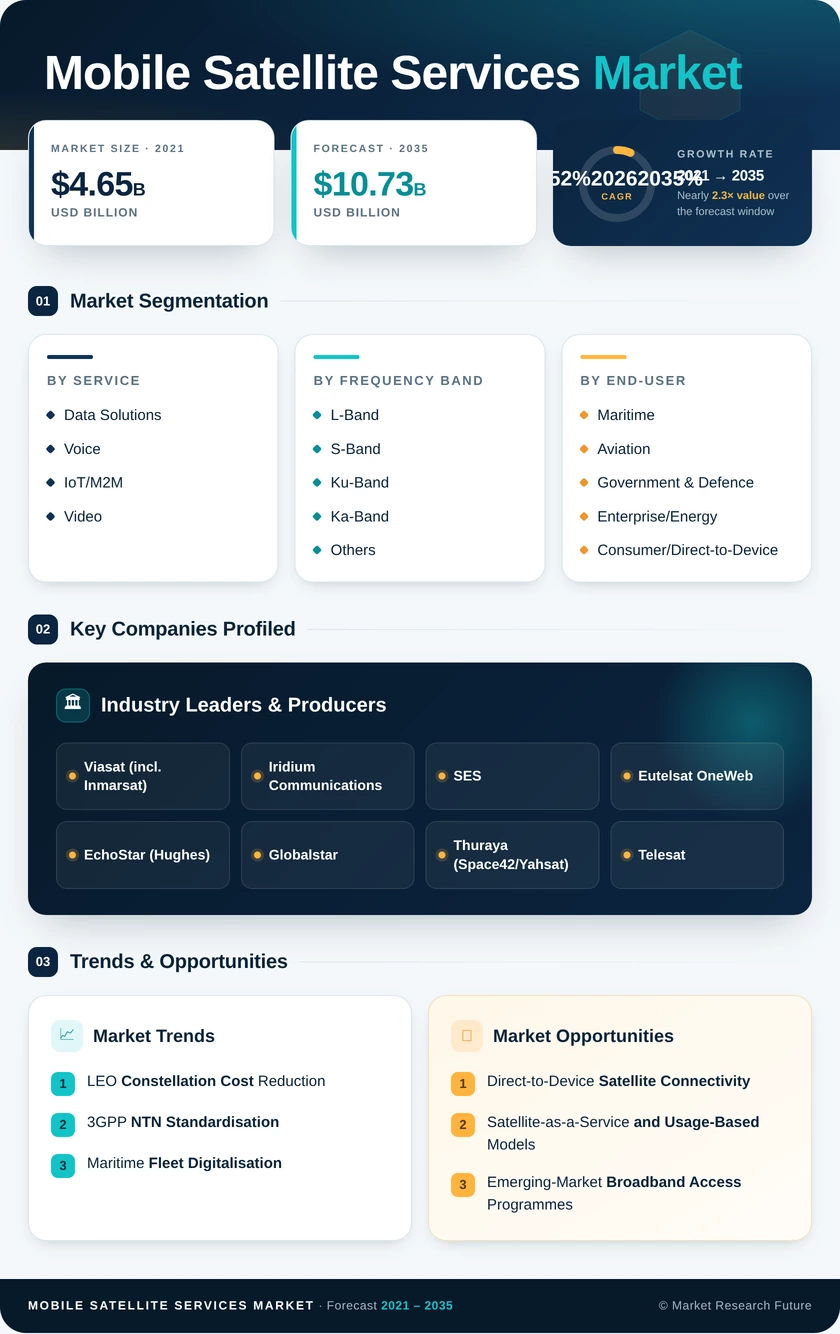
Mobile Satellite Services Market

ID: MRFR/ICT/8754-CR
200 Pages
Aarti Dhapte
Last Updated: June 22, 2026
Mobile Satellite Services Market Size, Share and Research Report By Service (Data Solutions, Voice, IoT/M2M, Video), By Frequency Band (L-Band, S-Band, Ku-Band, Ka-Band, Others (C, UHF/VHF)), By End-User (Maritime, Aviation, Government & Defence, Enterprise / Energy, Consumer / Direct-to-Device) and By Regional (North America, Europe, South America, Asia Pacific, Middle East and Africa) - Industry Forecast to 2035
Download PDF ×

We do not share your information with anyone. However, we may send you emails based on your report interest from time to time. You may contact us at any time to opt-out.

  1. 1 Market Overview |
    1. 1.1 Study Assumptions & Market Definition |
    2. 1.2 Scope of the Study |
    3. 1.3 Research Methodology
  2. 2 Market Summary & Key Takeaways
  3. 3 Market Dynamics |
    1. 3.1 Market Drivers Analysis | |
      1. 3.1.1 LEO Constellation Cost Reduction | |
      2. 3.1.2 3GPP NTN Standardisation | |
      3. 3.1.3 Maritime Fleet Digitalisation | |
      4. 3.1.4 Government Sovereign Connectivity Procurement | |
      5. 3.1.5 Aviation Inflight Connectivity Expansion | |
      6. 3.1.6 IoT/M2M Remote Sensor Proliferation | |
      7. 3.1.7 Rural Broadband Subsidy Programmes |
    2. 3.2 Market Restraints Analysis | |
      1. 3.2.1 Spectrum Coordination Complexity | |
      2. 3.2.2 High Terminal and Antenna Costs | |
      3. 3.2.3 Orbital Debris and Sustainability Risk | |
      4. 3.2.4 Regulatory Fragmentation Across Jurisdictions | |
      5. 3.2.5 Terrestrial 5G Substitution in Urban Zones |
    3. 3.3 Market Opportunity Analysis | |
      1. 3.3.1 Direct-to-Device Satellite Connectivity | |
      2. 3.3.2 Satellite-as-a-Service and Usage-Based Models | |
      3. 3.3.3 Emerging-Market Broadband Access Programmes | |
      4. 3.3.4 Maritime Autonomous Surface Ships (MASS) | |
      5. 3.3.5 Data Monetisation via In-Orbit Processing |
    4. 3.4 Industry Value Chain Analysis |
    5. 3.5 Porter's Five Forces Analysis
  4. 4 Global Mobile Satellite Services Market Size & Forecast (2021–2035) |
    1. 4.1 Historical Market Size (2021–2025) |
    2. 4.2 Current & Forecast Market Size (2026–2035) |
    3. 4.3 Market Size by Revenue (USD Billion) |
    4. 4.4 Year-over-Year Growth Analysis
  5. 5 Segmentation Analysis |
    1. 5.1 By Service | |
      1. 5.1.1 Data Solutions | |
      2. 5.1.2 Voice | |
      3. 5.1.3 IoT/M2M | |
      4. 5.1.4 Video |
    2. 5.2 By Frequency Band | |
      1. 5.2.1 L-Band | |
      2. 5.2.2 S-Band | |
      3. 5.2.3 Ku-Band | |
      4. 5.2.4 Ka-Band | |
      5. 5.2.5 Others (C, UHF/VHF) |
    3. 5.3 By End-User | |
      1. 5.3.1 Maritime | |
      2. 5.3.2 Aviation | |
      3. 5.3.3 Government & Defence | |
      4. 5.3.4 Enterprise / Energy | |
      5. 5.3.5 Consumer / Direct-to-Device
  6. 6 Regional Analysis |
    1. 6.1 North America | |
      1. 6.1.1 United States | |
      2. 6.1.2 Canada | |
      3. 6.1.3 Mexico |
    2. 6.2 Europe | |
      1. 6.2.1 Germany | |
      2. 6.2.2 United Kingdom | |
      3. 6.2.3 France | |
      4. 6.2.4 Italy | |
      5. 6.2.5 Spain | |
      6. 6.2.6 Nordic Countries | |
      7. 6.2.7 Russia | |
      8. 6.2.8 Rest of Europe |
    3. 6.3 Asia-Pacific | |
      1. 6.3.1 China | |
      2. 6.3.2 India | |
      3. 6.3.3 Japan | |
      4. 6.3.4 South Korea | |
      5. 6.3.5 ASEAN | |
      6. 6.3.6 Rest of Asia-Pacific |
    4. 6.4 South America | |
      1. 6.4.1 Brazil | |
      2. 6.4.2 Argentina | |
      3. 6.4.3 Rest of South America |
    5. 6.5 Middle East & Africa | |
      1. 6.5.1 Saudi Arabia | |
      2. 6.5.2 UAE | |
      3. 6.5.3 South Africa | |
      4. 6.5.4 Egypt | |
      5. 6.5.5 Rest of MEA
  7. 7 Competitive Landscape |
    1. 7.1 Market Share Analysis (2025) |
    2. 7.2 Competitive Benchmarking Matrix |
    3. 7.3 Company Profiles | |
      1. 7.3.1 Viasat (incl. Inmarsat) | |
      2. 7.3.2 Iridium Communications | |
      3. 7.3.3 SES | |
      4. 7.3.4 Eutelsat OneWeb | |
      5. 7.3.5 EchoStar (Hughes) | |
      6. 7.3.6 Globalstar | |
      7. 7.3.7 Thuraya (Space42/Yahsat) | |
      8. 7.3.8 Telesat | |
      9. 7.3.9 SpaceX (Starlink) | |
      10. 7.3.10 Ligado Networks
  8. 8 Future Outlook & Strategic Recommendations (2026–2035) |
    1. 8.1 AI-Optimised Spectrum and Network Management |
    2. 8.2 Multi-Orbit Service Convergence |
    3. 8.3 Sustainability and Space Environment Governance |
    4. 8.4 6G-Satellite Integration and the Non-Terrestrial Network Layer
  9. 9 Recent Developments & News
  10. 10 Frequently Asked Questions (FAQs)
  11. 11 Report Scope & Methodology |
    1. 11.1 Study Period & Base Year |
    2. 11.2 Data Sources & Citations |
    3. 11.3 Abbreviations
  12. 12 LIST OF TABLES |
  13. TABLE 1 Global Mobile Satellite Services Market Size & Forecast, by Revenue (USD Billion), 2021–2035 |
  14. TABLE 2 Global Mobile Satellite Services Market — Year-over-Year Growth Analysis, 2021–2035 |
  15. TABLE 3 Global Mobile Satellite Services Market — Driver Impact Analysis |
  16. TABLE 4 Global Mobile Satellite Services Market — Restraint Impact Analysis |
  17. TABLE 5 Global Mobile Satellite Services Market Size, by Service, 2021–2035 (USD Billion) |
  18. TABLE 6 Global Mobile Satellite Services Market Size, by Frequency Band, 2021–2035 (USD Billion) |
  19. TABLE 7 Global Mobile Satellite Services Market Size, by End-User, 2021–2035 (USD Billion) |
  20. TABLE 8 Global Mobile Satellite Services Market Size, by Region, 2021–2035 (USD Billion) |
  21. TABLE 9 North America Mobile Satellite Services Market Size, by Country, 2021–2035 (USD Billion) |
  22. TABLE 10 Europe Mobile Satellite Services Market Size, by Country, 2021–2035 (USD Billion) |
  23. TABLE 11 Asia-Pacific Mobile Satellite Services Market Size, by Country, 2021–2035 (USD Billion) |
  24. TABLE 12 South America Mobile Satellite Services Market Size, by Country, 2021–2035 (USD Billion) |
  25. TABLE 13 Middle East & Africa Mobile Satellite Services Market Size, by Country, 2021–2035 (USD Billion) |
  26. TABLE 14 Competitive Benchmarking Matrix — Global Mobile Satellite Services Market, 2025 |
  27. TABLE 15 Company Profiles — Key Players, Global Mobile Satellite Services Market |
  28. TABLE 16 Recent Developments & Strategic Announcements, 2024–2025 |
  29. TABLE 17 Report Scope & Methodology Summary |
  30. TABLE 18 Detailed Sources and Citations |
  31. TABLE 19 North America Mobile Satellite Services Market Size, by Service, 2021–2035 (USD Billion) |
  32. TABLE 20 North America Mobile Satellite Services Market Size, by Frequency Band, 2021–2035 (USD Billion) |
  33. TABLE 21 North America Mobile Satellite Services Market Size, by End-User, 2021–2035 (USD Billion) |
  34. TABLE 22 Europe Mobile Satellite Services Market Size, by Service, 2021–2035 (USD Billion) |
  35. TABLE 23 Europe Mobile Satellite Services Market Size, by Frequency Band, 2021–2035 (USD Billion) |
  36. TABLE 24 Europe Mobile Satellite Services Market Size, by End-User, 2021–2035 (USD Billion) |
  37. TABLE 25 Asia-Pacific Mobile Satellite Services Market Size, by Service, 2021–2035 (USD Billion) |
  38. TABLE 26 Asia-Pacific Mobile Satellite Services Market Size, by Frequency Band, 2021–2035 (USD Billion) |
  39. TABLE 27 Asia-Pacific Mobile Satellite Services Market Size, by End-User, 2021–2035 (USD Billion) |
  40. TABLE 28 South America Mobile Satellite Services Market Size, by Service, 2021–2035 (USD Billion) |
  41. TABLE 29 South America Mobile Satellite Services Market Size, by Frequency Band, 2021–2035 (USD Billion) |
  42. TABLE 30 South America Mobile Satellite Services Market Size, by End-User, 2021–2035 (USD Billion) |
  43. TABLE 31 Middle East & Africa Mobile Satellite Services Market Size, by Service, 2021–2035 (USD Billion) |
  44. TABLE 32 Middle East & Africa Mobile Satellite Services Market Size, by Frequency Band, 2021–2035 (USD Billion) |
  45. TABLE 33 Middle East & Africa Mobile Satellite Services Market Size, by End-User, 2021–2035 (USD Billion)
  46. 13 LIST OF FIGURES |
  47. FIGURE 1 Global Mobile Satellite Services Market Dynamics (Drivers, Restraints, Opportunities) |
  48. FIGURE 2 Industry Value Chain Analysis — Mobile Satellite Services Market |
  49. FIGURE 3 Porter's Five Forces Analysis — Mobile Satellite Services Market |
  50. FIGURE 4 Global Mobile Satellite Services Market Size Trend & Forecast, 2021–2035 (USD Billion) |
  51. FIGURE 5 Mobile Satellite Services Market Share, by Service, 2025 (%) |
  52. FIGURE 6 Mobile Satellite Services Market Share, by Frequency Band, 2025 (%) |
  53. FIGURE 7 Mobile Satellite Services Market Share, by End-User, 2025 (%) |
  54. FIGURE 8 Mobile Satellite Services Market Share, by Region, 2025 (%) |
  55. FIGURE 9 North America Mobile Satellite Services Market Size, 2021–2035 (USD Billion) |
  56. FIGURE 10 Europe Mobile Satellite Services Market Size, 2021–2035 (USD Billion) |
  57. FIGURE 11 Asia-Pacific Mobile Satellite Services Market Size, 2021–2035 (USD Billion) |
  58. FIGURE 12 South America Mobile Satellite Services Market Size, 2021–2035 (USD Billion) |
  59. FIGURE 13 Middle East & Africa Mobile Satellite Services Market Size, 2021–2035 (USD Billion) |
  60. FIGURE 14 Competitive Landscape — Mobile Satellite Services Market Share by Company, 2025

Segmentation Quick Reference

DimensionSub-SegmentsDominant SegmentFastest Growing Segment
By ServiceData Solutions, Voice, IoT/M2M, VideoData Solutions (67.5% share, 2025)IoT/M2M (11.15% CAGR)
By Frequency BandL-Band, S-Band, Ku-Band, Ka-Band, OthersL-Band (38% share, 2025)Ka-Band (8.40% CAGR)
By End-UserMaritime, Aviation, Government & Defence, Enterprise/Energy, Consumer/Direct-to-DeviceMaritime (31.35% share, 2025)Aviation (12.25% CAGR)
By RegionNorth America, Europe, Asia-Pacific, South America, Middle East & AfricaNorth America (40.5% share, 2025)Asia-Pacific (9.20% CAGR)


Market Segmentation Overview

By Service

Sub-SegmentKey Trend
Data SolutionsIP migration driving satellite broadband demand across maritime and aviation fleets
VoiceSteady legacy demand for push-to-talk, safety-of-life, and emergency calling services
IoT/M2MRapid uptake of low-power satellite modules for asset tracking and environmental sensing
VideoCrew welfare and passenger in-flight entertainment sustaining niche video demand


Data solutions remain the backbone of the Mobile Satellite Services Market, reflecting the decisive shift from legacy voice links to IP-based satellite broadband. IoT/M2M is the fastest-growing sub-segment as satellite mobile connectivity modules become compact and affordable enough for mass-scale remote area connectivity sensor deployments.

By Frequency Band

Sub-SegmentKey Trend
L-BandRegulatory mandates for GMDSS and aeronautical safety ensure a persistent demand
S-BandEarly-stage direct-to-device trials and terrestrial-satellite hybrid spectrum usage
Ku-BandEstablished VSAT mobile services for maritime and regional aviation platforms
Ka-BandHigh-throughput LEO satellite communication payloads delivering cost-efficient broadband
Others (C, UHF/VHF)Legacy military and telemetry applications with limited commercial growth


L-Band's dominance stems from its regulatory lock-in for safety-critical satellite mobile connectivity services. Ka-Band is rapidly gaining share as LEO satellite communication constellations deploy high-throughput payloads that dramatically lower satellite broadband cost-per-bit, attracting enterprise and maritime buyers seeking VSAT mobile services upgrades.

By End-User

Sub-SegmentKey Trend
MaritimeFleet digitalisation and IMO mandates are driving VSAT and LEO connectivity adoption
AviationIn-flight satellite broadband is becoming standard on new delivery aircraft
Government & DefenceSovereign LEO constellation procurement and resilient military communications
Enterprise / EnergyOil, gas, and mining operations requiring remote area connectivity backhaul
Consumer / Direct-to-DeviceSmartphone-integrated emergency SOS and messaging via satellite mobile connectivity


Maritime leads the Mobile Satellite Services Market on the strength of a captive installed base of over 100,000 merchant vessels. Aviation is accelerating fastest as airlines embed satellite broadband into fleet-renewal programmes and passengers increasingly expect seamless in-flight connectivity powered by LEO satellite communication.