Download Free Sample
Kindly complete the form below to receive a free sample of this Report
Multi-Cloud Networking in Fintech Market Size, Share and Research Report By Application (Payment Processing, Risk Management, Data Analytics, Fraud Detection), By Deployment Model (Public Cloud, Private Cloud, Hybrid Cloud), By End Use Sector (Banking, Insurance, Investment Services, Fintech Startups), By Service Type (Network Management, Security Services, Integration Services) and By Regional (North America, Europe, South America, Asia Pacific, Middle East and Africa) - Industry Forecast Till 2035
As per Market Research Future analysis, the Multi-Cloud Networking in Fintech Market was estimated at 10.67 USD Billion in 2024. The Multi-Cloud Networking in Fintech industry is projected to grow from 11.72 USD Billion in 2025 to 29.77 USD Billion by 2035, exhibiting a compound annual growth rate (CAGR) of 9.77% during the forecast period 2025 - 2035
The Multi-Cloud Networking in Fintech Market is experiencing robust growth driven by technological advancements and evolving consumer demands.
| 2024 Market Size | 10.67 (USD Billion) |
| 2035 Market Size | 29.77 (USD Billion) |
| CAGR (2025 - 2035) | 9.77% |
Amazon Web Services (US), Microsoft Azure (US), Google Cloud (US), IBM (US), Oracle (US), Alibaba Cloud (CN), VMware (US), Cisco Systems (US), Equinix (US)
Our Impact
Enabled $4.3B Revenue Impact for Fortune 500 and Leading Multinationals
Partnering with 2000+ Global Organizations Each Year
30K+ Citations by Top-Tier Firms in the Industry
The Multi-Cloud Networking in Fintech Market is currently experiencing a transformative phase, driven by the increasing demand for flexible and scalable solutions. Financial institutions are increasingly adopting multi-cloud strategies to enhance their operational efficiency and improve service delivery. This shift allows organizations to leverage the strengths of various cloud providers, thereby optimizing costs and ensuring redundancy. As regulatory pressures mount, the need for robust security measures and compliance frameworks becomes paramount, further influencing the adoption of multi-cloud networking solutions. Additionally, the integration of advanced technologies such as artificial intelligence and machine learning into multi-cloud environments is reshaping how financial services operate, enabling more personalized customer experiences and streamlined processes. Moreover, the competitive landscape within the Multi-Cloud Networking in Fintech Market is evolving, with numerous players vying for market share. Partnerships and collaborations among cloud service providers and fintech companies are becoming increasingly common, as they seek to create innovative solutions that address the unique challenges of the financial sector. This collaborative approach not only fosters innovation but also enhances the overall resilience of financial systems. As the market continues to mature, it appears that the focus will shift towards creating more integrated and user-friendly solutions that cater to the diverse needs of financial institutions, ultimately driving growth and transformation in the sector.
Organizations are gravitating towards hybrid cloud models, which combine public and private cloud infrastructures. This trend allows financial institutions to maintain sensitive data on private clouds while utilizing public clouds for less critical operations, thereby enhancing flexibility and security.
As cyber threats become more sophisticated, there is a growing emphasis on implementing advanced security measures within multi-cloud environments. Financial institutions are prioritizing solutions that offer robust encryption, identity management, and compliance with regulatory standards.
The incorporation of artificial intelligence and automation tools into multi-cloud networking is gaining traction. These technologies facilitate improved data analysis, operational efficiency, and customer engagement, enabling financial institutions to respond swiftly to market changes.
Cost optimization remains a pivotal driver in the Multi-Cloud Networking in Fintech Market. Financial institutions are under constant pressure to reduce operational costs while maintaining high service levels. Multi-cloud networking provides a pathway for organizations to optimize their cloud expenditures by allowing them to select the most cost-effective services from various providers. This flexibility enables institutions to avoid vendor lock-in and leverage competitive pricing. Recent analyses suggest that organizations employing multi-cloud strategies can achieve up to 25% savings on their cloud spending. As financial institutions continue to prioritize cost efficiency, the adoption of multi-cloud networking solutions is expected to gain momentum, reshaping the financial landscape.
The Multi-Cloud Networking in Fintech Market is experiencing a notable surge in demand for scalable solutions. As financial institutions increasingly seek to enhance their operational efficiency, the ability to scale resources dynamically becomes paramount. This trend is driven by the need to accommodate fluctuating workloads and customer demands. According to recent data, the market for cloud services in the financial sector is projected to grow at a compound annual growth rate of approximately 22% over the next five years. This growth indicates a strong inclination towards multi-cloud strategies, allowing organizations to leverage multiple cloud providers for optimal performance and cost-effectiveness. Consequently, the emphasis on scalability is likely to shape the future landscape of the Multi-Cloud Networking in Fintech Market.
Innovation is a key driver in the Multi-Cloud Networking in Fintech Market, as financial institutions strive to enhance their service offerings. The integration of advanced technologies such as artificial intelligence, machine learning, and blockchain is becoming increasingly prevalent. Multi-cloud networking facilitates the seamless deployment of these technologies across various platforms, enabling organizations to innovate rapidly. The ability to experiment with new services without the constraints of a single cloud provider fosters a culture of agility and responsiveness. Data indicates that financial institutions leveraging multi-cloud strategies are 40% more likely to introduce new products and services within a year. This trend underscores the critical role of multi-cloud networking in driving innovation within the Multi-Cloud Networking in Fintech Market.
The Multi-Cloud Networking in Fintech Market is witnessing a growing emphasis on enhanced disaster recovery solutions. Financial institutions are increasingly recognizing the importance of robust disaster recovery plans to mitigate risks associated with data loss and service interruptions. Multi-cloud networking offers a strategic advantage by enabling organizations to distribute their data and applications across multiple cloud environments, thereby enhancing resilience. Recent studies indicate that organizations with multi-cloud strategies experience 30% less downtime during outages compared to those relying on single-cloud solutions. This resilience is crucial in the financial sector, where operational continuity is paramount. As a result, the demand for sophisticated disaster recovery solutions within the Multi-Cloud Networking in Fintech Market is likely to escalate.
In the Multi-Cloud Networking in Fintech Market, regulatory compliance and data sovereignty are increasingly influencing cloud adoption strategies. Financial institutions are mandated to adhere to stringent regulations regarding data protection and privacy. This necessitates the implementation of multi-cloud solutions that can ensure compliance across various jurisdictions. The ability to store and process data in specific locations while maintaining access to diverse cloud services is becoming a critical requirement. As regulations evolve, the demand for multi-cloud networking solutions that facilitate compliance is expected to rise. This trend is underscored by the fact that nearly 70% of financial organizations report challenges in meeting regulatory requirements, highlighting the importance of adaptable cloud architectures in the Multi-Cloud Networking in Fintech Market.
In the Multi-Cloud Networking in Fintech Market, the application segment is primarily dominated by Payment Processing, which captures the majority of the market share due to the increasing reliance on digital transactions. Other areas like Risk Management, Data Analytics, and Fraud Detection are gaining traction, with Fraud Detection emerging as a critical component as financial institutions strive to enhance security measures. Together, these applications are vital in shaping a secure and efficient fintech landscape. The growth trends indicate that while Payment Processing remains the largest segment, the rise in online banking and e-commerce is rapidly boosting the demand for Fraud Detection solutions. This growth is driven by the need for advanced technologies capable of real-time data analysis and risk mitigation, making Fraud Detection one of the fastest-growing sectors in the market. As cyber threats become more sophisticated, fintech companies are increasingly investing in these technologies to protect their operations and improve customer trust.
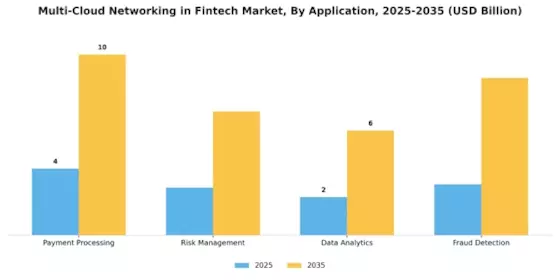
Payment Processing (Dominant) vs. Fraud Detection (Emerging)
Payment Processing serves as the dominant application within the Multi-Cloud Networking in Fintech Market, facilitating seamless transactions for consumers and businesses alike. This application is characterized by its capability to handle high volumes of transactions efficiently, utilizing advanced technologies for encryption and regulatory compliance. On the other hand, Fraud Detection is recognized as an emerging and vital application, becoming increasingly important as financial institutions face a surge in cyber threats. This segment leverages sophisticated algorithms and machine learning techniques to identify suspicious activities and mitigate risks in real-time. As such, while Payment Processing provides a robust foundation for transactions, Fraud Detection is essential for ensuring the integrity and security of these operations, creating a balanced approach in the evolving fintech landscape.
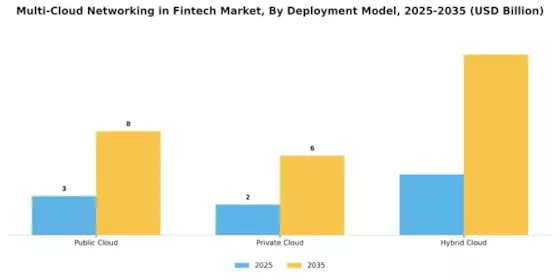
The deployment model of multi-cloud networking in the fintech market is diversified, with public cloud solutions taking the lead in market share. Public cloud deployments are preferred due to their cost-effectiveness, scalability, and flexibility, which allow financial institutions to efficiently manage their operations. Private cloud solutions also hold a significant portion of the market, focusing on enhanced security and regulatory compliance. Meanwhile, hybrid cloud models are carving out a notable share, appealing particularly to organizations looking to balance public and private allocations for optimal resource utilization. Growth trends in this segment reflect a growing inclination toward hybrid cloud solutions, driven by the increasing need for operational efficiency and security within the fintech sector. As more companies adopt advanced technologies, hybrid cloud deployments are quickly becoming the fastest-growing option. Influencing factors include the demand for improved agility, hybrid environments, and the increasing adoption of digital transformation initiatives in finance, which necessitates versatile and integrated network solutions.
Public Cloud: Dominant vs. Hybrid Cloud: Emerging
The public cloud remains the dominant deployment model in the multi-cloud networking sphere of the fintech market, favored for its extensive capabilities and ease of integration with existing systems. Financial organizations leverage the public cloud to tap into vast resources, utilizing the model for data storage, processing, and application development. In contrast, the hybrid cloud emerges as a significant player, appealing to businesses that require the flexibility to operate across both public and private infrastructures. This model allows companies to retain sensitive data in private environments while taking advantage of the scalability of public clouds for less critical functions. The growing combination of these two models indicates a shift toward operational flexibility, with fintech firms increasingly prioritizing a tailored approach.
In the Multi-Cloud Networking in Fintech Market, the end-use sector demonstrates a diverse distribution of market share. Banking remains the largest segment, driven by increasing digital transformation initiatives and the rising demand for secure, scalable cloud solutions. Insurance and Investment Services also hold significant shares, benefiting from the growing need for efficient data management and customer engagement strategies. Conversely, Fintech Startups, while currently smaller in market share, are essential players in reshaping financial services through innovative solutions and technology-driven approaches.
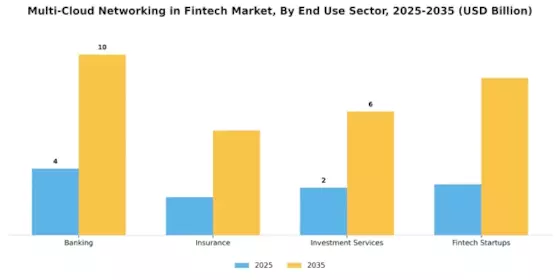
Banking (Dominant) vs. Fintech Startups (Emerging)
The Banking sector is characterized by its robust infrastructure and established client base, providing a sense of stability in the multi-cloud ecosystem. Its significant investments in modern technology enable banks to enhance operational efficiency, mitigate risk, and improve customer experience. In contrast, Fintech Startups are rapidly emerging players in this market, leveraging agile frameworks and cutting-edge technologies. They focus on niches such as blockchain, artificial intelligence, and peer-to-peer lending, thus attracting a younger demographic. The flexibility and innovation offered by these startups challenge traditional banking norms, making them a formidable force in the financial services landscape.
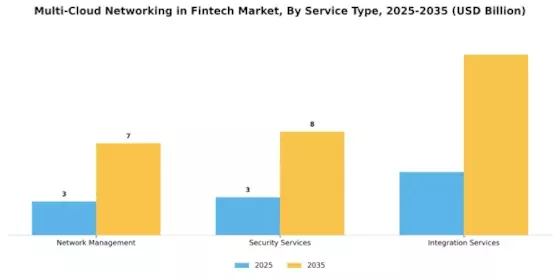
In the Multi-Cloud Networking in Fintech Market, the service type segment displays a diverse distribution among its primary values. Network Management holds the largest share, owing to its critical role in ensuring reliable connectivity and optimal performance across multiple cloud environments. Security Services, on the other hand, while currently smaller in market share, is witnessing rapid growth as financial institutions increasingly prioritize data protection and compliance in an evolving threat landscape. As digital transformation accelerates within the fintech sector, growth trends indicate a surge in demand for Security Services. Factors driving this trend include the rising incidents of cyber threats and the need for robust compliance frameworks. Integration Services also play a pivotal role by enabling seamless operations across various cloud platforms, promoting efficiency and agility. Overall, innovation and evolving regulatory requirements are the primary drivers shaping this service landscape.
Network Management (Dominant) vs. Integration Services (Emerging)
The Network Management segment stands out as the dominant force in the Multi-Cloud Networking in Fintech Market, offering essential capabilities that ensure reliable performance and connectivity across diverse cloud environments. Its focus on optimizing network resources and minimizing downtime is critical for financial institutions reliant on real-time data processing. Conversely, Integration Services emerge as an essential consideration for organizations striving for streamlined operations and effective interoperability among cloud solutions. This segment addresses the challenges of blending multiple cloud services, supporting businesses as they adapt to the complexities of a multi-cloud strategy. As the market evolves, these segments will likely see shifts as demand for comprehensive solutions grows, bridging management and integration needs effectively.
Get more detailed insights about Multi Cloud Networking in Fintech Market Request Free Sample
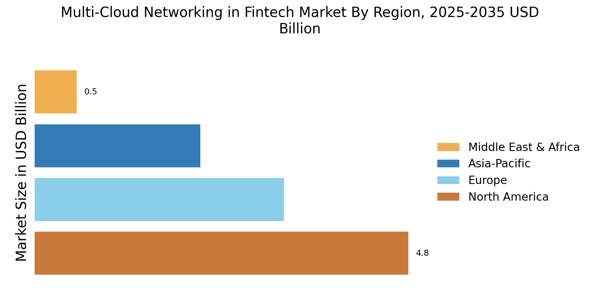
North America is the largest market for Multi-Cloud Networking in the Fintech sector, holding approximately 45% of the global market share. The region benefits from a robust technological infrastructure, high demand for digital financial services, and favorable regulatory frameworks that encourage innovation. The increasing adoption of cloud solutions by financial institutions is driven by the need for enhanced security, scalability, and operational efficiency. The United States leads the market, with significant contributions from Canada. Major players like Amazon Web Services, Microsoft Azure, and Google Cloud dominate the landscape, providing advanced solutions tailored for the fintech industry. The competitive environment is characterized by continuous innovation and strategic partnerships, ensuring that North America remains at the forefront of multi-cloud networking advancements.
Europe is witnessing rapid growth in the Multi-Cloud Networking sector, currently holding about 30% of the global market share. The region's growth is fueled by stringent data protection regulations, such as GDPR, which drive financial institutions to adopt multi-cloud strategies for compliance and security. Additionally, the increasing demand for digital banking solutions and fintech innovations is propelling market expansion across various European countries. Leading countries include the United Kingdom, Germany, and France, where a vibrant fintech ecosystem thrives. Key players like IBM and Oracle are actively investing in cloud solutions tailored for the financial sector. The competitive landscape is marked by collaborations between traditional banks and fintech startups, enhancing service offerings and customer experiences in the multi-cloud domain.
Asia-Pacific is rapidly emerging as a significant player in the Multi-Cloud Networking market, accounting for approximately 20% of the global share. The region's growth is driven by the increasing adoption of digital payment solutions, a burgeoning fintech landscape, and supportive government initiatives aimed at fostering innovation. Countries like China and India are at the forefront, with a strong push towards digital transformation in financial services. China, led by Alibaba Cloud, is a key market, while India is witnessing a surge in fintech startups leveraging cloud technologies. The competitive landscape is characterized by a mix of local and international players, with companies like VMware and Cisco Systems expanding their presence. The region's diverse market dynamics present both opportunities and challenges for stakeholders in the multi-cloud networking space.
The Middle East and Africa region is gradually emerging in the Multi-Cloud Networking market, currently holding about 5% of the global share. The growth is primarily driven by increasing internet penetration, mobile banking adoption, and government initiatives aimed at enhancing digital infrastructure. Countries like South Africa and the UAE are leading the charge, with a focus on improving financial services through cloud technologies. The competitive landscape is evolving, with local players and international firms like Cisco Systems and IBM entering the market. The region's unique challenges, such as regulatory hurdles and varying levels of technological adoption, present opportunities for innovative solutions tailored to local needs. As the fintech sector continues to grow, the demand for multi-cloud networking solutions is expected to rise significantly.
The Multi-Cloud Networking in Fintech Market is characterized by its rapidly evolving nature, driven by the increasing adoption of cloud technology across financial institutions. With the urgent need for flexibility, security, and efficiency in data management, organizations are turning to multi-cloud strategies to optimize their IT infrastructures. This competitive landscape is marked by a diverse array of players who are continually innovating to deliver advanced networking solutions tailored to the unique demands of the fintech sector. The insights gained from analyzing this market reveal the challenges and opportunities presented by multi-cloud integration, including the imperative for robust security measures, seamless interoperability, and the ability to scale services on demand. Companies are competing on the basis of technological advancements, customer-centric services, and the capability to integrate with existing systems to provide a cohesive and efficient operational environment for fintech clients. VMware has established a significant foothold in the Multi-Cloud Networking in Fintech Market by leveraging its strengths in virtualization and cloud infrastructure. The company focuses on providing comprehensive and agile networking solutions that allow financial institutions to manage their multi-cloud environments effectively. One of VMware's key strengths is its ability to maintain high levels of security while facilitating seamless data flow across multiple cloud platforms. This bolsters the operational efficiency of fintech companies, allowing them to meet stringent regulatory requirements while adopting innovative solutions. Moreover, VMware’s emphasis on hybrid cloud capabilities enables financial institutions to optimize their resources and ensure a smooth transition between different cloud services, thereby enhancing customer experiences. The proactive approach to resolving integration challenges helps position VMware as a preferred choice among fintech organizations striving for digital transformation in their networking strategies. Oracle occupies a prominent place in the Multi-Cloud Networking in Fintech Market, focusing on delivering a robust cloud infrastructure combined with powerful networking capabilities tailored for financial services. Oracle's strengths lie in its database management expertise, providing fintech companies with secure, high-performance data handling solutions that are crucial for real-time transactions and analytics. By offering integrated solutions that combine networking with deep analytics, Oracle empowers financial institutions to derive actionable insights from their data, ultimately optimizing decision-making processes and operational efficiency. Furthermore, the company's commitment to enhancing security measures, particularly in a multi-cloud environment, reassures clients about data integrity and compliance with financial regulations. Oracle’s innovative technology stack and focuses on collaboration with other cloud providers enables it to offer versatile solutions that appeal to a broad spectrum of fintech entities looking to harness the power of multi-cloud networking.





The Multi-Cloud Networking in Fintech Market has seen significant developments recently, particularly with major companies like VMware, Oracle, and IBM enhancing their cloud offerings to cater to financial institutions' needs for secure and flexible networking solutions. DigitalOcean and Cloudflare are also expanding their services, focusing on providing optimized multi-cloud environments for fintech startups and established companies alike. In terms of mergers and acquisitions, Amazon has reported intentions to bolster its cloud infrastructure capabilities through synergistic acquisitions, while Microsoft continues to explore strategic partnerships with telecom firms to improve its Azure cloud services.
Equinix’s recent acquisitions of data centers in the Asia-Pacific region highlights a push to enhance infrastructure for multi-cloud connectivity in financial services. Furthermore, Google and Cisco have been actively collaborating on solutions to improve scalability and security for fintech applications. The competition among these leading firms is driving innovation, resulting in enhanced services and pricing strategies that are reshaping the landscape of multi-cloud networking in the fintech sector, reflecting a robust growth trajectory in market valuation and service delivery.
The Multi-Cloud Networking in Fintech Market is projected to grow at a 9.77% CAGR from 2025 to 2035, driven by increasing demand for scalability, security, and operational efficiency.
New opportunities lie in:
By 2035, the market is expected to be robust, characterized by innovative solutions and enhanced competitive dynamics.
| MARKET SIZE 2024 | 10.67(USD Billion) |
| MARKET SIZE 2025 | 11.72(USD Billion) |
| MARKET SIZE 2035 | 29.77(USD Billion) |
| COMPOUND ANNUAL GROWTH RATE (CAGR) | 9.77% (2025 - 2035) |
| REPORT COVERAGE | Revenue Forecast, Competitive Landscape, Growth Factors, and Trends |
| BASE YEAR | 2024 |
| Market Forecast Period | 2025 - 2035 |
| Historical Data | 2019 - 2024 |
| Market Forecast Units | USD Billion |
| Key Companies Profiled | Amazon Web Services (US), Microsoft Azure (US), Google Cloud (US), IBM (US), Oracle (US), Alibaba Cloud (CN), VMware (US), Cisco Systems (US), Equinix (US) |
| Segments Covered | Application, Deployment Model, End Use Sector, Service Type, Regional |
| Key Market Opportunities | Integration of advanced security protocols enhances trust in Multi-Cloud Networking in Fintech Market. |
| Key Market Dynamics | Rising demand for secure, scalable solutions drives innovation in Multi-Cloud Networking within the Fintech sector. |
| Countries Covered | North America, Europe, APAC, South America, MEA |
The projected market valuation for Multi-Cloud Networking in Fintech is expected to reach 29.77 USD Billion by 2035.
The overall market valuation for Multi-Cloud Networking in Fintech was 10.67 USD Billion in 2024.
The expected CAGR for the Multi-Cloud Networking in Fintech Market during the forecast period 2025 - 2035 is 9.77%.
Key players in the Multi-Cloud Networking in Fintech Market include Amazon Web Services, Microsoft Azure, Google Cloud, IBM, Oracle, Alibaba Cloud, VMware, Cisco Systems, and Equinix.
The projected values for Payment Processing in the Multi-Cloud Networking in Fintech Market are expected to grow from 3.5 USD Billion in 2024 to 9.5 USD Billion by 2035.
The market for Risk Management in Multi-Cloud Networking in Fintech is projected to increase from 2.5 USD Billion in 2024 to 6.5 USD Billion by 2035.
The Hybrid Cloud deployment model is anticipated to grow from 4.97 USD Billion in 2024 to 14.77 USD Billion by 2035.
The projected values for Security Services in the Multi-Cloud Networking in Fintech Market are expected to rise from 3.0 USD Billion in 2024 to 8.2 USD Billion by 2035.
The market for Fintech Startups is projected to grow from 2.67 USD Billion in 2024 to 8.27 USD Billion by 2035.
The market for Integration Services in Multi-Cloud Networking in Fintech is expected to increase from 5.0 USD Billion in 2024 to 14.3 USD Billion by 2035.


Kindly complete the form below to receive a free sample of this Report

“This is really good guys. Excellent work on a tight deadline. I will continue to use you going forward and recommend you to others. Nice job”


“Thanks. It’s been a pleasure working with you, please use me as reference with any other Intel employees.”


“Thanks for sending the report it gives us a good global view of the Betaïne market.”


“Thank you, this will be very helpful for OQS.”


“We found the report very insightful! we found your research firm very helpful. I'm sending this email to secure our future business.”


“I am very pleased with how market segments have been defined in a relevant way for my purposes (such as "Portable Freezers & refrigerators" and "last-mile"). In general the report is well structured. Thanks very much for your efforts.”


“I have been reading the first document or the study, ,the Global HVAC and FP market report 2021 till 2026. Must say, good info! I have not gone in depth at all parts, but got a good indication of the data inside!”


“We got the report in time, we really thank you for your support in this process. I also thank to all of your team as they did a great job.”


“The Automotive 48V ECU Components Procurement Intelligence Study” was a complex project, but the Market Research Future (MRFR) team handled it with quality, agility, and customer-centricity. They delivered all requested data on time and within the agreed scope. The team, including Shubhendra Anand and Rahul Gotadki, was always readily available to clarify questions and swiftly implement necessary adjustments, driving the project to a successful conclusion within a very demanding timeframe.
I would also like to specifically commend Akshay Agarwal for his responsiveness and support at every stage—from our initial inquiry on May 6th through to final delivery on June 18th. His dedication made the entire process seamless.”



